
The UK property market in 2026 faces a dramatic transformation. Buyers no longer accept the traditional four-month wait for property transactions. Instead, they demand completion in approximately 6.78 weeks—nearly half the current 123-day average[1]. This seismic shift in expectations places unprecedented pressure on building surveyors to revolutionize their inspection scheduling, reporting turnaround, and communication protocols while maintaining the thoroughness that protects both buyers and lenders. The challenge is clear: how can surveyors deliver comprehensive property assessments without sacrificing quality in this accelerated environment?
Key Takeaways
- 🏠 Buyers now expect property transactions to complete in 6.78 weeks, down from the traditional 123-day timeline, creating urgent demands for faster survey delivery
- ⚡ RICS introduced updated survey protocols in January 2026 specifically designed to address buyer enquiry surges while maintaining inspection quality standards
- 📊 New ALTA/NSPS standards effective February 2026 require enhanced transparency and disclosure, fundamentally changing how surveyors document and report findings
- 🔄 Digital transformation is essential, with automated scheduling, real-time reporting, and integrated communication platforms becoming mandatory for competitive surveying practices
- ✅ Quality assurance cannot be compromised—accelerated timelines demand smarter workflows, not rushed inspections that expose clients to unidentified property risks
Understanding the 6-Week Completion Pressure in 2026
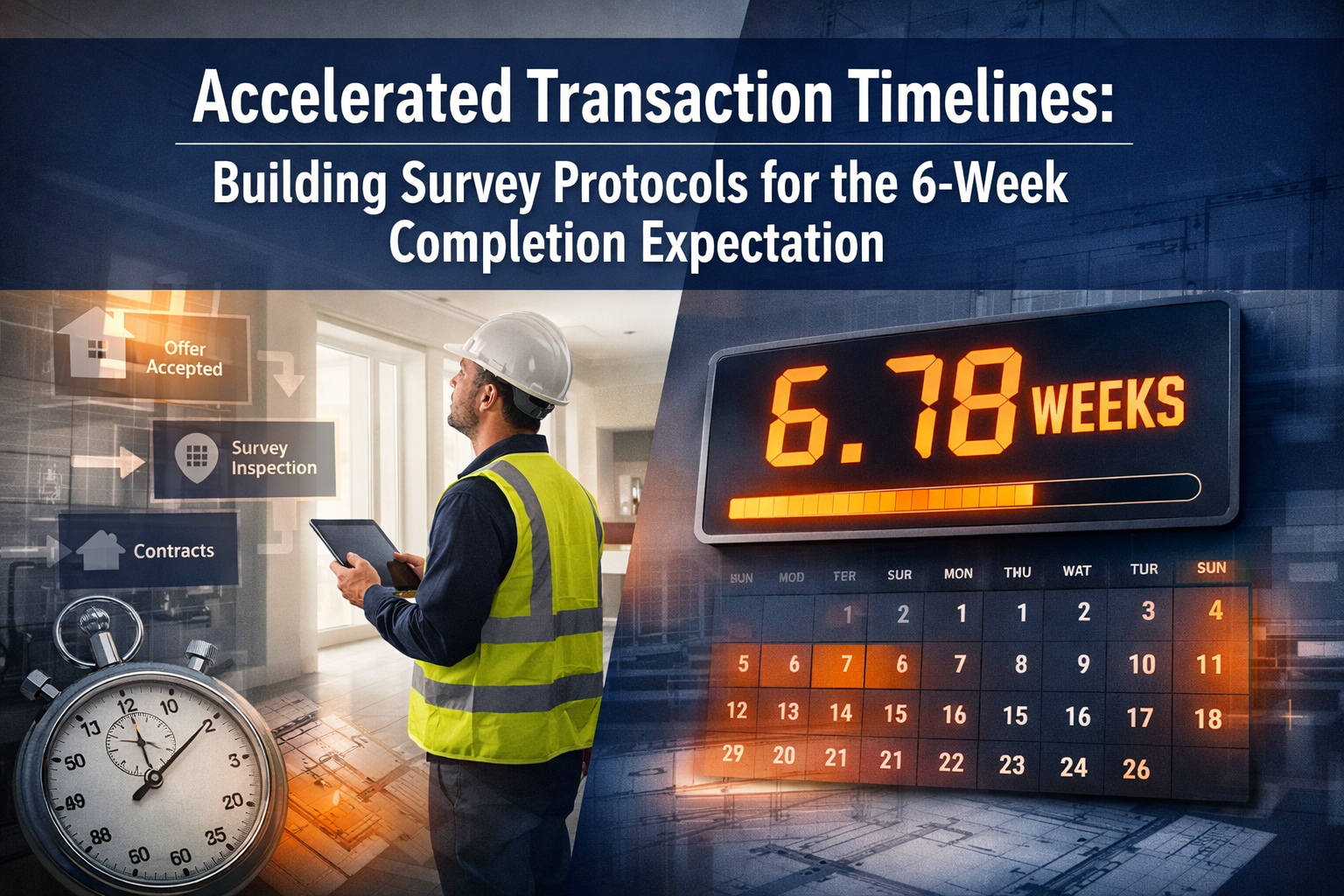
The property market has undergone a fundamental transformation in buyer expectations. The target of 6.78 weeks for transaction completion represents more than just an incremental improvement—it signals a complete reimagining of the property acquisition process[1].
The Market Forces Driving Timeline Acceleration
Several converging factors have created this pressure for faster completions:
Economic uncertainty has made buyers more decisive. When they find the right property, they want to secure it quickly before market conditions change. This decisiveness extends to their expectations of all transaction participants, including surveyors.
Digital transformation across other industries has reset consumer expectations. When people can order products online and receive them the next day, waiting four months for a property transaction feels increasingly outdated.
Competitive market dynamics mean that sellers favor buyers who can complete quickly. This creates a cascade effect where buyers pressure their entire transaction team—solicitors, mortgage brokers, and surveyors—to accelerate their processes.
The building surveyor services sector must adapt or risk becoming the bottleneck in an otherwise streamlined transaction process.
The Gap Between Current Practice and Market Expectations
Traditional building survey timelines typically follow this pattern:
| Phase | Traditional Timeline | 2026 Expectation |
|---|---|---|
| Initial enquiry to booking | 5-7 days | 1-2 days |
| Booking to site inspection | 10-14 days | 3-5 days |
| Inspection to draft report | 7-10 days | 2-3 days |
| Review and final report | 3-5 days | 1-2 days |
| Total survey phase | 25-36 days | 7-12 days |
This comparison reveals the magnitude of change required. Surveyors must compress their timeline by approximately 66% while maintaining the same level of thoroughness and accuracy.
Regional Variations and Market-Specific Demands
The pressure for accelerated timelines isn't uniform across all markets. The RICS January 2026 survey protocols specifically address buyer enquiry surges in regions like North West England, where competitive market conditions have intensified timeline expectations[2].
Different property types also present varying challenges:
- Standard residential properties can often accommodate faster timelines with streamlined protocols
- Period properties require more extensive investigation that cannot be rushed without risk
- Commercial properties involve complex systems requiring thorough assessment
- Properties with known defects need careful documentation that protects all parties
Understanding these variations allows surveyors to set realistic expectations while still meeting market demands where possible.
Accelerated Transaction Timelines: Redesigning Survey Protocols for Speed and Quality
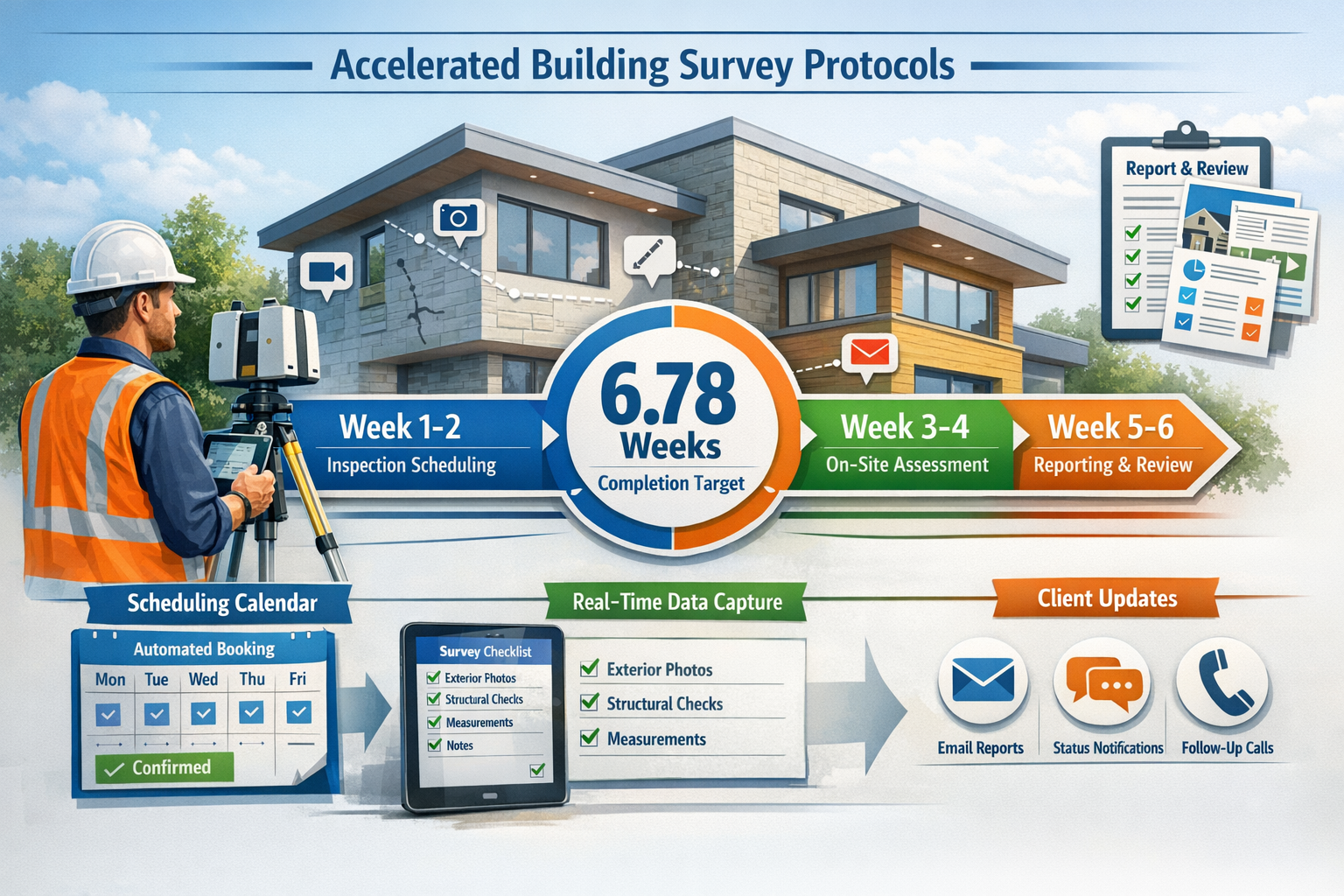
Meeting the 6-week completion expectation requires fundamental changes to how surveys are scheduled, conducted, and reported. The key is implementing protocols that increase efficiency without compromising the thoroughness that makes building surveys valuable.
Streamlined Scheduling and Instant Response Systems
The first bottleneck in traditional survey processes occurs at the initial enquiry stage. In 2026, surveyors must implement automated scheduling systems that provide instant availability and booking confirmation.
Digital booking platforms should offer:
- Real-time calendar integration showing available inspection slots
- Instant confirmation emails with detailed pre-inspection requirements
- Automated reminders to all parties with countdown notifications
- Mobile-friendly interfaces allowing clients to book at any time
For chartered surveyors in London and other high-demand areas, these systems prevent the traditional back-and-forth communication that adds days to the process.
Pre-Inspection Information Gathering
One of the most effective time-saving strategies involves comprehensive pre-inspection data collection. Before the surveyor arrives on-site, they should already have:
✅ Property documentation: Title deeds, previous survey reports, planning permissions
✅ Owner questionnaires: Known issues, renovation history, utility information
✅ Digital property records: Council records, flood risk data, historical planning applications
✅ Preliminary desktop analysis: Aerial imagery, street view assessment, local area research
This preparation allows surveyors to focus their on-site time on physical inspection rather than gathering basic information that could be obtained in advance.
Technology-Enhanced Inspection Protocols
The ALTA/NSPS standards update effective February 23, 2026, emphasizes enhanced transparency and disclosure requirements[4]. Meeting these standards while accelerating timelines requires leveraging technology throughout the inspection process.
Modern inspection tools include:
- Thermal imaging cameras for rapid identification of insulation issues and moisture problems
- Drone technology for comprehensive roof inspections without time-consuming ladder work (see our drone roof survey services)
- Digital measurement tools providing instant, accurate dimensions
- Mobile reporting apps allowing real-time note-taking and photo documentation with automatic organization
- Voice-to-text technology enabling surveyors to dictate observations while maintaining inspection flow
These tools don't replace professional judgment—they enhance it by removing administrative friction from the inspection process.
Simultaneous Assessment Methodologies
Rather than inspecting properties in a linear fashion (exterior, then interior, then services), accelerated protocols employ simultaneous assessment strategies:
Zone-based inspection: Systematically working through the property in logical zones, documenting all aspects of each area before moving forward. This reduces the need to revisit areas and ensures comprehensive coverage.
Parallel processing: For larger properties, teams of surveyors can work simultaneously on different sections, with one senior surveyor coordinating and ensuring consistency.
Integrated documentation: Rather than taking notes for later transcription, surveyors input findings directly into structured report templates during the inspection itself.
Quality Assurance in Accelerated Timelines
Speed must never compromise accuracy. Accelerated protocols require enhanced quality assurance measures:
"The pressure for faster completions cannot justify cutting corners on structural assessment or risk identification. Our duty of care to clients remains paramount regardless of timeline pressures."
Effective quality assurance in accelerated environments includes:
- Standardized checklists ensuring no inspection elements are overlooked
- Peer review protocols where senior surveyors review reports before client delivery
- Photographic evidence requirements documenting all significant findings
- Clear limitation statements explaining what was and wasn't accessible during inspection
For properties requiring more detailed assessment, such as those needing a structural survey, surveyors must communicate realistic timelines that allow for thorough investigation.
Rapid Reporting and Communication Frameworks

The reporting phase traditionally represents a significant portion of survey timeline. In accelerated transaction environments, this phase requires complete reimagining.
Real-Time Report Generation
The most effective strategy for reducing reporting time involves generating reports during the inspection itself rather than afterward. This approach requires:
Template-based systems with:
- Pre-structured sections for all standard property elements
- Drop-down menus for common findings and conditions
- Automated risk categorization (Category 1, 2, and 3 defects)
- Photo integration directly from mobile devices
- Voice-to-text capabilities for detailed observations
Cloud-based platforms that allow:
- Simultaneous access by multiple team members
- Real-time review by senior surveyors during inspection
- Immediate quality assurance checks
- Instant backup preventing data loss
By the time the surveyor leaves the property, the report should be 80-90% complete, requiring only final review and professional polish before client delivery.
Tiered Reporting Options
Not all clients need the same level of detail in the same timeframe. Offering tiered reporting options allows surveyors to meet varying needs:
Express preliminary report (24-48 hours):
- Summary of critical findings and red flags
- High-priority defects requiring immediate attention
- Initial cost estimates for major issues
- Recommendation on whether to proceed with purchase
Standard comprehensive report (5-7 days):
- Full detailed assessment of all property elements
- Comprehensive photographic documentation
- Detailed cost estimates and repair recommendations
- Technical appendices and supporting documentation
This approach, similar to the distinction between a homebuyer report and building survey, allows clients to make informed decisions quickly while still receiving complete documentation.
Integrated Communication Protocols
The 6-week completion timeline requires seamless communication between all transaction parties. Surveyors must implement protocols that keep everyone informed in real-time:
Automated status updates should notify clients when:
- Inspection is scheduled and confirmed
- Surveyor arrives on-site
- Inspection is completed
- Report is in review
- Final report is delivered
Multi-party access platforms allow:
- Solicitors to access findings relevant to legal enquiries
- Mortgage lenders to review structural concerns
- Estate agents to understand property condition
- Buyers to ask questions and receive clarification
Digital communication channels including:
- Secure client portals for document access
- Video call capabilities for report walkthroughs
- Instant messaging for urgent queries
- Mobile apps providing transaction timeline visibility
Managing Client Expectations Through Transparent Timelines
Even with accelerated protocols, some properties require more time for thorough assessment. Transparent communication about realistic timelines prevents disappointment and maintains professional credibility.
For properties requiring specialized assessment, such as specific defect reports or subsidence surveys, surveyors should clearly explain:
- Why additional time is necessary
- What specific investigations will be conducted
- How the extended timeline protects the client's interests
- What preliminary information can be provided while detailed assessment continues
This transparency builds trust and demonstrates professional integrity rather than appearing as an inability to meet market demands.
Accelerated Transaction Timelines: Institutional and Commercial Considerations
While residential property transactions drive much of the acceleration pressure, institutional landlords and commercial property transactions face unique challenges in meeting compressed timelines.
Due Diligence Requirements for Institutional Portfolios
Institutional landlords navigating tax pressures and portfolio risk in 2026 require comprehensive due diligence that cannot be rushed[4]. These surveys must address:
Portfolio-level considerations:
- Consistency across multiple property assessments
- Standardized risk categorization for comparison
- Long-term maintenance planning implications
- Capital expenditure forecasting accuracy
Regulatory compliance:
- Enhanced disclosure requirements under updated standards
- Tax implications of property condition assessments
- Environmental and sustainability reporting
- Health and safety compliance documentation
For commercial building surveys, the balance between speed and thoroughness becomes even more critical given the higher financial stakes involved.
Coordinating Multiple Specialist Assessments
Commercial and institutional properties often require multiple specialist surveys that must be coordinated within the accelerated timeline:
- Structural engineers for complex building systems
- M&E (mechanical and electrical) specialists for services assessment
- Environmental consultants for contamination and sustainability issues
- Fire safety experts for regulatory compliance
- Access consultants for disability regulations
Effective coordination requires:
Project management protocols including:
- Simultaneous scheduling of multiple specialists
- Shared digital platforms for findings integration
- Coordinated site access to minimize disruption
- Consolidated reporting that synthesizes all specialist inputs
Clear accountability structures defining:
- Who coordinates overall assessment
- How conflicting findings are resolved
- Which party has final sign-off authority
- How urgent issues are escalated
Balancing Speed with Risk Management
For high-value commercial transactions, the pressure for speed must be balanced against comprehensive risk identification. Rushing assessments can expose institutional buyers to:
- Unidentified structural defects requiring costly remediation
- Hidden environmental liabilities with regulatory implications
- Building services failures disrupting tenant operations
- Compliance issues triggering enforcement action
Professional surveyors must clearly communicate when accelerated timelines create unacceptable risk and recommend appropriate assessment depth regardless of completion pressure.
Technology Infrastructure Supporting Accelerated Protocols
Meeting the 6-week completion expectation requires significant investment in technology infrastructure that supports every aspect of the accelerated survey process.
Essential Digital Tools for Modern Survey Practice
Successful surveying practices in 2026 implement comprehensive technology stacks including:
Practice management systems providing:
- Automated enquiry handling and booking
- Resource allocation and scheduling optimization
- Workflow management and task tracking
- Financial management and invoicing integration
- Client relationship management (CRM) capabilities
Field data collection tools including:
- Mobile apps with offline functionality
- Integrated photography and annotation
- Voice recording and transcription
- GPS location tagging
- Measurement and calculation tools
Report generation platforms offering:
- Template-based report creation
- Automated formatting and branding
- Photo integration and manipulation
- Digital signature capabilities
- Multi-format export options (PDF, interactive web reports)
Communication and collaboration systems enabling:
- Secure client portals
- Multi-party document sharing
- Video conferencing integration
- Instant messaging with clients and colleagues
- Automated notification systems
Data Security and Professional Indemnity Considerations
Accelerated digital workflows create data security obligations that surveyors must address:
- GDPR compliance for client information handling
- Secure data transmission between field and office
- Cloud storage security with appropriate encryption
- Access control systems limiting data exposure
- Backup and disaster recovery protocols
Professional indemnity insurance may require specific technology protocols to maintain coverage when using accelerated survey methods.
Training and Competency Development
Technology is only effective when surveyors are properly trained in its use. Practices must invest in:
- Regular training on new tools and platforms
- Competency assessment ensuring consistent standards
- Mentoring programs pairing experienced and junior surveyors
- Continuous professional development (CPD) focused on efficiency
- Quality assurance reviews of technology-assisted surveys
Regional Implementation and Market Adaptation
The implementation of accelerated survey protocols varies significantly by region and local market conditions.
High-Demand Urban Markets
In areas like West London and Central London, where competition is intense and property values are high, accelerated protocols are becoming standard practice rather than optional enhancements.
These markets require:
- Extended operating hours to maximize inspection availability
- Larger surveyor teams to handle volume demands
- Premium pricing reflecting accelerated service delivery
- Established relationships with specialist consultants for rapid coordination
Regional Markets with Different Expectations
In contrast, markets in areas like Hertfordshire, Surrey, and Oxfordshire may experience less intense pressure for acceleration, allowing surveyors to balance speed with traditional thoroughness.
Regional adaptation strategies include:
- Market-specific timeline expectations
- Flexible service offerings matching local demand
- Pricing structures reflecting regional competition
- Marketing emphasizing either speed or thoroughness based on local priorities
Adapting to Property Type Variations
Different property types require customized acceleration strategies:
Modern residential properties:
- Standardized construction allows faster assessment
- Fewer hidden defects reduce investigation time
- Straightforward reporting with minimal technical complexity
Period and historic properties:
- Require more extensive investigation time
- Hidden defects more common requiring careful examination
- Specialist knowledge needed for traditional construction methods
- Longer timelines justified by complexity
Commercial and mixed-use properties:
- Multiple building systems requiring specialist assessment
- Tenant occupation complicating access
- Regulatory compliance adding assessment layers
- Longer timelines necessary for comprehensive due diligence
Professional Standards and Regulatory Compliance
Accelerated survey protocols must operate within the framework of professional standards and regulatory requirements that protect both surveyors and clients.
RICS Standards and Guidance
The Royal Institution of Chartered Surveyors provides comprehensive guidance on survey standards that must be maintained regardless of timeline pressure. The January 2026 survey protocols specifically address how to manage buyer enquiry surges while maintaining professional standards[2].
Key RICS requirements include:
Competency standards:
- Appropriate qualifications and experience for property type
- Continuing professional development (CPD) requirements
- Professional indemnity insurance coverage
- Adherence to RICS Code of Conduct
Survey scope and limitations:
- Clear terms of engagement defining inspection scope
- Explicit limitations on what was and wasn't inspected
- Appropriate disclaimers for areas not accessible
- Transparent communication of inspection constraints
Reporting standards:
- Comprehensive documentation of findings
- Clear categorization of defects and risks
- Appropriate recommendations for further investigation
- Professional presentation and clarity
ALTA/NSPS Standards for Enhanced Transparency
The updated ALTA/NSPS standards effective February 23, 2026, introduce enhanced transparency and disclosure requirements that fundamentally change survey protocols[4].
These standards require:
Enhanced disclosure of:
- Survey methodology and equipment used
- Limitations encountered during inspection
- Areas requiring specialist assessment
- Assumptions made in reaching conclusions
Improved documentation including:
- Comprehensive photographic evidence
- Detailed measurement records
- Clear annotation of findings on property plans
- Traceable decision-making processes
Client communication ensuring:
- Understanding of report contents and implications
- Opportunity for questions and clarification
- Clear explanation of risk categories
- Guidance on appropriate next steps
Managing Professional Risk in Accelerated Environments
Accelerated timelines create professional risk that surveyors must actively manage:
Risk mitigation strategies include:
- Comprehensive terms of engagement clearly defining scope and limitations
- Thorough documentation of all inspection activities and findings
- Quality assurance reviews before report delivery
- Professional indemnity insurance appropriate for accelerated work
- Clear communication of any concerns or limitations to clients
- Refusal to compromise when timelines threaten thoroughness
Surveyors must remember that their primary duty is to the client, not to meeting arbitrary timeline expectations that compromise professional standards.
Future Trends and Continuous Adaptation
The property survey sector continues to evolve, with several trends likely to shape accelerated transaction protocols beyond 2026.
Artificial Intelligence and Automated Analysis
AI-powered tools are beginning to assist surveyors with:
- Automated defect identification from photographs
- Pattern recognition for common issues
- Predictive maintenance recommendations
- Risk assessment and categorization
- Report generation and formatting
While AI cannot replace professional judgment, it can accelerate routine aspects of survey work, allowing surveyors to focus on complex analysis and client communication.
Blockchain and Smart Contracts
Emerging blockchain technologies may revolutionize property transactions by:
- Creating immutable records of property condition
- Automating transaction milestones and payments
- Enabling instant verification of survey completion
- Facilitating multi-party access to verified information
- Reducing transaction friction and delays
Continuous Monitoring and Predictive Maintenance
Future survey protocols may shift from point-in-time assessments to continuous monitoring systems:
- IoT sensors tracking building performance
- Regular automated condition updates
- Predictive alerts for emerging issues
- Ongoing condition reports for portfolio management
- Reduced need for comprehensive pre-purchase surveys
Regulatory Evolution
Professional standards and regulatory requirements will continue evolving to address:
- Consumer protection in accelerated transactions
- Professional liability in technology-assisted surveys
- Data security and privacy requirements
- Environmental and sustainability reporting
- Climate risk assessment and disclosure
Surveyors must commit to continuous professional development to remain current with evolving standards and market expectations.
Conclusion
The shift toward Accelerated Transaction Timelines: Building Survey Protocols for the 6-Week Completion Expectation represents a fundamental transformation in the UK property survey sector. Buyers in 2026 expect transactions to complete in approximately 6.78 weeks rather than the traditional 123 days, creating unprecedented pressure on building surveyors to revolutionize their practices[1].
Meeting these expectations requires comprehensive changes across every aspect of survey delivery—from instant digital booking systems and pre-inspection data gathering to technology-enhanced inspections and real-time report generation. The RICS January 2026 survey protocols and updated ALTA/NSPS standards provide frameworks for maintaining professional thoroughness while accelerating delivery[2][4].
However, speed must never compromise quality. Professional surveyors have a duty of care to clients that transcends timeline pressures. The most successful practices in 2026 are those that leverage technology and streamlined workflows to eliminate inefficiency while maintaining the comprehensive assessment that makes building surveys valuable.
Actionable Next Steps
For surveying practices looking to implement accelerated transaction protocols:
- Audit current processes to identify bottlenecks and inefficiencies that add time without adding value
- Invest in technology infrastructure including mobile reporting tools, automated scheduling systems, and cloud-based collaboration platforms
- Develop standardized protocols for different property types that balance speed with appropriate thoroughness
- Train staff comprehensively on new tools and workflows to ensure consistent implementation
- Implement quality assurance measures that prevent rushed work from compromising professional standards
- Communicate transparently with clients about realistic timelines and when acceleration creates unacceptable risk
- Monitor performance metrics tracking both speed and quality to ensure balanced improvement
The property market will continue evolving, with buyer expectations for speed likely to intensify further. Surveyors who proactively adapt their protocols while maintaining professional integrity will thrive in this transformed landscape, providing clients with both the rapid service they demand and the thorough assessment they deserve.
References
[1] Transaction Speed Demands In 2026 Building Surveys And Valuations Under 6 Week Completion Pressure – https://nottinghillsurveyors.com/blog/transaction-speed-demands-in-2026-building-surveys-and-valuations-under-6-week-completion-pressure
[2] Rics January 2026 Survey Insights Building Survey Protocols For Surging Buyer Enquiries In North West England – https://nottinghillsurveyors.com/blog/rics-january-2026-survey-insights-building-survey-protocols-for-surging-buyer-enquiries-in-north-west-england
[4] Building Survey Due Diligence For Institutional Landlords Navigating Tax Pressures And Portfolio Risk In 2026 – https://nottinghillsurveyors.com/blog/building-survey-due-diligence-for-institutional-landlords-navigating-tax-pressures-and-portfolio-risk-in-2026