
Geopolitical shocks are no longer tail risks—they're persistent drivers of asset returns that fundamentally reshape how property valuations must be conducted[3]. As Spring 2026 markets grapple with widening dispersion across sectors and regions, the Royal Institution of Chartered Surveyors (RICS) has positioned AI-enhanced methodologies at the forefront of maintaining valuation certainty amid unprecedented volatility. AI-Enhanced Valuation Certainty in Spring 2026 Markets: RICS Standards for Geopolitical Risk Navigation represents a critical evolution in how chartered surveyors integrate responsible automation with professional judgment to deliver reliable property assessments during turbulent times.
The convergence of artificial intelligence capabilities and heightened geopolitical uncertainty has created both challenges and opportunities for valuation professionals. With the MSCI World Index showing divergent performance patterns and energy market vulnerabilities dominating macro risk assessments[1], surveyors must now deploy sophisticated tools that can process complex risk variables while maintaining the rigorous standards that underpin professional valuation practice.

Key Takeaways
- 🤖 RICS has published comprehensive guidance on responsible AI adoption in real estate valuation, emphasizing professional judgment alongside automation[4]
- 🌍 Geopolitical risks now function as persistent drivers rather than occasional disruptions, requiring fundamental changes to valuation methodologies[3]
- 📊 Market dispersion widened significantly in early 2026, with AI-driven disruption and geopolitical escalation creating sector-specific volatility[1]
- ✅ Data sourcing, reliability, and verification form the cornerstone of RICS AI standards, ensuring transparency and accountability
- 🎯 Buyer sentiment analysis and price forecasting tools powered by AI are transforming how European property markets navigate uncertainty
Understanding AI-Enhanced Valuation Certainty in Spring 2026 Markets
The Spring 2026 property market landscape presents unprecedented complexity for valuation professionals. Traditional methodologies, while foundational, struggle to incorporate the rapid-fire succession of geopolitical developments that now characterize global markets. AI-Enhanced Valuation Certainty in Spring 2026 Markets: RICS Standards for Geopolitical Risk Navigation addresses this challenge by establishing clear frameworks for integrating machine learning capabilities with established valuation principles.
The RICS Framework for Responsible AI Integration
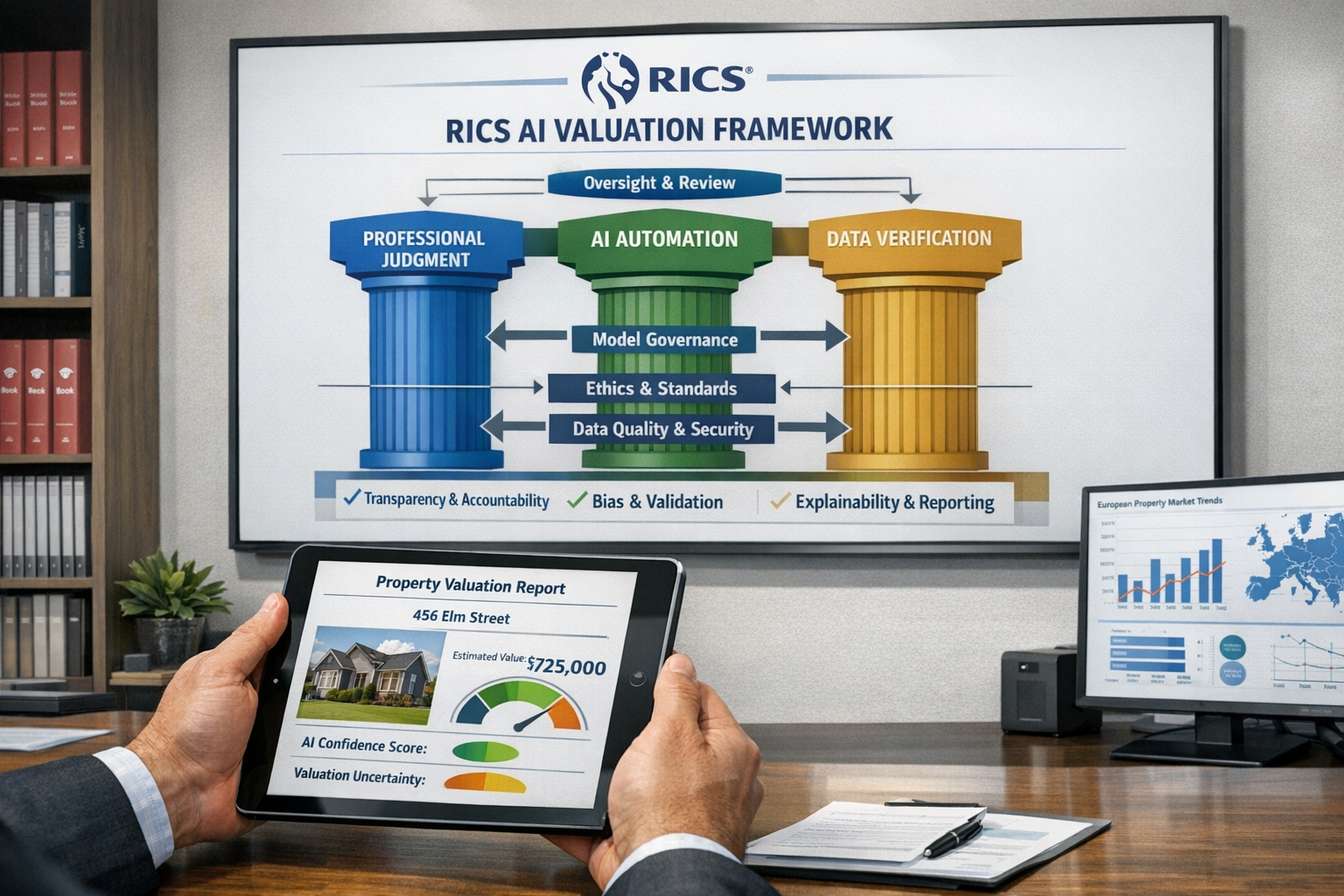
RICS has taken a leadership position in defining how artificial intelligence should interact with professional valuation practice. The organization's guidance specifically examines the intersection of AI capabilities with professional judgment, ensuring that automation enhances rather than replaces the critical thinking that defines chartered surveyor expertise[4].
Key components of the RICS AI framework include:
- Data Integrity Standards – Rigorous requirements for sourcing, validating, and maintaining data quality
- Transparency Protocols – Clear documentation of AI model inputs, processing logic, and confidence levels
- Professional Oversight – Mandatory human review and sign-off on AI-assisted valuations
- Continuous Monitoring – Regular assessment of model performance and recalibration requirements
- Client Communication – Explicit disclosure of AI usage and methodology in valuation reports
The framework recognizes that AI excels at processing vast datasets and identifying patterns that might escape human observation, while professional judgment remains essential for contextual interpretation and risk assessment. This balanced approach ensures that RICS registered valuers can leverage technological advantages without compromising the integrity that defines the profession.
Market Dispersion and Sector-Specific Volatility
February 2026 market data revealed significant divergence across sectors and regions, with the MSCI World Index rising just 0.73% while individual segments experienced dramatic swings[1]. This dispersion creates particular challenges for property valuation, as comparable analysis becomes less reliable when market conditions vary substantially across geographic areas and property types.
Spring 2026 market characteristics include:
| Market Factor | Impact on Valuation | AI Enhancement Opportunity |
|---|---|---|
| Regional Divergence | Reduced comparability across markets | Automated adjustment algorithms |
| Sector Volatility | Increased uncertainty in forecasts | Real-time sentiment analysis |
| Geopolitical Shocks | Sudden value shifts | Predictive risk modeling |
| Energy Market Vulnerability | Cost structure fluctuations | Supply chain impact assessment |
| Buyer Sentiment Shifts | Demand unpredictability | Behavioral pattern recognition |
Geopolitical Risk Navigation Through RICS Standards
The fundamental shift in how geopolitical events influence property markets demands a corresponding evolution in valuation methodology. New York Life Investment Management's 2026 analysis confirms that geopolitical shocks now function as persistent drivers of asset returns rather than occasional tail risks[3]. This reality requires surveyors to integrate ongoing risk assessment into every valuation assignment.
Energy Market Vulnerabilities and Property Valuation
The Strait of Hormuz represents the most significant macro risk for disruptions to oil and gas flows, creating ripple effects throughout property markets[1]. Energy costs directly impact property operating expenses, development feasibility, and tenant demand patterns. AI-enhanced valuation tools can now model these interdependencies with unprecedented sophistication.
Energy-related considerations in 2026 valuations:
- ⚡ Operating Cost Volatility – AI models track energy price fluctuations and project impact on net operating income
- 🏗️ Development Feasibility – Construction cost modeling incorporates commodity price scenarios
- 🌡️ Environmental Performance – Energy efficiency ratings gain valuation significance amid cost uncertainty
- 🚚 Supply Chain Dependencies – Location analysis includes energy transport route vulnerability
- 📍 Regional Risk Profiles – Geographic proximity to energy infrastructure affects risk premiums
Professional surveyors conducting commercial property valuations must now routinely incorporate energy market scenarios into their analysis. AI tools facilitate this by processing real-time commodity data, geopolitical event feeds, and historical correlation patterns to generate probability-weighted valuation ranges.
Portfolio Construction and Valuation Methodology
The shifting world order has forced institutional investors to re-evaluate portfolio construction strategies[3]. This institutional-level change cascades down to individual property valuations, as surveyors must consider how specific assets fit within diversified portfolios designed to withstand geopolitical shocks.
AI-enhanced portfolio context analysis includes:
- Correlation Mapping – Identifying how specific properties correlate with geopolitical risk factors
- Diversification Value – Quantifying the risk reduction benefit of particular assets
- Scenario Resilience – Testing property performance across multiple geopolitical scenarios
- Liquidity Assessment – Evaluating market depth under stress conditions
- Strategic Positioning – Analyzing alignment with institutional risk tolerance frameworks
This portfolio-level perspective enhances individual property valuations by providing context that traditional comparable-based approaches might miss. For specialized assignments like capital gains tax valuations or probate valuations, understanding portfolio context becomes particularly valuable.

Practical Implementation: Tools for Buyer Sentiment and Price Forecasting
AI-Enhanced Valuation Certainty in Spring 2026 Markets: RICS Standards for Geopolitical Risk Navigation extends beyond theoretical frameworks to practical implementation. European property markets have emerged as testing grounds for advanced buyer sentiment analysis and price forecasting tools that comply with RICS standards while delivering actionable insights.
Buyer Sentiment Analysis in European Markets
Traditional valuation relies heavily on historical transaction data and current market activity. AI-enhanced approaches supplement this foundation with real-time sentiment analysis drawn from multiple data streams:
Data sources for sentiment analysis:
- 📱 Social Media Monitoring – Natural language processing of property-related discussions
- 📰 News Sentiment Tracking – Automated analysis of media coverage and tone
- 🔍 Search Pattern Analysis – Property search behavior and query trends
- 💬 Survey Data Integration – Consumer confidence indices and buyer intention surveys
- 📧 Inquiry Volume Tracking – Real-time monitoring of property inquiry patterns
These sentiment indicators provide early warning signals of market shifts before they appear in transaction data. For surveyors preparing valuation reports, sentiment analysis offers valuable context about market momentum and potential inflection points.
European markets have proven particularly receptive to sentiment-enhanced valuation approaches due to their diverse regulatory environments and cross-border capital flows. The ability to track sentiment across multiple languages and cultural contexts provides insights that would be impossible to gather through traditional methods.
Price Forecasting Models and Uncertainty Quantification
RICS standards emphasize the importance of transparency about valuation uncertainty. AI-enhanced forecasting models excel at quantifying uncertainty through probabilistic approaches that generate confidence intervals rather than single-point estimates.
Advanced forecasting capabilities include:
- 📊 Monte Carlo Simulations – Generating thousands of scenarios to map probability distributions
- 🎯 Confidence Interval Reporting – Providing 68%, 95%, and 99% confidence ranges
- 🔄 Dynamic Model Updating – Continuous recalibration as new data becomes available
- ⚖️ Scenario Weighting – Adjusting probability weights based on geopolitical developments
- 📈 Trend Decomposition – Separating cyclical, seasonal, and structural price components
This probabilistic approach aligns perfectly with RICS requirements for professional judgment and appropriate caveats. Rather than pretending to know future values with false precision, AI-enhanced models explicitly acknowledge uncertainty while providing decision-makers with actionable probability ranges.
For clients requiring valuations for specific purposes—such as insurance reinstatement valuations or ATED valuations—the ability to understand uncertainty ranges proves invaluable for risk management and planning.
European Market Trends and Cross-Border Considerations
Spring 2026 has revealed distinct patterns across European property markets, with AI tools proving particularly valuable for cross-border investment analysis. Brexit aftermath effects, EU regulatory harmonization, and varying exposure to energy supply disruptions create a complex mosaic that demands sophisticated analytical approaches.
Key European market dynamics:
🇬🇧 UK Market – Post-Brexit regulatory divergence creates unique valuation considerations
🇪🇺 Continental Europe – Energy transition policies drive sustainability premiums
🇩🇪 Germany – Industrial property sensitivity to manufacturing sector volatility
🇫🇷 France – Residential market influenced by domestic policy shifts
🇳🇱 Netherlands – Logistics property values tied to port activity and trade flows
AI-enhanced tools can simultaneously track these market-specific factors while identifying cross-border correlations and arbitrage opportunities. For international investors, this capability transforms how portfolio allocation decisions incorporate property valuations.

Data Sourcing, Reliability, and Verification Standards
The RICS guidance on AI in real estate valuation places particular emphasis on data sourcing, reliability, and verification[4]. This focus reflects a fundamental truth: AI models are only as good as the data they process. AI-Enhanced Valuation Certainty in Spring 2026 Markets: RICS Standards for Geopolitical Risk Navigation requires rigorous data governance frameworks that ensure quality, consistency, and auditability.
Data Quality Requirements
Professional surveyors implementing AI-enhanced methodologies must establish clear standards for data acquisition and maintenance:
Essential data quality criteria:
- ✅ Accuracy – Verification protocols for all input data
- ✅ Completeness – Minimum data requirements for model reliability
- ✅ Timeliness – Update frequencies appropriate to market conditions
- ✅ Consistency – Standardized formats and definitions across sources
- ✅ Provenance – Clear documentation of data origins and transformations
These standards apply equally to traditional valuation data (comparable transactions, rental evidence) and newer AI-specific inputs (sentiment indicators, geopolitical risk scores). The integration of diverse data types requires careful attention to compatibility and weighting.
For specialized valuation assignments such as matrimonial valuations or shared ownership valuations, data quality becomes particularly critical as these contexts often involve legal scrutiny and potential disputes.
Verification and Audit Trails
RICS standards require clear audit trails that document how AI models process data and generate outputs. This transparency serves multiple purposes:
- Professional Accountability – Enabling review of methodology and assumptions
- Client Confidence – Demonstrating rigor and reliability of valuation process
- Regulatory Compliance – Meeting disclosure requirements across jurisdictions
- Continuous Improvement – Facilitating model refinement and error correction
- Dispute Resolution – Providing evidence base for defending valuation conclusions
Modern AI valuation platforms incorporate automatic logging of all data inputs, model parameters, and processing steps. This creates comprehensive documentation that satisfies RICS requirements while supporting efficient workflow management.
Human Oversight and Professional Judgment
Despite AI's impressive capabilities, RICS standards firmly establish that professional judgment remains irreplaceable. The guidance explicitly addresses how AI should augment rather than supplant the expertise of chartered surveyors[4].
Critical areas requiring human judgment:
- 🧠 Contextual Interpretation – Understanding local market nuances AI might miss
- ⚖️ Assumption Selection – Choosing appropriate scenarios and weighting factors
- 🎓 Model Limitations – Recognizing when AI outputs require adjustment
- 🤝 Stakeholder Communication – Explaining methodology and findings to clients
- 📋 Professional Responsibility – Taking ultimate accountability for valuation conclusions
This human-AI partnership model represents the optimal approach for navigating Spring 2026's complex market environment. Surveyors who master this integration deliver superior outcomes compared to those relying exclusively on either traditional or purely automated methods.
Practical Applications Across Valuation Types
The principles of AI-Enhanced Valuation Certainty in Spring 2026 Markets: RICS Standards for Geopolitical Risk Navigation apply across the full spectrum of valuation assignments, though implementation details vary by context.
Residential Property Valuations
For residential properties, AI tools excel at processing large comparable datasets and identifying subtle price determinants that might escape manual analysis. Geopolitical risk integration focuses primarily on:
- Economic confidence effects on buyer behavior
- Interest rate scenario modeling
- Regional employment stability assessment
- Infrastructure investment impact analysis
Commercial Property Valuations
Commercial valuations benefit particularly from AI's ability to model complex tenant behavior, lease structure variations, and market cycle dynamics. Geopolitical considerations include:
- Supply chain disruption impact on tenant viability
- Energy cost effects on operating expenses
- Cross-border capital flow patterns
- Sector-specific risk exposure assessment
Specialized Valuation Assignments
Certain valuation purposes demand additional considerations that AI-enhanced approaches can address:
Tax-Related Valuations – Non-domicile tax valuations and similar assignments benefit from scenario modeling that quantifies uncertainty ranges for tax planning purposes.
Retrospective Valuations – Retrospective valuations leverage AI's ability to reconstruct historical market conditions and sentiment patterns.
Charitable Purpose Valuations – Charities Act valuations require particular attention to transparency and defensibility that audit trails support.
Future Developments and Emerging Trends
As 2026 progresses, several emerging trends will shape how AI-enhanced valuation methodologies evolve:
Anticipated developments include:
- 🔮 Predictive Geopolitical Modeling – More sophisticated early warning systems for market-affecting events
- 🌐 Global Data Integration – Improved cross-border data standardization and accessibility
- 🤖 Automated Report Generation – AI-assisted drafting of valuation reports with human review
- 📱 Real-Time Valuation Updates – Continuous monitoring and adjustment of property values
- 🔐 Blockchain Verification – Immutable audit trails for data provenance and model outputs
The Atlantic Council has identified eight ways AI will shape geopolitics in 2026[2], many of which have direct implications for property markets and valuation practice. Surveyors who stay abreast of these developments will maintain competitive advantages in delivering client value.
Conclusion
AI-Enhanced Valuation Certainty in Spring 2026 Markets: RICS Standards for Geopolitical Risk Navigation represents a fundamental evolution in professional valuation practice. The convergence of sophisticated AI capabilities, heightened geopolitical uncertainty, and rigorous professional standards has created both challenges and opportunities for chartered surveyors.
The RICS framework for responsible AI adoption provides clear guidance that balances technological innovation with professional accountability[4]. By emphasizing data quality, transparency, and human oversight, these standards ensure that AI enhances rather than compromises valuation reliability.
Spring 2026 markets demand more from valuation professionals than ever before. Traditional methodologies, while foundational, prove insufficient for capturing the complex interplay of geopolitical risks, market sentiment shifts, and sector-specific volatility that now characterize property markets[1][3]. AI-enhanced approaches offer the analytical power needed to navigate this complexity while maintaining the professional judgment that defines chartered surveyor expertise.
Actionable Next Steps
For property professionals seeking to implement AI-enhanced valuation approaches:
- Review RICS AI Guidance – Familiarize yourself with the complete framework and requirements[4]
- Assess Current Capabilities – Evaluate your firm's data infrastructure and analytical tools
- Invest in Training – Develop team capabilities in both AI tools and geopolitical risk assessment
- Establish Data Governance – Implement quality control protocols for all data sources
- Engage Qualified Professionals – Consult with RICS registered valuers experienced in AI-enhanced methodologies
- Monitor Market Developments – Stay informed about geopolitical events and their market implications
- Document Methodology – Maintain comprehensive audit trails that satisfy professional standards
The integration of AI into valuation practice is not optional—it's essential for maintaining relevance and delivering value in 2026's complex market environment. However, success requires thoughtful implementation that respects professional standards while embracing technological capabilities.
Property owners, investors, and institutions requiring valuations should seek professionals who demonstrate competence in both traditional valuation principles and modern AI-enhanced approaches. Understanding valuation factors and valuation costs provides a foundation for engaging effectively with valuation professionals.
The Spring 2026 market environment will continue to test valuation methodologies as geopolitical developments unfold. Those who master the integration of AI capabilities with professional judgment—guided by RICS standards—will deliver the certainty that clients demand in uncertain times.
References
[1] March Global Equity Brief – https://russellinvestments.com/content/ri/us/en/insights/russell-research/2026/03/march-global-equity-brief.html
[2] Eight Ways Ai Will Shape Geopolitics In 2026 – https://www.atlanticcouncil.org/dispatches/eight-ways-ai-will-shape-geopolitics-in-2026/
[3] Shifting World Order Forces Re Evaluation Of Portfolio Construction – https://www.ai-cio.com/news/shifting-world-order-forces-re-evaluation-of-portfolio-construction/
[4] Ai In Real Estate Valuation – https://www.rics.org/profession-standards/rics-standards-and-guidance/sector-standards/valuation-standards/ai-in-real-estate-valuation
[5] 2026 Market Outlook Volatility Ai Investment And Geopolitical Risk – https://murraywealthgroup.com/2026-market-outlook-volatility-ai-investment-and-geopolitical-risk/
[6] Modus By Rics January 2026 – https://www.rics.org/content/dam/ricsglobal/documents/to-be-sorted/MODUS-by-RICS-January-2026.pdf