
The UK property market in 2026 presents a unique opportunity for first-time buyers. After years of being priced out or forced to accept any available property, improving affordability conditions are shifting the power dynamic. Building Survey Defect Prioritization for First-Time Buyers: What Matters Most When Affordability Improves and Buyer Confidence Grows has become the critical skill that separates successful purchases from costly mistakes. When buyers have choices, understanding which defects truly matter—and which can be negotiated or managed—transforms the survey from a simple report into a powerful negotiation tool.
Recent data shows that 88% of prospective buyers express readiness to purchase in 2026, with many reporting they are "very" or "somewhat" likely to buy [7]. This surge in buyer confidence, combined with 40% of builders cutting prices and 65% offering sales incentives [2], creates a market where first-time buyers can afford to be selective. The question is no longer "Can I afford any property?" but rather "Which property defects are dealbreakers, and which represent opportunities?"

Key Takeaways
- Structural defects demand immediate attention while cosmetic issues offer negotiation leverage in the improved 2026 market conditions
- 88% of buyers are ready to purchase in 2026, creating opportunities for selective decision-making based on comprehensive survey findings [7]
- Priority defects include RAAC concrete, cladding issues, damp problems, and electrical hazards that affect safety and long-term value [1]
- Price reductions averaging 6% and widespread sales incentives give buyers unprecedented negotiation power when armed with detailed defect reports [2]
- Understanding defect prioritization transforms surveys from obstacles into strategic tools for securing better purchase terms and protecting investments
Understanding the 2026 Market Context: Why Building Survey Defect Prioritization for First-Time Buyers Matters More Than Ever
The property market landscape has undergone significant transformation in early 2026. Builder confidence rose slightly to 38 in March 2026, up one point from February, though this remains well below the 50-point threshold indicating positive market conditions [4]. This cautious optimism among builders reflects persistent affordability challenges that have dominated the market for years.
However, the tide is turning for first-time buyers. Affordability improvements, while modest, have created breathing room for more selective purchasing decisions. When 40% of builders cut prices for three consecutive months and two-thirds offer sales incentives [2], buyers gain leverage they haven't experienced in years.
The Shift from Desperation to Selection 🏠
The psychological shift cannot be overstated. For years, first-time buyers operated in survival mode—accepting properties with known issues simply to secure homeownership. In 2026, improving conditions allow buyers to:
- Compare multiple properties rather than competing for single opportunities
- Negotiate repairs or price reductions based on survey findings
- Walk away from problematic properties without fear of missing their only chance
- Invest in comprehensive surveys knowing they have alternatives
This transition from "any home I can afford" to strategic selection makes understanding what survey you need absolutely essential. The right survey type reveals defects that matter most for your specific circumstances.
Market Indicators Supporting Buyer Confidence
Several key indicators demonstrate why 2026 represents a pivotal moment for first-time buyers:
| Market Indicator | 2026 Status | Impact on Buyers |
|---|---|---|
| Builder Price Cuts | 40% of builders | More negotiation leverage |
| Sales Incentives | 65% offering | Reduced effective prices |
| Buyer Readiness | 88% ready to purchase | Increased market activity [7] |
| Builder Confidence | 38 (below threshold) | Continued buyer-favorable conditions [4] |
| Prospective Traffic | Index at 23 | Less competition per property [2] |
Despite prospective buyer traffic remaining depressed at only 23 in January 2026 [2], those who are actively searching face less competition and have more time to conduct thorough due diligence through professional building surveyor services.
Critical Defect Categories: Building Survey Defect Prioritization for First-Time Buyers in Practice
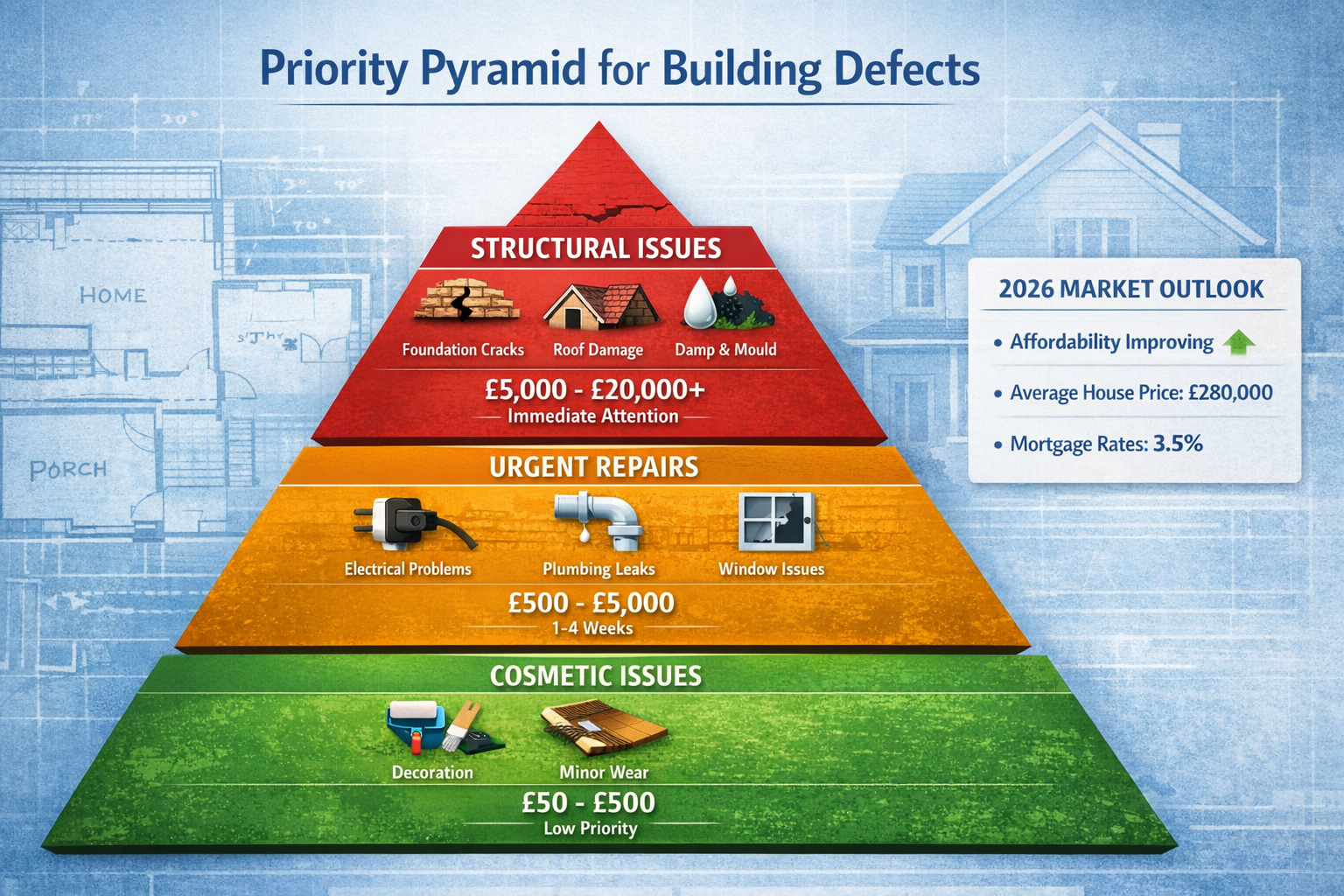
Not all building defects carry equal weight. Understanding the hierarchy of concerns enables first-time buyers to make informed decisions about which properties represent good value and which pose unacceptable risks. Professional surveys identify issues across multiple categories, but prioritization requires understanding both immediate safety implications and long-term financial impact.
Tier 1: Structural and Safety-Critical Defects (Dealbreakers) ⚠️
These defects pose immediate safety risks or require extensive, costly repairs that fundamentally affect property value and habitability:
RAAC (Reinforced Autoclaved Aerated Concrete)
The presence of RAAC has emerged as a priority survey concern for 2026 market recovery [1]. This lightweight concrete material, commonly used between the 1950s and mid-1990s, has a limited lifespan and can fail suddenly. Properties containing RAAC typically require:
- Complete replacement of affected structural elements
- Temporary propping during remediation
- Costs potentially exceeding £50,000-£100,000
Foundation and Structural Movement
Cracks wider than 5mm, stepped cracking in brickwork, or evidence of ongoing settlement indicate serious structural issues. These defects often require:
- Underpinning or foundation repairs (£10,000-£50,000+)
- Structural engineer assessments
- Potential insurance complications
- Significant disruption during repairs
Severe Damp and Water Ingress
Rising damp, penetrating damp, or active leaks cause progressive damage to structural timbers, plaster, and masonry. Beyond the visible damage, damp creates:
- Health hazards from mould growth
- Timber decay and potential collapse
- Electrical safety risks
- Repair costs from £5,000-£30,000 depending on extent
Dangerous Electrical Installations
Outdated wiring, lack of RCD protection, or aluminum wiring systems present fire and electrocution hazards. Full rewiring costs typically range from £3,000-£8,000 for average properties and must be addressed before occupation.
Cladding Issues
Following the increased focus on building safety, properties with combustible cladding face both safety concerns and mortgage lending difficulties. Cladding remediation can cost tens of thousands and may be required before purchase completion [1].
Tier 2: Urgent Repairs (Negotiation Opportunities) 🔧
These defects require attention but don't necessarily prevent purchase. They represent prime negotiation opportunities in the improved 2026 market:
Roof Repairs and Replacement
- Missing tiles or slates (£500-£2,000)
- Valley gutter repairs (£1,000-£3,000)
- Full roof replacement (£5,000-£15,000)
Heating System Issues
- Boiler replacement (£2,000-£4,000)
- Central heating system upgrades (£3,000-£6,000)
- Radiator replacements (£200-£500 each)
Window and Door Replacements
- Failed double glazing units (£200-£500 per window)
- Complete window replacement (£5,000-£12,000 for typical property)
- External door replacement (£800-£2,000 per door)
Drainage Problems
- Blocked or damaged drains (£500-£3,000)
- Soakaway repairs (£2,000-£5,000)
- Full drainage system replacement (£5,000-£15,000)
When comparing homebuyer reports versus building surveys, the more comprehensive building survey provides detailed cost estimates for these repairs, strengthening your negotiation position.
Tier 3: Cosmetic and Minor Issues (Acceptance or Minor Negotiation) ✨
These defects affect appearance or convenience but don't compromise structural integrity or safety:
- Interior decoration requirements
- Minor plaster cracks (non-structural)
- Garden maintenance issues
- Cosmetic bathroom or kitchen updates
- Minor woodwork repairs
- External repainting
In the improved 2026 market, buyers can afford to be selective even about cosmetic issues, potentially negotiating small price reductions or requesting completion of minor works before exchange.
Strategic Response Framework: What Building Survey Defect Prioritization for First-Time Buyers Means for Purchase Decisions

Understanding defect priorities is only half the equation. The strategic response to survey findings determines whether buyers maximize the opportunities presented by improved 2026 market conditions. With 88% of buyers ready to purchase [7] but builder confidence remaining subdued [4], first-time buyers hold significant negotiation leverage when armed with detailed survey information.
The Decision Matrix: Proceed, Negotiate, or Withdraw
When survey results arrive, first-time buyers face three primary options. The improved affordability environment of 2026 makes the "withdraw" option viable without losing their only chance at homeownership.
Option 1: Proceed Without Adjustment
Appropriate when:
- Only Tier 3 (cosmetic) defects identified
- Property priced significantly below market value
- Buyer has budget reserved for anticipated repairs
- Competition for the property remains high despite market conditions
Option 2: Renegotiate Terms
The most common response in 2026's buyer-favorable market:
Price Reduction Strategy
Request reduction equal to:
- 100% of Tier 1 defect repair costs (dealbreakers should typically trigger withdrawal)
- 75-100% of Tier 2 defect repair costs
- 25-50% of Tier 3 defect costs if negotiating leverage exists
Completion Requirements
Alternative to price reduction:
- Seller completes specified repairs before completion
- Retention held in escrow pending repair completion
- Warranty or guarantee provided for completed works
Extended Contingencies
- Additional time for specialist surveys or quotes
- Conditional approval pending specific remediation
- Right to re-inspect before final completion
Option 3: Withdraw from Purchase
Justified when:
- Tier 1 defects exceed 10% of purchase price to remedy
- RAAC, dangerous cladding, or major structural issues identified [1]
- Seller refuses reasonable negotiation despite market conditions
- Total repair costs would stretch finances beyond comfortable limits
With prospective buyer traffic remaining low [2], sellers face limited alternative buyers, strengthening the negotiation position for those who do make offers.
Leveraging Professional Expertise for Maximum Benefit
The quality of survey directly impacts negotiation success. Consider these approaches:
Obtain Detailed Cost Estimates
Professional surveyors can provide repair cost ranges, but obtaining specific quotes from contractors strengthens negotiation positions. For complex issues, specialist reports may be warranted:
- Structural engineers for foundation concerns
- Damp specialists for moisture problems
- Electrical contractors for wiring issues
- Roofing specialists for major roof defects
Document Everything Thoroughly
Photographic evidence, detailed descriptions, and professional assessments create compelling negotiation documentation. Sellers are more likely to negotiate when presented with clear, professional evidence rather than general concerns.
Understand Mortgage Lender Requirements
Some defects trigger mortgage valuation downgrades or lending refusals:
- Structural movement or subsidence
- RAAC presence [1]
- Dangerous cladding [1]
- Severe damp or timber decay
- Electrical safety hazards
Knowing which defects affect lending helps prioritize negotiation points and may justify withdrawal if remediation isn't feasible.
Case Study: Prioritization in Action
Scenario: First-time buyer identifies property listed at £325,000 in improved 2026 market conditions.
Survey Findings:
- Tier 1: Minor structural cracking (£8,000 repair estimate)
- Tier 2: Boiler replacement needed (£3,500), roof repairs required (£4,500), outdated electrical consumer unit (£800)
- Tier 3: Interior decoration throughout (£5,000), garden overgrown (£500)
Total Defect Cost: £22,300
Strategic Response:
- Request £18,000 price reduction (covering Tier 1 + Tier 2 fully, partial Tier 3)
- Alternative: £15,000 reduction plus seller completes boiler replacement before completion
- Walk-away position: Minimum £12,000 reduction (Tier 1 + essential Tier 2)
Outcome: In 2026's buyer-favorable market with 40% of builders cutting prices [2], seller agrees to £16,000 reduction, recognizing limited alternative buyers. Buyer proceeds with purchase at £309,000, immediately addressing structural repairs and planning remaining works over first year.
This approach transforms the survey from a potential deal-killer into a value-creation tool, precisely the opportunity that improved affordability and buyer confidence enables.
Building Long-Term Value Through Informed Decisions
Beyond immediate purchase negotiations, proper defect prioritization protects long-term investment value:
Avoid Future Selling Difficulties
Properties with unaddressed Tier 1 defects face:
- Mortgage lending restrictions for future buyers
- Reduced buyer pool and longer marketing times
- Mandatory disclosure requirements creating negotiation disadvantages
- Potential legal liability for non-disclosure
Plan Systematic Improvements
Understanding defect priorities enables strategic improvement planning:
- Address safety and structural issues immediately
- Schedule Tier 2 repairs over 1-2 years as budget allows
- Complete cosmetic improvements gradually
- Maintain detailed records of all remediation work
Protect Resale Value
Properties with documented defect remediation often achieve premium prices:
- New boilers, rewiring, or roof work add tangible value
- Structural repair guarantees transfer to future buyers
- Comprehensive maintenance records demonstrate responsible ownership
- Resolved issues remove objections for future purchasers
For those considering properties requiring extensive work, understanding schedule of condition reports helps document the property state before and after improvements, valuable for future sales or disputes.
Practical Implementation: Your Building Survey Defect Prioritization Action Plan
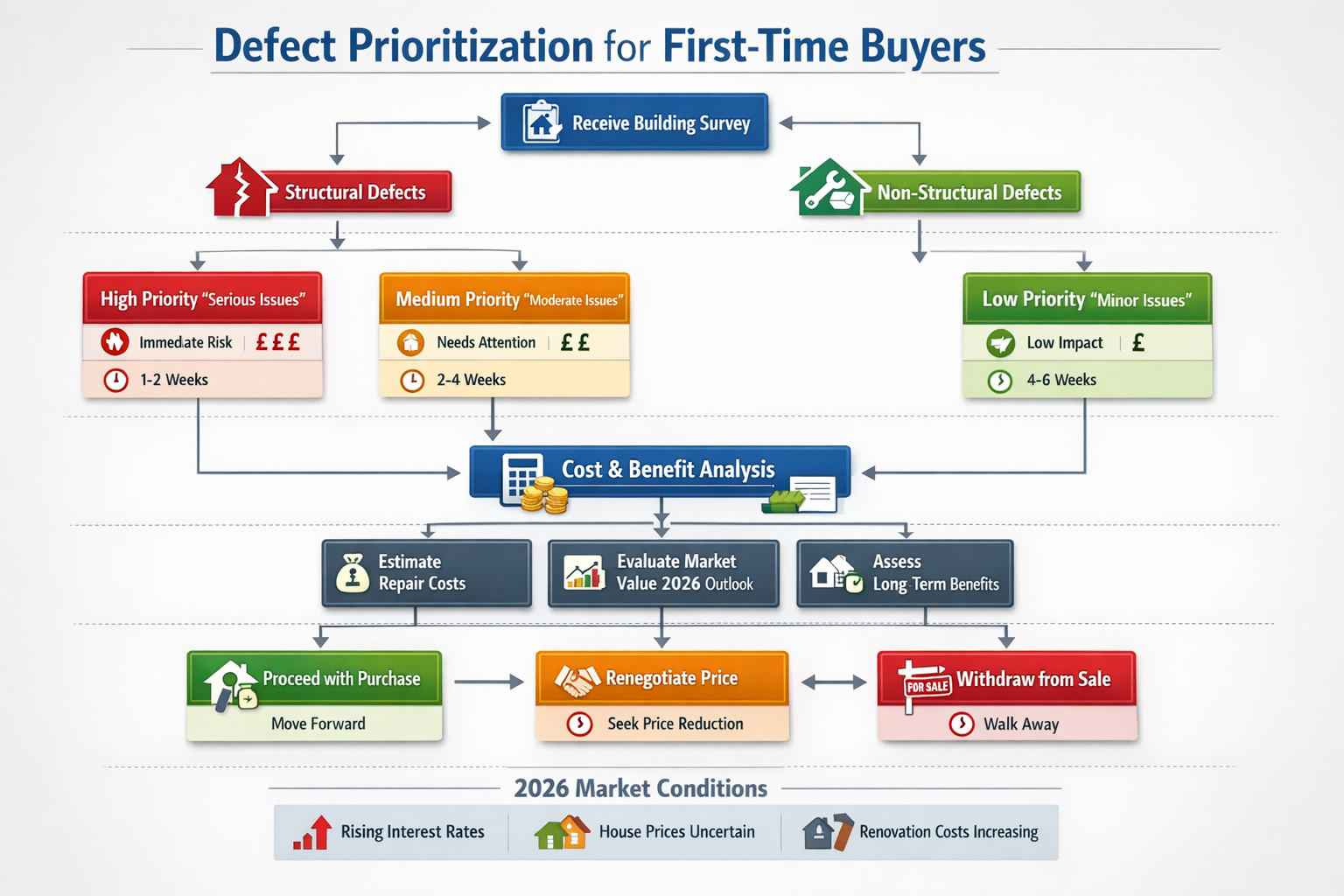
Theory becomes valuable only through effective implementation. First-time buyers navigating the improved 2026 market need a clear, actionable framework for translating survey findings into confident purchase decisions.
Step 1: Commission the Right Survey Type 📋
The foundation of effective defect prioritization begins with appropriate survey selection. Three main options exist:
RICS Level 2 Survey (Homebuyer Report)
Suitable for:
- Conventional properties built post-1900
- Properties in reasonable condition
- Standard construction methods
- Budget-conscious buyers of straightforward properties
RICS Level 3 Survey (Building Survey)
Recommended for:
- Properties built pre-1900
- Unusual construction types
- Properties with known issues or extensions
- Buyers planning significant renovations
- Higher-value properties where comprehensive information justifies additional cost
Specialist Surveys
Additional investigations for specific concerns:
- Structural engineer reports for movement or subsidence
- Damp and timber surveys for moisture issues
- Electrical installation condition reports
- Drainage surveys using CCTV inspection
Given the emphasis on RAAC, cladding, and latent defects in 2026 [1], many first-time buyers find the comprehensive Level 3 Building Survey provides the detail needed for confident decision-making in the improved market.
Step 2: Review Survey Results Systematically 🔍
When the survey arrives, resist the temptation to panic at the length or number of issues identified. Professional surveys deliberately err on the side of disclosure, noting even minor observations.
Create Your Prioritized Defect List:
- Highlight all Tier 1 (structural/safety) issues in red
- Mark Tier 2 (urgent repair) items in amber
- Note Tier 3 (cosmetic) concerns in green
- Calculate total estimated repair costs for each tier
- Identify any items affecting mortgage lending
This visual prioritization immediately clarifies which issues demand attention versus which represent minor concerns.
Step 3: Obtain Detailed Repair Quotations 💷
Survey cost estimates provide ranges, but specific contractor quotes strengthen negotiation positions:
For Tier 1 Defects:
- Obtain at least two detailed quotations
- Include full scope of work and specifications
- Ensure contractors are appropriately qualified/insured
- Request guarantees or warranties for proposed work
For Tier 2 Defects:
- Single quotation often sufficient for negotiation
- Focus on items with highest cost impact
- Consider bundling related repairs for better pricing
For Tier 3 Defects:
- Rough estimates typically adequate
- May not warrant formal quotations unless negotiating leverage exists
Step 4: Develop Your Negotiation Strategy 🤝
Armed with prioritized defects and cost estimates, formulate your approach:
Calculate Your Walk-Away Point:
- Maximum acceptable total defect cost
- Minimum required price reduction or repairs
- Deal-breaking defects that require resolution or withdrawal
Prepare Three Negotiation Positions:
- Ideal outcome: Full Tier 1 + Tier 2 cost recovery, partial Tier 3
- Acceptable outcome: Full Tier 1, majority of Tier 2
- Minimum acceptable: Tier 1 defects addressed through price reduction or completion
Consider Non-Price Alternatives:
- Extended completion timeline for seller to complete repairs
- Retention accounts holding funds pending work completion
- Seller contributions to specific high-priority repairs
- Warranties or guarantees for existing systems
Step 5: Present Your Case Professionally 📊
Effective negotiation requires clear, professional communication:
Prepare Documentation Package:
- Full survey report with priority items highlighted
- Contractor quotations for major defects
- Photographic evidence where available
- Calculated total cost impact
- Specific proposal for resolution
Frame Negotiation Positively:
Rather than: "This property has serious problems and I want £20,000 off."
Try: "We remain committed to purchasing this property. The professional survey has identified repairs totaling approximately £20,000. We propose proceeding with a price adjustment of £15,000 to reflect these necessary works, which we'll complete after purchase."
Leverage Market Conditions Appropriately:
In 2026's environment where 40% of builders cut prices and 65% offer incentives [2], sellers understand market realities. Reference market conditions factually without threats: "Given current market conditions and the repair requirements identified, we believe this adjustment represents fair value for both parties."
Step 6: Make Your Final Decision Confidently ✅
After negotiation concludes, make your final decision based on:
Financial Viability:
- Total purchase price plus required repairs within budget
- Emergency fund remains intact after addressing Tier 1 defects
- Tier 2 repairs achievable within 12-24 months
- No mortgage lending obstacles
Risk Tolerance:
- Comfortable with identified defects and remediation plans
- No unresolved Tier 1 safety concerns
- Clear understanding of all required works
- Confidence in ability to manage repair projects
Long-Term Value:
- Property represents good value after defect adjustment
- Location and fundamentals remain sound
- Remediation will restore or enhance market value
- No insurmountable issues affecting future resale
With 88% of buyers ready to purchase in 2026 [7] and improved affordability creating opportunities, confident decision-making based on thorough defect prioritization enables first-time buyers to secure properties that serve them well for years to come.
Common Pitfalls to Avoid ⚠️
Overreacting to Survey Length:
Comprehensive surveys identify everything, including minor observations. Focus on priority categorization rather than total item count.
Underestimating Cosmetic Costs:
While Tier 3 defects aren't structural, complete redecoration and modernization can still cost £10,000-£20,000. Factor these into long-term budgets.
Ignoring Specialist Recommendations:
When surveys recommend specialist investigations, obtain them. Unidentified major defects discovered post-purchase offer no recourse.
Negotiating Without Evidence:
General concerns carry little weight. Professional surveys and contractor quotes create compelling negotiation foundations.
Failing to Verify Seller Claims:
If sellers claim repairs have been completed, request documentation, guarantees, and independent verification rather than accepting verbal assurances.
Working with Professional Surveyors
The relationship with your surveyor extends beyond receiving the report. Professional surveyors provide valuable support throughout the process:
- Clarification of findings: Request explanations of technical terms or concerns
- Priority guidance: Ask surveyors to identify their top concerns
- Specialist referrals: Obtain recommendations for follow-up investigations
- Negotiation support: Some surveyors provide summary letters for negotiation purposes
Engaging with expert surveyor advice throughout the purchase process ensures first-time buyers fully understand the implications of survey findings and make informed decisions aligned with their circumstances.
Conclusion
The 2026 property market presents a transformative opportunity for first-time buyers. After years of constrained choices and desperate competition, improving affordability and subdued builder confidence have shifted power dynamics significantly. Building Survey Defect Prioritization for First-Time Buyers: What Matters Most When Affordability Improves and Buyer Confidence Grows represents the critical skill that separates successful purchases from costly mistakes.
Understanding the three-tier defect framework—structural and safety-critical issues (Tier 1), urgent repairs (Tier 2), and cosmetic concerns (Tier 3)—enables buyers to assess properties systematically rather than emotionally. With 88% of buyers ready to purchase [7] but only 38% builder confidence [4], those who approach surveys strategically gain unprecedented negotiation leverage.
The key insights for first-time buyers in 2026:
✅ Prioritize safety and structural integrity above all else—RAAC, dangerous cladding, severe damp, and foundation issues warrant serious consideration or withdrawal [1]
✅ Leverage Tier 2 defects for negotiation—with 40% of builders cutting prices and 65% offering incentives [2], repair costs provide legitimate grounds for price adjustments
✅ Don't fear comprehensive surveys—detailed information strengthens rather than weakens your position in buyer-favorable markets
✅ Maintain perspective on cosmetic issues—Tier 3 defects offer minor negotiation opportunities but shouldn't derail otherwise sound purchases
✅ Document everything professionally—contractor quotes, photographic evidence, and clear proposals create compelling negotiation cases
Your Next Steps
For first-time buyers ready to capitalize on improved 2026 market conditions:
- Commission appropriate surveys based on property age, type, and condition—don't skimp on this critical investment
- Review findings systematically using the three-tier prioritization framework outlined in this guide
- Obtain specific repair quotations for all significant defects to strengthen negotiation positions
- Develop clear negotiation strategies with defined walk-away points and acceptable outcomes
- Make confident decisions based on facts, professional advice, and your long-term financial capacity
- Proceed with purchases that represent genuine value after appropriate defect adjustments
The transformation from "any home I can afford" to selective, strategic purchasing represents a profound shift in first-time buyer empowerment. Survey defect prioritization provides the framework for exercising this newfound choice wisely, securing properties that serve as solid foundations for long-term financial security and homeownership satisfaction.
In a market where builders are cutting prices, offering incentives, and facing limited buyer traffic [2], those who understand defect prioritization can negotiate from strength, protect their investments, and build wealth through informed property purchases. The improved affordability and growing buyer confidence of 2026 create opportunities—but only for those equipped with the knowledge to evaluate properties thoroughly and negotiate effectively.
The power has shifted to buyers. The question is whether first-time purchasers will leverage comprehensive surveys and strategic defect prioritization to maximize this historic opportunity.
References
[1] Building Survey Priorities In 2026 Market Recovery Raac Cladding And Latent Defects For Stabilising Prices – https://nottinghillsurveyors.com/blog/building-survey-priorities-in-2026-market-recovery-raac-cladding-and-latent-defects-for-stabilising-prices
[2] Builder Sentiment Loses Ground At Start Of 2026 – https://www.nahb.org/news-and-economics/press-releases/2026/01/builder-sentiment-loses-ground-at-start-of-2026
[4] Builder Sentiment Inches Higher But Affordability Concerns Persist – https://eyeonhousing.org/2026/03/builder-sentiment-inches-higher-but-affordability-concerns-persist/
[5] Builder Sentiment Edges Lower On Affordability Concerns – https://www.nahb.org/news-and-economics/press-releases/2026/02/builder-sentiment-edges-lower-on-affordability-concerns
[7] More Buyers Ready Jump 2026 – https://nationalmortgageprofessional.com/news/more-buyers-ready-jump-2026