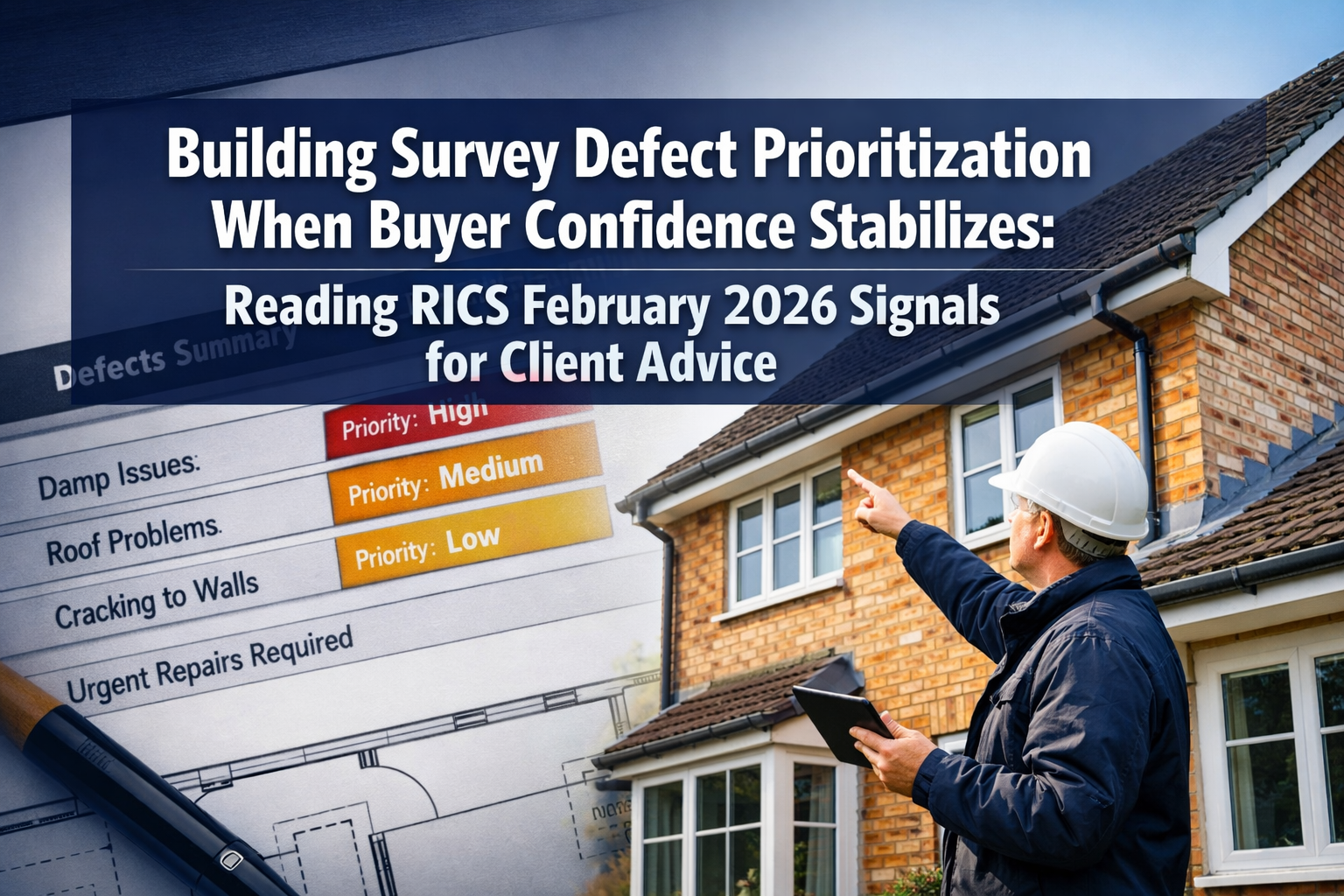
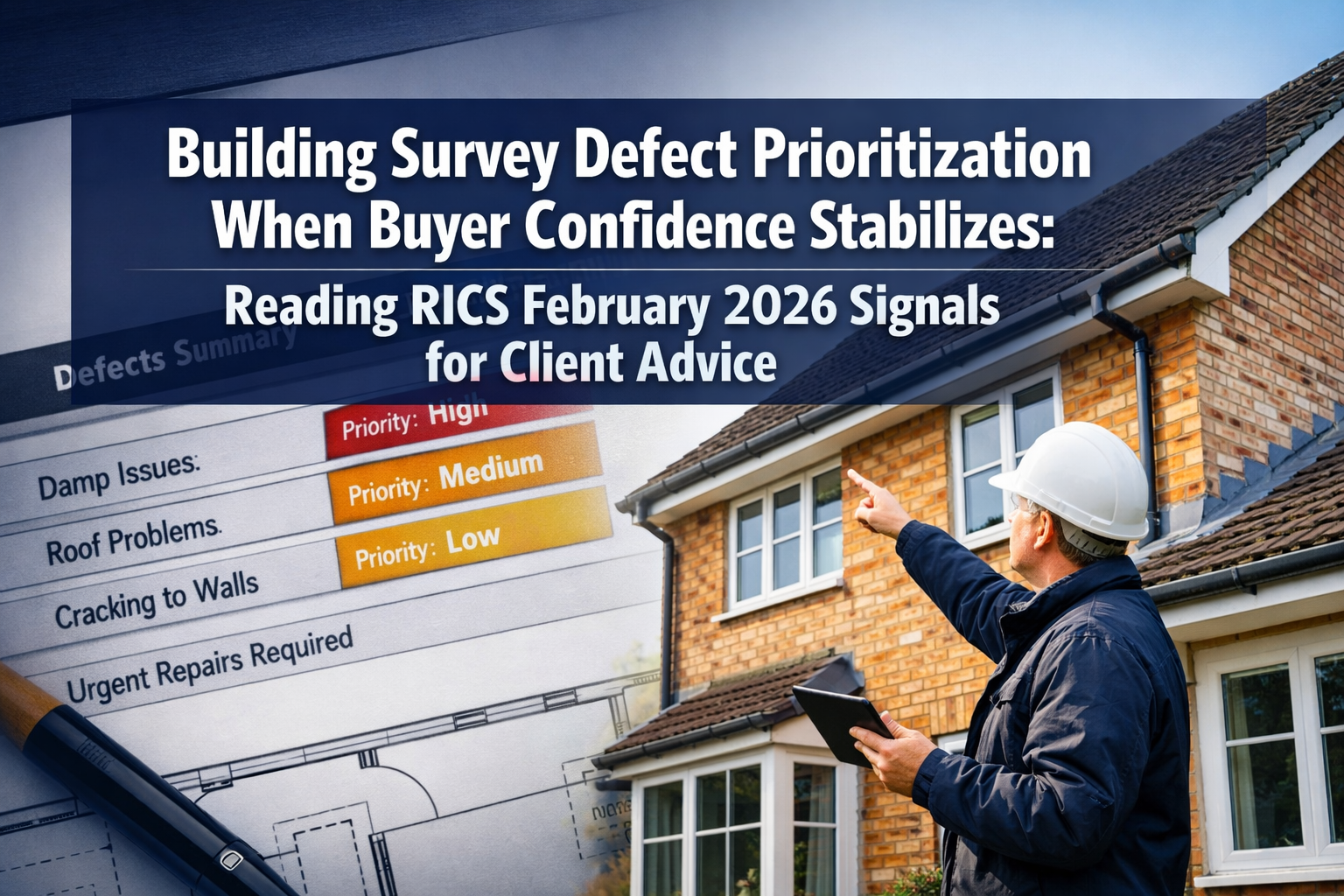
Property transactions in the UK reached their lowest buyer confidence levels in Q4 2025, with mortgage approvals down 18% year-on-year. Yet by February 2026, sentiment indicators began showing the first sustained recovery in 14 months. This shift from decline to cautious optimism demands a fundamental recalibration in how chartered surveyors approach Building Survey Defect Prioritization When Buyer Confidence Stabilizes: Reading RICS February 2026 Signals for Client Advice. When purchasing power remains constrained despite improving sentiment, the traditional comprehensive defect cataloguing must evolve into strategic risk assessment that acknowledges financial realities.
The Royal Institution of Chartered Surveyors (RICS) has responded to this market transformation with updated guidance frameworks and quality strengthening initiatives throughout early 2026. These changes signal a professional recognition that buyer confidence stabilization doesn't mean unlimited budgets—it means clients need smarter, more nuanced advice about which defects truly matter for their specific circumstances.
Key Takeaways
✅ Market Context Matters: Buyer confidence recovery doesn't equal pre-2024 purchasing power—defect prioritization must reflect constrained budgets and strategic risk assessment
✅ RICS 2026 Evolution: New quality strengthening initiatives and AI-powered detection methods are transforming how surveyors categorize and communicate defects[1][2]
✅ Three-Tier Framework: Critical structural risks, significant functional concerns, and minor cosmetic issues require distinct treatment in stabilized markets
✅ Client-Centered Reporting: February 2026 signals emphasize tailored advice over exhaustive cataloguing, with cost-impact analysis driving decision-making
✅ Technology Integration: Predictive analytics and AI defect detection enable more accurate prioritization and long-term maintenance forecasting[1]
Understanding the February 2026 Market Context for Building Survey Defect Prioritization
The property market landscape in February 2026 represents a delicate inflection point. Buyer confidence metrics show stabilization after 18 months of declining sentiment, yet this recovery occurs against a backdrop of elevated interest rates, tightened lending criteria, and reduced household savings. For surveyors conducting Level 3 building surveys, this creates a unique professional challenge.
What makes February 2026 different? 📊
Previous market recoveries typically featured expanding budgets and aggressive bidding. The 2026 stabilization shows different characteristics:
- Buyers returning to market with 15-20% lower purchasing power than 2022 peaks
- Increased scrutiny of survey findings before proceeding with purchases
- Greater willingness to renegotiate or withdraw based on defect discoveries
- Heightened expectations for clear, actionable surveyor guidance
RICS CEO Justin Young's February 2026 update emphasized the institution's commitment to "quality strengthening initiatives" that directly impact how building surveys are conducted and communicated[4]. This timing isn't coincidental—the organization recognizes that surveyor practice must adapt to serve clients navigating this stabilized but constrained market environment.
The Shift from Comprehensive Cataloguing to Strategic Prioritization
Traditional building survey reports often present defects in chronological discovery order or room-by-room sequences. While thorough, this approach can overwhelm buyers in 2026's market conditions. When a client faces £180,000 in identified repairs but has only £25,000 in contingency funds, they need prioritization frameworks, not just comprehensive lists.
Building Survey Defect Prioritization When Buyer Confidence Stabilizes: Reading RICS February 2026 Signals for Client Advice means recognizing this fundamental shift. The RICS Home Survey Standard's second edition, updated in April 2026, continues working through consultation feedback that addresses exactly these practical application challenges[3].
The Three-Tier Defect Classification Framework for Stabilized Markets
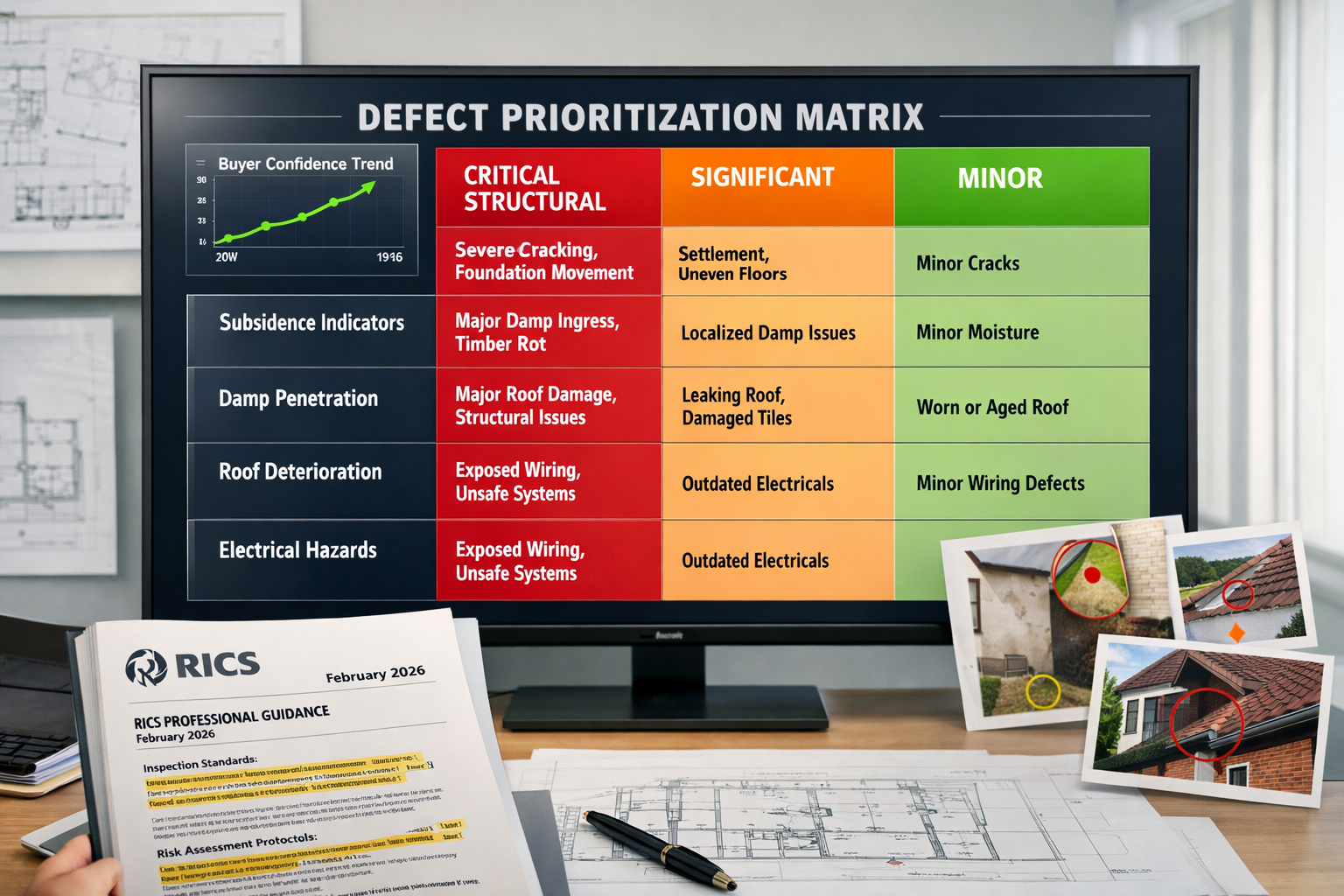
Effective Building Survey Defect Prioritization When Buyer Confidence Stabilizes: Reading RICS February 2026 Signals for Client Advice requires a structured classification system that separates defects by urgency, financial impact, and risk profile. The following framework aligns with RICS quality strengthening initiatives while addressing practical client needs[2].
Tier 1: Critical Structural and Safety Defects 🚨
These defects demand immediate attention regardless of market conditions or buyer budgets. They represent fundamental risks to property integrity, occupant safety, or legal compliance.
Priority indicators include:
- Active structural movement or progressive subsidence requiring urgent investigation
- Significant roof structure failure with water ingress affecting load-bearing elements
- Electrical systems presenting immediate fire or shock hazards
- Severe damp penetration causing timber decay in structural members
- Defective drainage causing foundation undermining
Client advice framework: Tier 1 defects should trigger one of three responses—immediate remediation before completion, substantial price reduction reflecting full repair costs plus contingency, or transaction withdrawal if costs exceed viability thresholds.
For properties showing subsidence indicators, surveyors must now provide clearer guidance on monitoring versus intervention costs, recognizing that buyers in 2026 need actionable timelines, not just technical descriptions.
Tier 2: Significant Functional Defects Requiring Medium-Term Action ⚠️
This middle category represents defects that won't cause immediate catastrophic failure but will deteriorate without intervention within 3-5 years. In stabilized markets with constrained budgets, these items become negotiation focal points.
Typical Tier 2 defects:
| Defect Category | Typical Cost Range | Urgency Timeline | Negotiation Impact |
|---|---|---|---|
| Roof covering deterioration | £8,000-£25,000 | 2-4 years | High |
| Window replacement (multiple units) | £12,000-£35,000 | 3-5 years | Medium-High |
| Heating system replacement | £6,000-£15,000 | 2-3 years | Medium |
| Damp-proofing works | £4,000-£12,000 | 1-3 years | Medium |
| Drainage repairs (non-critical) | £3,000-£10,000 | 2-4 years | Medium-Low |
The February 2026 RICS signals suggest that specific defect reports for Tier 2 items are increasingly valuable. Rather than general recommendations, clients benefit from detailed cost projections and maintenance timeline forecasts that support informed negotiation.
AI-powered enhancement: RICS priority development areas for 2026 include artificial intelligence applications for defect detection and predictive analytics[1]. For Tier 2 defects, this technology enables surveyors to provide deterioration rate projections—showing clients whether a roof will last 3 years or 5 years based on current condition patterns.
Tier 3: Minor Cosmetic and Maintenance Items ✓
These defects have minimal structural significance and can be addressed through routine maintenance or deferred until buyer finances improve. In previous market peaks, buyers often demanded price reductions for Tier 3 items. In 2026's stabilized environment, experienced surveyors help clients understand which items truly matter.
Common Tier 3 examples:
- Cosmetic plasterwork cracks without structural movement
- Minor external repointing requirements
- Gutter cleaning and minor repairs
- Internal decoration requirements
- Garden boundary maintenance
- Minor door and window adjustments
Professional guidance consideration: While individually minor, accumulated Tier 3 defects can represent £15,000-£30,000 in total costs. Surveyors must balance acknowledging these items without creating disproportionate concern that derails transactions in a stabilizing market.
Applying RICS February 2026 Signals to Client Advisory Frameworks
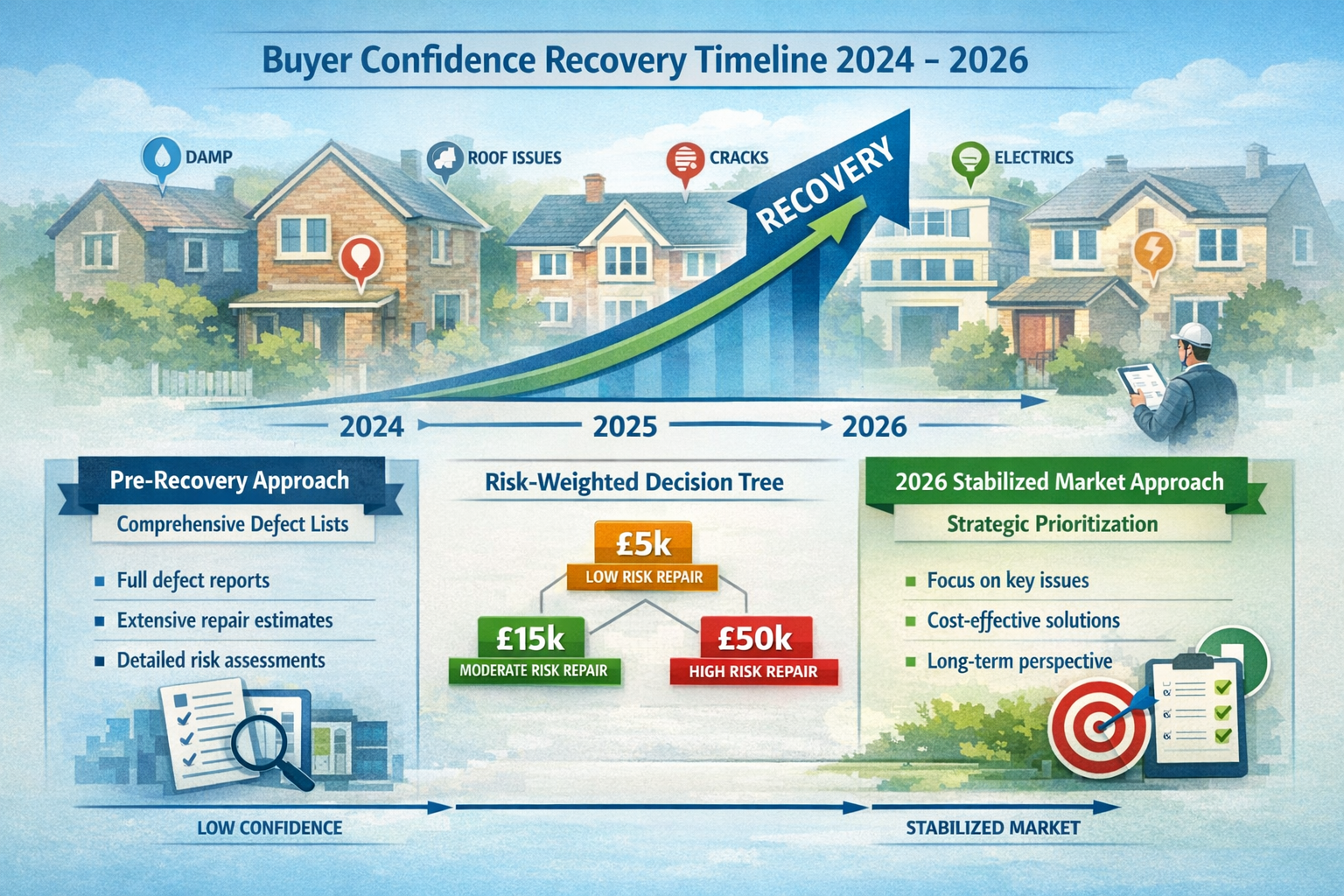
The practical application of Building Survey Defect Prioritization When Buyer Confidence Stabilizes: Reading RICS February 2026 Signals for Client Advice requires translating technical findings into decision-support frameworks. RICS quality strengthening initiatives throughout 2026 emphasize this client-centered approach[2].
Cost-Impact Analysis as Core Reporting Element
Traditional survey reports describe defects and recommend further investigation. The 2026 approach integrates cost-impact analysis directly into prioritization frameworks. This means providing:
Immediate cost implications: What must be addressed before occupation?
Short-term budget requirements (Years 1-2): Essential repairs that can't be deferred beyond initial occupancy period
Medium-term planning costs (Years 3-5): Significant items requiring financial preparation but not immediate action
Long-term maintenance forecasting (Years 6-10): Normal property lifecycle costs for informed ownership planning
For chartered surveyors across London and surrounding regions, this enhanced reporting approach addresses the specific challenges of period properties, where defect lists can be extensive but not all items carry equal urgency.
Risk-Weighted Decision Trees for Complex Defect Scenarios
Some defects don't fit neatly into three-tier classifications. Potential subsidence, for example, might be inactive historical movement or early-stage progressive settlement. The February 2026 RICS signals suggest surveyors should provide risk-weighted decision frameworks:
Low probability, high impact defects: Recommend monitoring protocols with clear intervention triggers
High probability, moderate impact defects: Prioritize immediate remediation or price adjustment
Uncertain classification defects: Provide multiple scenarios with associated cost ranges and probability assessments
This approach acknowledges that buyers in stabilized markets need to make informed risk decisions, not just receive comprehensive defect catalogues. A structural survey that presents three possible scenarios with associated costs and probabilities serves clients better than vague "further investigation recommended" statements.
Technology Integration: AI and Predictive Analytics in Defect Assessment
RICS priority development areas for 2026 explicitly include artificial intelligence applications for defect detection and predictive analytics in building surveys[1]. This technological evolution enables more sophisticated prioritization:
Thermal imaging analysis: AI-enhanced interpretation identifies moisture patterns indicating active leaks versus historical staining
Crack pattern recognition: Machine learning algorithms distinguish settlement cracks from thermal movement based on pattern characteristics
Deterioration rate prediction: Historical data analysis forecasts when Tier 2 defects will progress to Tier 1 urgency
Comparative cost modeling: AI systems provide location-specific repair cost estimates based on recent contractor data
For surveyors conducting roof surveys or drone roof inspections, AI-powered image analysis can identify deterioration patterns invisible to conventional visual inspection, enabling more accurate prioritization of roof covering replacement versus localized repairs.
Regional Considerations in Defect Prioritization
Market stabilization doesn't occur uniformly across regions. Buyer confidence recovery in Central London follows different timelines than Surrey or Berkshire markets. This geographic variation affects defect prioritization strategies.
Urban market characteristics (2026 stabilization):
- Higher property values support larger repair budgets
- Greater availability of specialist contractors affects cost estimates
- Period property prevalence means extensive defect lists are market-normalized
- Buyers typically more experienced with renovation project management
Suburban and regional considerations:
- Price sensitivity creates stronger negotiation pressure on Tier 2 defects
- Limited specialist contractor availability may increase costs and timelines
- Modern property stock means defects carry greater relative concern
- First-time buyers require more detailed prioritization guidance
Surveyors operating across West London, Richmond, Kingston, and surrounding areas must calibrate advice to reflect these regional market characteristics while maintaining consistent professional standards.
Communication Strategies: Translating Technical Findings into Client Decisions
The most sophisticated defect prioritization framework fails if clients can't understand and act on the guidance provided. Building Survey Defect Prioritization When Buyer Confidence Stabilizes: Reading RICS February 2026 Signals for Client Advice includes communication methodology as a core professional competency.
Executive Summary Frameworks for Complex Reports
Level 3 building surveys for period properties can extend to 60-80 pages of technical detail. The 2026 approach requires concise executive summaries that present prioritized findings:
Page 1: Critical decision factors
- Tier 1 defects requiring immediate response
- Total estimated costs for essential repairs
- Recommended transaction approach (proceed/renegotiate/withdraw)
Page 2: Financial planning overview
- Cost breakdown by tier and urgency timeline
- Comparative analysis against property price
- Contingency recommendations for uncertain items
Page 3: Key recommendations summary
- Prioritized action list with specific next steps
- Further investigation requirements with estimated costs
- Specialist referrals where appropriate
This structure ensures clients grasp essential information before engaging with comprehensive technical detail. For buyers working with chartered surveyors in areas like Ealing, Hounslow, or Harrow, this clarity proves especially valuable when coordinating with solicitors and mortgage lenders.
Visual Prioritization Tools
Text-heavy reports overwhelm clients in high-stress transaction environments. The February 2026 RICS quality strengthening initiatives encourage visual communication methods[2]:
Color-coded defect matrices: Red/amber/green systems instantly communicate priority levels
Cost-impact charts: Visual representations showing repair costs against property value percentages
Timeline graphics: Illustrated maintenance schedules showing when different repairs become urgent
Photographic annotation: Images with overlay text explaining significance and priority level
Comparison tables: Side-by-side presentations of different remediation approaches with cost-benefit analysis
These visual tools complement rather than replace detailed technical descriptions, ensuring clients with varying levels of property knowledge can engage with findings effectively.
Scenario Planning for Uncertain Defects
Some defects resist definitive classification. Potential timber decay in inaccessible areas, suspected but unconfirmed drainage issues, or ambiguous crack patterns require scenario-based communication:
Best-case scenario: Defect is minor/historical, estimated cost £X, probability Y%
Most likely scenario: Moderate intervention required, estimated cost £X, probability Y%
Worst-case scenario: Extensive remediation necessary, estimated cost £X, probability Y%
This framework enables clients to make informed risk decisions based on their financial capacity and risk tolerance. A buyer with substantial contingency funds might proceed despite worst-case scenarios, while constrained purchasers might withdraw if probable costs exceed budgets.
Professional Standards Evolution: RICS Quality Strengthening Impact
The RICS quality strengthening initiatives transforming surveyor practice in 2026 extend beyond technical survey methodology to encompass professional conduct, reporting standards, and client service expectations[2]. Understanding these evolving standards is essential for effective Building Survey Defect Prioritization When Buyer Confidence Stabilizes: Reading RICS February 2026 Signals for Client Advice.
Enhanced Competency Requirements
The 2026 RICS framework emphasizes specialized competencies for different property types and defect categories:
Period property specialists: Enhanced training in historical construction methods, traditional materials deterioration patterns, and conservation-appropriate remediation approaches
Modern construction experts: Competency in contemporary building systems, warranty implications, and new-build defect identification
Technology integration skills: Proficiency with AI-powered detection tools, thermal imaging interpretation, and digital reporting platforms
For clients seeking building surveyor services in 2026, these enhanced competency standards provide greater confidence that surveyors possess relevant expertise for specific property challenges.
Continuous Professional Development Focus Areas
RICS 2026 CPD priorities reflect the changing market environment and technological evolution:
- Risk communication: Training in translating technical findings into client decision frameworks
- Cost estimation accuracy: Enhanced methodologies for repair cost projection across different regions
- AI tool utilization: Professional development in leveraging technology for improved defect detection
- Market context integration: Understanding how economic conditions affect defect prioritization advice
Quality Assurance and Peer Review
The February 2026 signals indicate strengthened quality assurance mechanisms within RICS-regulated practice:
Report review protocols: Random sampling of member reports for quality compliance assessment
Client feedback integration: Systematic collection and analysis of client satisfaction data
Peer consultation requirements: Complex defect scenarios requiring second-opinion verification
Continuing competency validation: Regular reassessment of technical knowledge and practical skills
These measures ensure that Building Survey Defect Prioritization When Buyer Confidence Stabilizes: Reading RICS February 2026 Signals for Client Advice reflects consistently high professional standards across the chartered surveyor community.
Practical Implementation: Case Study Approaches
Theoretical frameworks gain meaning through practical application. The following scenarios illustrate how defect prioritization adapts to February 2026 market conditions:
Case Study 1: Victorian Terrace in South West London
Property: 1890s three-bedroom terrace, £725,000 purchase price
Buyer profile: First-time buyers with £15,000 contingency budget
Survey findings: 47 identified defects ranging from minor cosmetic issues to significant roof deterioration
Prioritization approach:
Tier 1 (Critical):
- Defective electrical consumer unit (£1,200 replacement)
- Active damp penetration in rear extension (£3,500 remediation)
- Total Tier 1: £4,700
Tier 2 (Significant, 3-5 year timeline):
- Main roof covering end-of-life (£18,000 replacement)
- Original single-glazed windows (£22,000 replacement)
- Heating system aged 18 years (£7,500 replacement)
- Total Tier 2: £47,500
Tier 3 (Minor maintenance):
- Various cosmetic repairs (£8,000 estimated)
Client advice: Proceed with transaction conditional on vendor addressing Tier 1 defects. Negotiate £20,000 price reduction reflecting most urgent Tier 2 item (roof) with understanding that windows and heating represent medium-term planning costs. This approach keeps the transaction viable within buyer budget constraints while ensuring critical safety issues are resolved.
This scenario demonstrates how surveyors in South West London apply prioritization frameworks to support viable transactions in stabilized markets.
Case Study 2: 1930s Detached Property in Surrey
Property: Four-bedroom detached house, £895,000 purchase price
Buyer profile: Experienced homeowners with £40,000 contingency budget
Survey findings: Suspected subsidence with visible cracking, plus various secondary defects
Prioritization approach:
Tier 1 (Critical – requires immediate investigation):
- Structural engineer assessment of cracking patterns (£1,500-£2,500)
- Potential subsidence remediation (£15,000-£45,000 depending on investigation findings)
Risk-weighted scenarios provided:
- Scenario A (40% probability): Historical settlement, monitoring only required, £2,000 cost
- Scenario B (45% probability): Localized underpinning required, £18,000-£25,000 cost
- Scenario C (15% probability): Extensive underpinning necessary, £35,000-£50,000 cost
Client advice: Transaction should be conditional on structural engineer investigation before exchange. If Scenario B confirmed, proceed with vendor contribution toward costs. If Scenario C confirmed, renegotiate purchase price by £40,000 or consider withdrawal depending on buyer risk tolerance.
This case illustrates how chartered surveyors in Surrey handle uncertain high-impact defects through scenario planning rather than simple "further investigation recommended" statements.
Future-Proofing Client Advice: Beyond Immediate Transaction Support
Effective Building Survey Defect Prioritization When Buyer Confidence Stabilizes: Reading RICS February 2026 Signals for Client Advice extends beyond immediate purchase decisions to long-term property ownership planning. The RICS 2026 approach encourages surveyors to provide forward-looking maintenance frameworks.
10-Year Maintenance Forecasting
Modern building survey reports increasingly include projected maintenance timelines:
Years 1-2: Essential repairs and immediate safety concerns
Years 3-5: Significant system replacements and structural maintenance
Years 6-10: Normal lifecycle replacements and preventive maintenance
Years 10+: Major refurbishment considerations
This long-term perspective helps buyers understand total ownership costs, not just immediate repair requirements. For properties requiring residential structural engineers or specialized interventions, these timelines prove especially valuable for financial planning.
Maintenance Prioritization Matrices
Beyond defect identification, forward-thinking surveyors provide maintenance prioritization guidance:
High priority, low cost: Items that prevent larger problems if addressed promptly (gutter maintenance, minor repointing)
High priority, high cost: Major systems requiring planned replacement (roof, heating, windows)
Low priority, low cost: Cosmetic improvements enhancing property value
Low priority, high cost: Non-essential upgrades with limited return on investment
This matrix approach helps clients allocate limited budgets strategically across immediate repairs and ongoing maintenance.
Technology-Enabled Maintenance Tracking
AI and digital tools enable ongoing defect monitoring beyond initial survey:
Digital defect registers: Clients receive editable databases tracking identified issues and completion status
Photographic baselines: Timestamped images enable future comparison for deterioration monitoring
Automated reminders: Digital systems prompt clients when deferred maintenance items reach action timelines
Cost updating: Inflation-adjusted repair cost estimates maintain accuracy over time
Conclusion
Building Survey Defect Prioritization When Buyer Confidence Stabilizes: Reading RICS February 2026 Signals for Client Advice represents a fundamental evolution in chartered surveyor practice. As market conditions shift from decline to cautious recovery, professional guidance must adapt to serve clients navigating constrained budgets, heightened transaction scrutiny, and complex risk decisions.
The RICS quality strengthening initiatives throughout 2026, coupled with technological advances in AI-powered defect detection and predictive analytics, provide surveyors with enhanced tools for delivering strategic, client-centered advice[1][2]. The Home Survey Standard's continuing evolution reflects institutional recognition that comprehensive defect cataloguing must give way to prioritized risk assessment and actionable decision frameworks[3].
Key Implementation Principles
✅ Adopt three-tier classification: Separate critical structural risks from significant functional concerns and minor maintenance items
✅ Integrate cost-impact analysis: Provide specific repair cost estimates with urgency timelines for informed client decision-making
✅ Embrace technology: Leverage AI-powered detection and predictive analytics for more accurate defect assessment and prioritization
✅ Communicate visually: Use color-coded matrices, timeline graphics, and annotated photography to complement technical descriptions
✅ Provide scenario planning: Address uncertain defects through risk-weighted probability assessments rather than vague recommendations
✅ Consider regional context: Calibrate advice to reflect local market conditions, contractor availability, and buyer expectations
✅ Think long-term: Extend guidance beyond immediate transaction support to include 10-year maintenance forecasting
Actionable Next Steps
For property buyers: Request prioritized defect reporting with specific cost estimates and urgency timelines. Ask surveyors to explain how February 2026 market conditions affect their recommendations. Seek scenario-based guidance for uncertain defects rather than accepting generic "further investigation" statements.
For chartered surveyors: Review current reporting templates against RICS 2026 quality strengthening principles. Invest in AI-powered defect detection technology and predictive analytics training. Develop visual communication tools that enhance client understanding. Establish peer review protocols for complex prioritization decisions.
For conveyancing professionals: Understand that modern building surveys provide strategic decision frameworks, not just defect catalogues. Coordinate with surveyors to ensure clients grasp prioritization logic. Recognize that February 2026 market stabilization creates different negotiation dynamics than previous recovery periods.
The stabilization of buyer confidence in 2026 doesn't signal a return to pre-2024 market conditions. Instead, it represents a new equilibrium where informed risk assessment, strategic defect prioritization, and client-centered communication define professional excellence in building survey practice. Surveyors who embrace these principles will deliver greater value to clients navigating the complexities of property purchase in this evolved market environment.
For comprehensive building survey services that incorporate the latest RICS 2026 guidance and defect prioritization frameworks, consider consulting with qualified chartered surveyors who understand how market stabilization affects strategic property advice.
References
[1] Building Survey Quality Standards 2026 Navigating Rics Updates And Enhanced Home Inspection Requirements – https://nottinghillsurveyors.com/blog/building-survey-quality-standards-2026-navigating-rics-updates-and-enhanced-home-inspection-requirements
[2] Building Survey Standards Evolution How Rics Quality Strengthening Initiatives Impact Surveyor Practice In 2026 – https://nottinghillsurveyors.com/blog/building-survey-standards-evolution-how-rics-quality-strengthening-initiatives-impact-surveyor-practice-in-2026
[3] Home Survey Standard 2nd Edition April 2026 Update – https://www.rics.org/news-insights/home-survey-standard-2nd-edition-april-2026-update
[4] Update From Justin Young Rics Ceo February 2026 – https://www.rics.org/news-insights/update-from-justin-young-rics-ceo-february-2026