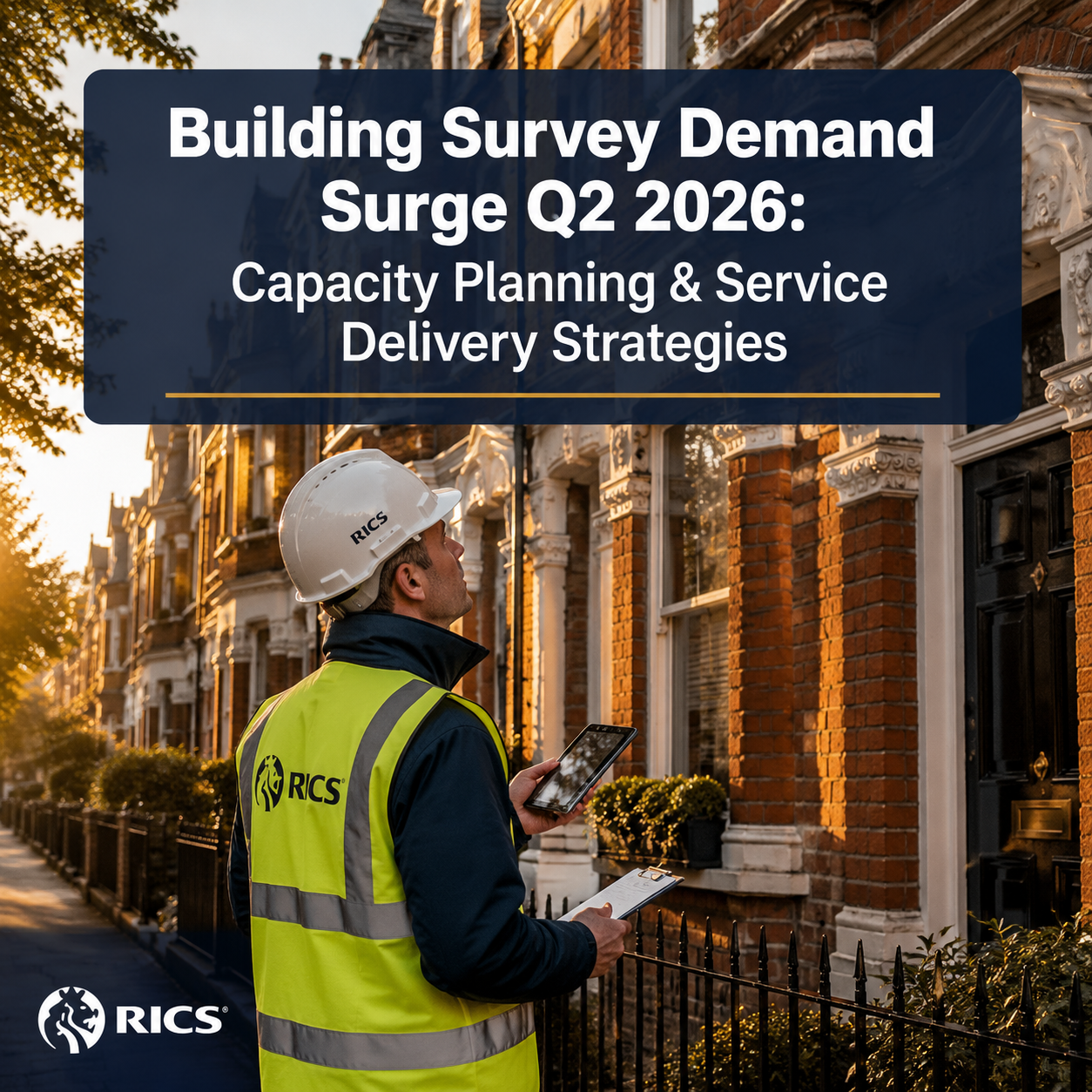

The RICS Residential Market Survey recorded a +35% net balance of optimism among surveyors for the 12-month sales outlook at the start of 2026 — the strongest forward confidence reading in over two years. Yet optimism alone does not pay salaries, clear backlogs, or protect professional standards. For surveying firms navigating the Building Survey Demand Surge in Q2 2026, the real challenge is not celebrating the upturn — it is being operationally ready for it.
This article breaks down the market signals, the regional divergences, and the practical strategies surveying practices need to plan capacity, protect quality, and grow sustainably through a recovering — but still fragile — market.
Key Takeaways 📌
- Demand is recovering unevenly — regional divergences mean some areas face acute capacity pressure while others remain subdued.
- Revenue growth is largely price-driven, not volume-driven, so firms must plan for margin management, not just headcount expansion.
- Staffing flexibility — using a blend of permanent staff, associates, and technology — is the most resilient capacity model.
- Quality control cannot be sacrificed to throughput; RICS compliance and client trust are long-term competitive advantages.
- Firms that invest now in systems, training, and regional coverage will capture disproportionate market share as transaction volumes rise.
Understanding the Market Signals Behind the Building Survey Demand Surge in Q2 2026
What the Data Actually Says
Before planning for a surge, it is essential to read the data honestly. The headline optimism is real — but so are the caveats.
The RICS January 2026 survey showed a net balance of +35% of respondents expecting higher sales volumes over the next 12 months. That is a meaningful shift from the negative or flat readings seen through much of 2024 and early 2025. However, several other data points urge caution:
- Builder confidence has declined sharply. The NAHB Housing Market Index fell to 34 in April 2026, with current sales conditions at 37 — down four points from prior months. Sales expectations for the next six months dropped seven points to 42, and prospective buyer traffic fell to just 22 [3].
- Price reductions remain widespread. 36% of builders cut prices in April 2026, with an average reduction of 5%, and 60% of builders used sales incentives for the 13th consecutive month [3].
- Order growth figures can be misleading. February 2026 showed +7% order growth — but February 2025 was the weakest month of that year (down 8%), making the comparison unusually favourable and overstating actual momentum [1].
- Overall building spending is projected to grow just 1.0% in 2026, with the AIA Consensus Construction Forecast noting these figures are not adjusted for inflation [5].
💡 Pull Quote: "A +35% optimism reading is a green light to prepare — not a guarantee of volume. Firms that confuse sentiment with certainty will be caught either overstaffed or overwhelmed."
Where Growth Is Real — and Where It Is Not
The sectoral picture is sharply divided:
| Sector | 2026 Spending Forecast | Notes |
|---|---|---|
| Commercial facilities | +3.0% | Strongest performing traditional sector [5] |
| Residential (custom) | Improving | 54% of dealers report accelerating orders [1] |
| Manufacturing | -3.9% | Second consecutive year of decline [5] |
| Retail & Warehouse | ~0% | Near-zero growth after pandemic boom [5] |
| Data centres / AI | +53% CapEx | Hyperscaler spending surged to $651bn [7] |
For building surveyors in the UK, the most relevant signals are in the residential and commercial sectors. Custom homebuilder demand has reached its highest level since mid-2024, buoyed by improved weather conditions and temporary mortgage rate dips [1]. This directly translates to increased demand for building surveyor services, particularly full building surveys, structural assessments, and pre-purchase inspections.
Regional Divergences: The UK Picture
The RICS data reveals significant regional variation that must shape any capacity planning strategy. London and the South East continue to show the strongest transaction activity, driven by:
- Pent-up buyer demand following two years of subdued activity
- Remortgaging and lease extension activity in urban areas
- Commercial-to-residential conversion projects accelerating post-pandemic
Firms operating across chartered surveyors in Surrey, West London, and Berkshire are reporting some of the sharpest upticks in instruction volumes. Meanwhile, more peripheral markets are recovering more slowly, meaning a one-size-fits-all capacity plan will not serve multi-region practices well.
Capacity Planning Strategies for the Building Survey Demand Surge in Q2 2026
Building a Flexible Staffing Model
The single biggest risk during a demand surge is binary thinking — either hiring aggressively and locking in fixed costs, or refusing to scale and losing market share. The most resilient surveying firms in 2026 are using a three-tier staffing model:
Tier 1 — Core Permanent Team
These are the RICS-chartered surveyors who carry the firm's professional reputation. They handle complex instructions, sign off reports, and maintain client relationships. This tier should be stable and well-supported.
Tier 2 — Associate and Consultant Network
A pre-vetted pool of experienced associates who can be activated quickly during peak periods. These individuals work on a fee-share or day-rate basis and should be briefed on the firm's quality standards before any surge begins.
Tier 3 — Technology and Automation
Tools that reduce administrative burden — digital report templates, automated scheduling, drone survey capabilities, and client communication platforms — effectively extend the capacity of every chartered surveyor without adding headcount.
Demand Forecasting: Moving Beyond Gut Feel
Firms that rely on intuition to predict demand will always be reactive. In 2026, the most competitive practices are using structured forecasting models built on:
- Transaction data feeds from Rightmove, Zoopla, and Land Registry (monthly completions by postcode)
- RICS survey sentiment data — the +35% optimism reading should be tracked quarterly and compared to actual instruction volumes
- Mortgage approval data from the Bank of England — a leading indicator of survey demand with a 6–8 week lag
- Seasonal adjustment — Q2 historically shows a 15–25% uplift in residential survey instructions versus Q1
A simple rolling 13-week instruction forecast, reviewed weekly, gives practice managers enough visibility to activate Tier 2 associates before the backlog builds — not after.
Scheduling and Turnaround Time Management ⏱️
During a surge, turnaround time is the primary competitive differentiator. Buyers under offer cannot wait three weeks for a survey report. Firms should set and communicate clear service level agreements:
- Standard building survey: 10 working days from inspection to report
- Homebuyer report: 7 working days
- Urgent pre-exchange instructions: 3–5 working days (premium fee applies)
Clients choosing between a homebuyer report vs building survey need clear guidance on both cost and timing — and firms that provide this upfront reduce drop-off rates significantly.
Geographic Coverage Expansion
One of the most effective capacity strategies is geographic reach. Rather than turning away instructions from slightly outside the core area, firms can:
- Partner with local associates in adjacent areas
- Use drone roof surveys to reduce on-site time for certain property types
- Leverage digital report delivery to serve clients across a wider geography without proportional overhead increases
Practices already covering central London, North West London, and South West London are well-positioned to absorb cross-borough demand spikes by coordinating surveyor deployment across zones rather than by fixed postcode.
Pricing Strategy During a Surge
The JBREC data confirms that revenue growth in 2026 is primarily price-driven, not volume-driven [1]. This is a critical insight for surveying firms. Rather than competing on price during a surge — which erodes margins and attracts the wrong clients — the strategic move is to:
- Hold or modestly increase fees in line with demand
- Introduce tiered service options (standard, priority, and premium)
- Communicate value clearly — a £600 building survey that prevents a £30,000 structural repair bill is not an expense; it is risk management
Service Delivery and Quality Control: Maintaining Standards During the Building Survey Demand Surge in Q2 2026
Why Quality Cannot Be Traded for Speed
The temptation during high-demand periods is to cut corners — shorter site visits, thinner reports, less thorough checking. This is the fastest route to professional indemnity claims, RICS complaints, and reputational damage that outlasts any market upturn.
The Building Survey Demand Surge in Q2 2026 will reward firms that maintain rigorous standards, because:
- Buyers are more cautious — after years of market uncertainty, clients want comprehensive, reliable information
- Lender requirements are tightening — mortgage lenders are increasingly scrutinising survey quality for high-value properties
- RICS compliance is non-negotiable — the regulator has signalled increased focus on report quality and professional standards
Quality Control Systems for High-Volume Periods
Every surveying firm handling increased volumes in 2026 should have the following in place:
1. Peer Review Protocol
All Level 3 building surveys should be reviewed by a second chartered surveyor before dispatch. For Level 2 homebuyer reports, a senior surveyor should spot-check at least 20% of reports monthly.
2. Standardised Report Templates
RICS-compliant templates reduce the risk of omissions and ensure consistency across the team. They also speed up report production without reducing thoroughness.
3. Client Communication Checkpoints
Proactive updates at three stages — booking confirmation, post-inspection, and report dispatch — reduce client anxiety and complaints.
4. Post-Instruction Feedback Loop
A brief client satisfaction survey after each instruction provides early warning of quality issues before they escalate.
Specialist Survey Demand: A Growing Sub-Market 🔍
Within the broader surge, certain specialist survey types are seeing above-average demand growth:
- Structural surveys for older and period properties — buyers of Victorian and Edwardian homes are increasingly requesting full structural surveys rather than basic homebuyer reports
- Subsidence surveys — climate-related soil movement is driving demand for subsidence surveys in clay-heavy areas across London and the South East
- Schedule of condition reports — particularly for commercial leases and party wall matters; understanding what a schedule of condition report involves is increasingly important for landlords and tenants alike
- Party wall matters — construction activity linked to extensions and loft conversions is generating significant party wall surveyor instructions across urban areas
Firms that have specialists in these areas — or can bring them in quickly — will capture a higher-value segment of the surge.
Technology as a Quality Enabler
Technology in 2026 is not a replacement for professional judgement — it is an amplifier of it. Key tools that support quality delivery at scale include:
| Technology | Application | Benefit |
|---|---|---|
| Drone roof surveys | Roof inspections without scaffold | Faster, safer, more detailed imagery |
| Thermal imaging | Damp and insulation assessment | Objective evidence in reports |
| Digital dictation + AI transcription | Report drafting | Reduces admin time by 30–40% |
| CRM with automated scheduling | Client management | Fewer missed appointments, better communication |
| Cloud-based report platforms | Delivery and storage | Instant client access, audit trail |
Managing Client Expectations Proactively
During high-demand periods, managing expectations is as important as managing workload. Clients who understand what a survey will and will not cover — and who receive their report within the promised timeframe — are far less likely to complain, regardless of the findings.
Firms should update their website and client-facing materials to clearly explain what survey type is needed for different property types and purchase situations. This reduces pre-instruction queries, speeds up the booking process, and sets the right expectations from day one.
Conclusion: Turning Market Optimism Into Operational Advantage
The Building Survey Demand Surge in Q2 2026 represents a genuine opportunity — but only for firms that have done the groundwork. The RICS +35% optimism reading is a signal to act, not a guarantee of easy growth. The broader market data tells a more nuanced story: price-driven revenue, uneven regional recovery, and persistent uncertainty in builder confidence [1][3][5].
Surveying practices that will thrive through this period share three characteristics: operational flexibility (the ability to scale capacity up and down without crisis), quality discipline (systems that protect standards even when volumes spike), and strategic positioning (the right service mix, geographic coverage, and pricing to capture high-value instructions).
Actionable Next Steps for Surveying Firms 🚀
- Audit current capacity now — map your team's maximum sustainable output and identify the gap between that and projected Q2 demand.
- Build your associate network before you need it — pre-vet and brief at least three associates who can be activated within two weeks.
- Implement a 13-week rolling demand forecast using transaction data and mortgage approval statistics.
- Review and update your report templates to ensure RICS compliance and consistency across all team members.
- Expand your service offering into high-demand specialist areas — structural surveys, subsidence assessments, and party wall matters.
- Communicate your capacity and turnaround times clearly on your website and in all client-facing materials.
- Invest in at least one technology upgrade — drone surveys, digital dictation, or a CRM platform — to extend the capacity of every chartered surveyor on your team.
The market is recovering. The question is not whether demand will come — it is whether your practice will be ready to serve it well.
References
[1] Building Product Orders Pricing Surge 2026 – https://jbrec.com/insights/building-product-orders-pricing-surge-2026/
[2] Survey Reveals Demand Uncertainty Is Changing 2026 Homebuilding Strategy – https://www.housingwire.com/articles/survey-reveals-demand-uncertainty-is-changing-2026-homebuilding-strategy/
[3] Housing Market Index – https://www.nahb.org/news-and-economics/housing-economics/indices/housing-market-index
[5] January 2026 – https://www.aia.org/resource-center/consensus-construction-forecast/january-2026
[7] Sector Market Perspectives Q2 2026 – https://www.ssga.com/us/en/individual/insights/sector-market-perspectives-q2-2026