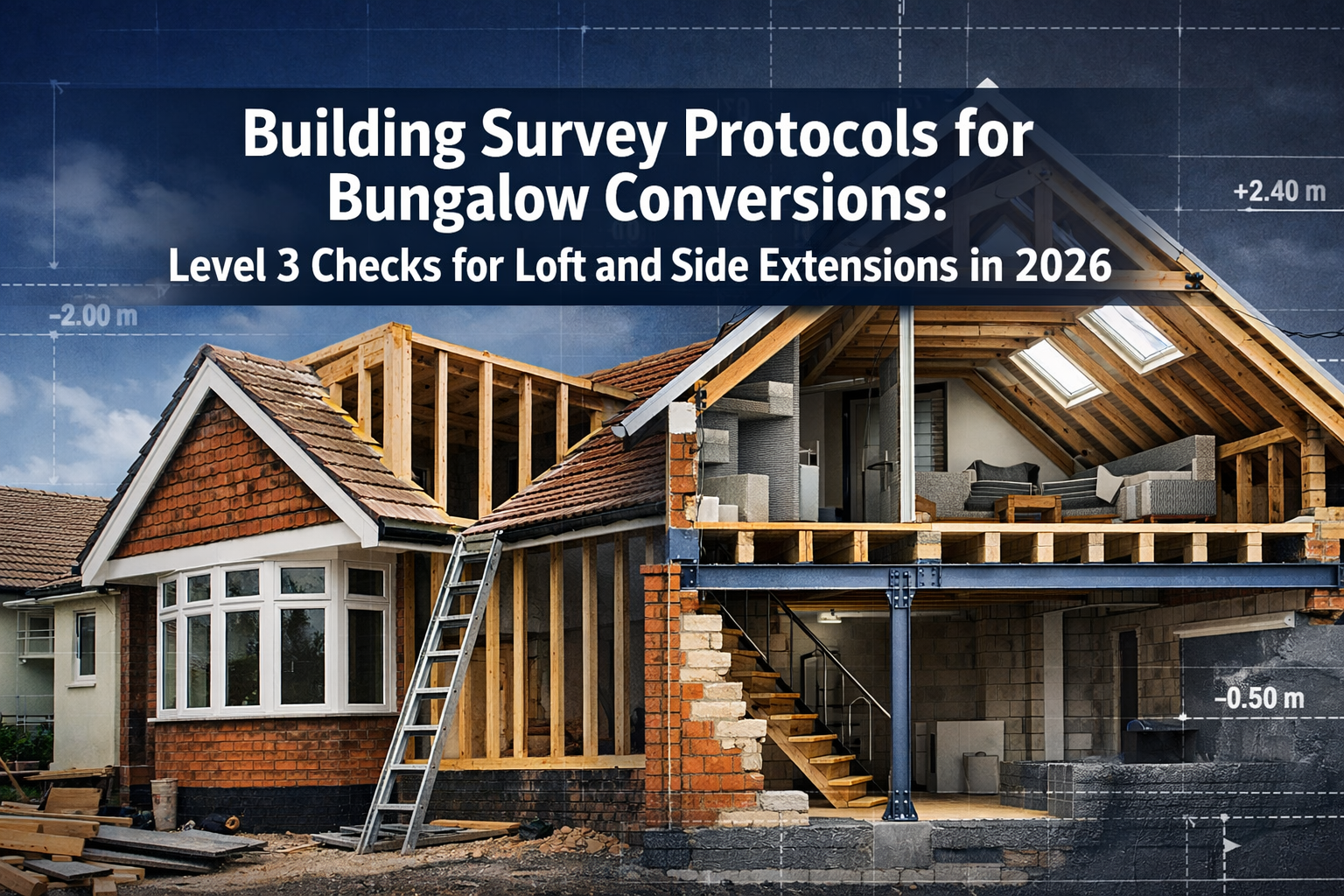
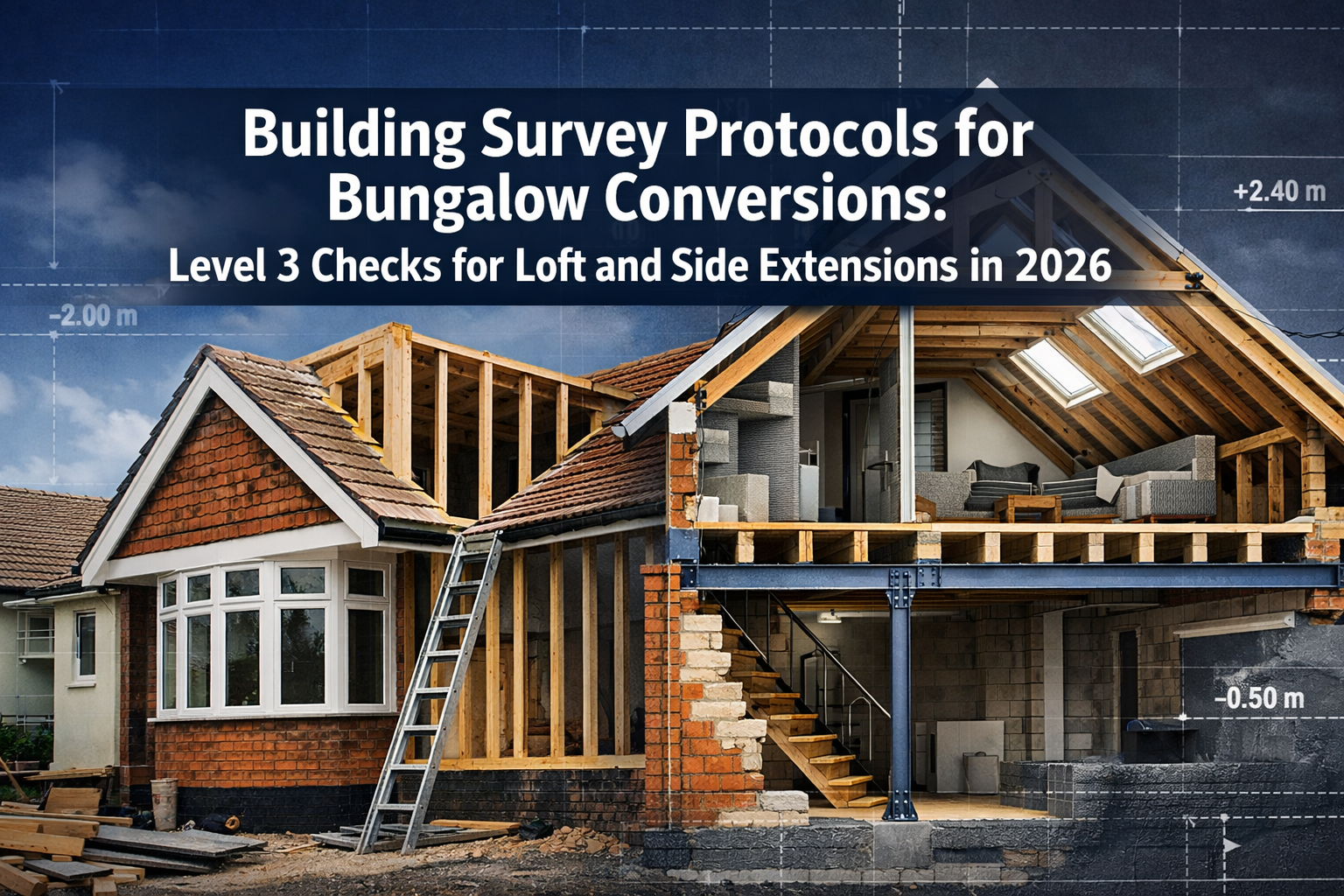
Bungalow conversions represent one of the fastest-growing segments of UK property development in 2026, with over 42% of single-storey homeowners now considering upward or outward expansion to maximize living space without relocating. Yet behind this renovation boom lies a critical challenge: standard property surveys often miss the unique structural vulnerabilities that make bungalows particularly susceptible to conversion-related failures. Building Survey Protocols for Bungalow Conversions: Level 3 Checks for Loft and Side Extensions in 2026 have evolved to address these specific risks, providing homeowners and developers with comprehensive structural assessments tailored to the distinct engineering demands of single-storey dwellings undergoing transformation.
Unlike traditional two-storey homes, bungalows typically feature different roof construction methods, foundation designs, and load distribution systems that require specialized inspection protocols. A Level 3 Building Survey—the most detailed property examination available under RICS standards—becomes essential when assessing conversion feasibility, as it identifies structural limitations, planning compliance issues, and hidden defects that could derail renovation projects or compromise safety.
Key Takeaways
- Level 3 surveys for bungalow conversions cost £600–£1,500+ and provide 20–30+ page reports detailing structural capacity, defects, and conversion feasibility[1][2]
- Roof spread, inadequate bracing, and foundation capacity represent the three most critical structural concerns in bungalow loft conversions
- Permitted development rights have specific limitations for bungalow extensions, including 2.5m height restrictions for side additions and 4m rear extensions
- RICS-accredited surveyors assess accessible loft spaces, roof structures, and extension points but do not perform invasive testing unless specifically commissioned[2]
- Early structural surveys prevent costly planning rejections and identify remedial work requirements before conversion projects commence
Understanding Level 3 Building Surveys for Bungalow Conversions
A Level 3 Building Survey—formerly known as a Full Structural Survey—represents the most comprehensive property inspection available under RICS Home Survey Standards. For bungalows targeted for conversion, this detailed examination becomes particularly valuable because it evaluates structural integrity, construction quality, and defect severity across all accessible areas[2].
What Makes Bungalow Conversions Different?
Bungalows present unique surveying challenges compared to multi-storey properties:
🏠 Single-storey load distribution: All structural loads transfer directly to foundations without intermediate floor support systems
📐 Roof construction variations: Many bungalows feature trussed rafter roofs (1960s onwards) or traditional cut timber roofs (pre-1960s), each with different conversion implications
⚖️ Foundation capacity limitations: Original foundations may not accommodate additional storey loads without reinforcement
🔧 Wall plate integrity: Horizontal timber members supporting roof structures often show deterioration in older bungalows
The Level 3 survey protocol addresses these specific concerns through targeted inspection sequences that evaluate conversion feasibility alongside general property condition. According to industry standards, these surveys typically cost between £600 and £1,500+ depending on property size and complexity[1][2].
Core Components of Level 3 Surveys
A comprehensive Level 3 Building Survey for bungalow conversions includes:
| Survey Element | Inspection Focus | Conversion Relevance |
|---|---|---|
| Roof Structure | Timber condition, bracing adequacy, roof spread indicators | Critical for loft conversion structural capacity |
| Wall Construction | Load-bearing capacity, cavity wall condition, damp penetration | Determines side extension attachment points |
| Foundations | Settlement evidence, subsidence indicators, capacity assessment | Essential for additional storey load calculations |
| Ceiling Joists | Size, spacing, condition, load-bearing capacity | Directly impacts loft conversion floor structure |
| External Walls | Verticality, cracking patterns, tie integrity | Affects extension bonding and structural stability |
These surveys produce detailed reports running 20–30+ pages with photographic evidence, repair recommendations, and maintenance guidance[2]. However, they do not include invasive investigations, service testing, or detailed cost estimates unless specifically commissioned as additional services[2].
For properties showing signs of structural movement, a subsidence survey may be recommended as a follow-up investigation to assess foundation stability before proceeding with conversion plans.
Building Survey Protocols for Bungalow Conversions: Level 3 Checks for Loft Extensions in 2026
Loft conversions represent the most popular bungalow transformation, potentially adding 30–50% more living space and significant property value. However, successful loft conversions depend on rigorous structural assessment protocols that identify both opportunities and limitations.
Critical Structural Checks for Loft Conversion Feasibility
1. Roof Construction Assessment
The surveyor's primary task involves determining whether the existing roof structure can accommodate habitable space. This requires detailed examination of:
Trussed Rafter Roofs (common in post-1960s bungalows):
- Modern "W-shaped" trusses with internal web bracing create obstacles for conversion
- Structural modification requires complete truss replacement or steel frame installation
- Survey identifies truss type, spacing (typically 400-600mm centers), and modification feasibility
- Cost implications: truss replacement significantly increases conversion expenses
Traditional Cut Timber Roofs (pre-1960s construction):
- Purlin and rafter systems with more adaptable internal space
- Existing ceiling joists may require strengthening to function as floor joists
- Survey measures timber dimensions, spacing, and load-bearing capacity
- Checks for historic alterations that may have compromised structural integrity
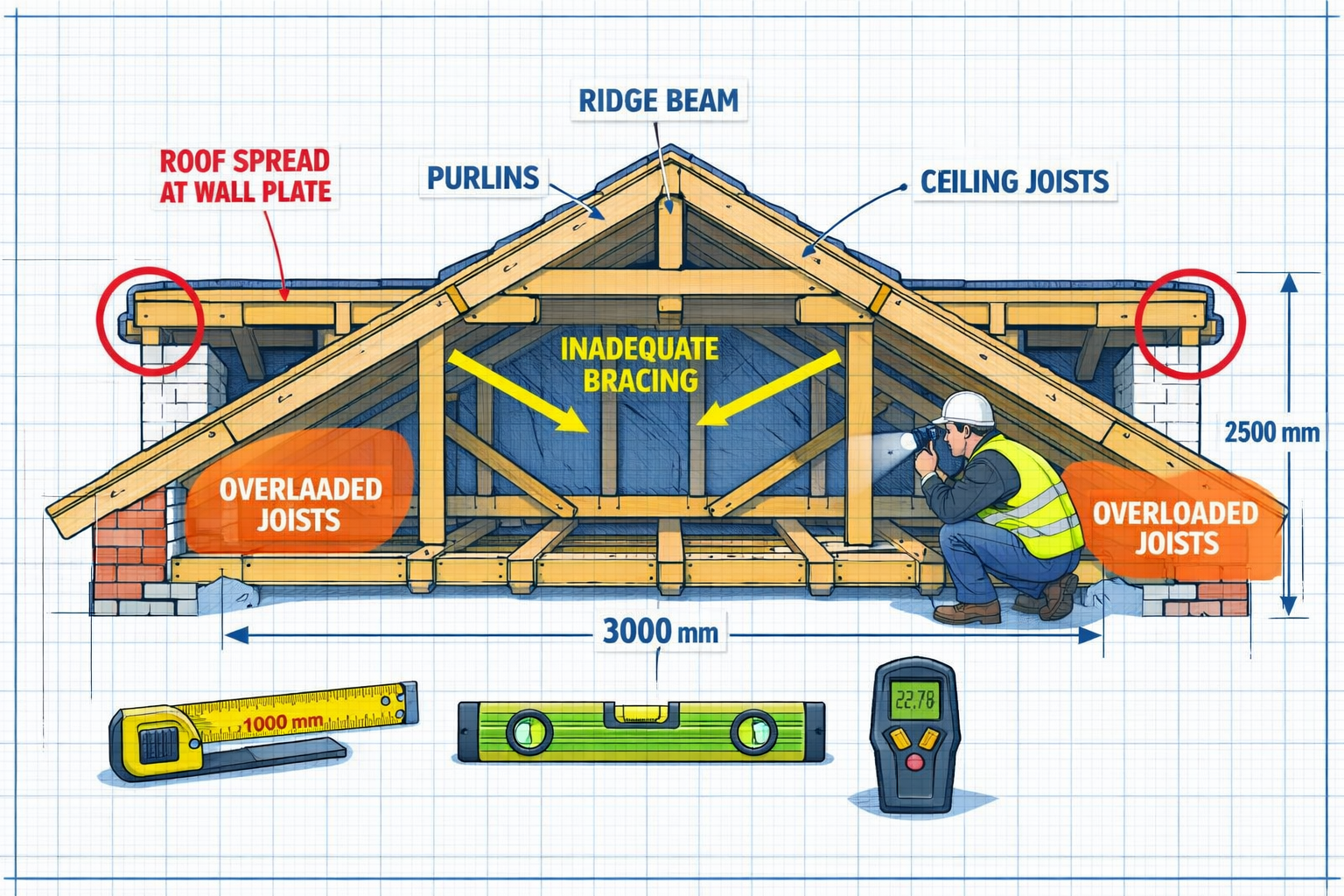
2. Roof Spread Detection
Roof spread represents one of the most critical defects in bungalow conversions—a condition where roof loads push external walls outward, creating structural instability. Level 3 surveys specifically look for:
⚠️ Outward bulging of external walls at eaves level
⚠️ Horizontal cracking along wall-to-roof junctions
⚠️ Separation between ceiling and walls
⚠️ Distorted roof profiles when viewed from ground level
⚠️ Inadequate or failed roof ties connecting opposite walls
Surveyors use spirit levels, plumb lines, and laser measuring devices to detect wall movement as subtle as 5-10mm. Any evidence of roof spread requires remedial work—typically steel tie installation or wall plate reinforcement—before loft conversion can proceed safely.
3. Ceiling Joist Capacity Evaluation
Original ceiling joists in bungalows were designed to support only ceiling weight (approximately 0.25 kN/m²), not floor loads required for habitable rooms (1.5 kN/m² for bedrooms, 2.0 kN/m² for living areas). The survey assesses:
- Joist dimensions: Typical ceiling joists measure 75mm x 50mm; floor joists require 150mm x 50mm minimum
- Joist spacing: Existing 600mm centers may need supplementary joists at 400mm centers
- Timber condition: Checks for woodworm, rot, or previous cutting for services
- Span distances: Longer spans require proportionally larger joists
The surveyor's report will indicate whether existing joists can be strengthened or require complete replacement—a determination that significantly impacts conversion costs and feasibility.
4. Head Height and Space Usability
Building Regulations require minimum 2.3m head height across 50% of usable floor area in loft conversions. The Level 3 survey measures:
- Ridge height from finished floor level
- Roof pitch angle (steeper pitches provide more usable space)
- Potential floor level after joist strengthening
- Dormer window requirements to achieve regulation compliance
Many 1950s-1970s bungalows feature shallow roof pitches (30-35°) that limit conversion potential without substantial dormer additions, which may trigger planning permission requirements beyond permitted development rights.
5. Access and Staircase Considerations
The survey identifies potential staircase locations by assessing:
- Available floor space in rooms below for staircase installation
- Structural implications of creating floor openings
- Building Regulation compliance for stair dimensions and headroom
- Impact on existing room layouts and circulation
For properties requiring party wall considerations, the survey notes proximity to shared boundaries and potential notification requirements under the Party Wall Act.
Thermal and Moisture Considerations
Modern loft conversions must meet stringent thermal efficiency standards. The Level 3 survey evaluates:
🌡️ Existing insulation: Identifies current insulation type and thickness
💧 Ventilation adequacy: Assesses roof space ventilation to prevent condensation
🔍 Damp evidence: Checks for water ingress, condensation staining, or roof covering defects
🌬️ Breathability: Evaluates whether roof construction allows vapor permeability
These factors influence conversion design, particularly insulation strategies that maintain thermal performance while preventing interstitial condensation—a common failure mode in poorly designed loft conversions.
Building Survey Protocols for Bungalow Conversions: Level 3 Checks for Side Extensions in 2026
Side extensions offer an alternative conversion strategy, providing ground-floor space expansion without the structural complexities of loft conversions. However, they introduce different technical challenges that require specific Level 3 survey protocols.
Permitted Development Assessment
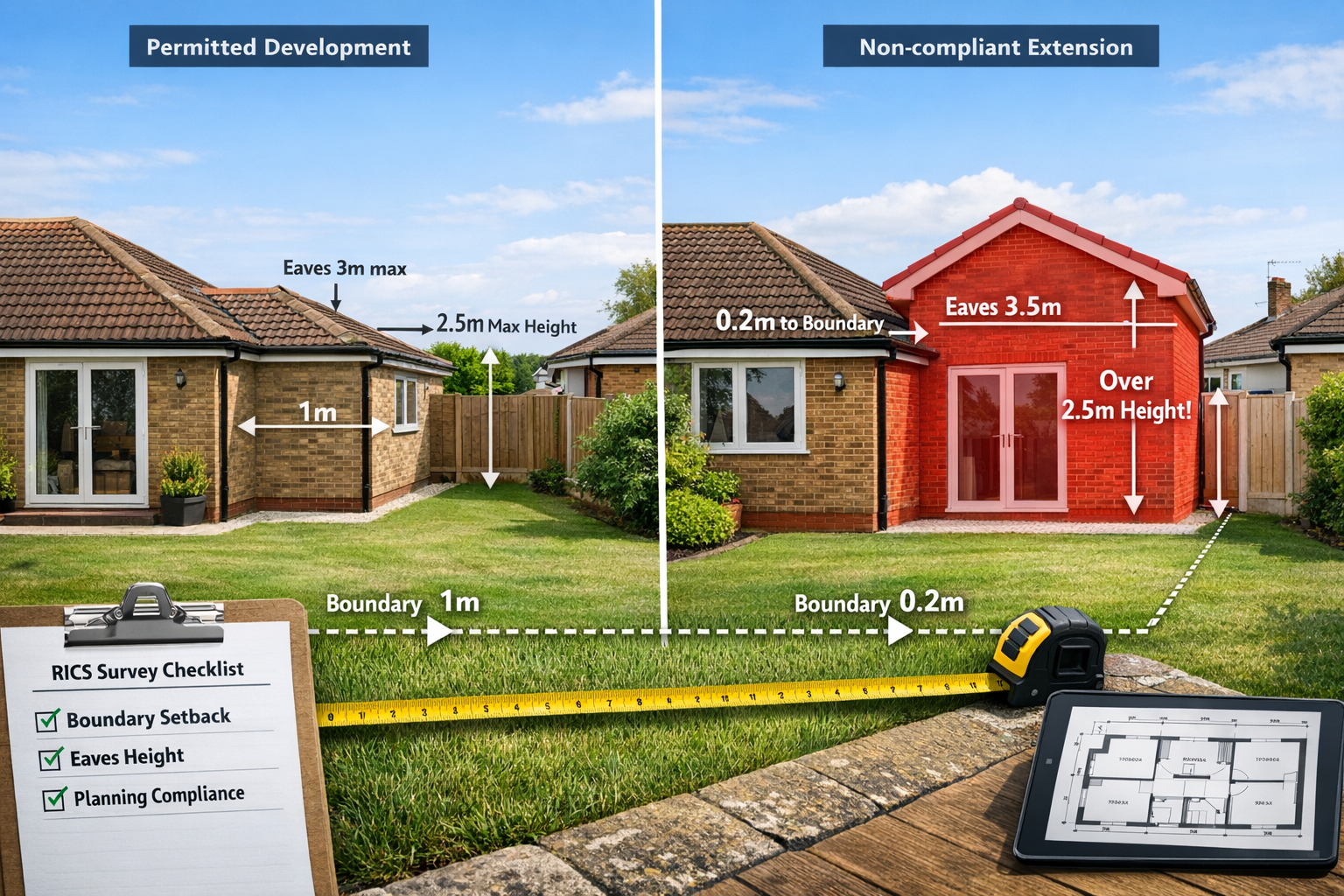
Understanding permitted development rights forms a crucial component of side extension surveys in 2026. The surveyor evaluates compliance with key limitations:
Height Restrictions:
- Single-storey side extensions limited to maximum 4m height
- Eaves height restricted to 2.5m maximum
- Ridge height must not exceed existing bungalow ridge
Boundary Setbacks:
- Extensions within 2m of boundary require specific design considerations
- Eaves must be positioned to avoid water discharge onto neighboring property
- Survey measures exact distances to establish compliance margins
Width Limitations:
- Side extensions must not exceed half the width of the original dwelling
- "Original dwelling" refers to property as first built or as it stood on 1 July 1948
- Previous extensions count toward total width calculations
The Level 3 survey documents these measurements precisely, providing evidence for planning decisions and identifying whether proposed extensions fall within permitted development or require full planning permission.
Foundation and Ground Condition Assessment
Side extensions require adequate foundations that match or exceed the original bungalow's foundation depth and design. The survey investigates:
Foundation Exposure Points
Where possible, surveyors examine:
- Existing foundation depth at air brick locations or exposed areas
- Foundation type (strip, trench fill, or raft)
- Ground conditions through visual assessment and historical records
- Drainage proximity that may affect foundation design
For properties on clay soils or with subsidence history, deeper foundations with appropriate reinforcement may be necessary.
Ground Level and Damp Course Alignment
Critical measurements include:
📏 Damp proof course (DPC) levels: New extension DPC must align with existing bungalow DPC
📏 Ground levels: Survey identifies any ground level changes that affect foundation design
📏 Drainage falls: Ensures proper water runoff away from both existing and new structures
📏 Service locations: Maps underground services that may constrain foundation placement
Wall Tie and Bonding Assessment
Successful side extensions require proper structural connection to the existing bungalow. The Level 3 survey evaluates:
Existing Wall Construction:
- Solid brick (pre-1930s): Direct bonding possible with appropriate toothing
- Cavity wall (post-1930s): Requires mechanical ties and proper cavity closure details
- Rendered or clad walls: Survey identifies underlying construction for connection planning
Wall Condition at Junction Points:
- Verticality and plumb of existing walls
- Presence of cracks or structural movement
- Quality of existing masonry and mortar
- Previous alterations that may complicate bonding
Poor wall condition at connection points may require remedial work before extension construction, adding costs and complexity to the project.
Roof Junction and Weather Protection
Where side extensions meet existing roofs, proper weatherproofing becomes critical. The survey examines:
🏗️ Roof covering condition: Identifies tile/slate condition at proposed junction areas
🏗️ Flashing requirements: Determines extent of lead flashing needed for weather protection
🏗️ Gutter and drainage: Assesses existing rainwater disposal and modification requirements
🏗️ Soffit and fascia condition: Checks for rot or deterioration requiring replacement
The surveyor also evaluates whether the existing roof structure can accommodate valley gutters or other junction details without modification.
Window and Opening Considerations
Side extensions often affect existing windows and create new openings. The Level 3 survey documents:
- Existing window positions that may require relocation or blocking
- Structural implications of creating new openings in existing walls
- Lintel requirements for doorways connecting extension to main dwelling
- Light and ventilation compliance with Building Regulations
For extensions near boundaries, the survey notes any windows facing neighboring properties that may trigger planning restrictions on glazing types and opening mechanisms.
Common Defects Identified in Bungalow Conversion Surveys
Level 3 surveys for bungalow conversions consistently identify recurring defects that impact conversion feasibility and costs. Understanding these common issues helps property owners anticipate challenges and budget appropriately.
Structural Movement and Settlement
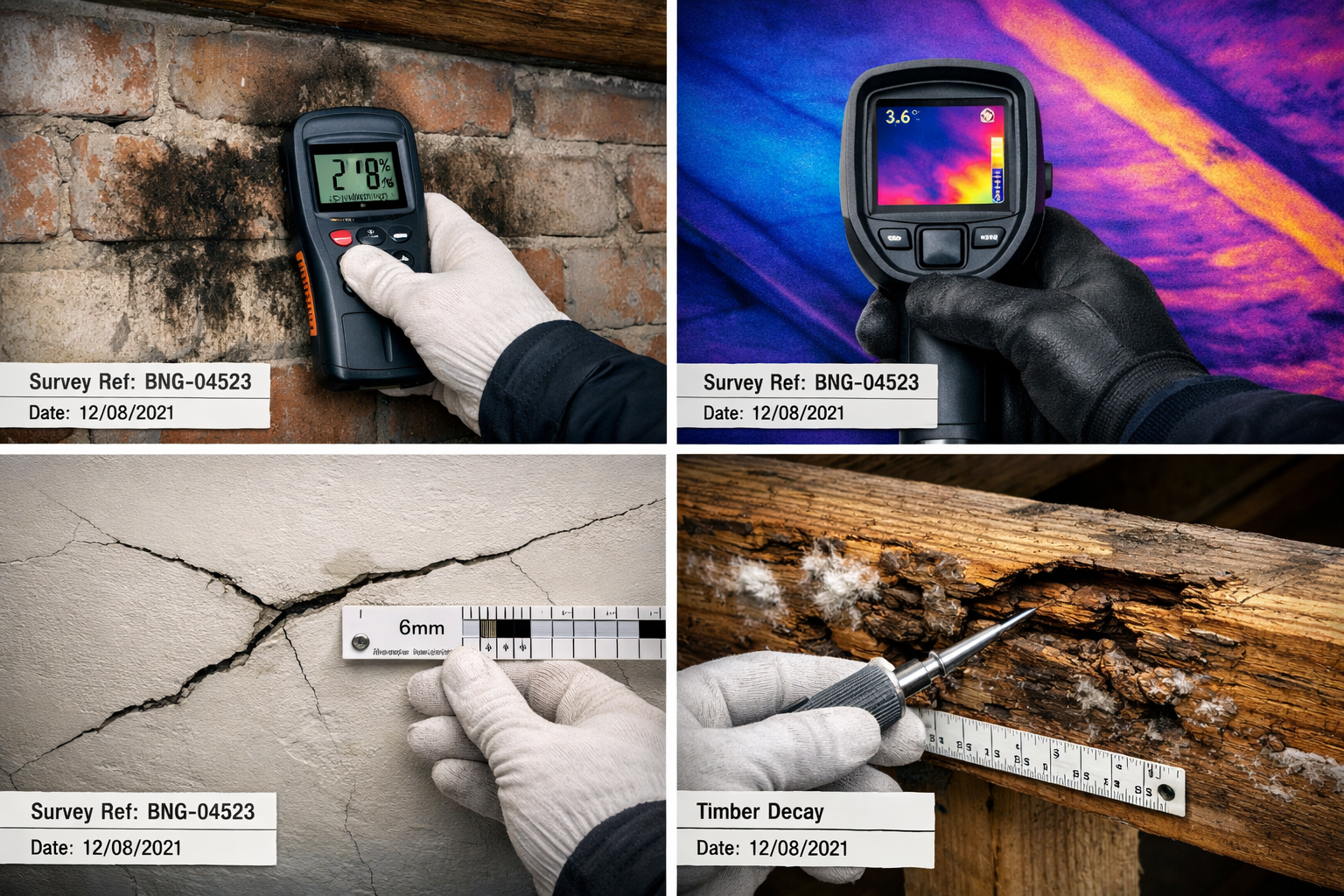
Differential settlement occurs frequently in bungalows, particularly those built on clay soils or with shallow foundations. Survey indicators include:
- Diagonal cracking in external walls (typically wider at top)
- Stepped cracking following mortar joints in brickwork
- Doors and windows binding or showing gaps
- Sloping floors or uneven ceiling lines
- Separation between extensions and main structure
Conversion projects must address existing movement before proceeding, often requiring structural engineering input to design appropriate underpinning or stabilization measures.
Timber Decay and Infestation
Roof timbers and floor joists in older bungalows frequently show:
🐛 Woodworm infestation: Active or historic beetle attack requiring treatment
🍄 Wet rot: Timber decay from prolonged moisture exposure
🍄 Dry rot: Serious fungal attack requiring extensive remedial work
💧 Water damage: Staining and deterioration from roof leaks
The survey identifies affected areas and recommends specialist timber treatment before conversion work begins. Severely compromised timbers require replacement, potentially affecting conversion structural design.
Inadequate Roof Bracing
Many bungalows, particularly those built between 1950-1980, lack adequate roof bracing to resist wind loads and prevent roof spread. The survey identifies:
- Missing or inadequate lateral restraint straps connecting roof to walls
- Insufficient diagonal bracing in roof plane
- Weak or deteriorated wall plates requiring reinforcement
- Inadequate purlin support causing roof sag
Conversion projects provide opportunities to upgrade roof bracing to current standards, improving overall structural stability.
Damp Penetration and Condensation
Moisture-related defects represent the most common issues in bungalow surveys:
💧 Rising damp: Failed or absent DPC causing ground moisture ingress
💧 Penetrating damp: Water ingress through walls, particularly at chimney junctions
💧 Condensation: Poor ventilation leading to mold growth and timber decay
💧 Roof leaks: Deteriorated coverings, flashings, or valley gutters
Conversion projects must resolve existing damp issues before creating habitable spaces, particularly in loft conversions where condensation risks increase significantly.
Inadequate Insulation and Thermal Performance
Older bungalows typically feature minimal insulation, creating challenges for conversion projects that must meet current Building Regulations:
- Roof insulation: Often limited to 50-100mm mineral wool (current standards require 270mm+)
- Wall insulation: Solid wall construction with no cavity insulation
- Floor insulation: Suspended timber floors with no underfloor insulation
- Thermal bridging: Uninsulated lintels, wall ties, and junction details
The survey documents existing thermal performance and identifies upgrade requirements to achieve compliance with Part L Building Regulations.
Engaging Professional Surveyors for Bungalow Conversion Projects
Selecting the right surveyor significantly impacts the quality and usefulness of conversion feasibility assessments. In 2026, homeowners should prioritize RICS-accredited surveyors with specific experience in bungalow conversions and structural assessments.
Qualifications and Expertise
Look for surveyors who hold:
✅ RICS membership (MRICS or FRICS designation)
✅ Building surveying specialism rather than valuation focus
✅ Experience with conversion projects and permitted development assessments
✅ Local knowledge of planning authority requirements and common regional construction types
Many surveyors offer specialized services beyond standard Level 3 surveys, including specific defect reports that focus exclusively on conversion-related structural concerns.
Survey Scope and Additional Services
When commissioning a Level 3 survey for conversion purposes, clearly specify:
📋 Conversion intentions: Loft, side, or rear extension plans
📋 Permitted development assessment: Request specific evaluation of PD compliance
📋 Structural capacity focus: Emphasize load-bearing assessments relevant to conversion
📋 Photographic documentation: Request detailed images of critical structural elements
Additional services that complement Level 3 surveys include:
- Structural engineering consultations: Detailed load calculations and beam sizing
- Drone roof surveys: Comprehensive roof condition assessment without scaffolding
- Party wall surveys: For conversions affecting shared boundaries
- Thermal imaging: Identifies insulation deficiencies and moisture patterns
Understanding Survey Limitations
Level 3 surveys, while comprehensive, have defined boundaries:
⚠️ Non-invasive inspection: Surveyors examine only accessible areas without removing fixtures or finishes[2]
⚠️ No service testing: Electrical, plumbing, and heating systems receive visual assessment only[2]
⚠️ No cost estimates: Surveys identify defects but don't typically provide repair costs[2]
⚠️ No planning advice: Surveyors assess physical condition, not planning compliance details
For detailed cost planning, engage quantity surveyors or contractors after receiving the Level 3 survey report. Planning consultants can provide specific guidance on permitted development boundaries and planning application requirements.
Regional Considerations
Survey requirements and construction practices vary across UK regions. Surveyors familiar with local conditions provide more accurate assessments:
- London and Southeast: Higher property values justify more detailed investigations; clay soil subsidence common
- Coastal areas: Salt exposure and wind loading require specific attention
- Historic areas: Conservation area restrictions affect conversion options
- Flood risk zones: Foundation and DPC requirements more stringent
Engaging local chartered surveyors ensures familiarity with regional construction methods, common defects, and local authority requirements.
Planning and Building Regulation Implications
While Level 3 surveys focus on structural condition rather than planning compliance, understanding the regulatory framework helps property owners interpret survey findings in context of conversion feasibility.
Permitted Development Rights for Bungalows
As of 2026, bungalow conversions benefit from specific permitted development allowances:
Loft Conversions:
- Roof height increase limited to 40m³ additional volume (detached) or 50m³ (terraced/semi-detached)
- No extension beyond existing roof plane on principal elevation
- Materials must match existing dwelling
- No balconies or raised platforms
- Side-facing windows must be obscure-glazed
Side Extensions:
- Maximum 4m height and 2.5m eaves height
- Must not exceed half the width of original dwelling
- Cannot extend beyond principal elevation
- Materials should match existing dwelling
Rear Extensions:
- Single-storey extensions up to 4m depth (detached) or 3m (attached)
- Maximum 4m height and 3m eaves height
- No extension within 2m of boundary exceeding 3m height
Survey findings help determine whether proposed conversions fit within these parameters or require full planning applications.
Building Regulation Compliance
All bungalow conversions require Building Regulation approval, regardless of planning status. Key regulatory areas include:
🏗️ Structural stability (Part A): Load-bearing calculations for new floors and roof modifications
🔥 Fire safety (Part B): Escape routes, fire-resistant construction, smoke alarms
🌡️ Thermal efficiency (Part L): Insulation standards, air tightness, heating efficiency
🚪 Ventilation (Part F): Background and extract ventilation requirements
🪜 Staircase design (Part K): Dimensions, headroom, guarding requirements
The Level 3 survey identifies existing conditions that affect Building Regulation compliance, allowing early identification of upgrade requirements.
Party Wall Considerations
Conversions affecting shared boundaries or structures within 3m of neighboring properties trigger Party Wall Act requirements:
- Party Wall Notices: Required 2 months before work commences
- Schedule of Condition: Documents pre-work condition of neighboring properties
- Party Wall Awards: Formal agreements detailing work scope and dispute resolution
For loft conversions specifically, the party wall process for loft conversions ensures proper notification and protection of neighboring interests.
Cost Considerations and Return on Investment
Understanding the financial implications of bungalow conversions helps property owners make informed decisions based on Level 3 survey findings.
Survey Costs
Level 3 Building Surveys for bungalows typically cost:
- Small bungalows (2 bedrooms): £600–£900
- Medium bungalows (3 bedrooms): £800–£1,200
- Large bungalows (4+ bedrooms): £1,000–£1,500+
Additional factors affecting cost include:
💷 Property age and complexity
💷 Regional location and surveyor availability
💷 Urgency and turnaround time requirements
💷 Additional services (thermal imaging, drone surveys)
Compared to homebuyer reports, Level 3 surveys cost 50-100% more but provide significantly greater detail essential for conversion planning[1].
Conversion Project Costs
Survey findings directly impact conversion budgets:
Loft Conversion Costs (2026 estimates):
- Basic conversion (truss roof, no dormers): £25,000–£35,000
- Dormer conversion (single dormer): £35,000–£50,000
- Hip-to-gable conversion: £40,000–£55,000
- Full-width dormer: £50,000–£70,000+
Side Extension Costs:
- Basic single-storey extension: £1,200–£1,800 per m²
- High-specification extension: £1,800–£2,500 per m²
- Foundation upgrades: £3,000–£10,000 additional
Survey-identified defects add to these baseline costs:
⚠️ Roof spread remediation: £2,000–£5,000
⚠️ Joist strengthening: £3,000–£8,000
⚠️ Foundation underpinning: £10,000–£25,000 per corner
⚠️ Timber treatment: £1,500–£5,000
⚠️ Damp remediation: £2,000–£8,000
Value Addition
Successful bungalow conversions typically add:
📈 Loft conversions: 15-25% property value increase
📈 Side extensions: 10-20% property value increase
📈 Combined conversions: 25-35% property value increase
However, value addition depends heavily on:
- Local market conditions: Demand for larger properties in the area
- Quality of execution: Professional design and construction standards
- Planning compliance: Permitted development vs. retrospective planning issues
- Structural integrity: Properly addressed defects and building regulation compliance
The Level 3 survey provides essential information for accurate cost-benefit analysis, helping property owners decide whether conversion represents sound financial investment.
Conclusion
Building Survey Protocols for Bungalow Conversions: Level 3 Checks for Loft and Side Extensions in 2026 represent essential due diligence for property owners considering expansion projects. These comprehensive structural assessments identify critical issues—from roof spread and foundation capacity to timber decay and thermal performance—that directly impact conversion feasibility, costs, and safety.
The specialized nature of bungalow construction demands surveying expertise beyond standard property inspections. Single-storey load distribution, varied roof construction methods, and foundation limitations create unique challenges that require targeted assessment protocols. RICS Level 3 surveys provide the detailed structural analysis necessary to make informed conversion decisions, typically delivering 20-30+ page reports with photographic evidence and repair recommendations for £600-£1,500+[1][2].
Actionable Next Steps
For property owners considering bungalow conversions in 2026:
- Commission a Level 3 Building Survey from a RICS-accredited surveyor with conversion experience before finalizing conversion plans
- Specify conversion intentions clearly when briefing surveyors to ensure focused assessment of relevant structural elements
- Budget for defect remediation based on survey findings, typically adding 15-25% to baseline conversion costs
- Engage structural engineers for detailed load calculations and beam specifications following survey completion
- Verify permitted development compliance early to avoid planning complications and project delays
- Address party wall requirements proactively if conversions affect shared boundaries
- Obtain multiple contractor quotes using survey findings to ensure comprehensive scope coverage
The investment in professional surveying—though representing only 2-3% of typical conversion costs—provides invaluable protection against structural failures, planning issues, and budget overruns. By identifying problems before work commences, Level 3 surveys enable property owners to proceed with confidence or make informed decisions to abandon unfeasible projects.
As bungalow conversions continue growing in popularity throughout 2026, the role of comprehensive structural surveys becomes increasingly critical. Property owners who prioritize thorough assessment through Level 3 surveys position themselves for successful conversions that add lasting value while maintaining structural integrity and regulatory compliance.
References
[1] Level 2 Vs Level 3 Survey Complete Comparison Guide – https://www.surveymerchant.com/blog/level-2-vs-level-3-survey-complete-comparison-guide
[2] What Does A Level 3 Survey Include 2025 – https://surveymatch.co.uk/what-does-a-level-3-survey-include-2025/