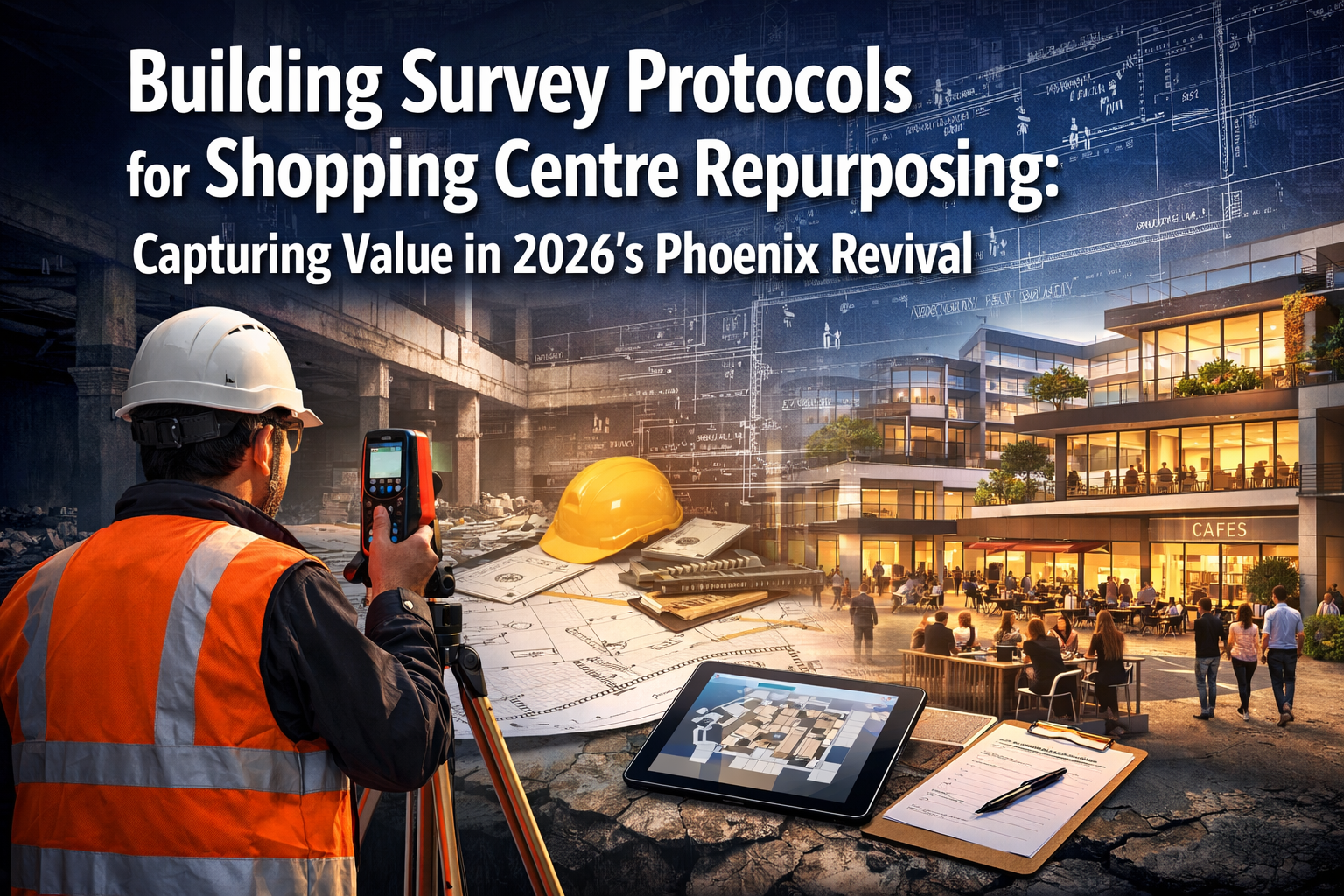
The landscape of commercial real estate is witnessing a remarkable transformation in 2026. While approximately 25% of industry professionals now recognize shopping centres as significantly undervalued assets, a strategic opportunity emerges for investors willing to implement rigorous Building Survey Protocols for Shopping Centre Repurposing: Capturing Value in 2026's Phoenix Revival. This phoenix-like resurrection of once-struggling retail spaces represents more than mere renovation—it demands comprehensive structural audits, meticulous compliance assessments, and strategic retrofit planning that can unlock extraordinary value.
As adaptive reuse establishes itself as a standalone asset class[1], the success of any shopping centre conversion hinges on thorough preliminary surveying. The difference between profitable transformation and costly failure often lies in the quality of initial building assessments.
Key Takeaways
- Comprehensive structural audits are essential for identifying hidden defects, load-bearing capacity, and retrofit feasibility before committing to shopping centre repurposing projects
- Building compliance assessments must address modern fire safety, accessibility, energy efficiency, and planning regulations that differ significantly from original retail specifications
- Strategic retrofit potential evaluation through detailed surveys can reveal opportunities that increase asset value by 30-50% when converting to mixed-use, healthcare, or distribution facilities
- Professional chartered surveyors provide critical risk mitigation through systematic inspection protocols that protect investor capital and ensure project viability
- Documentation standards established during initial surveys create the foundation for successful planning applications, contractor tendering, and long-term asset management
The Strategic Imperative: Understanding Building Survey Protocols for Shopping Centre Repurposing
Why Traditional Survey Approaches Fall Short
Shopping centres present unique surveying challenges that standard commercial building surveys must adapt to address. These sprawling structures—often exceeding 100,000 square feet—feature complex mechanical systems, multiple roof levels, extensive parking infrastructure, and structural configurations designed specifically for retail loading requirements.
Critical distinctions include:
- 🏗️ Structural complexity: Load-bearing walls designed for boutique retail may require significant reinforcement for residential or healthcare conversion
- ⚡ Electrical infrastructure: Legacy systems sized for retail lighting and HVAC often prove inadequate for residential or office applications
- 🚿 Plumbing capacity: Minimal restroom facilities in retail configurations require extensive upgrades for multi-residential or medical use
- 🔥 Fire safety compartmentation: Open-plan retail spaces demand comprehensive fire separation when converting to multiple occupancy types
The Phoenix Revival Opportunity in 2026
The shopping centre repurposing movement has gained remarkable momentum. According to recent research, 56 mixed-use mall redevelopment projects have been completed, with another 75 currently in development[1]. This surge reflects fundamental market recognition that the U.S. retail footprint must shrink, and adaptive reuse provides the solution[1].
However, successful conversions share one common denominator: thorough preliminary building surveys conducted by chartered surveyors who understand both the existing structure and the intended future use.
Comprehensive Structural Audit Protocols: The Foundation of Successful Repurposing
Phase 1: Initial Visual Inspection and Documentation
The first phase of Building Survey Protocols for Shopping Centre Repurposing: Capturing Value in 2026's Phoenix Revival begins with systematic visual assessment. This process differs significantly from standard residential surveys, requiring specialized expertise in commercial construction methods.
Essential inspection components include:
| Inspection Area | Key Assessment Points | Common Issues Identified |
|---|---|---|
| Structural Frame | Column integrity, beam deflection, foundation settlement | Concrete spalling, steel corrosion, differential settlement |
| Roof Systems | Membrane condition, drainage adequacy, structural deck | Water ingress, ponding, inadequate insulation |
| Building Envelope | Curtain wall seals, expansion joints, cladding attachment | Air leakage, thermal bridging, weather penetration |
| Floor Slabs | Load capacity, levelness, substrate condition | Cracking, inadequate reinforcement, surface deterioration |
| Parking Structures | Deck condition, waterproofing, structural soundness | Chloride contamination, delamination, drainage failure |
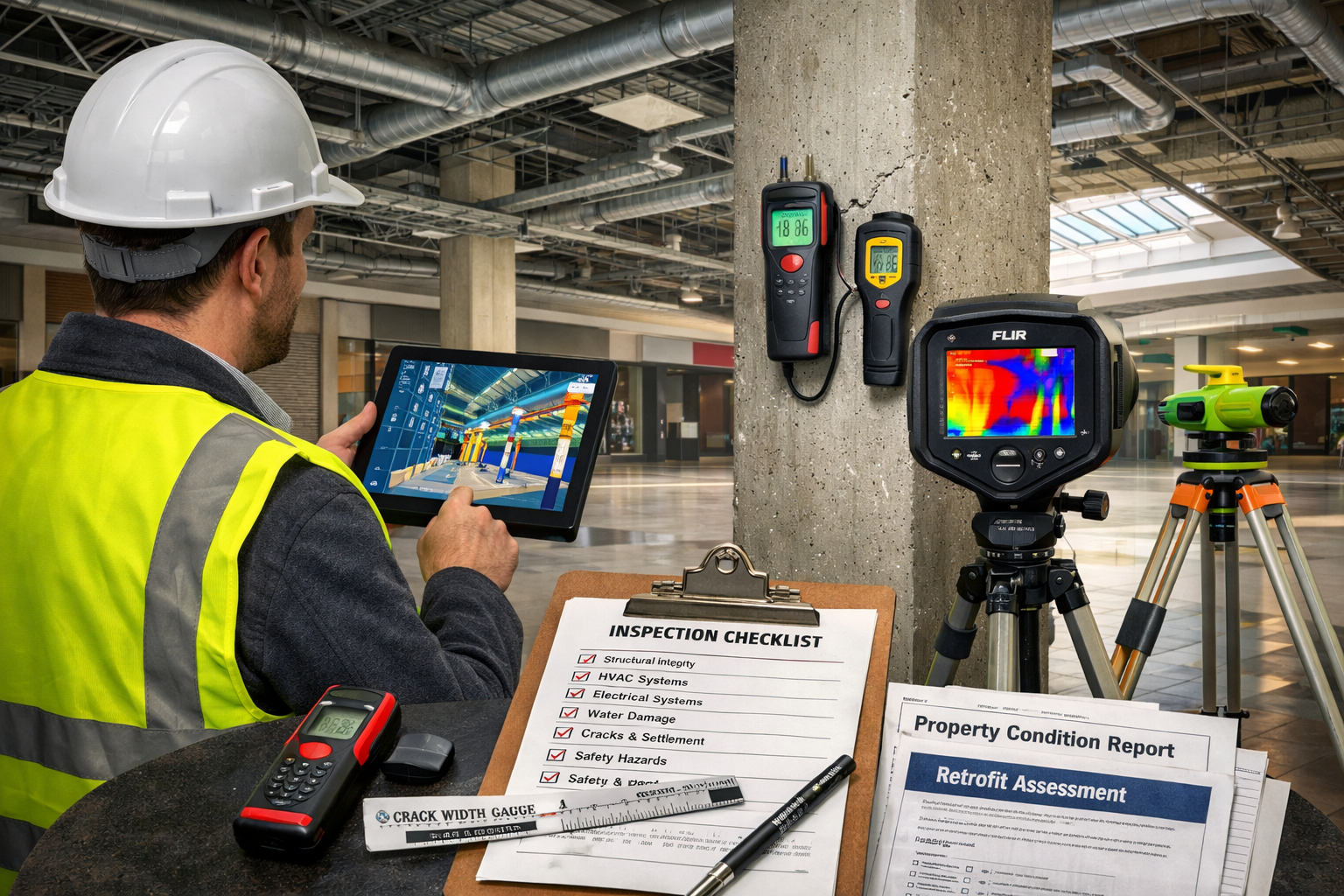
Professional surveyors utilize advanced diagnostic tools including thermal imaging cameras, moisture meters, concrete cover meters, and structural crack monitoring systems to capture data beyond visual observation.
Phase 2: Structural Load Capacity Analysis
Perhaps the most critical aspect of shopping centre repurposing involves determining whether existing structures can accommodate new uses. A building designed for retail loading (typically 50-75 pounds per square foot) may prove inadequate for residential occupancy (40 psf minimum) or healthcare facilities (80-100 psf for diagnostic equipment).
"The structural capacity assessment represents the single most important factor determining conversion feasibility. An inadequate survey at this stage can result in project costs escalating by 40-60% during construction." – Commercial Property Surveying Best Practices, 2026
Structural engineers working alongside surveyors must evaluate:
- Original design specifications and as-built drawings
- Current structural condition and material degradation
- Required loading for proposed new uses
- Feasibility and cost of structural reinforcement
- Foundation capacity for additional floors or weight
Phase 3: Building Services Infrastructure Assessment
Shopping centres typically feature centralized HVAC, electrical, and plumbing systems optimized for retail operations. Conversion to mixed-use developments requires comprehensive services evaluation to determine retrofit requirements.
Critical infrastructure surveys examine:
🔌 Electrical Systems
- Main service capacity and distribution
- Substation condition and upgrade potential
- Emergency power provisions
- Lighting infrastructure adaptability
💨 HVAC Systems
- Central plant capacity and efficiency
- Ductwork routing and condition
- Zoning capability for mixed-use applications
- Energy efficiency compliance with current standards
💧 Plumbing and Drainage
- Water supply capacity for increased demand
- Drainage system adequacy
- Hot water generation requirements
- Sprinkler system coverage and compliance
Building Compliance and Regulatory Assessment: Navigating 2026's Requirements
Modern Fire Safety Standards
Shopping centre conversions face stringent fire safety requirements that often exceed original building specifications. The transformation from single-use retail to mixed-use or residential occupancy triggers comprehensive Building Regulations compliance reviews.
Essential fire safety survey components:
- Compartmentation analysis: Identifying where fire-resistant barriers must be installed to separate different uses
- Means of escape evaluation: Ensuring adequate escape routes for new occupancy types, particularly residential units
- Fire detection and alarm systems: Assessing whether existing systems meet current standards or require complete replacement
- Sprinkler coverage: Determining if automatic suppression systems adequately protect all new areas
- Firefighting access: Evaluating whether emergency vehicle access meets current fire service requirements
Professional schedule of condition reports document existing fire safety provisions and identify necessary upgrades before conversion work begins.
Accessibility and Disabled Access Compliance
Modern accessibility standards demand comprehensive evaluation during shopping centre repurposing. While retail spaces typically provide ground-floor access, conversion to multi-story residential or office use introduces complex compliance requirements.
Accessibility survey protocols assess:
- Lift provision and capacity for vertical circulation
- Accessible parking allocation and proximity
- Level access routes throughout the development
- Accessible toilet facilities distribution
- Visual and tactile wayfinding provisions
- Refuge areas in case of emergency evacuation
Energy Efficiency and Environmental Performance
In 2026, building energy performance has become a critical value determinant. Shopping centres—often constructed during periods of minimal energy regulation—require substantial environmental upgrades to meet current standards and attract quality tenants.
Energy efficiency surveys evaluate:
- Building fabric thermal performance: U-values of walls, roofs, glazing, and floors
- Air tightness: Identifying and quantifying air leakage paths
- Heating and cooling efficiency: System age, fuel type, and performance metrics
- Renewable energy potential: Roof space for solar panels, ground source heat pump feasibility
- EPC rating improvement pathway: Strategies to achieve minimum energy performance standards
"Retail spaces are being adapted into medical centers due to strategic advantages including ample parking, proximity to population centers, and flexible interiors."[4]
Retrofit Potential Evaluation: Unlocking Hidden Value Through Strategic Survey Protocols
Identifying Conversion Opportunities Through Detailed Assessment
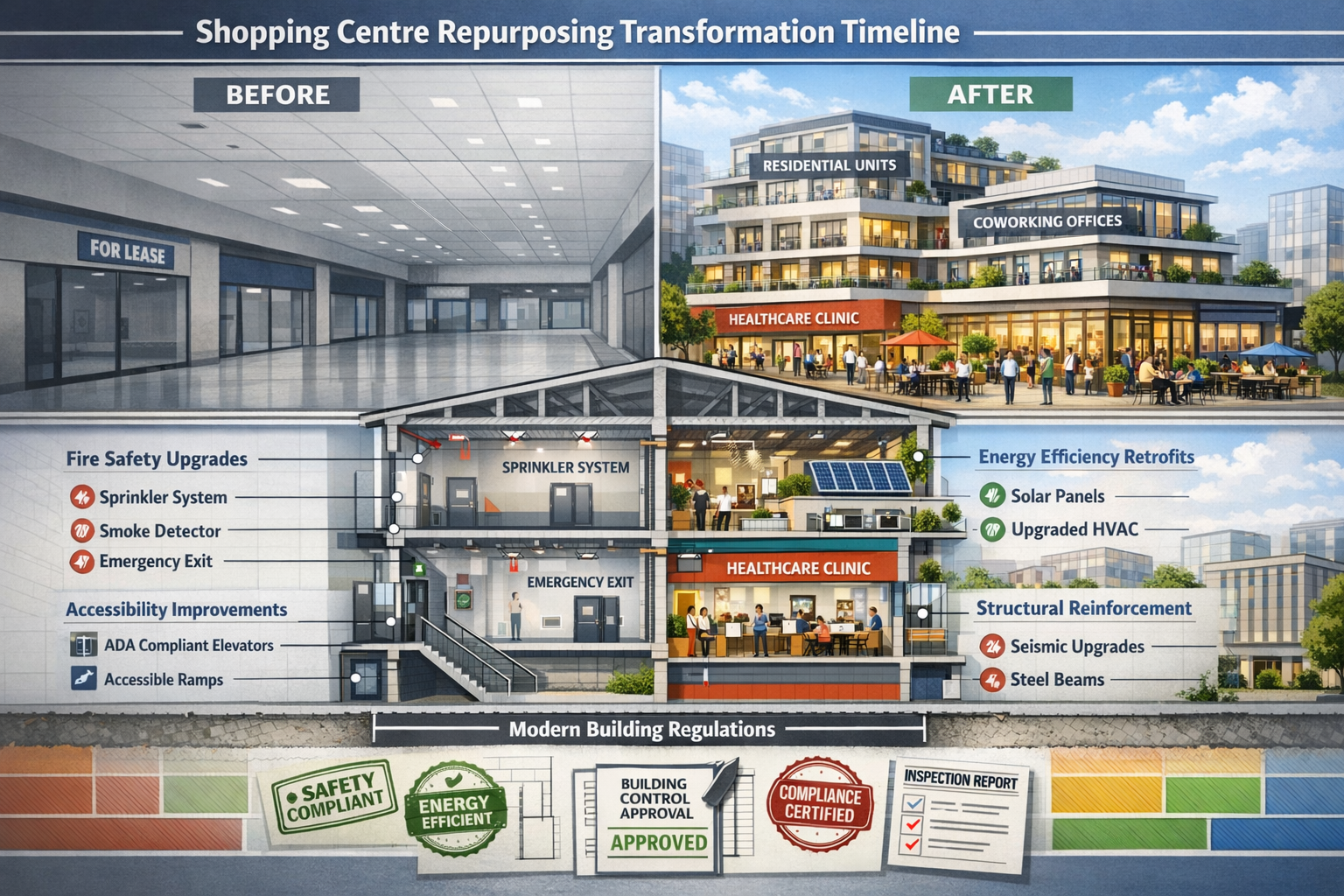
Building Survey Protocols for Shopping Centre Repurposing: Capturing Value in 2026's Phoenix Revival must systematically evaluate multiple conversion scenarios to maximize investor returns. The diversity of successful repurposing models—from mixed-use town centers[3] to healthcare facilities[4] and distribution centers[1]—demonstrates that no single template applies universally.
Strategic retrofit assessment examines:
📊 Mixed-Use Residential Conversion
- Floor-to-ceiling heights suitable for residential units (minimum 2.3m)
- Natural light access and window placement opportunities
- Acoustic separation feasibility between commercial and residential zones
- Private amenity space provision (balconies, terraces, communal gardens)
- Parking ratio adequacy for residential occupancy
🏥 Healthcare Facility Adaptation
- Structural capacity for medical equipment and increased floor loading
- Infection control zoning and ventilation requirements
- Accessibility for patients with mobility limitations
- Parking adequacy for staff, patients, and emergency vehicles
- Proximity to population centers and transport links
📦 Distribution Center Conversion
- Clear internal heights for racking systems (typically 8-12m required)
- Loading dock capacity and HGV access routes
- Floor slab strength for forklift operations and storage loads
- Power supply capacity for automated handling systems
- Sprinkler coverage for warehouse fire safety standards
Quantifying Retrofit Costs and Value Enhancement
Accurate cost estimation during the survey phase prevents budget overruns and ensures project viability. Professional surveyors provide detailed cost matrices that inform investment decisions.
Typical retrofit cost categories include:
| Retrofit Element | Cost Range (per sq ft) | Value Impact |
|---|---|---|
| Structural reinforcement | £45-£85 | Essential for feasibility |
| Building services replacement | £65-£120 | 15-25% value enhancement |
| Fire safety upgrades | £30-£55 | Regulatory compliance |
| Energy efficiency improvements | £40-£75 | 10-20% operational cost reduction |
| Accessibility enhancements | £25-£45 | Market appeal improvement |
| External envelope refurbishment | £85-£150 | 20-30% value enhancement |
Planning and Permitted Development Considerations
Survey findings directly inform planning strategy and application preparation. Understanding existing use rights, permitted development allowances, and local planning policy proves essential for conversion feasibility.
Planning-related survey documentation includes:
- Existing use classification and planning history
- Conservation area or listed building constraints
- Parking provision compliance with local standards
- Affordable housing requirements for residential conversion
- Section 106 agreement implications
- Community infrastructure levy calculations
Professional commercial dilapidation surveys can also identify existing lease obligations that may impact conversion timing and costs.
Investor-Led Revamp Strategies: Maximizing Returns Through Rigorous Survey Protocols
Due Diligence Survey Requirements for Acquisition
Sophisticated investors recognize that comprehensive building surveys represent insurance against unforeseen costs rather than discretionary expenses. The 25% of professionals who identify shopping centres as undervalued assets typically employ rigorous due diligence protocols before acquisition.
Pre-acquisition survey deliverables should include:
✅ Executive Summary: Clear statement of overall building condition, major defects, and conversion feasibility
✅ Detailed Condition Report: Room-by-room assessment with photographic evidence and defect prioritization
✅ Structural Engineer's Report: Load capacity analysis and reinforcement requirements
✅ M&E Services Assessment: Condition, capacity, and replacement/upgrade recommendations
✅ Compliance Gap Analysis: Identification of all regulatory upgrades required for intended use
✅ Cost Estimate Matrix: Itemized repair, upgrade, and conversion cost projections
✅ Risk Register: Prioritized list of technical, regulatory, and financial risks with mitigation strategies
Phased Development Survey Protocols
Large shopping centre conversions often proceed in phases to manage risk and cash flow. Survey protocols must accommodate this staged approach while maintaining overall project coherence.
Phased survey strategies include:
- Phase 0: Entire site overview survey identifying development zones and infrastructure constraints
- Phase-specific detailed surveys: Comprehensive assessment of each development phase immediately prior to construction
- Interface documentation: Detailed recording of connections between phases to ensure compatibility
- Ongoing condition monitoring: Regular inspections of retained structures during adjacent phase construction
Value Engineering Through Survey Insights
Strategic survey findings enable value engineering decisions that optimize return on investment without compromising quality or compliance.
Survey-informed value engineering opportunities:
- Selective demolition vs. retention: Identifying which structural elements provide value through reuse versus replacement
- Services infrastructure rationalization: Determining optimal balance between refurbishment and replacement
- Phasing optimization: Sequencing work to minimize disruption and maximize early revenue generation
- Specification refinement: Tailoring upgrade specifications to actual condition rather than assumed worst-case scenarios
Emerging Trends: Building Survey Protocols for Shopping Centre Repurposing in 2026's Market
Circular Economy and Sustainability Integration
The concept of shopping malls serving as retail return and resale centers[2] introduces new survey considerations. These circular economy models require specialized assessment of:
- Reverse logistics infrastructure: Loading docks, sorting areas, and storage capacity for returned goods
- Quality control spaces: Areas for product inspection, refurbishment, and repackaging
- Technology integration: Power and data infrastructure for inventory management systems
- Customer experience zones: Retail presentation areas for resale merchandise
Technology-Enhanced Survey Methodologies
2026 has witnessed significant advancement in survey technology, enabling more accurate and efficient building assessments.
Cutting-edge survey tools include:
- 🤖 Drone-based roof and facade inspection: Accessing difficult areas safely and cost-effectively
- 📱 Building Information Modeling (BIM) integration: Creating digital twins for conversion planning
- 🔬 Non-destructive testing advances: Ultrasonic, radar, and thermographic analysis of concealed elements
- 📊 AI-powered defect recognition: Machine learning algorithms identifying patterns in survey data
- ☁️ Cloud-based collaborative platforms: Real-time survey data sharing among project stakeholders
ESG and Social Value Assessment
Environmental, Social, and Governance (ESG) considerations now influence investment decisions significantly. Building surveys increasingly incorporate ESG metrics that quantify social value creation through adaptive reuse.
ESG-focused survey elements examine:
- Embodied carbon retention: Quantifying carbon savings through building reuse versus demolition
- Community benefit potential: Assessing capacity for affordable housing, community facilities, or public amenities
- Local employment opportunities: Evaluating construction and operational job creation potential
- Biodiversity enhancement: Identifying opportunities for green roofs, urban greening, and habitat creation
- Health and wellbeing provisions: Natural light, air quality, and active design features
Risk Mitigation and Professional Standards

The Role of Chartered Surveyors in Complex Conversions
Shopping centre repurposing demands expertise beyond standard property surveying. Chartered surveyors in London and throughout the UK provide professional indemnity-backed assessments that protect investor interests.
Professional surveyor qualifications ensure:
- RICS accreditation: Adherence to Royal Institution of Chartered Surveyors standards and ethics
- Specialist commercial expertise: Understanding of large-scale commercial property construction and conversion
- Professional indemnity insurance: Financial protection against survey errors or omissions
- Continuing professional development: Current knowledge of regulations, technology, and best practices
- Independent expert status: Objective assessment free from contractor or developer influence
Survey Documentation and Legal Protection
Comprehensive survey documentation provides legal protection throughout the development process. Properly structured reports serve multiple purposes:
- Acquisition negotiation leverage: Identifying defects that justify price reduction or vendor remediation
- Contractor tendering basis: Providing accurate scope definition for competitive bidding
- Planning application support: Demonstrating existing condition and conversion feasibility
- Warranty and defect liability baseline: Establishing pre-construction condition through schedule of dilapidations protocols
- Insurance underwriting information: Enabling accurate property insurance assessment
Quality Assurance Throughout the Conversion Process
Building surveys represent the beginning rather than the end of quality assurance. Ongoing monitoring protocols ensure conversion work proceeds according to specification and maintains building integrity.
Post-survey quality assurance includes:
- Pre-commencement verification: Confirming site conditions match survey findings before contractor mobilization
- Progress inspections: Regular site visits monitoring compliance with specifications and identifying emerging issues
- Practical completion assessment: Verifying all works meet required standards before handover
- Defects liability monitoring: Documenting and tracking remediation of post-completion defects
- Post-occupancy evaluation: Assessing building performance against design intentions
Conclusion: Capturing Value Through Rigorous Building Survey Protocols
The transformation of undervalued shopping centres into thriving mixed-use developments, healthcare facilities, or distribution hubs represents one of 2026's most compelling commercial real estate opportunities. However, success depends fundamentally on implementing comprehensive Building Survey Protocols for Shopping Centre Repurposing: Capturing Value in 2026's Phoenix Revival.
The 25% of professionals who recognize shopping centres as undervalued assets understand a critical truth: thorough preliminary surveying transforms speculative ventures into calculated investments. By conducting rigorous structural audits, comprehensive compliance assessments, and strategic retrofit potential evaluations, investors protect capital while unlocking hidden value.
Actionable Next Steps for Investors and Developers
For immediate implementation:
-
Engage chartered surveyors early: Commission preliminary assessments before making acquisition commitments to identify deal-breakers and negotiate from informed positions
-
Demand comprehensive scope: Ensure survey briefs address structural capacity, building services, compliance gaps, and conversion-specific requirements for intended use
-
Integrate specialist expertise: Combine building surveyors with structural engineers, M&E consultants, and planning advisors for holistic assessment
-
Establish clear documentation standards: Require detailed reports with photographic evidence, cost estimates, and risk registers that inform decision-making
-
Plan for ongoing monitoring: Build survey costs into development budgets as continuous quality assurance rather than one-time expenses
The phoenix revival of shopping centres in 2026 offers substantial returns for those who approach repurposing with diligence, expertise, and comprehensive survey protocols. The difference between profitable transformation and costly failure lies not in the vision for what these spaces might become, but in the rigorous understanding of what they currently are.
By implementing robust building survey protocols, investors capture value that others overlook, transforming yesterday's struggling retail spaces into tomorrow's thriving mixed-use communities.
References
[1] The Repositioning Of Retail The Growing Impact Of Adaptive Reuse – https://www.matthews.com/market_insights/the-repositioning-of-retail-the-growing-impact-of-adaptive-reuse
[2] Shopping Malls Repurposing Returns Recycling Studio Mm04 Report – https://www.recyclingtoday.com/news/shopping-malls-repurposing-returns-recycling-studio-mm04-report/
[3] Reinventing U S Malls As Mixed Use Town Centers – https://urbanland.uli.org/issues-trends/reinventing-u-s-malls-as-mixed-use-town-centers
[4] Repurposing Retail Spaces How Adaptive Reuse Is Transforming The Market – https://www.cbcworldwide.com/blog/repurposing-retail-spaces-how-adaptive-reuse-is-transforming-the-market