
The UK property market is experiencing a significant rebound in 2026, with lending institutions forecasting substantial increases in transaction volumes and survey requests following years of uncertainty [1]. This surge presents a critical challenge for building surveyors: how to maintain rigorous quality standards while managing unprecedented workload pressures. As the industry navigates this recovery phase, the risk of quality degradation becomes a pressing concern that could undermine professional credibility and client protection.
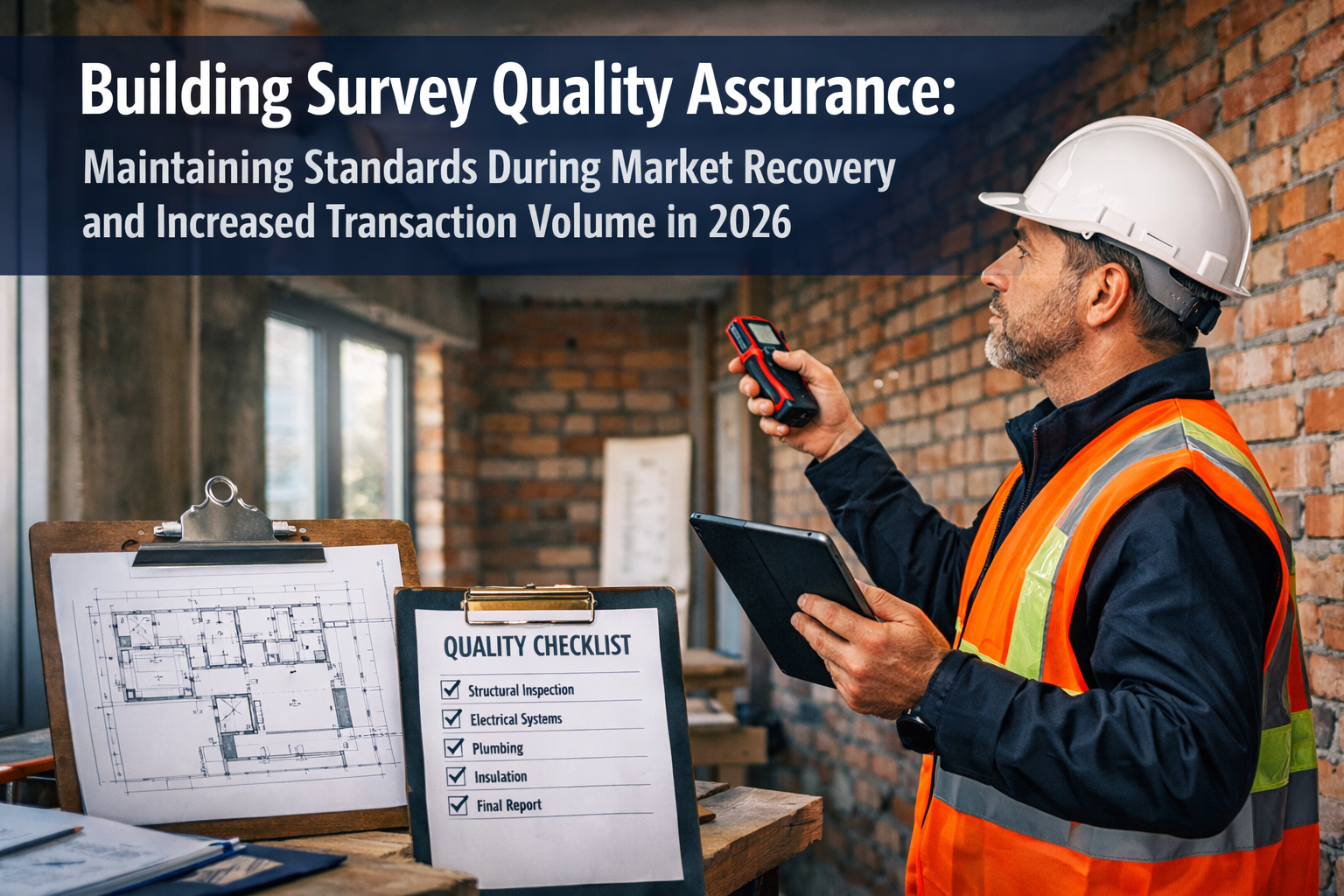
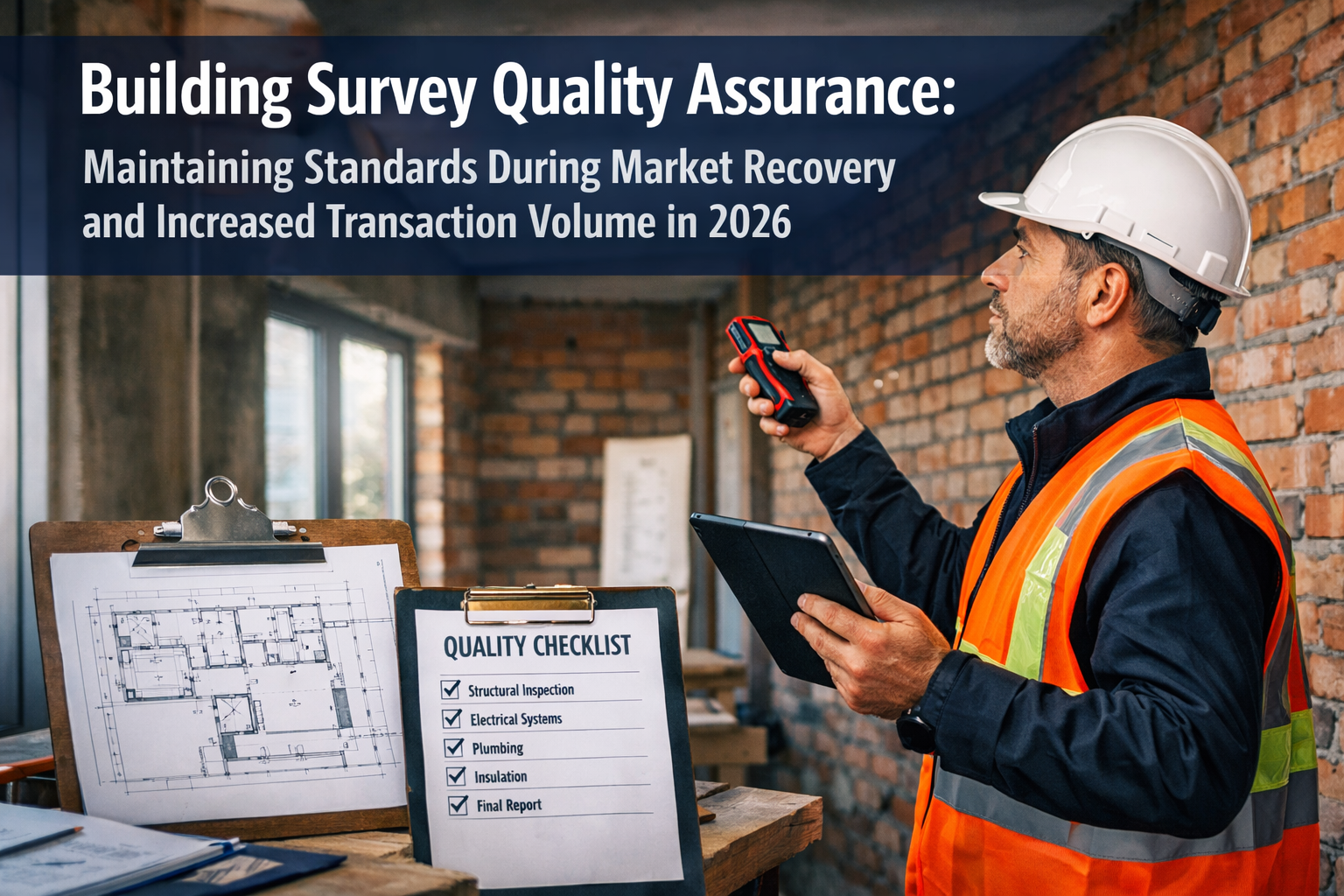
Building Survey Quality Assurance: Maintaining Standards During Market Recovery and Increased Transaction Volume in 2026 requires systematic approaches to quality control, resource allocation, and professional development. The stakes have never been higher, as both regulatory bodies and clients demand consistent, reliable survey outputs regardless of market conditions.
Key Takeaways
- Market recovery is driving significant increases in survey demand, with 2026 expected to deliver substantial volume growth across residential and commercial sectors [1]
- Systematic quality assurance protocols are essential to prevent survey deficiencies when workloads increase during market upturns
- Digital tools and standardized workflows enable surveyors to maintain consistency and thoroughness even under time pressure
- Continuing professional development (CPD) and team capacity planning are critical investments for sustaining quality during high-volume periods
- Proactive quality management strategies protect both client interests and professional reputations in competitive market conditions
Understanding the 2026 Market Recovery Context
Transaction Volume Forecasts and Industry Expectations
The surveying sector is experiencing what industry analysts describe as "a year of recovery and growth" in 2026 [1]. After several years of market uncertainty influenced by economic volatility and interest rate fluctuations, lending institutions are now expecting increased volumes and a strong start to the year. This optimism is reflected across multiple property sectors, from residential purchases to commercial transactions.
The anticipated uplift in volumes across both lending and surveys creates immediate operational challenges for surveying practices [1]. When transaction activity accelerates, surveyors face compressed timelines, increased client expectations, and the temptation to prioritize speed over thoroughness. This environment makes Building Survey Quality Assurance: Maintaining Standards During Market Recovery and Increased Transaction Volume in 2026 an operational imperative rather than merely a professional aspiration.
Regulatory Reform and Changing Survey Requirements
Beyond volume increases, the surveying landscape is evolving through potential regulatory changes. The government's proposed reforms to the homebuying process could make property condition assessments a standard upfront requirement [1]. This fundamental shift would significantly increase demand for surveys earlier in the transaction process and change how and when surveyors operate.
Such reforms underscore the importance of quality assurance systems that can scale effectively. If surveys become mandatory earlier in property transactions, the margin for error decreases while public scrutiny increases. Building surveyor services must adapt to these changing expectations while maintaining the rigorous standards that protect buyers and lenders alike.
Professional Landlord Demand and Quality Expectations
The buy-to-let sector dynamics reveal another quality-focused trend. Institutional and professional landlords remain bullish in 2026, with industry experts noting that these property professionals "understand the value of proper surveys" [1]. Unlike occasional buyers who might view surveys as optional expenses, professional investors recognize that comprehensive building assessments are essential risk management tools.
This sophisticated client base expects detailed, accurate reporting that identifies not just obvious defects but also latent issues that could affect property values or rental yields. Meeting these expectations requires surveyors to maintain consistent quality standards regardless of workload pressures.
Core Components of Building Survey Quality Assurance Systems
Standardized Inspection Protocols and Checklists
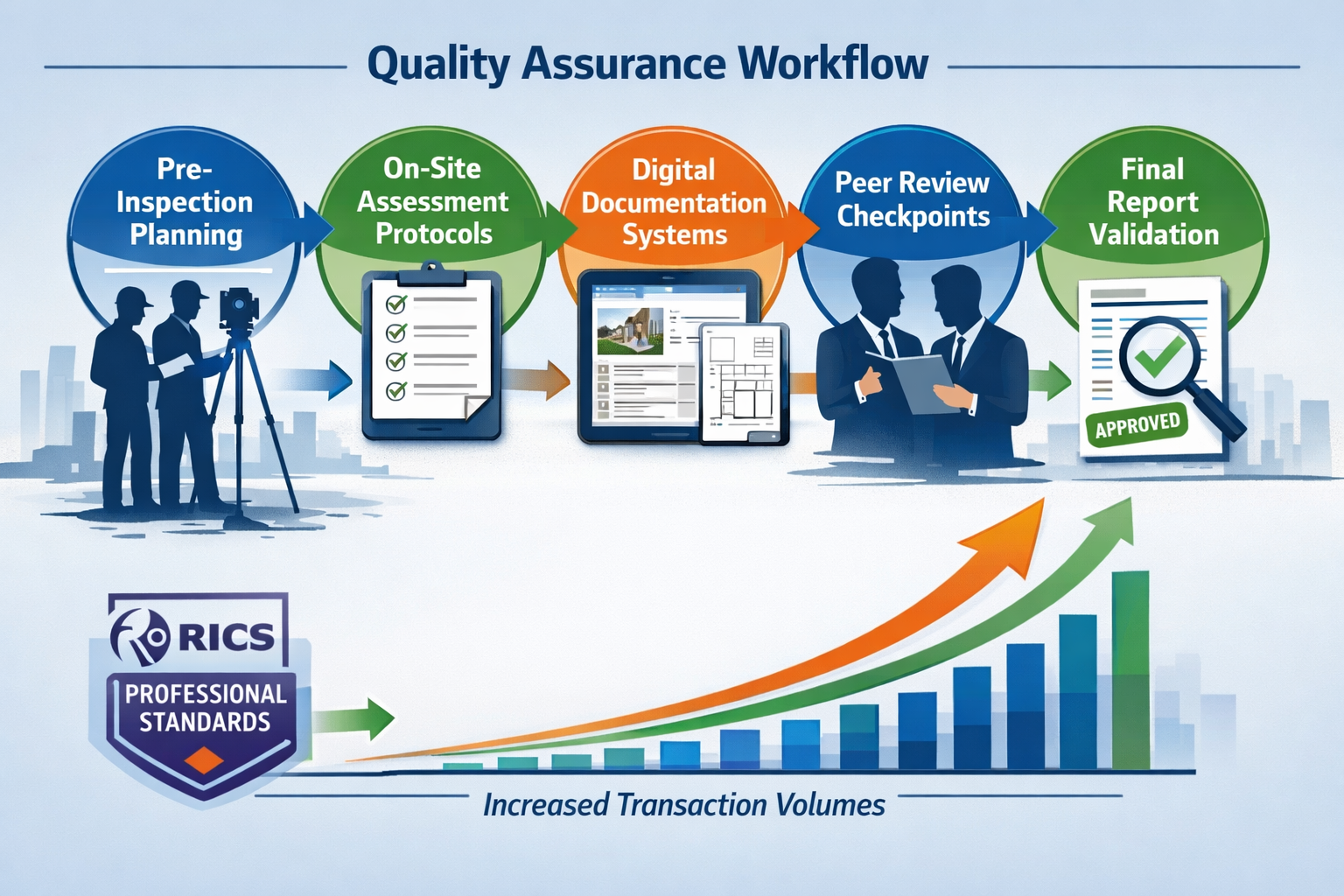
The foundation of quality assurance lies in systematic inspection protocols that ensure no critical elements are overlooked, even when surveyors face time constraints. Comprehensive checklists should cover:
- Structural elements: foundations, walls, roofs, floors, and load-bearing components
- Building envelope: external walls, windows, doors, damp-proofing, and weatherproofing
- Services and systems: electrical, plumbing, heating, drainage, and ventilation
- Internal finishes: ceilings, walls, floors, joinery, and decorative condition
- External areas: boundaries, outbuildings, drainage, paths, and landscaping
These protocols must be consistently applied across all survey types, from basic condition reports to comprehensive commercial building surveys. Standardization prevents the quality variations that can emerge when individual surveyors develop idiosyncratic approaches.
Digital Documentation and Evidence Capture
Modern quality assurance depends heavily on digital tools that enhance accuracy and consistency. Tablet-based survey applications enable surveyors to:
- ✅ Capture high-resolution photographs with automatic geotagging and timestamping
- ✅ Record detailed measurements using integrated laser distance tools
- ✅ Complete standardized data entry forms that prevent omissions
- ✅ Generate preliminary reports on-site for immediate quality checks
- ✅ Synchronize data to cloud platforms for backup and collaboration
Digital documentation creates an auditable trail that supports quality review processes. When questions arise about survey findings, surveyors can reference timestamped photographs, measurements, and notes that provide objective evidence of inspection thoroughness.
Peer Review and Quality Control Checkpoints
No quality assurance system is complete without independent verification mechanisms. Effective peer review processes include:
| Quality Checkpoint | Purpose | Frequency |
|---|---|---|
| Pre-inspection briefing | Ensure surveyor understands property specifics and client requirements | Every survey |
| Mid-survey consultation | Address complex or unusual findings with senior colleagues | As needed |
| Draft report review | Verify technical accuracy, completeness, and clarity before finalization | Every survey |
| Random audit sampling | Independently assess report quality across practice | Monthly/quarterly |
| Client feedback analysis | Identify recurring issues or improvement opportunities | Ongoing |
These checkpoints create multiple opportunities to identify and correct quality issues before reports reach clients. When implementing Building Survey Quality Assurance: Maintaining Standards During Market Recovery and Increased Transaction Volume in 2026, practices should resist the temptation to skip review stages during busy periods—this is precisely when quality controls matter most.
Technical Standards and Professional Guidelines
All quality assurance systems must align with RICS professional standards and technical guidance. The Royal Institution of Chartered Surveyors provides comprehensive frameworks that define minimum standards for survey inspections, reporting, and professional conduct. These include:
- RICS Home Survey Standard (for residential properties)
- RICS Guidance Note on Surveys of Residential Property
- Professional standards for commercial property surveys
- Ethical guidelines for conflict of interest and client relationships
Surveyors must stay current with evolving standards through regular expert surveyor advice and professional development. RICS is enhancing existing continuing professional development platforms "with improved digital tools and a new RICS member app" to support existing members [1], making it easier for busy professionals to maintain their technical knowledge.
Managing Quality During High-Volume Periods

Capacity Planning and Resource Allocation
The most common quality failure during market recoveries stems from accepting more work than available resources can handle properly. Effective capacity planning requires:
Realistic time allocation 📊 Each survey type requires minimum inspection and reporting time that cannot be compressed without quality compromise. A comprehensive building survey typically requires 3-4 hours on-site plus 4-6 hours for report preparation and review. Practices must calculate maximum weekly capacity based on available surveyor hours and refuse to exceed these limits.
Strategic workload distribution 🎯 Not all surveys require the same expertise level. Junior surveyors can handle straightforward properties under supervision, while complex cases involving subsidence, specific defects, or unusual construction require senior expertise. Proper task allocation maximizes efficiency without compromising quality.
Subcontractor quality management 🤝 When demand exceeds internal capacity, many practices engage associate surveyors or subcontractors. This approach only maintains quality if subcontractors undergo rigorous vetting, receive clear quality expectations, and submit to the same review processes as internal staff.
Template Standardization Without Rigidity
Standardized report templates support quality assurance by ensuring consistent coverage of essential topics. However, templates must allow sufficient flexibility for surveyors to address property-specific issues thoroughly. The balance requires:
- Core sections that appear in every report: property details, inspection scope, methodology, limitations, executive summary, detailed findings by element, conclusions, and recommendations
- Flexible content areas where surveyors expand on significant defects, unusual features, or complex technical issues
- Conditional sections that appear only when relevant (e.g., specialist investigations recommended, urgent repairs required)
- Standardized terminology for defect severity ratings and repair urgency classifications
When properly implemented, templates actually enhance quality by preventing omissions while reducing the cognitive load on surveyors during busy periods. They also facilitate more efficient peer review, as reviewers can quickly locate and assess critical report sections.
Time Management and Scheduling Strategies
Building Survey Quality Assurance: Maintaining Standards During Market Recovery and Increased Transaction Volume in 2026 requires intelligent scheduling that prevents the quality erosion caused by excessive time pressure. Effective strategies include:
Buffer time allocation ⏰ Schedules should include contingency time for unexpected complications (difficult site access, more extensive defects than anticipated, weather delays). A common approach allocates 20% buffer time across weekly schedules.
Batch processing similar properties 🏘️ When possible, scheduling multiple surveys in the same geographic area or of similar property types allows surveyors to work more efficiently through pattern recognition while maintaining thoroughness.
Protected report writing time ✍️ Many practices find that scheduling specific days or half-days exclusively for report preparation (without site inspections) improves report quality and reduces errors caused by task-switching.
Realistic client deadline management 📅 Rather than accepting impossible deadlines that force rushed work, successful practices educate clients about realistic timescales and the quality benefits of proper survey processes. Most clients prefer to wait an extra few days for a thorough survey rather than receive a rushed assessment that misses critical issues.
Professional Development and Surveyor Competency
Continuing Professional Development Requirements
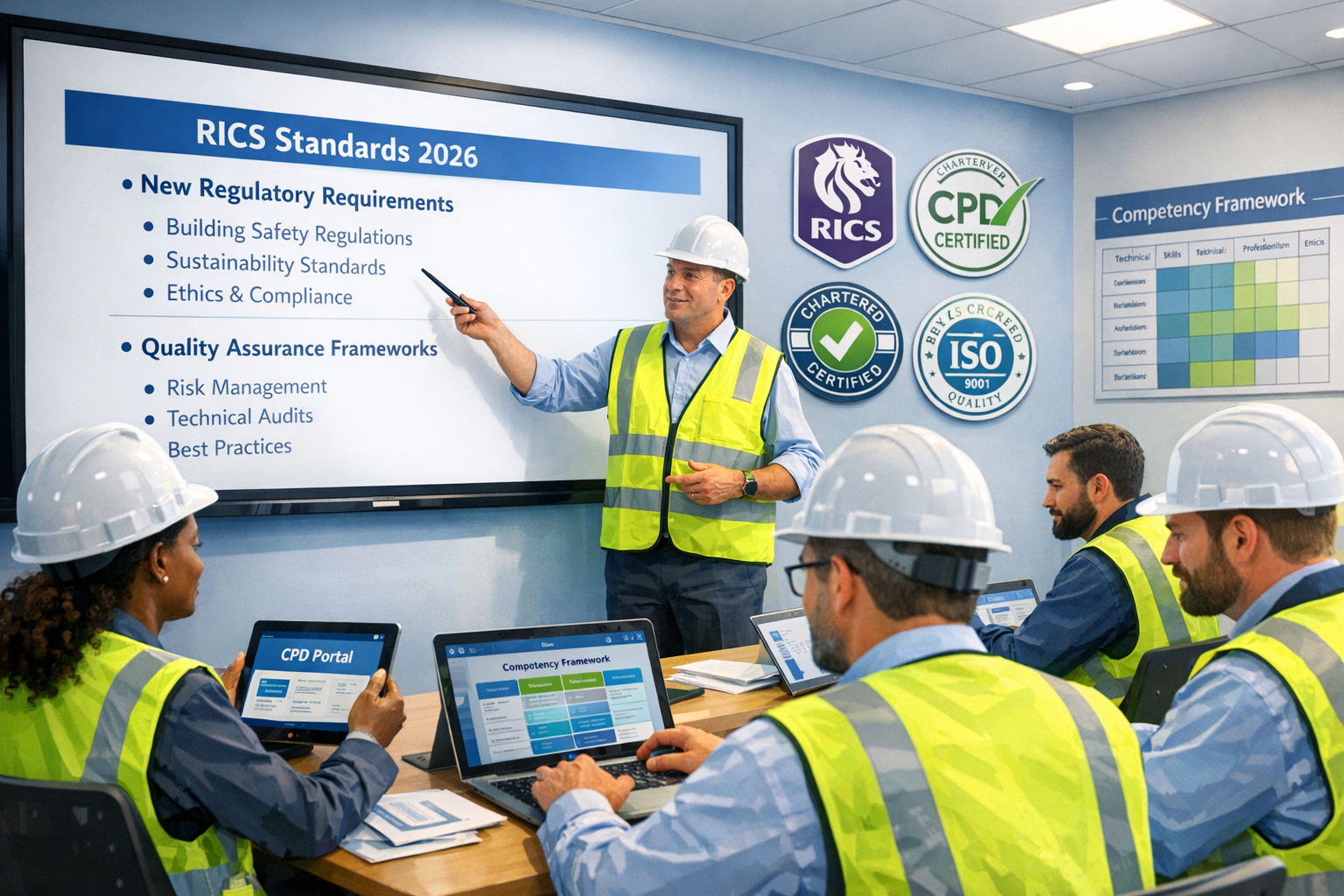
RICS is addressing capacity concerns by working on "clearer pathways for graduates to gain qualifications" and "ensuring surveyors are retrained and ready to meet new demands while attracting the next generation of talent" [1]. This focus on professional development is essential for maintaining quality standards as the industry scales to meet increased demand.
Effective CPD programs for quality assurance should include:
- Technical updates on new construction methods, materials, and defect identification techniques
- Regulatory changes affecting survey requirements and reporting standards
- Technology training on digital survey tools, measurement equipment, and report software
- Quality management systems and error prevention strategies
- Client communication skills for explaining complex technical issues clearly
Practices should track CPD participation and link professional development directly to quality metrics. Surveyors who regularly engage with technical training typically produce more thorough, accurate reports than those who rely solely on past experience.
Mentoring and Knowledge Transfer
As experienced surveyors approach retirement, the industry faces potential knowledge loss that could undermine quality standards. Structured mentoring programs address this risk by:
- Pairing junior surveyors with experienced professionals for supervised inspections
- Creating opportunities for junior staff to observe complex surveys and unusual defects
- Establishing formal review processes where senior surveyors provide detailed feedback on junior reports
- Documenting organizational knowledge in accessible formats (defect libraries, case studies, technical guides)
These knowledge transfer mechanisms become particularly important during high-volume periods when the temptation to deploy less-experienced surveyors independently increases. Building Survey Quality Assurance: Maintaining Standards During Market Recovery and Increased Transaction Volume in 2026 depends on maintaining appropriate supervision ratios even when demand pressures mount.
Specialist Expertise Development
Not all building issues can be adequately assessed through general surveying skills. Quality assurance systems must recognize when specialist expertise is required and ensure appropriate referrals. Common specialist areas include:
- Structural engineering for significant structural movement, unusual construction, or major alterations
- Timber and damp specialists for extensive rot, beetle infestation, or persistent moisture issues
- Environmental specialists for contamination, asbestos, or hazardous materials
- Building services engineers for complex mechanical, electrical, or HVAC systems
Practices should maintain relationships with trusted specialists and establish clear protocols for when referrals are appropriate. This approach protects clients and reduces professional liability exposure while maintaining the surveyor's role as the coordinating professional who interprets specialist findings within the broader property context.
Technology Integration for Quality Enhancement
Survey Software and Mobile Applications
Modern survey software platforms offer significant quality assurance benefits when properly implemented. Leading systems provide:
- Structured data capture that guides surveyors through systematic inspections
- Automated completeness checks that flag missing information before reports are finalized
- Integrated photo management with automatic linking to relevant report sections
- Consistent formatting that ensures professional presentation regardless of individual surveyor preferences
- Version control that tracks report revisions and maintains audit trails
When selecting survey software, practices should prioritize systems that support quality assurance rather than merely automating existing processes. The goal is to make it easier to produce thorough, accurate surveys rather than simply faster to produce mediocre ones.
Measurement and Documentation Technology
Accurate measurements are fundamental to quality building surveys. Modern technology enhances measurement accuracy through:
- Laser distance measurers that eliminate tape measure errors and enable single-person measurements
- Thermal imaging cameras that reveal hidden moisture, insulation defects, and thermal bridges
- Moisture meters (both surface and deep-wall types) for objective dampness assessment
- Endoscopic cameras for inspecting concealed spaces without destructive investigation
- Drones for safe, detailed roof and chimney inspections on tall or complex buildings
Investment in quality equipment demonstrates commitment to thorough inspections and provides objective evidence that supports survey findings. When implementing Building Survey Quality Assurance: Maintaining Standards During Market Recovery and Increased Transaction Volume in 2026, practices should ensure all surveyors have access to appropriate technology and receive proper training in its use.
Data Analytics and Quality Metrics
Progressive practices are using data analytics to monitor and improve quality systematically. Useful metrics include:
| Quality Metric | What It Reveals | Target Range |
|---|---|---|
| Average inspection time by property type | Whether surveyors spend adequate time on-site | Benchmark against industry standards |
| Report completion time | Efficiency without rushing | 2-5 days from inspection to final report |
| Revision requests from peer review | Draft quality before review | <10% requiring significant revision |
| Client queries post-delivery | Report clarity and completeness | <5% requiring clarification |
| Professional indemnity claims | Ultimate quality measure | Zero claims per 1000 surveys |
Regular analysis of these metrics helps practices identify quality trends, recognize training needs, and intervene before quality issues become systemic problems. This data-driven approach to quality management is particularly valuable during high-volume periods when subjective quality assessment becomes more difficult.
Regional Considerations and Market Variations
Geographic Quality Challenges
Surveyors operating across multiple regions face varying property types, construction methods, and defect patterns that affect quality assurance approaches. For example, chartered surveyors in Oxfordshire encounter different typical defects than those working in central London or coastal areas of Hampshire.
Quality assurance systems must account for these regional variations by:
- Ensuring surveyors receive training on region-specific construction types and common defects
- Maintaining regional defect libraries that document typical issues in different areas
- Assigning surveyors with appropriate local knowledge to properties in unfamiliar regions
- Conducting additional peer review when surveyors work outside their usual geographic areas
Urban Versus Rural Survey Considerations
Property surveys in dense urban environments like Islington, Chelsea, or Hampstead present different challenges than rural properties in Buckinghamshire or Berkshire. Urban surveys often involve:
- Limited external access due to adjacent properties
- Shared structures requiring party wall considerations
- Alterations to original construction that may not comply with current standards
- Restricted inspection times due to occupied neighboring properties
Quality assurance protocols must address these access limitations by clearly documenting inspection constraints and ensuring clients understand any resulting limitations on survey scope.
Commercial Property Quality Assurance Considerations
Complexity of Commercial Building Surveys
Commercial property surveys introduce additional quality assurance challenges due to property complexity, higher financial stakes, and sophisticated client expectations. Commercial surveys often require:
- Assessment of specialized building services (HVAC, fire suppression, security systems)
- Understanding of lease obligations and dilapidations liability
- Evaluation of compliance with commercial building regulations and accessibility standards
- Consideration of business use impacts on building condition and maintenance requirements
Building Survey Quality Assurance: Maintaining Standards During Market Recovery and Increased Transaction Volume in 2026 must address these commercial complexities through appropriate surveyor expertise, longer inspection times, and enhanced peer review processes.
Institutional Client Requirements
Professional landlords and institutional investors often impose additional quality requirements beyond standard RICS guidelines. These may include:
- Specific report formats compatible with portfolio management systems
- Detailed cost estimates for identified repairs and maintenance items
- Risk categorization aligned with corporate risk management frameworks
- Regular quality audits of surveying firms on approved panels
Practices serving institutional clients should implement quality assurance systems that meet or exceed these enhanced requirements, recognizing that commercial relationships depend on consistent delivery of high-quality outputs.
Risk Management and Professional Liability
Common Quality Failures and Prevention
Analysis of professional indemnity claims reveals recurring quality failures that effective QA systems can prevent:
Missed significant defects 🚨 The most serious quality failure occurs when surveyors fail to identify major issues like structural movement, extensive rot, or serious safety hazards. Prevention requires systematic inspection protocols, adequate time allocation, and appropriate use of diagnostic equipment.
Inadequate investigation of visible symptoms 🔍 Surveyors sometimes note symptoms (e.g., cracking, staining) without adequately investigating underlying causes. Quality assurance should emphasize that visible symptoms require investigation to determine extent and severity.
Unclear or ambiguous reporting 📝 Reports that use vague language ("some dampness noted," "repairs may be required") fail to provide clients with actionable information. Standardized terminology and clear recommendations prevent this failure mode.
Scope limitations not clearly communicated ⚠️ When inspection constraints prevent full assessment of certain elements, these limitations must be explicitly stated. Quality review should verify that all scope limitations are clearly documented.
Documentation and Defensibility
Quality assurance systems serve a dual purpose: ensuring client value and protecting professional liability. Comprehensive documentation supports both objectives by:
- Creating contemporaneous records of inspection thoroughness
- Demonstrating systematic application of professional standards
- Providing evidence of appropriate investigation and reasoning
- Supporting clear communication of findings and limitations
When implementing Building Survey Quality Assurance: Maintaining Standards During Market Recovery and Increased Transaction Volume in 2026, practices should recognize that robust quality systems are the best defense against professional liability claims.
Client Communication and Quality Perception
Managing Expectations During Busy Periods
Client satisfaction depends partly on survey quality but also significantly on expectation management. During high-volume periods, clear communication about timescales, scope, and limitations becomes even more important. Effective practices:
- Provide realistic timescales at the outset rather than optimistic estimates that lead to disappointment
- Explain the survey process and what clients can expect in the final report
- Clarify inspection limitations (e.g., areas not accessible, elements not tested)
- Offer preliminary verbal feedback on significant findings before the written report
This proactive communication approach reduces client anxiety, prevents misunderstandings, and reinforces the value of thorough professional surveys.
Post-Survey Support and Clarification
Quality assurance extends beyond report delivery. Clients often need assistance interpreting technical findings and determining appropriate next steps. Practices should:
- Offer post-delivery telephone consultations to discuss report findings
- Provide clear guidance on which issues require immediate action versus longer-term planning
- Recommend appropriate specialists for further investigation when needed
- Remain available for follow-up questions during the transaction process
This ongoing support enhances client satisfaction and demonstrates professional commitment to quality outcomes rather than merely completing transactions.
Future-Proofing Quality Assurance Systems
Adapting to Regulatory Changes
As mentioned earlier, proposed reforms to the homebuying process could fundamentally change survey requirements and timing [1]. Quality assurance systems must be sufficiently flexible to adapt to such changes without complete redesign. Key adaptability features include:
- Modular protocols that can be updated as requirements change
- Digital systems that can be reconfigured without extensive reprogramming
- Training programs that can quickly incorporate new requirements
- Quality metrics that can be adjusted to reflect evolving standards
Practices that build adaptability into their quality systems will navigate regulatory changes more successfully than those with rigid, inflexible approaches.
Sustainability and ESG Considerations
Building surveys are increasingly expected to address environmental performance, energy efficiency, and sustainability issues. While traditional surveys focus on condition and defects, clients now often want information about:
- Energy Performance Certificate (EPC) implications and improvement opportunities
- Renewable energy system suitability and installation considerations
- Thermal performance and insulation adequacy
- Sustainable material use and lifecycle considerations
Forward-thinking quality assurance systems should incorporate these emerging requirements, ensuring surveyors develop appropriate expertise and reports address client sustainability concerns.
Technology Evolution and AI Integration
Emerging technologies promise to enhance survey quality through artificial intelligence, machine learning, and advanced analytics. Potential applications include:
- AI-assisted defect identification from photographs
- Predictive maintenance algorithms based on property age, type, and condition
- Automated report generation with human oversight and refinement
- Pattern recognition across large survey databases to identify common issues
While these technologies offer quality enhancement potential, they also require careful integration to ensure they support rather than replace professional judgment. Building Survey Quality Assurance: Maintaining Standards During Market Recovery and Increased Transaction Volume in 2026 should embrace beneficial technology while maintaining the irreplaceable value of experienced professional assessment.
Conclusion
Building Survey Quality Assurance: Maintaining Standards During Market Recovery and Increased Transaction Volume in 2026 represents both a significant challenge and a critical opportunity for the surveying profession. As transaction volumes increase and market confidence returns, the temptation to prioritize speed over thoroughness poses real risks to professional standards and client protection.
The evidence is clear: systematic quality assurance systems are not optional luxuries but essential operational requirements. Practices that invest in standardized protocols, digital tools, professional development, and robust review processes will navigate high-volume periods successfully while maintaining the quality standards that protect both clients and professional reputations.
Key Implementation Priorities
Organizations seeking to strengthen quality assurance should prioritize:
- Develop comprehensive inspection protocols that ensure consistent coverage regardless of individual surveyor preferences or time pressures
- Implement digital documentation systems that enhance accuracy, create audit trails, and facilitate efficient peer review
- Establish realistic capacity limits based on available resources and refuse to accept more work than can be completed properly
- Invest in continuing professional development that keeps surveyors current with technical knowledge, regulatory requirements, and emerging issues
- Create quality metrics and monitoring systems that provide early warning of quality degradation during busy periods
The Professional Imperative
The surveying profession's credibility depends on consistent delivery of thorough, accurate assessments that clients can rely upon for major financial decisions. When quality standards slip—even temporarily during busy periods—the resulting failures undermine confidence in the entire profession.
Conversely, practices that maintain rigorous standards during challenging market conditions differentiate themselves competitively and build lasting client relationships based on trust and reliability. Professional landlords and institutional investors, in particular, value consistent quality and will direct business toward firms with proven quality assurance systems.
Taking Action
For surveying practices, the time to strengthen quality assurance systems is now—before volume pressures make implementation more difficult. Specific next steps include:
- Audit current quality assurance practices to identify gaps and improvement opportunities
- Benchmark against industry best practices and RICS professional standards
- Invest in technology and training that support quality enhancement
- Engage the entire team in quality improvement initiatives, recognizing that quality is everyone's responsibility
- Monitor quality metrics continuously and respond promptly when indicators suggest emerging issues
The market recovery of 2026 presents both opportunity and risk. Practices that prioritize Building Survey Quality Assurance: Maintaining Standards During Market Recovery and Increased Transaction Volume in 2026 will emerge stronger, more competitive, and better positioned for sustainable success.
For professional guidance on implementing quality assurance systems or to discuss specific survey requirements, consider consulting with expert surveyors who prioritize quality standards in all market conditions.
References
[1] Surveying In 2026 Reform Recovery And Renewed Demand – https://www.lrg.co.uk/news-and-insights/surveying-in-2026-reform-recovery-and-renewed-demand/
[2] Global Construction Survey – https://assets.kpmg.com/content/dam/kpmgsites/xx/pdf/2026/03/global-construction-survey.pdf
[3] 8233883d Industry Survey Identifies Top Concerns For 2026 Amid Dampened Expectations – https://acppubs.com/NAT/article/8233883D-industry-survey-identifies-top-concerns-for-2026-amid-dampened-expectations
[4] Construction Market Update Late 2025 To Early 2026 Insights – https://www.ajg.com/-/media/files/gallagher/us/2025/construction-market-update-late-2025-to-early-2026-insights.pdf
[5] 60 Of California Cre Executives More Optimistic On Development As Rate Cut Expectations Ease Market Headwinds Allen Matkins Survey Finds – https://www.allenmatkins.com/real-ideas/60-of-california-cre-executives-more-optimistic-on-development-as-rate-cut-expectations-ease-market-headwinds-allen-matkins-survey-finds.html
[6] Building Survey Market Sentiment In Early 2026 Navigating Regional Price Divergence And Buyer Uncertainty – https://nottinghillsurveyors.com/blog/building-survey-market-sentiment-in-early-2026-navigating-regional-price-divergence-and-buyer-uncertainty
[7] Commercial Real Estate Outlook – https://www.deloitte.com/us/en/insights/industry/financial-services/commercial-real-estate-outlook.html