
{"cover":"Professional landscape format (1536×1024) hero image featuring bold text overlay 'Building Survey Red Flags in Flats: Identifying Structural Issues in London's Stabilizing Market' in extra large 70pt white sans-serif font with dark shadow effect, positioned in upper third with perfect centering. Background shows split composition: left side displays Victorian London flat conversion with exposed brickwork and period features, right side shows modern chartered surveyor in hard hat examining structural cracks with clipboard and laser level. Foreground elements include architectural blueprints, EWS1 certification documents, and structural assessment tools. Color scheme: deep navy blue, crisp white, warning orange accents. High contrast overlay ensures text readability. Magazine cover quality, editorial photography style, professional lighting, sharp focus on structural details and documentation. Subtle London skyline silhouette in background. Composition follows rule of thirds, visually balanced, commanding presence, conveys authority and expertise in building surveying.","content":["Detailed landscape format (1536×1024) editorial image showing close-up structural defects commonly found in London flats: prominent diagonal crack running through Victorian brick wall with measuring tape showing width, damp staining with moisture meter reading, subsidence indicators with spirit level demonstrating floor slope, corroded steel beam with rust damage, defective cavity wall ties exposed in cross-section. Foreground shows professional surveyor's hands holding thermal imaging camera displaying heat loss patterns in blue and red gradients. Background includes clipboard with detailed defect checklist, RICS survey documentation, and annotated photographs. Technical diagrams overlay showing structural load paths and failure points. Color palette: industrial greys, warning reds for defects, professional blues. Clean, well-lit professional photography with macro detail on structural issues. Annotations and measurement callouts in white text. Educational infographic style combined with documentary photography aesthetic.","Professional landscape format (1536×1024) image depicting EWS1 fire safety assessment process for London residential blocks: central focus on multi-storey residential building facade showing external wall system layers in cutaway technical illustration style. Left panel displays EWS1 certification form with rating categories (A1-B2) highlighted, mortgage lender logos (Halifax, Santander, Barclays, NatWest) with approval/rejection stamps. Right panel shows remediation cost breakdown infographic with £40,000-£60,000 figures prominently displayed in large typography, pie chart showing cost distribution across cladding removal, fire barriers, balcony separation. Foreground includes fire safety inspector with ACM cladding sample, thermal imaging of building envelope. Background shows London skyline with iconic buildings. Color scheme: safety orange, regulatory red, professional navy, clean white backgrounds. Modern infographic aesthetic combined with architectural photography, clear data visualization, professional documentary style.","Detailed landscape format (1536×1024) comprehensive infographic showing leasehold complications and survey due diligence process for London flats: center features timeline graphic showing lease length degradation from 999 years to sub-80 years with mortgage availability zones color-coded (green for 100+ years, amber for 80-100, red for under 80). Left section displays service charge escalation graph trending upward from 2020-2026 with specific cost figures, insurance premium spike visualization. Right section shows buyer due diligence checklist with checkboxes: EWS1 status, building height measurement, managing agent credentials, Section 20 notices, sinking fund adequacy. Foreground elements include lease document with magnifying glass highlighting ground rent doubling clause, calculator showing lease extension costs, solicitor's file marked 'urgent'. Background shows professional meeting between surveyor, buyer, and solicitor reviewing documents. Color palette: financial green and red for positive/negative trends, professional navy, document cream. Clean modern business infographic style with data visualization, professional photography elements, clear hierarchy."]

As buyer confidence cautiously returns to London's flat market in 2026, the role of building surveyors has never been more critical. Understanding building survey red flags in flats: identifying structural issues in London's stabilizing market requires a forensic approach that goes far beyond traditional property inspections. With mortgage lenders tightening criteria and purchasers conducting deeper due diligence, surveyors must now navigate complex layers of structural defects, fire safety compliance, and leasehold complications to protect their clients' investments.
The landscape has fundamentally shifted. What once constituted a straightforward structural survey now demands expertise in EWS1 certification, remediation cost forecasting, and regulatory compliance assessment. This comprehensive guide equips chartered surveyors with the knowledge to identify critical red flags, communicate risks effectively, and provide the detailed analysis that today's discerning buyers demand.
Key Takeaways
- EWS1 certification has become mandatory for mortgage approval on many flats, with lenders rejecting properties lacking valid fire safety documentation[1]
- Remediation costs can reach £40,000-£60,000 per flat in developments with unresolved cladding and fire safety defects[1]
- Surveyor down-valuations are increasingly common as professionals scrutinize entire building blocks rather than individual units[1]
- Service charges and insurance premiums continue escalating, creating affordability concerns that affect property marketability[1]
- Professional Level 3 surveys are essential for properties over 50 years old, unusual designs, or those in poor condition[2]
Understanding Critical Structural Defects in London Flat Conversions
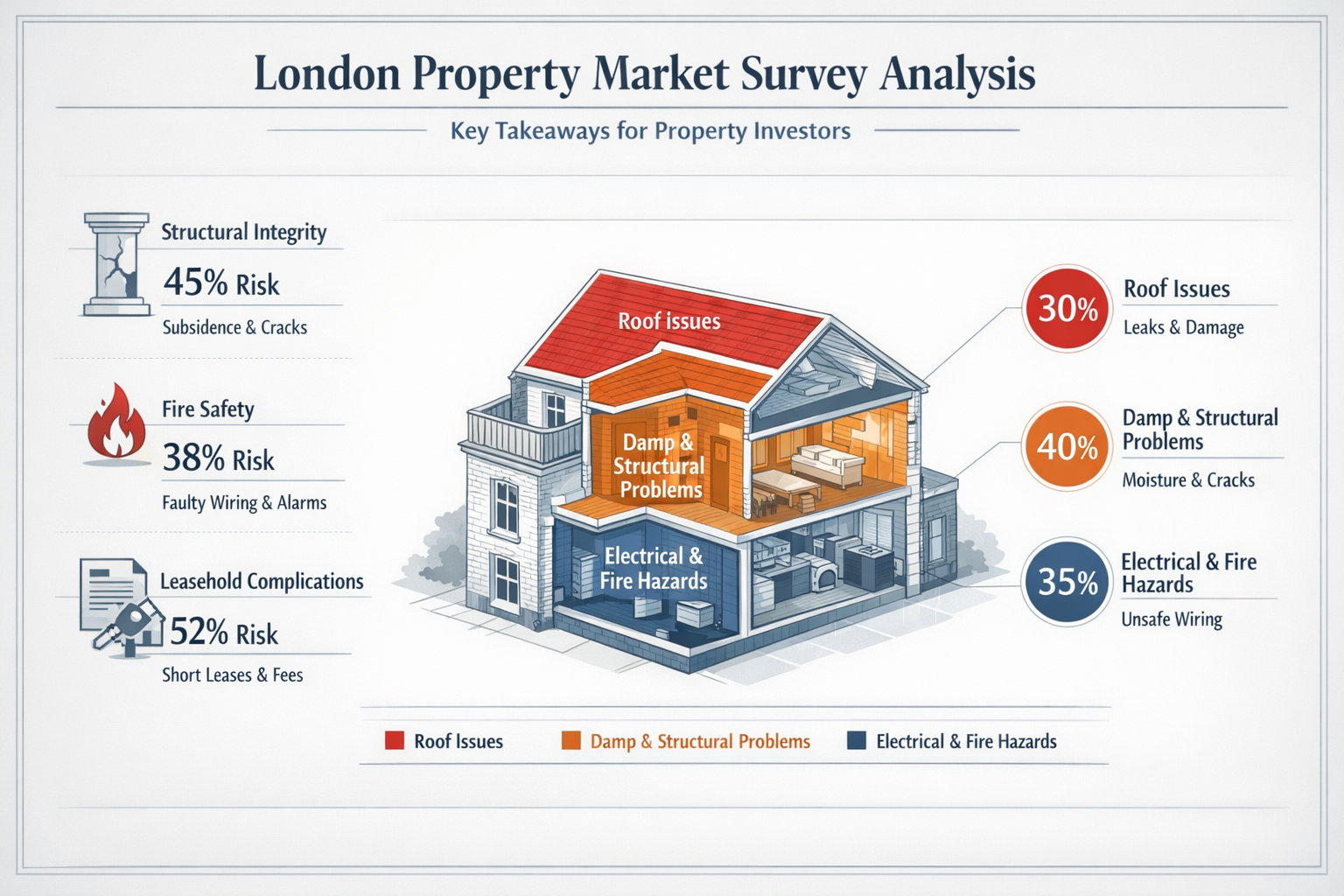
London's housing stock presents unique challenges for building surveyors. Victorian and Edwardian conversions, purpose-built blocks from the 1960s-1980s, and modern developments each carry distinct structural vulnerabilities that require specialized knowledge to identify and assess.
Common Structural Issues in Period Conversions
Subsidence and settlement remain among the most serious red flags in converted properties. Victorian terraces converted into flats often exhibit diagonal cracking patterns, particularly around door and window openings. These cracks typically indicate differential settlement where original load-bearing walls have been altered or removed during conversion works.
Key indicators include:
- Diagonal cracks wider than 3mm, especially those that taper
- Stepped cracking in brickwork following mortar joints
- Doors and windows that stick or show gaps in frames
- Sloping floors detectable with a spirit level (deviations exceeding 15mm over 3 meters)
- External wall bulging or leaning, measurable from street level
Professional chartered surveyors in London utilize laser levels and crack monitoring equipment to establish whether movement is historic or ongoing. Active subsidence requires immediate investigation through subsidence surveys that may include trial pits and soil analysis.
Structural Alterations and Building Regulation Compliance
Flat conversions frequently involve unauthorized structural alterations that compromise building integrity. Surveyors must scrutinize:
- Removal of load-bearing walls without adequate support beams
- Inadequate steel beam sizing or improper installation
- Missing or insufficient padstones beneath beam bearings
- Loft conversions lacking Building Control approval
- Floor joists notched excessively for service runs
🚨 Critical Red Flag: Any structural alteration completed without Building Regulations approval creates significant mortgage and insurance complications. Lenders increasingly require retrospective certification or indemnity insurance, which may prove impossible to obtain.
Damp Penetration and Water Ingress
Dampness represents one of the most common defects in London flats, with multiple potential causes:
| Damp Type | Common Locations | Identification Method |
|---|---|---|
| Rising damp | Ground floor flats, basement conversions | Moisture meter readings >20% up to 1m height |
| Penetrating damp | External walls, around windows | Damp patches after rainfall, thermal imaging |
| Condensation | Bathrooms, kitchens, poorly ventilated rooms | Surface moisture, mold growth, no external source |
| Leaks | Top floor flats, below bathrooms | Water staining, active drips, localized damage |
Modern moisture meters and thermal imaging cameras enable surveyors to differentiate between damp sources accurately. However, cosmetic redecoration often masks underlying issues—surveyors should remain vigilant for recently painted walls or new flooring that may conceal defects.
Building Survey Red Flags in Flats: Fire Safety and EWS1 Certification Requirements
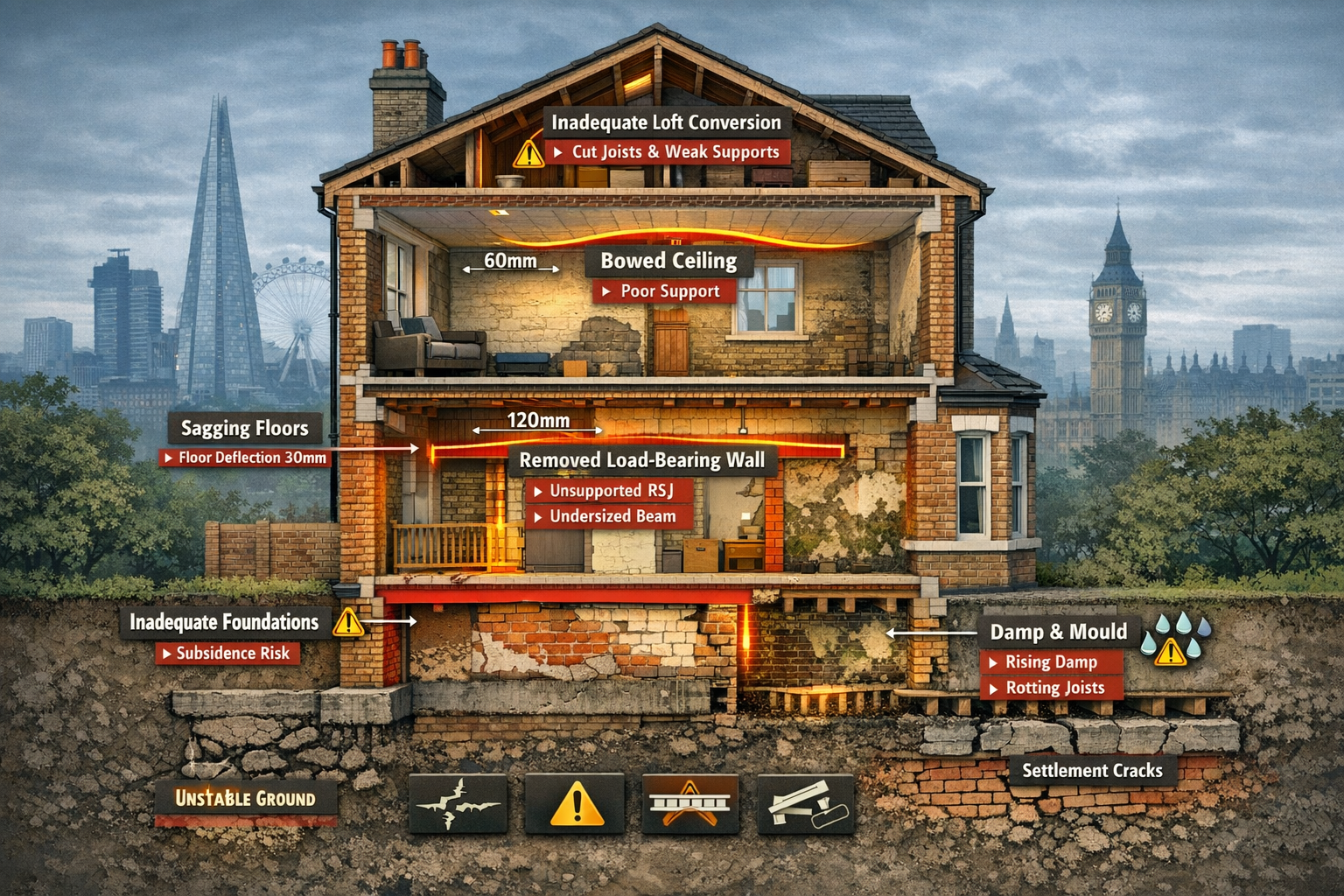
The post-Grenfell regulatory environment has fundamentally transformed how surveyors assess residential blocks. EWS1 certification now stands as a critical component of any building survey for flats in buildings over 11 meters (approximately five storeys) in height.
Understanding EWS1 Form Requirements
The External Wall System (EWS1) form provides confirmation that a qualified fire engineer has assessed a building's external wall construction and determined it meets current safety standards. Major lenders including Halifax, Santander UK, Barclays, and NatWest have implemented strict lending criteria requiring valid EWS1 certification[1].
Key assessment criteria include:
- External wall construction materials and fire rating
- Cladding systems and combustibility classification (A1, A2, B, C, D ratings)
- Cavity barriers and fire stopping adequacy
- Balcony construction and separation
- Attachments to external walls (signage, solar panels)
Properties receiving a B1 or B2 rating (indicating combustible materials requiring remediation) face severe mortgage restrictions. Surveyors must clearly communicate that such ratings typically render properties unmortgageable until remediation completes.
Remediation Costs and Leaseholder Liability
Remediation bills have reached staggering levels, with costs of £40,000-£60,000 per flat reported in certain developments as of early 2026[1]. These figures apply to buildings falling outside government protection schemes or those with defects extending beyond cladding issues.
Surveyors should investigate:
- Whether the building qualifies for government remediation funding
- Developer pledges or warranties covering defect costs
- Section 20 notices already served on leaseholders
- Sinking fund adequacy for anticipated works
- Managing agent competence and track record
"Buyer due diligence has become more forensic, with prospective purchasers, solicitors, and mortgage brokers now conducting deeper investigations upfront, asking specific questions about EWS1 status, building height, external wall conditions, and the managing agent's credibility."[1]
Insurance Premium Escalation
Buildings with unresolved fire safety issues face dramatically increased insurance premiums—or complete inability to obtain coverage. This creates a cascading effect where:
- Insurance costs rise 200-400% in some cases
- Service charges increase to cover higher premiums
- Leaseholder affordability deteriorates
- Property values decline due to reduced buyer pool
- Mortgage lenders further restrict lending
Chartered surveyors across South West London and West London report that insurance documentation now forms a critical component of pre-purchase investigations.
Leasehold Complications and Service Charge Red Flags in London's Flat Market
Beyond structural and fire safety concerns, leasehold tenure introduces additional complexity that surveyors must thoroughly investigate and clearly communicate to buyers.
Lease Length and Mortgage Implications
Lease length directly impacts both property value and mortgageability. The critical thresholds surveyors must flag include:
- Under 80 years: Marriage value becomes payable, dramatically increasing lease extension costs
- Under 70 years: Many lenders refuse mortgages entirely
- Under 60 years: Property becomes extremely difficult to sell
- Under 50 years: Lease extension costs may exceed property value
Ground rent provisions require careful scrutiny. Legacy leases with aggressive doubling clauses—where ground rent doubles every 10-15 years—create long-term affordability concerns that lenders now heavily penalize[1].
Service Charge Analysis and Escalation Trends
Rising service charges designed to cover communal area maintenance and long-term repairs have created significant affordability concerns for flat owners[1]. Surveyors should conduct comprehensive service charge analysis including:
Historical trend analysis (minimum 5-year review):
- Annual service charge amounts and percentage increases
- Major works contributions and frequency
- Reserve/sinking fund balances and adequacy
- Insurance premium escalation patterns
Future liability assessment:
- Section 20 consultation notices (indicating major works over £250 per flat)
- Building condition and anticipated repair schedules
- Lift replacement/refurbishment requirements
- Roof, windows, and common area renewal needs
🔍 Red Flag Indicators: Service charges increasing above inflation rates (>5% annually), depleted sinking funds, deferred maintenance backlogs, or managing agents with poor complaint records all warrant serious buyer caution.
Managing Agent Quality and Building Management
The competence of the managing agent significantly impacts both property enjoyment and long-term value. Surveyors should research:
- Agent's regulatory compliance record
- Response times to maintenance issues
- Financial management and accounting transparency
- Leaseholder satisfaction levels
- Track record with major works procurement
Properties managed by reputable agents with robust maintenance programs typically command premium values and experience smoother transaction processes.
Shared Ownership and Section 20 Notices
Section 20 notices indicate that major works exceeding £250 per leaseholder are proposed. Active Section 20 consultations represent significant red flags requiring detailed investigation:
- Scope and nature of proposed works
- Estimated costs per flat
- Timeline for completion
- Leaseholder consultation responses
- Potential for cost overruns
Buyers inheriting Section 20 liabilities may face immediate five or six-figure bills, making clear communication of these risks essential.
Professional Survey Types and When to Recommend Each Level
Understanding which survey level to recommend for specific flat types ensures clients receive appropriate advice while managing professional liability exposure.
RICS Home Survey Level 1 (Condition Report)
Best suited for: Modern flats in good condition, typically less than 10 years old, constructed by reputable developers with NHBC or similar warranties.
This basic survey provides:
- Visual inspection of accessible areas
- Traffic light condition ratings (1-3)
- No valuation included
- Costs typically £300-£450
⚠️ Not recommended for: Properties over 15 years old, converted buildings, or those with visible defects.
RICS Home Survey Level 2 (HomeBuyer Report)
Best suited for: Conventional flats in reasonable condition, purpose-built blocks from 1980s onwards, properties requiring mortgage valuations.
Includes:
- More detailed inspection than Level 1
- Market valuation and insurance reinstatement figure
- Identification of urgent defects and potential issues
- Costs typically £450-£800
This represents the most common survey type for standard London flats. For comprehensive guidance on selecting appropriate surveys, consult resources on what survey you need.
RICS Home Survey Level 3 (Building Survey)
Essential for: Properties over 50 years old, unusual construction, flat conversions, properties in poor condition, or where significant alterations are planned[2].
Provides:
- Comprehensive structural assessment
- Detailed defect analysis with remediation advice
- No standard format—tailored to property
- Costs typically £800-£1,500+
Level 3 surveys are strongly recommended for Victorian and Edwardian conversions, properties with visible structural movement, or buildings lacking EWS1 certification where detailed fire safety assessment is required.
Specialized Surveys for Specific Concerns
Certain circumstances warrant additional specialist investigations:
- Drone roof surveys for inaccessible flat roofs or high-rise buildings
- Subsidence surveys where active movement is suspected
- Snagging surveys for new-build flats (typically £320-£600)
- Electrical condition reports for properties with outdated wiring
- Asbestos surveys for buildings constructed before 2000
Communicating Survey Findings to Buyers in 2026's Market
Effective communication of survey findings has become increasingly important as buyers conduct more thorough due diligence before committing to purchases.
Structuring Reports for Maximum Clarity
Modern survey reports should prioritize:
Executive summary format:
- Critical issues requiring immediate attention (Category 3 defects)
- Significant issues requiring attention (Category 2 defects)
- Cost implications and repair urgency
- Impact on mortgage and insurance availability
Photographic evidence: High-resolution images with annotations clearly showing defects, measurement scales, and comparative examples help non-technical buyers understand severity.
Cost estimates: Providing realistic repair cost ranges enables buyers to negotiate purchase prices or budget for post-completion works.
Highlighting Deal-Breaking Issues
Certain defects should be clearly flagged as potentially transaction-ending:
✋ Deal-breakers requiring immediate disclosure:
- Lack of EWS1 certification on buildings requiring it
- Active subsidence without adequate insurance or remediation
- Structural alterations lacking Building Regulations approval
- Lease length under 70 years without seller commitment to extend
- Section 20 notices for works exceeding £30,000 per flat
Regional Market Context
Regional market disparities significantly affect how survey findings impact transactions[1]. Prime central London markets demonstrate greater resilience to defects than secondary markets, where buyers exercise more caution.
Surveyors operating across different London regions—from South East London to East London—should calibrate advice based on local market conditions and buyer expectations.
Conclusion
Building survey red flags in flats: identifying structural issues in London's stabilizing market requires a comprehensive, multi-layered approach that extends far beyond traditional structural assessment. As the market regains confidence in 2026, surveyors must balance thorough defect identification with clear communication of risks and remediation pathways.
The convergence of fire safety regulation, leasehold reform, and tightened lending criteria has created an environment where professional survey expertise has never been more valuable. Buyers rely on chartered surveyors to navigate complex technical, legal, and financial considerations that determine whether a flat purchase represents sound investment or potential financial disaster.
Actionable Next Steps for Surveyors
- Enhance EWS1 knowledge: Develop expertise in fire safety assessment or establish referral relationships with qualified fire engineers
- Expand due diligence protocols: Incorporate service charge analysis, managing agent research, and lease term reviews into standard survey processes
- Invest in technology: Utilize thermal imaging, moisture meters, and drone surveys to provide comprehensive assessments
- Strengthen communication: Develop clear, accessible reporting formats that help buyers understand complex technical issues
- Stay current: Monitor regulatory changes, lender policy updates, and market trends affecting flat mortgageability
For Prospective Flat Buyers
Engage qualified chartered surveyors early in the purchase process. Request Level 3 surveys for older or converted properties, and ensure your surveyor specifically investigates EWS1 status, service charge trends, and lease terms. The investment in comprehensive professional advice can prevent catastrophic financial mistakes and provide negotiating leverage when defects are identified.
London's flat market stabilization offers opportunities for informed buyers willing to conduct thorough due diligence. With expert survey guidance, structural issues become manageable considerations rather than hidden dangers, enabling confident property decisions in an increasingly complex market landscape.
References
[1] Property Report UK – https://www.youtube.com/watch?v=WYBbz0Jx2Jo
[2] What Sort Of Survey Should I Have – https://hoa.org.uk/advice/guides-for-homeowners/i-am-buying/what-sort-of-survey-should-i-have/