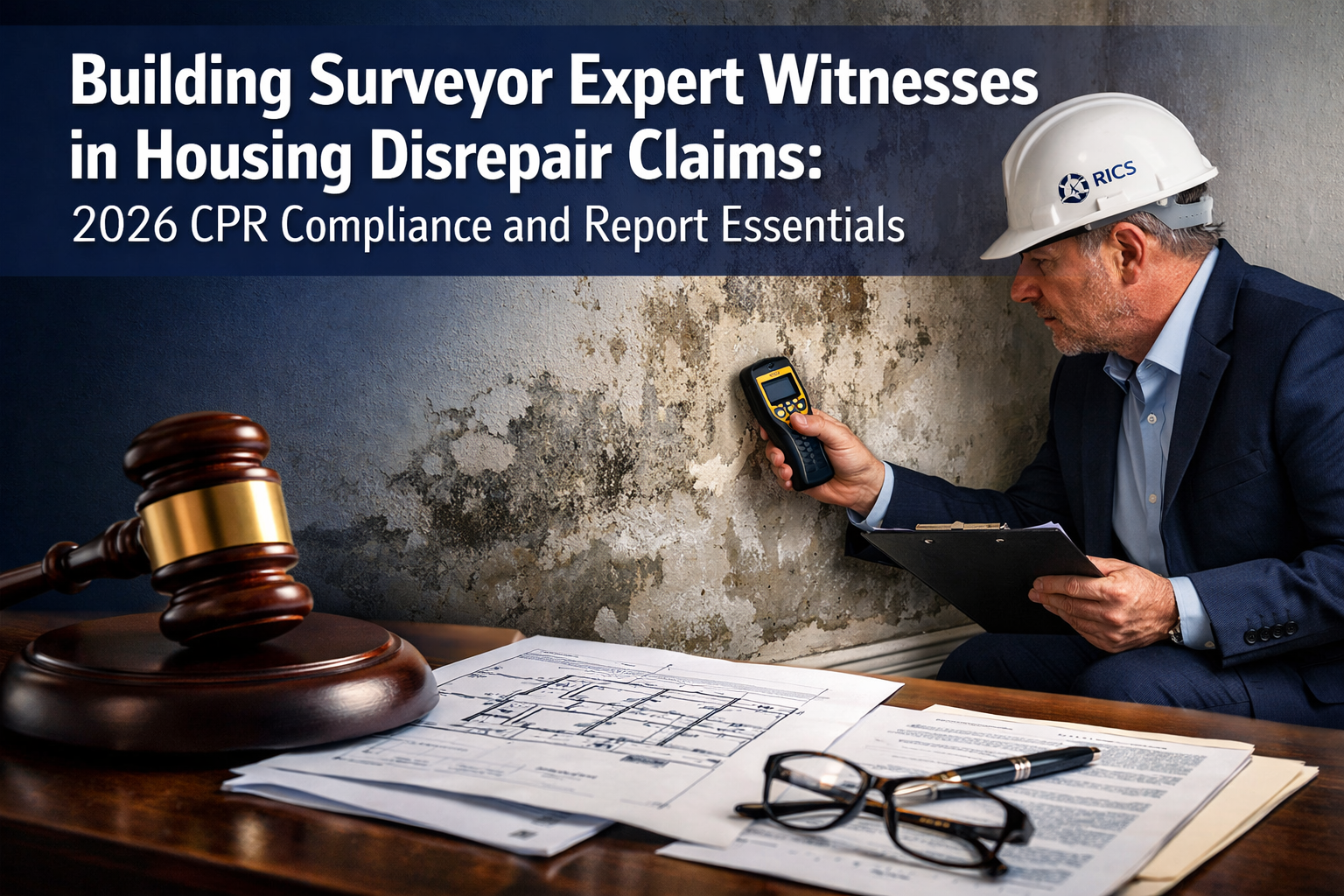

Courts reject approximately 30% of expert witness reports in housing disrepair cases due to non-compliance with Civil Procedure Rules, resulting in immediate case dismissal and wasted legal costs. This stark reality underscores the critical importance of understanding Building Surveyor Expert Witnesses in Housing Disrepair Claims: 2026 CPR Compliance and Report Essentials for legal professionals, property owners, and tenants navigating complex property condition disputes.
As housing disrepair litigation continues to escalate in 2026—particularly following the expansion of Awaab's Law—the role of qualified building surveyors as expert witnesses has never been more crucial. These professionals must balance technical expertise with strict legal compliance, providing impartial evidence that assists courts in resolving disputes fairly. Understanding the essential requirements for expert witness reports ensures that cases proceed smoothly and justice is served.
Key Takeaways
- CPR Part 35 compliance is mandatory: Non-compliant expert witness reports risk complete rejection by judges, potentially causing case failure and significant financial losses
- Court duty supersedes client loyalty: Building surveyor expert witnesses must provide unbiased opinions with their primary obligation to the court, not the instructing party
- Comprehensive documentation is essential: Reports must include specific elements including statement of truth, qualifications disclosure, conflict of interest declarations, and clear distinction between facts and assumptions
- 2026 regulatory changes increase demand: Awaab's Law expansion is projected to generate a 40% increase in housing disrepair disputes requiring expert witness involvement[9]
- Professional qualifications matter: RICS-accredited surveyors with specialized housing disrepair experience provide the most credible and defensible expert testimony
Understanding the Role of Building Surveyor Expert Witnesses in Housing Disrepair Claims
Building surveyor expert witnesses serve as independent technical advisors to the court in housing disrepair litigation. Their primary function is to provide objective, evidence-based opinions on property conditions, defect causation, and appropriate remedial measures. Unlike advocates who represent one party's interests, expert witnesses must maintain strict impartiality throughout the legal process.
What Constitutes Housing Disrepair?
Housing disrepair refers to the deterioration of a building from its original or properly maintained state due to lack of maintenance, natural wear and tear, or damage.[3] This deterioration compromises the property's safety, functionality, and aesthetic value, potentially creating hazardous living conditions for occupants.
Common categories of housing disrepair include:
- 🏚️ Structural defects: Cracking walls, subsidence, roof failures, and foundation issues
- 💧 Damp and mould: Rising damp, penetrating moisture, condensation, and fungal growth
- ⚡ Faulty systems: Defective plumbing, electrical hazards, and heating failures
- 🪟 External envelope failures: Damaged windows, doors, and weatherproofing elements
- 🏗️ Safety hazards: Unstable structures, fire safety deficiencies, and trip hazards
Building surveyors with expertise in building surveyor services possess the technical knowledge to identify, assess, and document these defects comprehensively.
The Expert Witness's Overriding Duty to the Court
The fundamental principle governing expert witness conduct is the overriding duty to the court. This means that regardless of who instructs and pays the expert, their primary obligation is to assist the court in reaching a fair and informed decision.[2]
This duty requires experts to:
✅ Provide opinions based solely on technical evidence and professional judgment
✅ Remain impartial and avoid advocacy for either party
✅ Acknowledge limitations in their expertise or available evidence
✅ Modify opinions if new evidence emerges
✅ Communicate clearly with opposing experts to narrow issues in dispute
Failure to uphold this duty can result in the expert's evidence being disregarded, professional sanctions, and damage to their reputation within the legal community.
CPR Part 35 Compliance Requirements for Building Surveyor Expert Witnesses in Housing Disrepair Claims
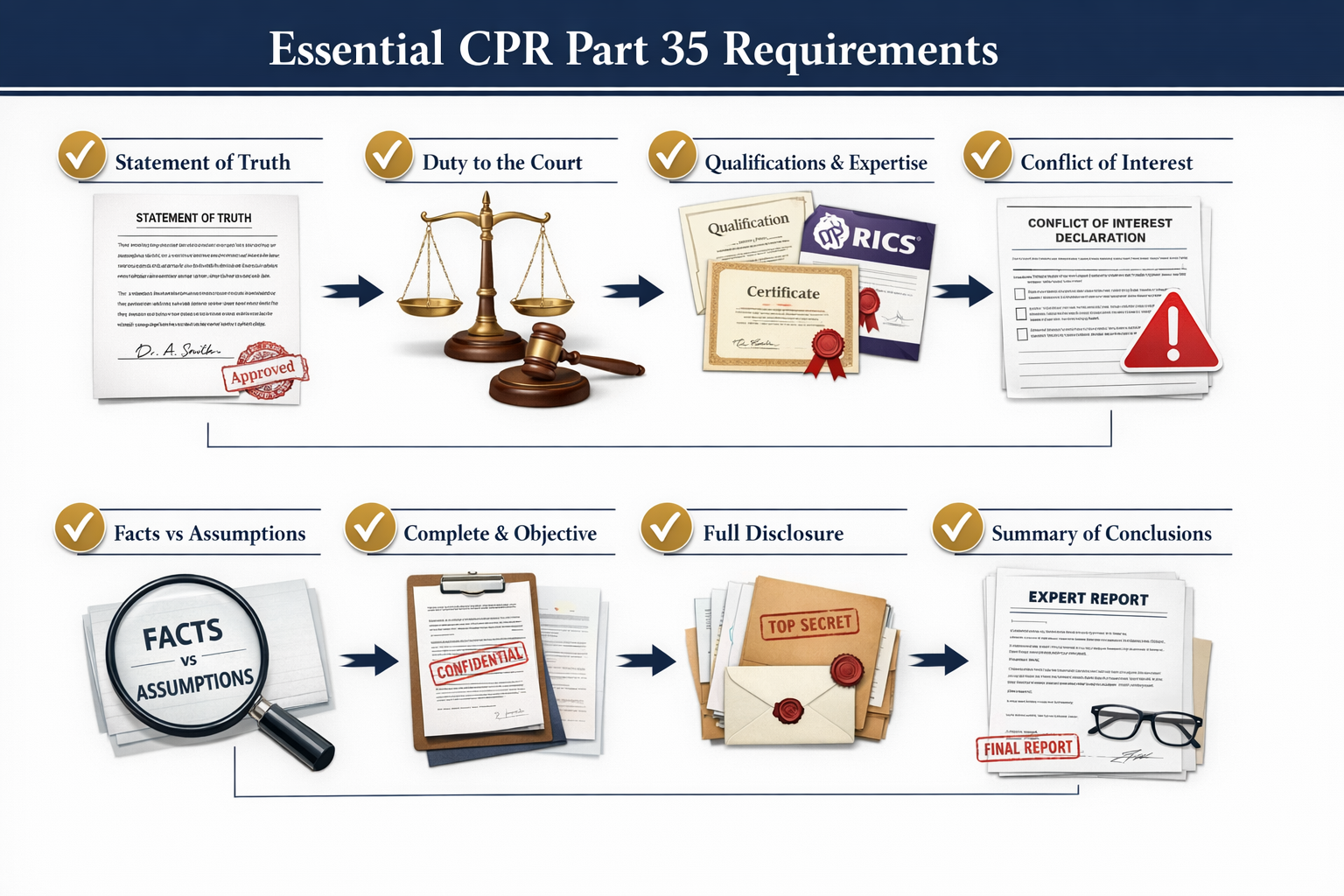
Part 35 of the Civil Procedure Rules establishes the framework for expert evidence in civil proceedings in England and Wales. Compliance with these requirements is mandatory, not optional.[1] Non-compliant reports may be rejected entirely by judges, causing severe detriment to the case and potentially resulting in trial loss.[2]
Essential Elements of a CPR Part 35 Compliant Report
Every expert witness report in housing disrepair claims must contain specific elements to satisfy CPR Part 35 requirements:
1. Statement of Truth
The report must conclude with a statement of truth using the exact CPR Part 35 wording:[2]
"I confirm that I have made clear which facts and matters referred to in this report are within my own knowledge and which are not. Those that are within my own knowledge I confirm to be true. The opinions I have expressed represent my true and complete professional opinions on the matters to which they refer."
This statement must be signed and dated by the expert personally.
2. Court Duty Declaration
The report must contain a clear statement confirming the expert understands their duty to the court and has complied with this duty and all CPR Part 35 requirements.[2] This typically appears near the beginning of the report and reinforces the expert's impartiality.
3. Expert Qualifications and Experience
The report must provide comprehensive details of the expert's relevant qualifications, professional memberships, and experience.[2] For building surveyors, this includes:
- Professional qualifications: MRICS, FRICS, or equivalent chartered status
- Specialist training: Housing disrepair, damp investigation, structural assessment
- Relevant experience: Years practicing, number of similar cases, specific expertise areas
- Professional memberships: RICS, specialist surveying organizations
- Continuing professional development: Recent training and knowledge updates
Experts with expert surveyor advice credentials and demonstrable housing disrepair expertise provide the most credible testimony.
4. Facts vs. Assumptions: Clear Distinction
One of the most critical requirements is that experts must explicitly distinguish between facts they know to be true and facts they assume to be true.[2] This transparency allows the court to assess the reliability of the expert's conclusions.
Best practice formatting:
| Category | Description | Example |
|---|---|---|
| Known Facts | Information directly observed or verified by the expert | "I personally inspected the property on 15th March 2026 and observed active water ingress through the roof" |
| Assumed Facts | Information provided by others or inferred from evidence | "Based on the tenant's statement, I assume the leak has been present since December 2025" |
| Professional Opinion | Conclusions drawn from facts and expertise | "In my professional opinion, the water ingress has caused the timber joists to decay, requiring replacement" |
5. Conflict of Interest Disclosure
Expert reports must address whether there is an actual or potential conflict of interest.[2] This is particularly important when the expert is employed by one of the parties or has a financial relationship with them beyond the current case.
Courts scrutinize these relationships carefully and may give greater weight to reports from genuinely independent experts. Building surveyors should disclose:
- Employment relationships with instructing parties
- Financial interests in the outcome
- Previous professional relationships with parties
- Any other circumstances that might affect impartiality
6. Documentation of Sources and Methodology
The report must provide comprehensive details of:[2]
- All literature and materials relied upon: Technical standards, building regulations, industry guidance
- Testing and investigations conducted: Moisture readings, thermal imaging, structural calculations
- Who performed tests: Whether the expert personally conducted investigations or relied on others' work
- Inspection methodology: Date, duration, access limitations, weather conditions
- Photographic evidence: Dated, captioned images showing defects and context
This documentation allows opposing experts and the court to verify the expert's methodology and challenge conclusions if appropriate.
Common CPR Part 35 Compliance Failures
Understanding frequent mistakes helps building surveyors avoid report rejection:
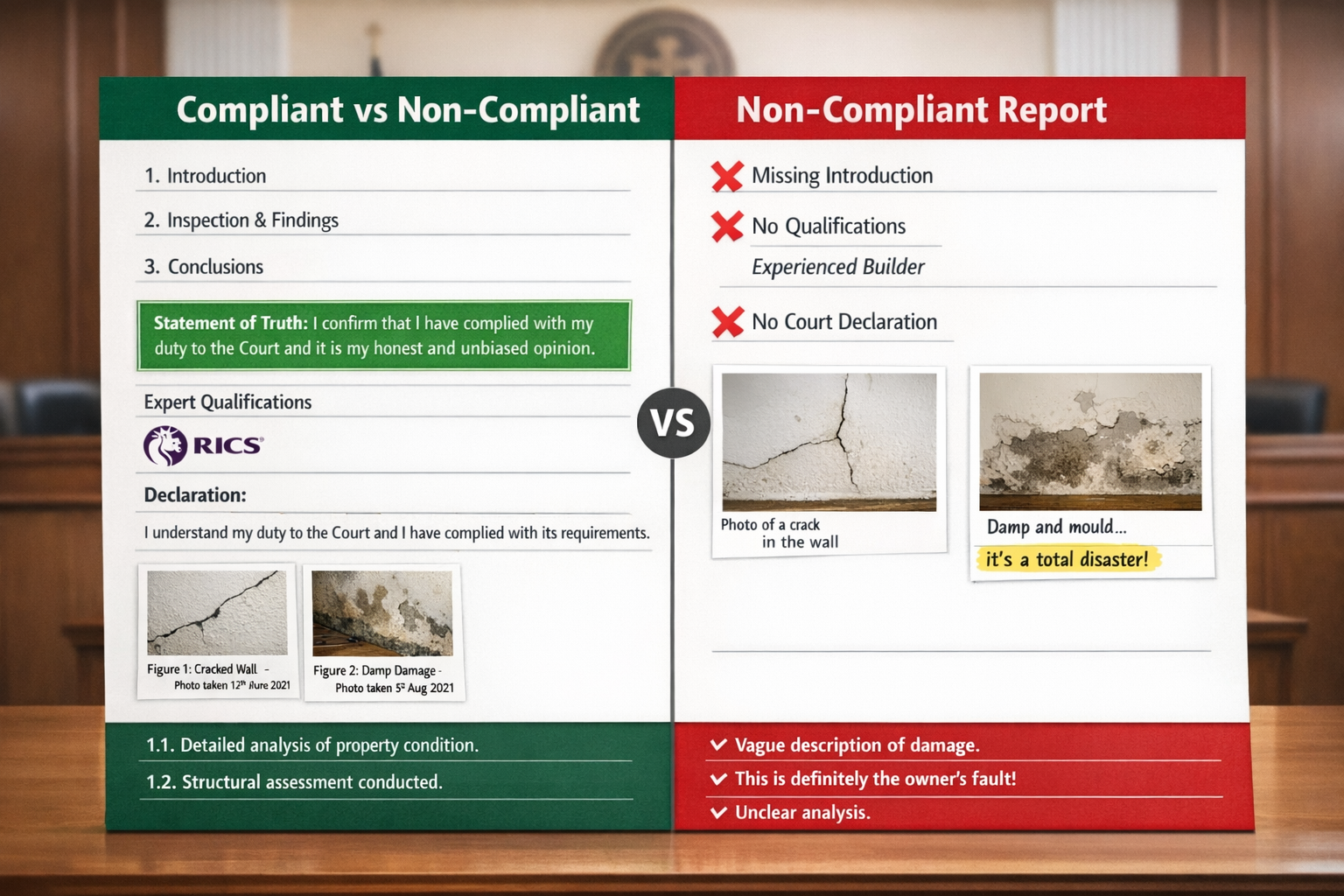
❌ Advocacy language: Using partisan phrases like "my client's property" or "the defendant's negligence"
❌ Missing statement of truth: Forgetting to include or properly sign the mandatory declaration
❌ Inadequate qualifications section: Vague descriptions of expertise without specific credentials
❌ Failure to distinguish facts from assumptions: Presenting assumed information as verified fact
❌ Incomplete conflict disclosure: Not addressing potential conflicts or employment relationships
❌ Unreferenced opinions: Making technical conclusions without citing supporting evidence or methodology
❌ Selective evidence presentation: Highlighting only evidence favorable to the instructing party
Report Structure and Essential Content for Building Surveyor Expert Witnesses in Housing Disrepair Claims
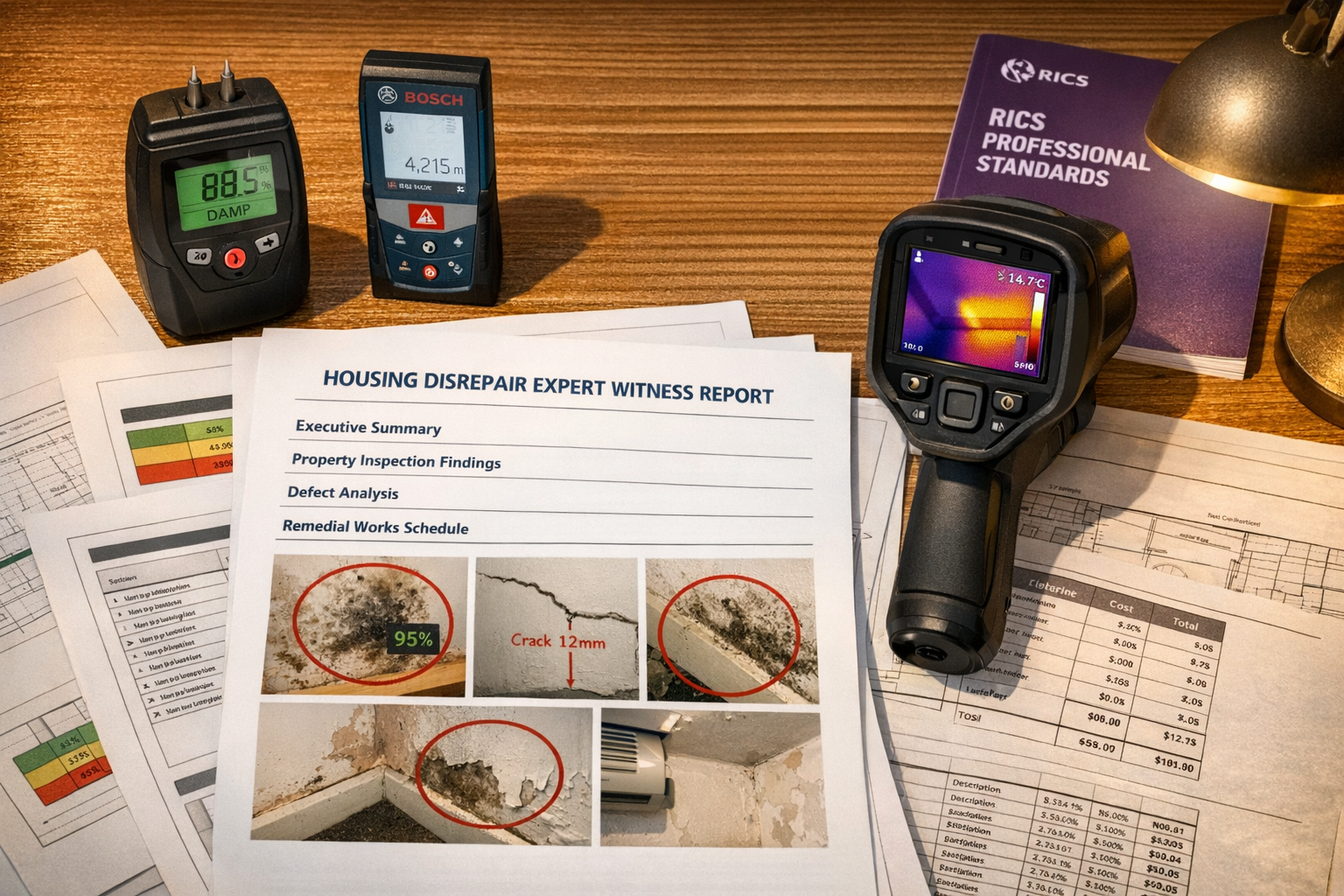
A well-structured expert witness report follows a logical progression that guides the court from background information through technical analysis to clear conclusions. While CPR Part 35 doesn't mandate a specific structure, best practice has established an effective framework.
Recommended Report Structure
Section 1: Introduction and Instructions
This opening section establishes the context and scope of the expert's involvement:
- Case details: Parties, court reference, claim type
- Instructions received: What the expert was asked to investigate and opine upon
- Documents reviewed: List of all materials provided (tenancy agreements, repair records, previous surveys)
- Inspection details: Date, time, attendees, access limitations
- Report purpose: Clarification that the report is prepared for court proceedings
Section 2: Expert Qualifications and Declaration
As discussed previously, this section must comprehensively detail:
- Professional qualifications and memberships
- Relevant experience in housing disrepair assessment
- Statement of understanding court duty
- Conflict of interest disclosure
Section 3: Property Description and Background
A factual description of the subject property including:
- Property type: House, flat, maisonette, etc.
- Age and construction: Victorian terrace, 1960s concrete frame, etc.
- Tenure: Social housing, private rental, leasehold
- Occupancy: Number of residents, vulnerable occupants
- Repair history: Known previous issues and remedial works
This section should clearly distinguish between facts known to the expert (from personal observation) and facts assumed based on documents or statements.
Section 4: Inspection Findings
This is the core technical section documenting all defects observed. Effective presentation includes:
Defect-by-defect analysis:
For each identified defect, the report should address:
- Location: Precise description (e.g., "first floor rear bedroom, north-facing external wall")
- Description: Detailed technical description of the defect
- Photographic evidence: Referenced, dated, captioned images
- Measurements: Moisture readings, crack widths, affected areas
- Severity assessment: Impact on health, safety, and habitability
Example defect description:
Defect 1: Penetrating Damp – First Floor Rear Bedroom
Location: North-facing external wall, approximately 2.5m from floor level
Description: I observed extensive damp staining covering approximately 1.2m² of plaster surface, accompanied by visible mould growth (black/green spores). The affected area was soft to touch, indicating saturated substrate.
Measurements: Moisture meter readings recorded 28% moisture content (normal range: <15%). Surface temperature 3°C below ambient, indicating thermal bridging.
Photographic Evidence: See Figures 1-4 (pages 12-13)
Severity: High – Creates conditions conducive to mould growth, potential respiratory health hazards, thermal discomfort
Similar specific defect reports provide detailed analysis of individual property issues.
Section 5: Causation Analysis
This section demonstrates the expert's technical reasoning by explaining:
- Root causes: Why defects have occurred (design failure, lack of maintenance, building defect)
- Contributing factors: Secondary issues exacerbating problems
- Timescales: When defects likely originated and how they've progressed
- Responsibility: Whether defects fall within landlord's repairing obligations
Professional opinion should be clearly labeled:
"In my professional opinion, the penetrating damp in the first floor bedroom has been caused by failure of the external render system, allowing rainwater ingress through cracks in the facade. This is a structural defect falling within the landlord's repairing covenant under Section 11 of the Landlord and Tenant Act 1985."
Section 6: Remedial Works Specification
The expert must specify appropriate remedial measures including:
- Scope of works: Detailed description of repairs required
- Methodology: How repairs should be executed to industry standards
- Materials: Appropriate materials and specifications
- Timescales: Reasonable timeframes for completion
- Cost estimates: Indicative or detailed costings for remedial works
- Temporary measures: Immediate actions to mitigate harm while awaiting permanent repairs
This section should reference relevant technical standards such as:
- Building Regulations Approved Documents
- British Standards (BS codes)
- RICS guidance notes
- Industry best practice publications
Section 7: Impact Assessment
For housing disrepair claims, the court needs to understand the impact on occupants:
- Health implications: Respiratory issues from mould, stress, sleep disturbance
- Safety hazards: Risk of injury, fire safety concerns
- Habitability: Rooms rendered unusable, loss of amenity
- Duration of impact: How long occupants have suffered these conditions
This assessment supports claims for damages and injunctive relief.
Section 8: Conclusions and Summary
A concise summary that:
- Lists key defects identified
- States primary conclusions about causation and responsibility
- Confirms compliance with CPR Part 35 requirements
- Includes the mandatory statement of truth (signed and dated)
Supplementary Documentation
Expert witness reports should be accompanied by:
📎 Appendices: Detailed photographs, floor plans, technical drawings
📎 CV: Current curriculum vitae demonstrating qualifications and experience
📎 Fee schedule: Transparent disclosure of fees charged (if required by court directions)
📎 Testing certificates: Laboratory reports, specialist investigation results
The 2026 Regulatory Landscape: Awaab's Law and Increased Expert Witness Demand
The expansion of Awaab's Law in 2026 represents a significant shift in housing standards enforcement. Named after two-year-old Awaab Ishak, who died from prolonged exposure to mould in social housing, this legislation imposes strict timeframes for landlords to address health hazards.
Impact on Expert Witness Requirements
The 2026 expansion introduces five new hazard categories, generating an estimated 40% increase in landlord-tenant disputes requiring expert witness involvement.[9] This surge in demand emphasizes the need for:
- Rapid response capabilities: Experts must conduct inspections and produce reports within tight timeframes
- Enhanced hazard assessment expertise: Understanding the Health and Safety Rating System (HHSRS) and new hazard categories
- Rental valuation integration: Assessing diminution in rental value due to disrepair conditions[9]
- Compliance documentation: Demonstrating whether landlords met statutory repair timeframes
Building surveyors serving as expert witnesses must stay current with these evolving regulatory requirements through continuing professional development.
Distinguishing Housing Disrepair from Other Property Disputes
While this article focuses on housing disrepair claims, building surveyor expert witnesses may also be instructed in related property matters:
- Boundary disputes: Requiring specialist boundary survey expertise
- Party wall matters: Involving party wall agreed surveyors
- Commercial dilapidations: Requiring commercial property surveying expertise
- Structural defects: Sometimes requiring input from residential structural engineers
Each dispute type has specific technical and legal considerations, though CPR Part 35 compliance requirements remain consistent across all expert witness roles.
Best Practices for Building Surveyor Expert Witnesses in 2026
Professional Development and Specialization
Maintaining credibility as an expert witness requires ongoing investment in professional development:
✅ Regular CPR training: Attending courses on expert witness duties and civil procedure
✅ Technical updates: Staying current with building pathology research, remedial techniques, and materials science
✅ Regulatory knowledge: Understanding housing legislation, building regulations, and case law developments
✅ Cross-examination preparation: Developing skills to defend opinions under hostile questioning
✅ Report writing excellence: Practicing clear, concise, jargon-free communication
Maintaining Independence and Objectivity
The expert's independence is their most valuable asset. Protecting this requires:
- Declining inappropriate instructions: Refusing cases where conflicts of interest cannot be managed
- Resisting pressure: Maintaining professional opinions despite client pressure to modify conclusions
- Transparent methodology: Documenting decision-making processes to demonstrate objectivity
- Willingness to concede: Acknowledging when opposing experts raise valid points
- Professional insurance: Maintaining adequate professional indemnity coverage
Effective Communication with Legal Teams
While maintaining independence, experts must communicate effectively with instructing solicitors:
- Clarifying instructions: Ensuring the scope of investigation is clearly defined
- Managing expectations: Explaining what opinions can and cannot be supported by evidence
- Timely updates: Informing solicitors of significant findings or difficulties encountered
- Joint expert discussions: Engaging constructively with opposing experts to narrow issues
- Court availability: Confirming availability for hearings well in advance
Documentation and Record Keeping
Meticulous documentation protects experts and strengthens their evidence:
📝 Inspection notes: Contemporaneous records of all observations
📝 Photographic metadata: Ensuring images are dated, geo-tagged, and properly captioned
📝 Correspondence files: Retaining all instructions, queries, and responses
📝 Draft reports: Keeping versions to demonstrate opinion development
📝 Research materials: Maintaining files of technical references consulted
This documentation may be subject to disclosure and should be maintained professionally.
Regional Considerations and Local Expertise
Housing conditions and construction methods vary significantly across regions, making local expertise valuable. Building surveyors with regional specialization understand:
- Local construction types: Victorian terraces in Battersea, post-war estates in Enfield, Georgian properties in Hampstead
- Regional climate factors: Coastal exposure in Sussex, clay soil issues in Essex
- Local authority practices: Building control approaches, social housing standards
- Regional cost variations: Realistic repair cost estimates for different areas
Experts should acknowledge the limits of their regional knowledge and decline instructions outside their geographical expertise when necessary.
Fee Structures and Commercial Considerations
Expert witness work requires transparent fee arrangements:
Common fee structures:
- Hourly rates: £150-£300+ per hour depending on experience and complexity
- Fixed fees: Agreed amounts for report preparation, court attendance
- Staged payments: Deposits, interim payments, final balance on completion
- Cancellation terms: Charges for aborted inspections or withdrawn instructions
Experts must ensure fee arrangements don't create conflicts of interest or appearance of bias. Contingency fees (payment dependent on case outcome) are prohibited for expert witnesses as they compromise independence.
Conclusion: Excellence in Building Surveyor Expert Witness Practice
Serving as a building surveyor expert witness in housing disrepair claims demands the highest standards of technical competence, professional integrity, and legal compliance. As the regulatory landscape evolves in 2026 with Awaab's Law expansion and increasing tenant protections, the role of expert witnesses becomes ever more critical in ensuring justice for vulnerable occupants while providing fair resolution for property owners.
Key success factors include:
🎯 Absolute CPR Part 35 compliance: Non-negotiable adherence to all procedural requirements
🎯 Unwavering impartiality: Maintaining court duty above client interests
🎯 Technical excellence: Deep expertise in building pathology and housing standards
🎯 Clear communication: Translating complex technical issues into accessible language
🎯 Professional development: Continuous learning and skill enhancement
Actionable Next Steps
For building surveyors seeking to develop expert witness capabilities:
- Complete specialized CPR Part 35 training through RICS or legal education providers
- Gain practical experience through mentorship with established expert witnesses
- Develop comprehensive report templates incorporating all mandatory elements
- Build expertise in specific housing disrepair categories (damp, structural defects, etc.)
- Maintain detailed CPD records demonstrating ongoing professional development
For legal professionals instructing expert witnesses:
- Verify expert qualifications and relevant experience before instruction
- Provide clear, comprehensive instructions defining scope and key issues
- Supply all relevant documentation to enable thorough analysis
- Allow adequate time for inspection and report preparation
- Review draft reports for CPR Part 35 compliance before finalization
For property owners and tenants involved in disrepair claims:
- Understand that expert witnesses serve the court, not individual parties
- Provide honest, complete information to enable accurate assessment
- Recognize that expert opinions are based on evidence, not desired outcomes
- Appreciate the value of early expert involvement in resolving disputes
- Consider whether professional survey services might prevent disputes through proactive property assessment
The intersection of technical expertise, legal compliance, and professional ethics makes building surveyor expert witness work both challenging and rewarding. Those who master these requirements provide invaluable service to the justice system while advancing professional standards across the surveying profession.
As housing standards continue to evolve and tenant protections strengthen, the demand for qualified, competent, and truly independent expert witnesses will only increase. Building surveyors who invest in developing these specialized skills position themselves at the forefront of this critical professional service, contributing to better housing outcomes for all parties involved in property disputes.
References
[1] Part 35 Compliant Housing Disrepair Expert Witness Reports – https://kershawsurveyors.com/services/part-35-compliant-housing-disrepair-expert-witness-reports/
[2] Disrepair Housing Conditions Claims Your Case Is Only As Strong As Your Expe 102mkj2 – https://www.clarkewillmott.com/views/disrepair-housing-conditions-claims-your-case-is-only-as-strong-as-your-expe-102mkj2/
[3] Building Surveyor Expert Witness – https://www.expertcourtreports.co.uk/building-surveyor-expert-witness/
[9] Expert Witness Preparation For Awaabs Law Expansion Disputes 2026 Hazard Assessments In Rental Valuations – https://nottinghillsurveyors.com/blog/expert-witness-preparation-for-awaabs-law-expansion-disputes-2026-hazard-assessments-in-rental-valuations