

The London property market has entered 2026 with a confidence not seen in years. After a period of price corrections and market uncertainty, flats across the capital and South East are attracting renewed buyer interest—but with one crucial difference: realistic pricing. For building surveyors and property professionals, this stabilization presents unique challenges and opportunities when conducting Building Surveys for Flats in Recovering Markets: Valuation Techniques as London and South East Stabilize in 2026. Understanding how to accurately assess and value flats in this transitional environment has become essential for protecting buyers, informing sellers, and ensuring lenders make sound decisions.
With average asking prices rising 2.8% in January 2026—the largest January increase on record—and stock levels at their highest since 2014, the market dynamics have fundamentally shifted. The days of dramatic appreciation are behind us, replaced by steady, sustainable growth projected between 2-5% annually. This new reality requires surveyors to adopt updated frameworks that account for market stabilization while maintaining rigorous assessment standards.
Key Takeaways
- Market stabilization in London and the South East requires surveyors to adopt valuation techniques that reflect realistic pricing rather than inflated expectations from previous years
- Building surveys for flats must now incorporate comprehensive defect analysis alongside market-aware valuations that account for the 2-5% growth trajectory
- Professional presentation matters more in balanced markets where buyers have increased choice and scrutiny of property condition directly impacts negotiation outcomes
- Updated valuation frameworks combining comparative, investment, and cost methods provide the most accurate assessments in recovering market conditions
- Chartered surveyors play a critical role in bridging the gap between historical price points and current market realities for flat purchases
Understanding the 2026 London and South East Market Recovery
The Shift from Distressed to Balanced Markets
The property landscape across London and the South East has transformed significantly as we move through 2026. After years of uncertainty driven by economic pressures, interest rate volatility, and affordability challenges, the market has found its footing. This recovery isn't characterized by the dramatic price surges of previous decades but rather by sustainable stabilization that benefits all market participants.
Stock levels reaching their highest point since 2014 for this time of year signals a fundamental shift. Buyers now have genuine choice, which means properties must compete on merit—both in terms of condition and pricing. For chartered surveyors across South East London, this environment demands precision in both building assessment and valuation methodology.
Key Market Indicators Affecting Flat Valuations
Several critical factors are shaping how flats should be valued in 2026:
- Falling mortgage rates creating renewed affordability and buyer confidence
- Realistic asking prices replacing the inflated expectations of 2021-2022
- Increased inventory providing better comparative data for valuation purposes
- Buyer scrutiny intensifying around property condition and defects
- Regional variations with some South East areas outperforming central London zones
Understanding these indicators is essential when conducting building surveys for flats in recovering markets. The valuation must reflect not just the property's physical condition but its position within this evolving landscape.
Why Traditional Valuation Methods Need Updating
Traditional valuation approaches developed during periods of consistent growth or decline don't always translate effectively to recovering markets. The challenge lies in determining whether current pricing represents true stabilization or temporary plateaus before further adjustment.
Surveyors must now integrate:
✅ Historical price analysis showing the adjustment journey from peak to present
✅ Market velocity metrics indicating how quickly similar flats are selling
✅ Condition-adjusted comparables rather than simple like-for-like pricing
✅ Forward-looking growth projections based on the 2-5% expectation
✅ Defect impact assessments that reflect buyer negotiating power in balanced markets
Building Surveys for Flats in Recovering Markets: Essential Assessment Components
Structural and Defect Analysis in Market Context
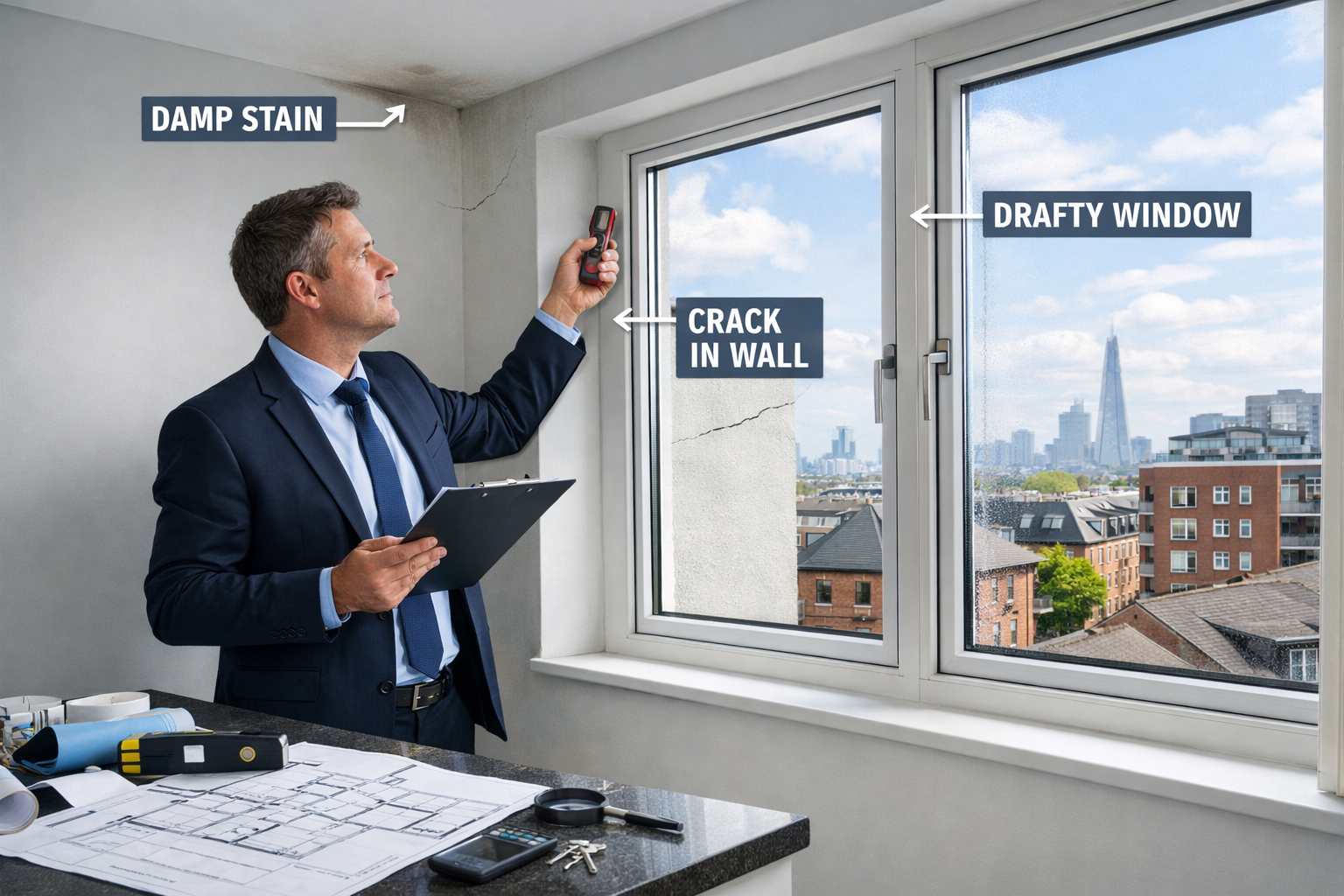
When conducting building surveys for flats in 2026's recovering market, the technical assessment must be more comprehensive than ever. Buyers exercising increased choice will walk away from properties with significant defects unless pricing reflects necessary remediation costs.
Critical assessment areas include:
| Survey Component | Market Impact | Valuation Consideration |
|---|---|---|
| Structural integrity | High – immediate concern | Deduct full remediation cost plus 10-15% negotiation buffer |
| Damp and moisture | High – common flat issue | Assess cause, deduct treatment costs, consider ongoing risk |
| Leasehold concerns | Very High – affects mortgageability | Short leases (<80 years) require immediate adjustment |
| Building safety compliance | Critical – regulatory requirement | Non-compliance can render property unsaleable |
| Shared facilities condition | Medium – affects service charges | Factor into ongoing cost analysis |
| Energy efficiency | Increasing – EPC requirements | Properties below EPC C may face future restrictions |
Professional chartered surveyors in London understand that each defect discovered during the survey phase directly impacts the final valuation in ways that are more pronounced in balanced markets than during boom periods.
Leasehold Considerations and Their Valuation Impact
Flats in London and the South East are predominantly leasehold, making lease terms a critical valuation component. In recovering markets, buyers are particularly sensitive to:
🏢 Remaining lease length – Leases under 80 years trigger marriage value calculations
🏢 Ground rent terms – Escalating ground rents can affect mortgageability
🏢 Service charge history – Rising charges impact affordability calculations
🏢 Building management quality – Poor management affects resale potential
🏢 Major works provisions – Upcoming Section 20 works require reserve adjustments
Surveyors should incorporate freehold valuation expertise when assessing leasehold flats, particularly when advising clients on lease extension costs that may be necessary to achieve optimal market value.
Technology-Enhanced Survey Techniques
Modern building surveys benefit from technological advances that improve accuracy and client communication:
- Drone roof surveys for high-rise flat buildings provide comprehensive external assessment without scaffolding costs
- Thermal imaging reveals hidden damp and insulation issues
- 3D laser scanning creates detailed dimensional records
- Digital reporting platforms with photographic evidence and interactive floor plans
- Moisture meters and hygrometers for precise damp diagnosis
These tools are particularly valuable when conducting surveys for flats in recovering markets, where detailed evidence supports valuation adjustments and helps clients make informed decisions. For comprehensive external assessments, drone roof survey services offer significant advantages in multi-story residential buildings.
Valuation Techniques for Flats as London and South East Stabilize
The Comparative Method in Stabilizing Markets
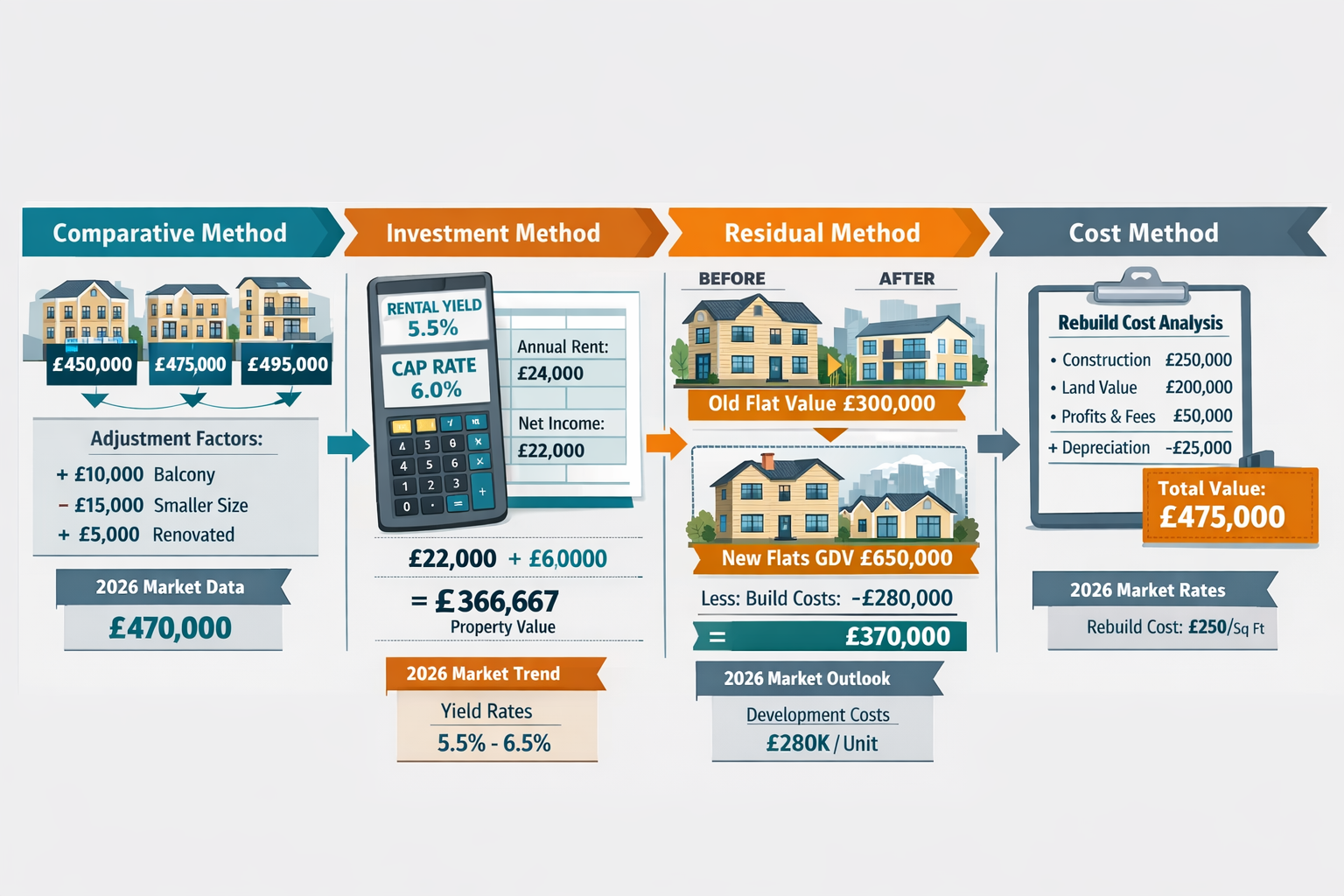
The comparative method remains the primary valuation approach for residential flats, but its application requires refinement in 2026's market conditions. Simply identifying recent sales of similar properties isn't sufficient—surveyors must account for:
Time adjustments: Properties sold six months ago may not reflect current stabilized pricing. Apply monthly adjustment factors based on local market indices.
Condition differentials: In balanced markets, condition matters significantly. A well-maintained flat may command a 5-10% premium over an identical property requiring cosmetic updates.
Negotiation patterns: Analyze the gap between asking prices and achieved prices to understand realistic market expectations.
Stock availability: Areas with high inventory may see slower price growth than those with limited supply.
When conducting professional valuations in London, experienced surveyors maintain databases of comparable transactions with detailed condition notes, allowing for precise adjustments that reflect true market value rather than optimistic asking prices.
The Investment Method for Buy-to-Let Flats
For flats purchased as investment properties, the investment method provides crucial valuation insight. This approach capitalizes the rental income to determine property value:
Basic formula: Market Value = Net Annual Rental Income ÷ Yield
In 2026's stabilizing market, yields are adjusting as follows:
- Prime Central London flats: 3.5-4.5% gross yield
- Outer London zones: 4.5-5.5% gross yield
- South East commuter locations: 5.0-6.0% gross yield
However, surveyors must account for:
💷 Void periods – Realistic vacancy assumptions (typically 4-6 weeks annually)
💷 Management costs – 10-15% of gross rental for professional management
💷 Maintenance reserves – 1% of property value annually for upkeep
💷 Regulatory compliance – Licensing, safety certificates, EPC requirements
💷 Mortgage costs – If applicable, affecting net yield calculations
The investment method proves particularly valuable when assessing flats in recovering markets, as it grounds valuation in income-generating capacity rather than speculative appreciation.
The Residual Method for Refurbishment Opportunities
Many flats in London and the South East offer refurbishment potential, particularly those requiring modernization to compete in today's market. The residual method calculates value by working backwards from the completed property value:
Calculation approach:
- Determine the Gross Development Value (GDV) – what the refurbished flat would sell for
- Deduct refurbishment costs including contingency (typically 10-15%)
- Deduct professional fees (architects, surveyors, project managers – 10-12%)
- Deduct finance costs for the refurbishment period
- Deduct developer's profit (15-20% of GDV for residential refurbishment)
- The remainder represents the residual land/property value
This method is particularly relevant in 2026 as buyers seek value-add opportunities in a market where well-presented properties command premium prices.
The Cost Method for Unique or New-Build Flats
For new-build flats or unique properties without adequate comparables, the cost method (also called the contractor's method) provides an alternative valuation approach:
Components:
- Land value – assessed separately based on comparable land sales
- Construction costs – current building costs per square meter
- Professional fees – architectural, engineering, surveying costs
- Developer's profit – typical margin for the development type
- Depreciation – for existing properties, adjust for age and condition
While less commonly used for standard flat valuations, this method proves valuable when assessing new developments or when market comparables are limited due to unique property characteristics.
For comprehensive valuation services across different scenarios, RICS registered valuers provide the expertise necessary to select and apply the most appropriate methodology.
Building Surveys for Flats in Recovering Markets: Practical Application in 2026
Case Study Approach: Typical London Flat Scenarios
Understanding how to apply these techniques requires examining real-world scenarios common in 2026's recovering market:
Scenario 1: Two-Bedroom Victorian Conversion in South West London
A buyer is considering a £550,000 two-bedroom flat in a converted Victorian house. The building survey reveals:
- Original sash windows requiring replacement (£8,000)
- Damp issues in one bedroom requiring treatment (£3,500)
- Shared roof needs repair within 2 years (£15,000 total, £3,750 flat's share)
- Lease has 95 years remaining
- Service charges are £1,200 annually
Valuation approach:
- Comparative method: Similar flats in good condition sold for £545,000-£560,000
- Defect adjustments: Total immediate costs £11,500 + contingency £1,500 = £13,000
- Future liability: Roof repair discounted to present value ≈ £3,500
- Adjusted valuation: £545,000 – £13,000 – £3,500 = £528,500
- Negotiation recommendation: Offer £520,000-£525,000 to account for inconvenience and risk
This example demonstrates how residential structural engineers and surveyors work together to provide comprehensive assessment and realistic valuation in recovering markets.
Scenario 2: Modern One-Bedroom Buy-to-Let in East London
An investor is evaluating a £375,000 one-bedroom flat in a purpose-built block from 2015. Survey findings:
- Property in excellent condition
- Building has 10-year NHBC warranty (5 years remaining)
- Current rental: £1,450 pcm (£17,400 annually)
- Service charge: £1,800 annually
- Ground rent: £250 annually
- Lease: 120 years remaining
Investment method valuation:
- Gross annual rent: £17,400
- Less service charge: -£1,800
- Less ground rent: -£250
- Less void allowance (4 weeks): -£1,340
- Less management (12%): -£2,088
- Net annual income: £11,922
- Typical yield for area: 5.2%
- Investment value: £11,922 ÷ 0.052 = £229,269 (land value component)
- Add building depreciated value: ≈ £145,000
- Total valuation: £374,269
The asking price of £375,000 aligns closely with investment value, suggesting fair pricing in the current market.
Regional Variations Across London and the South East
Valuation techniques must account for significant regional differences across the recovery landscape:
Central London: Slower recovery, high stock levels, yield compression
South East London: Moderate growth, strong commuter demand, family-focused
East London: Regeneration-driven growth, younger demographic, higher yields
North London: Stable demand, established neighborhoods, premium for schools
South West London: Strong family market, competitive pricing, quality focus
Professional surveyors operating across these regions maintain localized market knowledge that informs their valuation adjustments. Whether working in East London or Central London, understanding micro-market dynamics proves essential for accurate flat valuations.

Special Considerations for Flat Surveys in 2026
Building Safety and Regulatory Compliance
The building safety landscape has transformed dramatically following regulatory changes. Flats in buildings over 11 meters (approximately four stories) face particular scrutiny:
🔥 EWS1 certificates – External wall system assessments remain critical for mortgageability
🔥 Fire safety compliance – Adequate fire doors, alarms, and escape routes
🔥 Cladding issues – Properties with unsafe cladding face severe valuation impacts
🔥 Building Safety Act compliance – New regulations affecting resident safety
🔥 Accountable persons – Clear building management responsibility
Surveyors must explicitly address these issues in building surveys and factor them into valuations. Properties with unresolved building safety concerns may be unmortgageable, effectively rendering them unsaleable until remediation occurs.
Energy Performance and Future-Proofing
Energy efficiency has moved from nice-to-have to essential consideration in 2026. Properties with poor EPC ratings face:
- Rental restrictions – Minimum EPC E for lettings, likely to increase to EPC C
- Mortgage challenges – Some lenders preferring higher-rated properties
- Value depreciation – Buyers factoring improvement costs into offers
- Regulatory risk – Potential future restrictions on low-rated properties
Surveyors should identify energy improvement opportunities and estimate costs:
- Double glazing installation: £5,000-£15,000
- Improved insulation: £3,000-£8,000
- Modern boiler replacement: £2,500-£4,000
- Solar panel installation (where feasible): £4,000-£7,000
These improvements often provide ROI through both increased value and reduced running costs.
Shared Ownership and Part-Buy Valuations
Shared ownership flats require specialized valuation approaches that account for:
- Ownership percentage – Typically 25-75% initial share
- Rent on retained equity – Usually 2.75% of housing association's share
- Staircasing provisions – Terms for purchasing additional shares
- Resale restrictions – Some schemes limit resale to other eligible buyers
- Service charge allocations – How costs are split between owner and association
For accurate assessment of these properties, specialized shared ownership valuation expertise ensures all factors are properly considered.
Working with Professional Surveyors in Recovering Markets
Selecting the Right Survey Type
Not all building surveys are created equal. In 2026's market conditions, buyers should understand their options:
RICS Home Survey Level 1 (Condition Report)
- Basic visual inspection
- Traffic light condition rating
- Suitable only for new-build or excellent condition flats
- Cost: £300-£500
RICS Home Survey Level 2 (HomeBuyer Report)
- More detailed inspection
- Identifies significant defects
- Suitable for conventional flats in reasonable condition
- Cost: £400-£800
RICS Home Survey Level 3 (Building Survey)
- Comprehensive detailed inspection
- In-depth defect analysis
- Suitable for older flats, conversions, or those with visible issues
- Cost: £600-£1,200+
For most flat purchases in recovering markets, the Level 2 or Level 3 survey provides the necessary detail to support accurate valuation and informed decision-making. Learn more about which survey you need for your specific circumstances.
Questions to Ask Your Surveyor
When engaging a surveyor for flat assessment in 2026's market, ask:
- Do you have specific experience with flats in this area?
- How do you account for market recovery conditions in valuations?
- Will you provide detailed defect cost estimates?
- Can you assess building safety compliance issues?
- Do you offer post-survey consultation for negotiation support?
- Are you RICS registered with professional indemnity insurance?
- What is your typical turnaround time?
- Do you provide valuations alongside surveys?
Professional surveyors should provide clear answers demonstrating their market knowledge and technical expertise.
Understanding Survey Reports and Valuation Outputs
Modern survey reports should include:
📋 Executive summary – Key findings and valuation conclusion
📋 Detailed defect analysis – Room-by-room assessment with photographs
📋 Repair cost estimates – Realistic pricing for identified issues
📋 Urgent matters – Items requiring immediate attention
📋 Market context – How the property compares to local market
📋 Valuation figure – Market value in current conditions
📋 Recommendations – Next steps and further investigations if needed
The best reports translate technical findings into actionable information that supports negotiation and decision-making.
Negotiation Strategies Based on Survey Findings
Using Survey Results to Adjust Offers
In balanced markets with increased buyer choice, survey findings provide powerful negotiation leverage. The key is presenting evidence-based adjustments rather than arbitrary reductions:
Effective approach:
- Quantify all defects with professional cost estimates
- Categorize by urgency (immediate, short-term, long-term)
- Add contingency (10-15%) for unforeseen complications
- Present professionally with survey extracts and supporting quotes
- Propose fair adjustment that reflects actual cost impact
Example negotiation:
"The building survey has identified £18,500 in necessary repairs, including urgent damp treatment and window replacement. Adding a 15% contingency for a total of £21,275, we'd like to revise our offer from £450,000 to £430,000, which we believe reflects the property's true market value given its current condition."
This approach demonstrates seriousness while maintaining goodwill for successful transaction completion.
When to Walk Away
Some survey findings should trigger serious reconsideration or withdrawal:
⛔ Structural movement requiring underpinning or major structural work
⛔ Unmortgageable cladding without clear remediation timeline
⛔ Severe damp indicating fundamental building envelope failure
⛔ Short lease (<70 years) with uncooperative freeholder
⛔ Major upcoming works with inadequate sinking fund provisions
⛔ Illegal alterations requiring retrospective consent or reinstatement
In recovering markets, alternative properties are available. Don't compromise on fundamental issues that affect safety, mortgageability, or long-term value.
For properties with specific defects requiring detailed assessment, consider commissioning a specific defect report for targeted investigation before making final decisions.
Future-Proofing Flat Investments in Stabilizing Markets
Identifying Value-Add Opportunities
Smart buyers in 2026's recovering market look beyond current condition to potential:
High-ROI improvements for flats:
- Kitchen and bathroom modernization – 70-90% cost recovery
- Space optimization – Removing non-structural walls, improving layout
- Energy efficiency upgrades – Improving EPC rating by 2+ bands
- Storage solutions – Built-in wardrobes, clever space utilization
- Outdoor space enhancement – Balcony or terrace improvements
- Smart home technology – Appeals to modern buyers/tenants
Surveyors can identify these opportunities during building surveys, helping buyers understand not just current value but future potential.
Long-Term Market Positioning
Properties that will perform well through 2026 and beyond share common characteristics:
✨ Strong transport links – Proximity to Underground, Overground, or rail
✨ Established neighborhoods – Proven long-term demand
✨ Good building management – Well-maintained communal areas
✨ Reasonable service charges – Sustainable long-term costs
✨ Adequate lease length – 100+ years remaining
✨ Flexible space – Layouts that work for different demographics
✨ Local amenities – Shops, parks, schools, restaurants
Building surveys should assess not just current condition but how well the property aligns with these long-term value drivers.
Conclusion
As London and the South East property markets stabilize through 2026, the role of professional building surveys and accurate valuations has never been more critical. The shift from distressed to balanced market conditions means that Building Surveys for Flats in Recovering Markets: Valuation Techniques as London and South East Stabilize in 2026 requires updated frameworks that account for realistic pricing, increased buyer scrutiny, and sustainable growth expectations.
The most successful property transactions in this environment combine:
- Comprehensive building surveys that identify all defects and compliance issues
- Market-aware valuations using appropriate methodologies for the property type
- Regional market knowledge reflecting local recovery patterns
- Professional presentation of findings to support informed decision-making
- Future-focused assessment identifying both risks and opportunities
For buyers, investors, and lenders navigating 2026's recovering market, partnering with experienced chartered surveyors provides the foundation for confident property decisions. Whether purchasing a Victorian conversion in South West London, a modern buy-to-let in East London, or a family flat in the outer South East, professional survey and valuation services protect your interests and ensure you pay fair market value for properties in suitable condition.
Next Steps
If you're considering purchasing a flat in London or the South East in 2026:
- Engage a qualified surveyor early in your property search process
- Select the appropriate survey level based on property age and condition
- Request valuation services alongside your building survey
- Review findings thoroughly and ask questions about anything unclear
- Use evidence-based negotiation to achieve fair pricing
- Consider long-term factors beyond immediate condition
The recovering market offers genuine opportunities for those who approach purchases with professional guidance and realistic expectations. With proper survey and valuation support, 2026 can be an excellent year to secure quality flat accommodation in one of the world's most dynamic property markets.
For professional building survey and valuation services across London and the South East, contact experienced chartered surveyors who understand the nuances of recovering markets and can provide the expertise you need for confident property decisions.