

The UK buy-to-let market is experiencing a remarkable resurgence in 2026, with tenant demand climbing after two quarters of stagnant readings and landlord supply remaining notably constrained. This dynamic shift has created unprecedented opportunities for institutional investors seeking quality acquisition targets—but only for those equipped with rigorous due diligence processes. Building Surveys for Institutional Landlords: Why Buy-to-Let Expansion Drives Professional Assessment Demand in 2026 has become more than just a market trend; it represents a fundamental transformation in how professional investors approach property portfolio expansion in an increasingly competitive landscape.
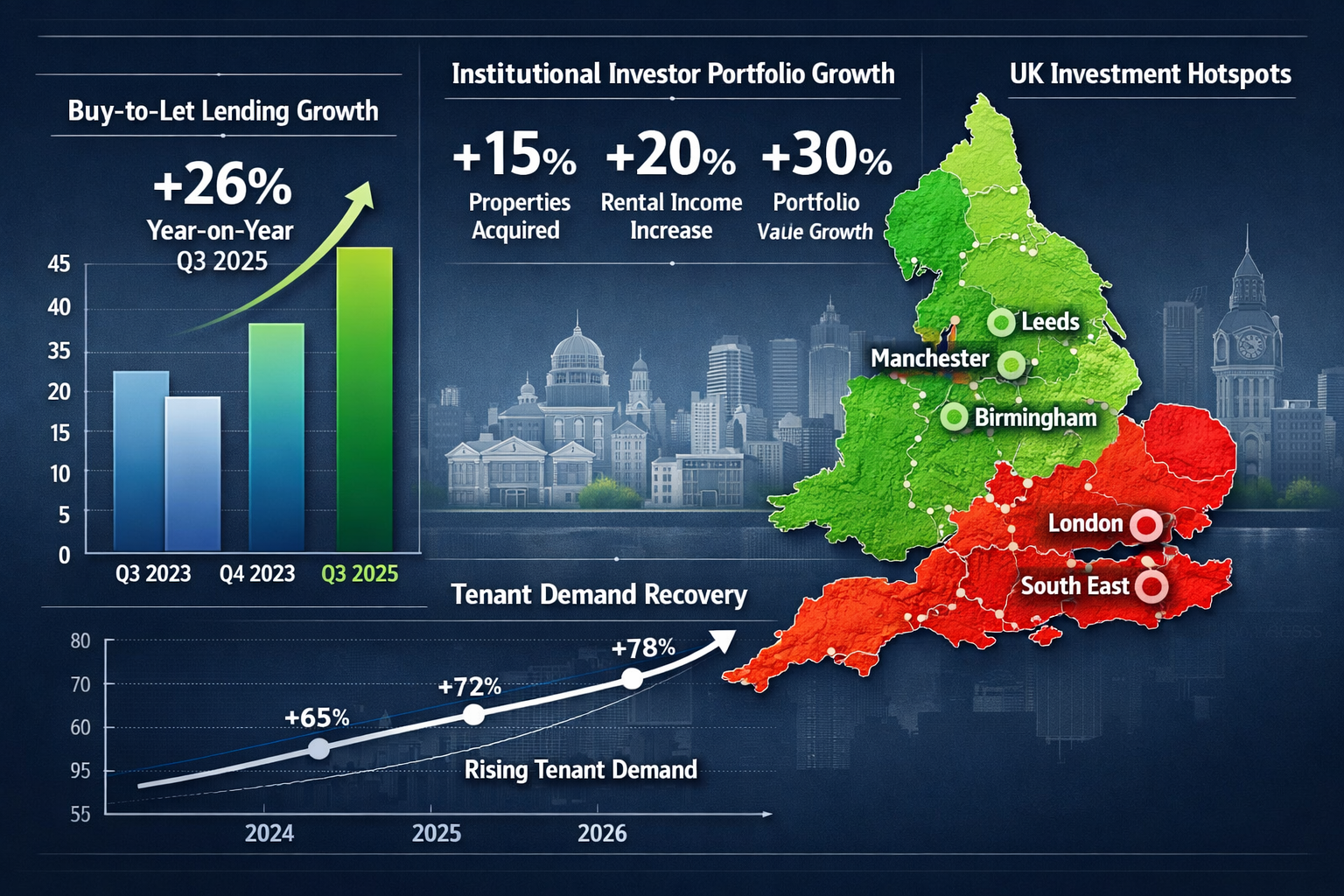
With buy-to-let lending surging 26% year-on-year in Q3 2025[6], institutional landlords are recognizing that success depends not merely on acquiring properties, but on securing the right properties through comprehensive professional assessments. As supply constraints tighten and tenant demand accelerates, the margin for error has virtually disappeared. Professional building surveys have evolved from optional extras to essential gatekeepers of portfolio quality and long-term investment performance.
Key Takeaways
- 🏢 Buy-to-let lending grew 26% year-on-year in Q3 2025, signaling robust institutional investor appetite despite market challenges
- 📊 Tenant demand is recovering strongly after two flat quarters, creating supply-demand imbalances that favor quality properties with verified condition
- 🔍 Professional building surveys enable institutional landlords to identify hidden defects, negotiate better prices, and avoid costly post-acquisition surprises
- 🎯 Regional market fragmentation requires location-specific assessment strategies, with southern markets facing affordability pressures while regional cities absorb demand
- ✅ Comprehensive due diligence through chartered surveyors protects institutional portfolios from structural risks, regulatory compliance issues, and unexpected capital expenditure
The 2026 Buy-to-Let Landscape: Why Institutional Investors Are Expanding Aggressively

The buy-to-let sector in 2026 presents a paradox that savvy institutional investors are learning to navigate. While the market is entering what analysts describe as a "calmer period" with rental growth expected to slow[1], the fundamentals driving institutional expansion remain remarkably strong. Understanding this landscape is crucial for appreciating why Building Surveys for Institutional Landlords: Why Buy-to-Let Expansion Drives Professional Assessment Demand in 2026 has become such a critical topic.
Rising Tenant Demand Meets Constrained Supply
After experiencing two consecutive quarters of flat readings, tenant demand has rebounded with renewed vigor in late 2025 and early 2026. This recovery comes at precisely the moment when landlord instructions remain severely constrained, creating a supply-demand imbalance that institutional investors are positioned to exploit.
Key market dynamics include:
- Limited new landlord entrants following years of regulatory changes and tax adjustments
- Existing landlords holding onto quality properties rather than selling into uncertain markets
- Demographic shifts driving rental demand, particularly among younger professionals unable to access mortgage finance
- Regional migration patterns creating localized demand hotspots that require sophisticated market analysis
This environment favors institutional landlords with the capital reserves and professional assessment capabilities to identify and secure quality acquisition targets before competitors. However, the stakes are higher than ever—overpaying for properties with hidden defects or structural issues can devastate portfolio returns in markets where rental growth is moderating.
The Maturation of Institutional Landlord Strategy
Experienced investors are fundamentally reshaping their approach to portfolio management in 2026. Rather than pursuing aggressive acquisition strategies focused purely on volume, institutional landlords have matured toward prioritizing "stronger locations, dependable tenants, and returns that hold up over time"[4].
This strategic evolution has several important implications:
| Traditional Approach | 2026 Institutional Strategy |
|---|---|
| Volume-focused acquisitions | Quality-focused selective expansion |
| Reactive maintenance | Proactive condition assessment |
| Basic valuations | Comprehensive building surveys |
| Opportunistic locations | Data-driven regional targeting |
| Short-term yield focus | Long-term capital preservation |
This shift toward quality over quantity makes professional building surveys indispensable. Institutional investors can no longer afford to rely on basic valuations or superficial inspections when each acquisition must meet increasingly stringent performance criteria over extended holding periods.
Regional Market Fragmentation Demands Location-Specific Assessment
One of the most significant developments in 2026 is the pronounced fragmentation of regional markets across the UK. Southern markets are experiencing affordability pressures that constrain both tenant capacity and capital appreciation potential, while regional cities continue absorbing demand from workers seeking better value[4].
High-performing regional markets in 2026 include:
- 🏙️ Manchester and Greater Manchester – Strong employment growth and relative affordability
- 🎓 Birmingham and West Midlands – Diverse economy and expanding rental sector
- 🌊 Liverpool – Regeneration projects and improving infrastructure
- 📚 Leeds and Yorkshire – University-driven demand and commercial development
- 🏴 Scottish cities (Edinburgh, Glasgow) – Different regulatory environment with strong fundamentals
This regional variation means that building survey requirements must be tailored to local construction standards, prevalent building types, and region-specific defect patterns. A chartered surveyor in London will encounter different structural challenges than one assessing properties in the North West, requiring specialized local knowledge alongside technical expertise.
Building Surveys for Institutional Landlords: Why Buy-to-Let Expansion Drives Professional Assessment Demand in 2026
The connection between buy-to-let expansion and professional assessment demand is neither coincidental nor temporary—it reflects fundamental changes in how institutional capital is deployed in residential property markets. As the sector matures and competition intensifies, Building Surveys for Institutional Landlords: Why Buy-to-Let Expansion Drives Professional Assessment Demand in 2026 captures the essential relationship between growth ambitions and risk management imperatives.
Why Institutional Landlords Cannot Afford Assessment Shortcuts
Unlike individual buy-to-let investors who might accept higher risk levels on single properties, institutional landlords managing portfolios worth millions or billions of pounds face entirely different risk-reward calculations. A single undetected structural defect can:
- Trigger cascade effects across portfolio valuations and lending covenants
- Generate regulatory scrutiny if tenant safety is compromised
- Damage institutional reputation with investors and stakeholders
- Consume disproportionate management resources through remediation projects
- Undermine financial projections through unexpected capital expenditure
Professional building surveys serve as the first line of defense against these risks. When conducted by qualified professionals, comprehensive assessments provide institutional investors with:
✅ Detailed condition reports identifying current and potential defects
✅ Cost estimates for remediation enabling accurate financial modeling
✅ Regulatory compliance verification across building safety, energy efficiency, and accessibility standards
✅ Negotiation leverage to adjust purchase prices based on identified issues
✅ Long-term maintenance planning supporting lifecycle cost analysis
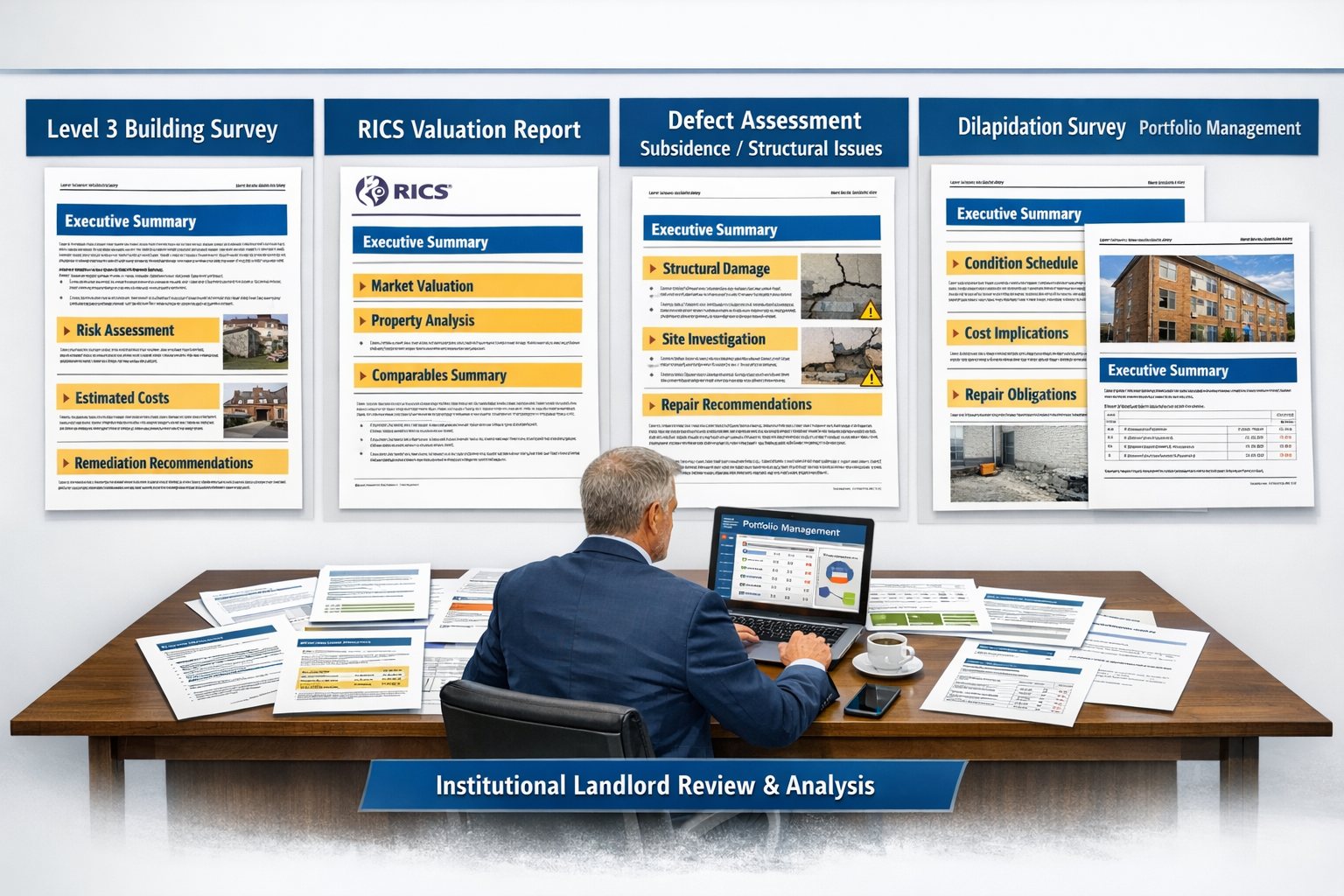
The difference between a homebuyer report and a building survey becomes particularly significant for institutional investors. While homebuyer reports may suffice for standard residential purchases, institutional acquisitions typically require the comprehensive Level 3 Building Survey that examines every accessible aspect of the property's construction and condition.
The Economics of Professional Surveys in Portfolio Expansion
At first glance, commissioning professional building surveys for every potential acquisition might appear to add significant transaction costs. However, institutional investors in 2026 are discovering that comprehensive assessments generate substantial returns through:
1. Price Negotiation Advantages
Detailed survey findings provide objective evidence for price reductions. Even a modest 2-3% price adjustment on a £500,000 property yields £10,000-£15,000 in savings—far exceeding typical survey costs of £800-£1,500.
2. Avoided Catastrophic Purchases
Surveys that identify deal-breaking defects (major structural issues, extensive subsidence, fire safety violations) prevent acquisitions that could generate losses of tens or hundreds of thousands of pounds. For properties showing signs of movement or settlement, a specialized subsidence survey can prevent catastrophic investment errors.
3. Accurate Financial Modeling
Comprehensive condition assessments enable precise forecasting of capital expenditure requirements over 5-10 year holding periods, improving investment committee confidence and reducing portfolio volatility.
4. Faster Portfolio Integration
Properties acquired with detailed survey reports can be integrated into portfolio management systems more efficiently, with maintenance schedules, compliance requirements, and risk ratings already established.
5. Enhanced Lending Terms
Lenders providing portfolio finance increasingly reward institutional borrowers who demonstrate rigorous due diligence processes, potentially reducing interest margins and improving loan-to-value ratios.
How Building Surveys Support Different Institutional Investment Strategies
Institutional landlords pursue diverse strategies in 2026, and professional assessments must align with specific investment objectives:
Value-Add Repositioning
Investors acquiring underperforming properties for renovation and repositioning require surveys that go beyond identifying defects to evaluate improvement opportunities. These assessments should:
- Identify structural capacity for reconfiguration or extension
- Evaluate energy efficiency upgrade potential and associated costs
- Assess compliance gaps that must be addressed during refurbishment
- Provide specific defect reports on targeted building elements
Core Income Portfolio Building
Institutional investors focused on stable, long-term income streams need surveys that emphasize:
- Long-term structural integrity and remaining useful life
- Predictable maintenance cost profiles
- Regulatory compliance status and future-proofing
- Tenant safety and habitability standards
Opportunistic Distressed Asset Acquisition
Investors targeting distressed properties at significant discounts require particularly comprehensive assessments that:
- Quantify total remediation costs with contingency allowances
- Identify hidden defects common in neglected properties
- Assess whether distress pricing adequately compensates for condition issues
- Evaluate feasibility of economical restoration versus demolition and rebuild
For properties with visible structural concerns, specialized surveys such as roof surveys or structural surveys provide the depth of analysis required for confident decision-making.
Professional Assessment Standards and Institutional Requirements in 2026
The professionalization of the buy-to-let sector has driven corresponding evolution in assessment standards and institutional requirements. Building Surveys for Institutional Landlords: Why Buy-to-Let Expansion Drives Professional Assessment Demand in 2026 reflects not just increased survey volume, but also heightened expectations for survey quality, comprehensiveness, and regulatory alignment.
RICS Standards and Institutional Compliance
The Royal Institution of Chartered Surveyors (RICS) sets the professional standards that govern building surveys in the UK. For institutional landlords, working with RICS registered valuers and surveyors provides essential credibility and quality assurance.
Key RICS standards relevant to institutional buy-to-let include:
- RICS Home Survey Standard – Defines the three levels of residential survey (Condition Report, HomeBuyer Report, and Building Survey)
- RICS Valuation – Global Standards (Red Book) – Establishes requirements for property valuations, with Red Book valuations often required for institutional financing
- RICS Professional Standards and Guidance – Covers surveyor conduct, conflicts of interest, and professional indemnity insurance
Institutional investors typically require surveyors to maintain:
✓ Professional indemnity insurance of £10 million or more
✓ RICS membership (MRICS or FRICS designation)
✓ Relevant specializations (building surveying, structural engineering, specific property types)
✓ Local market knowledge for accurate assessment of regional construction practices
✓ Experience with portfolio acquisitions and institutional client requirements
Comprehensive Survey Scope for Institutional Acquisitions
While basic residential surveys may examine only readily accessible areas, institutional landlords in 2026 typically commission surveys with expanded scope including:
Structural Elements:
- Foundation condition and load-bearing capacity
- Wall construction, pointing, and structural integrity
- Roof structure, covering, and weatherproofing
- Floor construction and condition
- Structural movement indicators and crack pattern analysis
Building Services:
- Electrical installation age, condition, and compliance
- Plumbing systems, water supply, and drainage
- Heating systems efficiency and remaining lifespan
- Ventilation adequacy and condensation risk
External Elements:
- Rainwater goods (gutters, downpipes)
- External decoration and weatherproofing
- Boundary structures and retaining walls
- Paving, access, and drainage
Regulatory Compliance:
- Building regulation compliance for any alterations
- Fire safety standards (particularly for HMOs and multi-unit buildings)
- Energy Performance Certificate (EPC) rating and improvement potential
- Accessibility standards and potential adaptations
Environmental Factors:
- Flood risk assessment
- Contaminated land considerations
- Japanese knotweed and other invasive species
- Asbestos presence in older properties
For properties with specific concerns, specialized assessments such as dilapidation surveys may be commissioned to establish baseline conditions before tenant occupation.
Technology Integration in Modern Building Surveys
The building survey profession has embraced technological innovation, providing institutional landlords with more comprehensive and actionable assessment data. Modern surveys in 2026 frequently incorporate:
🔬 Thermal Imaging
Infrared cameras identify heat loss, insulation deficiencies, moisture penetration, and hidden structural issues invisible to visual inspection.
📐 3D Laser Scanning
Creates precise digital models of properties, enabling accurate measurement, spatial analysis, and future renovation planning.
🚁 Drone Surveys
Provides safe, cost-effective inspection of roofs, chimneys, and high-level building elements without expensive scaffolding or access equipment.
💧 Moisture Detection Equipment
Electronic moisture meters and hygrometers identify damp issues, condensation risks, and water penetration that could lead to structural deterioration.
📱 Digital Reporting Platforms
Cloud-based survey reports with embedded photographs, annotated floor plans, and interactive defect registers enable efficient review and portfolio integration.
These technological enhancements don't replace professional expertise—they augment it, providing surveyors with more comprehensive data and institutional clients with more actionable intelligence for investment decisions.
Due Diligence Integration: Surveys Within Broader Acquisition Processes
Professional building surveys represent just one component of comprehensive institutional due diligence. Successful investors in 2026 integrate survey findings with:
Legal Due Diligence:
- Title verification and ownership clarity
- Restrictive covenants and easements
- Planning permissions and building regulation approvals
- Lease terms and tenant rights (for tenanted acquisitions)
Financial Due Diligence:
- Rental income verification and tenant creditworthiness
- Operating cost analysis and benchmarking
- Capital expenditure forecasting incorporating survey findings
- Tax structuring and stamp duty land tax optimization
Market Due Diligence:
- Local rental demand analysis and tenant demographics
- Comparable property performance and pricing
- Area development plans and infrastructure investment
- Supply pipeline and competitive positioning
Environmental Due Diligence:
- Phase I and Phase II environmental site assessments
- Energy efficiency analysis and EPC improvement pathways
- Sustainability credentials and ESG alignment
When survey findings identify significant issues, institutional investors may commission expert witness reports to support price negotiations or provide independent validation of remediation cost estimates.
Practical Implementation: How Institutional Landlords Should Approach Building Surveys in 2026
Understanding the importance of professional building surveys is one thing; implementing effective assessment processes across portfolio expansion activities is quite another. Institutional landlords succeeding in 2026 have developed systematic approaches that balance thoroughness with efficiency, ensuring that survey processes support rather than impede acquisition velocity.
Developing a Survey Strategy Aligned with Investment Objectives
Not all properties require identical assessment approaches. Sophisticated institutional investors develop tiered survey strategies that match assessment intensity to property characteristics and strategic importance:
Tier 1: Comprehensive Level 3 Building Surveys
Reserved for:
- High-value acquisitions (typically £750,000+)
- Properties showing visible defect indicators
- Older buildings (pre-1950s construction)
- Properties with complex histories (multiple extensions, conversions)
- Strategic portfolio anchors in key locations
Tier 2: Standard HomeBuyer Reports
Appropriate for:
- Modern properties (post-2000 construction)
- Properties in excellent visual condition
- Standardized building types (volume-built estates)
- Lower-value portfolio additions
- Properties in well-understood markets
Tier 3: Targeted Specific Defect Assessments
Commissioned when:
- Initial inspections identify isolated concerns
- Desktop due diligence raises specific questions
- Properties have known issues requiring quantification
- Vendor disclosures indicate particular defects
Understanding what survey you need based on property characteristics and investment objectives prevents both over-spending on unnecessary assessments and under-investing in critical due diligence.
Building Relationships with Preferred Survey Providers
Institutional landlords operating at scale in 2026 recognize significant advantages in developing preferred relationships with qualified survey providers rather than engaging different firms for each acquisition. Benefits include:
Consistency and Comparability
- Standardized reporting formats enable easier portfolio integration
- Consistent defect classification supports risk aggregation
- Comparable cost estimates improve financial modeling accuracy
Efficiency and Speed
- Preferred providers understand institutional requirements and documentation standards
- Streamlined engagement processes reduce transaction timelines
- Priority scheduling during competitive acquisition processes
Cost Optimization
- Volume discounts for multiple survey instructions
- Reduced administrative overhead through established processes
- Framework agreements with transparent pricing structures
Knowledge Accumulation
- Surveyors develop understanding of institutional investor's portfolio characteristics
- Regional expertise builds through repeated instructions in target markets
- Feedback loops improve survey quality and relevance over time
When selecting preferred providers, institutional investors should evaluate:
✅ Professional qualifications and insurance coverage
✅ Geographic coverage across target investment markets
✅ Technology capabilities and reporting platforms
✅ Turnaround times and capacity for volume instructions
✅ References from other institutional clients
✅ Quality control processes and peer review procedures
Managing Survey Findings: From Assessment to Action
The value of building surveys depends not just on the quality of the assessment, but on how effectively institutional landlords translate findings into acquisition decisions and portfolio management actions.
Immediate Decision Framework:
When survey reports are received, institutional investors should implement systematic evaluation processes:
- Red Flag Review – Identify deal-breaking defects that make acquisition unviable at any price
- Cost Quantification – Aggregate remediation costs for all identified defects
- Price Adjustment Calculation – Determine appropriate purchase price reduction based on findings
- Risk Assessment – Evaluate residual risks even after identified defects are addressed
- Strategic Fit Evaluation – Confirm property still aligns with portfolio objectives after survey findings
Negotiation Strategy:
Survey findings provide objective evidence for price renegotiation. Effective approaches include:
- Presenting comprehensive cost estimates from qualified contractors for identified remediation work
- Requesting vendor remediation of critical defects as condition of completion
- Adjusting completion timelines to allow for pre-acquisition repairs
- Restructuring deal terms to account for post-acquisition capital expenditure requirements
- Walking away from fundamentally flawed properties regardless of price adjustments
Post-Acquisition Integration:
For properties that proceed to acquisition, survey findings should inform:
- Immediate action plans addressing safety-critical defects
- Maintenance schedules for ongoing condition monitoring
- Capital expenditure budgets for planned remediation work
- Tenant communication regarding planned improvement works
- Insurance notifications of pre-existing conditions
- Portfolio risk registers aggregating defect patterns across holdings
Cost Management and Budgeting for Survey Programs
Institutional landlords pursuing active acquisition strategies must budget appropriately for comprehensive survey programs. Typical costs in 2026 include:
| Property Value | Level 3 Building Survey | HomeBuyer Report | Specific Defect Assessment |
|---|---|---|---|
| £200,000-£400,000 | £800-£1,200 | £400-£600 | £300-£800 |
| £400,000-£750,000 | £1,200-£1,800 | £600-£900 | £500-£1,200 |
| £750,000-£1,500,000 | £1,800-£2,500 | £900-£1,400 | £800-£1,800 |
| £1,500,000+ | £2,500-£4,000+ | £1,400-£2,000+ | £1,200-£2,500+ |
These costs should be budgeted as acquisition expenses alongside legal fees, stamp duty, and other transaction costs. For institutional investors evaluating multiple properties before selecting final acquisitions, survey costs for properties ultimately not purchased represent necessary due diligence expenses rather than wasted expenditure.
Cost optimization strategies include:
- 💰 Negotiating framework agreements with preferred providers for volume discounts
- 📊 Implementing initial desktop assessments to filter obvious non-starters before commissioning surveys
- 🤝 Requesting vendor-commissioned surveys (with appropriate caveats about reliance)
- 🎯 Tailoring survey scope to specific property characteristics rather than applying uniform approaches
- ⚡ Utilizing technology-enhanced surveys that provide more data at lower cost
Regional Considerations and Market-Specific Survey Requirements
The fragmentation of UK property markets in 2026 means that building survey requirements vary significantly by region. Institutional landlords expanding across multiple markets must understand location-specific construction characteristics, prevalent defect patterns, and regulatory variations that influence assessment approaches.
London and South East: Premium Properties with Unique Challenges
The capital and surrounding areas present distinct survey considerations:
Victorian and Edwardian Stock
- Solid wall construction requiring specialized damp assessment
- Original features (sash windows, decorative plasterwork) needing conservation expertise
- Underpinning and subsidence issues common in clay soil areas
- Conversion quality varies dramatically in period properties split into flats
Leasehold Complications
- Building surveys must address both individual unit and common areas
- Service charge liabilities and major works provisions require evaluation
- Lease extension requirements may affect value and financing
- Buying the freehold considerations for portfolio investors
Regulatory Intensity
- Stricter planning and conservation area restrictions
- Higher building control standards and enforcement
- Fire safety requirements particularly stringent for multi-unit buildings
Regional Cities: Modern Stock with Different Risk Profiles
Markets like Manchester, Birmingham, and Leeds present contrasting characteristics:
Modern Build-to-Rent Developments
- New-build surveys focusing on snagging and defect identification
- NHBC warranty coverage and claim procedures
- Developer reputation and construction quality variations
- Energy efficiency typically superior to older stock
Industrial Conversion Properties
- Structural adequacy of conversions from commercial to residential use
- Building regulation compliance for change of use
- Acoustic insulation between units in converted buildings
- Remaining useful life of industrial building elements
Terraced Housing Stock
- Party wall considerations for attached properties
- Shared structural elements and maintenance responsibilities
- Through-terrace damp issues requiring comprehensive assessment
- Rear extension quality and building control compliance
Scotland and Wales: Devolved Regulatory Frameworks
Properties in Scotland and Wales operate under different regulatory regimes requiring specialized knowledge:
Scottish Specific Considerations
- Home Report system (seller-commissioned surveys) already in place
- Different property law regarding tenements and common property
- Specific building standards and energy efficiency requirements
- Separate landlord registration and licensing schemes
Welsh Market Characteristics
- Licensing requirements for landlords in certain areas
- Welsh language considerations for tenant communications
- Different stamp duty land tax rates and thresholds
- Specific energy efficiency standards and timelines
Coastal and Flood Risk Areas: Environmental Assessment Integration
Properties in coastal locations or flood risk zones require enhanced environmental assessment:
Flood Risk Evaluation
- Flood zone classification and historical flooding incidents
- Flood defense infrastructure and maintenance responsibilities
- Insurance availability and premium implications
- Resilience measures and adaptation requirements
Coastal Erosion and Weathering
- Accelerated weathering of building materials in salt air environments
- Coastal erosion risks and property protection measures
- Wind exposure and structural adequacy for extreme weather
- Specialized maintenance requirements for coastal properties
Future Outlook: Building Survey Demand Trajectories Through 2026 and Beyond
As we progress through 2026, several trends suggest that demand for professional building surveys among institutional landlords will continue strengthening rather than plateauing. Understanding these trajectories helps investors prepare for evolving assessment requirements and emerging best practices.
Regulatory Pressures Driving Enhanced Due Diligence
The regulatory environment for landlords continues evolving, with several developments increasing the importance of comprehensive building surveys:
Energy Efficiency Requirements
- Minimum EPC ratings rising toward Band C for all rental properties by 2028
- Survey assessments must evaluate improvement pathways and associated costs
- Properties currently below minimum standards require detailed retrofit planning
- Green financing incentives reward properties meeting higher efficiency standards
Building Safety Regulations
- Post-Grenfell regulatory reforms continue implementation
- Fire safety assessments mandatory for multi-unit buildings
- Building safety certificates and compliance documentation requirements
- Potential retrospective requirements for existing portfolio holdings
Tenant Protection Standards
- Homes (Fitness for Human Habitation) Act enforcement intensifying
- Surveys must verify properties meet habitability standards
- Hazard awareness and risk assessment requirements
- Proactive identification of potential tenant complaints
Licensing Expansion
- Selective and additional licensing schemes expanding across local authorities
- License applications require property condition evidence
- Survey reports support compliance demonstrations
- Penalties for non-compliance increasing
Technology Evolution and Survey Innovation
The building survey profession continues embracing technological innovation, with several developments enhancing institutional value:
Artificial Intelligence Integration
- AI-powered image recognition identifying defects from survey photographs
- Predictive maintenance algorithms forecasting future defect emergence
- Automated cost estimation based on historical remediation data
- Portfolio-level pattern recognition identifying systemic issues
Digital Twin Technology
- Comprehensive 3D models enabling virtual property inspections
- Ongoing condition monitoring through sensor integration
- Maintenance planning and scenario modeling
- Enhanced asset management and lifecycle analysis
Blockchain Verification
- Immutable records of survey findings and property condition
- Transparent condition history for properties changing hands multiple times
- Verification of remediation work completion
- Enhanced confidence in survey report authenticity
Market Maturation and Professional Specialization
The institutional buy-to-let sector's maturation is driving increased specialization among survey providers:
Institutional-Focused Survey Firms
- Providers developing specific expertise in portfolio acquisition support
- Standardized reporting formats aligned with institutional requirements
- Technology platforms enabling portfolio-level data aggregation
- Dedicated account management for high-volume clients
Sector Specialization
- Student accommodation survey specialists
- Build-to-rent development assessment experts
- HMO and multi-unit property specialists
- Affordable housing and social housing assessment providers
Regional Expertise Development
- Survey firms establishing strong regional presences
- Local construction knowledge and defect pattern expertise
- Relationships with regional contractors for cost validation
- Understanding of local authority requirements and enforcement patterns
ESG Integration and Sustainability Assessment
Environmental, Social, and Governance (ESG) considerations increasingly influence institutional investment decisions, with building surveys expanding to address sustainability factors:
Environmental Performance
- Carbon footprint assessment and reduction pathways
- Renewable energy integration potential
- Water efficiency and conservation measures
- Sustainable materials and circular economy principles
Social Impact Evaluation
- Accessibility and universal design features
- Community integration and social value creation
- Tenant wellbeing and healthy building characteristics
- Affordability and social housing contribution
Governance Standards
- Regulatory compliance verification
- Ethical construction and supply chain considerations
- Transparent reporting and disclosure practices
- Stakeholder engagement and community consultation
Conclusion: Professional Building Surveys as Strategic Imperatives for Institutional Buy-to-Let Success
The resurgence of the UK buy-to-let market in 2026, characterized by recovering tenant demand, constrained supply, and 26% year-on-year lending growth[6], has created exceptional opportunities for institutional landlords with the capital and expertise to capitalize on market dynamics. However, success in this environment demands far more than financial resources—it requires rigorous due diligence processes anchored by comprehensive professional building surveys.
Building Surveys for Institutional Landlords: Why Buy-to-Let Expansion Drives Professional Assessment Demand in 2026 captures the essential relationship between growth ambitions and risk management imperatives. As institutional investors mature toward strategies prioritizing "stronger locations, dependable tenants, and returns that hold up over time"[4], professional assessments have evolved from optional extras to strategic imperatives that protect portfolio quality and investment performance.
Key Success Factors for Institutional Landlords in 2026
✅ Commission appropriate survey levels based on property characteristics, value, and strategic importance
✅ Develop relationships with qualified RICS surveyors who understand institutional requirements
✅ Integrate survey findings into comprehensive due diligence and acquisition decision frameworks
✅ Leverage technology-enhanced assessments for more comprehensive data at competitive costs
✅ Adapt survey approaches to regional market characteristics and construction patterns
✅ Use survey findings proactively for price negotiation, remediation planning, and portfolio risk management
✅ Stay ahead of regulatory changes by ensuring surveys address emerging compliance requirements
Actionable Next Steps for Institutional Investors
For institutional landlords seeking to optimize their building survey processes and capitalize on buy-to-let expansion opportunities in 2026, consider these immediate actions:
-
Audit Current Survey Practices – Review recent acquisitions to evaluate whether survey scope and quality adequately identified defects and supported investment decisions
-
Develop Survey Strategy Framework – Create tiered approach matching assessment intensity to property characteristics and strategic importance
-
Identify Preferred Survey Providers – Research and engage qualified chartered surveyors with institutional experience and appropriate geographic coverage
-
Implement Technology Solutions – Explore digital reporting platforms and survey technologies that enhance data quality and portfolio integration
-
Establish Clear Decision Protocols – Define how survey findings will influence pricing, negotiation, and acquisition decisions
-
Budget Appropriately – Allocate sufficient resources for comprehensive survey programs across anticipated acquisition volumes
-
Monitor Regulatory Developments – Stay informed about evolving building safety, energy efficiency, and landlord licensing requirements affecting survey scope
The institutional buy-to-let sector in 2026 rewards investors who combine financial strength with operational excellence and rigorous risk management. Professional building surveys represent a critical component of this winning formula—protecting portfolios from costly surprises, enabling confident acquisition decisions, and supporting long-term value creation in an increasingly competitive and regulated market environment.
As tenant demand continues recovering and supply constraints persist, the institutional landlords who thrive will be those who recognize that quality matters more than quantity, and that comprehensive professional assessments are essential tools for identifying quality in a fragmented and challenging market landscape.
References
[1] Buy To Let Market To Enter Calmer Period In 2026 As Rental Growth Slows – https://www.buyassociationgroup.com/en-us/news/buy-to-let-market-to-enter-calmer-period-in-2026-as-rental-growth-slows/
[2] Why Buy To Let Is Still Worth It In 2026 – https://www.propertynotify.co.uk/investment/why-buy-to-let-is-still-worth-it-in-2026/
[3] Best Buy To Let Areas – https://www.simplybusiness.co.uk/knowledge/buying-and-selling/best-buy-to-let-areas/
[4] Buy To Let In 2026 What The Market Really Looks Like For Landlords – https://uk-mortgagebroker.co.uk/buy-to-let-in-2026-what-the-market-really-looks-like-for-landlords/
[5] Property Market Predictions 2026 – https://www.cityrise.co.uk/property-market-predictions-2026/
[6] Buytolet Lending Grows 26 Yearonyear In Q3 – https://www.facilitiesmanagement-now.com/article/254207/buytolet-lending-grows-26-yearonyear-in-q3