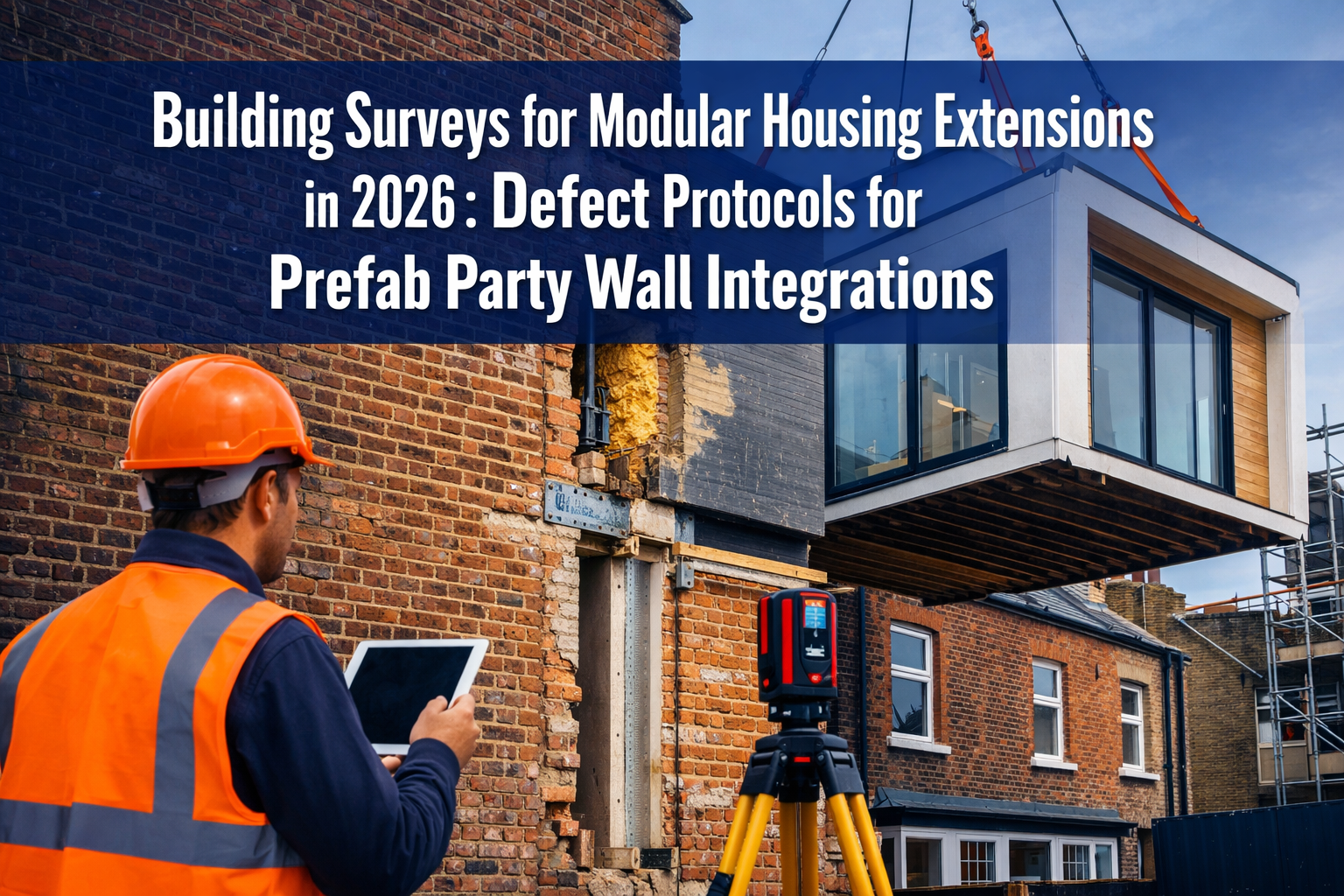

Modular construction volumes have surged to meet unprecedented housing demand, with the global market reaching $103.55 billion in 2024 and projected to hit $162.42 billion by 2030—a staggering 7.9% annual growth rate[4]. As prefabricated extensions increasingly adjoin shared walls in dense urban environments, the need for rigorous Building Surveys for Modular Housing Extensions in 2026: Defect Protocols for Prefab Party Wall Integrations has become critical to ensuring structural integrity, legal compliance, and neighbour protection.
This comprehensive guide examines the specialized survey protocols required when modular housing extensions interface with party walls, detailing Level 3 inspection checklists, defect identification frameworks, and compliance pathways that protect both property owners and adjoining neighbours. Understanding these protocols is essential for surveyors, developers, and homeowners navigating the intersection of off-site construction efficiency and traditional party wall legislation.
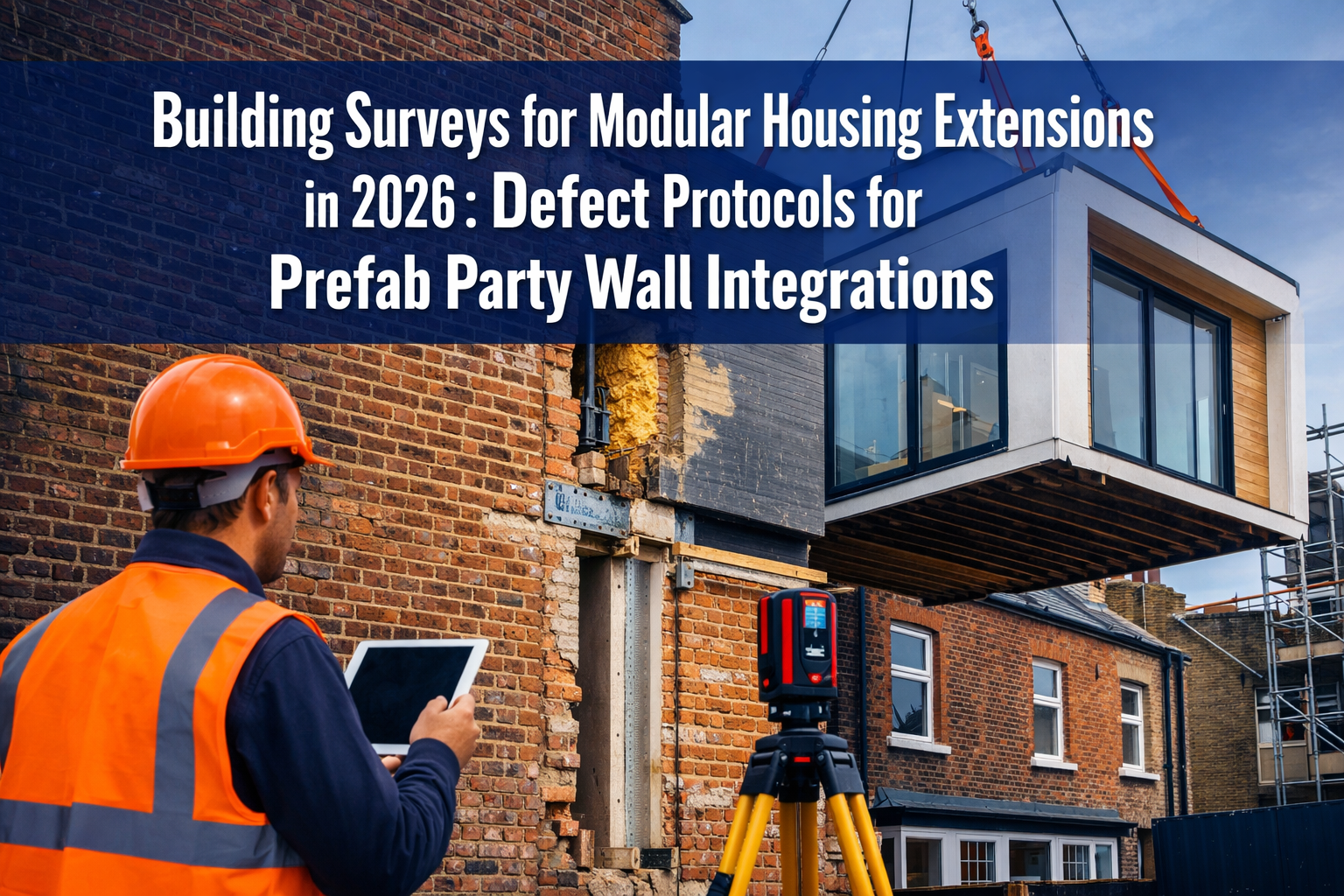
Key Takeaways
✅ Modular extensions reduce construction time by up to 30% but require specialized party wall surveys to address unique prefab integration challenges[3]
✅ Level 3 building surveys must include specific defect protocols for structural ties, acoustic performance, fire barriers, and moisture management at party wall junctions
✅ Party wall compliance remains mandatory regardless of construction method, with proper notices and agreements protecting all parties involved
✅ Thermal bridging and acoustic leakage represent the most common defects in prefab party wall integrations, requiring targeted inspection techniques
✅ Documentation standards have evolved to accommodate modular construction timelines while maintaining rigorous quality assurance
Understanding Modular Housing Extensions and Party Wall Requirements
The Rise of Modular Construction in Urban Extensions
The modular construction sector has experienced remarkable growth across the Northeast and Midwest regions, with permanent modular construction outpacing temporary solutions in repeatable building types[2]. This expansion into residential extensions reflects broader housing pressures and the appeal of reduced construction timelines and enhanced quality control through factory-based manufacturing.
Modular home extensions offer compelling advantages:
- Speed: 30% faster completion compared to traditional methods[3]
- Energy efficiency: Up to 30% reduction in energy consumption through superior insulation[3]
- Quality control: Factory conditions ensure consistent standards
- Reduced site disruption: Minimal on-site construction time
- Cost predictability: Fixed pricing with fewer weather-related delays
However, when these prefabricated units adjoin existing party walls—the shared structural elements between semi-detached or terraced properties—specialized survey protocols become essential. Traditional party wall legislation applies equally to modular construction, requiring proper notices, agreements, and condition surveys.
Party Wall Act Compliance for Modular Extensions
The Party Wall Act 1996 governs all work affecting shared walls, regardless of construction methodology. Modular extensions typically trigger three key notice requirements:
- Section 1 notices: For new walls built on or astride the boundary line
- Section 2 notices: For work to existing party walls or structures
- Section 6 notices: For excavation within 3 or 6 metres of neighbouring structures
Understanding what is a party wall agreement becomes crucial when planning modular extensions. The accelerated construction timeline of prefab units demands that party wall procedures begin earlier in the planning process—typically 2-3 months before crane delivery of modules.
Critical timing considerations:
| Phase | Traditional Build | Modular Build | Party Wall Action |
|---|---|---|---|
| Planning | Months 1-3 | Months 1-2 | Serve notices immediately |
| Foundation | Months 4-6 | Month 3 | Complete agreements before groundwork |
| Structure | Months 7-12 | Month 4 | Pre-delivery condition survey essential |
| Completion | Months 13-18 | Months 5-6 | Post-installation verification survey |
The compressed timeline means delays in party wall notice procedures can halt entire projects, making early engagement with professional surveyors essential.
Building Surveys for Modular Housing Extensions in 2026: Essential Inspection Frameworks
Level 3 Survey Protocols for Prefab Party Wall Interfaces
Building Surveys for Modular Housing Extensions in 2026: Defect Protocols for Prefab Party Wall Integrations require a specialized Level 3 inspection approach that addresses both traditional party wall concerns and unique modular construction challenges. Unlike standard homebuyer reports versus building surveys, these assessments demand detailed technical analysis of connection interfaces.
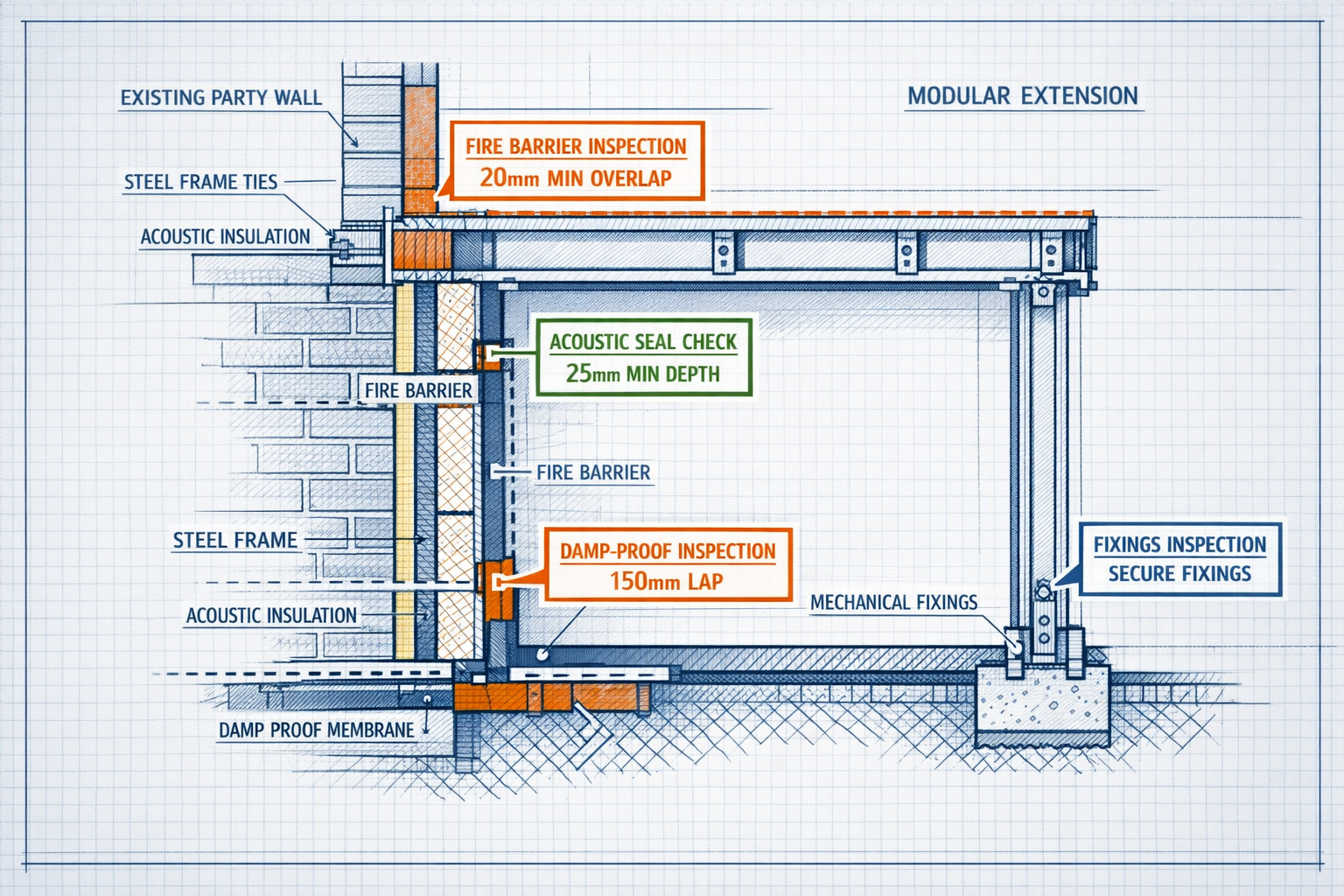
Core inspection zones for modular party wall integrations:
🔍 Structural Connection Points
- Steel frame-to-masonry tie specifications and spacing
- Load transfer mechanisms at party wall interface
- Settlement differential monitoring provisions
- Expansion joint adequacy and placement
- Foundation continuity and bearing capacity
🔍 Acoustic Performance Barriers
- Sound insulation ratings at junction points
- Acoustic seal integrity around penetrations
- Mass-spring-mass system effectiveness
- Flanking transmission pathways
- Compliance with Building Regulations Part E
🔍 Fire Resistance Measures
- Fire barrier continuity across party wall line
- Cavity barrier installation and specification
- Compartmentation integrity at module edges
- Fire-stopping around service penetrations
- Compliance with Building Regulations Part B
🔍 Moisture Management Systems
- Damp-proof course alignment and continuity
- Cavity tray installation and drainage paths
- Vapour barrier integrity at junctions
- Condensation risk assessment
- Weatherproofing of external interfaces
Pre-Installation Condition Surveys
Before modular units arrive on site, comprehensive condition surveys of existing party walls and neighbouring properties establish baseline documentation. This protects all parties from damage to property in party wall disputes.
Pre-installation survey checklist:
✔️ Photographic record of all party wall surfaces (internal and external)
✔️ Crack mapping with width measurements and monitoring points
✔️ Structural movement indicators and settlement patterns
✔️ Existing defects documentation with severity ratings
✔️ Drainage system condition and capacity assessment
✔️ Foundation exposure (where excavation is required)
✔️ Neighbouring property condition within 6-metre radius
✔️ Services identification and protection requirements
This baseline becomes critical when conducting post-installation comparisons. Professional specific defect reports can resolve disputes by providing objective evidence of pre-existing versus construction-related damage.
Post-Installation Verification Surveys
Once modular units are installed and connected to party walls, verification surveys confirm compliance with approved specifications and identify any defects requiring remediation before final sign-off.
Post-installation verification protocol:
- Structural tie inspection: Verify all mechanical fixings meet specification
- Acoustic testing: Conduct sound transmission tests at party wall junctions
- Thermal imaging: Identify thermal bridging and insulation deficiencies
- Moisture monitoring: Check for water ingress or condensation issues
- Fire barrier verification: Confirm cavity barriers and fire-stopping installation
- Dimensional accuracy: Verify alignment and tolerance compliance
- Neighbour property re-survey: Document any changes from baseline condition
- Compliance certification: Confirm Building Regulations adherence
Defect Protocols for Prefab Party Wall Integrations: Common Issues and Solutions
Critical Defect Categories in Modular Party Wall Connections
Building Surveys for Modular Housing Extensions in 2026: Defect Protocols for Prefab Party Wall Integrations must address recurring failure modes specific to prefabricated construction. Understanding these patterns enables surveyors to conduct targeted inspections and recommend appropriate remediation.
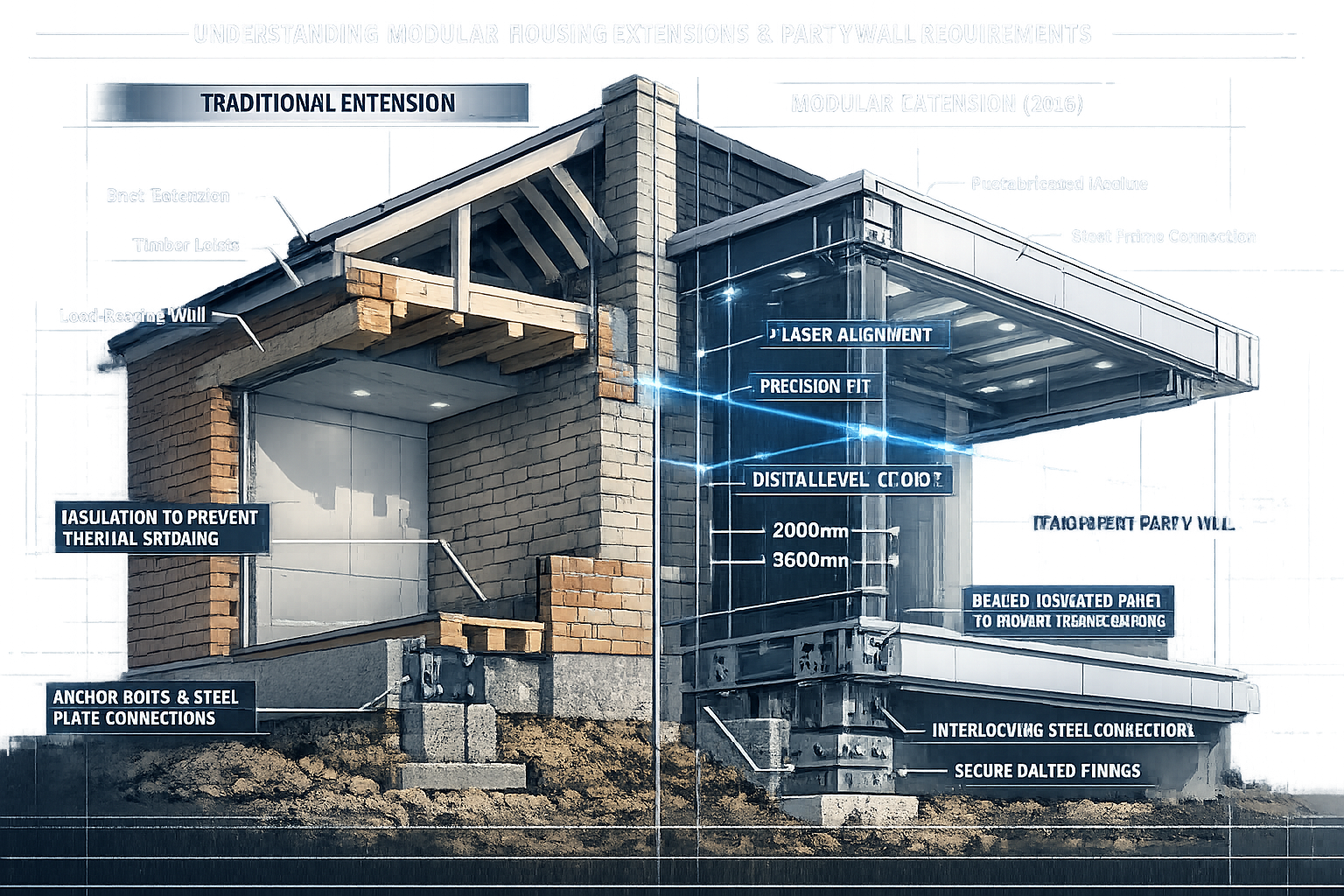
1️⃣ Structural Connection Defects
Common issues:
- Inadequate structural tie spacing exceeding design specifications
- Incorrect fastener types for party wall substrate (brick, block, or concrete)
- Missing or improperly installed expansion joints
- Load concentration points causing localized stress
- Differential settlement between modular unit and existing structure
Detection methods:
- Visual inspection of all accessible connection points
- Load testing of critical structural ties
- Crack monitoring over 3-6 month settlement period
- Structural engineer assessment for complex cases
Remediation protocols:
- Additional structural ties installed to correct spacing
- Replacement of inadequate fasteners with specified types
- Installation of supplementary expansion joints
- Load redistribution through steel frame modifications
- Underpinning or foundation enhancement if settlement occurs
2️⃣ Acoustic Performance Failures
Acoustic leakage at party wall junctions represents the most common complaint in modular extensions. Factory-controlled acoustic performance often degrades at site-installed connection points.
Common issues:
- Gaps in acoustic sealing materials at module edges
- Rigid connections creating sound transmission paths
- Insufficient mass in party wall interface layers
- Service penetrations without proper acoustic sealing
- Flanking transmission through floor or ceiling junctions
Detection methods:
- Sound transmission testing per Building Regulations Part E
- Visual inspection of all acoustic seal continuity
- Thermal imaging to identify hidden gaps
- Neighbour interviews regarding noise transmission
Remediation protocols:
- Acoustic sealant injection at identified gaps
- Installation of resilient isolation layers
- Additional mass layers (acoustic plasterboard)
- Service penetration sealing with acoustic foam
- Decoupling of rigid connections
3️⃣ Fire Barrier Discontinuities
Fire safety at party wall interfaces demands absolute continuity of fire-resistant barriers. Modular construction introduces additional complexity at junction points.
Common issues:
- Cavity barriers missing or incorrectly positioned
- Fire-stopping gaps around service penetrations
- Inadequate fire-resistant material specifications
- Compartmentation breaches at module edges
- Combustible materials in fire barrier zones
Detection methods:
- Visual inspection of all cavity barrier installations
- Smoke testing to identify air leakage paths
- Building Control inspection and certification
- Fire engineer assessment for complex scenarios
Remediation protocols:
- Installation of compliant cavity barriers
- Intumescent fire-stopping around all penetrations
- Replacement of non-compliant materials
- Compartmentation restoration with fire-rated boards
- Third-party certification of fire safety measures
4️⃣ Moisture and Thermal Performance Issues
The interface between factory-sealed modular units and site-installed party wall connections creates vulnerability to moisture ingress and thermal bridging.
Common issues:
- Damp-proof course misalignment or discontinuity
- Condensation at thermal bridges
- Water ingress through inadequately sealed junctions
- Vapour barrier breaches allowing interstitial condensation
- Cold spots reducing thermal efficiency
Detection methods:
- Thermal imaging surveys identifying cold bridges
- Moisture meter readings at junction points
- Condensation risk analysis using psychrometric calculations
- Visual inspection for water staining or mould growth
Remediation protocols:
- Damp-proof course installation or realignment
- Thermal break installation at identified bridges
- Enhanced weatherproofing at external junctions
- Vapour barrier repair or supplementation
- Ventilation improvements to manage condensation risk
Quality Assurance and Compliance Certification
Achieving compliance awards and quality certifications requires documented evidence of defect-free installation. Professional surveyors play a crucial role in this verification process.
Certification pathway:
📋 Stage 1: Pre-installation party wall agreements and condition surveys
📋 Stage 2: Factory inspection of modular units (optional but recommended)
📋 Stage 3: Foundation and party wall preparation verification
📋 Stage 4: Module installation supervision and immediate inspection
📋 Stage 5: Connection interface detailed survey
📋 Stage 6: Building Control inspection and sign-off
📋 Stage 7: Post-completion verification and neighbour agreement
📋 Stage 8: Final certification and warranty activation
This staged approach ensures that defects are identified and corrected promptly, avoiding costly retrospective remediation. Engaging experienced chartered surveyors familiar with both modular construction and party wall legislation provides essential expertise throughout this process.
Managing Party Wall Disputes in Modular Extension Projects
Preventing Disputes Through Proper Procedures
The accelerated timeline of modular construction can increase party wall dispute risk if proper procedures are not followed meticulously. Prevention strategies include:
Early engagement protocols:
- Serve party wall notices 2-3 months before module delivery
- Conduct pre-construction neighbour meetings explaining the process
- Provide clear timelines for crane operations and site activities
- Offer comprehensive condition surveys to all affected neighbours
- Appoint experienced party wall surveyors early in planning
Communication best practices:
- Weekly progress updates to adjoining owners
- 48-hour advance notice of noisy or disruptive activities
- Immediate notification of any unexpected issues
- Photographic documentation shared with neighbours
- Accessible project manager contact information
Understanding party wall surveyor costs helps budget appropriately for professional services that prevent expensive disputes.
Resolving Defect-Related Disputes
When defects at party wall interfaces cause damage or concern to neighbours, structured resolution processes protect all parties' interests.
Dispute resolution framework:
- Immediate documentation: Photograph and measure any alleged damage
- Expert assessment: Independent surveyor inspection within 48 hours
- Causation analysis: Determine whether damage relates to modular installation
- Remediation proposal: Detailed scope of corrective works with timeline
- Agreement formalization: Written acceptance of remediation plan
- Work completion: Supervised remediation with quality verification
- Final sign-off: Neighbour confirmation of satisfactory completion
Professional party wall matters expertise ensures disputes are resolved efficiently without escalation to formal legal proceedings.
Advanced Inspection Technologies for Modular Party Wall Surveys
Digital Survey Tools and Techniques
Modern Building Surveys for Modular Housing Extensions in 2026: Defect Protocols for Prefab Party Wall Integrations leverage advanced technologies for enhanced accuracy and documentation quality.
Technology applications:
🔧 Thermal Imaging Cameras
- Identify thermal bridges at party wall junctions
- Detect moisture ingress invisible to visual inspection
- Verify insulation continuity and performance
- Document temperature differentials for compliance evidence
🔧 3D Laser Scanning
- Create precise dimensional records of party wall interfaces
- Verify alignment and tolerance compliance
- Generate as-built documentation for future reference
- Enable clash detection between modular units and existing structures
🔧 Acoustic Testing Equipment
- Measure sound transmission at party wall junctions
- Verify compliance with Building Regulations Part E
- Identify acoustic leakage paths requiring remediation
- Provide objective evidence for acoustic performance
🔧 Moisture Detection Systems
- Non-invasive moisture content measurement
- Deep-wall moisture profiling
- Leak detection at hidden connection points
- Condensation risk monitoring over time
🔧 Drone Roof Surveys
- Inspect upper-level party wall connections safely
- Document external weatherproofing details
- Verify crane access routes and clearances
- Create aerial photographic records
Integrating drone roof survey capabilities with traditional ground-level inspection provides comprehensive coverage of multi-story modular extensions.
Data Management and Reporting Standards
Professional survey reports for modular party wall integrations must meet enhanced documentation standards to support compliance certification and potential dispute resolution.
Essential report components:
📄 Executive summary with compliance status and critical findings
📄 Detailed inspection methodology and equipment used
📄 Comprehensive photographic evidence with annotated images
📄 Defect register with severity ratings and remediation priorities
📄 Compliance matrix against Building Regulations and party wall requirements
📄 Thermal imaging and acoustic testing results with analysis
📄 Comparison with pre-installation baseline condition
📄 Remediation recommendations with cost estimates
📄 Certification pathway status and outstanding requirements
📄 Appendices with technical specifications and test certificates
Digital report delivery with interactive elements (clickable photo galleries, embedded videos, 3D model links) enhances client understanding and facilitates stakeholder communication.
Future Trends in Modular Party Wall Integration
Emerging Standards and Best Practices
As modular construction volumes continue their projected growth trajectory toward $162.42 billion by 2030[4], industry standards for party wall integration are evolving rapidly.
Anticipated developments:
🔮 Standardized Connection Details: Industry-wide adoption of proven party wall interface designs reducing defect rates
🔮 Pre-Certified Modules: Factory testing and certification of acoustic, thermal, and fire performance before site delivery
🔮 Digital Twin Integration: Real-time monitoring of party wall junctions using embedded sensors detecting settlement, moisture, or acoustic issues
🔮 Hybrid Construction Optimization: Enhanced protocols for multi-story modular buildings on site-built podiums addressing complex party wall scenarios[2]
🔮 Regulatory Harmonization: Streamlined approval processes recognizing modular construction's controlled quality advantages
Professional Development and Specialization
The growing complexity of Building Surveys for Modular Housing Extensions in 2026: Defect Protocols for Prefab Party Wall Integrations demands specialized surveyor expertise combining traditional party wall knowledge with modular construction understanding.
Recommended competencies:
✓ Advanced understanding of modular construction methods and materials
✓ Party Wall Act 1996 expertise and dispute resolution experience
✓ Building Regulations compliance verification for hybrid construction
✓ Structural engineering principles for steel frame-to-masonry connections
✓ Acoustic and thermal performance testing and analysis
✓ Digital survey technology proficiency (thermal imaging, 3D scanning)
✓ Project management skills for compressed modular timelines
✓ Stakeholder communication and neighbour relations management
Surveyors developing these specialized skills position themselves advantageously in a rapidly expanding market segment where expertise directly correlates with project success and client satisfaction.
Conclusion
Building Surveys for Modular Housing Extensions in 2026: Defect Protocols for Prefab Party Wall Integrations represent a critical specialization as modular construction volumes surge to meet housing demand. The intersection of off-site manufacturing efficiency and traditional party wall legislation requires rigorous inspection protocols addressing structural connections, acoustic performance, fire barriers, and moisture management at prefab-to-masonry interfaces.
Key success factors include:
✅ Early party wall procedure initiation accommodating compressed modular timelines
✅ Comprehensive pre-installation condition surveys establishing baseline documentation
✅ Specialized defect protocols targeting common failure modes in prefab connections
✅ Advanced inspection technologies enhancing detection accuracy and documentation quality
✅ Structured compliance certification pathways ensuring regulatory adherence
✅ Proactive dispute prevention through transparent communication and professional expertise
Actionable Next Steps
For property owners planning modular extensions:
- Engage experienced party wall surveyors 2-3 months before module delivery
- Request detailed defect protocols specific to prefab party wall integrations
- Ensure comprehensive pre-installation condition surveys of neighbouring properties
- Budget for professional Level 3 building surveys with modular expertise
- Verify surveyor proficiency with advanced inspection technologies
For surveyors expanding into this specialization:
- Develop technical knowledge of modular construction methods and materials
- Invest in thermal imaging, acoustic testing, and 3D scanning equipment
- Build relationships with modular manufacturers and contractors
- Stay current with evolving standards for prefab party wall connections
- Create standardized inspection checklists addressing common defect patterns
The modular construction revolution offers tremendous opportunities for faster, more sustainable housing delivery. By implementing rigorous Building Surveys for Modular Housing Extensions in 2026: Defect Protocols for Prefab Party Wall Integrations, professionals ensure these innovations meet the highest standards of structural integrity, neighbour protection, and regulatory compliance—securing the industry's long-term success and reputation.
References
[1] Modular Housing Construction Mbi Survey Data – https://www.realtor.com/news/real-estate-news/modular-housing-construction-mbi-survey-data/
[2] 2026 State Of Modular Construction Speed Certainty And Smarter Space Across The Northeast And Midwest – https://www.triumphmodular.com/blog/2026-state-of-modular-construction-speed-certainty-and-smarter-space-across-the-northeast-and-midwest/
[3] 2026 Best Modular Houses Innovative Designs Features – https://www.szskycamp.com/blog/2026-best-modular-houses-innovative-designs-features/
[4] Modular Homes In Everything You Need To Know Before Building Or Buying – https://www.amerisave.com/learn/modular-homes-in-everything-you-need-to-know-before-building-or-buying
[5] Modular Vs Traditional Construction In 2026 Cost Speed Roi Compared – https://www.s2amodular.com/2026/01/30/modular-vs-traditional-construction-in-2026-cost-speed-roi-compared/
[6] Colorado Ihip Prop 123 Modular Housing Spotlight – https://www.taxcreditadvisor.com/articles/colorado-ihip-prop-123-modular-housing-spotlight/
[7] Modular Home Extensions Fast High Performance Prefab Extension Kits – https://warmerroof.com/modular-home-extensions-fast-high-performance-prefab-extension-kits/
[8] Modular Homes Market Report – https://www.cognitivemarketresearch.com/modular-homes-market-report