
`
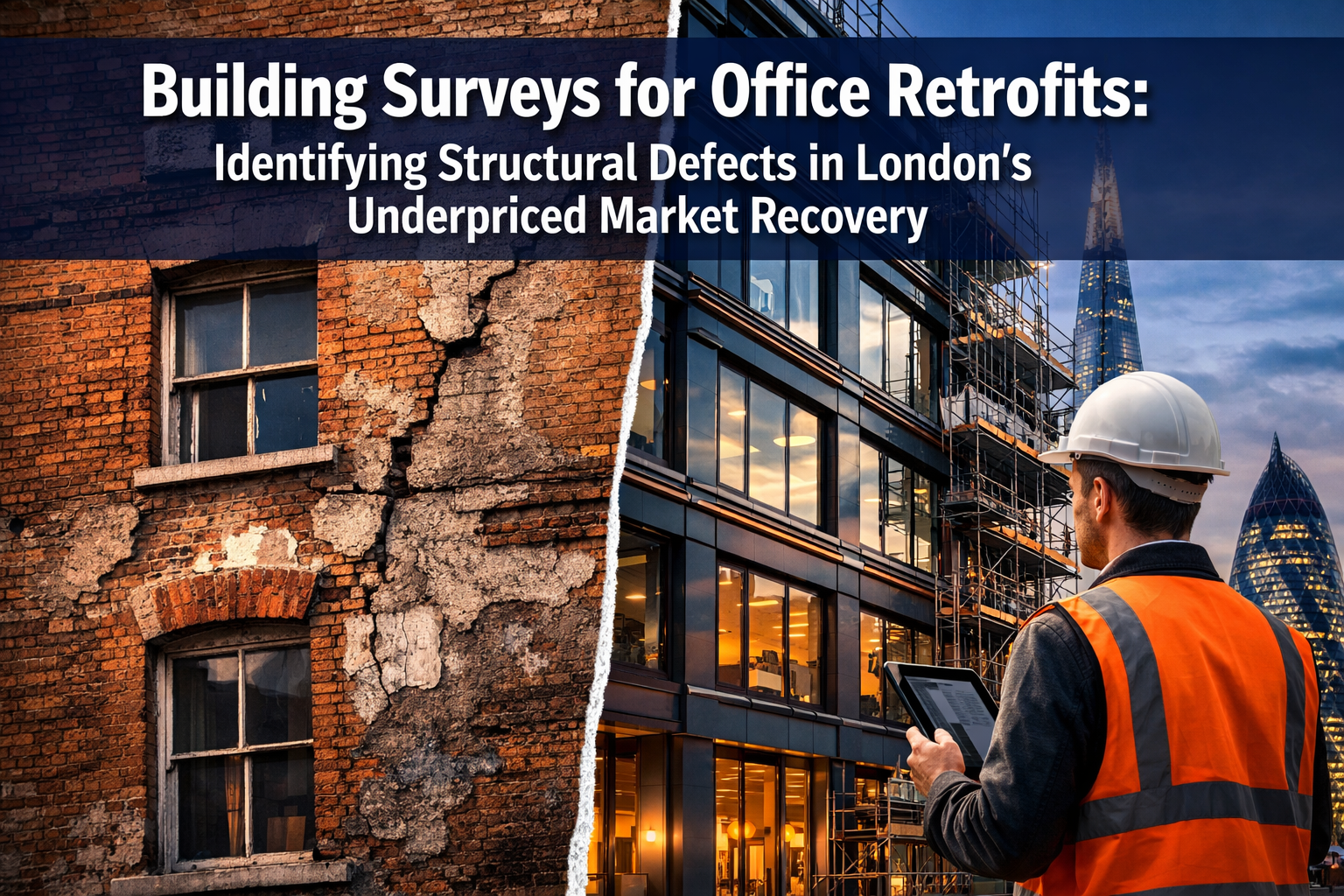
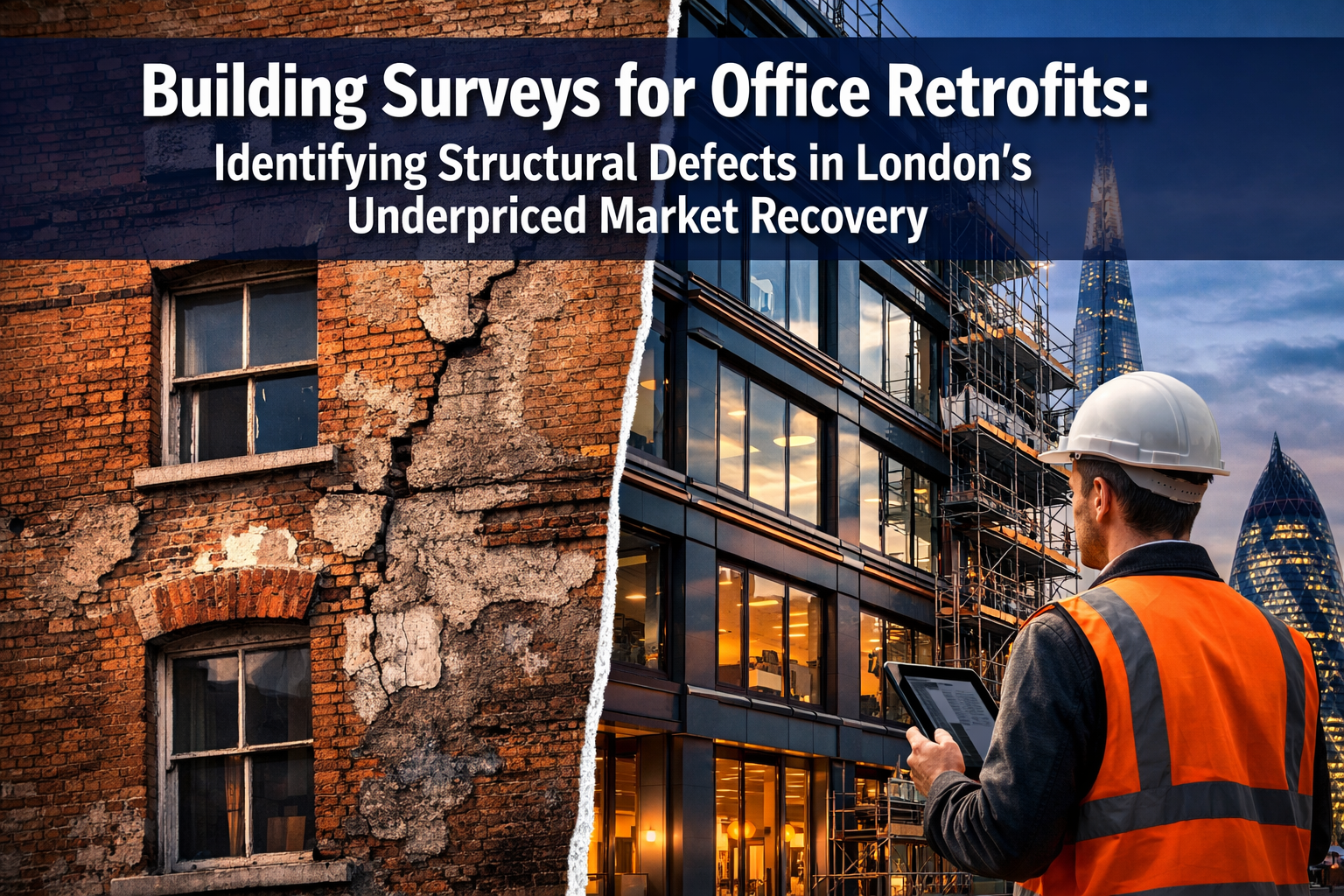
London's commercial office market stands at a pivotal crossroads in 2026. After years of uncertainty, investor confidence is returning—but with a sharp focus on value and viability. Office properties, now widely regarded as the most undervalued asset class in the capital, present unprecedented opportunities for those who can accurately assess retrofit potential. The key to unlocking these opportunities lies in comprehensive building surveys for office retrofits: identifying structural defects in London's underpriced market recovery before committing capital to transformation projects.
The stakes have never been higher. With new sustainability mandates, evolving building regulations, and a pronounced "flight to quality" reshaping tenant demand, investors must distinguish between genuinely viable retrofit candidates and money pits disguised as bargains. Structural defects that might have been overlooked during the pre-pandemic boom now represent critical decision points that can make or break a project's financial viability.
Key Takeaways
- 📊 London office properties represent the most undervalued commercial asset class in 2026, creating significant opportunities for investors who can accurately assess retrofit viability through comprehensive structural surveys
- 🏗️ ESG compliance and whole life-cycle carbon assessments are now enforceable planning requirements in the City of London, making defect identification critical to determining retrofit feasibility versus demolition
- ⚠️ Common structural defects in aging London offices—including foundation subsidence, corroded steel frameworks, and facade deterioration—can add 15-40% to projected retrofit costs if not identified early
- 🔍 RICS-aligned building surveys must now incorporate enhanced compliance assessments, thermal performance evaluation, and fire safety legislation requirements to meet 2026 regulatory standards
- 💡 Strategic defect assessment enables informed investment decisions, with successful retrofits achieving 20% energy savings and significantly improved rental yields in London's recovering market
Understanding London's Office Market Recovery Context
The Undervalued Asset Opportunity
London's office sector has experienced a dramatic repricing over the past several years, creating what many analysts consider a once-in-a-generation buying opportunity. However, this recovery is highly selective. The market has bifurcated sharply between modern, ESG-compliant Grade A space and older, energy-inefficient buildings that face extended void periods and discounted rents[1].
This divergence creates the perfect storm for strategic retrofit investment—but only for properties where the underlying structure can support comprehensive modernization. Buildings with significant structural defects may appear attractively priced but could quickly consume projected returns through remediation costs.
The Flight to Quality Phenomenon
Tenant demand in 2026 has consolidated around properties that offer:
- Superior energy performance (EPC ratings of B or higher)
- Modern amenities and flexible workspace configurations
- Wellness features including enhanced air quality and natural light
- Sustainability credentials aligned with corporate ESG commitments
Older office stock without the potential for deep retrofitting faces increasingly longer void periods and rental discounts[1]. This reality makes accurate structural assessment the foundation of any successful acquisition strategy.
Regulatory Drivers Reshaping Retrofit Decisions
The City of London's Sustainability Supplementary Planning Document (SPD) has fundamentally altered the retrofit landscape. Whole life-cycle carbon assessments and retrofit-first design approaches are now enforceable planning requirements[5]. This regulatory framework means that structural defects don't just impact construction costs—they can determine whether a project receives planning approval at all.
Building Surveys for Office Retrofits: The Foundation of Due Diligence
Why Standard Surveys Fall Short for Retrofit Projects
Traditional commercial property surveys often focus on immediate health and safety concerns and obvious defects. However, retrofit projects demand a fundamentally different approach. A structural survey in London for retrofit purposes must evaluate:
🔍 Structural capacity to accommodate additional loads from new building services, green roofs, or facade upgrades
🔍 Thermal performance of existing building fabric and potential for improvement
🔍 Hidden defects that may only manifest during intrusive retrofit works
🔍 Compliance gaps between current condition and 2026 building regulations
🔍 Heritage constraints for listed buildings or properties in conservation areas
The RICS Framework for Retrofit Surveys
Professional building surveyors conducting retrofit assessments in 2026 must align their methodologies with RICS guidance while incorporating enhanced compliance requirements. This includes:
Level 1: Initial Viability Assessment
- Desktop review of building records and planning history
- Visual inspection of accessible areas
- Preliminary identification of major defect categories
- High-level retrofit feasibility determination
Level 2: Comprehensive Structural Survey
- Detailed inspection of all accessible structural elements
- Non-destructive testing where appropriate
- Identification of all visible and suspected defects
- Preliminary cost estimates for remediation
Level 3: Intrusive Investigation
- Opening up works to expose hidden elements
- Materials testing and laboratory analysis
- Structural calculations for proposed modifications
- Detailed remediation specifications
For complex retrofit projects, engaging residential structural engineers in London with commercial expertise ensures that assessments address both current defects and future structural requirements.
Common Structural Defects in London's Office Building Stock
Era-Specific Defect Patterns
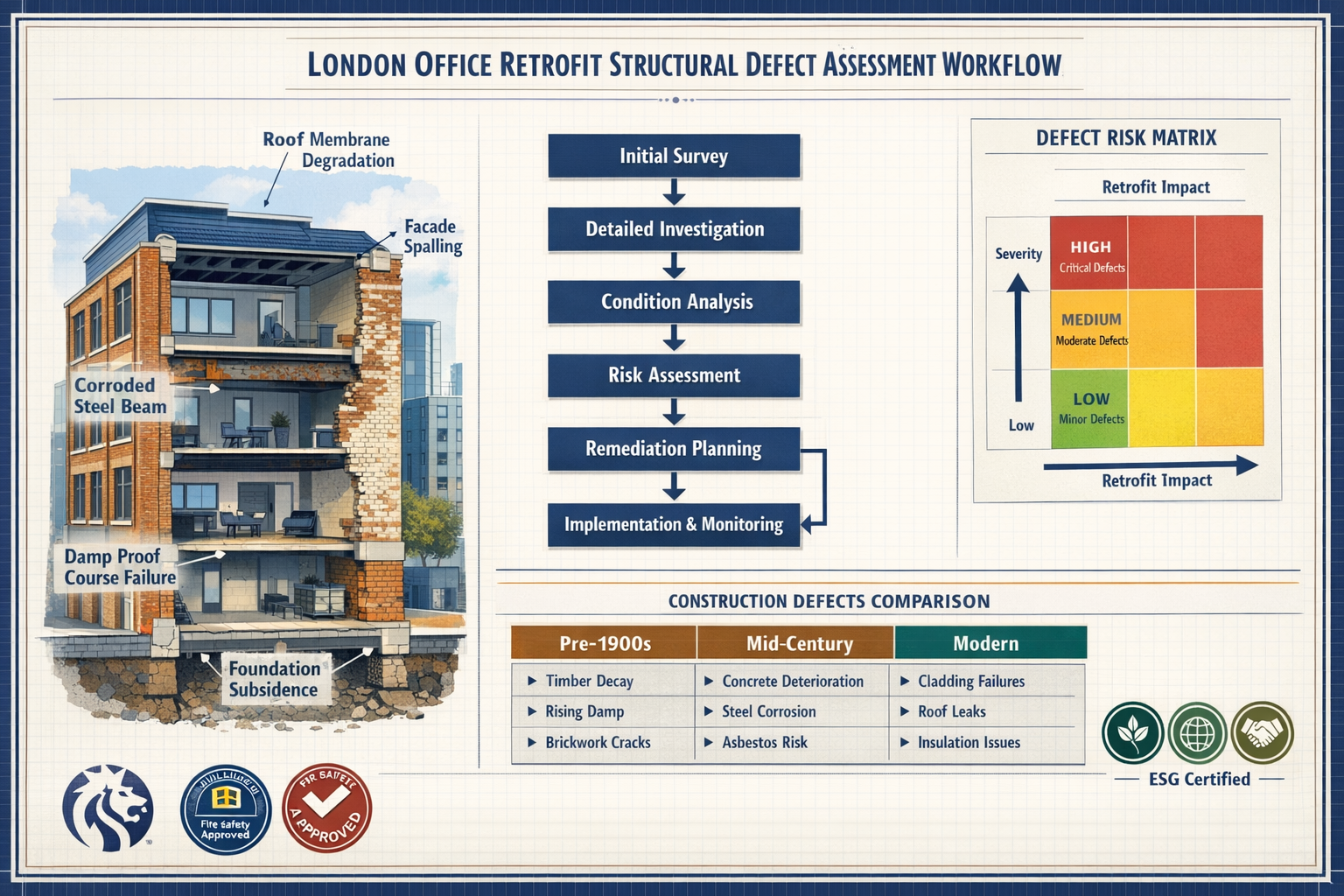
London's diverse commercial building stock presents distinct defect profiles based on construction period:
Victorian and Edwardian Era (Pre-1914)
Typical Construction:
- Load-bearing brick or masonry walls
- Timber or cast iron floor structures
- Slate or clay tile roofing
- Minimal damp-proofing
Common Defects:
- Foundation settlement and differential movement
- Deteriorated or absent damp-proof courses
- Corroded cast iron beams and columns
- Timber decay in floor joists and roof structures
- Facade spalling and brick deterioration
- Inadequate lateral stability provisions
Mid-Century Modern (1950s-1970s)
Typical Construction:
- Reinforced concrete frames
- Curtain wall facades
- Flat concrete roof slabs
- Asbestos-containing materials
Common Defects:
- Concrete carbonation and reinforcement corrosion
- Curtain wall water infiltration and thermal bridging
- Flat roof membrane failure
- Asbestos presence requiring specialist removal
- Inadequate thermal performance
- Structural alterations compromising original design intent
Late 20th Century (1980s-1990s)
Typical Construction:
- Steel or concrete frames
- Precast concrete cladding panels
- Suspended ceilings and raised floors
- Complex building services integration
Common Defects:
- Cladding panel deterioration and fixings corrosion
- Structural modifications for services compromising integrity
- Inadequate fire protection to structural steel
- Building services obsolescence
- Poor energy performance requiring complete facade replacement
Critical Defect Categories for Retrofit Viability
| Defect Category | Impact on Retrofit | Typical Cost Impact | Assessment Priority |
|---|---|---|---|
| Foundation Issues | May preclude additional loads; limits vertical extension | 15-30% of project budget | Critical |
| Structural Frame Deterioration | Requires extensive remediation before retrofit works | 20-40% cost increase | Critical |
| Facade Defects | Often necessitates complete replacement vs. retention | 10-25% of project budget | High |
| Roof Structure Problems | Limits green roof or PV installation potential | 5-15% cost increase | High |
| Fire Safety Non-Compliance | Triggers extensive remediation under new legislation | 10-20% cost increase | Critical |
| Asbestos Presence | Adds removal costs and program delays | 3-8% cost increase | Medium |
| Thermal Performance | Determines depth of retrofit required | Variable (5-30%) | High |
A specific defect report can provide targeted investigation of particular concerns identified during initial surveys.
The Hidden Defect Challenge
One of the most significant risks in retrofit projects involves defects that only become apparent once intrusive works begin. Building regulation compliance delays caused by defective works requiring mid-project remediation have become a prominent source of project delays and cost overruns in 2026[4].
Common hidden defects include:
- Concealed structural modifications from previous fit-outs
- Water damage within wall cavities and floor voids
- Deteriorated connections between structural elements
- Non-compliant fire stopping and compartmentation
- Undocumented services penetrations compromising structural integrity
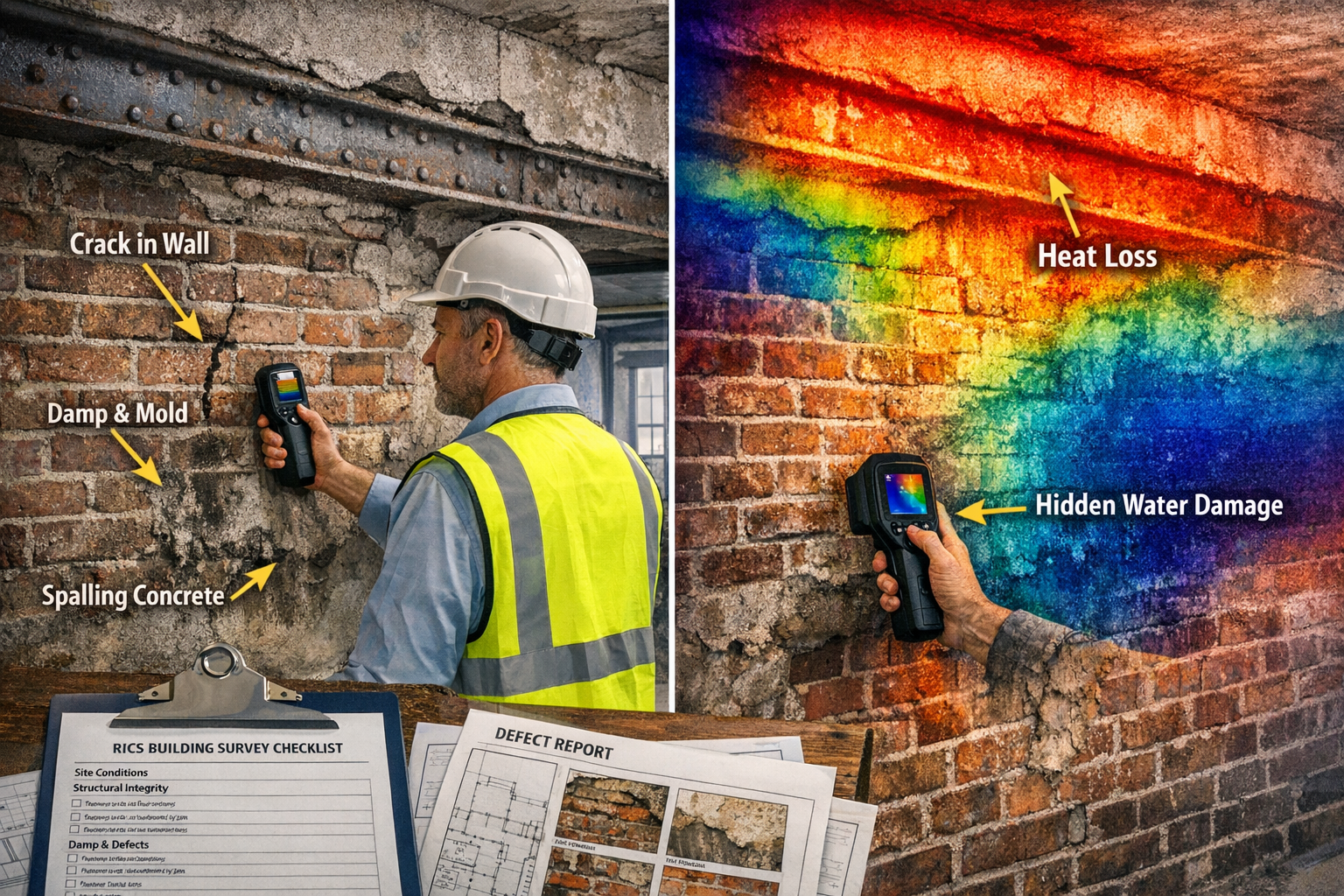
Professional surveyors mitigate this risk through strategic opening-up works during the survey phase, using thermal imaging, moisture meters, and other non-destructive testing methods to identify likely problem areas before committing to full acquisition.
Building Surveys for Office Retrofits: Identifying Structural Defects in London's Underpriced Market Recovery – The Assessment Process
Pre-Acquisition Survey Strategy
Successful investors in London's office retrofit market employ a phased survey approach that balances thoroughness with cost-efficiency:
Phase 1: Desktop Due Diligence (Week 1)
- Review building control records and planning history
- Obtain previous survey reports and maintenance records
- Identify listed building or conservation area constraints
- Research known defect patterns for building type and era
- Preliminary financial modeling based on typical defect scenarios
Phase 2: Initial Site Survey (Week 2-3)
- Comprehensive visual inspection by RICS-qualified surveyor
- Photographic documentation of all accessible areas
- Non-destructive testing of suspect areas
- Preliminary defect categorization and remediation cost estimates
- Go/no-go decision point for proceeding to detailed investigation
Phase 3: Detailed Investigation (Week 4-6)
- Strategic opening-up works to expose hidden elements
- Materials testing and structural analysis
- Specialist consultations (fire engineers, MEP engineers, heritage consultants)
- Detailed remediation specifications and cost certainty
- Final investment decision with comprehensive risk assessment
This phased approach allows investors to abandon non-viable opportunities early while developing accurate cost certainty for promising retrofit candidates.
Essential Survey Components for Retrofit Projects
Structural Capacity Assessment
Beyond identifying existing defects, retrofit surveys must evaluate whether the structure can accommodate proposed improvements:
✅ Additional Dead Loads: Green roofs, solar panels, new building services, upgraded facades
✅ Enhanced Live Loads: Modern office density requirements, collaborative spaces, amenity floors
✅ Lateral Load Capacity: Wind loading on modified facades, seismic considerations for structural alterations
✅ Vertical Extension Potential: Foundation capacity for additional floors, structural frame adequacy
A roof survey in London becomes particularly critical when evaluating potential for solar PV installation, green roofs, or rooftop amenity spaces that can significantly enhance rental values.
Thermal Performance Evaluation
Energy efficiency has transitioned from a "nice-to-have" to a fundamental requirement for competitive office space in 2026. Surveys must assess:
- Current thermal performance of building envelope
- Air tightness and infiltration rates
- Thermal bridging at structural connections
- Potential for fabric improvements vs. complete replacement
- Cost-benefit analysis of various thermal upgrade strategies
Buildings with poor thermal performance but sound structure often represent the best retrofit opportunities, as energy improvements deliver immediate operational cost savings and rental premiums.
Fire Safety Compliance Assessment
New fire safety legislation has created significant compliance challenges for office retrofits in 2026[2]. Surveys must identify:
🔥 Compartmentation deficiencies and fire stopping failures
🔥 Inadequate means of escape from upper floors
🔥 Non-compliant fire protection to structural elements
🔥 Cladding systems requiring replacement under updated regulations
🔥 Sprinkler and detection system upgrade requirements
Fire safety remediation can represent 10-20% of total project costs, making early identification essential for accurate financial modeling.
Heritage Building Considerations
Retrofitting listed properties and buildings in conservation areas requires specialist skills to avoid unintended consequences such as mould growth and fabric damage[3][6]. Common challenges include:
Breathability vs. Thermal Performance
Traditional construction relies on vapor-permeable materials. Inappropriate insulation can trap moisture, leading to accelerated deterioration.
Reversibility Requirements
Conservation officers often require retrofit interventions to be reversible, limiting options for structural modifications.
Materials Compatibility
Modern materials must be compatible with historic fabric to avoid chemical or physical incompatibility issues.
Visual Impact
External alterations face strict controls, often necessitating more expensive internal insulation approaches.
Engaging surveyors with conservation expertise early in the process prevents costly redesigns and planning delays. For properties with complex heritage constraints, an expert witness report may be valuable if disputes arise with conservation authorities.
Defect Identification Checklist for Office Retrofits
Foundation and Substructure
Visual Indicators:
- Stepped cracking in external walls
- Doors and windows out of square
- Floor level variations
- External ground level changes adjacent to building
Investigation Methods:
- Trial pit excavation to expose foundations
- Ground investigation and soil testing
- Structural monitoring of active movement
- Review of nearby construction activities
Critical Questions:
- Can foundations support additional loads from retrofit?
- Is ongoing settlement active or historic and stabilized?
- What remediation options exist and at what cost?
- Do neighboring properties show similar distress?
Structural Frame
Visual Indicators:
- Deflection or sagging in beams and slabs
- Cracking in concrete elements
- Corrosion staining on steel or concrete
- Previous unauthorized structural modifications
Investigation Methods:
- Concrete core sampling and carbonation testing
- Reinforcement location and corrosion surveys
- Steel thickness measurement and material testing
- Structural calculations for existing and proposed loads
Critical Questions:
- Does the frame meet current loading standards?
- What is the remaining service life without intervention?
- Can the structure accommodate proposed modifications?
- Are there concealed structural alterations from previous fit-outs?
Building Envelope
Visual Indicators:
- Water staining on internal finishes
- Facade cracking, spalling, or movement
- Window and door seal failures
- Thermal imaging anomalies indicating heat loss
Investigation Methods:
- Water testing of facade systems
- Thermal imaging surveys
- Air tightness testing
- Facade fixing inspection and pull testing
Critical Questions:
- Can the existing facade be retained and upgraded?
- What is the cost differential between repair and replacement?
- Does the facade meet current thermal performance requirements?
- Are there safety concerns requiring immediate remediation?
Working with chartered surveyors in London who specialize in commercial properties ensures that envelope assessments address both technical performance and aesthetic considerations.
Roof Structure and Covering
Visual Indicators:
- Water ingress and staining to top floor ceilings
- Ponding water on flat roofs
- Deflection in roof structure
- Deteriorated roof coverings and flashings
Investigation Methods:
- Roof access inspection and moisture surveys
- Structural capacity calculations for proposed upgrades
- Core samples through roof build-up
- Drone roof surveys for large or complex roofs
Critical Questions:
- What is the remaining service life of roof coverings?
- Can the structure support green roof or solar PV installation?
- Are there concealed drainage or structural issues?
- What is the most cost-effective upgrade strategy?
Building Services Integration
Visual Indicators:
- Structural penetrations compromising integrity
- Unauthorized modifications to structural elements
- Inadequate services capacity for modern requirements
- Asbestos-containing materials in services
Investigation Methods:
- Services capacity and condition assessment
- Structural impact evaluation of existing penetrations
- Coordination review between structure and proposed MEP
- Asbestos surveys and sampling
Critical Questions:
- Can existing services be retained and upgraded?
- What structural modifications are required for modern MEP?
- Are there opportunities for services cost savings through strategic reuse?
- What is the asbestos removal scope and cost?
A successful Central London refurbishment project achieved 98% client satisfaction and 20% energy savings through smart sensors despite post-pandemic volatility[2], demonstrating the value of integrating modern building services with existing structures.
Financial Implications of Structural Defects
Cost Impact Modeling
Accurate defect assessment enables sophisticated financial modeling that distinguishes viable opportunities from value traps:
Scenario 1: Minor Defects (5-10% cost impact)
- Localized repairs to building fabric
- Routine maintenance items deferred by previous owner
- Compliance upgrades within normal retrofit scope
- Investment Decision: Proceed with standard contingency
Scenario 2: Moderate Defects (10-20% cost impact)
- Partial facade replacement or significant repair
- Structural strengthening for new loads
- Fire safety system upgrades
- Asbestos removal from accessible areas
- Investment Decision: Proceed with enhanced contingency and value engineering
Scenario 3: Major Defects (20-40% cost impact)
- Foundation remediation or underpinning
- Extensive structural frame repair
- Complete facade replacement
- Major fire safety remediation
- Investment Decision: Requires significant acquisition discount or project abandonment
Scenario 4: Critical Defects (>40% cost impact)
- Fundamental structural instability
- Extensive contamination or hazardous materials
- Insurmountable planning or heritage constraints
- Investment Decision: Project abandonment
The Retrofit vs. Demolition Decision
The City of London's retrofit-first planning policy means that demolition and rebuild requires compelling justification[5]. Structural surveys must provide evidence supporting either approach:
Factors Favoring Retrofit:
- Sound structural frame with localized defects
- Heritage value or planning constraints on demolition
- Embodied carbon benefits of retention
- Shorter program and lower risk
- Retention of existing tenants during phased works
Factors Favoring Demolition:
- Fundamental structural inadequacy
- Excessive defect remediation costs
- Inability to achieve required energy performance
- Site constraints preventing effective retrofit
- Whole life-cycle carbon analysis favoring rebuild
The Sheldon Square project demonstrated the value of strategic retention, preserving the facade while reducing building services installation costs by 30% through strategic MEP reuse[3].
Risk Allocation and Contingency Planning
Structural defect risks should inform contract strategy and contingency allocation:
| Risk Category | Typical Contingency | Mitigation Strategy |
|---|---|---|
| Known Defects | 5-10% | Detailed specification and competitive tendering |
| Suspected Hidden Defects | 10-15% | Strategic opening-up works pre-contract |
| Unknown Unknowns | 5-10% | Experienced contractor selection and collaborative contracts |
| Regulatory Changes | 3-5% | Enhanced compliance buffer and flexible design |
| Supply Chain Disruption | 5-10% | Early procurement and alternative supplier identification |
Supply chain instability remains a prominent risk for London office refurbishment in 2026[2], making early identification of critical materials and long-lead items essential.
Regulatory Compliance and Building Surveys for Office Retrofits
2026 Building Regulations Landscape
The regulatory environment for office retrofits has evolved significantly, with several major policy changes affecting structural requirements:
Enhanced Energy Performance Standards
- Minimum EPC rating requirements for commercial lettings
- Whole building energy modeling requirements
- Operational energy monitoring and reporting
Updated Fire Safety Legislation
- Enhanced compartmentation requirements
- Improved means of escape standards
- Cladding system restrictions and testing
- Sprinkler installation thresholds
Accessibility Improvements
- Updated Part M requirements for commercial buildings
- Inclusive design standards
- Vertical circulation capacity requirements
Structural Safety
- Enhanced robustness requirements
- Disproportionate collapse provisions
- Updated loading standards
A comprehensive guide to major policy changes in UK construction provides additional context for these evolving requirements[8].
The Enhanced Compliance Assessment
Building surveys in 2026 must incorporate enhanced compliance assessments that evaluate the gap between current condition and regulatory requirements. Defective works requiring mid-project remediation and "enhanced compliance" have caused significant project delays and increased costs, with claims anticipated to flow from these issues[4].
Compliance Gap Analysis Should Address:
📋 Current vs. Required Performance: Quantified assessment of energy, fire safety, accessibility, and structural adequacy
📋 Remediation Pathways: Multiple options for achieving compliance with cost-benefit analysis
📋 Phasing Opportunities: Strategies for staged compliance improvements aligned with tenant lease events
📋 Future-Proofing: Anticipation of likely regulatory evolution over building life cycle
Planning and Heritage Constraints
For properties in conservation areas or with listed status, surveys must evaluate retrofit options within planning constraints:
Conservation Area Considerations:
- External alteration restrictions
- Materials and detailing requirements
- Impact on setting and character
- Consultation requirements with conservation officers
Listed Building Constraints:
- Significance assessment of affected elements
- Reversibility requirements for interventions
- Specialist conservation techniques
- Listed building consent process and timeline
Barriers to historic building retrofit remain significant in 2026, requiring specialist skills and careful planning to navigate successfully[6].
Selecting the Right Survey Provider
Essential Qualifications and Experience
Not all building surveyors possess the specialized knowledge required for complex office retrofit assessments. Key qualifications include:
✅ RICS Membership: Chartered status with relevant commercial property expertise
✅ Retrofit Experience: Demonstrated track record with similar building types and eras
✅ Technical Specializations: Structural engineering knowledge, thermal performance assessment, fire safety expertise
✅ Local Knowledge: Familiarity with London building stock, local authority requirements, and heritage constraints
✅ Professional Indemnity Insurance: Adequate coverage for project scale and complexity
The Multi-Disciplinary Approach
Complex retrofit projects benefit from integrated survey teams bringing diverse expertise:
Core Survey Team:
- Lead building surveyor (RICS qualified)
- Structural engineer
- MEP consultant
- Quantity surveyor for cost estimation
Specialist Consultants (as required):
- Fire safety engineer
- Conservation architect
- Environmental consultant
- Asbestos surveyor
- Acoustic consultant
Engaging commercial property surveyors in London with established multi-disciplinary networks ensures seamless coordination and comprehensive assessments.
Survey Deliverables and Reporting
Professional retrofit surveys should deliver comprehensive documentation supporting informed investment decisions:
Essential Report Components:
📊 Executive Summary: High-level findings, critical defects, and viability assessment
📊 Detailed Defect Schedule: Categorized by severity, location, and remediation urgency
📊 Photographic Evidence: Comprehensive documentation of all identified defects
📊 Remediation Specifications: Detailed descriptions of required works
📊 Cost Estimates: Itemized remediation costs with appropriate contingencies
📊 Compliance Assessment: Gap analysis against current regulations
📊 Recommendations: Prioritized action plan and risk mitigation strategies
For properties with tenant occupation, dilapidation surveys can help establish baseline conditions and allocate responsibility for existing defects.
Case Studies: Defect Assessment Driving Investment Decisions

Case Study 1: Victorian Warehouse Conversion – Defects Identified, Value Unlocked
Property Profile:
- 1890s brick warehouse in East London
- 45,000 sq ft across five floors
- Vacant for three years
- Asking price: £8.5 million
Survey Findings:
- Foundation settlement stabilized but requiring monitoring
- Deteriorated timber floor joists requiring selective replacement (15% of area)
- Absent damp-proof course requiring retrofit installation
- Sound brick facade suitable for retention with repointing
- Roof structure adequate for green roof installation
Financial Impact:
- Defect remediation: £850,000 (10% of purchase price)
- Total project cost including retrofit: £12.3 million
- Post-retrofit valuation: £18.5 million
- Investment Decision: Proceed with 15% contingency
Outcome:
The detailed survey enabled confident investment in what appeared to be a risky asset, with accurate cost forecasting preventing mid-project surprises.
Case Study 2: 1970s Office Block – Critical Defects Trigger Withdrawal
Property Profile:
- 1973 concrete frame office building
- 65,000 sq ft across eight floors
- Partially occupied with short-term tenants
- Asking price: £11.2 million
Survey Findings:
- Extensive concrete carbonation with reinforcement corrosion
- Curtain wall water infiltration causing internal damage
- Structural modifications from previous fit-outs compromising frame integrity
- Asbestos throughout building services and finishes
- Foundation capacity inadequate for vertical extension
Financial Impact:
- Defect remediation: £4.8 million (43% of purchase price)
- Asbestos removal: £1.2 million
- Structural strengthening: £2.1 million
- Total project cost: £19.3 million
- Post-retrofit valuation: £17.8 million
- Investment Decision: Project abandoned
Outcome:
Comprehensive survey prevented a value-destructive investment, saving the investor from significant losses.
Case Study 3: Mid-Century Listed Building – Strategic Retention Approach
Property Profile:
- 1965 Grade II listed office building
- 38,000 sq ft across six floors
- Architecturally significant curtain wall facade
- Asking price: £6.8 million
Survey Findings:
- Structurally sound concrete frame
- Curtain wall requiring complete refurbishment but retainable
- Internal fit-out completely obsolete
- Good thermal upgrade potential through internal insulation
- Roof structure suitable for discreet PV installation
Financial Impact:
- Facade refurbishment: £1.9 million
- Internal retrofit: £3.2 million
- Total project cost: £11.9 million
- Heritage grant funding: £850,000
- Post-retrofit valuation: £16.2 million
- Investment Decision: Proceed with conservation-led approach
Outcome:
Survey identified a path to compliance within heritage constraints, accessing grant funding and achieving premium rental rates for sensitive restoration.
Future-Proofing Through Comprehensive Defect Assessment
Anticipating Regulatory Evolution
The regulatory landscape for commercial buildings continues to evolve. Forward-thinking surveys assess not just current compliance but likely future requirements:
Emerging Regulatory Trends:
- Progressive tightening of energy performance standards
- Enhanced climate resilience requirements (overheating, flood risk)
- Circular economy and material reuse mandates
- Operational carbon monitoring and reporting
- Enhanced biodiversity and green infrastructure requirements
Buildings that can accommodate future regulatory evolution without fundamental reinvestment maintain value better than those requiring repeated major interventions.
Climate Adaptation Considerations
Structural surveys should evaluate climate resilience:
🌡️ Overheating Risk: Thermal mass, solar gain, natural ventilation potential
🌡️ Flood Resilience: Basement waterproofing, drainage capacity, services location
🌡️ Extreme Weather: Facade durability, roof wind resistance, thermal cycling
🌡️ Water Scarcity: Rainwater harvesting potential, greywater systems
Climate-adapted buildings command rental premiums and lower obsolescence risk.
Technology Integration Readiness
Modern office tenants expect sophisticated building systems. Surveys should assess:
- Structural capacity for heavy floor loading (data centers, battery storage)
- Services capacity for high electrical loads
- Connectivity infrastructure and fiber access
- Smart building system integration potential
- EV charging infrastructure accommodation
Conclusion: Building Surveys for Office Retrofits as Strategic Investment Tools
As London's office market continues its recovery in 2026, the ability to accurately identify and quantify structural defects separates successful retrofit investors from those who overcommit to fundamentally flawed assets. Building surveys for office retrofits: identifying structural defects in London's underpriced market recovery represents not just a due diligence exercise but a strategic investment tool that enables confident capital deployment in an evolving market.
The convergence of undervalued assets, returning investor confidence, and stringent sustainability requirements creates a unique opportunity landscape. However, this opportunity comes with complexity. New fire safety legislation, enhanced building regulations, and retrofit-first planning policies mean that structural defects carry implications far beyond simple remediation costs—they determine planning viability, regulatory compliance pathways, and ultimate investment returns.
Actionable Next Steps
For investors and developers targeting London's office retrofit market:
1. Engage Specialist Surveyors Early
Don't wait until you're under offer. Preliminary surveys during the initial screening phase prevent wasted time on non-viable opportunities. Work with chartered surveyors throughout London who understand both structural assessment and retrofit economics.
2. Adopt a Phased Investigation Approach
Balance thoroughness with cost-efficiency through staged surveys that allow early abandonment of problematic assets while developing cost certainty for promising opportunities.
3. Integrate Multi-Disciplinary Expertise
Complex retrofits require coordinated input from structural engineers, MEP consultants, fire safety specialists, and heritage experts. Assemble your team early and ensure integrated assessments.
4. Model Multiple Scenarios
Use survey findings to develop detailed financial models across optimistic, base case, and pessimistic defect scenarios. Ensure your investment thesis works even under adverse conditions.
5. Plan for Regulatory Evolution
Don't just achieve minimum compliance—build in capacity for likely future requirements to protect long-term value.
6. Document Everything
Comprehensive survey documentation protects against future disputes, supports warranty claims, and provides valuable records for ongoing asset management.
7. Consider the Whole Life Cycle
Evaluate defect remediation not just as a cost but as an investment in building longevity, operational efficiency, and tenant appeal.
The London office market's recovery offers substantial rewards for those who can navigate its complexities with rigor and expertise. Comprehensive building surveys provide the foundation for confident decision-making, transforming undervalued assets into high-performing, sustainable office space that meets the demands of 2026 and beyond.
Whether you're evaluating a Victorian warehouse conversion, a mid-century modern landmark, or a 1980s office block, the principles remain constant: thorough investigation, accurate cost forecasting, and strategic assessment of retrofit viability separate successful investments from expensive mistakes.
In a market where the difference between a value opportunity and a value trap often lies hidden behind finishes and within wall cavities, professional building surveys represent not an expense but an essential investment in due diligence that pays dividends throughout the project lifecycle and beyond.
References
[1] How Retrofit And Quality Are Shaping – https://www.constructionmagazine.uk/2025/10/how-retrofit-and-quality-are-shaping.html
[2] What Challenges Are Being Forecast For The Commercial Construction Industry In 2026 And Beyond – https://virtus-contracts.co.uk/blog/what-challenges-are-being-forecast-for-the-commercial-construction-industry-in-2026-and-beyond/
[3] Challenges And Opportunities In Commercial Retrofit – https://ukgbc.org/news/challenges-and-opportunities-in-commercial-retrofit/
[4] Uk Construction Sector What S On The Cards For 2026 – https://www.kennedyslaw.com/en/thought-leadership/article/2026/uk-construction-sector-what-s-on-the-cards-for-2026/
[5] City London Planning Sustainability Spd Developers Guide Compliance – https://www.thorntontomasetti.com/news/city-london-planning-sustainability-spd-developers-guide-compliance
[6] Barriers To Historic Building Retrofit – https://www.londonforum.org.uk/2026/02/11/barriers-to-historic-building-retrofit/
[7] Retrofit At Scale Guide 2025 – https://www.gensler.com/press-releases/retrofit-at-scale-guide-2025
[8] 2026 Guide To Major Policy Changes In Uk Construction – https://www.lizmale.co.uk/blog/2026-guide-to-major-policy-changes-in-uk-construction