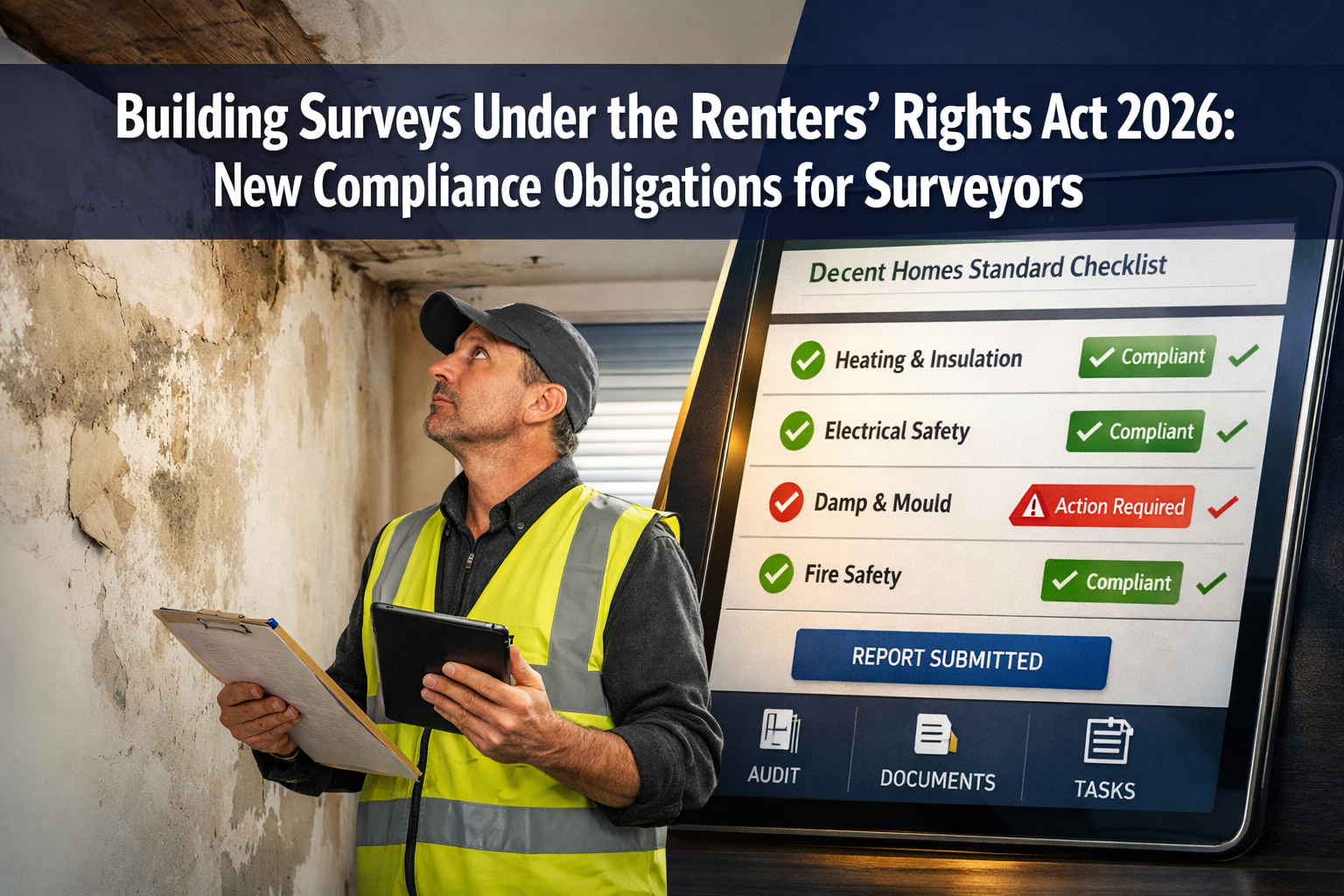

The private rental sector is experiencing its most significant regulatory transformation in decades: from May 1, 2026, over 4.6 million privately rented homes across England must meet the Decent Homes Standard—a benchmark previously reserved exclusively for social housing. This seismic shift under the Renters' Rights Act 2026 fundamentally redefines Building Surveys Under the Renters' Rights Act 2026: New Compliance Obligations for Surveyors Assessing Private Rental Properties, creating unprecedented demand for qualified surveyors who can navigate the complex intersection of property assessment, regulatory compliance, and tenant protection law.
For chartered surveyors, building inspectors, and property professionals, the implications extend far beyond routine inspections. The legislation introduces strict timeframes for hazard remediation under Awaab's Law, establishes a mandatory Private Rented Sector Ombudsman for dispute resolution, and grants local councils expanded enforcement powers that became effective December 27, 2025—months before the main provisions take effect [2][3]. Surveyors now occupy a critical position as gatekeepers of compliance, expert witnesses in disputes, and advisors to landlords facing substantial investment requirements to meet statutory standards.
Key Takeaways
- 📋 Decent Homes Standard extends to all private rentals from May 1, 2026, requiring comprehensive building surveys to verify compliance with minimum quality benchmarks for repair, facilities, thermal comfort, and hazard elimination
- ⚖️ Awaab's Law provisions mandate strict remediation timeframes for serious hazards like damp and mould, with surveyors providing critical evidence for enforcement and dispute resolution
- 🔍 Surveyor demand will surge significantly as landlords require pre-registration inspections, compliance verification, and detailed condition reports for the new mandatory landlord portal
- 📊 Enhanced documentation and record-keeping become essential as surveyors may be called to provide expert testimony in Ombudsman disputes or enforcement proceedings
- ⚡ Expanded council enforcement powers allow immediate action against non-compliant properties, increasing liability risks for surveyors who miss critical defects
Understanding the Decent Homes Standard for Private Rentals
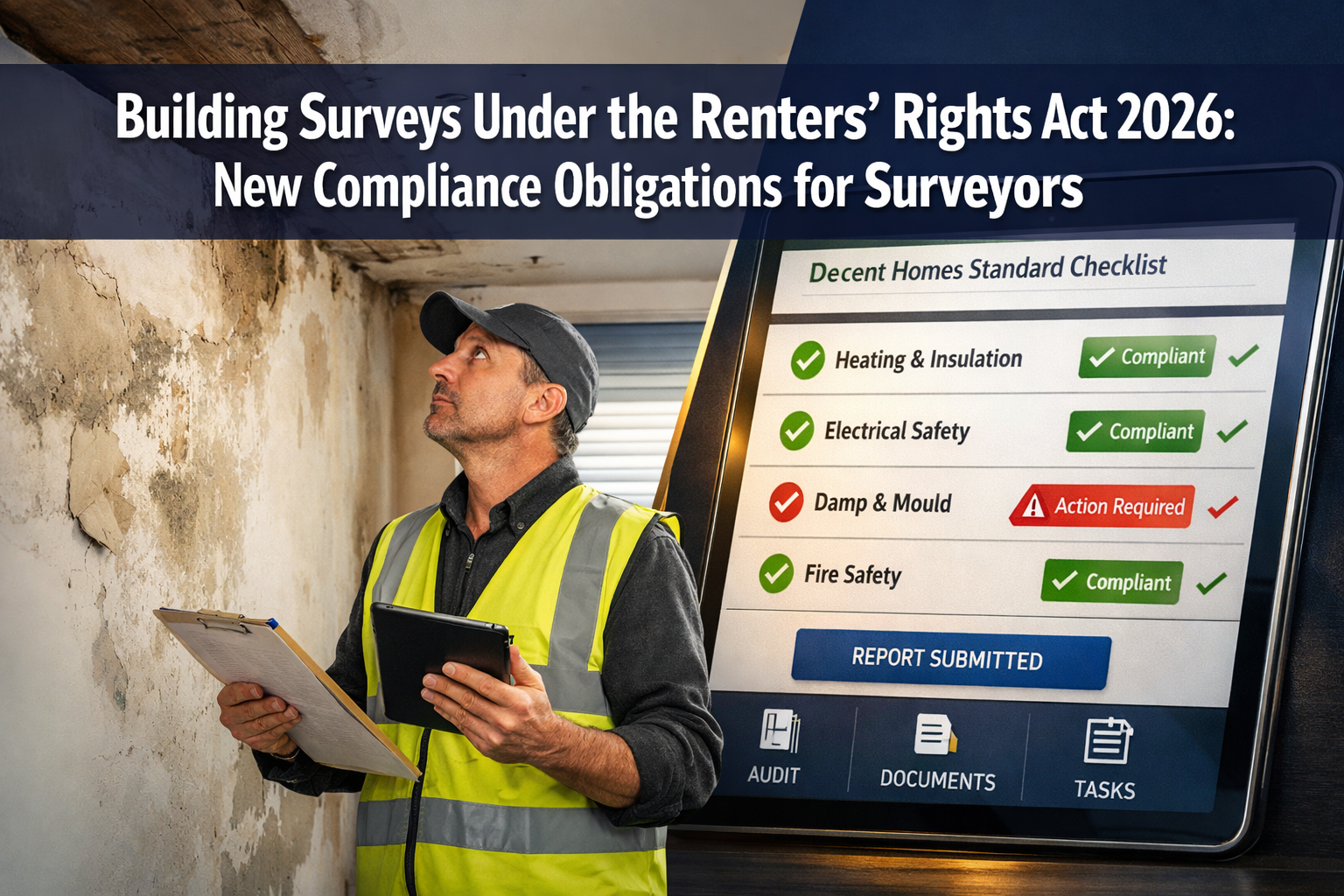
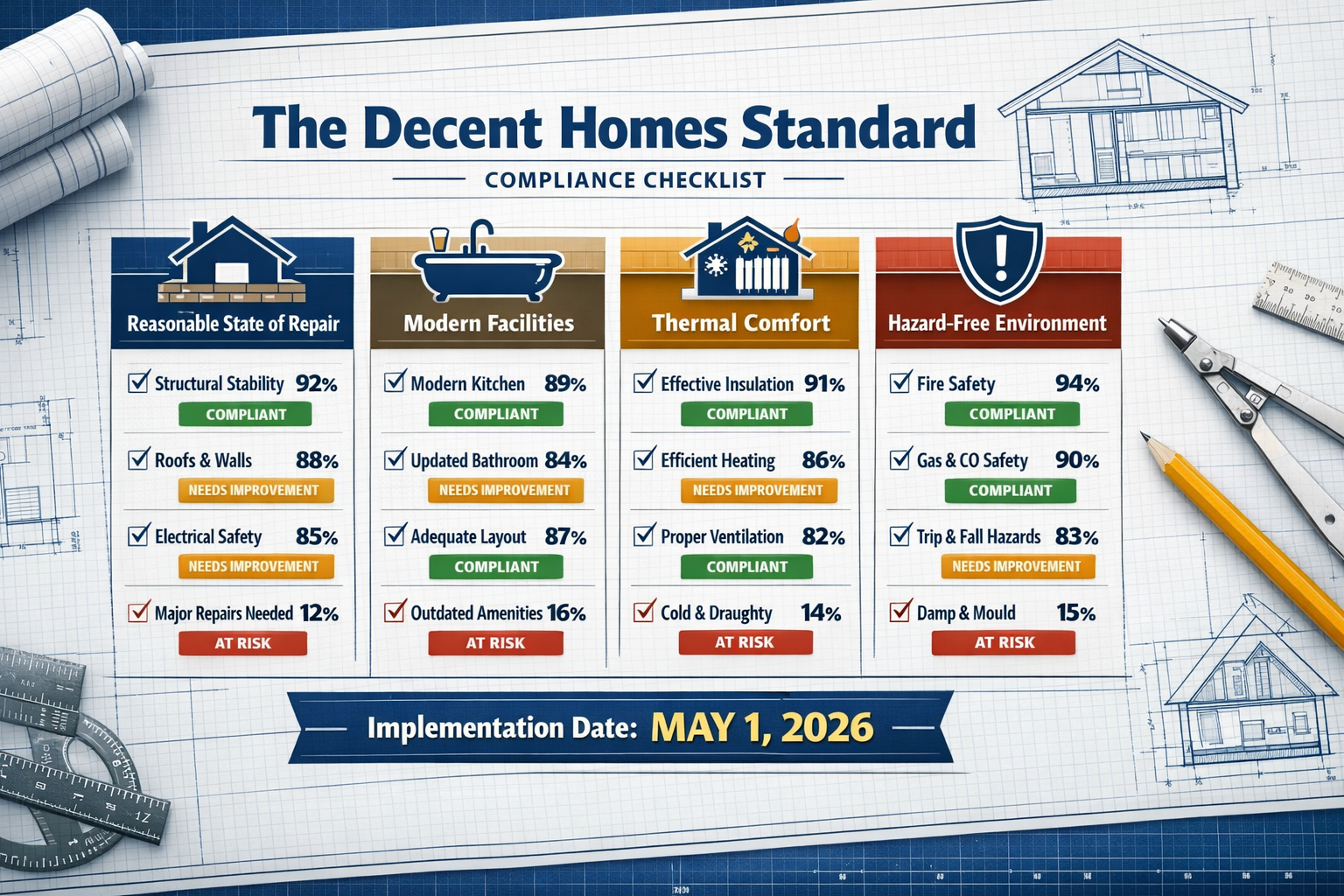
The cornerstone of Building Surveys Under the Renters' Rights Act 2026: New Compliance Obligations for Surveyors Assessing Private Rental Properties is the extension of the Decent Homes Standard to the private sector. Originally developed for social housing, this framework establishes four fundamental criteria that every rental property must satisfy [1][2]:
The Four Pillars of Decent Homes Compliance
1. Reasonable State of Repair 🏠
Properties must be in a reasonable state of repair, with building components assessed against their age and condition. This includes structural elements, exterior envelope, and all major building systems. Surveyors conducting structural surveys must evaluate:
- Foundation integrity and load-bearing walls
- Roof condition and weatherproofing (requiring detailed roof surveys)
- External walls, windows, and doors
- Chimneys, rainwater goods, and drainage systems
2. Modern Facilities and Services 🚿
Rental properties must provide modern facilities including:
- Reasonably modern kitchen (less than 20 years old)
- Kitchen with adequate space and layout
- Bathroom that is not more than 30 years old
- Appropriate heating and hot water systems
3. Thermal Comfort 🌡️
Properties must provide efficient heating and effective insulation, meeting current energy efficiency standards. This aligns with existing Energy Performance Certificate (EPC) requirements, with properties needing at least an E rating unless exempt [3].
4. Hazard-Free Environment ⚠️
The property must be free from Category 1 hazards as defined under the Housing Health and Safety Rating System (HHSRS). This includes 29 potential hazards ranging from damp and mould to electrical hazards and structural collapse risks.
Implementation Timeline and Enforcement
While the full Decent Homes Standard requirements take effect May 1, 2026, councils received expanded enforcement powers on December 27, 2025, allowing them to act swiftly against unsafe conditions and poor practice [3]. This phased implementation means surveyors must already be prepared to assess properties against these elevated standards.
The legislation requires landlords to register properties on a new government portal, confirming that statutory standards have been met [2]. This registration process will drive substantial demand for pre-compliance building surveys and condition assessments.
Building Surveys Under the Renters' Rights Act 2026: Enhanced Inspection Protocols and Surveyor Responsibilities
The regulatory landscape for Building Surveys Under the Renters' Rights Act 2026: New Compliance Obligations for Surveyors Assessing Private Rental Properties demands a fundamental evolution in inspection methodology and professional practice. Surveyors can no longer rely solely on traditional building survey protocols—they must integrate compliance verification, hazard assessment, and regulatory reporting into every rental property inspection.
Comprehensive Inspection Requirements
Modern rental property surveys under the 2026 Act must address multiple regulatory frameworks simultaneously:
Statutory Safety Inspections 🔌
Surveyors must verify or recommend:
- Electrical Installation Condition Reports (EICRs): Required every five years, with any remedial work addressed promptly [3]
- Gas Safety Certificates: Annual inspections by Gas Safe registered engineers, with certificates provided to tenants within 28 days [3]
- Energy Performance Certificates (EPCs): Valid certificates with minimum E rating (unless exempt) [3]
HHSRS Hazard Assessment 🏚️
Every survey must include systematic evaluation of all 29 HHSRS hazards, with particular attention to:
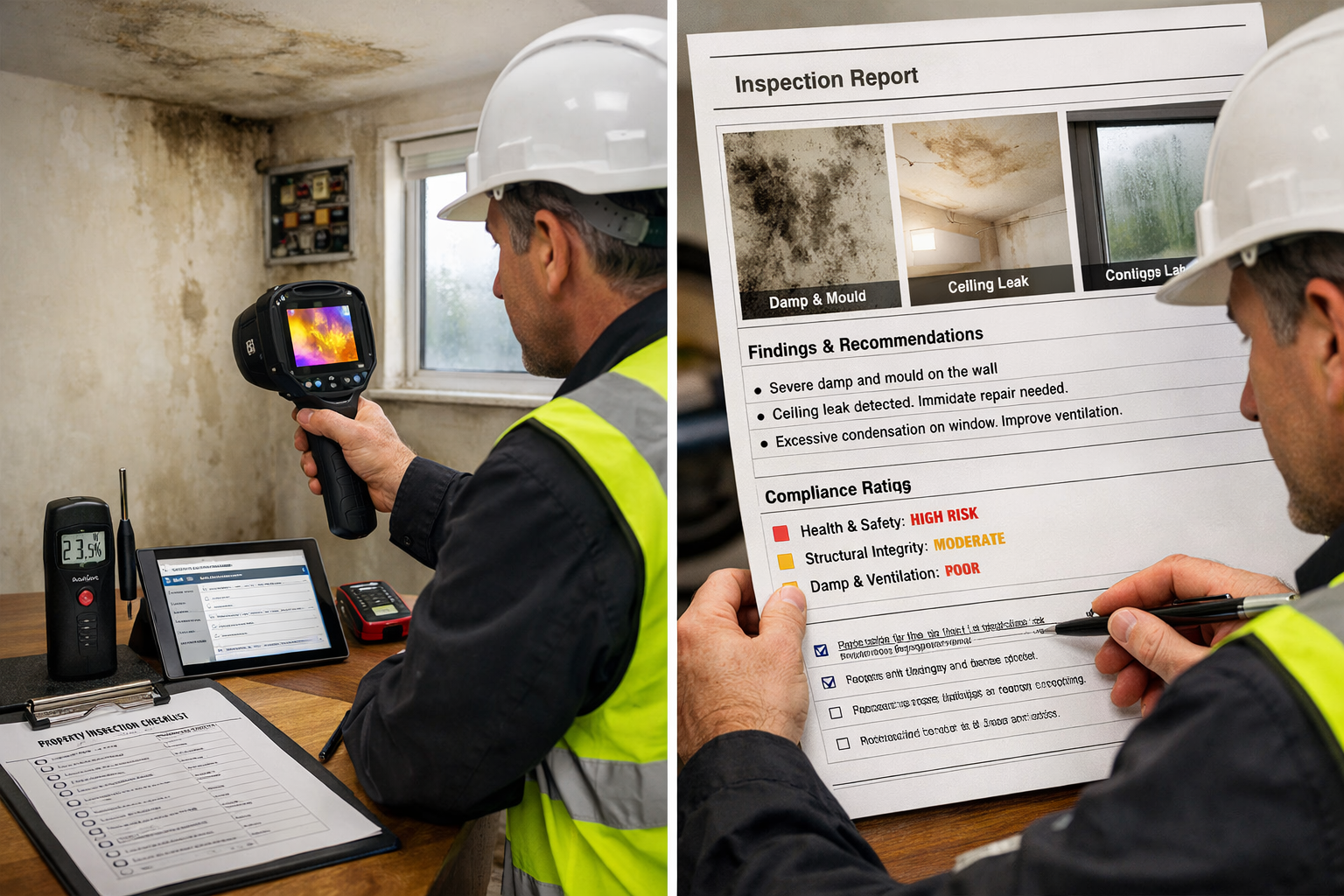
- Damp and mould growth (subject to Awaab's Law timeframes)
- Excess cold and thermal deficiencies
- Falls on stairs, steps, and level surfaces
- Electrical hazards and fire safety
- Structural collapse and building integrity
For properties showing signs of dampness or structural concerns, specialized subsidence surveys may be necessary to determine the extent and cause of defects.
Awaab's Law: Strict Remediation Timeframes
One of the most significant compliance obligations stems from the expanded scope of Awaab's Law, which establishes mandatory timeframes for addressing serious hazards, particularly damp and mould [2]. While specific timeframes are still being finalized in secondary legislation, the principle is clear: landlords must act swiftly to remedy dangerous conditions, and surveyors must provide the evidence base for enforcement.
Surveyor Responsibilities Under Awaab's Law:
✅ Immediate hazard identification: Document and report Category 1 hazards that pose imminent risk to tenant health
✅ Causation analysis: Determine whether damp and mould result from structural defects, building failures, or other factors
✅ Remediation specifications: Provide detailed, actionable recommendations for hazard elimination
✅ Follow-up verification: Confirm that remedial works have successfully addressed identified hazards
Documentation and Evidence Standards
The Act significantly elevates documentation requirements for surveyors. Comprehensive records must be maintained for all correspondence and documents received in relation to inspections, as surveyors may be asked to provide evidence if disputes arise about a property's condition [2].
Essential Documentation Components:
| Document Type | Purpose | Retention Period |
|---|---|---|
| Photographic evidence | Visual record of defects and hazards | Minimum 6 years |
| Condition ratings | HHSRS scoring and severity assessment | Minimum 6 years |
| Correspondence logs | Communications with landlords/agents | Minimum 6 years |
| Remediation specifications | Detailed repair recommendations | Minimum 6 years |
| Follow-up reports | Post-remediation verification | Minimum 6 years |
This documentation may prove critical in Ombudsman proceedings or enforcement actions, where surveyors serve as expert witnesses providing technical evidence about property conditions.
Timely, Unbiased, and Detailed Advice
Surveyors must provide timely, unbiased, and detailed advice to landlords and property managers regarding a property's condition and any remedial works required [2]. This professional obligation carries increased weight under the 2026 Act, as delayed or inadequate advice could result in:
- Landlord non-compliance with statutory timeframes
- Tenant health and safety risks
- Enforcement action by local authorities
- Professional liability claims against the surveyor
For complex defects requiring specialist assessment, surveyors should recommend specific defect reports to provide detailed analysis of particular building failures.
The Private Rented Sector Ombudsman and Surveyor Involvement in Dispute Resolution
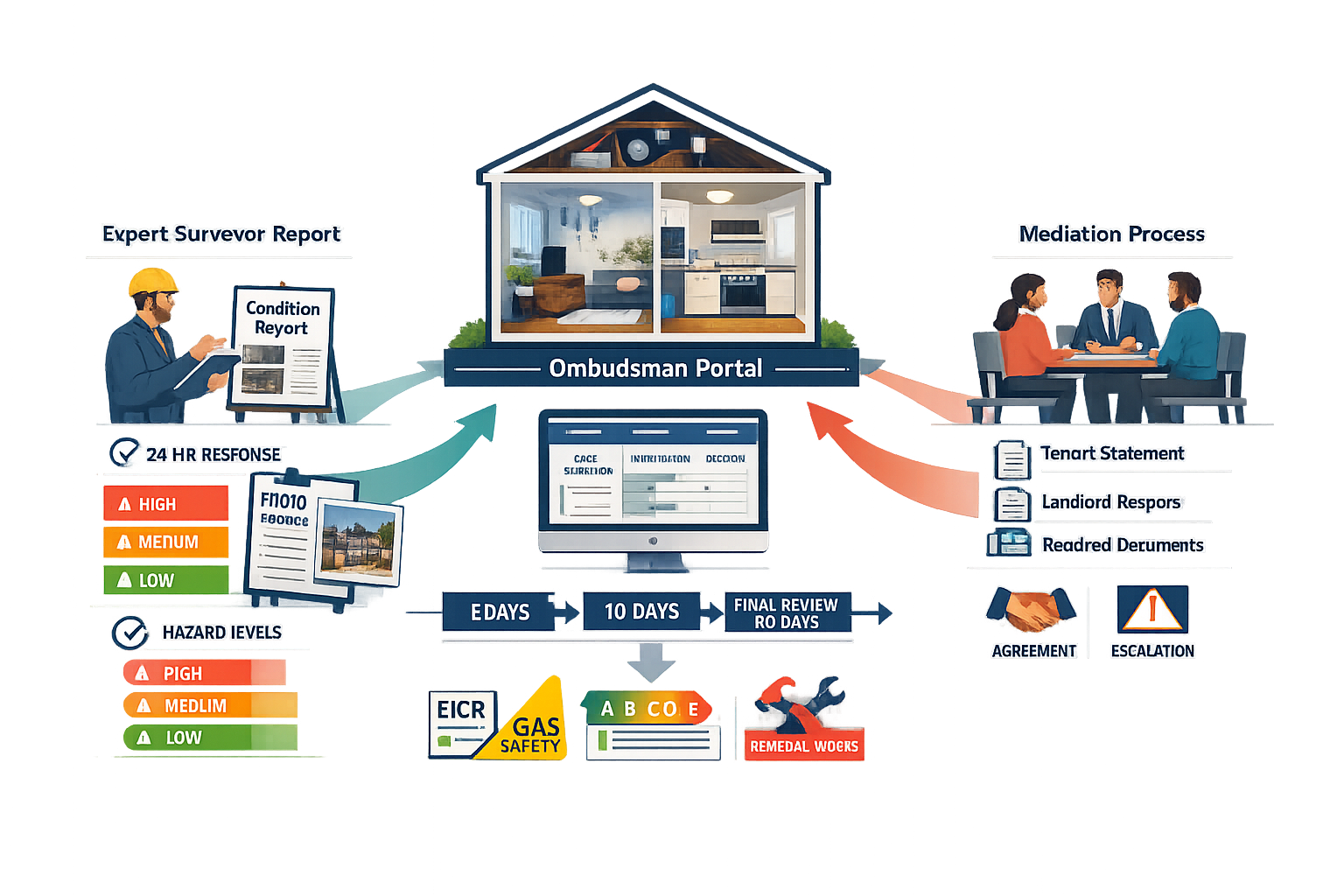
A landmark feature of the Renters' Rights Act 2026 is the establishment of a mandatory Private Rented Sector Ombudsman, creating a formal dispute resolution mechanism for landlord-tenant conflicts [1]. This development fundamentally changes the role of surveyors in rental property disputes, transforming them from neutral assessors into potential expert witnesses whose reports may determine case outcomes.
Ombudsman Jurisdiction and Surveyor Evidence
The Ombudsman will handle complaints about property conditions, maintenance failures, and compliance with the Decent Homes Standard. In these proceedings, surveyor reports serve as primary evidence establishing:
🔍 Factual property condition at specific points in time
🔍 Compliance status with Decent Homes Standard and HHSRS
🔍 Causation of defects (building failure vs. tenant behavior)
🔍 Appropriate remediation methods and costs
🔍 Timeframe reasonableness for completing repairs
Expert Witness Responsibilities
When surveyors provide evidence in Ombudsman cases, they assume expert witness obligations that require:
Independence and Objectivity ⚖️
Surveyors must provide impartial technical opinions regardless of which party commissioned the original inspection. This may create tension when landlords who paid for pre-tenancy surveys find those same reports used against them in disputes.
Technical Clarity 📋
Complex building pathology must be explained in accessible language that non-technical adjudicators can understand. Surveyors should avoid jargon and provide clear explanations of defect severity, health implications, and remediation requirements.
Proportionate Recommendations 💰
Remediation specifications must be proportionate to the defect severity and property type. Over-specifying repairs can impose unreasonable costs on landlords; under-specifying can leave tenants in hazardous conditions.
For surveyors regularly involved in dispute resolution, developing expertise in expert witness reporting becomes increasingly valuable.
Pre-emptive Dispute Prevention Through Quality Surveys
The most effective approach to Ombudsman disputes is preventing them through comprehensive initial surveys. Building Surveys Under the Renters' Rights Act 2026: New Compliance Obligations for Surveyors Assessing Private Rental Properties should include:
✅ Pre-tenancy condition surveys: Establishing baseline property condition before occupation
✅ Check-in/check-out reports: Documenting condition changes during tenancy
✅ Periodic compliance inspections: Verifying ongoing Decent Homes Standard compliance
✅ Responsive defect assessments: Investigating tenant-reported maintenance issues
Many landlords are adopting dilapidation survey protocols from the commercial sector to create detailed condition records that protect both parties' interests.
Liability Considerations for Surveyors
The enhanced role of surveyors in compliance verification and dispute resolution creates new professional liability exposures:
Negligent Inspection Claims 🚨
If a surveyor fails to identify Category 1 hazards that subsequently harm tenants or trigger enforcement action, the landlord may pursue negligence claims for losses resulting from the oversight.
Incorrect Compliance Certification 📄
Surveyors who certify properties as meeting Decent Homes Standard when significant defects exist face liability for both landlord losses (enforcement penalties, remediation costs) and potential tenant harm.
Inadequate Remediation Specifications 🔧
Vague or incomplete repair recommendations that fail to address underlying defects can result in recurring problems, ongoing tenant complaints, and extended liability exposure.
Professional indemnity insurance policies should be reviewed to ensure adequate coverage for these expanded risks under the 2026 Act.
Preparing Your Survey Practice for the 2026 Compliance Surge
The extension of the Decent Homes Standard to 4.6 million private rental properties creates an unprecedented demand spike for qualified surveyors. Practices that prepare strategically will capture significant market opportunities, while those that fail to adapt risk being overwhelmed or excluded from this expanding sector [2].
Resource Planning and Capacity Building
Surveyor Recruitment and Training 👥
Firms should:
- Recruit additional qualified surveyors with RICS accreditation
- Develop specialized training in HHSRS hazard assessment
- Create internal protocols for Decent Homes Standard compliance verification
- Establish quality assurance processes for rental property inspections
Technology and Systems Investment 💻
Modern rental property surveys require:
- Digital inspection platforms with HHSRS hazard checklists
- Photographic documentation systems with metadata capture
- Report templates addressing all compliance requirements
- Client portals for landlord access to inspection records
- Case management systems for tracking remediation completion
Drone roof surveys are becoming increasingly valuable for safely assessing large rental property portfolios without extensive access equipment.
Service Offering Expansion
Forward-thinking practices are developing comprehensive rental property service packages:
Pre-Compliance Audits 📊
Landlords need gap analysis identifying all deficiencies before the May 1, 2026 deadline. These audits should:
- Assess current compliance status against Decent Homes Standard
- Identify all Category 1 and Category 2 HHSRS hazards
- Prioritize remediation works by urgency and cost
- Provide budget estimates for achieving full compliance
- Recommend phased implementation strategies for portfolio landlords
Portfolio Management Services 🏘️
Landlords with multiple properties require:
- Coordinated inspection scheduling across portfolios
- Centralized compliance tracking and reporting
- Periodic re-inspection services to maintain ongoing compliance
- Emergency response for tenant-reported hazards
- Annual compliance certification for landlord portal registration
Expert Witness Services ⚖️
As Ombudsman disputes increase, specialized expert witness services become valuable, including:
- Independent condition assessments for disputed properties
- Technical report preparation for adjudication proceedings
- Expert testimony in complex building pathology cases
- Mediation support for landlord-tenant negotiations
Geographic Market Considerations
Demand for Building Surveys Under the Renters' Rights Act 2026: New Compliance Obligations for Surveyors Assessing Private Rental Properties varies significantly by location. High-demand areas include:
- London and Southeast: Large private rental sectors with older housing stock requiring substantial upgrades. Surveyors operating in West London, Central London, and South West London will see particularly strong demand
- University cities: High concentrations of rental properties serving student populations
- Northern industrial cities: Older housing stock with higher rates of Category 1 hazards
- Coastal towns: Properties with damp and structural issues from environmental exposure
Practices should consider expanding coverage to underserved areas where surveyor availability may limit landlord compliance. Regional offices in Surrey, Hertfordshire, and Essex can capture growing suburban rental markets.
Pricing Strategies and Fee Structures
The compliance imperative changes pricing dynamics for rental property surveys:
Premium Pricing for Comprehensive Compliance Surveys 💷
Landlords recognize that thorough pre-compliance surveys prevent costly enforcement action and tenant disputes. Practices can command premium fees for:
- Comprehensive Decent Homes Standard compliance audits
- HHSRS hazard assessments with detailed remediation specifications
- Expert witness-quality documentation suitable for dispute proceedings
- Fast-track inspection services for urgent compliance deadlines
Volume Discounts for Portfolio Landlords 📉
Landlords with multiple properties seek efficiency and consistency. Structured pricing tiers based on portfolio size encourage bulk engagement while maintaining profitability.
Retainer Arrangements for Ongoing Compliance 🔄
Annual compliance monitoring retainers provide predictable revenue streams while ensuring landlords maintain standards throughout tenancies.
Marketing and Client Education
Many landlords remain unaware of the full scope of their obligations under the 2026 Act. Educational marketing positions survey practices as trusted advisors:
- Compliance webinars explaining Decent Homes Standard requirements
- Downloadable guides to HHSRS hazards and remediation approaches
- Case studies demonstrating successful compliance transformations
- Email campaigns highlighting approaching deadlines and enforcement risks
Practices should emphasize their role in protecting landlords from enforcement action, tenant disputes, and property devaluation resulting from non-compliance.
Practical Compliance Checklist for Surveyors
To ensure Building Surveys Under the Renters' Rights Act 2026: New Compliance Obligations for Surveyors Assessing Private Rental Properties meet all regulatory requirements, surveyors should adopt this comprehensive inspection protocol:
Pre-Inspection Preparation ✅
- Confirm scope of inspection with client (compliance audit vs. standard survey)
- Review property history, previous surveys, and known defects
- Obtain relevant documentation (EPCs, EICRs, gas safety certificates)
- Prepare HHSRS hazard assessment checklist
- Ensure appropriate equipment (moisture meters, thermal imaging, etc.)
On-Site Inspection Protocol ✅
- Structural Assessment: Foundation, walls, floors, roof structure
- Envelope Integrity: Weatherproofing, damp penetration, thermal performance
- Mechanical Systems: Heating, hot water, ventilation adequacy
- Electrical Safety: Visible wiring condition, consumer unit age, socket provision
- Facilities Assessment: Kitchen and bathroom age, layout, functionality
- HHSRS Hazards: Systematic evaluation of all 29 potential hazards
- Photographic Documentation: Comprehensive visual record of all defects
- Tenant Interview (if occupied): Reported issues, maintenance history
Report Preparation ✅
- Clear executive summary of compliance status
- Detailed findings for each Decent Homes Standard criterion
- HHSRS hazard ratings with severity classifications
- Specific remediation recommendations with priority rankings
- Cost estimates for required works
- Compliance timeline and critical path for meeting standards
- Supporting photographic evidence with annotations
Follow-Up and Verification ✅
- Maintain comprehensive inspection records for minimum 6 years
- Schedule post-remediation verification inspections
- Provide ongoing compliance monitoring for retained clients
- Update inspection protocols as secondary legislation clarifies requirements
Key Differences from Standard Building Surveys
Traditional building surveys and Building Surveys Under the Renters' Rights Act 2026: New Compliance Obligations for Surveyors Assessing Private Rental Properties serve different purposes:
| Aspect | Standard Building Survey | Renters' Rights Act Compliance Survey |
|---|---|---|
| Primary Purpose | Inform purchase decision | Verify regulatory compliance |
| Hazard Assessment | General condition evaluation | Mandatory HHSRS hazard scoring |
| Remediation Detail | Broad recommendations | Specific, actionable specifications |
| Legal Weight | Advisory | Potential evidence in enforcement/disputes |
| Timeframe Focus | Current condition | Ongoing compliance maintenance |
| Documentation Standard | Professional best practice | Evidentiary quality for proceedings |
Surveyors must clearly communicate these distinctions to clients and ensure inspection scope matches the intended purpose.
Conclusion: Embracing the Surveyor's Expanded Role in Rental Property Compliance
The Renters' Rights Act 2026 represents a watershed moment for the private rental sector, fundamentally transforming the role of building surveyors from passive observers to active compliance gatekeepers. The extension of the Decent Homes Standard to 4.6 million privately rented homes, combined with Awaab's Law remediation requirements and the new Ombudsman dispute resolution system, creates both significant professional responsibilities and substantial market opportunities for qualified surveyors.
Building Surveys Under the Renters' Rights Act 2026: New Compliance Obligations for Surveyors Assessing Private Rental Properties demands a comprehensive evolution in inspection methodology, documentation standards, and professional practice. Surveyors who invest in specialized training, develop robust compliance assessment protocols, and build capacity to handle the coming demand surge will position themselves as indispensable advisors in the transformed rental property landscape.
Immediate Action Steps for Survey Practices 🎯
- Audit current capabilities: Assess whether existing inspection protocols adequately address Decent Homes Standard and HHSRS requirements
- Invest in training: Ensure all surveyors understand the full scope of compliance obligations under the 2026 Act
- Upgrade systems: Implement digital inspection platforms with comprehensive documentation capabilities
- Expand capacity: Recruit additional qualified surveyors or establish partnership networks to handle demand increases
- Develop marketing materials: Educate landlord clients about their obligations and position your practice as the compliance solution
- Review insurance coverage: Confirm professional indemnity policies adequately cover expanded liability exposures
- Establish quality assurance: Create internal review processes ensuring all rental property surveys meet evidentiary standards
The May 1, 2026 implementation deadline is rapidly approaching, and landlords across England are beginning to recognize the scale of work required to achieve compliance. Survey practices that prepare strategically now will capture the substantial market opportunity while fulfilling their professional obligation to protect both landlord clients and tenant safety.
For surveyors seeking to expand their expertise in rental property compliance, developing comprehensive knowledge of commercial building survey methodologies can provide valuable frameworks for systematic condition assessment. Similarly, understanding commercial dilapidation survey approaches offers useful models for detailed condition documentation that withstands legal scrutiny.
The transformation of the private rental sector under the Renters' Rights Act 2026 elevates the surveyor profession to a position of unprecedented importance in protecting tenant welfare, supporting responsible landlords, and maintaining housing quality standards across England. Practices that embrace this expanded role with professionalism, technical excellence, and commitment to thorough compliance verification will thrive in the evolving regulatory landscape.
References
[1] Renters Rights Act 2026 Impact On Building Surveys Surveyor Roles In Decent Homes Standard Compliance For Landlords – https://nottinghillsurveyors.com/blog/renters-rights-act-2026-impact-on-building-surveys-surveyor-roles-in-decent-homes-standard-compliance-for-landlords
[2] The Renters Rights Bill – https://www.rpclegal.com/thinking/construction/the-renters-rights-bill/
[3] 2026 Landlord Compliance Checklist – https://www.davistate.com/blog/2026-landlord-compliance-checklist