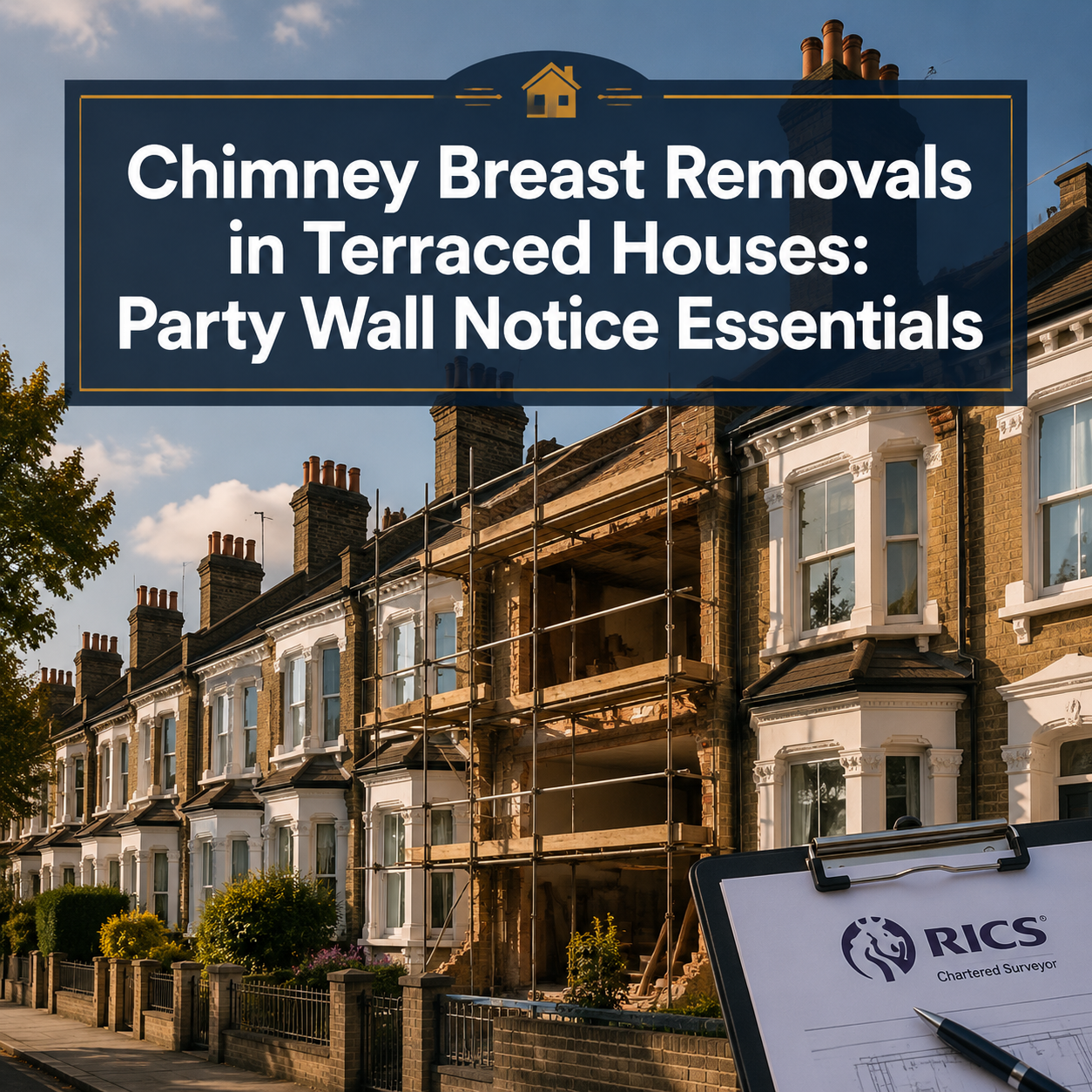

Roughly one in three Victorian terraced houses in England still contains a chimney breast that homeowners want removed — yet fewer than half of those projects are started with the correct legal notices in place, leaving owners exposed to injunctions, neighbour disputes, and costly structural remediation. Chimney Breast Removals in Terraced Houses: Party Wall Notice Essentials and Structural Survey Protocols is not simply a bureaucratic checklist — it is a structured framework that protects your property, your neighbour's home, and the structural integrity of a shared wall that has stood for over a century.
This guide breaks down every critical step: from identifying whether the Party Wall etc. Act 1996 applies to your specific property type, to serving a legally compliant notice, commissioning the right structural survey, and protecting yourself with a properly drafted Party Wall Award.
Key Takeaways 📋
- The Party Wall etc. Act 1996 almost always applies to chimney breast removals in mid-terraced houses where the chimney sits on or near a shared wall.
- A formal written notice must be served at least two months before work begins — failure to do so can result in an injunction stopping your project.
- Structural calculations and Building Regulations approval are legally separate from the Party Wall process — both are required.
- A Schedule of Condition report protects both parties by documenting the neighbour's property before any work starts.
- Steel support beams (RSJs or gallows brackets) are almost always needed when a chimney breast is removed from one floor while the stack remains above.
Does the Party Wall Act Apply to Your Terraced House Chimney Removal?
Before serving any notice, the first task is establishing whether the Party Wall etc. Act 1996 actually applies. The answer depends on where the chimney breast sits within the property. [1]
Mid-Terraced Properties
In a standard mid-terraced house — the classic 2-up-2-down layout common across London boroughs like Ilford, Stratford, Hackney, and Lewisham — the chimney breast almost always forms part of, or is built directly against, the party wall. In these cases, the Party Wall Act applies without exception. [1]
💡 Pull Quote: "Chimney breast removal in a mid-terrace should be treated with the same legal and structural gravity as removing a load-bearing wall — because structurally, it often is one." [5]
End-Terraced and Semi-Detached Properties
End-terrace properties present a more nuanced picture. If the chimney breast sits on the gable end wall (the external wall that faces the street or garden, not shared with a neighbour), the Party Wall Act is unlikely to apply. [1] However, if the chimney is on the shared wall between the two properties, the same notification requirements apply as for a mid-terrace. Semi-detached houses follow identical rules. [1]
When the Act Does NOT Apply
The Party Wall Act is not triggered when:
- The chimney breast is located entirely on an external wall with no shared structure [3]
- The chimney sits wholly within the building owner's own property with no connection to a party wall [3]
- The work involves only cosmetic changes (e.g., boxing in a breast) with no structural interference
Quick Reference Table: Does the Party Wall Act Apply?
| Property Type | Chimney Location | Party Wall Act Applies? |
|---|---|---|
| Mid-terrace | Party wall | ✅ Yes — always |
| End-terrace | Gable end wall | ❌ No |
| End-terrace | Shared wall | ✅ Yes |
| Semi-detached | Shared wall | ✅ Yes |
| Detached | External wall | ❌ No |
| Any type | Internal wall only | ❌ No |
For properties in South East London where Victorian terraced stock is dense, consulting chartered surveyors in South East London at the earliest stage is strongly advisable.
Party Wall Notice Essentials: Chimney Breast Removals in Terraced Houses
Once it is confirmed that the Act applies, the process of serving a correct and legally compliant notice begins. This is where many homeowners make costly errors. [2]
Step 1: Prepare and Serve the Party Wall Notice
A formal written Party Wall Notice must be served on all adjoining owners — not just neighbours who share the party wall, but any owner whose property may be affected. [2] The notice must include:
- ✅ Full name and address of the building owner (the person carrying out the works)
- ✅ Address of the property where works will take place
- ✅ A clear description of the proposed works (e.g., "removal of chimney breast from ground floor and first floor, insertion of RSJ steel beam to support remaining stack")
- ✅ The proposed start date of the works
- ✅ Reference to the relevant section of the Party Wall etc. Act 1996 (typically Section 2)
- ✅ A statement that the neighbour has 14 days to consent or dissent in writing
⚠️ Critical Timing Rule: The notice must be served at least two months before work commences. Serving it late — even by a day — can give neighbours grounds to seek an injunction. [4]
Step 2: Await the Neighbour's Response
After serving the notice, there are three possible outcomes:
- Written consent — The neighbour agrees in writing. Work can proceed, though a Schedule of Condition is still strongly recommended.
- Written dissent — The neighbour disagrees. Surveyors must be appointed and a Party Wall Award prepared. [2]
- No response within 14 days — This is treated as a deemed dissent, triggering the same surveyor appointment process. [7]
Understanding the full implications of each outcome is covered in detail in our guide on what is a Party Wall dispute.
Step 3: Appoint Surveyors and Prepare the Party Wall Award
When a dissent occurs, both parties must appoint surveyors. Options include:
- An Agreed Surveyor — a single, impartial surveyor appointed by both parties (cost-effective and faster). Learn more about what an agreed surveyor does.
- Two separate surveyors — one for each party, who then select a Third Surveyor if they cannot agree.
The Party Wall Award is a legally binding document that sets out:
- The scope and method of the works
- Hours of working
- Access arrangements
- Responsibility for damage and repairs
- The Schedule of Condition for the adjoining property
For a full breakdown of what a Party Wall Agreement contains, see our dedicated resource.
Partial Removals Still Require Full Compliance
A common misconception is that removing a chimney breast from only one floor avoids the Party Wall Act. This is incorrect. If the party wall or any shared structural element — including beams, hearths, or chimney stacks — is affected, the Act applies in full. [3]
Structural Survey Protocols: Chimney Breast Removals in Terraced Houses
The Party Wall process runs parallel to — not instead of — structural engineering and Building Regulations requirements. Both streams must be completed correctly.
Surveyor Checklist: Assessing Load-Bearing Risks 🔍
The following checklist reflects current RICS standards for 2026 and should be used by surveyors and homeowners alike when commissioning or reviewing a structural assessment for chimney breast removal:
Pre-Survey Desktop Assessment
- Confirm property age and construction type (Victorian brick, Edwardian, 1930s, etc.)
- Obtain original building plans (if available from Local Authority)
- Review any previous Party Wall Awards or structural reports on the property
- Check whether the chimney serves a gas appliance (decommissioning required separately)
On-Site Structural Survey
- Confirm chimney breast dimensions and wall thickness at each floor level
- Identify whether the chimney stack continues above the removal point
- Assess the condition of existing lintel or hearth at each floor
- Check for signs of previous underpinning, settlement, or cracking in party wall
- Inspect neighbouring property's chimney breast for mirrored structural dependency
- Measure floor-to-ceiling heights to confirm beam clearance feasibility
- Assess access routes for steel beam delivery and installation
Structural Calculation Requirements
- Calculate dead loads from chimney stack above removal point
- Design RSJ (Rolled Steel Joist) or gallows bracket specification
- Confirm padstone requirements at each bearing point
- Prepare structural drawings to Building Regulations standard
For complex cases, engaging residential structural engineers in London ensures calculations meet current standards.
Steel Support: What Happens When the Stack Stays?
When a chimney breast is removed from the ground or first floor while the stack and upper breast remain, the weight of that masonry must be redirected. [3] Engineers typically specify one of two solutions:
| Support Type | Best Used When | Key Consideration |
|---|---|---|
| RSJ Steel Beam | Full-width support across opening | Requires padstones at each end; beam hidden in ceiling void |
| Gallows Brackets | Limited ceiling void space | Cantilever design; must be engineered precisely |
| Combined system | Multi-floor removal | Both beam and brackets used at different levels |
⚠️ Structural Warning: An undersized or incorrectly specified beam is one of the most common causes of chimney stack movement following removal. Always use a qualified structural engineer — not just a builder's estimate.
Building Regulations: The Parallel Legal Requirement
Building Regulations approval is entirely separate from the Party Wall process and equally mandatory. [3] Homeowners must submit either:
- A Building Notice (simpler, faster, but less documentation upfront), or
- Full Plans (more detailed, provides greater certainty before work starts)
Submissions go to the Local Authority Building Control (LABC) or an approved inspector. A completion certificate must be issued on finishing the works. [5]
📌 Important for Future Sales: Solicitors acting for buyers will request the completion certificate as proof of compliance. Missing paperwork can delay or collapse a property sale. [5]
Schedule of Condition: Protecting Both Parties
Before any work begins, a Schedule of Condition report should be commissioned. This is a photographic and written record of the adjoining property's current state — walls, ceilings, floors, and any existing cracks or defects.
Its purpose is straightforward: if the neighbour later claims that the chimney removal caused damage to their property, the Schedule of Condition provides an objective baseline. Without it, disputes about pre-existing versus new damage become very difficult to resolve. Our guide on damage to property in party wall situations explains the claims process in full.
What a Structural Survey Report Should Include
A competent structural survey for chimney breast removal should contain the following sections:
- Executive Summary — findings and recommendations in plain language
- Property Description — age, construction type, materials
- Chimney Breast Assessment — dimensions, condition, structural role
- Load Path Analysis — how loads are currently distributed and how they will be redirected
- Proposed Works Specification — beam sizes, padstone details, temporary propping requirements
- Building Regulations Compliance Statement
- Risk Register — potential issues during construction (e.g., hidden flues, asbestos)
- Photographic Evidence — dated site photographs
For a broader structural assessment of the property, a structural survey in London provides the most comprehensive baseline.
Common Mistakes That Lead to Neighbour Disputes
Even well-intentioned homeowners trigger disputes through avoidable errors. The most frequent include:
- Starting work without serving notice — this is the single most common mistake and can result in an immediate court injunction [2]
- Serving notice too late — the two-month minimum is non-negotiable [4]
- Failing to describe the works accurately — vague notices can be challenged
- Not commissioning a Schedule of Condition — leaving no baseline for damage claims
- Assuming verbal consent is sufficient — only written consent satisfies the Act [7]
- Ignoring partial removals — assuming a single-floor removal avoids the Act [3]
Conclusion: Your Actionable Next Steps
Chimney Breast Removals in Terraced Houses: Party Wall Notice Essentials and Structural Survey Protocols demand a methodical, legally compliant approach from day one. Cutting corners on notice periods, structural calculations, or Building Regulations submissions creates legal exposure, potential injunctions, and structural risk — not just for the project, but for future property sales.
Here is a clear action plan for 2026:
- Identify your chimney's location — determine whether it sits on a party wall using the table above.
- Engage a party wall surveyor early — ideally before finalising your build programme.
- Serve the formal Party Wall Notice at least two months before work starts — use a qualified surveyor to draft it correctly.
- Commission a structural engineer to design the support beam and prepare Building Regulations drawings simultaneously.
- Order a Schedule of Condition report on the adjoining property before any work begins.
- Obtain the Party Wall Award (if the neighbour dissents) and keep it with your property documents.
- Collect the Building Regulations completion certificate on project completion and store it securely.
Following these steps protects the project, the property, and the relationship with neighbours. For professional guidance tailored to your specific property, speak with a chartered surveyor in London who specialises in party wall matters and structural assessments.
References
[1] Chimney Removal Structural Engineer London – https://sbsstructures.co.uk/blog/chimney-removal-structural-engineer-london
[2] Removing A Chimney Breast On A Party Wall Costs Process Legal Requirements – https://thepartywallguru.com/removing-a-chimney-breast-on-a-party-wall-costs-process-legal-requirements/
[3] Party Wall Act Rules For Removing Chimney Breasts – https://charrettelaw.co.uk/party-wall-act-rules-for-removing-chimney-breasts/
[4] Chimney breast removal – https://www.designingbuildings.co.uk/wiki/Chimney%20breast%20removal
[5] Removing Chimney Breast Party Wall Agreement – https://collier-stevens.co.uk/advice-hub/party-wall/removing-chimney-breast-party-wall-agreement/
[7] Party Wall Agreement – https://hoa.org.uk/advice/guides-for-homeowners/i-am-improving/party-wall-agreement/