The courtroom falls silent as the expert witness approaches the stand. In their hands: evidence that could determine liability for millions of pounds in building safety defects. Since the Grenfell Tower tragedy of 2017, building safety disputes have transformed from technical disagreements into high-stakes litigation involving criminal prosecution, massive remediation costs, and profound questions about professional responsibility. For expert witnesses navigating this landscape in 2026, the challenges have never been more complex—or more consequential.
Expert Witness Challenges in Building Safety Disputes: Testifying on Post-Grenfell Compliance Failures represents one of the most demanding areas of professional testimony today. With local regulators issuing 124% more formal notices and undertaking 140% more inspections compared to the previous year,[1] expert witnesses face unprecedented scrutiny when presenting evidence on compliance failures. The stakes extend beyond individual cases: testimony shapes industry standards, influences regulatory enforcement, and determines how the construction sector learns from past failures.
Key Takeaways
- Regulatory enforcement has intensified dramatically: Local authorities issued 124% more formal notices in 2025, creating extensive documentation trails that expert witnesses must analyze when assessing compliance failures[1]
- Extended liability periods demand historical expertise: The Building Safety Act 2022 introduced a 30-year lookback period for negligence claims, requiring expert witnesses to evaluate standards and practices from decades past[2]
- Systematic dishonesty complicates product compliance testimony: Three major manufacturers engaged in deliberate misrepresentation of fire test data, creating complex evidentiary challenges when determining whether products met regulations at time of installation[2]
- Gateway documentation creates new evidence standards: Expert witnesses must now navigate Building Control approval processes, fire risk assessments, and competency declarations that didn't exist before 2024
- Professional competence gaps affect liability apportionment: The Grenfell Inquiry documented widespread qualification inconsistencies across trades, requiring expert witnesses to carefully assess standard-of-care expectations for different professions[1]
Understanding the Post-Grenfell Regulatory Landscape
The regulatory environment for building safety has undergone a complete transformation since 2017. Expert witnesses testifying in 2026 must understand not only current requirements but also how standards have evolved—and more importantly, what constituted reasonable practice at the time alleged failures occurred.
The Building Safety Act 2022 Framework
The Building Safety Act 2022 introduced fundamental changes to how higher-risk buildings are regulated, designed, and maintained. For expert witnesses, this legislation creates both opportunities and challenges:
Extended Limitation Periods: The Act introduced a 30-year lookback period for negligence claims related to building safety defects.[2] This means expert witnesses may need to evaluate construction practices, product specifications, and regulatory compliance from as far back as the 1990s—requiring deep historical knowledge of evolving standards.
Gateway Documentation Requirements: Higher-risk buildings (residential buildings over 18 meters or seven stories) must now pass through three regulatory gateways during design and construction. Expert witnesses frequently encounter cases where gateway submissions contain incomplete or misleading information, requiring careful analysis of what was disclosed versus what should have been disclosed.
Accountability Person Regime: Building owners must appoint an Accountable Person responsible for safety, creating new chains of responsibility that expert witnesses must trace when determining liability.
"The Building Safety Act doesn't go far enough in closing gaps and loopholes in the law for unscrupulous manufacturers." — Counsel to the Grenfell Inquiry[2]
Enforcement Infrastructure in 2026
The regulatory enforcement landscape has matured significantly. The Remediation Enforcement Unit became fully staffed by the end of March 2026, enabling direct intervention in the highest-risk buildings.[1] This development provides expert witnesses with:
- Consolidated regulatory records documenting enforcement actions
- Standardized assessment methodologies for evaluating compliance
- Expert technical reports from Joint Inspection Team assessments
The Joint Inspection Team supported more than 110 building assessments in 2025, leading to 15 enforcement actions where risks remained unresolved.[1] Each assessment creates potential evidence that expert witnesses must review and contextualize when preparing testimony.
Expert Witness Challenges in Building Safety Disputes: Preparing Evidence for Court
Preparing compelling, defensible evidence for building safety disputes requires expert witnesses to navigate multiple layers of technical, regulatory, and legal complexity. The preparation process in 2026 differs substantially from pre-Grenfell practice.
Analyzing Gateway Documentation and Compliance Records
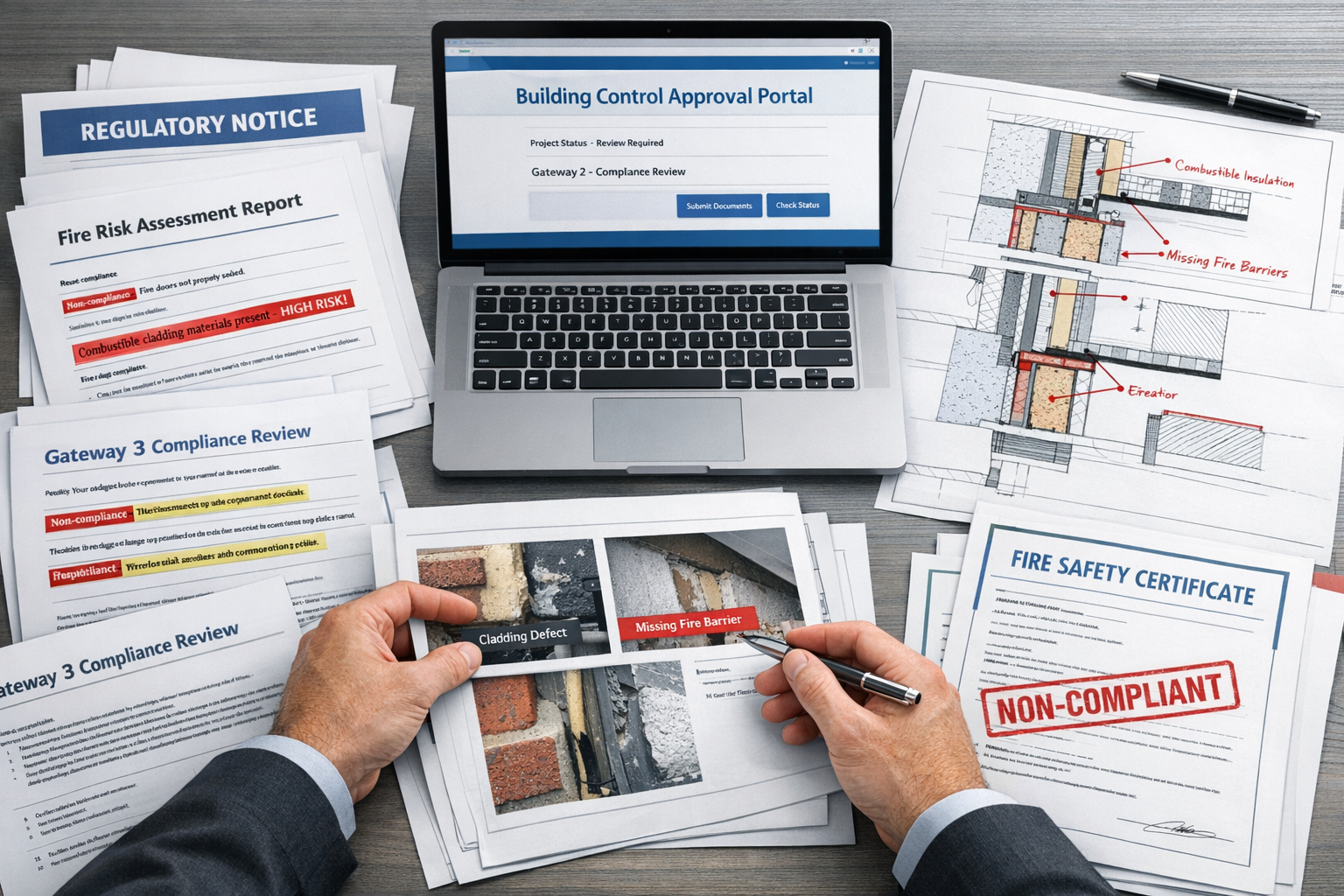
Gateway documentation represents a critical evidence source for expert witnesses. These submissions—required at planning, pre-construction, and completion stages—create a paper trail of what building professionals knew and when they knew it.
Key Documentation to Review:
| Document Type | What It Reveals | Common Compliance Failures |
|---|---|---|
| Fire and Emergency File | Fire safety strategy, evacuation procedures | Incomplete compartmentation details, missing product specifications |
| Building Control Approval | Regulatory sign-off on design | Inadequate scrutiny of external wall systems, missing fire test certificates |
| Competency Declarations | Professional qualifications of design team | Unqualified personnel making critical fire safety decisions |
| Product Certification | Manufacturer test data and approvals | Misleading classification, test results not representative of installed configuration |
| Change Control Records | Design modifications during construction | Substitution of specified materials without fire safety review |
Expert witnesses must scrutinize these documents for internal inconsistencies, missing critical information, and discrepancies between submitted documentation and as-built conditions. When preparing expert witness reports, chartered surveyors should cross-reference gateway submissions against physical evidence gathered during site inspections.
Conducting Fire Risk Valuations and Technical Assessments
Fire risk assessments form the cornerstone of building safety compliance. Expert witnesses must evaluate whether assessments were:
✅ Competently conducted by appropriately qualified assessors
✅ Comprehensive in scope, addressing all relevant fire safety systems
✅ Accurate in conclusions, correctly identifying defects and risks
✅ Appropriately actioned, with timely remediation of identified defects
The challenge intensifies when assessing historic fire risk assessments conducted before current standards existed. Expert witnesses must determine: What would a reasonably competent fire risk assessor have identified in 2015? In 2010? In 2005?
Technical Assessment Methodology:
- Document Review Phase: Analyze original fire risk assessments, building control submissions, and product certifications
- Physical Inspection Phase: Conduct detailed site surveys to verify as-built conditions against documentation
- Testing and Analysis Phase: Commission fire testing, thermal imaging, or destructive investigation where necessary
- Comparative Analysis Phase: Benchmark findings against contemporary standards and industry practice at time of construction
- Causation Analysis Phase: Establish clear links between identified defects and alleged compliance failures
For complex structural assessments, expert witnesses may need to collaborate with specialist structural engineers to fully evaluate building performance under fire conditions.
Addressing Manufacturer Dishonesty in Product Compliance
One of the most challenging aspects of post-Grenfell testimony involves evaluating product compliance when manufacturers engaged in systematic dishonesty. The Grenfell Inquiry found that three major manufacturers—Arconic, Celotex, and Kingspan—engaged in "systematic dishonesty," "deliberate and sustained strategies to manipulate the testing processes," and deliberate misrepresentation of test data to mislead the market.[2]
Expert Witness Considerations:
🔍 What the specifier knew: Did design professionals have access to accurate product information, or were they misled by manufacturer marketing?
🔍 Reasonable reliance: Could a competent professional reasonably rely on manufacturer certifications and test data available at the time?
🔍 Alternative information sources: Were there industry warnings, technical bulletins, or competing product data that should have raised concerns?
🔍 Verification obligations: What level of independent verification was expected of design professionals when specifying fire safety products?
These questions require expert witnesses to carefully reconstruct the information environment at the time of specification. This often involves reviewing historical marketing materials, technical data sheets, test certificates, and industry publications to establish what a diligent professional should have known.
The challenge is compounded by regulatory body failures. The British Research Establishment and British Board of Agrément prioritized commercial interests over independence and rigor in testing and certification, resulting in misleading product approvals.[2] Expert witnesses must address whether reliance on these seemingly authoritative certifications was reasonable.
Court Strategies for Higher-Risk Building Litigation in 2026
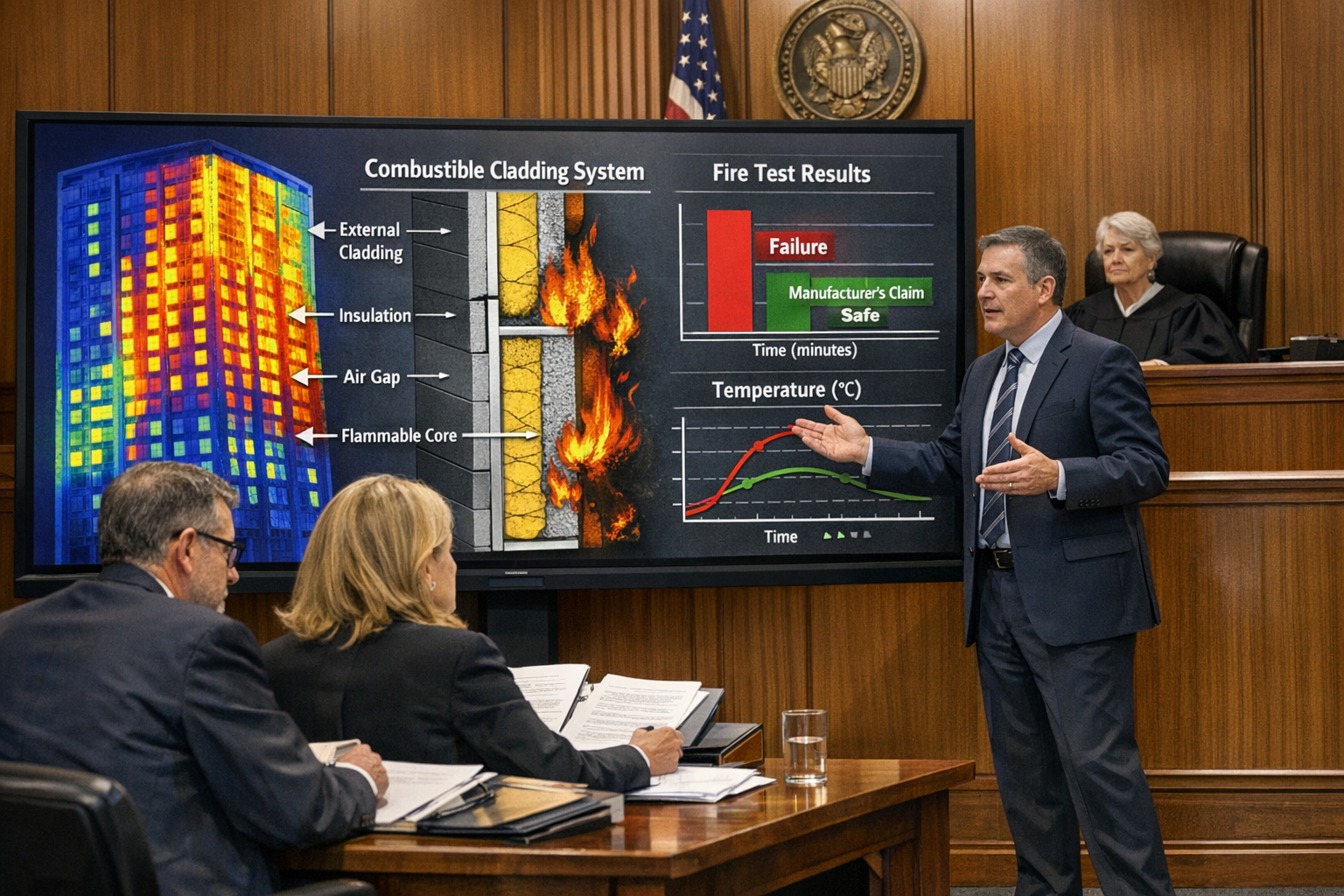
Testifying effectively in building safety disputes requires more than technical expertise. Expert witnesses must present complex evidence clearly, withstand rigorous cross-examination, and help courts understand nuanced regulatory requirements.
Establishing Standard of Care Across Multiple Professions
Building safety failures typically involve multiple parties: architects, fire engineers, building control officers, contractors, product manufacturers, and building owners. The Grenfell Tower Inquiry identified inconsistent qualifications, poor understanding of fire safety requirements, and an absence of reliable professional standards among key professions involved in building safety assurance.[1]
Expert witnesses face the challenge of establishing what constituted reasonable professional practice for each party:
Architects: Studio E architects failed to recognize that ACM cladding was dangerous and failed to warn clients against its use. They also failed to recognize that Celotex insulation was combustible and unsuitable for buildings over 18 meters—failures representing "a very significant degree of responsibility for the disaster."[3]
Building Control: Expert witnesses must evaluate whether building control officers exercised appropriate scrutiny when reviewing fire safety submissions, or whether they rubber-stamped inadequate designs.
Fire Safety Consultants: Did fire engineers provide competent advice on compartmentation, means of escape, and external wall systems?
Contractors: Were site teams adequately supervised? Were product substitutions properly reviewed for fire safety implications?
When preparing testimony, expert witnesses should:
- Define the relevant professional standards applicable at the time of the alleged failure
- Identify specific breaches of those standards with clear evidence
- Explain causation: How did the breach contribute to the defect or safety risk?
- Quantify consequences: What remediation is required? What was the risk to building occupants?
For disputes involving party wall matters or boundary issues, expert witnesses may need to address how structural alterations affected fire compartmentation between properties.
Navigating Approved Document B Ambiguities
One persistent challenge in building safety litigation involves the interpretation of Approved Document B—the statutory guidance for fire safety compliance. The Grenfell Inquiry found that Approved Document B "still contains confusing language and doesn't provide the information needed to ensure buildings are fire safe."[2]
Expert witnesses frequently encounter disputes over:
- "Limited combustibility" requirements: What materials satisfied this standard in different time periods?
- Cavity barrier specifications: Where exactly are cavity barriers required, and what performance standards apply?
- External wall system testing: What constitutes adequate testing of a complete wall system versus individual components?
Effective Court Strategy:
When addressing Approved Document B ambiguities, expert witnesses should:
- Acknowledge the ambiguity explicitly: Courts appreciate honesty about regulatory gaps
- Reference industry guidance: Cite technical standards, industry codes of practice, and professional body guidance that clarified ambiguous requirements
- Establish industry practice: Demonstrate what competent professionals typically did when faced with the same ambiguity
- Apply the precautionary principle: In fire safety, ambiguity should be resolved in favor of greater safety
Presenting Complex Technical Evidence Clearly
Building safety disputes involve highly technical evidence: fire dynamics, thermal performance, structural behavior under fire loading, and complex regulatory frameworks. Expert witnesses must make this evidence accessible to judges, juries, and lay parties.
Communication Strategies:
📊 Visual aids: Use diagrams, photographs, thermal images, and annotated drawings to illustrate defects and compliance failures
📊 Analogies and comparisons: Relate technical concepts to everyday experiences ("The lack of cavity barriers is like leaving fire doors propped open")
📊 Incremental explanation: Build understanding progressively, starting with fundamental concepts before addressing complex details
📊 Quantified risk: Where possible, express fire safety risks in quantifiable terms (time to escape, fire spread rates, temperature exposure)
📊 Regulatory context: Explain not just what the regulations required, but why those requirements exist
For specific defect reports involving building safety issues, expert witnesses should ensure their written reports follow the same clear communication principles that guide oral testimony.
Withstanding Cross-Examination on Historic Standards
Cross-examination in building safety disputes often focuses on whether current standards should apply to historic construction. Opposing counsel may argue: "You're applying 2026 knowledge to judge 2010 decisions—that's unfair."
Effective Response Strategies:
✅ Distinguish between knowledge and standards: "While we know more about fire behavior today, the 2010 Building Regulations already prohibited combustible materials in external walls over 18 meters. The defendant didn't comply with the standards that existed at the time."
✅ Reference contemporary warnings: "Industry publications in 2012 specifically warned about the fire risks of this cladding system. A competent professional should have been aware."
✅ Emphasize fundamental principles: "The basic principle that external walls shouldn't contribute to fire spread has been established since the 1960s. The specific products changed, but the principle remained constant."
✅ Acknowledge evolution where appropriate: "Testing methodologies have improved, but the defendant's failure to conduct any fire testing of the complete system fell below even 2010 standards."
Expert witnesses should prepare for cross-examination by thoroughly researching the regulatory environment, industry standards, and professional guidance that existed at the time of the alleged failure. This preparation often requires reviewing historical editions of British Standards, building regulations, and professional body guidance documents.
Liability Apportionment in Multi-Party Building Safety Claims
Building safety disputes typically involve multiple defendants: developers, contractors, architects, fire engineers, product manufacturers, building control authorities, and building owners. Expert witnesses play a crucial role in helping courts apportion liability among these parties.
Analyzing Chains of Causation
The Grenfell Inquiry documented how multiple failures combined to create the disaster. Social landlords and construction clients demonstrated "persistent indifference to fire safety" and prioritized cost-cutting during refurbishment.[2] Simultaneously, manufacturers misrepresented products, architects failed to recognize dangers, and building control officers failed to exercise adequate scrutiny.
Expert witnesses must trace causal chains:
- Primary causation: Which party's failure was most directly responsible for the defect?
- Contributory causation: Which parties' failures contributed to or exacerbated the defect?
- Preventive failure: Which parties had opportunities to identify and prevent the defect but failed to do so?
Example Analysis:
A combustible cladding system was installed on a 20-story residential building in 2014:
- Manufacturer (40% liability): Misrepresented product fire performance through manipulated test data
- Architect (25% liability): Failed to verify manufacturer claims or specify appropriate fire testing
- Building Control (20% liability): Approved design without adequate scrutiny of external wall system
- Contractor (10% liability): Installed system in manner that further compromised fire performance
- Building Owner (5% liability): Failed to commission adequate fire risk assessment post-completion
These apportionments require careful justification based on each party's specific duties, the information available to them, and the severity of their breach.
Addressing Systemic vs. Individual Failures
One challenge in post-Grenfell litigation involves distinguishing between systemic industry failures and individual professional negligence. When an entire industry misunderstood regulatory requirements or relied on flawed guidance, does that excuse individual failures?
Expert witnesses must carefully analyze:
🔎 What was known within the industry generally?
🔎 What should have been known by a diligent professional?
🔎 Did the defendant fall below general industry standards, or did they meet inadequate industry standards?
🔎 Were there "outlier" professionals who got it right, demonstrating that correct practice was achievable?
The Grenfell Inquiry's finding of "systematic dishonesty" by manufacturers provides important context: professionals who relied on fraudulent product data may bear less responsibility than those who ignored warning signs or failed to conduct due diligence.
For disputes involving commercial property, expert witnesses should consider whether different standards of care apply to commercial versus residential buildings, particularly regarding life safety systems.
Emerging Issues in Building Safety Expert Testimony
As building safety regulation continues to evolve in 2026, expert witnesses face emerging challenges that require adaptation and ongoing professional development.
Retrospective Compliance Assessments
Many building safety disputes involve retrospective assessments: evaluating whether buildings constructed decades ago comply with current understanding of fire safety requirements. This creates tension between:
- Legal compliance (Did the building meet regulations at time of construction?)
- Functional safety (Does the building meet current safety expectations?)
- Remediation obligations (Must the building be upgraded to current standards?)
Expert witnesses must carefully distinguish between these questions. A building may have been legally compliant when constructed but still require remediation to meet current safety standards. Conversely, a building may have violated regulations at time of construction even though those violations only became apparent after the Grenfell disaster.
Competency and Qualification Evidence
The Building Safety Act 2022 introduced new competency requirements for professionals working on higher-risk buildings. Expert witnesses increasingly face questions about:
- Professional qualifications: Did the design team possess appropriate qualifications for the work undertaken?
- Continuing professional development: Were professionals current with evolving fire safety knowledge?
- Supervision and review: Were junior professionals adequately supervised when making critical fire safety decisions?
The Grenfell Inquiry's findings about "inconsistent qualifications" and "poor understanding of fire safety requirements" across professions[1] have made competency a central issue in building safety litigation. Expert witnesses should be prepared to evaluate not just what professionals did, but whether they were qualified to do it.
Digital Evidence and Building Information Modeling
Modern construction increasingly relies on Building Information Modeling (BIM) and digital documentation. Expert witnesses must now review:
- BIM models showing design intent versus as-built conditions
- Digital approval workflows documenting review and sign-off processes
- Email communications revealing knowledge of defects or shortcuts
- Project management software tracking design changes and material substitutions
This digital evidence can be powerful but requires expert witnesses to develop new technical skills in forensic digital analysis. The challenge intensifies when dealing with historic cases where digital records may be incomplete, corrupted, or stored in obsolete formats.
Climate Change and Building Performance
An emerging area of expert testimony involves how climate change affects building safety. Expert witnesses may need to address:
- Overheating risks in buildings with combustible insulation
- Extreme weather impacts on external wall system performance
- Adaptation requirements for buildings designed before climate projections were understood
While these issues remain nascent in 2026, expert witnesses should anticipate increasing focus on climate resilience in building safety disputes.
Best Practices for Expert Witnesses in Building Safety Disputes
Drawing on lessons from post-Grenfell litigation, expert witnesses can adopt several best practices to enhance the quality and defensibility of their testimony.
Maintain Independence and Objectivity
Building safety disputes often involve emotionally charged issues: residents displaced from homes, massive remediation costs, and questions about who bears responsibility for a national scandal. Expert witnesses must maintain strict independence:
⚖️ Avoid advocacy: Present evidence objectively, acknowledging strengths and weaknesses in both parties' positions
⚖️ Resist pressure: Instructing parties may pressure experts to support their case—resist this pressure
⚖️ Disclose limitations: Acknowledge areas where evidence is incomplete or conclusions are uncertain
⚖️ Update opinions: If new evidence emerges that changes your opinion, disclose this promptly
Professional bodies emphasize that expert witnesses' primary duty is to the court, not to the party instructing them. This principle becomes especially important in building safety cases where public interest and safety considerations transcend individual party interests.
Document Methodology Thoroughly
Expert witnesses should meticulously document their methodology, including:
- Site inspection procedures: What was examined? What testing was conducted? What was inaccessible?
- Document review process: What documents were reviewed? What weight was given to each?
- Standards and guidance consulted: What regulatory requirements, industry standards, and professional guidance informed the analysis?
- Assumptions made: What assumptions underpin the conclusions? How would different assumptions affect the outcome?
Thorough documentation serves two purposes: it demonstrates rigor in the analysis, and it allows opposing experts to understand and critique the methodology. For boundary surveys or other technical assessments, clear documentation of methodology is essential.
Collaborate with Multi-Disciplinary Teams
Building safety disputes often require expertise across multiple disciplines: fire engineering, structural engineering, building physics, regulatory compliance, and construction practice. Expert witnesses should:
🤝 Collaborate with experts in complementary disciplines
🤝 Clearly delineate areas of expertise and responsibility
🤝 Ensure consistency across multi-disciplinary evidence
🤝 Identify and address gaps in collective expertise
This collaborative approach mirrors the multi-disciplinary nature of building design and construction, ensuring that expert evidence comprehensively addresses all relevant technical issues.
Engage in Continuous Professional Development
The regulatory landscape for building safety continues to evolve rapidly. Expert witnesses must invest in ongoing professional development:
- Regulatory updates: Stay current with Building Safety Act implementation, new approved documents, and enforcement guidance
- Technical advances: Understand evolving fire testing methodologies, assessment techniques, and remediation approaches
- Case law: Follow building safety litigation to understand how courts interpret standards and apportion liability
- Industry lessons: Engage with industry bodies, attend conferences, and participate in post-incident reviews
Professional bodies increasingly require evidence of continuing professional development for expert witnesses. Beyond compliance, ongoing learning ensures that expert testimony reflects current best practice and understanding.
Conclusion
Expert Witness Challenges in Building Safety Disputes: Testifying on Post-Grenfell Compliance Failures represents one of the most consequential areas of professional testimony in 2026. The dramatic increase in enforcement actions—with local regulators issuing 124% more formal notices[1]—combined with the Building Safety Act's 30-year lookback period for negligence claims[2], has created unprecedented demand for expert evidence on building safety compliance.
Expert witnesses navigating this landscape face multiple challenges: analyzing complex gateway documentation, evaluating historic fire risk assessments against evolving standards, addressing systematic manufacturer dishonesty in product compliance, and presenting highly technical evidence clearly to courts. The Grenfell Inquiry's findings about widespread competency gaps, regulatory failures, and persistent cost-cutting[1][2] have fundamentally reshaped how courts evaluate building safety disputes.
Success requires expert witnesses to maintain strict independence, document methodology thoroughly, collaborate across disciplines, and engage in continuous professional development. The stakes extend beyond individual cases: expert testimony shapes industry standards, influences regulatory enforcement, and determines how the construction sector learns from the Grenfell tragedy.
Actionable Next Steps
For expert witnesses preparing to testify in building safety disputes:
- Conduct comprehensive document review: Obtain and analyze all gateway submissions, fire risk assessments, building control approvals, and product certifications before forming opinions
- Establish historic context: Research the regulatory environment, industry standards, and professional guidance that existed at the time of alleged failures
- Engage specialist support: Collaborate with fire engineers, structural engineers, and regulatory experts to ensure comprehensive technical analysis
- Prepare visual evidence: Develop clear diagrams, annotated photographs, and comparative illustrations to make complex technical evidence accessible
- Anticipate cross-examination: Identify potential challenges to your methodology, assumptions, and conclusions, and prepare robust responses
For building owners, developers, and professionals seeking expert support, engaging qualified chartered surveyors with specific expertise in post-Grenfell building safety compliance is essential. The complexity of these disputes demands professionals who understand not just technical requirements but also the evolving regulatory landscape and litigation strategies.
The transformation of building safety regulation following Grenfell represents a fundamental shift in how the construction industry approaches fire safety. Expert witnesses play a crucial role in this transformation—not just resolving individual disputes, but establishing the standards of professional practice that will protect building occupants for decades to come.
References
[1] Grenfell Tower Inquiry Phase 2 Annual Report February 2026 – https://www.gov.uk/government/publications/grenfell-tower-inquiry-government-annual-report-february-2026/grenfell-tower-inquiry-phase-2-annual-report-february-2026
[2] Grenfell Report 2 – https://www.ibanet.org/grenfell-report-2
[3] Who Will They Blame For The Grenfell – https://lloydalter.substack.com/p/who-will-they-blame-for-the-grenfell