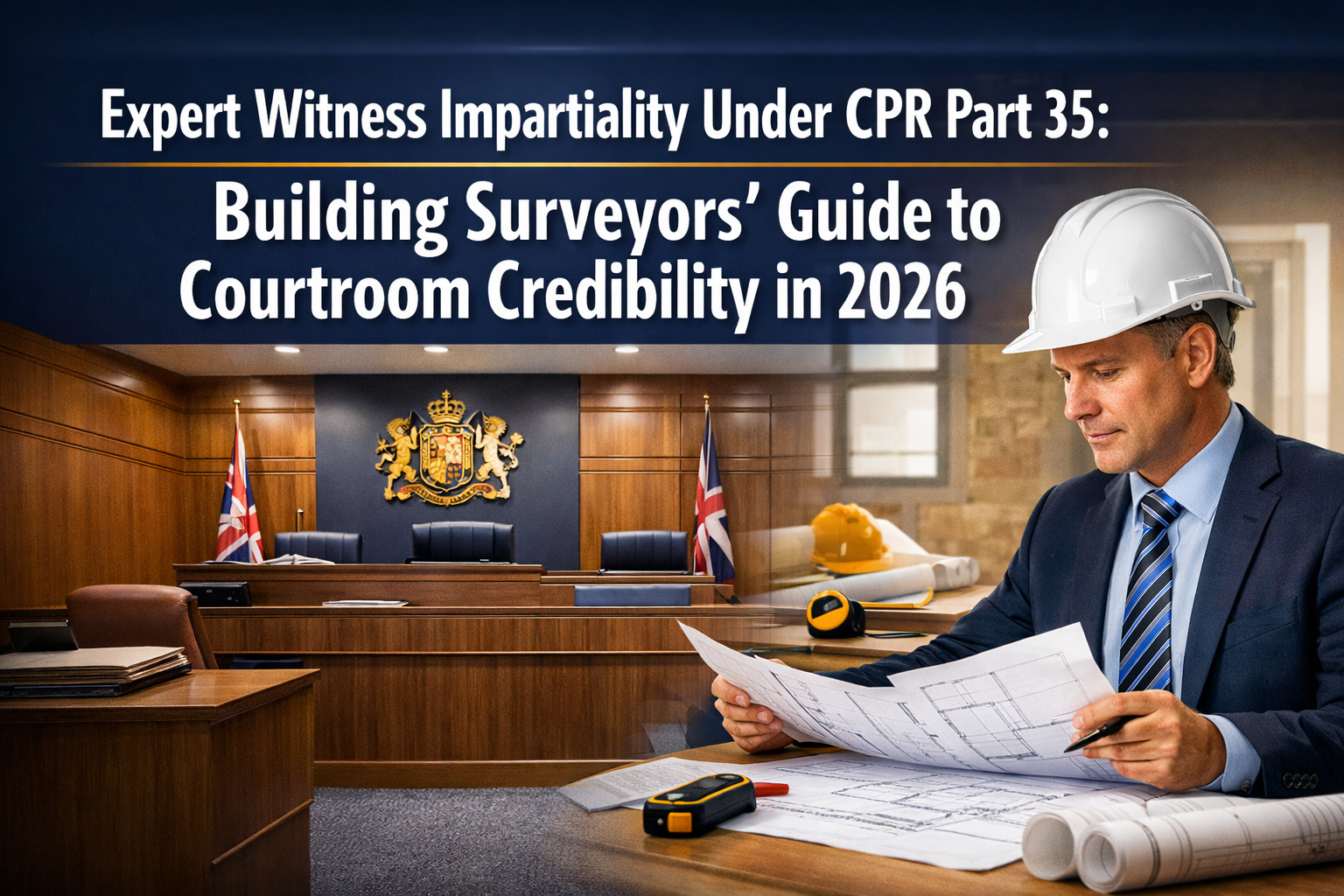

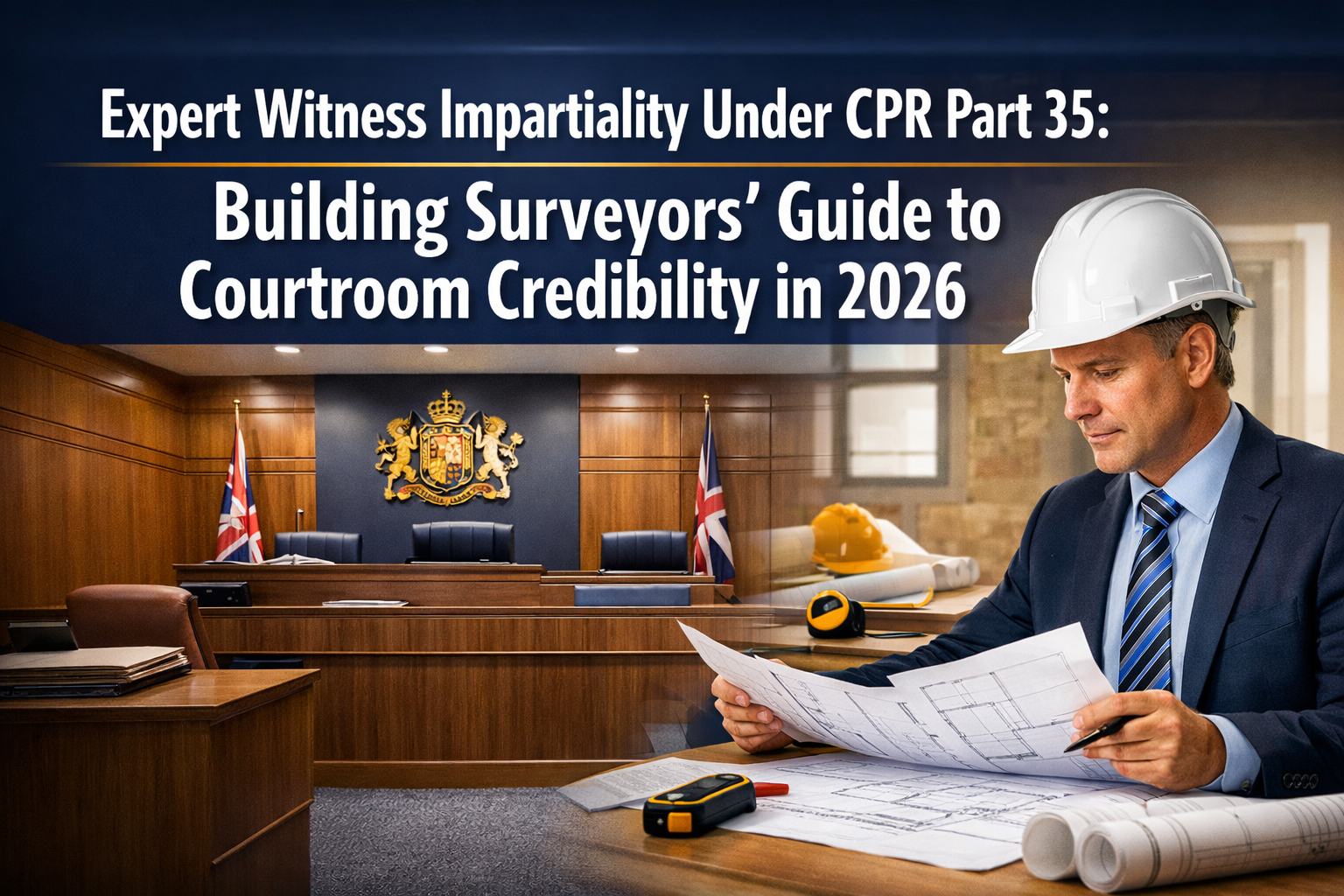
A 2024 Court of Appeal judgment overturned a £2.3 million construction dispute verdict specifically because the building surveyor's expert report failed to demonstrate sufficient independence from the instructing party. This single case sent shockwaves through the surveying profession, reminding practitioners that courtroom credibility hinges entirely on impartiality, not technical expertise alone. As we navigate 2026, understanding Expert Witness Impartiality Under CPR Part 35: Building Surveyors' Guide to Courtroom Credibility in 2026 has become non-negotiable for building surveyors who provide litigation support.
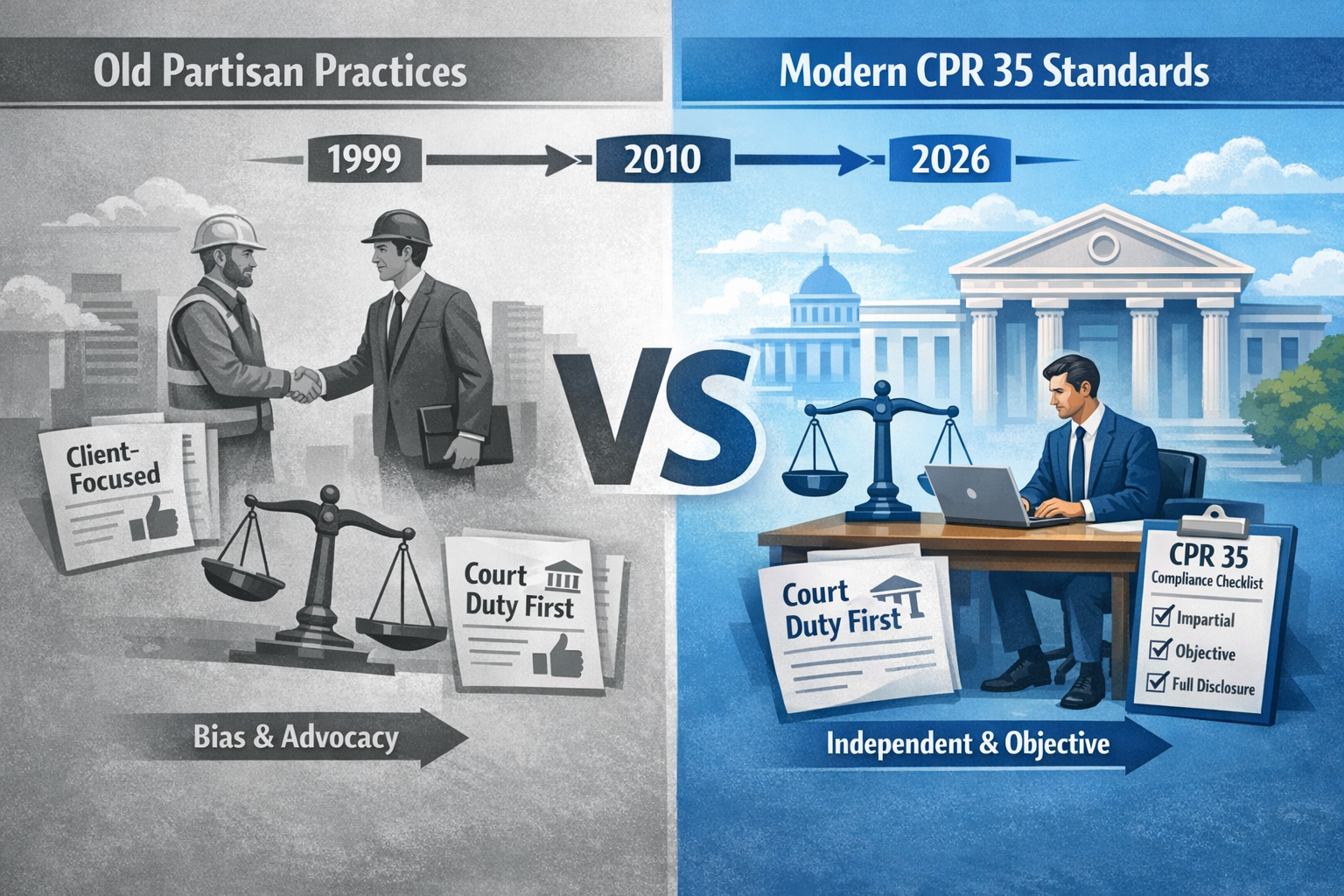
The landscape has shifted dramatically from the partisan practices of the 1990s, when experts were often viewed as advocates for their instructing clients. Today's building surveyors must navigate strict regulatory frameworks that place their duty to the court above all other obligations. This transformation reflects a fundamental change in how the legal system values expert evidence—prioritizing objectivity over advocacy.
For building surveyors providing expert witness reports in London and beyond, mastering CPR Part 35 requirements isn't just about compliance; it's about maintaining professional reputation and ensuring your evidence actually influences judicial decisions.
Key Takeaways
- Court duty supersedes client obligations: Building surveyors must prioritize their duty to the court over any relationship with instructing parties, as mandated by CPR 35.3[1]
- Independence is verifiable: Reports must demonstrate genuine independence through transparent methodology, consideration of contrary evidence, and explicit compliance statements[2]
- Report structure matters: Properly structured reports following CPR 35 guidelines significantly increase judicial acceptance and courtroom credibility[9]
- Material facts cannot be ignored: Experts must actively consider and address all relevant facts, including those that undermine their conclusions[2][5]
- Pre-permission is mandatory: No expert evidence can be served without obtaining court permission first, emphasizing the court's gatekeeping role[8]
The Fundamental Shift: From Partisan Advocacy to Court-Centered Impartiality
Understanding the Historical Context
Before the Civil Procedure Rules reforms of 1999, expert witnesses operated in a fundamentally different environment. Building surveyors and other technical experts were frequently treated—and behaved—as extensions of their instructing solicitor's legal team. Reports were drafted with explicit bias toward the client's position, and cross-examination often exposed embarrassing partisan positions that undermined the entire expert evidence framework.
The introduction of CPR Part 35 represented a revolutionary change in expert witness obligations. The core principle established was unambiguous: an expert's overriding duty is to help the court on matters within their expertise, and this duty overrides any obligation to the instructing party[1][6]. For building surveyors accustomed to client-focused service delivery, this represented a significant professional recalibration.
What CPR Part 35 Demands from Building Surveyors
The Civil Procedure Rules Part 35 establishes several non-negotiable requirements that building surveyors must understand and implement:
Primary Duty to the Court 🏛️
Every building surveyor acting as an expert witness must recognize that their evidence serves the court's need for objective, reliable information—not their client's desire for favorable testimony. This duty must be explicitly acknowledged in every expert report through a formal statement of truth[1][4].
Independent and Unbiased Evidence
Expert evidence must be "the independent product of the expert uninfluenced by the pressures of litigation"[2]. This means building surveyors cannot allow instructing solicitors, clients, or litigation strategy to shape their technical conclusions. The evidence must reflect genuine professional opinion based solely on the facts and the surveyor's expertise.
Consideration of All Material Facts
Perhaps most challenging for practitioners, CPR 35 requires experts to take into account all material facts—including those that might detract from their opinions[2][5]. Building surveyors cannot cherry-pick favorable evidence while ignoring contradictory findings. This requirement demands intellectual honesty and professional courage.
Staying Within Expertise Boundaries
The rules explicitly state that expert evidence should be restricted to matters within the expert's expertise[2]. Building surveyors must clearly delineate when they're providing opinion within their competence versus when issues fall outside their professional scope—even if this admission weakens their instructing party's case.
The Court Permission Requirement
A critical aspect often overlooked is that no party may call an expert or put expert evidence before the court without the court's permission[8]. This gatekeeping function means judges actively control the extent and nature of expert evidence, deciding whether expert input is necessary and, if so, in what form and from how many experts.
For building surveyors, this underscores that your role exists at the court's discretion, not automatically upon client instruction. Courts increasingly limit expert evidence to genuinely disputed technical matters, rejecting expert testimony on issues within the judge's own competence or where the probative value doesn't justify the cost.
Expert Witness Impartiality Under CPR Part 35: Practical Implementation for Building Surveyors
Structuring Your Expert Report for Maximum Credibility
The structure and content of your expert report directly impact your courtroom credibility. A properly formatted report that demonstrates compliance with CPR Part 35 requirements signals professionalism and reliability to the court. Here's what building surveyors must include:
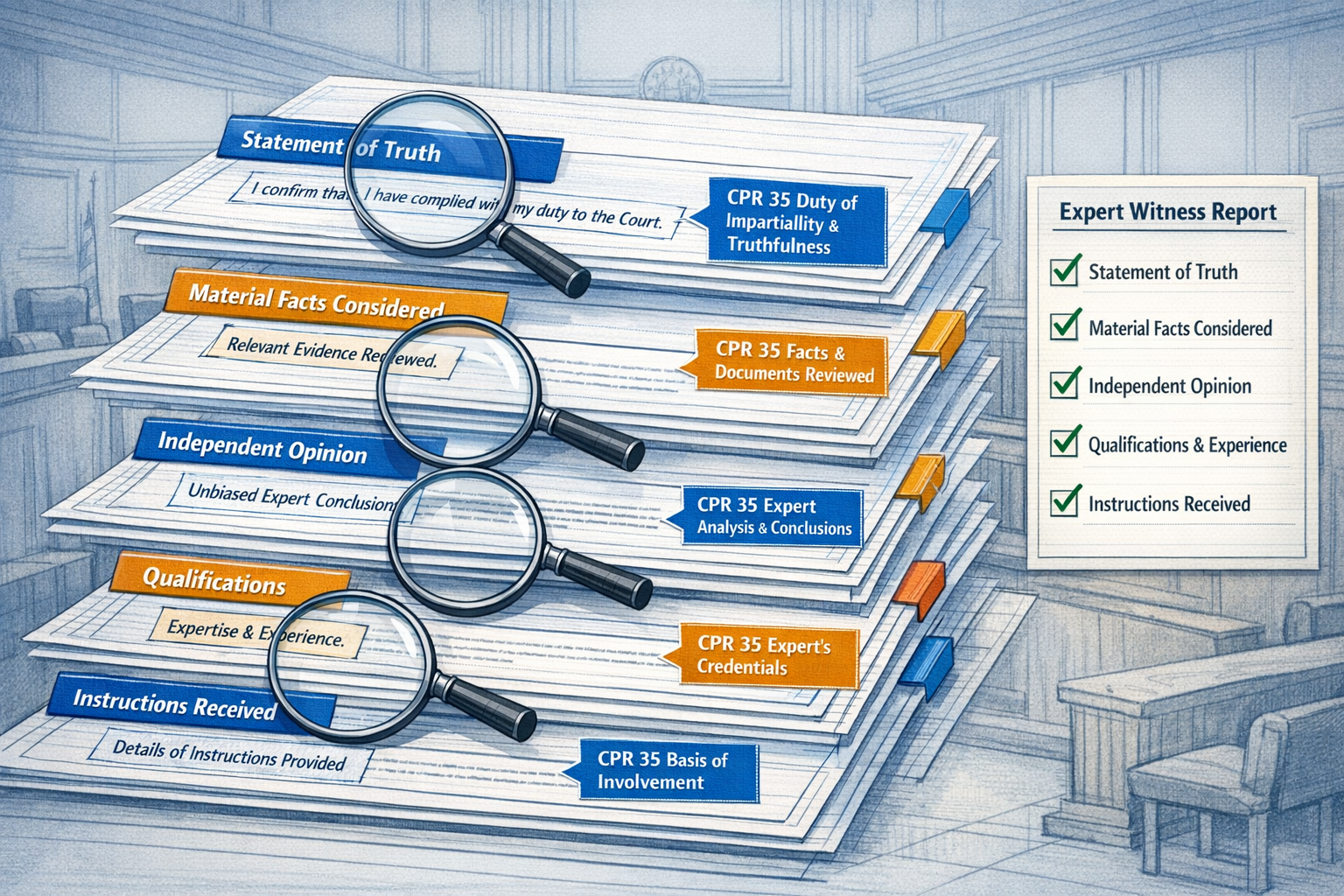
Essential Report Components
| Section | Purpose | CPR 35 Requirement |
|---|---|---|
| Statement of Truth | Confirms understanding of court duty | Mandatory declaration of compliance with CPR 35.3[1][4] |
| Qualifications & Experience | Establishes expertise boundaries | Must detail relevant credentials and experience |
| Instructions Received | Transparency about scope | Must include substance of all material instructions[2] |
| Material Facts Considered | Demonstrates thoroughness | Must address facts supporting AND contradicting opinion[2][5] |
| Independent Opinion | Core technical analysis | Must be uninfluenced by litigation pressures[2] |
| Range of Opinion | Acknowledges uncertainty | Must indicate if opinion not fully researched[2] |
| Summary of Conclusions | Clear bottom-line findings | Must be logically supported by analysis |
The Statement of Truth: More Than Boilerplate
Every expert report must contain a statement that the expert understands their duty to the court and has complied with that duty[1][4]. This isn't mere formality—it's a declaration with potential professional and legal consequences if violated.
Recommended statement language:
"I confirm that I understand my duty to the court and have complied with that duty. I am aware that my overriding duty is to the court and not to those instructing me. I confirm that I have made clear which facts and matters referred to in this report are within my own knowledge and which are not. Those that are within my own knowledge I confirm to be true. The opinions I have expressed represent my true and complete professional opinions on the matters to which they refer."
This declaration should appear prominently, typically at the report's beginning and end, signed and dated by the building surveyor personally—not by support staff or the firm.
Addressing Material Facts That Undermine Your Opinion
One of the most challenging aspects of Expert Witness Impartiality Under CPR Part 35: Building Surveyors' Guide to Courtroom Credibility in 2026 is the requirement to actively consider and address evidence that contradicts your conclusions. This goes against natural human cognitive biases and client service instincts.
Practical approach for building surveyors:
✅ Actively seek contrary evidence during your investigation, not just confirming evidence
✅ Document contradictory findings in your working papers
✅ Address contrary evidence explicitly in your report, explaining why it doesn't change your conclusion or acknowledging limitations
✅ Avoid dismissive language when discussing opposing evidence—treat it seriously and analytically
✅ Acknowledge uncertainty when the evidence is genuinely ambiguous
When building surveyors working on party wall disputes or structural survey matters encounter contradictory technical evidence, the credible approach is transparent engagement, not evasion.
Maintaining Independence During Instruction
The relationship between building surveyors and instructing solicitors requires careful management to preserve impartiality. Here are common scenarios where independence can be compromised:
🚫 Problematic Practices:
- Allowing solicitors to draft technical conclusions
- Accepting "suggested findings" from the instructing party
- Modifying opinions based on litigation strategy discussions
- Providing "preliminary views" that become locked-in positions
- Failing to update opinions when new evidence emerges
✅ Best Practices:
- Insist on direct access to sites, documents, and relevant parties
- Document all instructions in writing
- Maintain independent working papers showing your analytical process
- Communicate limitations and uncertainties clearly from the outset
- Reserve the right to modify opinions based on new information
- Decline instructions that require predetermined conclusions
Building surveyors providing building surveyor services in litigation contexts must establish these boundaries early in the engagement, ideally through written terms of appointment that reference CPR 35 obligations.
Building Courtroom Credibility: Beyond Technical Competence
The Credibility Factors Judges Assess
Technical expertise alone doesn't guarantee courtroom credibility. Judges evaluate expert witnesses across multiple dimensions, and building surveyors must excel in all areas to maintain influence:
1. Demonstrable Independence 💼
Judges scrutinize whether experts show genuine independence or subtle advocacy. This assessment begins with report review but intensifies during cross-examination. Building surveyors who maintain consistent positions, acknowledge limitations, and treat contrary evidence fairly demonstrate credibility.
2. Intellectual Honesty
Courts value experts who acknowledge uncertainty, admit mistakes, and recognize the limits of their expertise. A building surveyor who says "I don't know" or "that's outside my area" when appropriate gains more credibility than one who overreaches.
3. Clarity of Communication
Technical jargon alienates judges and undermines impact. Building surveyors must translate complex structural, defect, or construction issues into clear, accessible language without oversimplification. Visual aids, diagrams, and photographs significantly enhance communication effectiveness.
4. Responsiveness to Questions
Under CPR 35.6, parties can put written questions to experts after receiving their reports[3]. Building surveyors must respond substantively and promptly to these Part 35 questions, as evasive or delayed responses damage credibility and may result in court sanctions.
5. Professional Presentation
From report formatting to courtroom demeanor, professional presentation matters. Reports should be well-organized, properly referenced, and free from errors. In-person testimony should be respectful, composed, and focused on assisting the court rather than "winning" for a party.
Responding to Part 35 Questions
The Part 35 questions procedure allows parties to seek clarification or challenge expert opinions through written questions[3]. For building surveyors, this represents both a risk and an opportunity:
Risk: Poorly considered responses can undermine your entire report and expose weaknesses in your analysis.
Opportunity: Thoughtful responses can strengthen your position, demonstrate flexibility, and showcase your expertise.
Guidelines for effective responses:
📝 Respond within the timeframe specified by the court (typically 28 days)
📝 Answer the questions asked, not the questions you wish were asked
📝 Maintain consistency with your original report unless new information justifies a change
📝 Acknowledge valid points raised by the questioning party
📝 Explain changes if your opinion evolves based on new information
📝 Seek clarification if questions are ambiguous or compound
📝 Refuse inappropriate questions that seek legal opinions or exceed your expertise
Building surveyors should coordinate with instructing solicitors on Part 35 questions but must personally author the responses, maintaining independence throughout the process.
The Expert Witness Conference: Collaborative Problem-Solving
Courts frequently order expert witness conferences (often called "hot-tubbing" or concurrent evidence sessions) where experts from both sides meet to identify areas of agreement and disagreement[6]. For building surveyors, these conferences test impartiality in real-time.
Effective conference participation:
🤝 Approach with genuine openness to finding common ground
🤝 Focus on technical issues, not party positions
🤝 Acknowledge valid points from the opposing expert
🤝 Clearly articulate genuine disagreements with supporting reasoning
🤝 Produce joint statements that accurately reflect discussions
🤝 Maintain professional courtesy regardless of disagreement intensity
Building surveyors who demonstrate collaborative professionalism during expert conferences significantly enhance their credibility with the court. Judges value experts who can work constructively with colleagues while maintaining independent judgment.
Common Pitfalls That Destroy Credibility
Even experienced building surveyors can fall into traps that undermine their courtroom credibility:
❌ Overreaching Beyond Expertise
Offering opinions on structural engineering when you're a general building surveyor, or vice versa, immediately raises credibility concerns.
❌ Inconsistent Positions
Taking different positions in different cases on similar technical issues without explaining the distinctions suggests results-oriented advocacy rather than principled expertise.
❌ Ignoring Contrary Evidence
Failing to address obvious contradictory evidence in your report virtually guarantees damaging cross-examination.
❌ Excessive Advocacy
Using inflammatory language, making legal arguments, or displaying obvious bias toward the instructing party destroys the perception of independence.
❌ Poor Documentation
Inability to explain your methodology, reference your sources, or produce working papers suggests sloppy analysis or post-hoc rationalization.
❌ Defensive Testimony
Becoming argumentative, evasive, or emotional during cross-examination undermines your professional standing and makes judges question your objectivity.
Building surveyors working on specific defect reports or schedules of condition that may later become litigation evidence should maintain documentation and analytical rigor from the outset, anticipating potential expert witness roles.
Expert Witness Impartiality Under CPR Part 35: The 2026 Landscape and Future Trends
Recent Developments Affecting Building Surveyors
The legal landscape surrounding expert evidence continues to evolve. Several recent developments impact how building surveyors must approach expert witness work in 2026:
Increased Judicial Scrutiny
Courts are exercising their gatekeeping function more actively, challenging expert qualifications, methodology, and independence before admitting evidence. Building surveyors should expect more robust preliminary challenges to their expertise and approach.
Cost Proportionality
The overriding objective of dealing with cases justly and at proportionate cost increasingly influences expert evidence decisions[8]. Courts limit expert involvement to genuinely necessary issues, and building surveyors must justify their value proposition clearly.
Technology Integration
Digital tools for site documentation, drone roof surveys, and 3D modeling are becoming standard expectations. Building surveyors who leverage technology effectively while maintaining analytical rigor gain credibility advantages.
Professional Body Guidance
The Royal Institution of Chartered Surveyors (RICS) continues refining guidance on expert witness work, emphasizing ethical obligations and professional standards. Building surveyors must stay current with RICS requirements alongside CPR 35 compliance.
Building Long-Term Credibility as an Expert Witness
For building surveyors seeking to establish themselves as credible expert witnesses, reputation building is a long-term investment:
Professional Development
Specialized training in expert witness skills, courtroom procedures, and report writing enhances competence and confidence. Organizations like Bond Solon offer targeted programs for construction professionals[4].
Selective Case Acceptance
Building surveyors should decline instructions where independence cannot be maintained, where expertise is insufficient, or where predetermined conclusions are expected. Reputation protection requires saying "no" to inappropriate engagements.
Consistent Methodology
Developing and applying consistent analytical frameworks across cases demonstrates principled expertise rather than results-oriented flexibility. Document your standard approaches and apply them uniformly.
Peer Relationships
Maintaining collegial relationships with other expert building surveyors, even those who frequently appear for opposing parties, supports professional standards and facilitates productive expert conferences.
Continuing Education
Technical knowledge evolves, building standards change, and construction methods advance. Building surveyors must invest in ongoing education to maintain expertise currency, particularly in specialized areas like commercial building surveys or dilapidations.
The Intersection with Other Professional Roles
Building surveyors often wear multiple hats—providing homebuyer reports, conducting party wall surveys, and offering expert surveyor advice. Managing the transition between advisory and expert witness roles requires careful attention:
Role Clarity
Clearly distinguish when you're acting as an advisor to a client versus when you're serving as an independent expert to the court. These roles have fundamentally different obligations.
Conflict Management
Building surveyors should avoid accepting expert witness instructions in matters where they've previously provided advisory services to one party, as this creates actual or perceived bias.
Documentation Practices
Maintain separate file systems and documentation protocols for expert witness work versus advisory work, ensuring that expert files contain only materials relevant to your court duties.
Communication Boundaries
When acting as an expert witness, limit communications with instructing parties to necessary coordination, avoiding strategic litigation discussions that could compromise independence.
Conclusion: Excellence in Expert Witness Impartiality
Expert Witness Impartiality Under CPR Part 35: Building Surveyors' Guide to Courtroom Credibility in 2026 represents more than regulatory compliance—it embodies a professional commitment to serving justice through objective, reliable technical evidence. The transformation from partisan advocacy to court-centered impartiality has elevated the expert witness role while simultaneously raising performance standards.
Building surveyors who master these principles position themselves as valuable contributors to the legal process, commanding respect from judges, solicitors, and fellow experts. The pathway to credibility requires:
✨ Unwavering independence from instructing parties
✨ Intellectual honesty in addressing contrary evidence
✨ Clear communication of complex technical matters
✨ Rigorous methodology consistently applied
✨ Professional presentation in reports and testimony
✨ Continuous development of expertise and skills
Actionable Next Steps
For building surveyors seeking to excel in expert witness work:
- Review your current practices against CPR Part 35 requirements, identifying gaps in compliance
- Invest in specialized training focused on expert witness skills and courtroom procedures
- Develop standardized templates for expert reports that incorporate all required CPR 35 elements
- Create written protocols for managing expert witness engagements, including independence safeguards
- Build relationships with solicitors who value genuine expertise over partisan advocacy
- Stay current with RICS guidance, case law developments, and technical advances in your specialization
- Seek mentorship from experienced expert witnesses who can provide practical guidance
- Document your methodology thoroughly in every engagement, anticipating potential scrutiny
The legal system depends on building surveyors who can provide truly independent, objective technical evidence. By embracing the principles of Expert Witness Impartiality Under CPR Part 35: Building Surveyors' Guide to Courtroom Credibility in 2026, practitioners not only enhance their professional standing but also contribute meaningfully to the administration of justice. Your credibility in the courtroom ultimately rests on your commitment to serving the court's need for truth, regardless of which party instructed you.
References
[1] What Is An Expert Witnesses Part 35 – https://www.jonathanlea.net/blog/what-is-an-expert-witnesses-part-35/
[2] Pd Part35 – https://www.justice.gov.uk/courts/procedure-rules/civil/rules/part35/pd_part35
[3] A Guide To Part 35 Questions For Experts – https://www.stewartslaw.com/news/a-guide-to-part-35-questions-for-experts/
[4] Expert Witness Cpr 35 Is Gospel – https://www.bondsolon.com/news-and-insights/expert-witness-cpr-35-is-gospel/
[5] The Importance Of Impartiality Of Expert Witnesses In International Arbitration And Litigation – https://rimkus.com/article/the-importance-of-impartiality-of-expert-witnesses-in-international-arbitration-and-litigation/
[6] fenwickelliott – https://www.fenwickelliott.com/research-insight/newsletters/insight/39
[7] Cpr 35 Understanding Expert Evidence – https://legalvision.co.uk/disputes-litigation/cpr-35-understanding-expert-evidence/
[8] Part35 – https://www.justice.gov.uk/courts/procedure-rules/civil/rules/part35
[9] Part 35 Compliant Expert Witness Report What Is It And Why Is It Important – https://www.circlecasemanagement.com/news/article/part-35-compliant-expert-witness-report-what-is-it-and-why-is-it-important