}
Professional negligence claims against building surveyors have surged by 23% since 2024, driven by stricter building safety regulations and increased scrutiny following high-profile structural failures. As litigation intensifies, the role of expert witnesses in these cases has become more critical—and more complex. Understanding how to prepare robust Expert Witness Reports for Professional Negligence Claims: Building Surveyor Duties in 2026 Litigation is now essential for surveyors who may find themselves either defending their work or providing expert testimony in disputes involving their peers.
The landscape of professional negligence litigation has fundamentally shifted. Courts now demand unprecedented levels of detail, transparency, and adherence to procedural rules when expert witnesses submit reports. For building surveyors, this means navigating the delicate balance between professional obligations to clients and overriding duties to the court—a balance that, when mismanaged, can result in excluded testimony and failed cases.
Key Takeaways
- Expert evidence is mandatory in most professional negligence cases, with courts requiring testimony to establish breach of duty and causation in technical matters
- CPR 35 compliance is non-negotiable; expert witnesses owe their primary duty to the court, not the instructing party, with violations resulting in testimony exclusion
- Median expert witness rates have reached £391 per hour for case review, with testimony commanding 45% higher fees[3]
- Building surveyor reports must demonstrate competence measured against professional standards at the time of the alleged negligence, not current standards
- Documentation quality directly impacts case outcomes, with detailed evidence of inspection methodology and reasoning essential for credibility
Understanding Professional Negligence in Building Survey Context
Professional negligence occurs when a building surveyor fails to exercise the skill, care, and diligence reasonably expected of a person of ordinary competence in their field. The standard is measured by professional norms at the time of the alleged negligence—not by hindsight or current standards[1].
The Legal Framework for Negligence Claims
To succeed in a professional negligence claim against a building surveyor, claimants must establish four elements:
- Duty of care – The surveyor owed a professional duty to the claimant
- Breach of duty – The surveyor failed to meet the required standard of care
- Causation – The breach directly caused the loss
- Damages – The claimant suffered quantifiable loss
Expert witness testimony is generally required to establish breach and causation in building survey cases, as these involve technical matters beyond the knowledge of ordinary persons[1]. However, courts recognize two narrow exceptions where expert evidence may not be necessary:
- Cases involving non-technical matters that ordinary persons can reasonably assess
- Cases where conduct is so egregious that breach is obvious without knowing precise professional standards
Common Scenarios Triggering Negligence Claims
Building surveyors face negligence claims across various scenarios:
Structural defect oversight – Failing to identify significant structural issues during pre-purchase surveys, such as subsidence, foundation problems, or load-bearing wall defects. When buyers discover these defects post-purchase, they may claim the surveyor's negligence caused financial loss.
Boundary disputes – Incorrectly identifying property boundaries or failing to flag potential boundary disputes that later result in costly legal proceedings.
Valuation errors – Significantly overvaluing or undervaluing properties due to inadequate inspection or analysis, leading to financial losses for lenders or buyers.
Damp and moisture issues – Missing evidence of rising damp, penetrating damp, or condensation problems that require expensive remediation.
Building regulation compliance – Failing to identify unauthorized alterations or non-compliant construction work that affects property value or safety.
The distinction between different types of surveys becomes crucial in negligence claims, as the scope of duty varies significantly between a basic valuation report and a comprehensive building survey.
The Expert Witness Role in Professional Negligence Claims: Building Surveyor Duties in 2026 Litigation
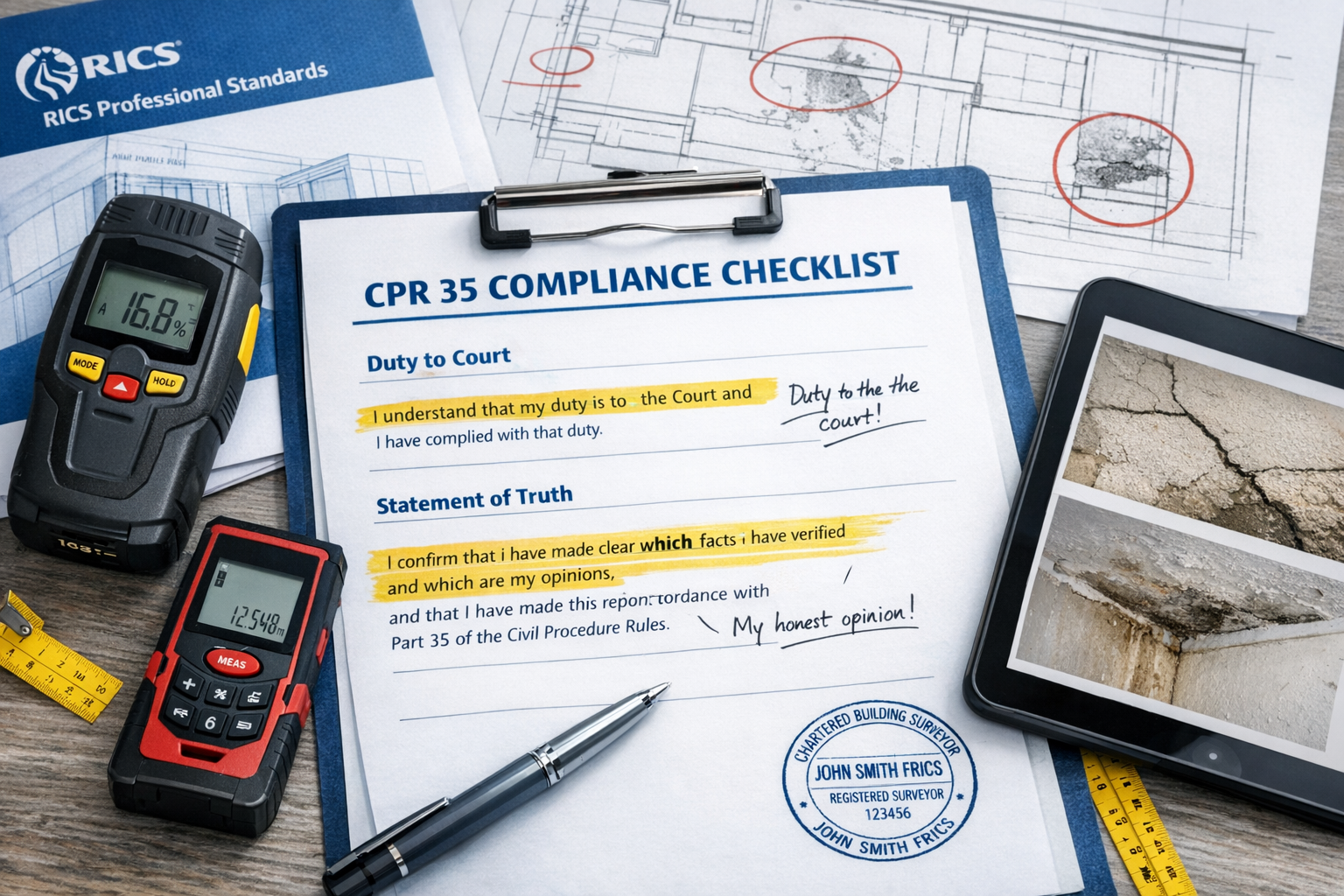
Expert witnesses in building surveyor negligence cases serve a unique dual function: they educate the court on technical matters while providing independent opinions on whether the defendant's conduct met professional standards. This role requires understanding both the substantive issues and the procedural requirements governing expert evidence.
CPR 35 and the Overriding Duty to the Court
Under Civil Procedure Rule 35, expert witnesses have an overriding duty to help the court on matters within their expertise. This duty supersedes any obligation to the party instructing or paying them—a principle that fundamentally distinguishes expert witnesses from ordinary witnesses of fact.
Key obligations under CPR 35 include:
✅ Independence – Experts must provide objective opinions uninfluenced by the pressures of litigation
✅ Impartiality – Experts must not advocate for the instructing party's position
✅ Transparency – Experts must disclose the basis of their opinions, including contrary evidence
✅ Limitation acknowledgment – Experts must clearly state when questions fall outside their expertise
✅ Statement of truth – All expert reports must include a declaration that the expert understands their duty to the court
Failure to comply with these requirements can result in testimony exclusion, cost sanctions, or professional disciplinary action. In 2026, courts have become increasingly willing to strike out expert evidence that fails to demonstrate genuine independence or adequate reasoning.
Qualifications and Expertise Requirements
For Expert Witness Reports for Professional Negligence Claims: Building Surveyor Duties in 2026 Litigation to carry weight, the expert must demonstrate relevant qualifications and experience. Courts typically require:
- Professional accreditation – Membership in recognized bodies such as RICS (Royal Institution of Chartered Surveyors)
- Relevant experience – Substantial practical experience in the specific type of survey work in question
- Current knowledge – Familiarity with professional standards applicable at the time of the alleged negligence
- Expert witness training – Completion of recognized expert witness training programs
- No conflicts of interest – Absence of relationships that could compromise independence
The median hourly rate for expert witness initial case review now stands at £391 across all specialties, with testimony rates averaging 45% higher[3]. Additionally, 40% of expert witnesses require non-refundable retainers before beginning work[3], reflecting the significant time investment required for thorough case analysis.
The Expert's Assessment Framework
When evaluating whether a building surveyor breached their duty of care, expert witnesses apply a structured assessment framework:
1. Identify the applicable standard – What would a reasonably competent building surveyor have done in similar circumstances at the relevant time?
2. Analyze the defendant's conduct – What did the defendant actually do or fail to do?
3. Compare conduct to standard – Does the defendant's conduct fall below the acceptable standard?
4. Consider causation – Did the breach cause or materially contribute to the claimant's loss?
5. Assess quantum – What is the extent of loss attributable to the breach?
This framework requires experts to distinguish between mere errors of judgment (which may not constitute negligence) and clear departures from accepted practice (which likely do). The standard is not perfection but rather the conduct expected of a competent practitioner.
Preparing Bulletproof Expert Witness Reports for Building Surveyor Negligence Cases
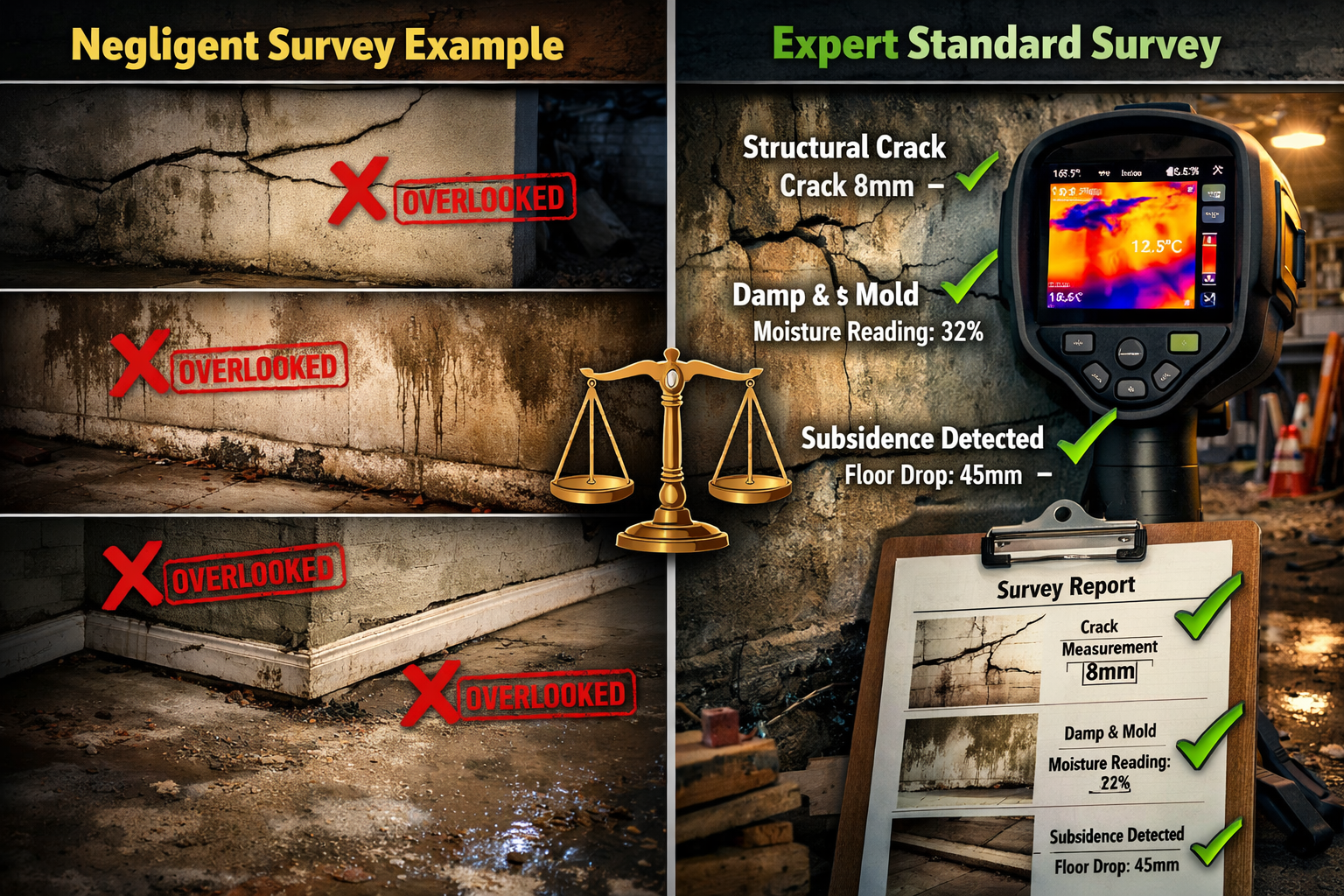
The quality of an expert witness report can determine case outcomes. In 2026, courts expect comprehensive, well-reasoned reports that comply with both procedural requirements and professional standards. Building surveyors acting as experts must master the art of report writing to ensure their testimony withstands scrutiny.
Essential Components of Compliant Expert Reports
A compliant expert report for professional negligence litigation must include specific elements mandated by CPR 35 and case law:
1. Expert's Qualifications and Experience
- Detailed CV demonstrating relevant expertise
- Professional memberships and accreditations
- Relevant publications or teaching experience
- Previous expert witness experience
2. Instructions Received
- Clear statement of questions posed
- Documents and materials reviewed
- Site inspections conducted
- Limitations on scope of instruction
3. Statement of Compliance
- Confirmation of understanding of CPR 35 duties
- Declaration of independence and impartiality
- Acknowledgment of overriding duty to court
- Statement that report includes all material facts
4. Factual Background
- Chronology of relevant events
- Description of property and survey scope
- Summary of defendant surveyor's report and methodology
- Details of defects discovered and subsequent losses
5. Applicable Professional Standards
- Relevant RICS guidance current at time of survey
- Industry practice standards
- Regulatory requirements
- Professional literature and technical guidance
6. Expert Opinion
- Clear statement of whether defendant's conduct met required standards
- Detailed reasoning supporting conclusions
- Analysis of causation and quantum
- Response to alternative theories or defenses
7. Range of Opinion
- Acknowledgment of areas of legitimate professional disagreement
- Explanation of why expert's view is preferred
- Discussion of uncertainties or limitations
8. Declaration and Statement of Truth
- Formal declaration of compliance with duties
- Statement that opinions are genuinely held
- Signature and date
The Importance of Methodology and Reasoning
Courts increasingly scrutinize the methodology underlying expert opinions. Simply stating conclusions without explaining the reasoning process invites challenge and potential exclusion. Effective expert reports demonstrate:
Systematic inspection approach – Describing how the expert examined the property, what tests were conducted, and what evidence was gathered
Reference to authoritative sources – Citing relevant RICS guidance, British Standards, Building Regulations, and professional literature
Comparative analysis – Explaining how the defendant's approach compared to accepted practice
Consideration of context – Acknowledging the specific circumstances, time constraints, and information available to the defendant
Logical progression – Showing clear reasoning from facts to conclusions
"The expert's role is not to advocate but to educate. A report that reads like a partisan brief undermines credibility and serves neither the client nor the court." – Senior Expert Witness Trainer, 2026
Common Pitfalls to Avoid
Building surveyors preparing Expert Witness Reports for Professional Negligence Claims: Building Surveyor Duties in 2026 Litigation should avoid these frequent errors:
❌ Advocacy – Writing as though representing one party rather than assisting the court
❌ Hindsight bias – Judging past conduct by current standards or knowledge not available at the time
❌ Insufficient reasoning – Stating conclusions without explaining the analytical process
❌ Selective evidence – Ignoring facts that don't support preferred conclusions
❌ Overstepping expertise – Offering opinions on matters outside the expert's field
❌ Technical jargon – Using unexplained terminology that obscures rather than clarifies
❌ Inadequate documentation – Failing to properly reference sources or evidence
❌ Missing qualifications – Not clearly establishing why the expert is qualified to opine
For surveyors conducting specific defect reports or structural surveys, maintaining detailed contemporaneous notes becomes essential, as these may later form the basis of expert analysis in litigation.
Case Studies: Expert Evidence in Boundary and Defect Disputes
Real-world examples illustrate how Expert Witness Reports for Professional Negligence Claims: Building Surveyor Duties in 2026 Litigation function in practice. These case studies highlight the critical role of expert evidence in establishing liability and quantum.
Case Study 1: Missed Subsidence in Pre-Purchase Survey
Background: A buyer commissioned a homebuyer report on a Victorian terrace property. The surveyor noted minor cracking but attributed it to normal settlement. Six months after purchase, severe subsidence became apparent, requiring £85,000 in underpinning and repairs.
Negligence Claim: The buyer sued the surveyor, claiming the cracking pattern clearly indicated active subsidence that should have been identified and investigated further.
Expert Evidence: The claimant's expert witness, a chartered surveyor with 25 years' experience, prepared a detailed report that:
- Analyzed photographs from the original survey showing diagonal cracking wider than 3mm
- Referenced RICS guidance on identifying subsidence indicators
- Conducted site inspection revealing clay soil conditions and proximity to large trees
- Demonstrated that a competent surveyor would have recommended structural engineer investigation
- Calculated the diminution in value and repair costs attributable to the missed defect
The defendant's expert argued the cracking appeared minor and could reasonably be attributed to historic settlement. However, the claimant's expert's report proved more persuasive because it:
✓ Provided detailed photographic analysis with measurements
✓ Referenced specific RICS technical guidance current at the time
✓ Explained why tree proximity and soil type were significant red flags
✓ Demonstrated clear causation between the breach and loss
Outcome: The case settled before trial for £78,000, with the expert evidence establishing clear liability.
Key Lesson: Detailed documentation and reference to contemporary professional standards are essential for establishing breach of duty.
Case Study 2: Boundary Dispute Arising from Inadequate Survey
Background: A commercial property buyer commissioned a boundary survey before purchasing a warehouse with adjacent land. The surveyor's report failed to identify that a fence line did not correspond to the legal boundary shown on title documents. After purchase, the neighboring property owner claimed ownership of a 2-meter strip of land the buyer believed was included in the purchase.
Negligence Claim: The buyer incurred £45,000 in legal fees resolving the boundary dispute and lost access to parking spaces, claiming the surveyor negligently failed to identify the discrepancy.
Expert Evidence: The claimant's expert, a specialist in boundary disputes, demonstrated that:
- The surveyor failed to compare physical boundaries with title plan measurements
- Standard practice required checking Land Registry documents against site features
- The discrepancy was readily apparent from comparing the title plan to site conditions
- The surveyor should have flagged the issue and recommended legal advice before completion
The defendant's expert argued that boundary determination involves legal interpretation beyond a surveyor's scope. However, this defense failed because:
✗ RICS guidance clearly requires surveyors to identify and report boundary discrepancies
✗ The expert's role was not to resolve the legal boundary but to identify the discrepancy
✗ Competent practice required comparing physical features to title documents
Outcome: Court found for the claimant, awarding damages for legal costs and diminution in value.
Key Lesson: Expert reports must clearly distinguish between identifying issues (within surveyor's duty) and resolving them (potentially outside scope).
Case Study 3: Damp Misdiagnosis in Listed Building
Background: A buyer purchased a Grade II listed property based on a building survey that identified "minor damp issues" requiring improved ventilation. After purchase, extensive dry rot and wet rot were discovered, requiring £120,000 in specialist repairs and temporary accommodation costs.
Negligence Claim: The buyer alleged the surveyor failed to adequately investigate damp readings and missed clear signs of timber decay.
Expert Evidence: The case involved competing expert reports:
Claimant's Expert argued:
- Moisture meter readings in the original survey showed levels exceeding 20%, indicating significant moisture ingress
- Visual inspection should have revealed timber decay in accessible areas
- A competent surveyor would have recommended invasive investigation by specialists
- The surveyor's "minor damp" characterization was negligently misleading
Defendant's Expert argued:
- Listed building surveys have inherent limitations due to protected fabric
- Dry rot can be concealed and may not be apparent during non-invasive inspection
- The surveyor appropriately recommended monitoring and ventilation improvement
- The buyer was advised to seek specialist advice but chose not to
Critical Difference: The claimant's expert provided a detailed analysis of the original moisture meter readings, demonstrating they were sufficiently elevated to trigger further investigation. The expert also obtained specialist mycologist evidence confirming the fungal decay was advanced and would have been detectable through probing accessible timbers.
Outcome: Court found partial liability (60% against surveyor), noting that while some concealment was inevitable, the elevated moisture readings should have prompted more emphatic recommendations for specialist investigation.
Key Lesson: Expert reports must address both what was detectable and what actions a competent surveyor would have taken in response to findings.
Disclosure Requirements and Evidence Standards in 2026
The procedural requirements for expert evidence have evolved significantly, with courts demanding greater transparency and earlier disclosure. Understanding these requirements is essential for Expert Witness Reports for Professional Negligence Claims: Building Surveyor Duties in 2026 Litigation.
Timing and Content of Expert Disclosures
Courts typically require expert reports to be exchanged simultaneously, preventing parties from tailoring their evidence to oppose the other side's expert. Standard directions include:
📅 Expert report deadline – Usually 12-16 weeks before trial
📅 Questions to experts – 28 days after exchange for written questions
📅 Joint expert meetings – Required in most cases to narrow issues
📅 Joint statements – Documenting areas of agreement and disagreement
Expert reports must include comprehensive disclosures, including[2]:
- Complete qualifications – Detailed CV and experience relevant to the issues
- All opinions – Every opinion the expert will express at trial
- Bases for opinions – Facts, data, and reasoning supporting each opinion
- Materials considered – Every document, photograph, or information reviewed
- Fee structures – Hourly rates, retainers, and total fees charged
Failure to include required content can result in exclusion of testimony or limitation of the expert's evidence at trial. In 2026, courts have become increasingly strict about enforcing disclosure requirements, recognizing that transparency is essential for fair litigation.
The Duty of Continuing Disclosure
Expert witnesses have a continuing duty to supplement or correct their reports if circumstances change. This includes:
- Discovery of additional relevant facts
- Identification of errors in the original report
- Changes in professional standards or guidance
- New technical information affecting opinions
Failing to update reports when material changes occur can undermine credibility and may constitute a breach of the duty to the court.
Expert Meetings and Joint Statements
In most professional negligence cases, courts order expert meetings to identify areas of agreement and narrow disputes. These meetings occur without lawyers present, allowing experts to discuss technical issues candidly.
Following the meeting, experts prepare a joint statement that:
✓ Lists matters on which experts agree
✓ Lists matters on which experts disagree
✓ Provides brief reasons for disagreements
✓ Identifies additional information needed to resolve disputes
Joint statements are powerful tools for case management, often leading to settlements when experts agree on key liability or causation issues. For building surveyor cases, experts frequently agree on applicable standards but disagree on whether the defendant's conduct met those standards—a disagreement that typically requires trial resolution.
Evidence Standards: Proving Breach and Causation
Expert evidence must meet specific standards to establish professional negligence:
For Breach of Duty: The expert must demonstrate that the defendant's conduct fell below the standard of a reasonably competent building surveyor. This requires:
- Identifying the applicable standard from professional guidance, regulations, or established practice
- Showing that the defendant's conduct departed from that standard
- Explaining why the departure was unreasonable, not merely a different approach
For Causation: The expert must establish that the breach caused the claimant's loss. This requires:
- Demonstrating what would have happened if the surveyor had acted competently
- Showing that the loss would have been avoided or reduced
- Quantifying the loss attributable to the breach
The standard of proof is balance of probabilities (more likely than not), but expert evidence must be sufficiently detailed and reasoned to meet this threshold.
Financial Considerations: Expert Witness Fees and Cost Management
The financial aspects of expert witness engagement have become increasingly significant in 2026, with rising rates and stricter cost control measures affecting litigation strategy.
Current Fee Structures and Market Rates
Expert witness fees vary based on experience, specialization, and case complexity. Current market data shows[3]:
| Service Type | Median Rate | Range |
|---|---|---|
| Initial case review | £391/hour | £250-£600/hour |
| Report preparation | £391/hour | £250-£600/hour |
| Testimony/deposition | £567/hour | £350-£850/hour |
| Court appearance | £567/hour + travel | £350-£900/hour |
Retainer requirements: Approximately 40% of expert witnesses now require non-refundable retainers before beginning work[3], typically ranging from £2,500 to £10,000 depending on case complexity.
Total case costs: A typical professional negligence case involving building surveyor expert evidence may incur expert costs of:
- Simple case: £8,000-£15,000
- Moderate complexity: £15,000-£30,000
- Complex multi-issue case: £30,000-£60,000+
These costs include initial review, report preparation, responding to questions, expert meetings, and trial preparation/testimony.
Cost-Benefit Analysis for Instructing Parties
Parties considering professional negligence claims must weigh expert costs against potential recovery:
Threshold considerations:
- Claims under £25,000 may not justify expert costs unless liability is clear
- Claims £25,000-£100,000 require careful cost-benefit analysis
- Claims over £100,000 typically justify comprehensive expert evidence
Cost recovery: The losing party typically pays the winner's reasonable expert costs, but courts may limit recovery if:
- Expert fees are deemed excessive
- Multiple experts were unnecessary
- Expert evidence proved unhelpful
Alternative approaches: For smaller claims, parties may consider:
- Single joint expert – Appointed by agreement, reducing costs
- Expert determination – Binding expert decision without full litigation
- Mediation – Using expert as neutral evaluator rather than partisan witness
Best Practices for Building Surveyors: Minimizing Negligence Risk
While this article focuses on Expert Witness Reports for Professional Negligence Claims: Building Surveyor Duties in 2026 Litigation, prevention is always preferable to defense. Building surveyors can minimize negligence risk through systematic best practices.
Documentation and Record-Keeping
Comprehensive contemporaneous notes are the foundation of defensible survey practice:
✅ Photograph everything – Take extensive photographs of all areas inspected and defects identified
✅ Record methodology – Document inspection approach, areas accessed, and limitations encountered
✅ Note weather conditions – Record conditions that may affect inspection (rain, cold, etc.)
✅ Time-stamp observations – Create clear chronology of inspection activities
✅ Preserve raw data – Retain moisture meter readings, measurements, and test results
For commercial building surveys and complex residential inspections, detailed documentation becomes even more critical given the higher stakes and complexity.
Clear Communication and Scope Definition
Managing client expectations prevents many negligence claims:
✅ Define scope precisely – Clearly state what the survey will and will not cover
✅ Explain limitations – Identify areas not accessible or requiring specialist investigation
✅ Use clear language – Avoid ambiguous terms like "minor" without context
✅ Prioritize findings – Clearly distinguish critical defects from minor issues
✅ Recommend further investigation – Explicitly state when specialist input is needed
When conducting specific defect reports or roof surveys, surveyors should be particularly clear about the focused scope and any broader issues outside the inspection parameters.
Continuing Professional Development
Maintaining current knowledge is essential for meeting professional standards:
✅ Regular RICS training – Attend technical updates and guidance seminars
✅ Professional literature – Stay current with Building Regulations and British Standards
✅ Peer consultation – Discuss challenging cases with experienced colleagues
✅ Specialist referral – Know when to involve structural engineers or other specialists
✅ Technology adoption – Use modern inspection tools (thermal imaging, drones) where appropriate
Drone roof surveys and thermal imaging are increasingly becoming standard practice, and failure to use available technology may constitute negligence in appropriate circumstances.
Professional Indemnity Insurance
Adequate professional indemnity insurance is essential:
- RICS requires minimum coverage levels based on practice size
- Policy should cover both breach of duty and pure economic loss
- Ensure policy covers all service types offered
- Maintain run-off cover when retiring or changing practice structure
- Report potential claims promptly to insurers
The Future of Expert Evidence in Building Surveyor Negligence Cases
The landscape of Expert Witness Reports for Professional Negligence Claims: Building Surveyor Duties in 2026 Litigation continues to evolve, with several trends shaping future practice.
Technology and Digital Evidence
Digital documentation is transforming expert evidence:
- 3D scanning and modeling – Creating detailed digital twins of properties for analysis
- Drone imagery – Providing comprehensive roof and elevation documentation
- Thermal imaging – Detecting concealed defects not visible to naked eye
- AI-assisted analysis – Using machine learning to identify defect patterns
Expert witnesses must now be proficient in analyzing and presenting digital evidence, while also understanding its limitations and potential for manipulation.
Increased Scrutiny of Expert Independence
Courts are intensifying focus on expert independence, with recent cases highlighting:
- Greater willingness to exclude partisan expert evidence
- Increased use of court-appointed experts in complex cases
- Stricter enforcement of CPR 35 compliance requirements
- Professional disciplinary action for experts who breach duties
Building surveyors acting as experts must demonstrate genuine independence and resist pressure to advocate for instructing parties.
Alternative Dispute Resolution
ADR mechanisms are increasingly preferred for professional negligence disputes:
- Expert determination – Binding decision by agreed expert, faster and cheaper than litigation
- Mediation – Facilitated negotiation with expert input
- Early neutral evaluation – Expert assessment to inform settlement discussions
These approaches often produce better outcomes for all parties while reducing costs and time.
Conclusion
Expert Witness Reports for Professional Negligence Claims: Building Surveyor Duties in 2026 Litigation represent a critical intersection of professional practice, legal procedure, and technical expertise. As negligence claims continue to rise, building surveyors must understand both how to defend their work and how to provide credible expert testimony when called upon.
The key principles are clear: independence, transparency, and rigorous methodology. Expert witnesses owe their primary duty to the court, not to instructing parties. Reports must be comprehensive, well-reasoned, and compliant with CPR 35 requirements. Opinions must be based on applicable professional standards at the relevant time, supported by detailed evidence and clear reasoning.
For building surveyors, the best defense against negligence claims remains excellent practice: thorough inspections, comprehensive documentation, clear communication, and appropriate referral to specialists when needed. When disputes do arise, quality expert evidence—whether defending or prosecuting claims—can make the difference between success and failure.
Actionable Next Steps
For building surveyors facing potential claims:
- Notify insurers immediately – Don't delay reporting potential claims
- Preserve all documentation – Gather all files, notes, photographs, and correspondence
- Seek legal advice promptly – Engage solicitors experienced in professional negligence defense
- Avoid direct contact with claimants – Let insurers and lawyers manage communications
- Consider expert review – Obtain preliminary expert opinion on liability and quantum
For those instructing expert witnesses:
- Select qualified experts early – Look for relevant experience and expert witness training
- Provide comprehensive instructions – Give experts all relevant documents and clear questions
- Respect expert independence – Don't pressure experts to support particular positions
- Budget appropriately – Factor in expert costs from case outset
- Facilitate expert meetings – Encourage dialogue to narrow issues and promote settlement
For building surveyors considering expert witness work:
- Obtain proper training – Complete recognized expert witness courses
- Understand CPR 35 duties – Study procedural requirements thoroughly
- Develop report writing skills – Practice clear, structured, objective writing
- Maintain independence – Establish systems to ensure impartiality
- Keep current with standards – Stay updated on professional guidance and case law
The intersection of building surveying expertise and litigation skills requires continuous development and unwavering commitment to professional standards. As the regulatory environment becomes more demanding and public expectations rise, the role of expert witnesses in maintaining professional accountability will only grow in importance.
Whether defending your own work, evaluating a colleague's conduct, or providing expert testimony in complex disputes, understanding the principles outlined in this article will help navigate the challenging terrain of professional negligence litigation in 2026 and beyond. The investment in quality expert evidence—whether in time, money, or professional development—pays dividends in case outcomes and professional reputation.
References
[1] Proving Professional Negligence Claims Required Expert Evidence – https://www.millerthomson.com/en/insights/lloyds-brief/proving-professional-negligence-claims-required-expert-evidence/
[2] Florida Expert Witness Disclosure Requirements – https://www.expertinstitute.com/resources/insights/florida-expert-witness-disclosure-requirements/
[3] Expert Witness Industry Statistics – https://wifitalents.com/expert-witness-industry-statistics/