The Northern Ireland property market has emerged as one of the UK's strongest performers in 2026, creating unprecedented challenges for property valuations in legal disputes. As prices surge past pre-recession levels and outpace national trends, Expert Witness Roles in 2026 Northern Ireland Property Disputes: Valuing Outperforming Markets Post-Recovery have become increasingly complex and critical to achieving fair outcomes in litigation. Expert witnesses must now navigate a landscape where traditional valuation methodologies meet rapidly appreciating markets, requiring sophisticated analysis and credible testimony backed by robust data.
Property disputes in Northern Ireland have intensified as the market recovers, with disagreements over valuations in divorce proceedings, boundary disputes, professional negligence claims, and restrictive covenant cases becoming more common. The role of the expert witness has evolved beyond simple property appraisal to encompass comprehensive market analysis, trend forecasting, and the ability to explain complex valuation principles to legal professionals and courts. Understanding how Expert Witness Roles in 2026 Northern Ireland Property Disputes: Valuing Outperforming Markets Post-Recovery function is essential for property owners, legal practitioners, and surveyors operating in this dynamic environment.
Key Takeaways
- 📈 Northern Ireland's property market leads UK growth in 2026, requiring expert witnesses to apply specialized valuation techniques that account for rapid appreciation and market volatility
- ⚖️ RICS-accredited expert witnesses provide credible testimony in disputes ranging from divorce valuations to professional negligence claims, with structured referral services available
- 🎯 Post-recovery market conditions demand data-driven approaches, with expert witnesses relying on comparable sales analysis, market trend data, and stabilizing national indicators
- 💼 Multiple specialist firms across Northern Ireland offer expert witness services, including planning evidence, land use disputes, and restrictive covenant cases
- 🔍 Proper qualification and methodology are critical, with courts expecting expert witnesses to demonstrate independence, technical competence, and adherence to professional standards
Understanding the Northern Ireland Property Market Recovery in 2026
Market Performance and Growth Indicators
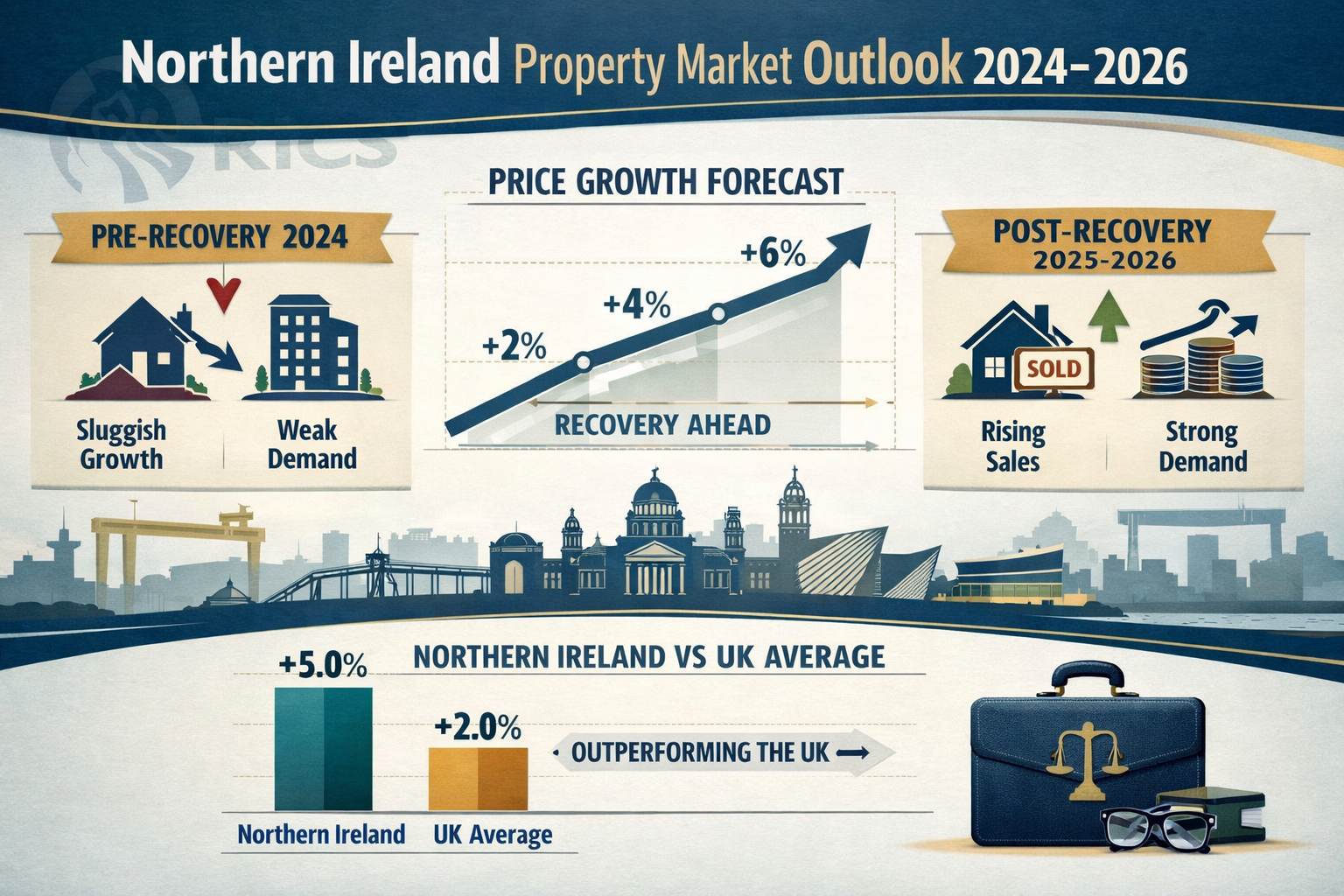
Northern Ireland's property market has demonstrated remarkable resilience and growth throughout 2025 and into 2026, positioning the region as a standout performer within the United Kingdom. Price appreciation has consistently outpaced the national average, with quarterly growth figures showing sustained momentum even as other UK regions experience stabilization or modest declines. This exceptional performance creates both opportunities and challenges for property valuations in dispute resolution contexts.
The recovery trajectory has been characterized by several key factors:
Supply Constraints: Limited housing stock combined with increasing demand has driven prices upward, particularly in Belfast and surrounding commuter areas. New construction has struggled to keep pace with population growth and household formation, creating a supply-demand imbalance that supports continued price appreciation.
Economic Fundamentals: Strong employment figures, wage growth, and business confidence have underpinned the property market recovery. Northern Ireland's economy has benefited from its unique position following Brexit, with access to both UK and EU markets creating investment opportunities.
Interest Rate Environment: While interest rates have risen from historic lows, the gradual nature of increases has allowed the market to adjust without triggering a sharp correction. Mortgage affordability, though tightened, remains within manageable parameters for many buyers.
Investment Activity: Both domestic and international investors have recognized Northern Ireland's value proposition, with rental yields remaining attractive compared to other UK regions. This investment demand has added liquidity and price support to the market.
For expert witnesses providing valuation evidence, understanding these macroeconomic drivers is essential. Courts expect witnesses to contextualize individual property valuations within broader market trends, demonstrating how local and regional factors influence specific properties. The ability to reference credible data sources and explain market dynamics in accessible terms distinguishes effective expert testimony from mere opinion.
Stabilizing National Trends and Their Impact
While Northern Ireland continues to outperform, national UK property market trends show signs of stabilization in 2026. This divergence between regional and national performance creates complexity for expert witnesses who must explain why Northern Ireland properties may appreciate while UK-wide indices show moderation or decline.
| Market Indicator | Northern Ireland | UK National Average | Variance |
|---|---|---|---|
| Annual Price Growth | +8.2% | +2.1% | +6.1% |
| Transaction Volume | +12% | -3% | +15% |
| Average Days on Market | 42 days | 68 days | -26 days |
| Price-to-Earnings Ratio | 6.8x | 8.4x | -1.6x |
Table: 2026 Northern Ireland vs UK Property Market Performance Indicators
The stabilization of national trends provides valuable reference points for expert witnesses. When valuing properties in Northern Ireland disputes, witnesses can demonstrate that local appreciation is supported by fundamentals rather than speculative excess by comparing regional metrics to national benchmarks. This comparative analysis strengthens the credibility of valuations that might otherwise appear inflated when viewed in isolation.
Expert witnesses must also consider forward-looking indicators. While current performance is strong, courts are interested in sustainability and whether valuations reflect temporary market conditions or durable value. Analysis of mortgage approval rates, construction pipeline data, and economic forecasts helps witnesses provide balanced opinions that account for both current market strength and potential future adjustments.
The Critical Role of Expert Witnesses in Property Disputes
Types of Property Disputes Requiring Expert Testimony
Property disputes in Northern Ireland span a wide range of legal contexts, each requiring specialized expertise and tailored valuation approaches. Understanding Expert Witness Roles in 2026 Northern Ireland Property Disputes: Valuing Outperforming Markets Post-Recovery begins with recognizing the diversity of cases where expert testimony proves essential.
Divorce and Matrimonial Proceedings 💑
Divorce cases frequently require property valuations to ensure equitable asset division. In Northern Ireland's appreciating market, disagreements over property values have intensified, with significant financial consequences for both parties. Expert witnesses must provide impartial valuations that reflect market reality rather than either party's negotiating position. The divorce valuation process requires sensitivity to the emotional context while maintaining professional objectivity and technical rigor.
Boundary and Neighbour Disputes 🏘️
Property boundaries become contentious when land values rise, making even small parcels financially significant. Expert witnesses in boundary disputes must combine surveying expertise with valuation skills, determining how boundary adjustments affect property values. These cases often involve historical documents, physical inspections, and analysis of how boundary changes impact development potential and market appeal.
Professional Negligence Claims ⚠️
When surveyors, valuers, or other property professionals are accused of negligence, expert witnesses evaluate whether the professional's conduct met industry standards. These cases require witnesses to assess whether valuations, surveys, or advice provided were reasonable given market conditions at the time. In a rapidly appreciating market, demonstrating what constituted reasonable professional judgment becomes particularly challenging.
Planning and Land Use Disputes 🏗️
Multiple firms across Northern Ireland, including Gravis Planning, provide expert witness services for planning appeals and land use disputes[2][3]. These cases often involve valuing properties with development potential, assessing the impact of planning restrictions on value, or evaluating compensation claims related to planning decisions. Expert witnesses must understand planning law, development economics, and valuation methodology to provide comprehensive testimony.
Restrictive Covenant and Easement Cases 📜
Disputes over restrictive covenants, rights of way, and easements require expert witnesses to value the impact of these legal interests on property values. In an outperforming market, the financial consequences of such restrictions become more pronounced, making expert valuation evidence critical to fair resolution.
The RICS Framework and Professional Standards
The Royal Institution of Chartered Surveyors (RICS) provides the professional framework that governs expert witness practice in property disputes. RICS-accredited expert witnesses must adhere to strict standards that ensure independence, competence, and reliability.
RICS Expert Witness Accreditation ✅
The RICS Expert Witness Accreditation Service (EWAS) maintains a register of qualified expert witnesses who have demonstrated specialized knowledge and experience. The service charges £425 for expert witness nominations and £180 for contact details of three accredited witnesses, providing a structured referral mechanism for legal professionals seeking qualified experts[5]. This accreditation process ensures that expert witnesses possess not only technical valuation skills but also understanding of legal procedures and expert witness duties.
The Red Book Valuation Standards 📕
RICS Valuation – Global Standards (the "Red Book") establishes mandatory requirements for RICS members undertaking valuation assignments. While not all expert witness work falls under Red Book requirements, adherence to these standards demonstrates professional rigor and provides a recognized methodology that courts respect. Expert witnesses must clearly state whether their valuations comply with Red Book standards and explain any departures from standard methodology.
Duty to the Court ⚖️
Expert witnesses owe their primary duty to the court, not to the party instructing them. This fundamental principle distinguishes expert evidence from advocacy. RICS members providing expert witness services must maintain independence, provide objective opinions based on their expertise, and clearly distinguish between facts, assumptions, and professional judgment. This duty becomes particularly important in Northern Ireland's appreciating market, where instructing parties may pressure experts to support favorable valuations.
Continuing Professional Development 📚
RICS requires members to maintain competence through continuing professional development (CPD). For expert witnesses, this includes staying current with market trends, valuation methodology developments, legal precedents, and regulatory changes. In 2026's dynamic Northern Ireland market, ongoing education ensures expert witnesses can credibly address market conditions and apply appropriate valuation techniques.
Expert Witness Valuation Methodologies for Outperforming Markets
Comparative Sales Analysis in Appreciating Markets
The comparative method remains the foundation of residential property valuation, but applying it in Northern Ireland's rapidly appreciating market requires careful consideration and adjustment. Expert Witness Roles in 2026 Northern Ireland Property Disputes: Valuing Outperforming Markets Post-Recovery demand sophisticated comparative analysis that accounts for market velocity and temporal adjustments.
Selecting Appropriate Comparables 🔍
In a fast-moving market, the selection of comparable properties becomes critical. Expert witnesses must identify sales that are:
- Temporally Relevant: Recent sales provide the most reliable evidence, but in an appreciating market, even transactions from 3-6 months prior may require adjustment for market movement
- Geographically Proximate: Location remains paramount, with expert witnesses needing to demonstrate that comparables share similar locational attributes and market dynamics
- Physically Similar: Property type, size, condition, and features must align, though expert witnesses can make adjustments for differences when properly supported
- Arm's Length Transactions: Sales between related parties, distressed sales, or transactions with unusual terms may not reflect market value
The property valuation guide principles apply equally in Northern Ireland, though expert witnesses must adapt methodologies to regional market characteristics.
Time Adjustments and Market Trend Analysis 📊
When comparable sales occurred weeks or months before the valuation date, expert witnesses must apply time adjustments to reflect market appreciation. This requires:
- Establishing Market Trend Data: Using indices, repeat sales analysis, or portfolio tracking to quantify market movement
- Applying Appropriate Adjustment Rates: Demonstrating that adjustments reflect actual market behavior rather than assumptions
- Sensitivity Analysis: Showing how different adjustment rates affect final valuations, acknowledging uncertainty
- Documentation: Providing clear audit trails that courts can follow and understand
In Northern Ireland's outperforming market, time adjustments can significantly impact valuations, making transparent methodology essential to credible expert testimony.
Hierarchical Adjustment Methodology 🎯
Expert witnesses should apply adjustments systematically:
| Adjustment Category | Typical Range | Evidence Required |
|---|---|---|
| Time/Market Movement | 0.5-1.5% per month | Market indices, repeat sales data |
| Location | ±5-15% | Locational analysis, amenity comparison |
| Size | £100-300 per sq ft | Size-adjusted sales analysis |
| Condition | ±10-25% | Condition surveys, renovation costs |
| Features/Specification | ±5-20% | Market preference analysis |
Table: Typical Adjustment Ranges for Northern Ireland Residential Comparables
Each adjustment must be justified with reference to market evidence rather than subjective judgment. Courts expect expert witnesses to explain the basis for adjustments and demonstrate consistency across multiple comparables.
Investment and Income Approaches
For commercial properties, investment properties, and some residential assets, income-based valuation methods provide important evidence. In Northern Ireland's strong rental market, the investment method offers valuable cross-checks against comparative sales approaches.
Rental Value Assessment 💰
Determining market rent requires analysis of comparable lettings, with similar temporal and locational considerations as sales comparables. Expert witnesses must demonstrate understanding of:
- Tenant demand dynamics: Sector-specific rental market conditions
- Lease terms: How lease length, break clauses, and tenant obligations affect rental value
- Rental growth prospects: Forward-looking analysis of rental appreciation potential
- Void periods: Expected vacancy rates and their impact on effective income
Capitalization Rates and Yield Analysis 📈
Applying appropriate capitalization rates (yields) requires market knowledge and judgment. Expert witnesses must justify yield selection by reference to:
- Comparable investment sales: Analyzing yields achieved on similar properties
- Risk assessment: Considering location, tenant quality, lease security, and property condition
- Market sentiment: Understanding investor demand and capital availability
- Benchmark yields: Comparing to published indices and market reports
In Northern Ireland's appreciating market, yields may compress (fall) as investor demand increases, requiring expert witnesses to demonstrate that yield assumptions reflect current market conditions rather than historical norms.
Residual and Development Appraisal Methods
For properties with development potential, the residual method estimates value by calculating the completed development value less development costs and developer's profit. This method is particularly relevant in Northern Ireland where development activity has intensified with market recovery.
Key Components of Residual Valuations 🏗️
Expert witnesses applying residual methodology must address:
- Gross Development Value (GDV): The completed scheme's market value
- Construction Costs: Building costs, professional fees, and contingencies
- Finance Costs: Interest on development funding
- Developer's Profit: Risk-adjusted return expectations
- Planning and Timing: Obtaining permissions and development phasing
Each component requires careful analysis and justification. In an appreciating market, expert witnesses must consider how market movement during the development period affects GDV and whether current pricing is sustainable.
Sensitivity and Scenario Analysis 🔄
Given the uncertainties inherent in development appraisals, expert witnesses should present sensitivity analysis showing how variations in key assumptions affect residual land value. This demonstrates professional rigor and helps courts understand the range of reasonable valuations rather than a false precision.
Navigating Common Challenges in Northern Ireland Property Dispute Valuations

Addressing Market Volatility and Uncertainty
Northern Ireland's outperforming market creates valuation challenges that expert witnesses must acknowledge and address. Expert Witness Roles in 2026 Northern Ireland Property Disputes: Valuing Outperforming Markets Post-Recovery require honest assessment of market uncertainty while providing definitive opinions that courts can rely upon.
The Tension Between Precision and Uncertainty ⚡
Courts expect expert witnesses to provide specific valuations, yet professional integrity requires acknowledging the inherent uncertainty in property valuation. Expert witnesses navigate this tension by:
- Providing Point Estimates with Ranges: Offering a single figure as the most likely value while indicating a reasonable range
- Explaining Confidence Levels: Discussing factors that increase or decrease valuation confidence
- Documenting Assumptions: Clearly stating the assumptions underlying valuations and how changes would affect conclusions
- Avoiding False Precision: Rounding valuations appropriately rather than implying unwarranted accuracy
"The expert witness's role is not to provide certainty where none exists, but to apply professional judgment to available evidence and explain the reasoning transparently."
Market Cycle Positioning 🔄
Expert witnesses must consider where Northern Ireland's market sits within the broader property cycle. Is the current outperformance sustainable, or does it represent a peak that may correct? While expert witnesses cannot predict the future, they can:
- Reference historical market cycles and their characteristics
- Analyze fundamental value drivers versus speculative factors
- Consider affordability metrics and their sustainability
- Acknowledge different scenarios and their probability
This balanced approach provides courts with context for understanding valuations and their potential evolution.
Dealing with Limited Comparable Evidence
In some Northern Ireland locations or property types, limited transaction evidence challenges expert witnesses. Unique properties, rural locations, or specialized uses may lack sufficient comparables for robust analysis.
Alternative Evidence Sources 🔎
When direct comparables are scarce, expert witnesses may rely on:
- Broader Geographic Searches: Expanding the search area while adjusting for locational differences
- Property Type Adjustments: Using similar but not identical properties with appropriate adjustments
- Historical Sales: Analyzing the subject property's previous sales with time adjustments
- Asking Prices and Withdrawn Sales: Using with caution as supporting evidence
- Professional Networks: Consulting with local agents and surveyors familiar with the market
Each alternative source requires careful explanation of its limitations and how the expert has accounted for differences from ideal comparable evidence.
The Role of Professional Judgment 💡
When evidence is limited, professional judgment becomes more prominent. Expert witnesses must clearly distinguish between:
- Facts: Verifiable data and evidence
- Assumptions: Necessary suppositions that fill evidence gaps
- Professional Opinion: Judgments based on experience and expertise
Courts appreciate this transparency, which allows them to assess the weight to give expert evidence based on its evidential foundation.
Managing Instructing Party Expectations
Expert witnesses often face pressure from instructing parties to support favorable valuations. Maintaining independence while managing client relationships requires skill and professional courage.
Clear Engagement Terms 📋
Expert witnesses should establish clear terms of engagement that:
- Define the scope of work and deliverables
- Confirm the expert's duty to the court
- Explain that opinions cannot be guaranteed to support the client's position
- Set out fee arrangements that don't create conflicts of interest
Similar to expert witness report preparation, Northern Ireland experts must establish professional boundaries from the outset.
Communication Strategies 💬
When preliminary findings don't support the instructing party's expectations, expert witnesses should:
- Communicate early and clearly
- Explain the evidence and reasoning
- Remain open to additional evidence or alternative perspectives
- Stand firm on professional conclusions while remaining respectful
- Document all communications regarding opinions and any pressure received
Withdrawal Considerations 🚪
In extreme cases where instructing parties demand opinions that cannot be professionally supported, expert witnesses must be prepared to withdraw from instructions. RICS guidance supports this position, prioritizing professional integrity over commercial relationships.
Practical Considerations for Engaging Expert Witnesses in Northern Ireland
Selecting the Right Expert Witness
Parties to property disputes must carefully select expert witnesses whose qualifications, experience, and approach align with the case requirements. Understanding Expert Witness Roles in 2026 Northern Ireland Property Disputes: Valuing Outperforming Markets Post-Recovery helps instructing parties make informed choices.
Essential Qualifications and Credentials 🎓
Effective expert witnesses typically possess:
- Professional Accreditation: RICS membership (MRICS or FRICS) with valuation specialization
- Expert Witness Training: Specific training in expert witness duties and court procedures
- Local Market Knowledge: Demonstrated experience in Northern Ireland property markets
- Relevant Specialization: Expertise in the specific property type and dispute context
- Professional Indemnity Insurance: Adequate coverage for expert witness work
The RICS Expert Witness Referral Service provides a structured method for identifying qualified experts[5], though parties may also engage experts directly through professional networks.
Evaluating Experience and Track Record 📊
When assessing potential expert witnesses, consider:
- Number of Expert Witness Instructions: Demonstrated experience providing expert evidence
- Court Testimony Experience: Comfort and competence in giving oral evidence
- Report Quality: Clarity, thoroughness, and adherence to professional standards
- Peer Recognition: Reputation among legal professionals and other experts
- Continuing Development: Evidence of ongoing learning and market knowledge
Regional Expertise Across Northern Ireland 🗺️
Northern Ireland's property markets vary significantly between Belfast, commuter areas, coastal locations, and rural regions. Expert witnesses should demonstrate specific knowledge of the relevant geographic market. While firms like McGeehan Chartered Surveyors operate in South Belfast[6], and Quigg Golden serves the broader Belfast area[4], parties should ensure their expert has direct experience in the specific location relevant to the dispute.
Cost Considerations and Fee Structures
Expert witness services represent a significant cost in property disputes, requiring careful budgeting and fee negotiation.
Typical Fee Structures 💷
Expert witnesses may charge:
- Hourly Rates: £150-400+ per hour depending on seniority and specialization
- Fixed Fees: Agreed amounts for specific deliverables (reports, court attendance)
- Daily Rates: £1,500-3,500+ for court attendance days
- Retainers: Upfront payments to secure availability
Fees vary based on the expert's experience, the complexity of the case, and the urgency of the instruction.
Managing Costs Effectively 💰
Parties can control expert witness costs by:
- Defining Scope Clearly: Avoiding unnecessary work through precise instructions
- Providing Complete Information: Reducing time spent requesting additional documents
- Encouraging Joint Expert Instructions: Sharing costs when appropriate
- Negotiating Fee Caps: Agreeing maximum fees for specific work phases
- Considering Alternative Dispute Resolution: Using expert evidence in mediation or arbitration to avoid court costs
Disbursements and Additional Costs 📝
Beyond professional fees, parties should budget for:
- Travel and accommodation for site inspections and court attendance
- Research costs and data subscriptions
- Reproduction of reports and exhibits
- Administrative and secretarial support
Clear fee agreements should specify how these costs are handled.
The Expert Witness Report: Structure and Content
The expert witness report is the primary deliverable in most instructions, providing written evidence that forms the basis for court consideration and potential cross-examination.
Essential Report Components 📄
A comprehensive expert witness report should include:
- Introduction and Instructions: Who instructed the expert, the purpose of the report, and the questions to be addressed
- Qualifications and Experience: The expert's credentials and relevant expertise
- Statement of Truth: Declaration that the expert understands their duty to the court
- Property Description: Detailed description of the subject property
- Inspection Details: When and how the property was inspected
- Market Analysis: Relevant market conditions and trends
- Valuation Methodology: Explanation of approaches used
- Comparable Evidence: Detailed analysis of comparable transactions
- Valuation Conclusion: Clear statement of opinion on value
- Assumptions and Limitations: Any factors that qualify the opinion
- Declaration: Confirmation of independence and duty to court
Writing for Non-Technical Audiences ✍️
Expert witnesses must remember that judges, lawyers, and juries may lack property expertise. Effective reports:
- Use clear, accessible language
- Define technical terms when first used
- Include visual aids (maps, photographs, charts)
- Explain reasoning step-by-step
- Avoid unnecessary jargon
- Provide executive summaries for complex reports
The goal is to educate the court while demonstrating expertise, not to obscure conclusions with technical complexity.
Common Report Deficiencies to Avoid ⚠️
Expert witness reports may be criticized for:
- Failing to address the specific questions asked
- Insufficient explanation of methodology
- Inadequate comparable evidence
- Advocacy rather than independence
- Failure to acknowledge alternative views
- Poor presentation and organization
- Missing declarations or qualifications
Adhering to professional standards and seeking peer review can help avoid these pitfalls.
The Future of Expert Witness Services in Northern Ireland Property Markets
Technological Advances in Valuation and Evidence Presentation
Technology is transforming how expert witnesses gather evidence, conduct analysis, and present findings. Expert Witness Roles in 2026 Northern Ireland Property Disputes: Valuing Outperforming Markets Post-Recovery increasingly incorporate digital tools and data analytics.
Automated Valuation Models (AVMs) 🤖
AVMs use statistical modeling and property databases to generate valuations. While not suitable as standalone expert evidence, AVMs can:
- Provide preliminary valuations for case assessment
- Offer quality control checks on manual valuations
- Support market trend analysis with large datasets
- Demonstrate market-wide patterns and relationships
Expert witnesses must understand AVM methodologies, their limitations, and when they provide useful supporting evidence versus when traditional approaches remain superior.
Geographic Information Systems (GIS) 🗺️
GIS technology allows expert witnesses to:
- Visualize property locations and comparable evidence spatially
- Analyze locational factors and their impact on value
- Demonstrate market areas and submarkets
- Present evidence in compelling visual formats
GIS presentations can help courts understand complex locational relationships that are difficult to convey through text alone.
Data Analytics and Market Intelligence 📊
Access to comprehensive property databases and analytical tools enables expert witnesses to:
- Analyze larger comparable datasets
- Identify market trends and cycles
- Test valuation assumptions against market evidence
- Provide more robust statistical support for opinions
However, expert witnesses must ensure data quality and explain analytical methodologies clearly to maintain credibility.
Virtual Inspections and Remote Evidence 💻
While physical inspections remain the gold standard, technology enables:
- Virtual property tours using 360-degree photography
- Drone surveys for roof and site analysis
- Remote collaboration with instructing parties
- Digital evidence management and presentation
These tools proved valuable during pandemic restrictions and continue to offer efficiency benefits, though expert witnesses must acknowledge any limitations compared to physical inspection.
Emerging Dispute Types and Expert Witness Challenges
Northern Ireland's evolving property market and regulatory environment create new dispute contexts requiring expert witness input.
Climate Change and Environmental Factors 🌍
Increasing awareness of climate risks affects property values through:
- Flood Risk: Properties in flood-prone areas face valuation impacts
- Energy Efficiency: EPC ratings and retrofit requirements influence value
- Climate Resilience: Adaptation costs and long-term sustainability considerations
Expert witnesses must develop competence in assessing these factors and their market impact.
Build Quality and Defects 🏗️
Northern Ireland's construction boom has led to concerns about build quality in some developments. Expert witnesses may be instructed regarding:
- Valuation impacts of construction defects
- Professional negligence in surveys and valuations
- Remediation costs and their effect on value
- Construction dispute resolution requiring valuation evidence
Short-Term Letting and Property Use 🏠
The growth of short-term letting platforms creates new dispute contexts:
- Valuation of properties with short-term letting potential
- Impact of letting restrictions on value
- Neighbour disputes related to short-term letting activities
- Investment value analysis for mixed-use strategies
Leasehold Reform and Ground Rents 📜
Ongoing leasehold reform discussions may create disputes requiring expert valuation of:
- Ground rent capitalization and reform impacts
- Lease extension and enfranchisement valuations
- Service charge disputes and their effect on value
Professional Development and Continuing Education
Expert witnesses must commit to ongoing learning to maintain competence in Northern Ireland's dynamic market.
Essential Knowledge Areas 📚
Continuing professional development should address:
- Market Trends: Regular analysis of Northern Ireland property market developments
- Legal Updates: Changes in property law, dispute resolution procedures, and expert witness duties
- Valuation Methodology: Emerging techniques and refinements to established approaches
- Technology: New tools and their application to expert witness work
- Communication Skills: Effective report writing and oral testimony techniques
Professional Networks and Resources 🤝
Expert witnesses benefit from:
- RICS Northern Ireland branch activities and events
- Property market reports and research publications
- Legal seminars on property dispute resolution
- Peer discussion groups and case study sharing
- Cross-border learning from experts in other jurisdictions
Maintaining Accreditation and Standards ✅
RICS expert witness accreditation requires ongoing compliance with professional standards and CPD requirements. Expert witnesses should:
- Document all professional development activities
- Seek feedback on reports and testimony
- Participate in peer review processes
- Stay current with RICS guidance updates
- Consider advanced certifications and specializations
Conclusion: Excellence in Expert Witness Practice

Expert Witness Roles in 2026 Northern Ireland Property Disputes: Valuing Outperforming Markets Post-Recovery demand a sophisticated blend of technical valuation expertise, market knowledge, professional integrity, and communication skills. As Northern Ireland's property market continues to outperform national trends, the importance of credible, independent expert evidence in resolving disputes has never been greater.
The key to effective expert witness practice lies in maintaining unwavering independence while providing clear, well-reasoned opinions based on robust evidence. Expert witnesses must navigate the tension between the complexity of property valuation and the need to communicate findings accessibly to legal professionals and courts. They must acknowledge uncertainty while providing definitive opinions, balance market optimism with professional skepticism, and resist pressure to advocate while serving their instructing parties effectively.
Actionable Next Steps
For Property Owners and Parties to Disputes: 🏡
- Engage Experts Early: Seek expert advice before disputes escalate to understand valuation issues and settlement prospects
- Choose Qualified Professionals: Verify RICS accreditation, relevant experience, and local market knowledge
- Provide Complete Information: Supply comprehensive documentation to enable thorough analysis
- Understand Expert Duties: Recognize that experts serve the court, not just the instructing party
- Consider Joint Instructions: Where appropriate, jointly instructed experts can reduce costs and facilitate settlement
For Legal Professionals: ⚖️
- Develop Expert Networks: Build relationships with qualified expert witnesses across property specializations
- Frame Instructions Clearly: Provide precise questions and complete background information
- Respect Expert Independence: Avoid pressuring experts while maintaining appropriate communication
- Prepare for Cross-Examination: Work with experts to anticipate challenges and strengthen evidence
- Stay Informed on Market Conditions: Understand Northern Ireland property market trends to evaluate expert opinions effectively
For Aspiring and Current Expert Witnesses: 👨💼
- Invest in Training: Complete expert witness courses and RICS accreditation programs
- Build Local Expertise: Develop deep knowledge of Northern Ireland property markets and submarkets
- Maintain Independence: Establish clear engagement terms and resist pressure to compromise professional opinions
- Develop Communication Skills: Practice explaining complex valuation concepts in accessible language
- Commit to Professional Development: Stay current with market trends, methodology developments, and legal requirements
- Seek Mentorship: Learn from experienced expert witnesses through observation and collaboration
The property disputes landscape in Northern Ireland will continue to evolve as the market matures and new challenges emerge. Expert witnesses who combine technical excellence with professional integrity, market knowledge with communication skills, and independence with commercial awareness will remain essential to achieving fair, evidence-based dispute resolution. By adhering to the highest professional standards and continuously developing their expertise, expert witnesses serve not only their instructing parties but the broader goal of justice in property disputes.
Whether valuing properties for divorce proceedings, providing evidence in boundary disputes, or addressing professional negligence claims, expert witnesses must approach each instruction with rigor, independence, and a commitment to assisting the court in reaching fair outcomes. As Northern Ireland's property market continues its post-recovery trajectory, the demand for qualified, credible expert witnesses will only increase, making this an essential professional service for the property and legal sectors alike.
References
[1] Expert Witness – https://www.ricsfirms.com/residential/legal-issues/expert-witness/?search=true&location=Northern+Ireland
[2] Expert Witness – https://www.gravisplanning.com/what-we-do/expert-witness
[3] Expert Witness – https://www.gravisplanning.ie/what-we-do/expert-witness
[4] Expert Witness – https://www.quigggolden.com/services/expert-witness/
[5] Expert Witness Referral Service – https://www.rics.org/dispute-resolution-service/drs-services/expert-services/expert-witness-referral-service
[6] mcgeehan.co.uk – http://www.mcgeehan.co.uk
[7] Ireland Property Tracker 2026 – https://www.lexisnexis.co.uk/legal/guidance/ireland-property-tracker-2026