

Service charge disputes now account for a significant proportion of all residential leasehold cases reaching the First-tier Tribunal (Property Chamber) in England — and the stakes have never been higher. With the Service Charge Residential Management Code (4th Edition) taking effect on 7 April 2026 [2], and RICS actively revising its expert witness professional statement following a public consultation in October 2025 [1], surveyors who step into the expert witness role face a sharply elevated standard of scrutiny. Understanding Expert Witness Roles in Service Charge Disputes: RICS Standards for 2026 Leasehold Block Valuations is no longer optional — it is a professional imperative.
Key Takeaways 📋
- The RICS Service Charge Residential Management Code (4th Edition), effective April 2026, incorporates the Building Safety Act 2022 and Fire Safety Act 2021, raising the bar for leasehold block valuations.
- RICS is updating its "Surveyors Acting as Expert Witnesses" professional statement to address conditional fees, technology, and impartiality requirements.
- The Expert Witness Accreditation Service (EWAS) provides a voluntary but increasingly expected standard for surveyors giving evidence in tribunal proceedings.
- CPR-compliant reporting is non-negotiable; a flawed report structure can undermine otherwise sound valuation evidence.
- Surveyors must proactively address cladding, fire safety costs, and Building Safety Act liabilities within leasehold block valuations submitted as expert evidence.
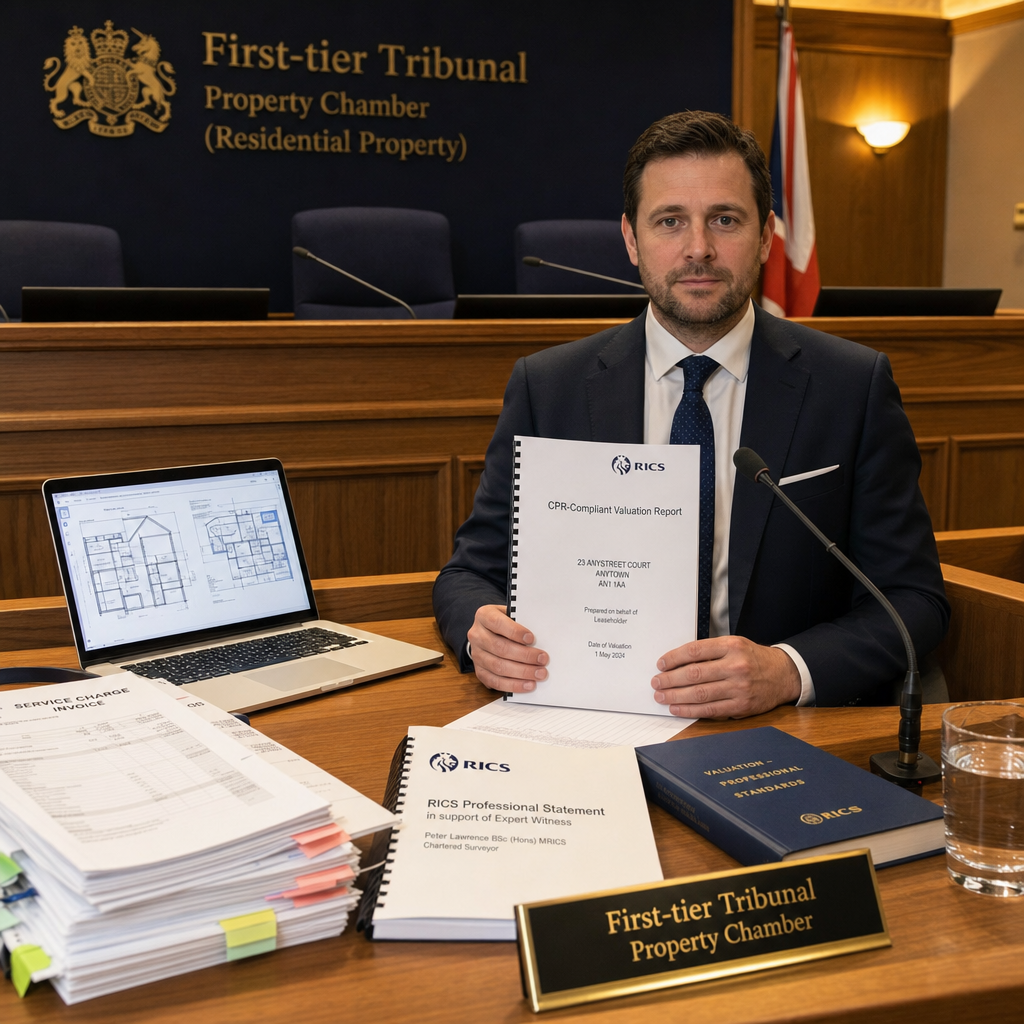
Understanding the Expert Witness Role in Service Charge Disputes
What Makes Service Charge Disputes Unique?
Service charge disputes differ fundamentally from straightforward property valuations. The contested amounts often involve multi-year accounts, complex apportionment methodologies, and competing interpretations of lease covenants. Leaseholders may challenge whether costs were reasonably incurred, whether works were necessary, or whether the managing agent followed proper consultation procedures under Section 20 of the Landlord and Tenant Act 1985.
An expert witness in this context is not simply a valuer — they are a translator between technical surveying evidence and legal decision-making [7]. The tribunal relies on expert testimony to understand whether service charges are reasonable, proportionate, and consistent with RICS standards.
💡 "The expert's overriding duty is to the tribunal, not to the party instructing them. This distinction is the foundation of credible expert evidence."
The Overriding Duty to the Tribunal
Under Civil Procedure Rules (CPR) Part 35, an expert witness owes a primary duty to the court or tribunal — not to the instructing solicitor or client. RICS reinforces this obligation through its professional statement on surveyors acting as expert witnesses, which is currently being updated to reflect modern challenges including conditional fee arrangements and the use of AI-assisted valuation tools [1].
Key duties include:
- ✅ Providing objective, unbiased opinions based on evidence
- ✅ Disclosing any conflicts of interest before accepting instruction
- ✅ Acknowledging the limits of expertise and not straying beyond them
- ✅ Updating the tribunal promptly if opinions change during proceedings
- ✅ Participating in without-prejudice discussions with opposing experts where directed
RICS members are advised to carefully consider the complexities and risks before accepting expert witness instructions, including the possibility of intense cross-examination and potential court appearances [3]. For surveyors seeking formal recognition, the Expert Witness Accreditation Service (EWAS) provides a structured pathway to demonstrate competence and credibility.
RICS Standards for 2026 Leasehold Block Valuations: What Has Changed?
The Service Charge Residential Management Code (4th Edition)
The most significant development shaping Expert Witness Roles in Service Charge Disputes: RICS Standards for 2026 Leasehold Block Valuations is the introduction of the 4th Edition of the Service Charge Residential Management Code, effective from 7 April 2026 [2]. This code establishes best practice for managing residential leasehold properties in England and is now the benchmark against which expert witnesses must assess whether service charge demands were properly administered.
Key updates in the 4th Edition include:
| Area of Change | Previous Standard | 2026 Standard |
|---|---|---|
| Building Safety Act compliance | Not addressed | Mandatory integration |
| Fire Safety Act obligations | Limited guidance | Explicit requirements |
| Transparency in reporting | Best practice | Code requirement |
| Leaseholder protection costs | Advisory | Prescriptive guidance |
| Digital record-keeping | Optional | Strongly recommended |
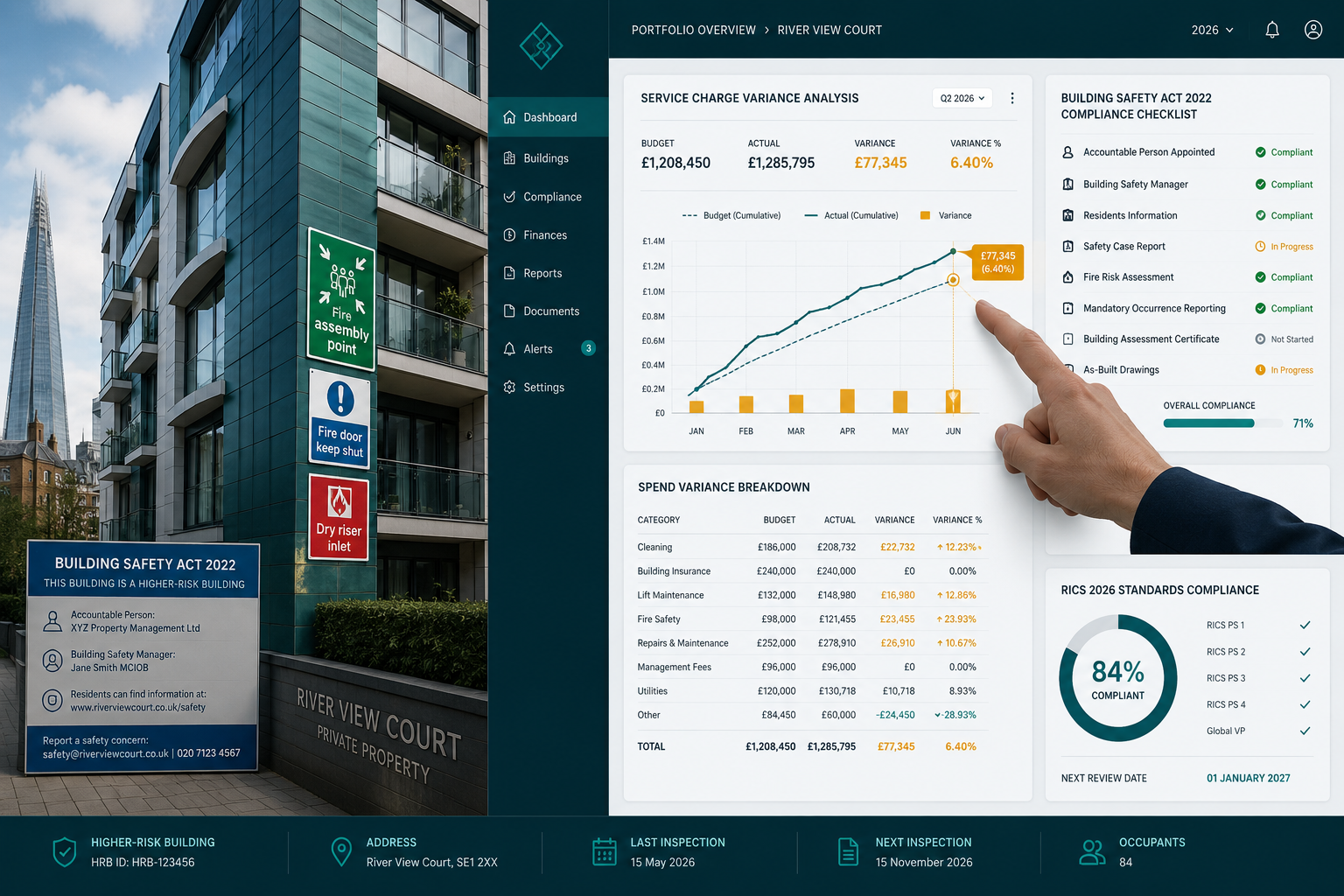
The code's incorporation of the Building Safety Act 2022 and Fire Safety Act 2021 is particularly consequential. Expert witnesses must now be prepared to assess whether building safety remediation costs — including cladding replacement — were legitimately charged to leaseholders, and whether the landlord complied with the statutory protections introduced by those Acts [6].
The Revised Commercial Service Charge Standard
For mixed-use blocks or commercial leasehold properties, the updated "Service Charges in Commercial Property" standard, effective from 31 December 2025, introduces enhanced transparency requirements in service charge governance [5]. Expert witnesses instructed on commercial or mixed-tenure blocks must be familiar with both the residential and commercial frameworks, as apportionment disputes frequently arise at the boundary between the two.
RICS Expert Witness Accreditation Service (EWAS)
RICS launched the Expert Witness Accreditation Service (EWAS) as a voluntary scheme to raise professional standards in a sector that previously lacked formal regulation [4]. While participation remains voluntary, tribunals and instructing solicitors are increasingly favouring EWAS-accredited surveyors. The scheme requires candidates to:
- Complete RICS-approved expert witness training
- Pass a competency assessment
- Submit to ongoing monitoring and CPD requirements
- Demonstrate independence and impartiality in practice
For RICS registered valuers in London and beyond, EWAS accreditation is becoming a meaningful differentiator in a competitive market for expert witness instructions.
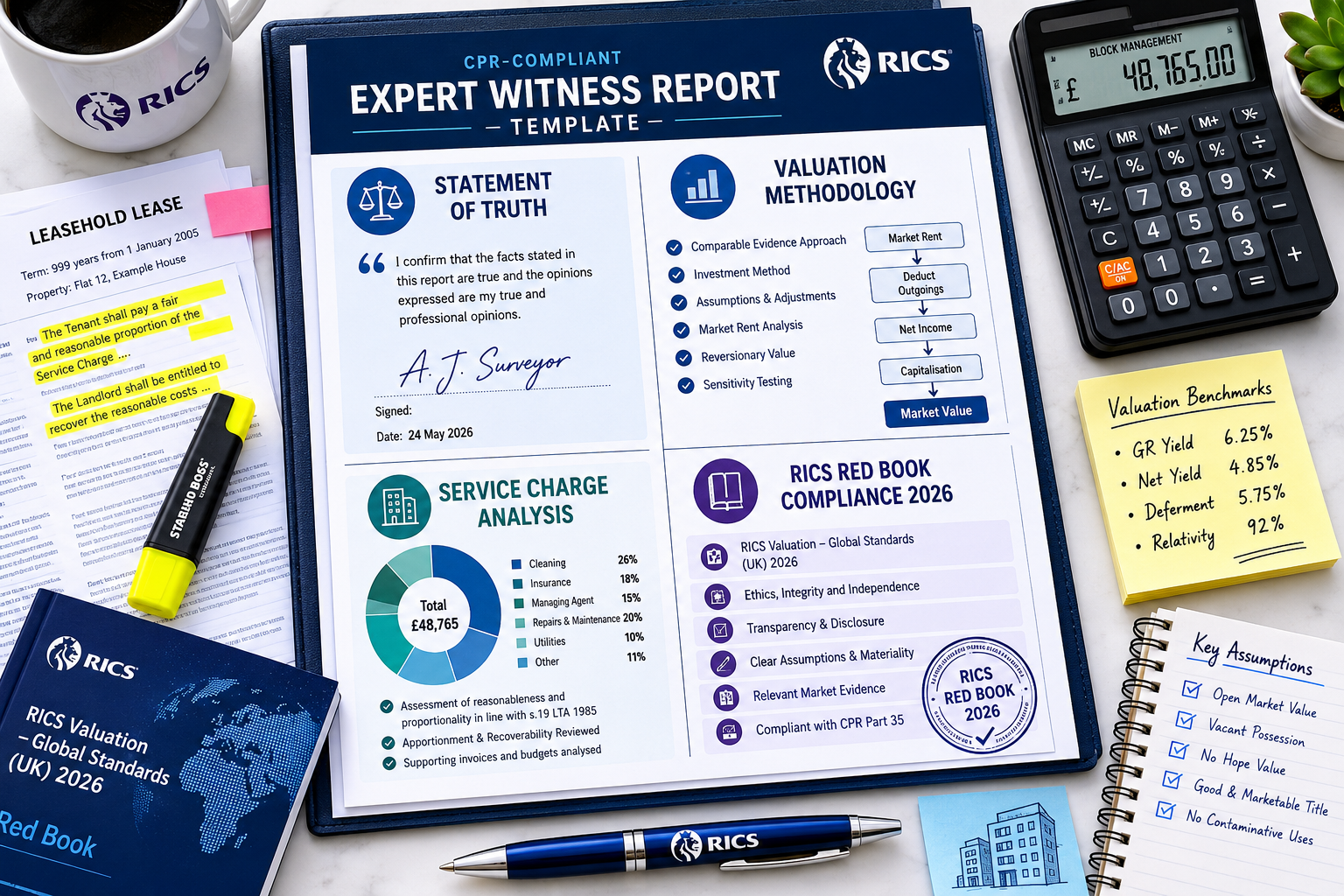
CPR-Compliant Reporting Templates and Valuation Evidence Strategies
Structuring a CPR Part 35-Compliant Expert Witness Report
A technically sound valuation means nothing if the report fails to meet CPR Part 35 requirements. The following template structure reflects current best practice for service charge expert witness reports submitted to the First-tier Tribunal (Property Chamber) in 2026:
📄 EXPERT WITNESS REPORT TEMPLATE — SERVICE CHARGE DISPUTE
1. Cover Page
- Expert's name, qualifications, RICS membership number, EWAS accreditation (if held)
- Instructing party and case reference
- Date of report
2. Statement of Truth
(Mandatory under CPR Part 35.3)
"I confirm that I have made clear which facts and matters referred to in this report are within my own knowledge and which are not. Those that are within my own knowledge I confirm to be true. The opinions I have expressed represent my true and complete professional opinions on the matters to which they refer."
3. Instructions and Scope of Instruction
- Summary of what the expert was asked to do
- Documents reviewed
- Inspections carried out and dates
4. Summary of Opinions
(Placed early for tribunal convenience)
- Key findings in plain language
- Areas of agreement and disagreement with opposing expert
5. Factual Background
- Property description and tenure details
- Lease terms relevant to service charge obligations
- History of service charge demands under dispute
6. Methodology
- Valuation basis (RICS Red Book / VPS 4 for leasehold interests)
- Comparable evidence relied upon
- Approach to assessing reasonableness of service charges
7. Detailed Analysis
- Line-by-line assessment of disputed service charge items
- Benchmarking against RICS Service Charge Residential Management Code (4th Edition) [2]
- Assessment of Section 20 consultation compliance
- Building Safety Act / Fire Safety Act implications [6]
8. Conclusions
- Reasoned opinions on each disputed item
- Recommended adjustments (if any) with supporting rationale
9. Appendices
- Comparable evidence
- Inspection photographs
- Documents relied upon
- Expert's CV and declaration of independence
Valuation Evidence Strategies for Escalating Claims
As service charge claims grow in complexity — particularly those involving major works, fire safety remediation, and building safety levy disputes — expert witnesses must deploy robust evidentiary strategies. The following approaches are recommended for 2026 proceedings:
🔍 Strategy 1: Benchmark Against the 4th Edition Code
Every disputed service charge item should be assessed against the specific provisions of the Service Charge Residential Management Code (4th Edition). Where a managing agent has deviated from the code, this should be clearly identified and quantified.
🔍 Strategy 2: Use RICS Red Book Valuation Principles
For disputes involving the capitalised value of service charge obligations — particularly relevant in Red Book valuations for secured lending or enfranchisement — expert witnesses should apply RICS Valuation — Global Standards (the Red Book) consistently and transparently.
🔍 Strategy 3: Address Building Safety Costs Explicitly
Following the Grenfell Tower fire, valuers must be aware of potential costs to leaseholders arising from cladding and fire safety remediation, and their impact on property values [6]. Expert reports should clearly distinguish between:
- Costs legitimately charged to leaseholders under the lease
- Costs protected by statute under the Building Safety Act 2022
- Costs that are disputed on reasonableness grounds
🔍 Strategy 4: Prepare a Scott Schedule
In multi-item disputes, a Scott Schedule (a tabular document setting out each disputed item, the parties' positions, and the expert's opinion) is invaluable. Tribunals frequently direct experts to produce these collaboratively, and arriving prepared with a draft demonstrates competence and professionalism.
🔍 Strategy 5: Engage in Without-Prejudice Expert Discussions
CPR Part 35.12 allows tribunals to direct experts to meet and produce a joint statement identifying areas of agreement and disagreement. Experienced expert witnesses prepare thoroughly for these discussions, as concessions made without proper analysis can significantly damage a client's case.
For complex leasehold matters — including buying the freehold where service charge history affects the premium — expert evidence quality can determine the entire outcome.
Handling Conditional Fees and Conflicts of Interest
The revised RICS professional statement on expert witnesses specifically addresses conditional fee arrangements [1]. Surveyors must be aware that accepting fees contingent on the outcome of a dispute is incompatible with the expert witness role and could result in disciplinary action. All fee arrangements must be disclosed to the instructing party and, where directed, to the tribunal.
Competence, Independence, and the Risks of Getting It Wrong
What RICS Expects of Expert Witnesses in 2026
RICS has consistently emphasised that competence and independence are non-negotiable for surveyors acting as expert witnesses [3]. The updated professional statement reinforces several critical obligations:
- Surveyors must only accept instructions within their genuine area of expertise
- They must maintain up-to-date knowledge of relevant standards, including the 2026 code changes
- They must be prepared to withstand cross-examination on their methodology and conclusions
- They must not act as both advocate and expert for the same party
⚠️ "A surveyor who oversteps their expertise, or who appears to be an advocate rather than an independent expert, risks not only losing the case for their client but also facing RICS disciplinary proceedings."
The introduction of EWAS reflects RICS's recognition that the expert witness market needed formal quality assurance [4]. Surveyors who invest in accreditation signal to instructing solicitors and tribunals that they meet a verified standard of training, assessment, and professional conduct.
Practical Risks in Service Charge Expert Evidence
The following risks are particularly relevant to Expert Witness Roles in Service Charge Disputes: RICS Standards for 2026 Leasehold Block Valuations:
| Risk | Consequence | Mitigation |
|---|---|---|
| Inadequate CPR compliance | Report excluded or given little weight | Follow template structure rigorously |
| Straying beyond expertise | Credibility undermined in cross-examination | Define scope clearly in instructions |
| Failure to update opinions | Adverse costs orders possible | Monitor developments and notify promptly |
| Conditional fee arrangements | RICS disciplinary action | Fixed or hourly fees only |
| Ignoring Building Safety Act | Flawed reasonableness assessment | Integrate statutory framework fully |
For surveyors providing valuation reports in London or across the wider South East, staying current with both the RICS professional statement revisions and the 4th Edition code is essential to maintaining credibility in tribunal proceedings.
The Role of Retrospective Valuations
Service charge disputes frequently require retrospective analysis — assessing whether costs incurred in prior years were reasonable at the time. Retrospective property valuations require the expert to reconstruct the market conditions and professional standards applicable at the relevant date, not those prevailing today. This temporal discipline is critical to producing credible evidence that withstands tribunal scrutiny.
Navigating Leasehold Reform: The Expanding Scope of Expert Evidence
Commonhold, Enfranchisement, and Service Charge Intersections
The ongoing leasehold reform agenda in England is creating new categories of dispute in which expert witness evidence plays a pivotal role [7]. As leaseholders pursue collective enfranchisement, lease extensions, and — increasingly — commonhold transitions, the service charge history of a block becomes directly relevant to the premium calculation and the terms of any new arrangement.
Expert witnesses instructed in these hybrid disputes must be comfortable operating across:
- Leasehold valuation tribunal evidence (service charge reasonableness)
- Upper Tribunal (Lands Chamber) evidence (enfranchisement premiums)
- County Court proceedings (breach of covenant claims)
The comprehensive guide to leasehold and freehold matters illustrates how interconnected these issues have become in 2026, with service charge records forming a critical part of the due diligence for any collective purchase.
Technology and the Future of Expert Evidence
The RICS professional statement revision acknowledges technological advancements as a key driver of change [1]. AI-assisted valuation tools, automated comparable databases, and digital building management systems are all entering the expert witness toolkit. However, RICS cautions that technology must support — not replace — the exercise of professional judgment. Expert witnesses who rely on algorithmic outputs without demonstrating independent analysis risk having their evidence challenged on the basis that no genuine expert opinion was formed.
Conclusion: Actionable Next Steps for Surveyors in 2026
The landscape for Expert Witness Roles in Service Charge Disputes: RICS Standards for 2026 Leasehold Block Valuations has been transformed by converging regulatory changes. The 4th Edition Service Charge Residential Management Code, the revised RICS expert witness professional statement, and the Building Safety Act framework collectively demand a higher standard of preparation, reporting, and professional conduct than ever before.
Surveyors should take the following steps now:
- ✅ Review the 4th Edition Code (effective 7 April 2026) and update internal checklists and report templates accordingly.
- ✅ Consider EWAS accreditation to demonstrate verified competence to instructing solicitors and tribunals.
- ✅ Audit existing CPR Part 35 report templates against the structure outlined above and address any gaps.
- ✅ Develop a Building Safety Act checklist for integration into all leasehold block service charge reports.
- ✅ Engage in expert witness CPD — RICS requires ongoing competence, and the 2025/2026 standard revisions make this a timely priority.
- ✅ Seek specialist instruction for complex multi-tenure or mixed-use blocks where commercial and residential service charge standards intersect.
The tribunals are scrutinising expert evidence more closely than ever. Surveyors who invest in their expert witness skills, align with the latest RICS standards, and produce rigorously structured CPR-compliant reports will be best positioned to provide genuinely valuable evidence — and to protect their professional reputation in the process.
References
[1] Surveyors Acting As Expert Witnesses – https://www.rics.org/profession-standards/rics-standards-and-guidance/sector-standards/dispute-resolution-standards/surveyors-acting-as-expert-witnesses?utm_source=openai
[2] Service Charge Residential Management Code – https://www.rics.org/profession-standards/rics-standards-and-guidance/sector-standards/real-estate-standards/service-charge-residential-management-code?utm_source=openai
[3] Expert Witness Duties Responsibilities – https://ww3.rics.org/uk/en/journals/built-environment-journal/expert-witness-duties-responsibilities.html?utm_source=openai
[4] Expert Witness Accreditation Service (EWAS) – https://www.ricsfirms.com/accreditations/expert-witness/?utm_source=openai
[5] The New RICS Service Charge Standard: What It Is And Changes For 2026 – https://www.stevens-bolton.com/insights/102miag/the-new-rics-service-charge-standard-what-it-is-and-changes-for-2026?utm_source=openai
[6] Valuation of Residential Leasehold Properties for Secured Lending Purposes (May 2023) – https://www.rics.org/content/dam/ricsglobal/documents/standards/Valuation%2520of%2520resi%2520leasehold%2520properties%2520for%2520secured%2520lending%2520purposes_May%25202023_approved.pdf?utm_source=openai
[7] Expert Witness Roles In 2026 Leasehold Reform Disputes: Valuation Evidence For Commonhold Transitions – https://wimbledonsurveyors.com/expert-witness-roles-in-2026-leasehold-reform-disputes-valuation-evidence-for-commonhold-transitions/?utm_source=openai
[8] Expert Witness Valuations In 2026 Buyer Enquiry Surge: RICS Guidelines For Resolving Regional Disputes – https://www.canterburysurveyors.com/blog/expert-witness-valuations-in-2026-buyer-enquiry-surge-rics-guidelines-for-resolving-regional-disputes/?utm_source=openai