
When property disputes escalate beyond negotiation and mediation, the courtroom becomes the final battleground. In these high-stakes legal proceedings, expert witnesses serve as the critical bridge between complex technical property matters and judicial decision-making. As litigation risks continue to rise across the UK property sector in 2026, surveyors who serve as expert witnesses must navigate increasingly sophisticated standards for admissible evidence—particularly with the introduction of the RICS 5th Edition standards that fundamentally reshape how property professionals support court proceedings.
Expert Witness Roles in UK Property Disputes: Strengthening Court Evidence with RICS 2026 Standards represents more than just regulatory compliance; it establishes a comprehensive framework that protects both professional integrity and public interest while ensuring that technical property evidence meets the rigorous demands of modern litigation. Whether addressing boundary disputes, valuation disagreements, or building defect claims, surveyors must understand their evolving responsibilities under these updated standards.
Key Takeaways
✅ Global Application: The RICS 5th Edition (2026) now applies globally, not just in the UK, marking the first major overhaul in 12 years and establishing universal professional standards for expert witnesses.[1][3]
✅ Primary Duty Reinforced: Expert witnesses owe their primary duty to the tribunal, not the client, requiring complete independence and unbiased evidence within their genuine area of expertise.[3]
✅ Enhanced Conflict Disclosure: Stricter requirements for identifying and disclosing conflicts of interest now include clearer explanations of legal consequences for non-compliance.[3][6]
✅ Fee Structure Clarity: Updated guidance on conditional and deferred fees protects professional independence while addressing modern practice challenges in high-volume litigation.[3][6]
✅ Accreditation Pathway: The RICS Expert Witness Accreditation Service (EWAS) and formal certification programs provide structured professional development for surveyors entering expert witness roles.[5][7]
Understanding Expert Witness Roles in UK Property Disputes
The Fundamental Purpose of Expert Witnesses
Expert witnesses occupy a unique position within the UK legal system. Unlike fact witnesses who simply recount what they observed, expert witnesses provide specialized technical knowledge that helps judges and juries understand complex property matters beyond the comprehension of ordinary individuals. In property disputes, this expertise becomes indispensable when evaluating boundary conflicts, assessing property values, identifying building defects, or determining compliance with construction standards.
The role demands a delicate balance: expert witnesses must translate highly technical surveying concepts into accessible language while maintaining professional rigor and accuracy. They serve as educators to the court, providing context, analysis, and professional opinion on matters requiring specialized knowledge in property, construction, valuation, and building pathology.
Types of Property Disputes Requiring Expert Witnesses
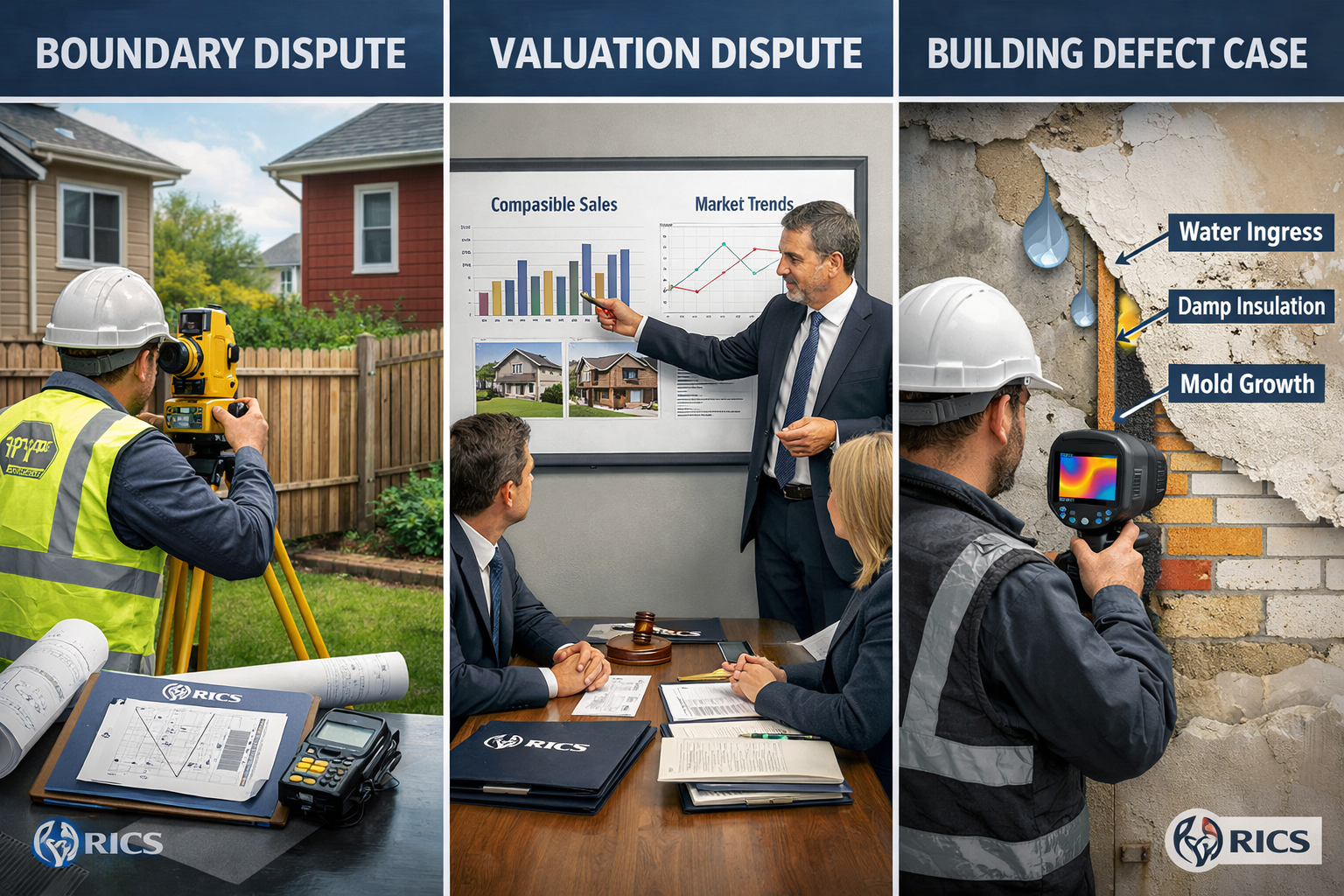
Property litigation in the UK encompasses several distinct categories where expert witness testimony proves essential:
🏘️ Boundary and Neighbour Disputes
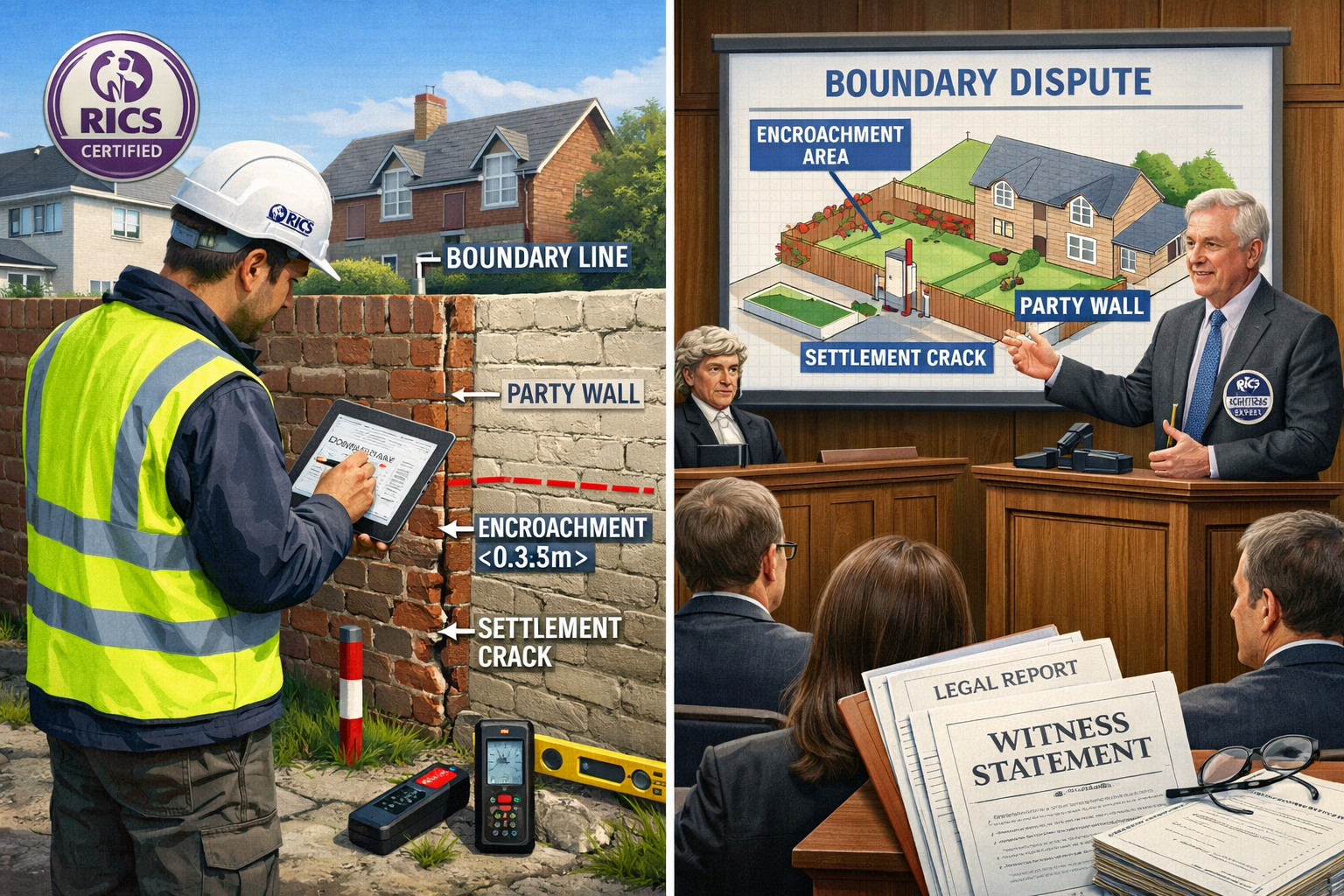
Boundary disputes frequently require expert witnesses to analyze historical deeds, ordnance survey maps, physical evidence, and legal precedents to determine true property boundaries. These cases often involve:
- Fence and wall placement disagreements
- Encroachment claims
- Adverse possession matters
- Rights of way and easement disputes
- Land registry discrepancies
Expert witnesses in boundary cases must possess detailed knowledge of land surveying techniques, historical mapping practices, and the legal principles governing property boundaries in England and Wales.
💷 Valuation Disputes
Property valuation disagreements arise in numerous contexts, including:
- Compulsory purchase compensation
- Lease renewal negotiations
- Matrimonial proceedings
- Tax assessments and appeals
- Partnership dissolution
- Probate valuations
RICS registered valuers serving as expert witnesses must demonstrate comprehensive understanding of valuation methodologies, market conditions, comparable evidence, and the specific valuation standards applicable to each case type.
🏗️ Building Defect and Dilapidation Claims
Construction defect litigation requires expert witnesses to identify, analyze, and quantify building failures, including:
- Structural defects and subsidence
- Water ingress and damp problems
- Defective workmanship
- Specification failures
- Dilapidation claims in commercial leases
These cases demand extensive knowledge of building construction, materials science, building regulations, and remediation methodologies.
🧱 Party Wall Disputes
Party wall disputes under the Party Wall etc. Act 1996 occasionally escalate to litigation when parties cannot resolve disagreements through the statutory process. Expert witnesses may address:
- Damage causation and extent
- Appropriate remediation methods
- Cost assessments for repairs
- Compliance with party wall awards
- Party wall agreement interpretation
The Legal Framework Governing Expert Witnesses
Expert witness obligations in the UK operate within a well-established legal framework. The landmark 2011 Supreme Court decision in Jones v Kaney fundamentally altered the landscape by removing the blanket immunity previously enjoyed by expert witnesses, making it possible to sue experts for negligence.[5] This decision established clear accountability and professional liability standards that continue to shape expert witness practice in 2026.
The Civil Procedure Rules (CPR) Part 35 sets out the overriding duty of expert witnesses to help the court on matters within their expertise. This duty overrides any obligation to the party instructing or paying them—a principle that the RICS 2026 standards reinforce and clarify.[3]
The RICS 2026 Standards: A Comprehensive Framework for Expert Witness Roles in UK Property Disputes
Background and Development of the 5th Edition
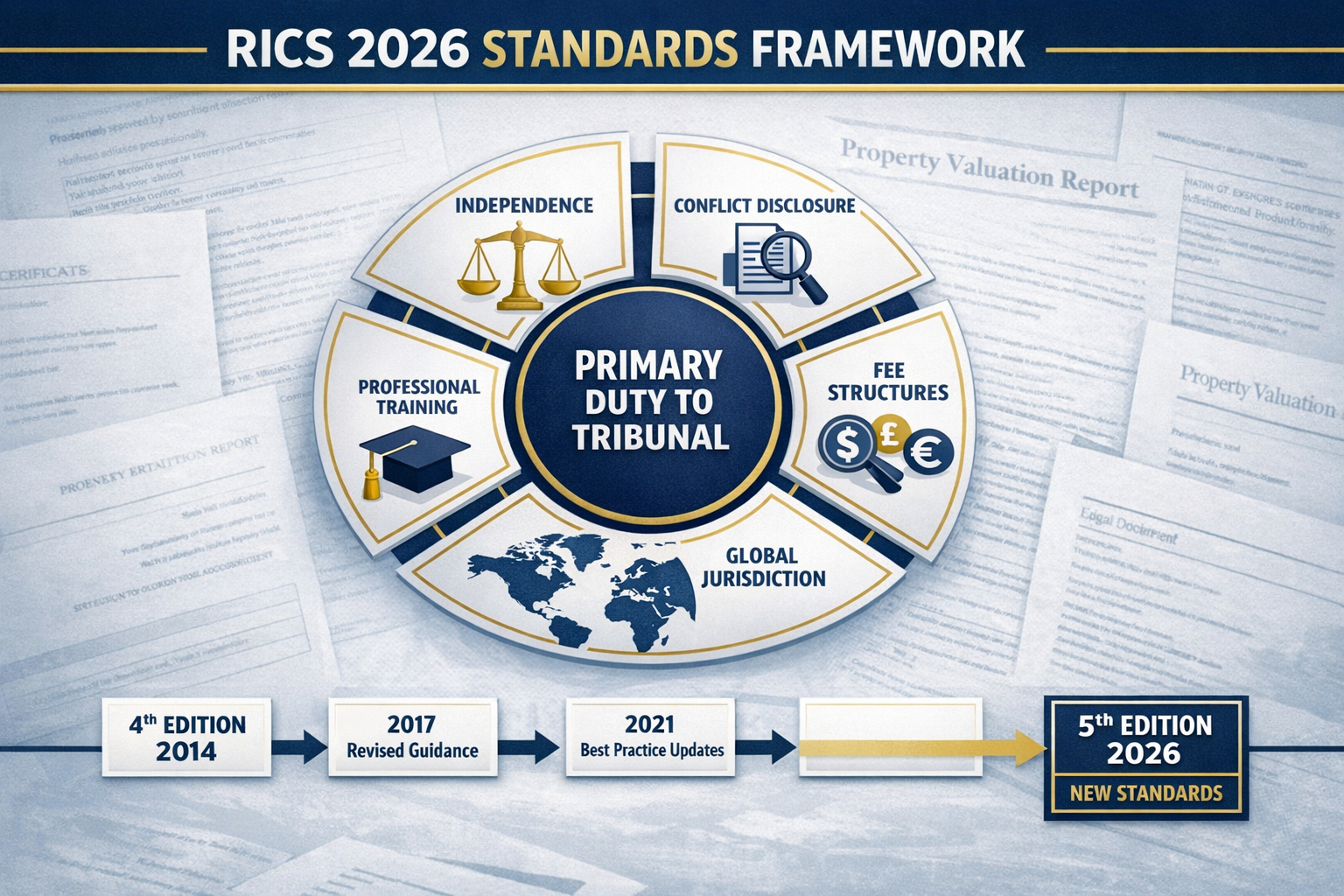
The RICS Professional Standard for Surveyors Acting as Expert Witnesses, 5th Edition, represents the first major overhaul in 12 years, marking a significant evolution since the 4th Edition was published in April 2014 (with a minor amendment in February 2023).[1][3] This comprehensive revision reflects several years of collaborative development with technical experts and demonstrates RICS' commitment to protecting public interest through regulatory clarity.
Following a public consultation launched on August 26, 2025, with a six-week consultation window, the 5th Edition was published in late 2025/early 2026, with a short transition period allowing members and stakeholders to implement changes before the standard became effective.[1][3]
The updated standard builds upon the foundation established by RICS' April 2025 Practice Alert, which reminded members of their obligations in expert witness work, particularly in housing disrepair cases—an area experiencing significant growth in litigation volume.[3]
Key Changes and Enhancements in the 2026 Standards
🌍 Global Jurisdictional Scope
Perhaps the most fundamental shift in the 5th Edition is its global applicability. Unlike the 4th Edition, which applied only to the UK, the new standard now provides guidance for RICS members serving as expert witnesses across all jurisdictions worldwide.[1][3] This expansion recognizes that property professionals increasingly work across borders while maintaining core professional principles that transcend local legal differences.
The global scope acknowledges varying legal systems, procedural rules, and evidentiary standards across different countries while establishing universal professional conduct expectations for all RICS members undertaking expert witness roles.
⚖️ Reinforced Primary Duty Principle
The 2026 standards explicitly reinforce that the primary duty of expert witnesses is to the tribunal, not the client.[3] This fundamental principle requires all reports and evidence to be:
- Independent: Free from client influence or pressure
- Unbiased: Presenting balanced analysis regardless of which party benefits
- Within expertise: Limited to areas where the surveyor possesses genuine specialized knowledge
- Objective: Based on facts, evidence, and professional judgment rather than advocacy
This reinforcement addresses concerns about expert witnesses becoming "hired guns" who advocate for their instructing party rather than assisting the court with impartial expertise.
💰 Enhanced Fee Guidance and Professional Protection
The 5th Edition provides substantially clearer guidance on conditional and deferred fee arrangements to protect professional independence.[3] This enhancement addresses a growing concern in high-volume litigation, particularly in housing disrepair claims where some firms sought to instruct experts on conditional fee arrangements.
The February 2023 amendment to the 4th Edition specifically clarified that experts can take instructions from solicitors operating on conditional fees, provided the expert themselves is instructed on unconditional terms.[6] This crucial distinction protects expert independence by ensuring their compensation does not depend on case outcomes.
The updated guidance also addresses:
- Risk mitigation strategies for high-volume cases
- Template usage and customization requirements
- Professional indemnity insurance considerations
- Fee agreement transparency and documentation
🔍 Strengthened Conflict of Interest Disclosure
The 2026 standards include significantly clearer requirements for identifying and disclosing conflicts of interest, with enhanced explanations of legal consequences for non-compliance.[3][6] Modern practice presents increasingly complex conflict scenarios, including:
- Prior professional relationships with parties or properties
- Financial interests in litigation outcomes
- Personal relationships with instructing parties
- Multiple instructions involving related parties
- Organizational conflicts within larger firms
The enhanced guidance helps surveyors navigate these challenges while maintaining the transparency essential to credible expert evidence. Failure to properly disclose conflicts can result in evidence being excluded, professional discipline, and potential negligence claims.
🏘️ Housing Disrepair Legislative Integration
Recognizing the significant growth in housing disrepair litigation, the 5th Edition specifically requires RICS expert witnesses involved in these claims to note evolving legislation, including Awaab's Law (effective October 2025) and the Housing Health and Safety Rating System (HHSRS).[3]
This integration ensures expert reports address current legal standards and regulatory requirements, particularly regarding:
- Landlord repair obligations and timeframes
- Health and safety hazards in residential properties
- Damp and mould conditions
- Tenant notification and response procedures
- Remediation standards and methodologies
Strengthening Court Evidence: Practical Application of Expert Witness Roles in UK Property Disputes
Preparing Admissible Expert Evidence
The quality and admissibility of expert evidence depends on rigorous preparation and adherence to professional standards. Surveyors serving as expert witnesses must understand what courts require and expect from their evidence.
📋 The Expert Report Structure
A comprehensive expert witness report typically includes:
-
Introduction and Qualifications
- Expert's professional background and credentials
- Relevant experience in the specific property matter
- Statement of understanding of expert duties
- Confirmation of independence
-
Instructions and Scope
- Clear statement of questions to be addressed
- Documents and materials reviewed
- Site inspections conducted
- Limitations or constraints on the investigation
-
Factual Background
- Relevant property history
- Physical characteristics and conditions
- Documentary evidence summary
- Chronology of relevant events
-
Technical Analysis
- Methodology employed
- Findings and observations
- Application of professional standards
- Consideration of alternative explanations
-
Professional Opinion
- Clear conclusions on each question
- Reasoning and supporting evidence
- Degree of certainty or qualification
- Assumptions underlying opinions
-
Statement of Truth
- Formal declaration of expert duties
- Confirmation of belief in opinion accuracy
- Acknowledgment of understanding regarding false statements
Common Pitfalls and How to Avoid Them
❌ Overstepping Expertise Boundaries
One of the most serious errors expert witnesses commit is offering opinions beyond their genuine area of expertise. The 2026 RICS standards emphasize that evidence must remain within the surveyor's true specialized knowledge.[3]
For example, a valuation surveyor should not offer detailed opinions on structural engineering matters, even if they have general knowledge of construction. Similarly, a building surveyor should recognize the limits of their expertise regarding specialized systems like electrical installations or mechanical engineering.
Solution: Clearly define expertise boundaries in the report, recommend additional experts when necessary, and decline instructions outside competence areas.
❌ Advocacy Rather Than Independence
Some expert witnesses fall into the trap of becoming advocates for their instructing party, selectively presenting evidence that supports one position while ignoring contradictory information.
Solution: Present balanced analysis, acknowledge weaknesses in your position, consider alternative explanations, and remember the primary duty is to the court, not the client.[3]
❌ Inadequate Conflict Disclosure
Failing to identify and disclose potential conflicts of interest can fatally undermine expert credibility and may result in evidence exclusion.[3][6]
Solution: Conduct thorough conflict checks before accepting instructions, disclose any potential conflicts promptly, and document all conflict considerations in writing.
❌ Template Overreliance
While templates can provide useful structure, excessive reliance without proper customization to case-specific circumstances produces generic, unconvincing evidence.
Solution: Use templates as frameworks only, ensure all content addresses the specific property and questions at issue, and customize analysis to reflect unique case characteristics.
Case Study Applications
Boundary Dispute Resolution
Consider a typical boundary dispute involving two neighboring properties where the fence line has been contested for years. The expert witness surveyor's role includes:
- Analyzing historical conveyance documents and deed plans
- Examining ordnance survey maps across different time periods
- Conducting detailed site measurements and surveys
- Comparing physical features with documentary evidence
- Applying legal principles of boundary determination
- Providing clear opinion on the probable true boundary location
The expert must acknowledge uncertainty where evidence is ambiguous and explain the reasoning process transparently, allowing the court to understand how professional judgment was applied to incomplete or conflicting information.
Valuation Dispute in Matrimonial Proceedings
In matrimonial valuation disputes, expert witnesses must provide objective market value opinions despite the emotionally charged context. This requires:
- Comprehensive comparable evidence analysis
- Market condition assessment at the relevant valuation date
- Adjustment methodology for differences between comparables
- Consideration of special purchaser arguments
- Clear explanation of valuation approach and reasoning
The expert must resist pressure from either party to skew the valuation and maintain strict independence, even when one party expresses dissatisfaction with the opinion.
Building Defect Causation Analysis
When addressing building defects, expert witnesses must distinguish between:
- Pre-existing conditions versus new damage
- Design deficiencies versus construction failures
- Normal wear and tear versus actionable defects
- Primary causes versus contributing factors
This analysis requires systematic investigation, proper documentation through photographs and technical drawings, and clear explanation of causation conclusions supported by building science principles and construction standards.
Professional Development and Accreditation for Expert Witness Roles
The RICS Expert Witness Accreditation Service (EWAS)
The RICS Expert Witness Accreditation Service provides a voluntary accreditation pathway that signals high standards of expertise and professionalism underpinned by regulation.[5] This scheme sets rigorous standards for professionals serving as expert witnesses and includes:
- Demonstration of relevant technical expertise
- Evidence of expert witness experience
- Understanding of legal and procedural requirements
- Commitment to ongoing professional development
- Adherence to RICS professional standards
Accreditation provides assurance to instructing solicitors and courts that the expert possesses both technical competence and proper understanding of expert witness duties. While voluntary, accreditation increasingly serves as a differentiator in competitive expert witness markets.
The RICS Expert Witness Certificate
The RICS Expert Witness Certificate offers a structured 12-week practical learning program developed in alignment with RICS Standards and Guidance.[7] This comprehensive training equips professionals with essential knowledge in:
- Expert Report Writing: Structure, content, and style requirements
- Evidence Presentation: Courtroom testimony techniques and procedures
- Professional Conduct: Ethical obligations and independence maintenance
- Legal Framework: Understanding court procedures and expert duties
- Case Analysis: Practical application to property dispute scenarios
Upon successful completion, participants become eligible to apply for RICS Accredited Expert Witness status, providing formal recognition of their training and competence.[7]
Continuing Professional Development Requirements
Expert witness work demands ongoing professional development to maintain current knowledge of:
- Evolving legal precedents and procedural rules
- Updated technical standards and best practices
- New construction technologies and materials
- Changing market conditions and valuation methodologies
- Regulatory developments affecting property disputes
RICS members serving as expert witnesses should prioritize CPD activities specifically relevant to their expert witness practice, including attendance at legal conferences, participation in expert witness training programs, and engagement with case law developments.
Managing Risk and Maintaining Professional Standards
Professional Indemnity Insurance Considerations
Expert witness work carries significant professional liability risks, particularly following the Jones v Kaney decision that removed expert witness immunity.[5] Surveyors must ensure their professional indemnity insurance:
- Provides adequate coverage limits for expert witness work
- Does not exclude expert witness activities
- Covers both negligence claims and disciplinary proceedings
- Includes legal defense costs
- Applies across all relevant jurisdictions
Some insurers impose specific requirements or limitations on expert witness work, including notification obligations, maximum case values, or restrictions on certain dispute types. Understanding these policy terms is essential before accepting expert instructions.
Quality Assurance and Peer Review
Implementing robust quality assurance processes helps maintain high standards and reduce error risks:
Internal Review Procedures
- Systematic checking of calculations and measurements
- Verification of factual statements and document references
- Consistency review across report sections
- Proofreading for clarity and professional presentation
Peer Review Benefits
- Independent technical review by qualified colleagues
- Challenge of assumptions and methodology
- Identification of gaps or weaknesses
- Enhancement of report quality and credibility
While peer review adds time and cost, it provides valuable protection against errors that could undermine expert credibility or expose the surveyor to negligence claims.
Record Keeping and Documentation
Comprehensive record keeping is essential for defending expert opinions and demonstrating compliance with professional standards:
- Site Visit Records: Detailed notes, photographs, measurements, and observations
- Document Analysis: Summaries and analysis of reviewed materials
- Research Documentation: Technical references, standards consulted, and comparable evidence
- Instruction Records: All communications with instructing parties
- Draft Reports: Version control and revision tracking
- Conflict Checks: Documentation of conflict analysis and disclosures
These records serve multiple purposes: supporting the expert opinion, demonstrating thorough methodology, providing defense against challenges, and evidencing compliance with professional obligations.
The Future of Expert Witness Roles in UK Property Disputes
Emerging Trends and Challenges
🖥️ Technology Integration
Property disputes increasingly involve sophisticated technology, including:
- Building Information Modeling (BIM) data
- Drone surveys and photogrammetry
- Thermal imaging and moisture detection
- 3D laser scanning and point cloud analysis
- Digital measurement and analysis tools
Expert witnesses must develop competence with these technologies while maintaining the ability to explain technical findings in accessible terms to courts that may be unfamiliar with advanced surveying methods.
📈 Litigation Volume Growth
Certain property dispute categories continue experiencing significant growth, particularly:
- Housing disrepair claims driven by awareness of tenant rights
- Leasehold disputes involving service charges and building safety
- Construction defect claims in new-build properties
- Cladding and fire safety litigation
- Climate-related building performance issues
This growth creates both opportunities and challenges for expert witnesses, including pressure to handle higher case volumes while maintaining quality standards.
🌐 Cross-Border Complexity
The global scope of the RICS 2026 standards reflects increasing internationalization of property disputes, with expert witnesses potentially working across multiple jurisdictions with varying legal frameworks, procedural rules, and evidentiary standards.
Maintaining Public Trust and Professional Integrity
The ultimate purpose of rigorous expert witness standards extends beyond individual case outcomes. By upholding professional standards, expert witnesses help maintain the integrity of the surveying profession and protect public interest.[6] Courts rely on expert witnesses to provide trustworthy, independent technical evidence that enables just outcomes in complex property disputes.
The RICS 2026 standards provide a comprehensive framework for meeting these responsibilities, but standards alone cannot ensure quality. Individual surveyors must embrace the professional values underlying the standards:
- Independence: Resisting pressure to advocate rather than educate
- Competence: Working only within genuine areas of expertise
- Transparency: Disclosing limitations, assumptions, and conflicts
- Diligence: Conducting thorough investigations and analysis
- Integrity: Prioritizing duty to the court above commercial interests
These values, combined with proper training, accreditation, and ongoing professional development, enable surveyors to fulfill their expert witness roles effectively while strengthening the quality of evidence available to UK courts.
Conclusion: Strengthening Property Dispute Resolution Through Professional Excellence
Expert Witness Roles in UK Property Disputes: Strengthening Court Evidence with RICS 2026 Standards establishes a robust framework that elevates professional standards while addressing the evolving challenges of modern property litigation. The comprehensive updates in the 5th Edition—from global applicability and reinforced independence principles to enhanced conflict disclosure and fee structure guidance—provide surveyors with clear direction for meeting their obligations to courts, clients, and the public.
As property disputes continue to grow in complexity and volume across the UK in 2026, the demand for qualified, competent expert witnesses will only increase. Surveyors who invest in proper training, pursue accreditation through programs like the RICS Expert Witness Accreditation Service, and commit to the highest professional standards position themselves to make valuable contributions to the justice system while building sustainable expert witness practices.
Actionable Next Steps
For surveyors considering or currently undertaking expert witness work:
-
Review the RICS 5th Edition Standards thoroughly to understand updated requirements and implement necessary practice changes during the transition period.
-
Assess Your Expertise Boundaries honestly, identifying specific property dispute types where you possess genuine specialized knowledge worthy of expert witness status.
-
Pursue Formal Training through the RICS Expert Witness Certificate program or equivalent courses to develop essential skills in report writing, evidence presentation, and professional conduct.[7]
-
Consider EWAS Accreditation to demonstrate commitment to professional excellence and differentiate your services in competitive markets.[5]
-
Review Insurance Coverage to ensure your professional indemnity policy adequately covers expert witness activities without problematic exclusions or limitations.
-
Implement Quality Systems including peer review processes, comprehensive record-keeping, and systematic conflict checking procedures.
-
Maintain Ongoing CPD specifically focused on expert witness practice, legal developments, and technical advances relevant to your areas of expertise.
For property owners, legal professionals, and others involved in property disputes, understanding the rigorous standards governing expert witnesses helps in selecting qualified professionals and appreciating the value that properly qualified experts bring to dispute resolution.
The integration of strengthened RICS 2026 standards with established legal frameworks creates a comprehensive system that protects all parties while ensuring courts receive the high-quality technical evidence necessary for just outcomes. Whether addressing party wall matters, boundary conflicts, valuation disagreements, or building defect claims, professional expert witnesses operating under these enhanced standards contribute essential expertise that strengthens the entire property dispute resolution system.
References
[1] Rics Consultation On Professional Standard For Surveyors Acting As Expert Witnesses 5th Edition 2025 – https://www.ewi.org.uk/News/Case-Updates/rics-consultation-on-professional-standard-for-surveyors-acting-as-expert-witnesses-5th-edition-2025
[2] Dispute Resolution Standards – https://www.rics.org/profession-standards/rics-standards-and-guidance/sector-standards/dispute-resolution-standards
[3] Rics Launches Global Consultation On Updated Expert Witness Standard – https://www.rics.org/news-insights/rics-launches-global-consultation-on-updated-expert-witness-standard
[4] Rics Expert Witness – https://www.jamesscottassociates.com/rics-expert-witness/
[5] Expert Witness Accreditation Service – https://www.rics.org/dispute-resolution-service/panel-of-experts/expert-witness-accreditation-service
[6] Surveyors Acting As Expert Witnesses – https://www.rics.org/profession-standards/rics-standards-and-guidance/sector-standards/dispute-resolution-standards/surveyors-acting-as-expert-witnesses
[7] Expert Witness Certificate – https://www.rics.org/training-events/training-courses/expert-witness-certificate
[8] Expert Witness – https://www.ricsfirms.com/accreditations/expert-witness/
[9] Rics Launches Consultation On Updated Global Expert Witness Professional Standard – https://www.lexisnexis.co.uk/legal/news/rics-launches-consultation-on-updated-global-expert-witness-professional-standard
[10] When Should You Instruct An Expert Witness Surveyor – https://lmsurveyors.co.uk/when-should-you-instruct-an-expert-witness-surveyor/