
The property market in 2026 presents an unprecedented challenge for legal professionals and valuation experts alike. As regional price growth diverges dramatically across the United Kingdom—with some areas experiencing double-digit appreciation while others face stagnation or decline—valuation disputes have surged to record levels. This divergence creates fertile ground for disagreements between buyers and sellers, divorcing parties, tax authorities, and business partners. At the heart of these disputes stands the expert witness, whose testimony must navigate complex market dynamics, articulate why comparable properties in different regions support varying valuations, and withstand rigorous scrutiny under evolving legal standards.
The role of expert witness testimony in 2026 valuation disputes has never been more critical or complex. Courts increasingly demand that experts demonstrate not only technical competence but also the ability to explain how regional market variations impact property values in ways that ordinary jurors cannot comprehend on their own. This requirement, combined with heightened scrutiny under Rule 702 and similar evidentiary standards, means that preparation for expert testimony requires a sophisticated understanding of both market fundamentals and legal requirements.
Key Takeaways
- 📊 Regional price divergence in 2026 has created unprecedented complexity in property valuation disputes, requiring experts to justify comparable selection across geographically diverse markets
- ⚖️ Rule 702 compliance demands that expert witnesses demonstrate specialized knowledge beyond ordinary understanding, with courts increasingly excluding testimony that fails this threshold
- 📅 Valuation date precision is critical—experts must base opinions only on information known or knowable at the effective date, avoiding hindsight bias
- 🎯 Strategic expert classification between consulting and testifying roles can protect litigation strategy and preserve privilege protections
- 💼 Standard of value alignment with case circumstances prevents expert exclusion and strengthens testimony credibility
Understanding Regional Price Divergence in 2026 Property Markets
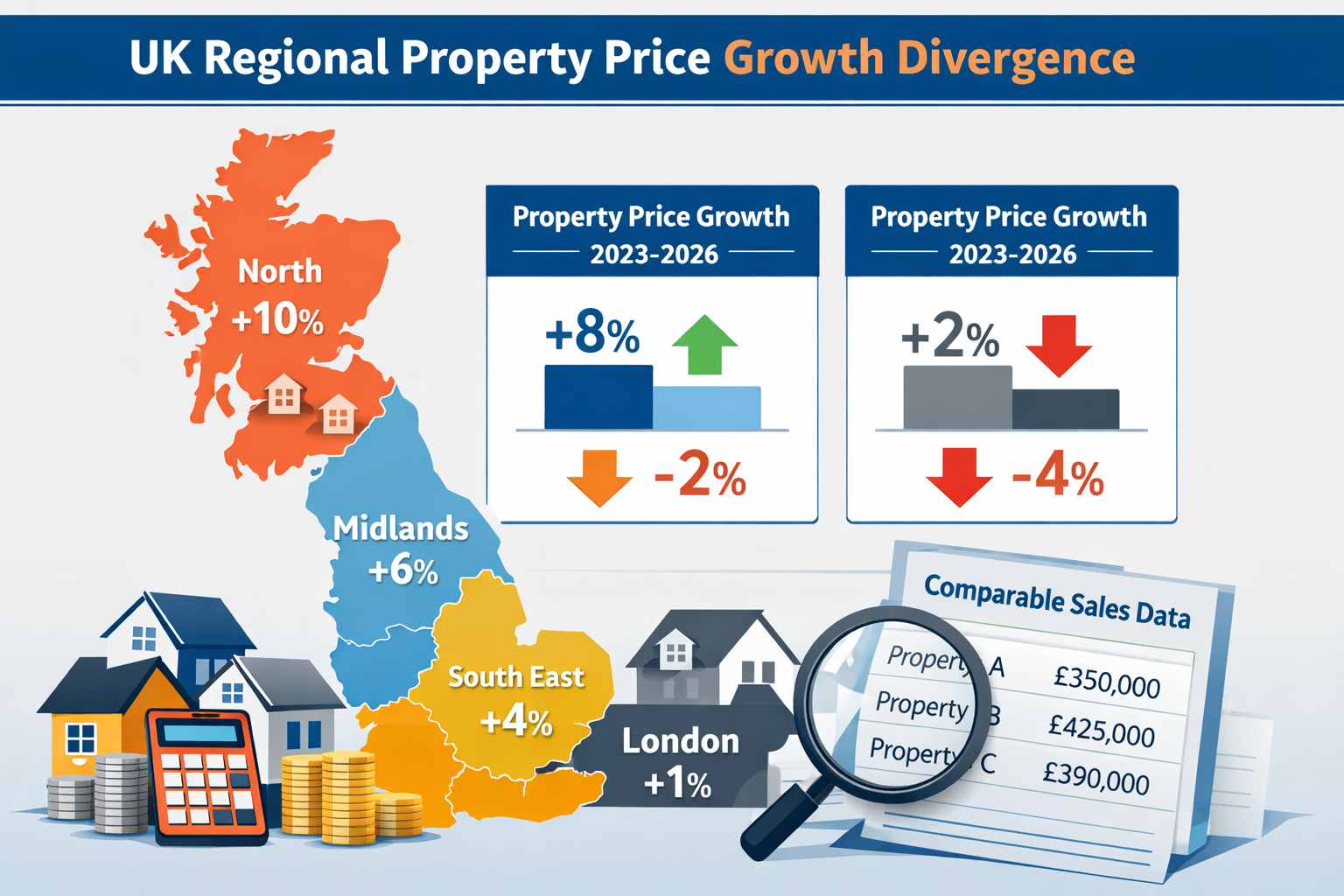
The property landscape in 2026 bears little resemblance to the relatively uniform market conditions of previous decades. Regional price growth has fragmented dramatically, driven by remote work patterns, infrastructure investments, demographic shifts, and localized economic conditions. While prime London postcodes may have appreciated by 15-20% over the past three years, certain suburban and rural markets have experienced flat or negative growth during the same period.
This divergence creates immediate challenges for valuation experts tasked with providing expert witness report testimony in disputes. The fundamental question becomes: which comparable properties truly reflect the subject property's market value when geographic proximity no longer guarantees market similarity?
The Geographic Complexity of Comparable Selection
Traditional valuation methodology relies heavily on comparable sales analysis—identifying recently sold properties with similar characteristics to establish market value. However, in 2026's fragmented market, experts must justify their comparable selection with unprecedented rigor.
Consider a divorce valuation dispute involving a four-bedroom detached property in outer London. The expert might identify comparable sales within a two-mile radius, but if those properties sold during periods of different market conditions or in micro-markets experiencing divergent trends, their relevance becomes questionable. Courts now expect experts to:
- Explain regional market dynamics that justify or exclude specific comparables
- Quantify adjustments for geographic differences with supporting data
- Demonstrate market knowledge extending beyond mechanical comparable selection
- Address alternative valuation scenarios based on different comparable sets
For professionals handling matrimonial valuations or divorce property valuations, this complexity multiplies when parties dispute not only the property's value but also the appropriate market area for comparable selection.
Market Segmentation and Micro-Market Analysis
The 2026 property market demands micro-market analysis that recognizes neighborhood-level variations. Experts must now routinely segment markets by:
| Market Factor | Impact on Valuation | Expert Testimony Requirement |
|---|---|---|
| Transport infrastructure | ±10-25% value variation | Demonstrate connectivity premium with data |
| School catchment areas | ±5-15% value variation | Quantify education quality impact on demand |
| Employment hub proximity | ±8-20% value variation | Analyze commute patterns and remote work trends |
| Development pipeline | ±5-30% value variation | Assess supply impact on local pricing |
| Demographic composition | ±3-12% value variation | Connect buyer profiles to price points |
This granular approach requires experts to maintain extensive market databases and demonstrate familiarity with localized trends that affect property values. Generic regional statistics no longer suffice when opposing counsel can challenge comparable selection with neighborhood-specific data.
Expert Witness Testimony in 2026 Valuation Disputes: Legal Standards and Admissibility Requirements
The legal framework governing expert testimony has evolved significantly, with courts applying increasingly stringent admissibility standards. Understanding these requirements is essential for preparing cases amid divergent regional price growth, as the complexity of market analysis heightens scrutiny of expert qualifications and methodologies.
Rule 702 Compliance and the Daubert Standard
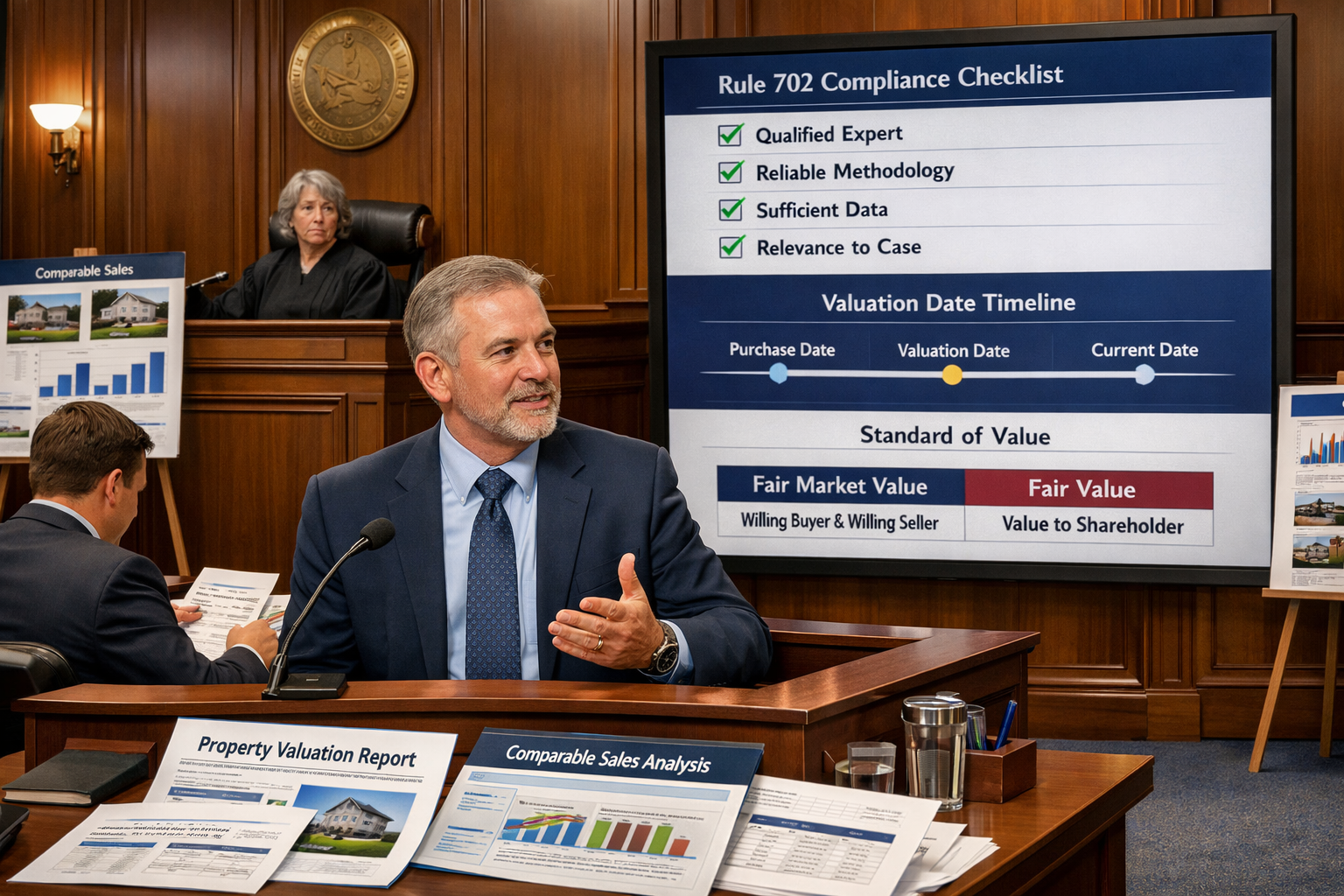
Rule 702 compliance remains critical for expert witness admissibility in 2026 valuation disputes[2]. Courts require experts to demonstrate that their scientific, technical, or specialized knowledge will genuinely help the trier of fact understand evidence or determine facts in issue. This threshold has become particularly challenging in property valuation cases where judges increasingly question whether expert testimony provides insights beyond what ordinary jurors could determine themselves.
The key requirements under Rule 702 include:
- ✅ Sufficient specialized knowledge – The expert must possess qualifications specific to property valuation in the relevant market
- ✅ Reliable methodology – Valuation techniques must be generally accepted within the profession
- ✅ Proper application – Methods must be appropriately applied to the specific case facts
- ✅ Helpful testimony – The evidence must assist the factfinder beyond common knowledge
Courts have excluded valuation experts who failed to demonstrate specialized knowledge beyond basic property assessment skills that jurors might possess[2]. For professionals providing RICS registered valuation services, maintaining current accreditation and demonstrating ongoing professional development becomes essential to establishing credibility.
The Critical Importance of Valuation Date Selection
Proper valuation date selection is essential to expert testimony admissibility[2]. A common ground for excluding valuation experts involves applying valuations based on information that would not have been known or knowable as of the effective valuation date. This requirement creates particular challenges in 2026's rapidly changing market environment.
Consider a retrospective valuation required for a tax dispute. The expert must value the property as of a date three years prior, using only market information available at that time. However, the expert's knowledge of subsequent market movements—including the regional price divergence that has since emerged—can unconsciously influence their analysis through hindsight bias.
Courts now expect experts to:
- 📌 Document the information available as of the valuation date
- 📌 Exclude subsequent market data from the valuation analysis
- 📌 Explain market expectations as they existed at the valuation date
- 📌 Avoid retrospective adjustments based on later developments
For capital gains tax valuations and probate valuations, this temporal discipline becomes absolutely critical to testimony admissibility.
Standard of Value and Premise of Value Alignment
Standard of value must align with case circumstances[2]. Courts have excluded experts who applied inappropriate standards or premises of value, such as using synergistic value where fair value was required, or valuing a company as a going concern when liquidation value was more appropriate.
In property valuation disputes, experts must clearly distinguish between:
- Market value – The price likely to be achieved in an open market transaction
- Fair value – Value determined for specific legal purposes (divorce, partnership dissolution)
- Investment value – Value to a particular investor based on individual requirements
- Forced sale value – Value achievable under constrained marketing conditions
The premise of value—whether the property is valued as vacant, tenanted, for redevelopment, or in current use—must also align with the legal context. A Red Book valuation conducted for one purpose cannot simply be repurposed for litigation without confirming that the standard and premise of value remain appropriate.
Preparing Expert Witness Testimony in 2026 Valuation Disputes: Strategic Considerations
The preparation of expert testimony in valuation disputes requires careful strategic planning that extends well beyond technical analysis. As regional price divergence complicates market assessments, legal teams must make critical decisions about expert engagement, role definition, and testimony scope.
Consulting Expert vs. Testifying Expert: A Critical Distinction
Expert strategy distinction is gaining prominence in 2026 litigation[3]. Legal teams increasingly recognize the strategic importance of distinguishing between consulting experts (who support litigation behind the scenes with privilege protections) and testifying experts (whose opinions are discoverable and subject to cross-examination).
This distinction carries profound implications for valuation disputes:
Consulting Experts:
- 🔒 Work product remains privileged and protected from discovery
- 🔒 Can provide candid assessments of case strengths and weaknesses
- 🔒 Help attorneys develop litigation strategy without disclosure risk
- 🔒 Analyze opposing expert reports and identify vulnerabilities
- 🔒 Support settlement negotiations with confidential valuations
Testifying Experts:
- 📢 All reports and communications are discoverable
- 📢 Subject to deposition and cross-examination
- 📢 Must maintain objectivity and independence
- 📢 Opinions become part of the litigation record
- 📢 Credibility directly impacts case outcome
Misclassified expert roles create litigation risks[3]. Incorrectly positioning an expert can expose legal theory earlier than intended, weaken privilege protections, and create credibility challenges that are difficult to reverse. For complex valuation disputes involving commercial property or shared ownership valuations, maintaining this distinction becomes essential to effective case management.
Building a Comprehensive Valuation Report
A robust expert witness report forms the foundation of credible testimony. In 2026's complex market environment, reports must address regional price divergence explicitly and comprehensively. Essential components include:
1. Market Context and Regional Analysis
- Detailed explanation of regional market conditions during the relevant period
- Quantification of price growth divergence across comparable market areas
- Analysis of factors driving regional variations (employment, infrastructure, demographics)
- Discussion of market segmentation and micro-market dynamics
2. Comparable Selection Methodology
- Clear criteria for comparable property selection
- Geographic boundaries justified by market analysis
- Temporal parameters aligned with market conditions
- Adjustment methodology for property differences
3. Valuation Date Compliance
- Documentation of information available as of the valuation date
- Exclusion of subsequent market developments
- Analysis of market expectations at the relevant time
- Explanation of any retrospective challenges
4. Standard and Premise of Value
- Clear statement of applicable standard (market value, fair value, etc.)
- Justification for the selected standard based on legal context
- Premise of value (vacant possession, tenanted, etc.)
- Alignment with case requirements and legal framework
5. Alternative Scenarios and Sensitivity Analysis
- Valuation ranges reflecting market uncertainty
- Impact of alternative comparable selections
- Sensitivity to key assumptions and adjustments
- Acknowledgment of valuation limitations
For professionals preparing RICS valuation reports, adherence to professional standards while addressing litigation-specific requirements creates the foundation for admissible and persuasive testimony.
Anticipating Cross-Examination Challenges
Effective expert testimony preparation requires anticipating cross-examination strategies that opposing counsel will employ. In valuation disputes involving regional price divergence, common challenges include:
Geographic Comparable Challenges:
"Mr. Expert, you selected comparable properties from Area A, which experienced 12% growth, while excluding properties from Area B just two miles away, which experienced only 3% growth. Isn't this selective use of data designed to support your client's desired outcome?"
Preparation Response: Document objective criteria for market area definition based on recognized market boundaries, buyer behavior patterns, and professional standards. Demonstrate that the selection methodology would yield the same market area regardless of which party retained the expert.
Valuation Date Hindsight Challenges:
"You valued this property in January 2023, but you prepared this report in 2026 with full knowledge of how the market actually performed. How can you claim your valuation isn't influenced by hindsight?"
Preparation Response: Maintain contemporaneous market research and documentation from the valuation date. Reference market forecasts and expectations as they existed at the time, not subsequent actual performance.
Standard of Value Challenges:
"You applied market value, but this divorce case requires fair value. These are different standards, aren't they?"
Preparation Response: Understand the legal definition of fair value in the jurisdiction and explain how your methodology addresses the specific requirements. If market value and fair value align in the circumstances, articulate why.
Navigating Specific Valuation Dispute Contexts in 2026
Different types of valuation disputes present unique challenges that experts must address in their testimony. Understanding these context-specific requirements ensures that expert opinions align with legal requirements and withstand scrutiny.
Matrimonial and Divorce Valuations
Divorce proceedings generate substantial valuation disputes, particularly when regional price divergence affects the marital property portfolio differently. Experts providing testimony in these cases must address:
- Valuation date selection – Whether to value as of separation, filing, or trial date
- Marketability assumptions – Whether forced sale or orderly marketing timeframes apply
- Encumbrance treatment – How mortgages and liens affect net equity calculations
- Future market assumptions – Whether anticipated price changes should influence current valuations
The emotional stakes in divorce cases often intensify disputes over relatively small valuation differences. Experts must maintain objectivity while explaining technical concepts to judges who may have limited property market expertise.
Tax-Related Valuation Disputes
Tax disputes involving capital gains tax, inheritance tax, and ATED valuations require strict adherence to statutory definitions and HMRC guidance. Regional price divergence complicates these cases because:
- Historic valuations must be prepared without hindsight bias
- Statutory assumptions may differ from market reality
- Comparable evidence may be limited for the required valuation date
- Professional guidance evolves, potentially creating conflicts between valuation date standards and current practice
Experts must demonstrate familiarity with relevant tax legislation and case law while maintaining independence from the taxpayer's desired outcome.
Commercial Property and Investment Disputes
Commercial property disputes often involve rent review disagreements, lease renewal terms, or partnership dissolution valuations. The 2026 commercial market has experienced even greater regional divergence than residential property, with office values in particular varying dramatically based on:
- Remote work adoption rates in different regions
- Infrastructure quality and connectivity
- Sector composition of local employment
- Development pipeline and vacancy rates
Experts must understand investment market dynamics, including yield compression in favored markets and yield expansion in declining areas. The complexity of commercial valuation methodology—incorporating income capitalization, discounted cash flow analysis, and comparable transactions—requires experts to explain technical concepts clearly while demonstrating rigorous analytical foundations.
Leasehold and Enfranchisement Valuations
Lease extension valuations and freehold purchase valuations involve statutory formulas that incorporate assumptions about future property values and market behavior. Regional price divergence affects:
- Deferment rates – The discount rate applied to future freehold reversion
- Relativity – The relationship between leasehold and freehold values at different lease lengths
- Marriage value – The additional value created by lease extension or enfranchisement
These technical components require experts to justify assumptions with market evidence while adhering to tribunal precedents and professional guidance. The interaction between statutory requirements and market reality creates fertile ground for disputes that demand sophisticated expert analysis.
Best Practices for Expert Witness Testimony in 2026 Valuation Disputes
Success in providing expert witness testimony requires adherence to professional best practices that enhance credibility, ensure admissibility, and withstand cross-examination. The following guidelines reflect the evolved standards applicable in 2026.
Maintain Professional Independence and Objectivity
The expert's primary duty is to the court, not to the instructing party. This principle becomes particularly challenging in valuation disputes where parties have clear financial interests in particular outcomes. Best practices include:
- 🎯 Forming opinions independently before considering client preferences
- 🎯 Documenting methodology before knowing the resulting valuation
- 🎯 Acknowledging limitations and uncertainties in the analysis
- 🎯 Revising opinions when presented with compelling contrary evidence
- 🎯 Avoiding advocacy for the instructing party's position
Professional organizations including RICS emphasize that experts must not allow instruction by one party to compromise objectivity. This independence forms the foundation of expert credibility and testimony admissibility.
Document Methodology and Assumptions Comprehensively
Thorough documentation serves multiple purposes: it demonstrates rigorous analysis, facilitates peer review, and provides a foundation for defending opinions under cross-examination. Experts should document:
- All data sources consulted, including those ultimately not relied upon
- Comparable property research and selection criteria
- Adjustment calculations with supporting rationale
- Market research and regional analysis
- Communications with instructing attorneys regarding scope and assumptions
- Revisions to opinions and the reasons for changes
This documentation trail becomes particularly important when expert surveyor advice must withstand challenges based on alternative methodologies or data sources.
Understand the Legal Context and Requirements
Effective expert testimony requires understanding the legal framework within which the dispute arises. Experts should:
- Research relevant case law affecting valuation standards in the jurisdiction
- Understand evidentiary requirements for expert testimony admissibility
- Familiarize themselves with procedural rules governing expert evidence
- Coordinate with instructing counsel regarding testimony scope and format
- Anticipate legal arguments that opposing counsel may advance
This legal awareness ensures that technical valuation analysis aligns with legal requirements and addresses the specific issues in dispute.
Communicate Complex Concepts Clearly
The most sophisticated valuation analysis becomes worthless if the factfinder cannot understand it. Experts must develop the ability to explain technical concepts in accessible language without oversimplification. Effective communication strategies include:
- Using visual aids – Charts, graphs, and maps that illustrate regional price divergence
- Providing analogies – Comparing technical concepts to familiar situations
- Defining terminology – Explaining jargon and technical terms when first used
- Structuring logically – Presenting analysis in a clear, step-by-step progression
- Anticipating questions – Addressing potential areas of confusion proactively
Remember that testimony must be understandable to judges and jurors without specialized property market knowledge.
Engage in Continuous Professional Development
The property market evolves continuously, and 2026's regional divergence represents just one example of changing market dynamics. Experts must maintain current knowledge through:
- Regular market research and data analysis
- Professional education and certification maintenance
- Participation in industry organizations and conferences
- Review of relevant case law and tribunal decisions
- Networking with other valuation professionals
This ongoing development ensures that expert opinions reflect current market conditions and professional standards rather than outdated methodologies.
Technology and Data Analytics in Expert Witness Testimony
The 2026 landscape for expert witness testimony has been transformed by technological advances that enable more sophisticated market analysis and data presentation. Experts who leverage these tools effectively gain significant advantages in preparing compelling testimony.
Advanced Market Analytics and Modeling
Modern valuation experts utilize sophisticated analytical tools that enable:
- Automated comparable selection using machine learning algorithms that identify similar properties based on multiple characteristics
- Regression analysis quantifying the impact of specific property attributes on value
- Geographic information systems (GIS) mapping regional price trends and market boundaries
- Time-series analysis identifying market cycles and trend changes
- Predictive modeling (with appropriate caveats about limitations and uncertainty)
These tools enable experts to analyze larger datasets and identify patterns that manual analysis might miss. However, experts must be prepared to explain the underlying methodology and validate algorithmic outputs, as courts remain skeptical of "black box" analyses that experts cannot fully explain.
Data Visualization for Testimony
Effective visual presentation of complex data enhances jury comprehension and retention. Modern experts employ:
- Interactive dashboards displaying market trends and comparable analysis
- Heat maps illustrating regional price divergence geographically
- Timeline graphics showing market evolution and valuation date context
- Comparison tables highlighting property similarities and differences
- Sensitivity charts demonstrating how key assumptions affect conclusions
These visual tools must be designed for clarity and accessibility, avoiding unnecessary complexity that might confuse rather than illuminate.
Challenges and Limitations of Technology
While technology enhances analytical capabilities, experts must acknowledge limitations:
- Data quality issues – Automated data sources may contain errors or incomplete information
- Algorithm bias – Machine learning models may perpetuate biases in training data
- Over-reliance risk – Technology should supplement, not replace, professional judgment
- Explainability requirements – Courts expect experts to explain how technology-assisted conclusions were reached
The most effective approach combines technological tools with traditional valuation expertise, using each to validate and enhance the other.
Conclusion: Preparing for Success in 2026 Valuation Disputes
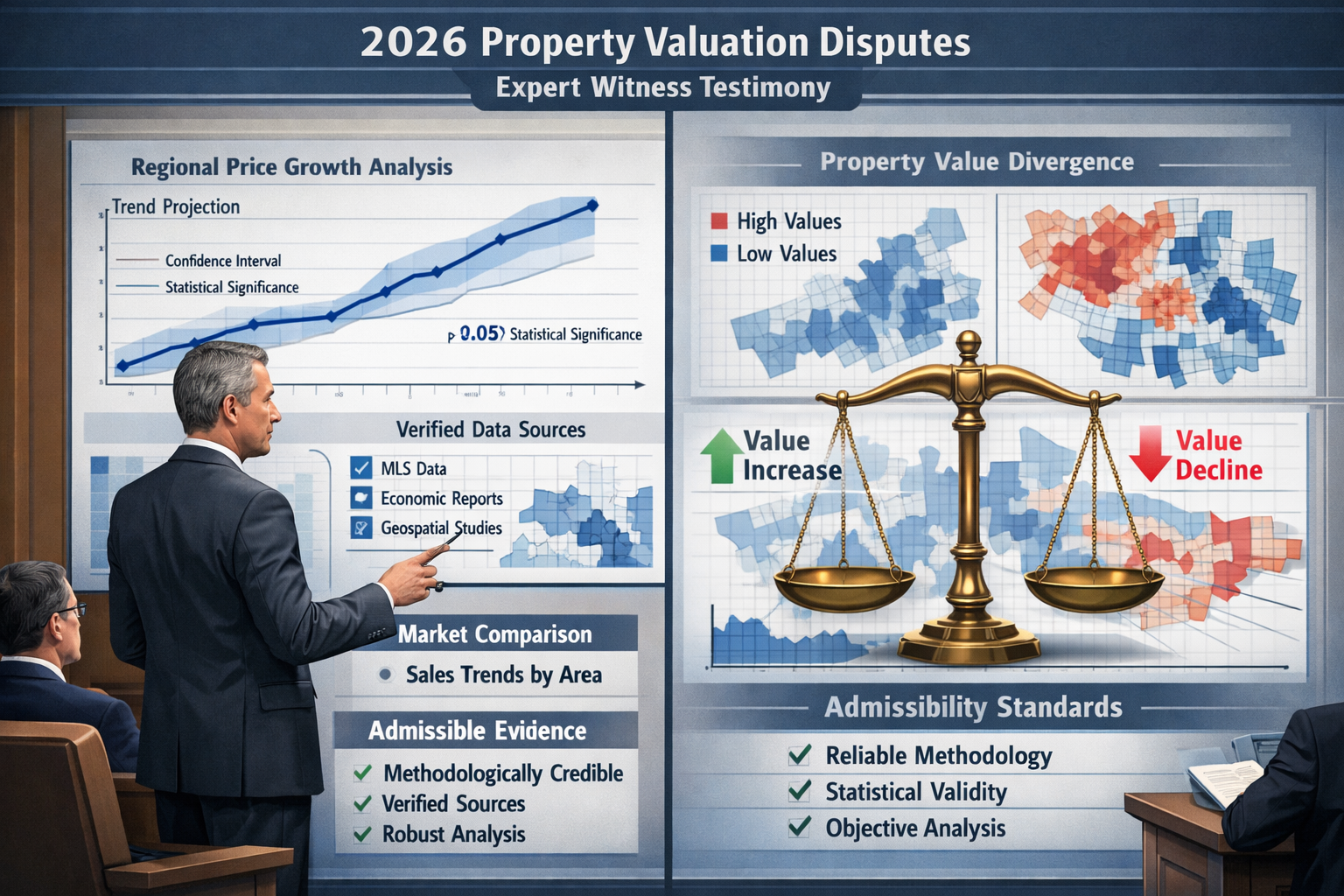
Expert witness testimony in 2026 valuation disputes demands a sophisticated blend of technical expertise, legal knowledge, communication skills, and strategic awareness. The divergent regional price growth characterizing today's property market creates unprecedented complexity in comparable selection, market analysis, and valuation justification. Experts who succeed in this environment demonstrate not only mastery of valuation methodology but also the ability to explain complex market dynamics in accessible terms while maintaining objectivity and independence.
The legal framework governing expert testimony continues to evolve, with courts applying increasingly rigorous admissibility standards under Rule 702 and related evidentiary rules. Experts must demonstrate specialized knowledge that genuinely assists factfinders, apply reliable methodologies appropriate to the specific case circumstances, and avoid common pitfalls including valuation date errors, inappropriate standards of value, and insufficient comparable analysis.
Strategic considerations around expert engagement—particularly the distinction between consulting and testifying expert roles—can significantly impact litigation outcomes. Legal teams that thoughtfully structure expert involvement maximize privilege protections while ensuring that testifying experts provide compelling, admissible testimony that withstands cross-examination.
Actionable Next Steps for Legal Professionals and Experts
For attorneys preparing valuation dispute cases:
- Engage experts early in the litigation process to benefit from strategic consulting before designating testifying experts
- Verify expert qualifications specific to the property type, market area, and valuation purpose at issue
- Confirm methodology alignment with legal requirements and evidentiary standards before expert opinions are finalized
- Coordinate closely with experts regarding valuation date, standard of value, and scope of analysis
- Prepare thoroughly for cross-examination by identifying potential challenges and developing response strategies
For valuation professionals serving as expert witnesses:
- Maintain professional independence and objectivity throughout the engagement
- Document methodology comprehensively to support opinions and facilitate defense under cross-examination
- Stay current with market developments, professional standards, and legal requirements
- Develop communication skills to explain technical concepts clearly to non-specialist audiences
- Leverage technology appropriately while maintaining the ability to explain and validate technology-assisted conclusions
The complexity of 2026's property market, characterized by unprecedented regional divergence and rapid change, ensures that valuation disputes will remain frequent and contentious. Experts and attorneys who master the technical, legal, and strategic dimensions of expert witness testimony will achieve superior outcomes for their clients while advancing professional standards in this critical area of practice.
For comprehensive support with valuation disputes, consider consulting chartered surveyors with expert witness experience who understand both market complexities and legal requirements. Whether the dispute involves boundary issues, neighbour disputes, or complex valuation disagreements, professional expertise makes the difference between successful and unsuccessful litigation outcomes.
References
[1] Gems Jewelry Appraisal Expert Witness Testimony Key Evidence In Jewelry Valuation Dispute – https://www.expertwitnessblog.com/gems-jewelry-appraisal-expert-witness-testimony-key-evidence-in-jewelry-valuation-dispute/
[2] Litigation Leu Wilson Smith Dont Get Struck Financial Expert – https://quickreadbuzz.com/2026/02/04/litigation-leu-wilson-smith-dont-get-struck-financial-expert/
[3] Consulting Expert Vs Testifying Expert Litigation – https://gavinsolmonese.com/insights/consulting-expert-vs-testifying-expert-litigation/
[4] Expert Witness Testimony – https://stoneturn.com/service/disputes-economic-consulting/expert-witness-testimony/
[5] Expert Witness Testimony – https://steinsperling.com/areas-of-interest/expert-witness-testimony/