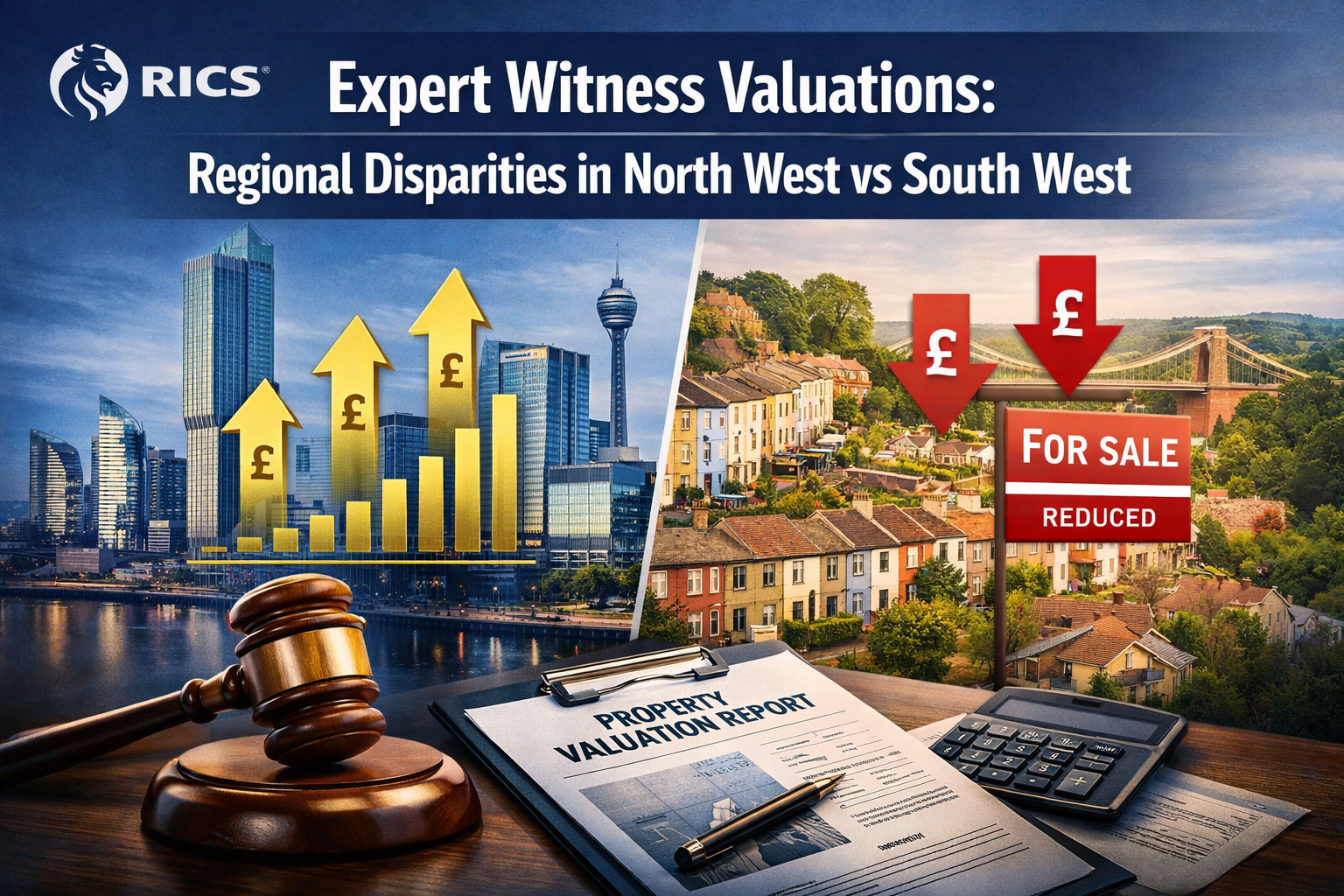

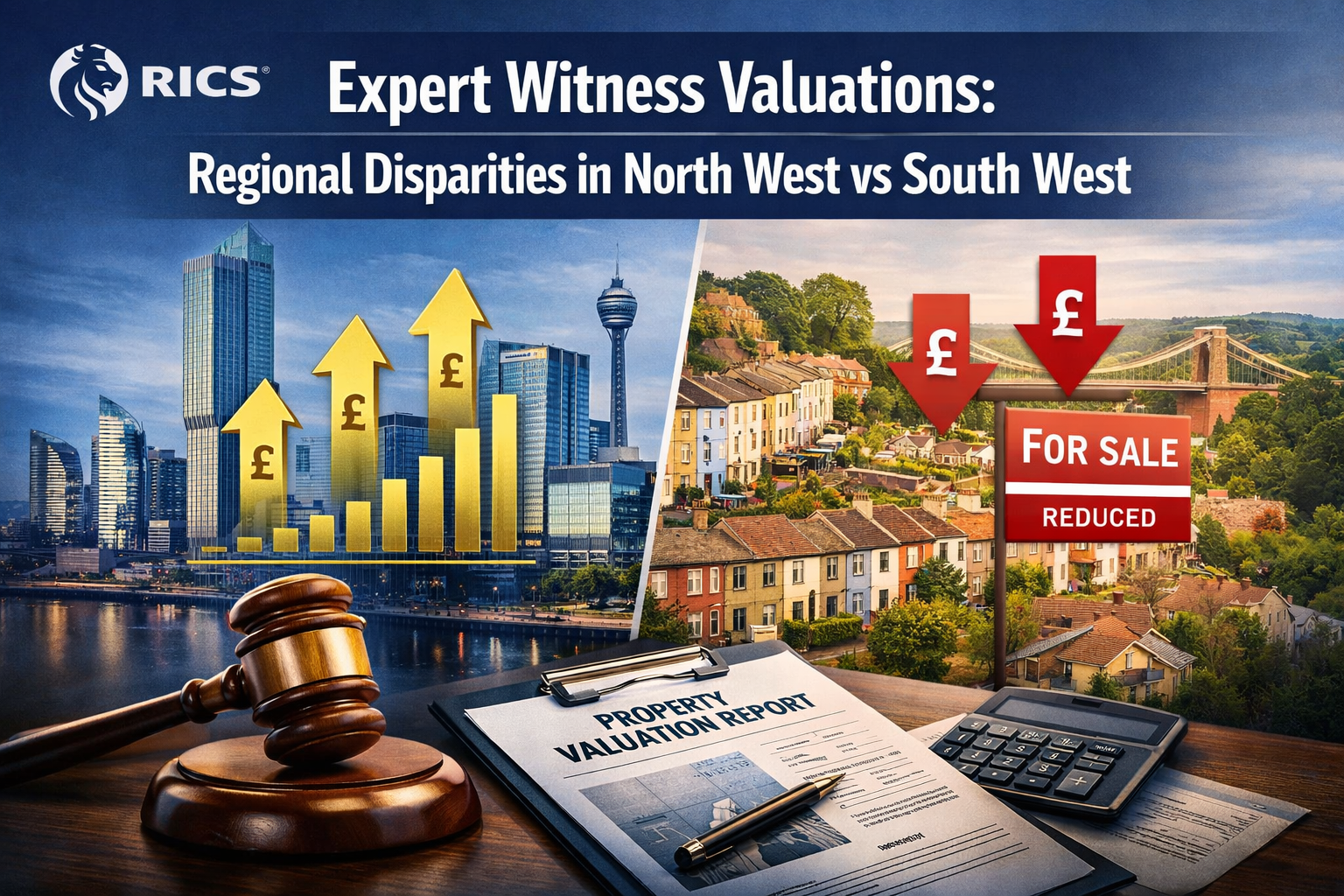
The UK property market in 2026 presents unprecedented challenges for expert witnesses navigating valuation disputes between regions experiencing dramatically different trajectories. Expert Witness Valuations Amid Widening Regional Disparities: Defending Assessments in North West vs South West Disputes has become a critical concern as RICS survey data reveals significant divergence between the robust North West market and the comparatively stagnant South West sector[1]. For chartered surveyors and property professionals, understanding how to build defensible evidence in tribunal settings requires mastery of regional nuances, interest rate impacts, and evolving market dynamics.
As property disputes increasingly hinge on regional performance differences, expert witnesses must navigate complex valuation methodologies that account for local economic conditions, infrastructure investment, and demographic shifts. The stakes are high: poorly defended assessments can result in unfavorable tribunal outcomes, professional liability claims, and reputational damage.
Key Takeaways
- 📊 Regional divergence between North West and South West markets has reached historic levels in 2026, requiring distinct valuation approaches for each region
- ⚖️ RICS data-driven preparation is essential for defending assessments in tribunal settings, particularly when addressing interest rate volatility impacts[1]
- 🏘️ Lettings market dynamics show tenant demand outpacing supply in both regions, but with different implications for capital valuations[2]
- 📋 Evidence-building techniques must incorporate comparable transaction analysis, local economic indicators, and infrastructure development patterns
- 🎯 Expert witness credibility depends on demonstrating thorough understanding of regional market characteristics and transparent methodology
Understanding Regional Market Divergence in 2026
The property landscape across England has undergone substantial transformation, with Expert Witness Valuations Amid Widening Regional Disparities: Defending Assessments in North West vs South West Disputes reflecting fundamentally different economic trajectories. The North West London market has demonstrated remarkable resilience and growth, while the South West region has experienced more modest performance.
North West Market Characteristics
The North West region has benefited from several converging factors that have strengthened property valuations:
- Infrastructure investment: Major transport projects including HS2 extensions and Northern Powerhouse initiatives have enhanced connectivity
- Employment growth: Technology sector expansion in Manchester and Liverpool has created high-wage employment opportunities
- Demographic trends: Young professionals migrating from London seeking affordability while maintaining career prospects
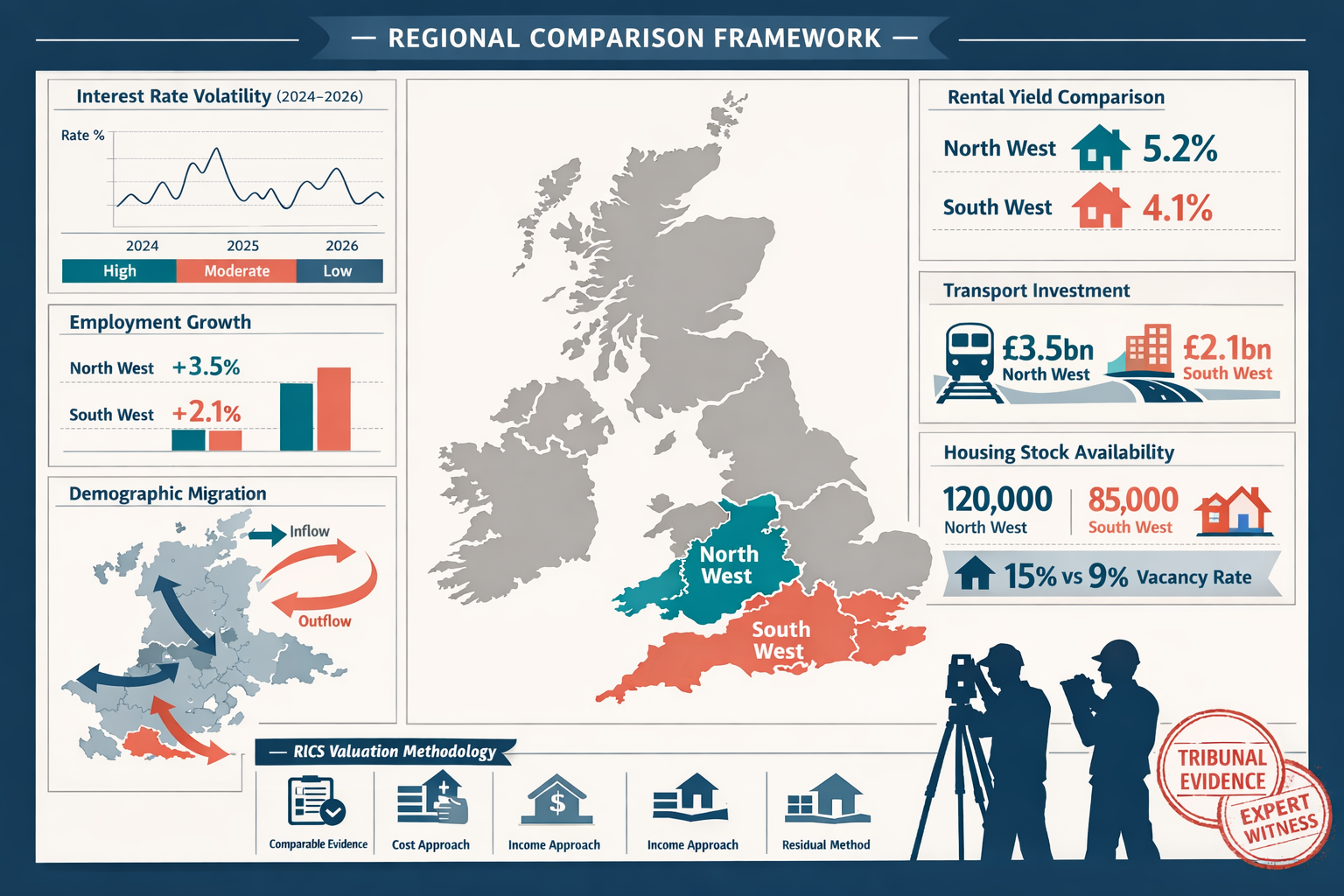
- Rental yields: Strong tenant demand supporting 5.2-6.1% gross yields on residential investment properties[2]
According to RICS survey data from February 2026, the North West has seen price growth of 8.3% year-over-year, significantly outpacing national averages[1]. This robust performance creates specific challenges for expert witnesses defending valuations in dispute scenarios, particularly when opposing parties question whether such growth is sustainable.
South West Market Dynamics
Conversely, the South West presents a more complex picture:
- Price stagnation: Annual growth rates of just 1.7-2.4% across major South West markets
- Affordability constraints: Higher baseline prices limiting first-time buyer entry despite slower growth
- Tourism dependency: Economic reliance on seasonal tourism creating volatility in rental markets
- Infrastructure gaps: Slower transport investment compared to Northern regions
The South West London property sector has not experienced the same momentum, creating valuation challenges when comparable evidence from different timeframes must be reconciled.
Key Valuation Factors by Region
| Factor | North West | South West |
|---|---|---|
| Annual Price Growth (2026) | 8.3% | 2.1% |
| Average Property Value | £485,000 | £625,000 |
| Rental Yield | 5.2% | 4.1% |
| Days on Market | 32 | 47 |
| Transaction Volume Change | +12% | -3% |
| Infrastructure Investment | High | Moderate |
These disparities mean that expert witnesses must carefully contextualize their valuation approaches, ensuring that methodologies reflect genuine regional characteristics rather than applying generic national assumptions.
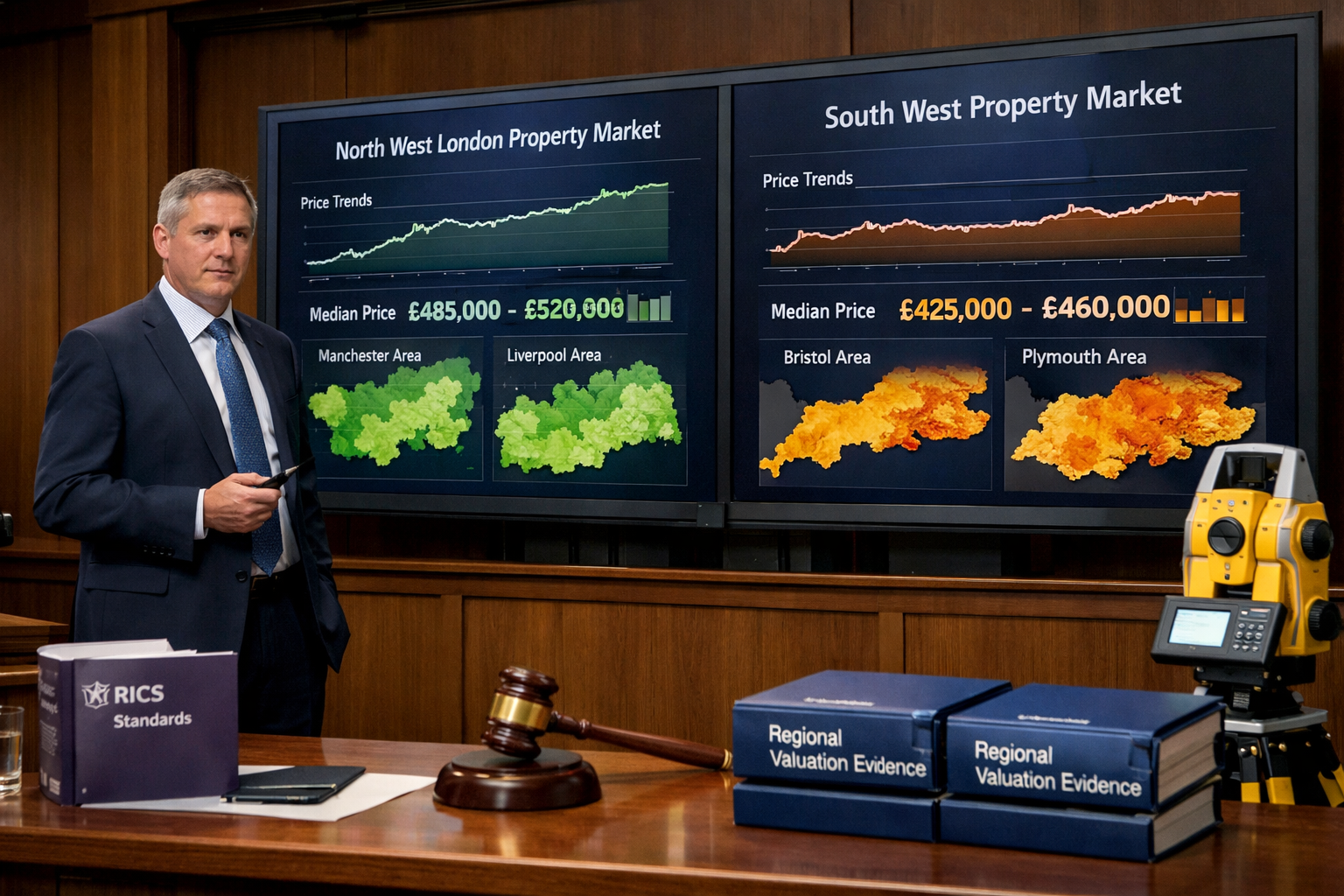
Building Defensible Evidence for Expert Witness Valuations Amid Widening Regional Disparities
Creating robust, tribunal-ready valuations requires meticulous attention to evidence quality and methodology transparency. When addressing Expert Witness Valuations Amid Widening Regional Disparities: Defending Assessments in North West vs South West Disputes, expert witnesses must demonstrate comprehensive understanding of both regional markets and applicable valuation standards.
RICS Red Book Compliance and Regional Adaptation
The RICS Valuation – Global Standards (Red Book) provides the foundational framework for all professional valuations. However, applying these standards in regionally divergent markets requires careful adaptation:
🔍 Market Evidence Requirements
Expert witnesses must gather comprehensive comparable evidence specific to each region. For expert witness reports in London, this includes:
- Transaction comparables: Minimum 5-8 comparable sales within 0.5-mile radius, completed within 6 months
- Rental evidence: Current and historical rental achievements for investment property valuations
- Market sentiment indicators: RICS member surveys, local agent feedback, and auction results
- Economic data: Employment statistics, wage growth, and population trends specific to the locality
The challenge intensifies when valuations cross regional boundaries or when disputes involve properties in transitional markets. Expert witnesses must explain why North West comparables may show 8% growth while South West equivalents demonstrate 2% growth, providing economic rationale rather than simple data presentation.
Addressing Interest Rate Volatility Impacts
Interest rate fluctuations have created significant valuation challenges throughout 2026. As documented in recent RICS analysis, interest rate volatility disputes require data-driven preparation that accounts for:
- Timing sensitivity: Valuations conducted in January 2026 versus June 2026 may reflect different rate environments
- Buyer affordability: How rate changes impact purchasing power differently across price points
- Investment yields: Relationship between base rates and expected property yields[1]
"Expert witnesses must demonstrate how interest rate movements of 0.25-0.50% translate into tangible impacts on property values, with regional variations accounting for local economic resilience." – RICS Expert Witness Guidance 2026
For valuation factors in dispute scenarios, expert witnesses should prepare sensitivity analysis showing how values respond to rate changes, with region-specific assumptions reflecting local market conditions.
Lettings Market Evidence in Capital Valuations
The 2026 lettings market presents unique challenges, with tenant demand surging while landlord constraints limit supply[2]. This dynamic affects capital valuations in several ways:
Investment Property Considerations
- Yield compression: Strong rental demand may support higher capital values despite modest rental growth
- Regulatory impact: Evolving landlord regulations affecting different regions at varying rates
- Tenant demographics: Professional tenant concentration in North West versus mixed demographics in South West
When defending valuations for investment properties, expert witnesses must clearly articulate the relationship between rental performance and capital value, particularly when retrospective valuations require reconstruction of historical market conditions.
Documentation and Evidence Presentation
Tribunal-ready evidence requires meticulous documentation:
✅ Essential Documentation Checklist
- Detailed valuation report following RICS standards
- Comparable evidence schedule with full property details
- Market analysis demonstrating regional context
- Methodology explanation with assumption transparency
- Sensitivity analysis for key variables
- Professional indemnity insurance confirmation
- CV demonstrating relevant expertise and qualifications
- Declarations of independence and conflicts of interest
Expert witnesses should anticipate challenges to their methodology and prepare responses addressing:
- Why specific comparables were selected or rejected
- How adjustments for property differences were calculated
- Regional market trend interpretation and forecasting basis
- Treatment of abnormal transactions or outlier data points
Handling Cross-Examination on Regional Differences
When Expert Witness Valuations Amid Widening Regional Disparities: Defending Assessments in North West vs South West Disputes reach tribunal stages, expert witnesses face rigorous cross-examination. Preparation should include:
Common Challenge Areas
- "Cherry-picking" accusations: Claims that favorable comparables were selected while unfavorable ones were ignored
- Regional bias: Suggestions that North West optimism or South West pessimism colored professional judgment
- Methodology inconsistency: Questions about whether the same approach would yield different results in different regions
- Assumption validity: Challenges to growth rate projections or adjustment factors
Effective responses require demonstrating systematic, transparent processes that would produce consistent results when applied by other competent professionals. The best property valuation practices emphasize reproducibility and professional judgment transparency.
Specialized Valuation Scenarios in Regional Disputes
Beyond standard residential valuations, several specialized scenarios frequently arise in disputes between North West and South West properties, each requiring tailored approaches.
Reinstatement Cost Assessments
Reinstatement cost valuations for insurance purposes present unique challenges when regional building cost variations come into play. Expert witnesses must account for:
- Labor cost differentials: Construction labor rates varying by 15-25% between regions
- Material transportation: Logistics costs affecting material prices in different locations
- Contractor availability: Regional capacity constraints influencing rebuild timeframes and costs
- Building regulations: Local authority requirements potentially differing between regions
In dispute scenarios, opposing parties may challenge whether regional adjustments are justified or whether national average rates should apply. Expert witnesses must provide detailed breakdowns demonstrating actual cost differences through builder quotations, quantity surveyor schedules, and industry cost indices.
Probate and Matrimonial Valuations
Probate valuations and matrimonial dispute assessments require particular care when properties span different regions. Key considerations include:
Timing Issues
- Valuation date significance in rapidly changing markets
- Historical reconstruction when disputes involve past transactions
- Market condition differences between valuation date and dispute resolution date
Methodology Debates
- Whether to use comparable or investment method for mixed-use properties
- Treatment of development potential in transitional areas
- Adjustment for property condition versus market location factors
For expert witnesses, maintaining consistency while acknowledging regional differences is critical. A North West property with development potential may warrant different treatment than a South West equivalent, but the underlying methodology must remain defensible and transparent.
Commercial Property Considerations
Commercial valuations introduce additional complexity, particularly for commercial building surveys and rent review scenarios. Regional disparities affect:
- Tenant covenant strength: Business viability varying by regional economic conditions
- Comparable rent evidence: Limited transaction volumes in some South West markets
- Yield expectations: Investor requirements differing based on perceived regional risk
- Lease terms: Market norms for lease length and break clauses varying regionally
Expert witnesses must demonstrate familiarity with commercial property market nuances in both regions, recognizing that retail, office, and industrial sectors may show different regional patterns than residential markets.
Leasehold and Freehold Valuations
Freehold valuations and lease extension calculations require careful consideration of regional growth assumptions. When valuing leasehold interests, expert witnesses must:
- Select appropriate deferment rates: Reflecting regional market risk and growth expectations
- Determine relativity: How short lease values relate to freehold values in specific regional markets
- Apply growth rates: Justifying different growth assumptions for North West versus South West properties
- Consider settlement precedents: Regional tribunal decisions influencing valuation parameters
The Leasehold Reform Act provisions apply nationally, but their practical application varies by regional market conditions. Expert witnesses must balance statutory requirements with market reality, explaining how regional factors influence calculations while maintaining compliance with legal frameworks.
Dispute Resolution and Neighbour Issues
Property disputes often involve neighbour disagreements and party wall matters, where valuations assess diminution in value or compensation. Regional considerations include:
Damage Assessment
- Construction cost variations affecting repair expense calculations
- Property value impacts differing by regional market sensitivity
- Alternative accommodation costs during repairs varying significantly by location
Development Impact
- How new developments affect neighboring property values differently in tight North West markets versus slower South West markets
- Light, air, and outlook value impacts varying by regional property characteristics
- Market evidence for diminution calculations being region-specific
Expert witnesses must resist the temptation to apply generic percentage adjustments, instead providing detailed analysis of how specific impacts affect value in the particular regional context.
Professional Standards and Continuing Competence
Maintaining credibility as an expert witness in Expert Witness Valuations Amid Widening Regional Disparities: Defending Assessments in North West vs South West Disputes requires ongoing professional development and market knowledge maintenance.
RICS Expert Witness Requirements
The Royal Institution of Chartered Surveyors maintains strict standards for members acting as expert witnesses:
🎓 Qualification Requirements
- Full RICS membership (MRICS or FRICS status)
- Relevant experience in valuation discipline (typically 5+ years post-qualification)
- Specific expertise in relevant property types and regional markets
- Understanding of Civil Procedure Rules Part 35 and Practice Direction 35
- Professional indemnity insurance with expert witness coverage
For those seeking RICS registered valuers, additional registration demonstrates commitment to valuation excellence and professional standards.
Regional Market Knowledge Maintenance
Expert witnesses must actively maintain current knowledge of both North West and South West markets through:
- Regular market visits: Physical inspection of properties and areas to understand current conditions
- Agent liaison: Ongoing relationships with local estate agents and property professionals
- Transaction monitoring: Reviewing Land Registry data and auction results
- Economic analysis: Following regional employment, infrastructure, and demographic trends
- Peer discussion: Engaging with fellow professionals practicing in each region
The rapid pace of regional divergence in 2026 means that knowledge from 12-18 months ago may be outdated. Expert witnesses must demonstrate current, not historical, market understanding.
Ethical Considerations and Independence
Expert witness duties to the tribunal supersede duties to instructing parties. Critical ethical principles include:
Independence Requirements
- Providing objective opinions regardless of which party benefits
- Disclosing any relationships or interests that might affect independence
- Refusing instructions where conflicts of interest exist
- Resisting pressure to modify opinions to favor instructing parties
"The expert witness's primary duty is to the court or tribunal, not to the party paying their fees. This principle becomes especially important when regional market evidence may favor one party over another."
When regional evidence clearly supports one party's position, expert witnesses must report this honestly rather than seeking artificial balance. Credibility depends on demonstrated objectivity, even when conclusions are unfavorable to instructing clients.
Continuous Professional Development
Maintaining expertise requires structured CPD activities:
Recommended CPD Focus Areas for 2026
- Interest rate impact analysis and valuation sensitivity
- Regional economic forecasting and market trend interpretation
- Lettings market dynamics and investment valuation implications[2]
- Tribunal procedure and expert witness presentation skills
- Advanced comparable analysis techniques for divergent markets
- Technology tools for valuation evidence presentation
RICS members must complete minimum 20 hours annual CPD, with expert witnesses benefiting from exceeding this minimum and focusing on dispute-relevant topics.
Practical Strategies for Tribunal Success
Successfully defending valuations in tribunal settings requires more than technical competence—it demands effective communication, thorough preparation, and strategic thinking.
Pre-Tribunal Preparation
📋 90-Day Preparation Timeline
Days 90-60: Evidence Assembly
- Gather all comparable transaction evidence
- Compile regional market data and economic indicators
- Prepare detailed valuation calculations with sensitivity analysis
- Review opposing expert's report (if available) and identify areas of disagreement
Days 60-30: Report Refinement
- Draft comprehensive expert witness report
- Prepare visual aids and exhibits for tribunal presentation
- Conduct peer review with colleague familiar with regional markets
- Anticipate cross-examination questions and prepare responses
Days 30-7: Final Preparation
- Review all documentation and ensure consistency
- Prepare opening statement and key points summary
- Coordinate with instructing solicitors on procedural matters
- Visit tribunal venue if unfamiliar with location
Days 7-0: Mental Preparation
- Review key facts and figures for instant recall
- Practice explaining complex concepts in accessible language
- Ensure all materials are organized for easy reference
- Rest adequately before tribunal appearance
Effective Communication Techniques
Expert witnesses must translate technical valuation concepts into language accessible to tribunal members who may lack property expertise:
Communication Best Practices
✅ Use analogies: Compare regional market differences to familiar concepts
✅ Employ visuals: Charts, maps, and photographs enhance understanding
✅ Avoid jargon: Explain technical terms when first used
✅ Structure logically: Present evidence in clear, sequential order
✅ Acknowledge limitations: Admit uncertainty where appropriate rather than overreaching
❌ Avoid defensiveness: Respond calmly to challenges
❌ Don't overcomplicate: Resist showing off technical knowledge unnecessarily
❌ Never guess: Say "I don't know" rather than speculating
❌ Avoid advocacy: Maintain neutral, objective tone throughout
Handling Opposing Expert Evidence
Disputes typically involve competing expert opinions. Effective strategies include:
Pre-Hearing Engagement
- Participate constructively in expert discussions to narrow issues
- Prepare joint statement identifying areas of agreement and disagreement
- Maintain professional courtesy regardless of opinion differences
- Focus discussions on methodology and evidence rather than personalities
During Cross-Examination
- Listen carefully to questions before responding
- Answer only what is asked without volunteering additional information
- Maintain composure when opinions are challenged
- Acknowledge valid points made by opposing expert while explaining remaining differences
Post-Hearing Conduct
- Respond promptly to any tribunal requests for clarification
- Maintain professional relationships with opposing experts
- Reflect on experience to improve future performance
- Document lessons learned for continuing professional development
Technology and Evidence Presentation
Modern tribunal proceedings increasingly incorporate technology for evidence presentation:
Effective Technology Use
- Digital exhibits: PDF bundles with hyperlinked contents for easy navigation
- Interactive maps: Showing property locations and comparable evidence geographically
- Data visualization: Charts and graphs illustrating market trends and valuation calculations
- Photographic evidence: High-quality images showing property condition and regional characteristics
- Video presentations: Virtual property tours when physical inspection isn't possible
However, expert witnesses should ensure technology enhances rather than distracts from evidence. Always have paper backup materials in case of technical difficulties.
Conclusion
Expert Witness Valuations Amid Widening Regional Disparities: Defending Assessments in North West vs South West Disputes represents one of the most challenging aspects of property valuation practice in 2026. The unprecedented divergence between robust North West markets and comparatively stagnant South West regions requires expert witnesses to demonstrate sophisticated understanding of regional economics, meticulous evidence-gathering capabilities, and exceptional communication skills.
Success in tribunal settings depends on several critical factors:
🎯 Comprehensive regional knowledge that goes beyond generic market understanding to encompass specific local economic drivers, infrastructure developments, and demographic trends
📊 Data-driven methodology that leverages RICS survey insights and robust comparable evidence while transparently explaining all assumptions and adjustments[1]
⚖️ Professional independence that prioritizes duty to the tribunal over instructing party preferences, maintaining credibility through objective analysis
🔍 Thorough preparation that anticipates challenges, prepares detailed responses, and ensures all evidence is properly documented and accessible
💬 Clear communication that translates complex valuation concepts into accessible language for tribunal members without property expertise
The lettings market dynamics of 2026, with tenant demand surging while supply constraints persist, add further complexity to capital valuations across both regions[2]. Expert witnesses must integrate rental market evidence appropriately while explaining how regional differences in yields and tenant demographics affect property values.
Actionable Next Steps
For property professionals seeking to enhance their expert witness capabilities:
- Invest in regional market research: Develop systematic processes for monitoring both North West and South West markets continuously
- Enhance technical skills: Complete CPD focused on valuation methodology, interest rate impact analysis, and tribunal procedures
- Build evidence libraries: Create organized databases of comparable transactions, market reports, and economic data for both regions
- Develop communication abilities: Practice explaining complex concepts clearly through mock tribunal exercises
- Engage with professional networks: Join RICS expert witness panels and regional property professional groups
- Review recent cases: Study published tribunal decisions involving regional valuation disputes to understand successful strategies
For those requiring expert witness services or chartered surveyor support in either the North West or South West London regions, selecting professionals with demonstrated expertise in regional market characteristics and tribunal experience is essential.
The property market landscape will continue evolving throughout 2026 and beyond, with regional disparities potentially widening further or converging depending on economic policy, infrastructure investment, and demographic shifts. Expert witnesses who maintain current knowledge, rigorous methodology, and professional independence will remain invaluable in resolving the complex disputes that inevitably arise in such dynamic markets.
By combining technical excellence with effective communication and unwavering professional standards, expert witnesses can successfully defend valuations across divergent regional markets, contributing to fair dispute resolution and maintaining public confidence in the property valuation profession.
References
[1] Expert Witness Challenges In 2026 Interest Rate Volatility Disputes Rics Data Driven Preparation – https://nottinghillsurveyors.com/blog/expert-witness-challenges-in-2026-interest-rate-volatility-disputes-rics-data-driven-preparation
[2] Expert Witness Roles In 2026 Lettings Market Disputes Navigating Tenant Demand Surge And Landlord Constraints – https://nottinghillsurveyors.com/blog/expert-witness-roles-in-2026-lettings-market-disputes-navigating-tenant-demand-surge-and-landlord-constraints