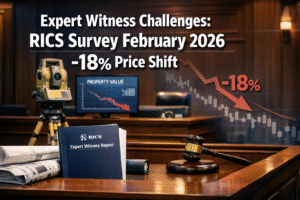
The UK property market in 2026 presents a unique challenge for expert witnesses: regional price recovery is anything but uniform. While Northern markets experience unexpected premiums and growth, Southern regions show signs of stabilization—creating a perfect storm for valuation disputes that end up in courtrooms. Expert witness valuations for regional disputes: North-South price gaps in 2026 RICS cases have become increasingly complex as surveyors must navigate diverging market conditions while maintaining the independence and rigor demanded by the courts.
For RICS registered valuers, the stakes have never been higher. Tribunals and courts now scrutinize regional adjustment factors with unprecedented intensity, demanding robust evidence that accounts for localized market dynamics. This article explores how expert witnesses can build court-ready evidence using current RICS data, prepare for increased litigation in recovering markets, and maintain professional standards when North-South price differentials challenge traditional valuation methodologies.

Key Takeaways
- Regional divergence is accelerating: Northern markets show premium growth while Southern regions stabilize, creating valuation challenges that require sophisticated regional adjustment methodologies
- Court scrutiny has intensified: Expert witnesses must provide more granular comparable evidence and transparent regional adjustment calculations to withstand cross-examination in 2026 disputes
- RICS guidance is evolving: The fifth edition of expert witness guidance emphasizes independence and market-specific data requirements for regional valuation disputes
- Litigation is increasing: Market recovery uncertainty drives more disputes to court, requiring expert witnesses to prepare comprehensive, defensible evidence packages
- Professional accreditation matters: RICS Accredited Expert Witness Scheme (EWAS-UK) registration provides credibility in cases involving complex regional price gap analysis
Understanding the 2026 North-South Property Price Divide
Market Recovery Patterns Across UK Regions
The 2026 property market demonstrates a fundamental shift in traditional North-South dynamics. Northern regions including Manchester, Leeds, Newcastle, and Liverpool are experiencing robust price growth driven by several converging factors:
- 🏭 Industrial investment in green technology and manufacturing sectors
- 👥 Population migration from expensive Southern cities to affordable Northern urban centers
- 🏢 Remote work flexibility enabling professionals to relocate while maintaining London salaries
- 🚄 Infrastructure improvements including High Speed 2 connectivity (partial routes operational)
Conversely, Southern markets including London, Brighton, Oxford, and Cambridge show price stabilization characterized by:
- 📊 Modest growth rates of 1-3% annually compared to Northern rates of 5-8%
- 💷 Affordability ceilings limiting further price escalation in already expensive markets
- 🏛️ Market maturity with fewer first-time buyers able to enter premium Southern markets
- 📉 International buyer hesitation due to regulatory changes and economic uncertainty
This divergence creates significant challenges for expert witnesses preparing valuation reports for regional disputes. Traditional comparable evidence may not adequately reflect these rapid market shifts.
Why Regional Price Gaps Drive Litigation
Several dispute scenarios commonly arise from North-South price differentials:
Matrimonial disputes: Divorcing couples disagree on property values when one party relocates from South to North, with matrimonial valuations requiring precise regional adjustment factors.
Probate disagreements: Beneficiaries contest estate valuations when properties span multiple regions with diverging market conditions, making probate valuations particularly contentious.
Tax assessment appeals: Property owners challenge HMRC valuations for capital gains, inheritance tax, or ATED purposes when regional price movements create valuation discrepancies.
Commercial lease disputes: Rent review disagreements intensify when comparable evidence from different regions produces vastly different rental values.
Compulsory purchase compensation: Local authorities and property owners dispute fair compensation when regional market conditions affect land values.
Expert Witness Valuations for Regional Disputes: Building Court-Ready Evidence

RICS Requirements for Expert Witness Independence
The RICS Accredited Expert Witness Scheme (EWAS-UK) maintains strict standards for professionals providing expert witness reports in regional valuation disputes. The fifth edition of RICS Surveyors acting as expert witnesses guidance (in production as of early 2026) emphasizes:
Duty to the court over client: Expert witnesses must provide objective, unbiased opinions regardless of which party instructs them. This principle becomes especially critical when regional price gaps create pressure to favor one interpretation over another.
Independence from prior involvement: Surveyors who previously acted as negotiators or advisors in a dispute face heightened scrutiny regarding conflicts of interest. Clear disclosure and, where appropriate, recusal are essential.
Transparency in methodology: Courts demand explicit explanation of how regional adjustments are calculated, which comparable evidence is selected, and why certain market data is weighted more heavily.
Competence in regional markets: Expert witnesses must demonstrate specific knowledge of both Northern and Southern markets when cases involve cross-regional comparisons. Generic national data is insufficient.
Selecting Appropriate Comparable Evidence
The foundation of defensible expert witness valuations for regional disputes lies in robust comparable selection. In 2026 RICS cases involving North-South price gaps, courts expect:
Geographic Proximity Standards
| Dispute Type | Acceptable Comparable Radius | Regional Adjustment Required |
|---|---|---|
| Residential urban | 0.5-1 mile | Yes, if crossing micro-market boundaries |
| Residential suburban | 1-3 miles | Yes, for different postal districts |
| Residential rural | 3-5 miles | Yes, for village-to-village variations |
| Commercial retail | Same high street/retail park | Minimal if truly comparable |
| Commercial office | Same business district | Yes, for different transport zones |
| Industrial/warehouse | 5-10 miles | Yes, for different industrial estates |
Temporal Relevance in Recovering Markets
2026's diverging regional markets require tight temporal parameters for comparable evidence:
- ✅ Ideal: Transactions within 3 months of valuation date
- ⚠️ Acceptable with adjustment: Transactions within 6 months, with explicit market movement adjustment
- ❌ Problematic: Transactions older than 6 months without comprehensive market trend analysis
Expert witnesses must document monthly price movements in both subject property region and comparable property regions to justify temporal adjustments.
Quality and Quantity Balance
Courts in 2026 RICS cases expect:
- Minimum 5-6 comparable transactions for residential properties
- Minimum 3-4 comparable transactions for commercial properties (recognizing limited availability)
- Mix of comparable types: Actual sales, offers, withdrawn listings, and rental evidence where appropriate
- Hierarchy of reliability: Completed sales weighted most heavily, followed by agreed offers, then asking prices
Calculating Regional Adjustment Factors
The most scrutinized aspect of expert witness valuations for regional disputes involves regional adjustment calculations. Courts demand mathematical rigor and market evidence to support adjustments.
Market-Based Adjustment Methodology
Step 1: Establish baseline regional indices
- Utilize Land Registry Price Paid Data for specific postal districts
- Reference ONS House Price Index for broader regional trends
- Incorporate local authority planning data on supply constraints
- Consider employment statistics and wage growth differentials
Step 2: Calculate percentage differentials
- Compare subject property region to comparable property region
- Adjust for time lag between transactions
- Account for property type variations (detached, semi-detached, terraced, flat)
- Factor in size brackets (price per square foot variations by region)
Step 3: Apply micro-market adjustments
- School catchment area premiums (vary significantly North-South)
- Transport connectivity (rail, motorway access)
- Local amenity differences (parks, shopping, cultural facilities)
- Crime statistics and neighborhood desirability factors
Example Calculation:
A Manchester property (subject) valued using a Leeds comparable (similar property sold 3 months prior):
- Leeds comparable sold: £425,000
- Manchester market growth vs Leeds (3-month period): +2.3%
- Micro-market adjustment (Manchester location premium): +5%
- Property-specific adjustments (condition, garden size): +3%
Adjusted comparable value: £425,000 × 1.023 × 1.05 × 1.03 = £466,147
This calculation must be fully documented and justified in expert witness reports, with supporting market data appendices.
Documentation Standards for Court Proceedings
Expert witnesses preparing for regional dispute cases must provide comprehensive documentation packages including:
📋 Core valuation report components:
- Executive summary with clear opinion of value
- Property description and inspection notes
- Comparable evidence schedule with full transaction details
- Regional adjustment calculations with supporting data
- Market context analysis (local and regional trends)
- Methodology explanation compliant with RICS Red Book standards
- Professional qualifications and experience statement
- Declaration of independence and conflicts disclosure
📊 Supporting evidence appendices:
- Land Registry transaction data extracts
- Property photographs (subject and comparables)
- Location maps showing comparable positions
- Market reports from reputable sources
- Planning authority data on local development
- Economic indicators (employment, wages, demographics)
🔍 Quality assurance documentation:
- Peer review notes (where applicable)
- Calculation worksheets showing all mathematical steps
- Data source verification records
- Alternative valuation scenarios (sensitivity analysis)
Understanding valuation factors that courts scrutinize helps expert witnesses anticipate cross-examination challenges.
Preparing for Cross-Examination in Regional Valuation Disputes

Common Challenge Areas in North-South Cases
Opposing counsel in 2026 RICS cases involving regional price gaps typically focus cross-examination on:
1. Comparable selection bias
- "Why did you choose comparables from this specific area rather than [alternative location]?"
- "Aren't you cherry-picking evidence that supports your client's position?"
- "How do you justify excluding [specific comparable] from your analysis?"
Defense strategy: Maintain transparent, objective selection criteria applied consistently. Document why each comparable was included or excluded based on predetermined parameters.
2. Regional adjustment magnitude
- "Your 7% regional adjustment seems arbitrary—where's the market evidence?"
- "Why does your adjustment differ from [opposing expert's] 3% adjustment?"
- "Aren't you double-counting by applying both regional and micro-market adjustments?"
Defense strategy: Provide granular market data supporting each adjustment component. Show mathematical derivation from objective sources. Explain differences from opposing expert's methodology with evidence, not opinion.
3. Market trend interpretation
- "You claim Northern markets are outperforming—isn't this just temporary speculation?"
- "How can you justify using 3-month-old comparables in a rapidly changing market?"
- "What if the market reverses next quarter—does your valuation still hold?"
Defense strategy: Distinguish between valuation date opinion (retrospective) and market prediction (prospective). Cite multiple independent sources confirming trend direction. Acknowledge uncertainty while defending methodology.
4. Professional competence in unfamiliar regions
- "How many valuations have you personally conducted in [Northern/Southern region]?"
- "Aren't you primarily a [London/regional] surveyor without local market expertise?"
- "Did you physically inspect comparable properties or just rely on online data?"
Defense strategy: Demonstrate specific regional knowledge through case examples. Cite local market contacts and research. Explain how professional standards and methodology apply across regions despite local variations.
Building Defensible Position Statements
Expert witnesses should prepare position statements anticipating challenges:
"My valuation opinion of £X is based on [number] comparable transactions within [radius] of the subject property, all occurring within [timeframe] of the valuation date. I have applied a [percentage]% regional adjustment factor derived from [specific data sources], which I can demonstrate through [calculation methodology]. This approach is consistent with RICS guidance and accepted valuation practice for regional dispute cases."
This statement should be expandable with supporting detail for any component challenged during cross-examination.
Maintaining Professional Standards Under Pressure
The adversarial nature of litigation can pressure expert witnesses to compromise objectivity. RICS standards require:
Never advocate for the instructing party: Expert witnesses serve the court, not the client. When evidence contradicts the client's preferred outcome, the expert must report findings honestly.
Acknowledge limitations and uncertainties: Markets are imperfect, data is incomplete, and valuations involve judgment. Admitting reasonable uncertainty strengthens credibility rather than weakening it.
Revise opinions when presented with new evidence: If opposing expert presents compelling data not previously considered, professional integrity requires acknowledging its relevance and, if appropriate, adjusting conclusions.
Communicate clearly with opposing experts: Joint statements identifying areas of agreement and disagreement help courts focus on genuine technical disputes rather than misunderstandings.
For complex cases involving multiple valuation purposes, understanding specialized requirements for capital gains tax valuations or ATED valuations may be necessary.
Emerging Trends in 2026 RICS Regional Dispute Cases
Technology Integration in Expert Evidence
Courts increasingly expect expert witnesses to leverage technology for more robust evidence presentation:
Geospatial analysis tools: Mapping software displaying comparable locations, transport links, and amenity proximity provides visual clarity for complex regional adjustments.
Automated valuation models (AVMs): While not replacing professional judgment, AVM outputs from multiple providers offer supporting evidence for regional price trends and adjustment factors.
Market data platforms: Subscription services providing granular transaction data, rental evidence, and trend analysis strengthen comparable selection justification.
Virtual site inspections: Drone footage, 360-degree photography, and virtual tours supplement physical inspections, particularly for comparable properties not accessible for viewing.
Increased Scrutiny of Regional Economic Factors
2026 cases demonstrate heightened judicial interest in macroeconomic regional drivers:
- 📈 Employment growth differentials: Northern tech sector expansion versus Southern financial sector contraction
- 🏗️ Infrastructure investment: HS2, Northern Powerhouse projects, and regional transport improvements
- 🎓 Education and skills: University expansion and research funding affecting regional property demand
- 🌱 Sustainability initiatives: Green energy projects and environmental policies creating regional economic variation
Expert witnesses must demonstrate awareness of these broader economic contexts when explaining regional price gaps.
Cross-Border Valuation Complexity
With Scotland, Wales, and Northern Ireland experiencing distinct market conditions from England, cross-border disputes require additional expertise:
- Different legal frameworks affecting property rights and valuation approaches
- Separate Land Registry systems with varying data availability
- Distinct tax regimes (Scottish Land and Buildings Transaction Tax, Welsh Land Transaction Tax)
- Cultural and economic factors unique to each nation
Expert witnesses handling cross-border cases should consider partnering with local specialists or obtaining additional regional accreditation.
Practical Steps for Surveyors Handling Regional Disputes
Building Regional Market Expertise
Surveyors seeking to provide expert witness services in regional valuation disputes should:
1. Develop multi-regional knowledge
- Conduct valuations in both Northern and Southern markets regularly
- Subscribe to regional property market reports and economic analyses
- Attend regional RICS events and professional development courses
- Build networks with local surveyors for market intelligence
2. Maintain comprehensive market databases
- Create searchable comparable evidence libraries organized by region
- Track monthly price movements in key regional markets
- Document regional adjustment factors with supporting calculations
- Archive market reports and economic data for historical reference
3. Pursue relevant professional development
- Complete RICS Accredited Expert Witness Scheme registration
- Attend expert witness training focused on cross-examination techniques
- Study recent tribunal decisions involving regional valuation disputes
- Participate in mock trial exercises to practice evidence presentation
4. Establish quality assurance protocols
- Implement peer review processes for complex regional cases
- Use standardized templates ensuring consistent methodology application
- Document decision-making processes throughout valuation preparation
- Maintain independence checks to identify potential conflicts early
For surveyors working across different regions, understanding local market nuances in areas like Surrey, Sussex, or Hampshire provides valuable comparative context.
When to Engage Specialist Support
Complex regional disputes may require additional expertise:
Legal counsel consultation: Understanding procedural requirements, disclosure obligations, and courtroom protocols before accepting expert witness instructions.
Economic experts: Partnering with economists who can provide authoritative evidence on regional economic trends, employment patterns, and demographic shifts.
Specialist valuers: Collaborating with experts in specific property types (heritage properties, specialized commercial assets) when regional disputes involve unique valuation challenges.
Data analysts: Engaging statistical experts to validate regional adjustment methodologies and provide robust quantitative analysis.
Cost Considerations and Fee Structures
Expert witness work in regional disputes typically involves:
Initial instruction and case review: £1,500-£3,000 depending on complexity
Site inspections and comparable research: £2,000-£5,000 for multi-property cases
Report preparation: £3,000-£8,000 for comprehensive expert witness reports
Court attendance: £2,000-£5,000 per day plus preparation time
Additional conferences and consultations: £200-£400 per hour
Understanding RICS valuation costs helps clients budget appropriately for expert witness services.
Fee structures should:
- Be agreed in writing before commencing work
- Clearly separate professional fees from disbursements
- Not be contingent on case outcome (maintaining independence)
- Include provisions for additional work if case scope expands
Conclusion
Expert witness valuations for regional disputes: North-South price gaps in 2026 RICS cases represent one of the most challenging areas of professional surveying practice. The diverging recovery patterns between Northern and Southern UK property markets create unprecedented complexity for valuers who must provide robust, defensible evidence in courtrooms where traditional methodologies may not adequately capture rapid market changes.
Success in this specialized field requires:
✅ Rigorous methodology: Transparent comparable selection, mathematically sound regional adjustments, and comprehensive market analysis
✅ Professional independence: Unwavering commitment to serving the court rather than the instructing party
✅ Regional expertise: Deep knowledge of both Northern and Southern markets, supported by ongoing research and professional development
✅ Clear communication: Ability to explain complex valuation concepts to judges, barristers, and juries without technical expertise
✅ Technological competence: Leveraging modern tools for data analysis, visualization, and evidence presentation
Actionable Next Steps
For surveyors preparing to enter expert witness practice:
- Obtain RICS Accredited Expert Witness Scheme registration by contacting RICS Dispute Resolution Services at drs@rics.org or 020 7334 3806
- Review the fifth edition of RICS expert witness guidance (available 2026) to understand current professional standards
- Build regional market knowledge through systematic comparable evidence collection across Northern and Southern markets
- Develop court-ready documentation templates ensuring consistent, comprehensive reporting for all regional dispute cases
- Seek mentorship from experienced expert witnesses who have successfully handled complex regional valuation disputes
For property professionals involved in regional disputes:
- Engage qualified expert witnesses early in dispute resolution processes to assess case strength and evidence requirements
- Provide comprehensive instructions including all relevant background information, previous valuations, and specific questions requiring expert opinion
- Budget appropriately for expert witness fees, recognizing that robust evidence preparation requires significant professional time
- Maintain realistic expectations about valuation certainty in markets experiencing rapid regional divergence
- Consider alternative dispute resolution such as expert determination or mediation before proceeding to costly litigation
The 2026 property market's regional complexity will continue driving valuation disputes to courts and tribunals. Expert witnesses who combine technical competence, professional integrity, and clear communication will find increasing demand for their specialized services. By following RICS guidance, maintaining independence, and building defensible evidence packages, surveyors can provide the authoritative opinions that courts require to resolve these challenging regional disputes fairly and efficiently.
For expert surveyor advice on complex valuation matters, professional guidance ensures compliance with evolving RICS standards and courtroom expectations in this dynamic field.