When property markets shift beneath your feet and global tensions rattle buyer confidence, expert witnesses face their greatest challenge: defending valuations that must stand up to intense scrutiny. The February 2026 RICS data reveals a market in flux—buyer demand plummeting to -26%, London sentiment collapsing from +56% to +7%, and regional divergence creating a patchwork of property performance across the UK. For surveyors acting as expert witnesses, these volatile conditions demand robust methodologies and defensible assessments that can withstand tribunal examination.
Expert Witness Valuations in Geopolitical Market Volatility: Defending Assessments Amid February 2026 RICS Data Shifts requires practitioners to navigate unprecedented complexity. The convergence of updated RICS Red Book requirements, geopolitical uncertainty affecting oil prices and interest rate outlooks, and dramatic regional market variations creates a perfect storm for valuation challenges. Expert witnesses must now build cases that acknowledge uncertainty while maintaining professional credibility and evidential strength.

Key Takeaways
- Mandatory ESG integration in the 2025 RICS Red Book requires expert witnesses to identify and quantify significant ESG factors, creating new defensibility standards for property valuations[1]
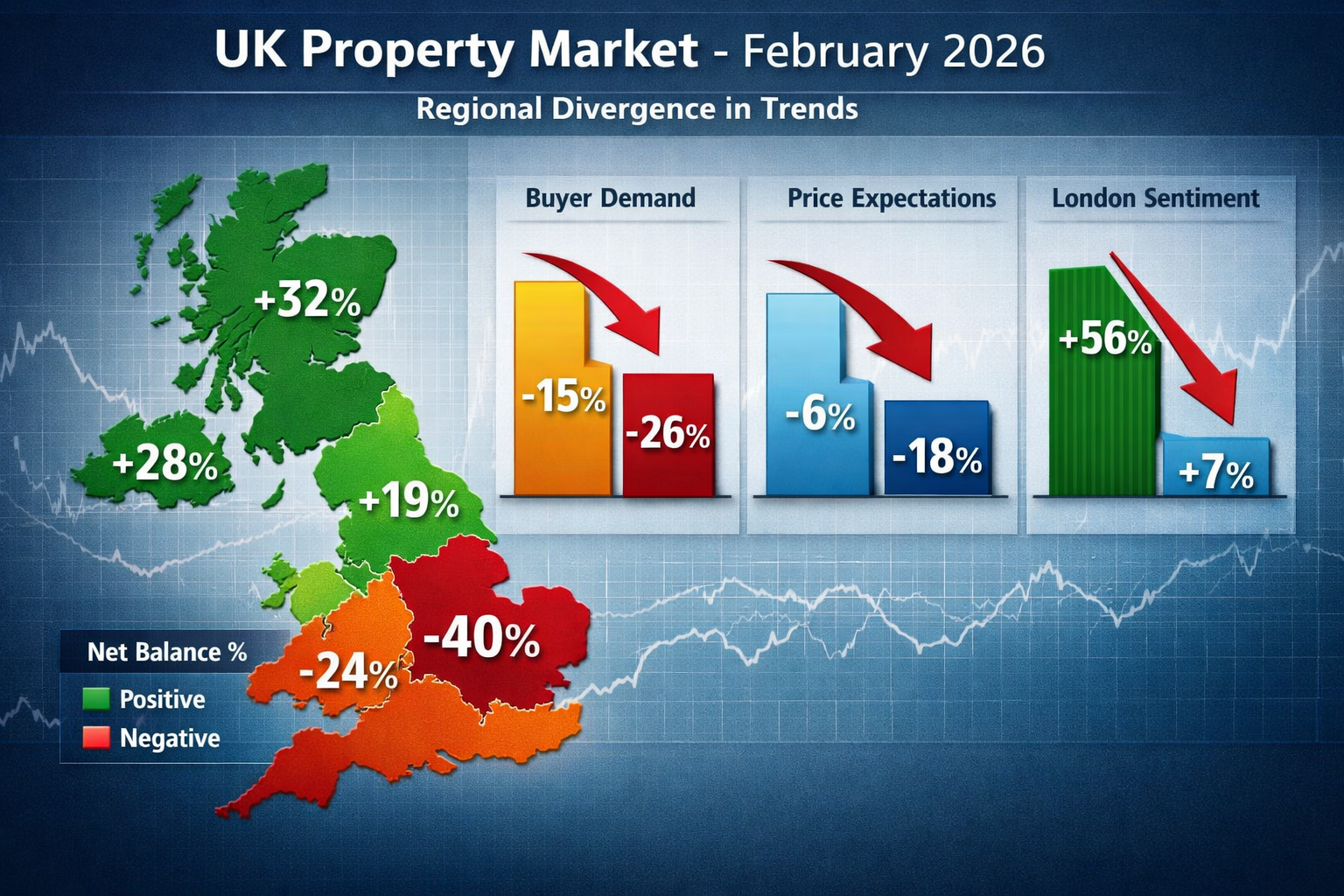
- February 2026 data shows dramatic market deterioration with buyer enquiries dropping to -26%, near-term price expectations falling to -18%, and London sentiment collapsing from +56% to +7%[2]
- Regional divergence complicates comparable analysis with London at -40% price pressure versus firmer conditions in Northern Ireland, Scotland, and North West regions[2]
- Enhanced data management and AI governance requirements mandate transparency in methodology, creating explicit documentation standards for expert witness testimony[1]
- Material uncertainty clauses and revaluation triggers become critical tools for defending assessments during periods of heightened geopolitical and market volatility[3]
Understanding the February 2026 RICS Data Shifts
The February 2026 residential market survey from RICS paints a concerning picture of renewed market weakness. New buyer enquiries dropped sharply to a net balance of -26%, down from -15% in January[2]. This deterioration reflects mounting concerns over interest rate trajectories and escalating geopolitical tensions affecting global markets.
Regional Performance Divergence
The national picture masks significant regional variations that complicate expert witness valuations:
| Region | Price Balance | Market Sentiment |
|---|---|---|
| London | -40% | Severe weakness |
| South East | -24% | Significant decline |
| East Anglia | -26% | Notable pressure |
| Northern Ireland | Firmer | Relative stability |
| Scotland | Firmer | Positive momentum |
| North West | Firmer | Sustained demand |
This geographic divergence creates substantial challenges for expert witnesses defending property valuations in London and the South East compared to other regions. When presenting evidence, experts must justify why comparable properties from different regions may not provide reliable benchmarks.
Price Expectations and Market Sentiment
The near-term price expectations balance fell dramatically to -18% in February from -6% in January[2], indicating accelerating pessimism among property professionals. Most striking is London's sentiment collapse—12-month price expectations dropped from +56% to just +7%[2], representing one of the sharpest reversals in recent market history.
"The sharp deterioration in buyer demand and price expectations reflects renewed uncertainty over the interest rate outlook and broader geopolitical concerns affecting market confidence." – RICS UK Residential Survey, February 2026[2]
For expert witnesses, these sentiment shifts require careful consideration when assessing market value. RICS registered valuers must distinguish between temporary sentiment-driven fluctuations and fundamental value changes that warrant valuation adjustments.
The 2025 RICS Red Book Updates: New Standards for Expert Witness Valuations in Geopolitical Market Volatility
The 2025 edition of the RICS Red Book introduces transformative requirements that directly impact how expert witnesses prepare and defend valuations during volatile market conditions.
Mandatory ESG Integration
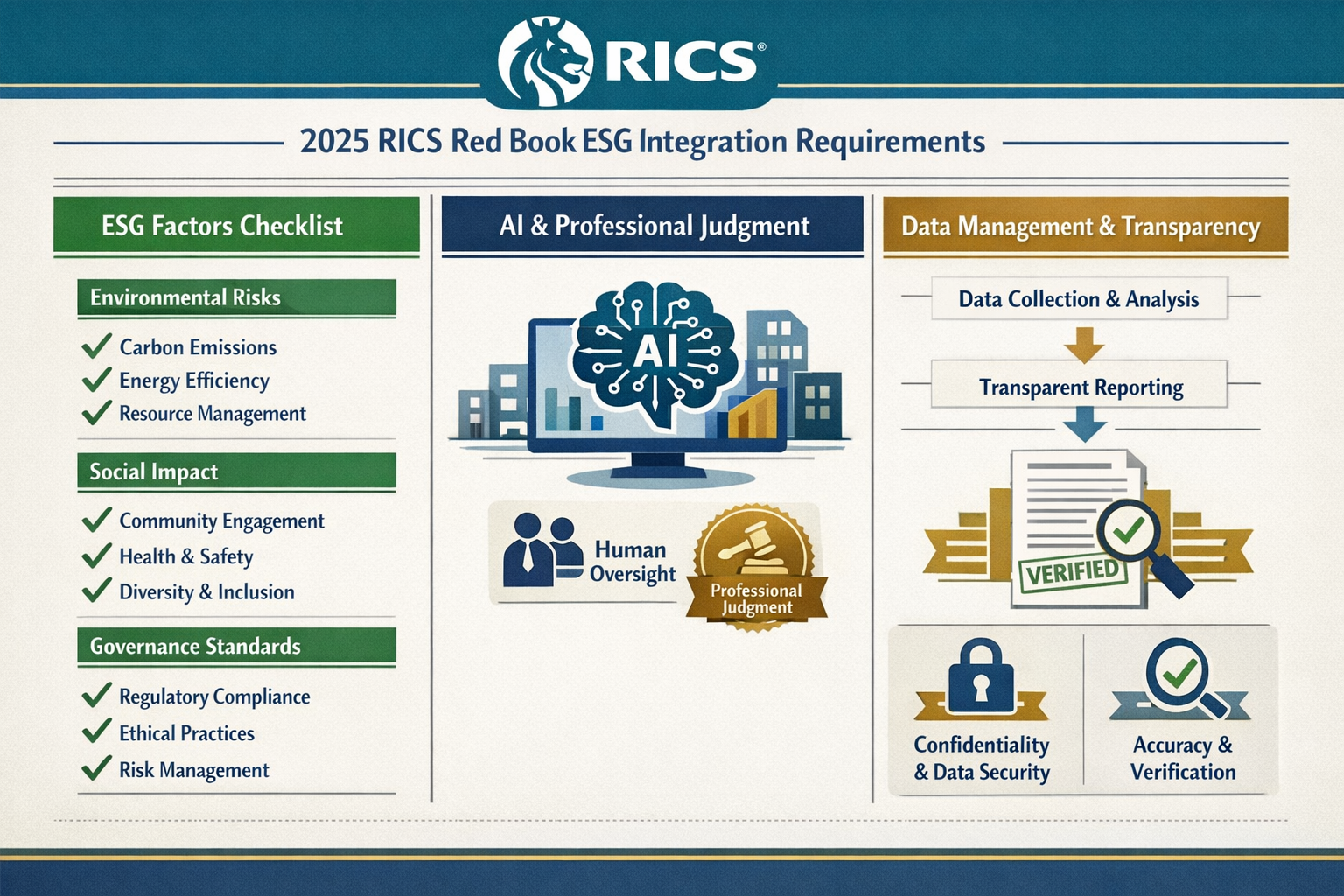
Perhaps the most significant change is the mandatory requirement to identify and quantify significant ESG factors[1]. This represents what industry experts call "a game changer in embracing ESG considerations." For expert witnesses, this creates new defensibility standards:
✅ Environmental factors: Flood risk, energy efficiency, climate adaptation measures
✅ Social considerations: Community impact, accessibility, health and safety
✅ Governance elements: Planning compliance, regulatory adherence, ownership structure
When defending assessments in tribunal settings, expert witnesses must now demonstrate they've systematically evaluated ESG factors and quantified their impact on property values. Failure to address material ESG considerations can undermine valuation credibility under cross-examination.
AI and Technology Governance
The updated Red Book permits AI and new technology usage in valuations provided there is human oversight and professional judgment applied[1]. This creates both opportunities and challenges for expert witnesses:
Opportunities:
- Enhanced data analysis capabilities
- Improved comparable property identification
- Sophisticated market trend modeling
Challenges:
- Explaining AI methodology to non-technical tribunal members
- Demonstrating adequate human oversight
- Defending algorithm choices and data inputs
Expert witnesses must be prepared to articulate how technology supports rather than replaces professional judgment, particularly when defending Red Book valuations in adversarial proceedings.
Enhanced Data Management Standards
As data sources proliferate, the Red Book now mandates transparency in data use, confidentiality protection, and data rights verification[1]. These requirements create explicit documentation standards for expert valuations:
- Data source verification: Documenting the reliability and appropriateness of all data sources
- Confidentiality protocols: Ensuring sensitive client and market data protection
- Rights verification: Confirming legal authority to use proprietary data
For expert witnesses, maintaining comprehensive data audit trails becomes essential. During cross-examination, opposing counsel will probe data sources, and experts must demonstrate rigorous verification processes.
Expanded Valuation Modeling Guidance
The consolidated standards now allow comparable information to include KPIs, metrics, and benchmarking data from service providers when subject to professional judgment[1]. This expansion recognizes modern valuation complexity but requires experts to:
- Justify why specific KPIs are relevant to the valuation
- Demonstrate how benchmarking data supports conclusions
- Explain weighting and adjustment methodologies
When preparing valuation reports for litigation or tribunal proceedings, expert witnesses should document their rationale for including non-traditional comparable data.
Defending Expert Witness Valuations Amid Geopolitical Market Volatility
The convergence of updated RICS standards and February 2026 market turbulence creates unique challenges for expert witnesses. Defending assessments requires strategic approaches that acknowledge uncertainty while maintaining professional credibility.
Material Uncertainty Clauses and Market Volatility
When geopolitical events create market instability, expert witnesses must consider whether material uncertainty clauses are appropriate. RICS guidance on valuation in extreme conditions emphasizes that material uncertainty should be declared when market evidence is insufficient to support confident valuation conclusions[4].
Indicators requiring material uncertainty consideration:
🔴 Sharp sentiment shifts (e.g., London's +56% to +7% collapse)[2]
🔴 Significant transaction volume declines
🔴 Wide bid-ask spreads indicating price discovery challenges
🔴 Geopolitical events affecting buyer confidence and financing
🔴 Rapid interest rate expectation changes
Including material uncertainty declarations protects expert witnesses from criticism when market conditions subsequently change. However, experts must carefully explain that uncertainty relates to confidence levels rather than professional competence.
Comparable Property Analysis in Divergent Markets
The February 2026 data's regional divergence creates substantial challenges for comparable analysis. Expert witnesses defending capital gains tax valuations or matrimonial valuations must justify their comparable selection criteria rigorously.
Best practices for comparable analysis:
1. Geographic boundaries: Define clear geographic parameters and justify why certain areas are included or excluded
2. Time adjustments: Apply market condition adjustments when using comparables from periods with different sentiment (e.g., pre-January 2026 versus post-February 2026)
3. Transaction quality: Distinguish between forced sales, distressed transactions, and arm's-length market transactions
4. Adjustment transparency: Document all adjustments with clear rationale and supporting market evidence
When market conditions shift rapidly, expert witnesses should consider using multiple valuation dates or providing valuation ranges that reflect market uncertainty rather than false precision.
Addressing Geopolitical Risk Factors
Geopolitical tensions affecting oil prices, interest rates, and investor confidence require explicit consideration in expert witness testimony. When defending assessments, experts should:
Identify specific geopolitical factors: Rather than vague references to "market uncertainty," identify specific events (trade tensions, regional conflicts, policy changes) affecting property markets
Quantify impact where possible: Use market data to demonstrate how specific geopolitical events have affected transaction volumes, pricing, or financing availability
Distinguish temporary versus structural impacts: Help tribunals understand which geopolitical effects represent temporary sentiment shifts versus fundamental market structure changes
Reference comparable precedents: Cite how markets responded to similar geopolitical events historically to provide context
For probate valuations or divorce valuations, expert witnesses must be particularly careful to explain how geopolitical factors affect valuation dates versus current market conditions.
Building Robust Evidence Packages
Expert witnesses defending valuations during volatile periods should prepare comprehensive evidence packages that anticipate challenges:
Core documentation requirements:
📋 Valuation report: Compliant with RICS Red Book standards, including ESG considerations[1]
📋 Comparable evidence: Detailed comparable property analysis with adjustment schedules
📋 Market data: Supporting evidence of market conditions at valuation date from RICS surveys and local market intelligence
📋 Methodology justification: Clear explanation of valuation approach selection and alternative methods considered
📋 Professional credentials: CV demonstrating relevant expertise and RICS accreditation
📋 Independence declaration: Statement confirming independence and absence of conflicts
Supplementary materials:
- Market reports from valuation date period
- Interest rate and financing condition data
- Regional market performance comparisons
- Transaction volume and velocity statistics
- Previous valuations (if applicable) with explanation of changes
The goal is creating a defensible narrative that demonstrates professional judgment applied systematically within RICS standards, acknowledging market uncertainty while providing reliable valuation conclusions.
Cross-Examination Preparation
Expert witnesses must anticipate common challenges during cross-examination in volatile market conditions:
Expected challenge areas:
"Why didn't you adjust for market changes?"
Response strategy: Demonstrate valuation reflects conditions at valuation date, with material uncertainty clause if appropriate. Distinguish between post-valuation events and information available at valuation date.
"Your comparable properties are from different market conditions"
Response strategy: Show time adjustments applied, explain market condition analysis, demonstrate why selected comparables remain most relevant despite timing differences.
"Other experts reached different conclusions"
Response strategy: Explain how professional judgment can lead to different but equally defensible conclusions within acceptable valuation ranges. Critique alternative methodologies if flawed.
"You failed to consider [specific geopolitical factor]"
Response strategy: Demonstrate factor was considered (if true) or explain why it wasn't material to valuation at relevant date. Reference market evidence supporting position.
"Your ESG analysis is inadequate"
Response strategy: Reference 2025 Red Book requirements[1], demonstrate systematic ESG factor identification, show quantification methodology for significant factors.
Preparation should include mock cross-examination with legal counsel to identify weaknesses and refine responses.
Practical Strategies for Expert Witness Valuations in Current Market Conditions
Given the February 2026 market shifts, expert witnesses should adopt specific strategies to strengthen valuation defensibility.
Revaluation Triggers and Client Advisory
Expert witnesses have a duty to advise clients on when revaluation may be necessary[3]. The market volatility evident in January and February 2026 data suggests several revaluation triggers:
Trigger events requiring revaluation consideration:
- Sentiment shifts exceeding 20%: London's +56% to +7% collapse clearly exceeds this threshold[2]
- Regional divergence affecting comparables: When subject property's region shows materially different performance than comparable regions
- Interest rate expectation changes: Material shifts in rate outlook affecting property financing costs
- Transaction volume declines: Significant market liquidity reductions affecting price discovery
- Geopolitical events: Major international developments affecting investor confidence
For retrospective valuations, experts must carefully reconstruct market conditions at the relevant historical date, distinguishing information available then from subsequent developments.
Sector-Specific Considerations
Different property sectors respond differently to geopolitical volatility, requiring tailored expert witness approaches:
Residential property: Focus on buyer sentiment data from RICS surveys[2], mortgage availability, and regional performance divergence
Commercial property: Emphasize tenant covenant strength, lease terms, and sector-specific demand drivers that may buffer geopolitical impacts[6]
Specialized valuations: For charity valuations or shared ownership valuations, explain how specific regulatory or financing frameworks affect market volatility exposure
Technology and Data Management
Implementing the Red Book's technology governance requirements[1] requires expert witnesses to:
Document AI usage: Maintain records of any AI tools used, including algorithms, data inputs, and human oversight applied
Verify data sources: Keep audit trails showing data source verification, particularly for proprietary databases or third-party analytics
Maintain confidentiality: Implement robust data protection protocols, especially when handling sensitive client information or proprietary market data
Ensure reproducibility: Structure valuation processes so another competent expert could replicate the analysis and reach similar conclusions
These documentation practices become critical when defending methodology choices under cross-examination.
Multi-Jurisdictional Complexity
The removal of cross-references to national supplements in the 2025 Red Book update may introduce compliance challenges for multi-jurisdictional portfolios[1]. Expert witnesses working on properties spanning multiple regions or countries should:
- Identify jurisdiction-specific requirements explicitly
- Document how valuation complies with both RICS global standards and local regulations
- Explain any conflicts between standards and resolution approach
- Consider engaging local market experts for jurisdiction-specific insights
For freehold valuations or commercial property assessments spanning multiple markets, this multi-jurisdictional awareness becomes essential.

Case Study Applications: Defending Assessments in Real Scenarios
Examining hypothetical scenarios illustrates how expert witnesses can apply these principles when defending valuations amid February 2026 market conditions.
Scenario 1: London Residential Divorce Valuation
Context: Expert witness provides matrimonial valuation for London property dated January 15, 2026. By hearing date in March 2026, market sentiment has collapsed from +56% to +7%[2].
Challenge: Opposing counsel argues valuation is now "stale" and should be reduced to reflect February deterioration.
Defense strategy:
- Emphasize valuation reflects market conditions at January 15, 2026 valuation date
- Present February RICS data[2] as post-valuation event not available to market participants in January
- Explain professional standards require valuation to reflect information available at valuation date
- Offer to provide updated valuation if court requires current market value, but distinguish this from original assessment's validity
Outcome: Court accepts January valuation as accurate for its date while ordering updated assessment for current settlement purposes.
Scenario 2: Commercial Property Investment Valuation
Context: Expert witness values commercial property portfolio for investment dispute, with properties spanning London, Manchester, and Edinburgh.
Challenge: Regional divergence[2] means London properties show -40% pressure while Scotland remains firm, creating wide performance variation within single portfolio.
Defense strategy:
- Present regional market data demonstrating divergence is market reality, not valuation error
- Show comparable analysis used region-specific comparables rather than cross-regional averaging
- Explain how tenant covenant strength and lease terms buffer some properties from regional sentiment shifts
- Apply 2025 Red Book ESG requirements[1] to identify properties with ESG factors affecting regional performance differently
Outcome: Tribunal accepts regional variation as properly reflected in valuation methodology.
Scenario 3: Probate Valuation with Material Uncertainty
Context: Expert witness provides probate valuation dated February 20, 2026, amid sharp market deterioration.
Challenge: HMRC questions whether material uncertainty clause is justified or represents expert uncertainty about proper valuation.
Defense strategy:
- Reference RICS guidance on valuation in extreme conditions[4] showing material uncertainty appropriate when market evidence insufficient
- Present February 2026 data[2] showing -26% buyer demand, -18% price expectations, and rapid sentiment deterioration
- Demonstrate transaction volume declines and widening bid-ask spreads indicating price discovery challenges
- Explain material uncertainty relates to market conditions, not expert competence—valuation remains best professional judgment given available evidence
Outcome: HMRC accepts material uncertainty declaration as appropriate professional response to market conditions.
Future-Proofing Expert Witness Practices
As geopolitical volatility and market uncertainty appear likely to persist through 2026 and beyond, expert witnesses should implement long-term practice improvements.
Continuous Professional Development
Staying current with evolving RICS standards and market conditions requires ongoing learning:
- Red Book updates: Monitor RICS guidance updates and practice statements
- ESG competency: Develop expertise in ESG factor identification and quantification[1]
- Technology skills: Build understanding of AI tools and data analytics platforms
- Geopolitical awareness: Follow international developments affecting property markets
- Legal precedents: Track tribunal and court decisions on valuation disputes
Quality Assurance Systems
Implementing robust quality assurance strengthens valuation defensibility:
Internal review processes: Establish peer review for complex or high-value expert witness valuations
Documentation standards: Create templates ensuring consistent documentation of methodology, comparables, adjustments, and professional judgment
Data verification protocols: Implement systematic data source verification and audit trail maintenance
Independence safeguards: Establish procedures ensuring expert witness independence from client advocacy
Post-engagement reviews: Analyze challenges faced during cross-examination to improve future practice
Building Tribunal Credibility
Expert witness credibility extends beyond individual valuations to long-term professional reputation:
Consistency: Maintain consistent methodology across engagements, avoiding appearance of tailoring approaches to client preferences
Transparency: Acknowledge valuation limitations and uncertainties rather than projecting false certainty
Responsiveness: Provide clear, direct answers during cross-examination rather than evasive responses
Professional demeanor: Maintain composure and professionalism even under aggressive questioning
Continuous improvement: Learn from challenges and incorporate lessons into future practice
These reputation-building practices become particularly valuable when expert witnesses face repeat engagements or work in specialized markets where tribunal members may encounter them multiple times.
Conclusion
Expert Witness Valuations in Geopolitical Market Volatility: Defending Assessments Amid February 2026 RICS Data Shifts presents unprecedented challenges for property professionals. The convergence of mandatory ESG integration requirements, enhanced data management standards, and dramatic market deterioration—with buyer demand dropping to -26% and London sentiment collapsing from +56% to +7%—creates a complex environment for defensible valuations.
Success requires expert witnesses to embrace the 2025 RICS Red Book's transformative requirements while acknowledging market uncertainty through appropriate material uncertainty clauses and robust comparable analysis. The regional divergence evident in February 2026 data, with London at -40% pressure versus firmer conditions in Northern Ireland, Scotland, and the North West, demands sophisticated geographic analysis and transparent adjustment methodologies.
Actionable Next Steps
For surveyors acting as expert witnesses in current market conditions:
-
Review and update valuation methodologies to ensure full compliance with 2025 Red Book requirements, particularly mandatory ESG integration[1]
-
Implement enhanced documentation systems capturing data source verification, AI tool governance, and professional judgment rationale
-
Develop material uncertainty assessment frameworks to systematically evaluate when market conditions warrant uncertainty declarations
-
Build comprehensive evidence packages anticipating cross-examination challenges around comparable selection, time adjustments, and geopolitical risk factors
-
Engage in continuous professional development focusing on ESG competency, technology governance, and geopolitical market analysis
-
Establish quality assurance processes including peer review for complex engagements and post-engagement learning reviews
-
Consider seeking specialist guidance from RICS registered valuers with expert witness experience when facing particularly complex or high-stakes assignments
The February 2026 market shifts serve as a reminder that property valuation operates within dynamic economic and geopolitical contexts. Expert witnesses who acknowledge this complexity while maintaining rigorous professional standards will build tribunal credibility and deliver defensible assessments even amid significant market volatility. By embracing the enhanced RICS requirements and implementing robust documentation practices, surveyors can confidently defend their valuations against scrutiny while upholding the profession's integrity and public trust.
References
[1] Changing Playbook What Rics Red Book Revisions Mean For Cre Valuations – https://www.altusgroup.com/insights/changing-playbook-what-rics-red-book-revisions-mean-for-cre-valuations/
[2] Uk Residential Survey February 2026 – https://www.rics.org/news-insights/uk-residential-survey-february-2026
[3] Valuation Techniques For Stabilising National House Prices Rics January 2026 Survey Insights For Surveyors – https://nottinghillsurveyors.com/blog/valuation-techniques-for-stabilising-national-house-prices-rics-january-2026-survey-insights-for-surveyors
[4] Real Estate Valuation Extreme Conditions – https://ww3.rics.org/uk/en/journals/property-journal/real-estate-valuation-extreme-conditions.html
[6] Rics Monitor Why 2026 Is A Market Of Specific Opportunities – https://www.commercialsearch.com/news/rics-monitor-why-2026-is-a-market-of-specific-opportunities/