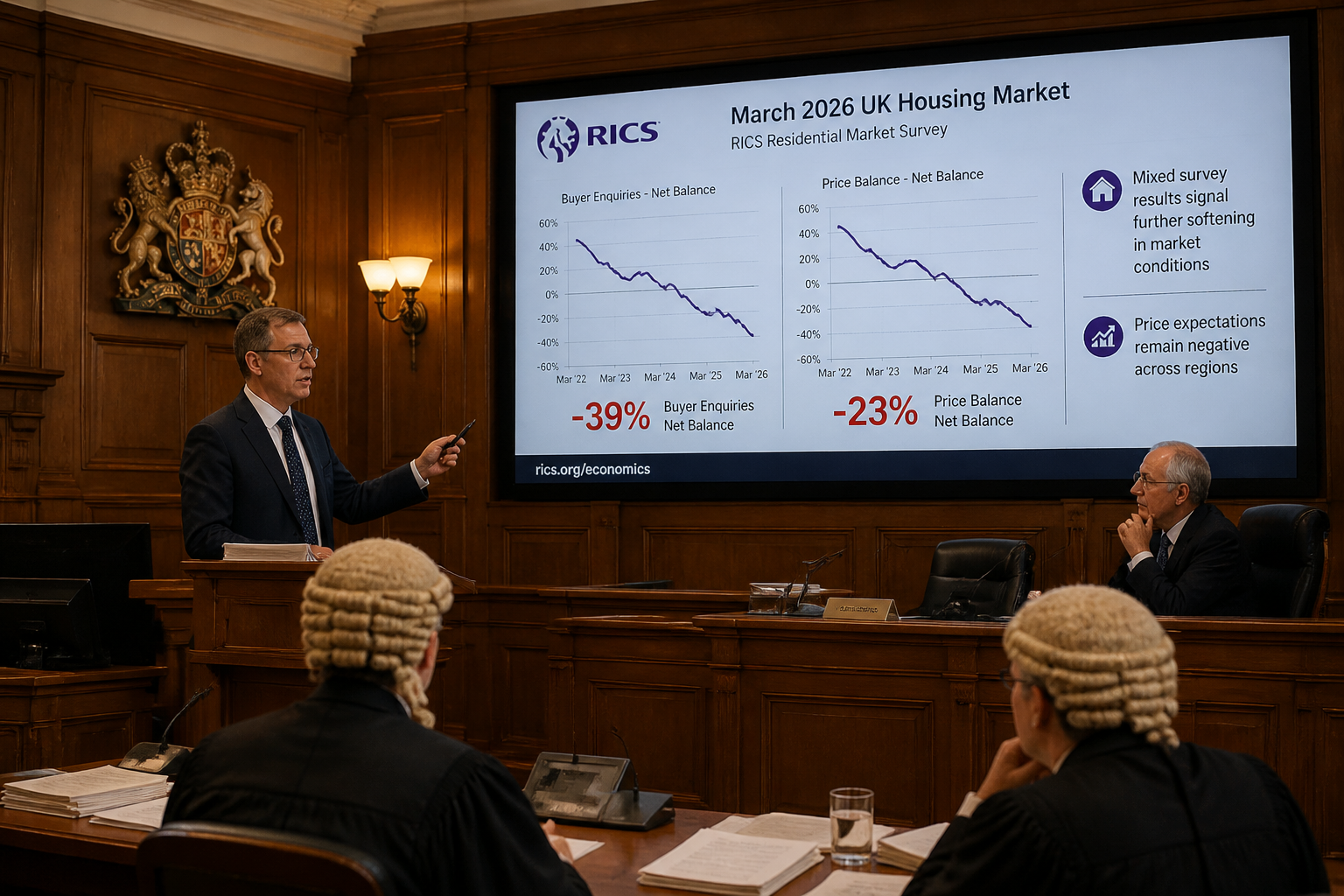
New buyer enquiries collapsed to a net balance of -39% in March 2026 — the weakest reading since August 2023 — as escalating Middle East tensions pushed borrowing costs higher and rattled confidence across the UK property market [1]. For solicitors, barristers, and property professionals involved in litigation, that single statistic signals something urgent: expert witness valuations are now being challenged like never before.
When markets move fast and unpredictably, courts need expert witnesses who can defend their figures with precision. The question is no longer just "what is this property worth?" — it is "how do you justify that number in a market shaped by geopolitical shocks?" This article examines how Expert Witness Valuations in Geopolitical Volatility: RICS Protocols for 2026 House Price Disputes Post-Middle East Escalations are reshaping litigation strategy, what the RICS framework demands from valuers, and how practitioners can build defensible, CPR-compliant testimony.
Key Takeaways 📌
- Buyer demand is at a three-year low (net -39% in March 2026), driven by Middle East conflict raising borrowing costs [1].
- House price balances fell to -23% in March 2026, with short-term expectations at -43% [1] — creating fertile ground for valuation disputes.
- RICS Red Book Global Standards remain the gold standard for expert witness reports, but volatile market conditions demand enhanced methodology disclosure.
- CPR Part 35 compliance is non-negotiable; courts are increasingly scrutinising how geopolitical risk factors are evidenced and weighted.
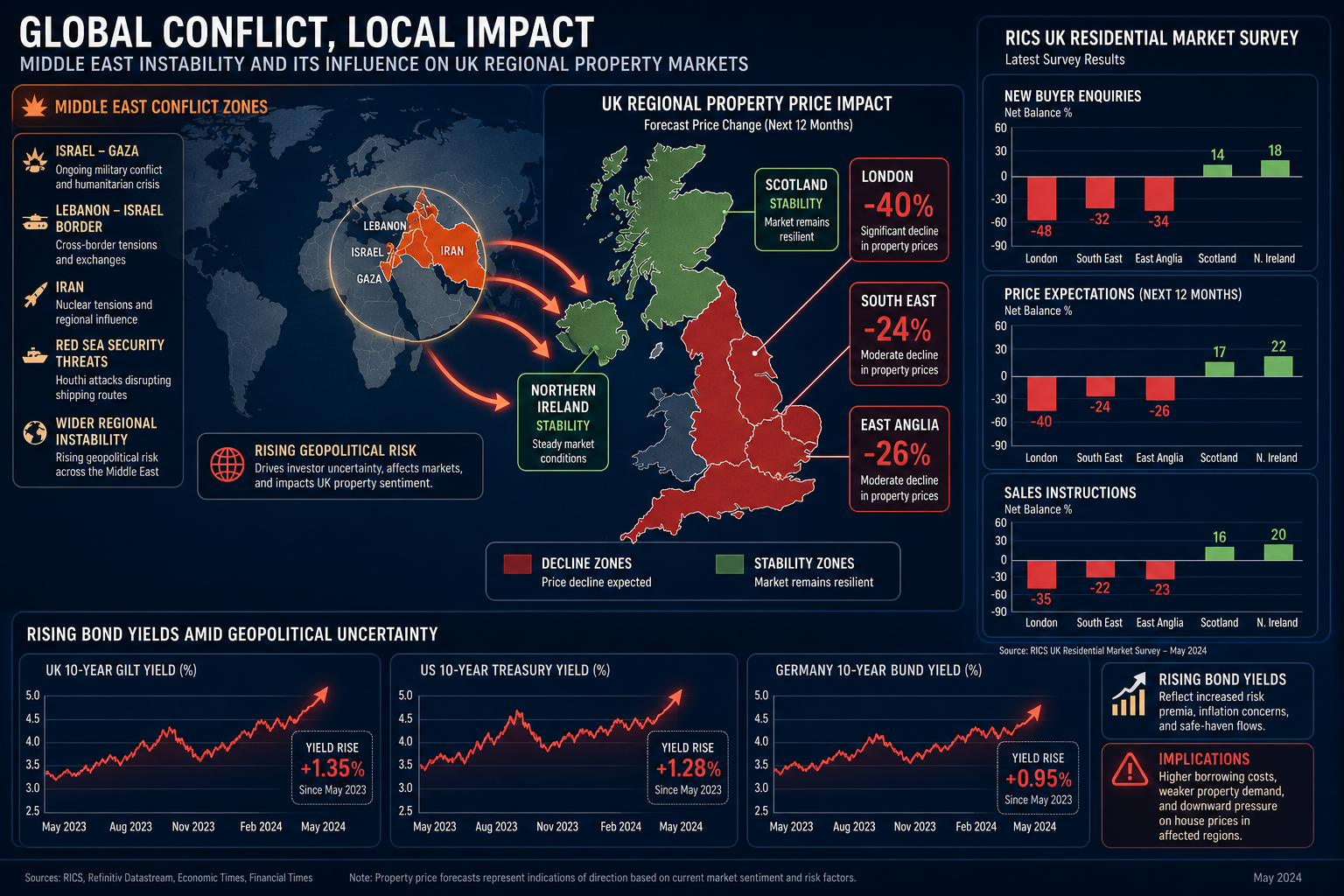
- Regional divergence (London -40%, Scotland broadly stable) means a one-size-fits-all approach to comparable evidence will fail in court [3].
Why Geopolitical Volatility Is Driving a Wave of Property Disputes in 2026
The link between Middle East escalations and UK house prices is not theoretical — it is measurable and documented. Ongoing conflict in the region has driven energy price volatility, contributed to inflationary pressure, and forced bond yields higher. Higher yields feed directly into mortgage rates, cooling buyer demand and suppressing property values [2].
The RICS UK Residential Market Survey for March 2026 paints a stark picture [1]:
| Metric | February 2026 | March 2026 | Change |
|---|---|---|---|
| New Buyer Enquiries (net balance) | -28% | -39% | ⬇️ -11pts |
| House Price Balance | -14% | -23% | ⬇️ -9pts |
| 3-Month Price Expectations | -31% | -43% | ⬇️ -12pts |
| 12-Month Outlook | Positive | Broadly Flat | ⬇️ Deteriorated |
Source: RICS UK Residential Market Survey, March 2026 [1]
This deterioration creates a perfect storm for disputes. Sellers who agreed prices in late 2025 are now completing in a market that has moved against them. Buyers who pulled out of transactions cite market uncertainty. Divorce proceedings, probate valuations, and tax disputes all hinge on what a property was worth at a specific date — a date that may now sit on the wrong side of a geopolitical shock.
💬 "When market conditions shift this rapidly, every historic valuation becomes a potential battlefield. The expert witness who cannot explain geopolitical risk factors in plain, evidenced terms will struggle under cross-examination."
For practitioners handling matrimonial property valuations or retrospective property valuations in London, understanding the precise timeline of market deterioration is now a core competency, not an optional extra.
Regional Divergence: Why Location Changes Everything
The national headline figures mask significant regional variation [3]:
- 🔴 London: Net price balance of -40% — the sharpest decline in England
- 🔴 South East: -24% — sustained downward pressure
- 🔴 East Anglia: -26% — consistent weakness
- 🟡 Midlands & North West: Modest negative readings
- 🟢 Scotland: Broadly stable
- 🟢 Northern Ireland: Holding firm
This divergence is legally significant. An expert witness presenting London comparables must explicitly account for the capital's amplified sensitivity to interest rate movements and international investor sentiment — both of which are directly affected by geopolitical instability [4].
Understanding RICS Protocols for Expert Witness Valuations in Geopolitical Volatility: RICS Protocols for 2026 House Price Disputes Post-Middle East Escalations
The RICS Red Book Global Standards (2022, as updated) provide the foundational framework for all formal valuations used in litigation. In volatile market conditions, several provisions become especially critical.
The Red Book's Core Requirements in Disputed Markets
1. Basis of Value — Market Value vs. Special Assumptions
In a fast-moving market, the basis of value must be stated with absolute clarity. Market Value assumes a hypothetical willing buyer and seller with adequate market exposure — but when buyer enquiries have collapsed by 39% [1], "adequate market exposure" requires careful definition. Expert witnesses must address:
- What constitutes a reasonable marketing period in the subject market at the valuation date?
- Were there forced-sale conditions that depress value below Market Value?
- Does the instruction require a Special Assumption (e.g., "as if the market had not been affected by geopolitical events")?
2. Comparable Evidence Selection and Adjustment
The RICS requires valuers to use the best available comparable evidence. In a declining market, this creates a timing problem: recent sales may reflect panic-selling, while older sales may be too stale to be reliable. The expert witness must:
- Document the date of each comparable transaction
- Apply explicit time adjustments supported by index data (e.g., ONS House Price Index, Halifax, Nationwide)
- Cross-reference with RICS survey data to justify the adjustment quantum [1][3]
3. Market Conditions Narrative
The Red Book requires valuers to comment on market conditions. In 2026, this section cannot be boilerplate. A court-ready report must reference:
- The specific RICS survey findings for the relevant month and region
- The mechanism by which Middle East escalations have affected UK borrowing costs [2]
- The distinction between temporary market disruption and structural value change
💬 "A valuation that ignores geopolitical context in 2026 is not just incomplete — it is professionally indefensible."
CPR Part 35: The Legal Framework That Governs Expert Witnesses
The Civil Procedure Rules Part 35 sets out the duties of expert witnesses in England and Wales. Key obligations include:
- Duty to the court: The expert's primary duty is to the court, not the instructing party
- Statement of truth: The report must include a declaration of compliance with CPR Part 35
- Single Joint Expert (SJE) considerations: Courts may direct a single joint expert; valuers must be prepared for this scenario
- Questions from opposing parties: Experts must respond to written questions within 28 days
In volatile markets, the independence requirement is under particular pressure. Instructing solicitors may push for valuations that support their client's position. The expert witness must resist this pressure and ensure their methodology is transparent, reproducible, and grounded in RICS standards.
For RICS registered valuers in London handling dispute instructions, maintaining this independence while producing commercially useful reports is a core professional skill.
The RICS's Own Response to Middle East Volatility
RICS has been proactive in supporting members navigating geopolitical uncertainty [6]. Guidance issued to members operating across the Middle East and those valuing assets affected by regional instability emphasises:
- Enhanced market uncertainty clauses in valuation reports
- Greater transparency around comparability limitations
- Explicit sensitivity analysis showing how value changes under different market scenarios
These principles translate directly to UK expert witness work. A valuation report that includes a sensitivity table — showing, for example, how a 1% rise in mortgage rates affects the subject property's value — is far more defensible than one that presents a single point estimate.
Building a Defensible Expert Witness Report: Practical Strategies for 2026 Disputes
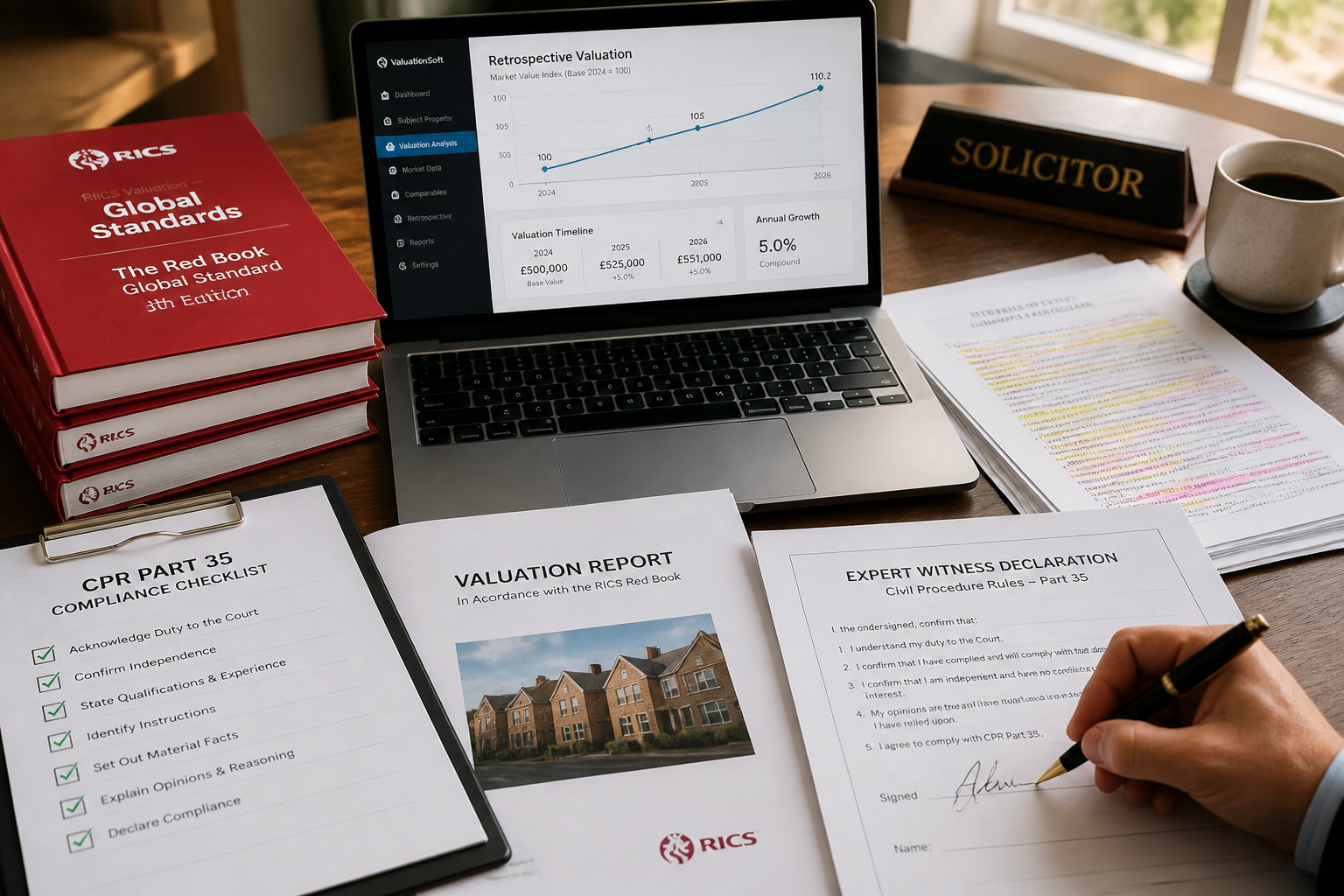
The practical challenge for expert witnesses in 2026 is translating complex, fast-moving market data into testimony that a judge can follow and trust. The following framework addresses the most common failure points.
Step 1: Establish the Precise Valuation Date
In geopolitically volatile markets, a valuation date of "early 2026" is insufficient. The expert must pin the date to a specific day, then map that date against:
- The RICS monthly survey data closest to that date [1][3]
- Mortgage rate movements driven by bond yield changes
- Any specific news events (e.g., escalation announcements) that may have caused immediate market reactions
For capital gains tax valuations or ATED valuations, the valuation date is often fixed by statute — making this precision even more critical.
Step 2: Build a Robust Comparable Evidence Matrix
A court-ready comparable evidence matrix should include:
| Comparable | Address | Sale Date | Sale Price | Adjustments | Adjusted Value |
|---|---|---|---|---|---|
| 1 | [Property A] | Jan 2026 | £X | Time (-3%), size (+2%) | £Y |
| 2 | [Property B] | Nov 2025 | £X | Time (-6%), condition (+5%) | £Y |
| 3 | [Property C] | Mar 2026 | £X | Time (0%), location (-4%) | £Y |
Each adjustment must be supported by cited evidence — not just professional judgment. In 2026, the RICS survey data provides the time adjustment benchmark [1][3], while local transaction databases and Land Registry data support location and condition adjustments.
Step 3: Address Geopolitical Risk Explicitly
The expert witness report must contain a dedicated section on market conditions that:
- Names the geopolitical factors affecting the market (Middle East escalations, energy price volatility, borrowing cost transmission)
- Quantifies the market impact using RICS and other data sources [1][2]
- Explains the transmission mechanism — how conflict affects bond yields, which affects mortgage rates, which affects buyer demand and prices
- Distinguishes between regional and national effects [3]
This section should be written in plain English. Judges are not property economists. The expert who can explain a complex causal chain clearly and concisely will always outperform one who hides behind jargon.
Step 4: Include Sensitivity Analysis
Rather than presenting a single value, consider presenting a value range with explicit assumptions:
- Base case: Current market conditions persist
- Downside scenario: Geopolitical escalation worsens; mortgage rates rise a further 0.5%
- Upside scenario: Ceasefire/de-escalation; rates stabilise or fall
This approach aligns with RICS guidance on market uncertainty [6] and demonstrates the intellectual rigour courts expect from expert witnesses.
Step 5: Prepare for Cross-Examination on Methodology
Opposing counsel in 2026 disputes will likely challenge:
- Why specific comparables were chosen (and others excluded)
- The quantum of time adjustments — is -3% per month evidenced or assumed?
- Whether the RICS survey data is representative of the specific micro-market
- The expert's independence from the instructing party
Preparation for these challenges should begin at the report-drafting stage, not the night before the hearing. Every methodological choice should be documented with its rationale.
For complex disputes involving lease extension valuations or divorce property valuations, the stakes of inadequate preparation are particularly high — these cases often turn on relatively small differences in assessed value that can have large financial consequences for the parties involved.
Common Expert Witness Pitfalls in Volatile Markets ⚠️
- ❌ Using pre-volatility comparables without adjustment — courts will notice the timing gap
- ❌ Ignoring regional divergence — national averages are not local evidence
- ❌ Boilerplate market conditions commentary — generic text signals lack of research
- ❌ Failing to disclose methodology limitations — transparency builds credibility
- ❌ Overstating precision — a single point estimate in a volatile market invites challenge
- ✅ Citing RICS survey data by month and region [1][3]
- ✅ Explaining the geopolitical transmission mechanism in plain English [2]
- ✅ Including a sensitivity analysis or value range
- ✅ Maintaining a clear audit trail from instruction to conclusion
For those seeking a broader understanding of how different factors interact in property valuations, the guide to valuation factors provides useful foundational context that complements expert witness work.
Conclusion: Actionable Next Steps for Expert Witnesses in 2026
The convergence of Middle East geopolitical escalations, rising borrowing costs, and a weakening UK housing market has created conditions where Expert Witness Valuations in Geopolitical Volatility: RICS Protocols for 2026 House Price Disputes Post-Middle East Escalations are no longer a niche specialism — they are a mainstream litigation requirement.
With buyer demand at a three-year low [1], house prices under sustained downward pressure [1], and regional markets diverging sharply [3], every disputed valuation in 2026 carries heightened scrutiny. Courts expect expert witnesses who understand not just property values, but the macro-economic and geopolitical forces shaping them.
Here are the immediate actionable steps for practitioners:
- Update your market conditions library — ensure you have the RICS monthly survey data for every month from Q3 2025 onwards, segmented by region [1][3]
- Review your report template — does it include a dedicated geopolitical risk section? If not, add one now
- Stress-test your comparable evidence — can you defend every time adjustment with cited data?
- Practise your cross-examination responses — brief a colleague to challenge your methodology before you face opposing counsel
- Engage RICS guidance on market uncertainty — the institution's support resources for members navigating volatile conditions are directly relevant [6]
- Consult a specialist — if you are instructing an expert witness rather than acting as one, ensure the valuer you appoint holds current RICS registration and has demonstrable experience in disputed valuations
The property market of 2026 rewards preparation and penalises complacency. Expert witnesses who build their reports on transparent, evidenced, RICS-compliant methodology will not just survive cross-examination — they will define the outcome of disputes.
References
[1] UK Housing Market Slows As Ongoing Middle East Conflict Raises Borrowing Costs – https://www.rics.org/news-insights/uk-housing-market-slows-as-ongoing-middle-east-conflict-raises-borrowing-costs
[2] building.co.uk – https://www.building.co.uk/news/uk-housing-market-to-stagnate-as-middle-east-conflict-raises-borrowing-costs-says-rics/5141680.article
[3] UK Residential Survey February 2026 – https://www.rics.org/news-insights/uk-residential-survey-february-2026
[4] housingtoday.co.uk – https://www.housingtoday.co.uk/news/uk-housing-market-to-stagnate-in-year-ahead-as-middle-east-conflict-raises-borrowing-costs-says-rics/5141678.article
[5] economictimes – https://economictimes.com/markets/digital-real-estate/realty-news/uk-home-buyer-sentiment-hit-by-worries-stemming-from-middle-east-conflict-rics-says/articleshow/129501626.cms
[6] Supporting Our Members Across Middle East – https://www.rics.org/news-insights/supporting-our-members-across-middle-east