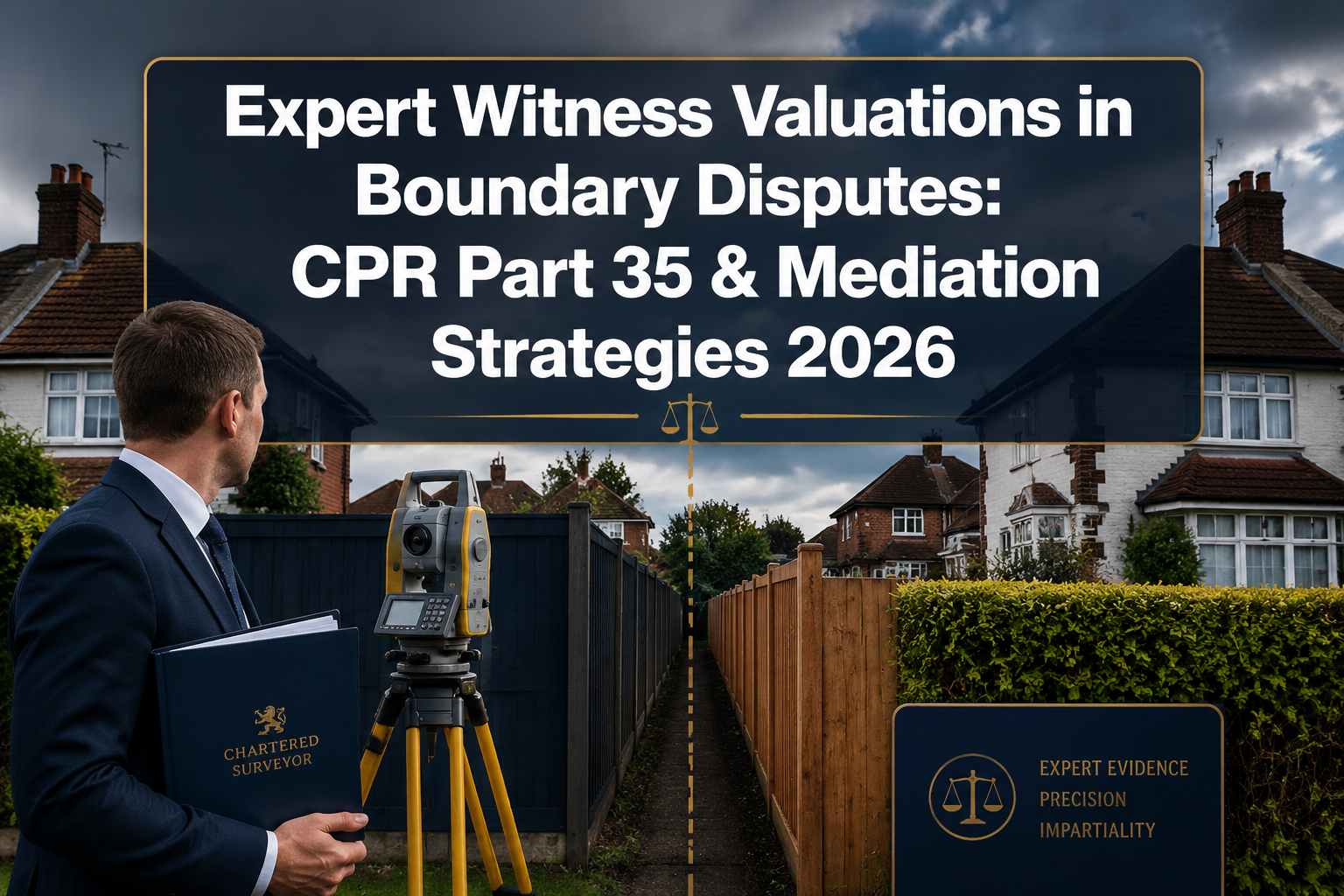
Boundary disputes between neighbours cost UK property owners an estimated £30,000–£100,000 in litigation fees when cases reach the First-tier Tribunal or High Court — yet research consistently shows that over 70% of these disputes could be resolved far earlier with the right expert evidence in place. The growing demand for Expert Witness Valuations in Neighbour Boundary Disputes: CPR Part 35 Compliance and Mediation Strategies for 2026 Settlements reflects a significant shift: courts, mediators, and solicitors are increasingly relying on RICS-qualified surveyors not just to measure land, but to quantify the financial impact of disputed boundaries on property values.
This article unpacks how expert witness surveyors operate within the Civil Procedure Rules framework, what CPR Part 35 compliance actually demands in practice, and how well-prepared valuation evidence can unlock faster, cheaper mediated settlements in 2026.
Key Takeaways 📌
- CPR Part 35 governs all expert evidence in civil proceedings — an expert's primary duty is to the court, not to the instructing party.
- A RICS-qualified expert witness surveyor can quantify the financial impact of a boundary encroachment, making abstract disputes tangible for courts and mediators alike.
- Single Joint Expert (SJE) appointments under CPR Part 35 are increasingly common in lower-value boundary disputes to control costs.
- Mediation supported by expert valuation evidence resolves the majority of boundary disputes before trial — saving months of delay and significant legal fees.
- Compliance failures — such as submitting an expert report that lacks the required Part 35 declaration — can result in evidence being excluded entirely.
What Is an Expert Witness Surveyor in a Boundary Dispute?
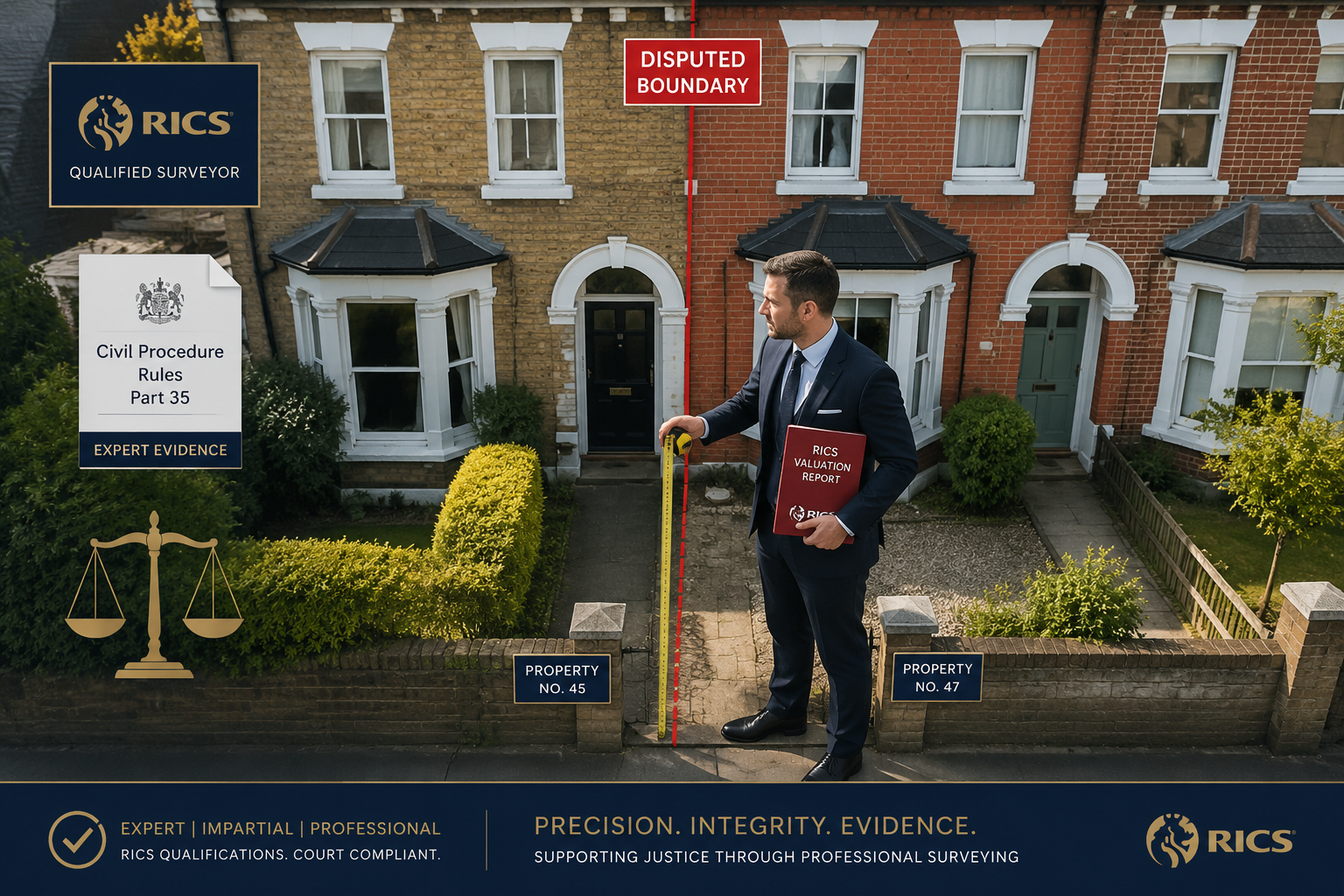
A boundary dispute arises when two neighbouring property owners disagree about the exact legal line dividing their land. These disputes can involve encroaching fences, walls, extensions, driveways, or garden boundaries — and the financial stakes are often surprisingly high, even for relatively small strips of land [2].
An expert witness surveyor is a RICS-qualified professional appointed to provide independent, objective evidence on matters within their specialist knowledge. In boundary disputes, their role typically covers:
- Interpreting title deeds and Land Registry plans to establish the legal boundary
- Conducting measured surveys to identify physical encroachments
- Producing valuation evidence quantifying the financial impact of the disputed land
- Preparing a CPR Part 35-compliant expert report for use in court or mediation
- Attending hearings to give oral evidence and answer questions under cross-examination [3]
💬 "The expert's overriding duty is to the court, not to the party who instructed them. This independence is what gives expert evidence its weight." — CPR Part 35.3 [1]
For those navigating neighbour disputes, understanding this distinction is critical: an expert witness is not an advocate. They must present findings impartially, even if those findings are unfavourable to the instructing party.
Understanding CPR Part 35: The Legal Framework for Expert Evidence
What CPR Part 35 Requires
Part 35 of the Civil Procedure Rules is the cornerstone of expert evidence in English and Welsh civil litigation [1]. Its key provisions include:
| Requirement | Detail |
|---|---|
| Court Permission | Expert evidence may only be used if the court gives permission [1] |
| Duty to the Court | The expert's duty overrides any obligation to the instructing party [1] |
| Single Joint Expert | Courts may direct that one expert be appointed jointly by both parties [1] |
| Written Questions | Parties may submit written questions to the expert within 28 days of the report |
| Form and Content | Reports must comply with Practice Direction 35 and include a specific declaration |
The Mandatory Part 35 Declaration
Every expert report submitted to court must include a declaration confirming that:
✅ The expert understands their duty to the court
✅ The report complies with the requirements of Part 35
✅ The expert has not received instructions that have compromised their independence
✅ The expert will notify the court if their opinion changes
Failure to include this declaration — or submitting a report that reads more like advocacy than independent analysis — can result in the evidence being struck out entirely [1]. This is a common and costly mistake.
Single Joint Experts in Boundary Disputes
In lower-value boundary disputes (typically below £25,000), courts frequently direct the appointment of a Single Joint Expert (SJE) rather than allowing each party to instruct their own surveyor [1]. The SJE:
- Is jointly instructed by both parties
- Answers written questions from both sides
- Provides one neutral report to the court
This approach significantly reduces costs and avoids the "battle of experts" that can extend litigation unnecessarily. For disputes involving party wall matters, an SJE with dual expertise in boundary law and party wall procedure is particularly valuable.
Expert Witness Valuations in Neighbour Boundary Disputes: How Surveyors Quantify Financial Impact
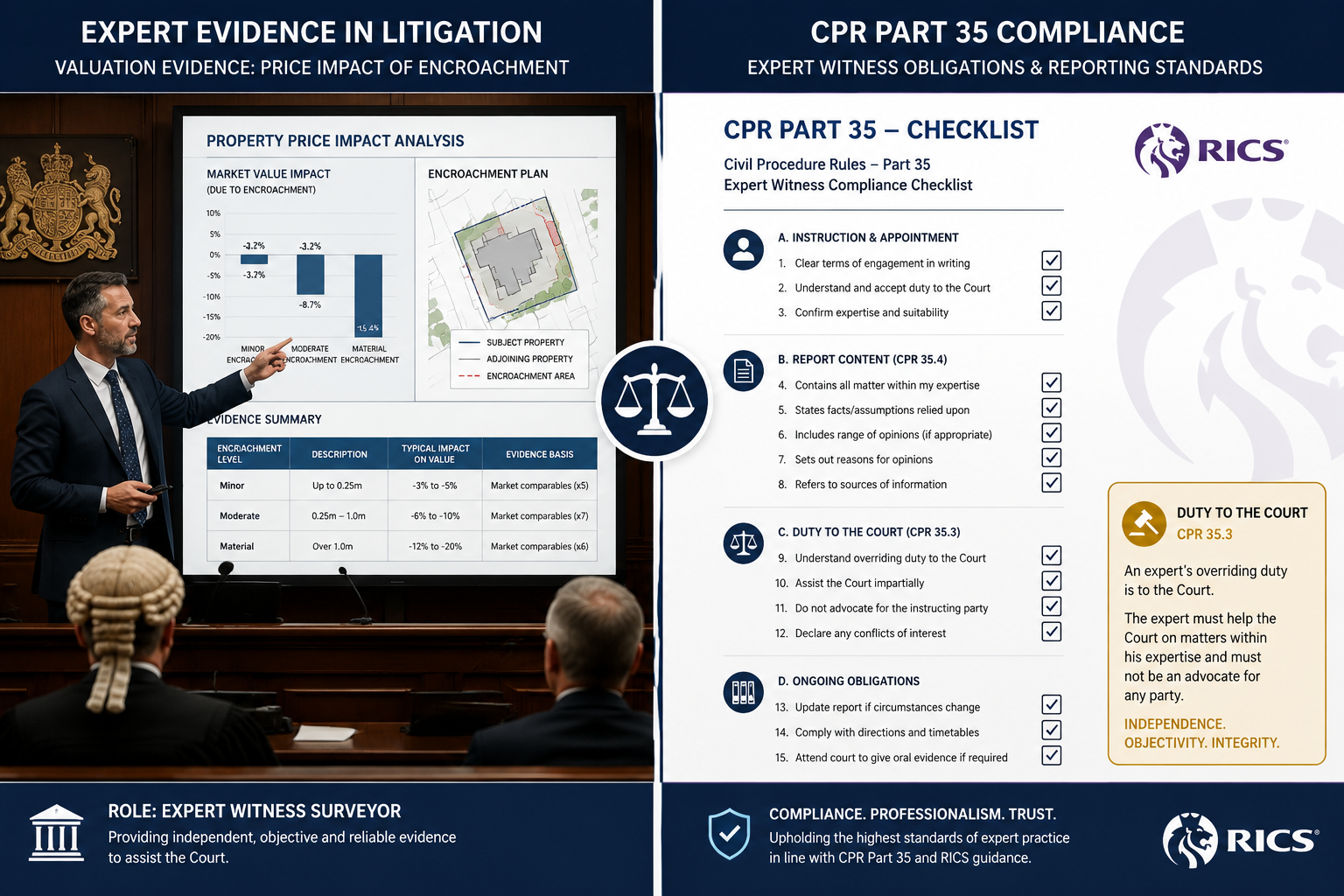
One of the most powerful — and often overlooked — contributions an expert witness surveyor makes is quantifying the financial impact of a boundary encroachment. This transforms a dispute from a subjective argument about fence posts into an evidence-based conversation about measurable loss.
Key Valuation Methods Used
1. Diminution in Value
The surveyor calculates how much the encroachment has reduced the market value of the claimant's property. This requires a Red Book valuation conducted in accordance with RICS Valuation — Global Standards (the "Red Book"), which sets the professional benchmark for all formal property valuations.
2. Ransom Strip Valuation
Where a small strip of land controls access or development potential, its value can be disproportionately high relative to its size. Expert surveyors use established case law principles (including the Stokes v Cambridge formula) to calculate ransom value.
3. Overage and Development Value
If the disputed land has planning potential, the expert must assess its development value — not just its current use value. This requires careful analysis of comparable transactions and planning history.
4. Reinstatement Costs
Where physical structures (walls, fences, extensions) have been built on disputed land, the expert may need to provide a reinstatement cost valuation to quantify the cost of removal or rebuilding.
What a Compliant Expert Valuation Report Contains
A CPR Part 35-compliant valuation report for a boundary dispute should include:
- Executive summary of findings and opinion
- Methodology — the valuation approach used and why
- Comparable evidence — market transactions supporting the valuation
- Assumptions and caveats — clearly stated
- Photographs and plans — annotated site plans showing the disputed boundary
- The Part 35 declaration — mandatory
- Statement of truth
For parties seeking comprehensive valuation reports in London, instructing a surveyor experienced in litigation support — not just standard residential valuations — is essential.
Mediation Strategies for 2026 Settlements: Using Expert Evidence to Resolve Disputes Without Trial
Why Mediation Works Better With Expert Valuation Evidence
Courts now actively encourage — and in many cases require — parties to consider mediation before proceeding to trial. The Civil Procedure Rules' overriding objective includes dealing with cases proportionately and at reasonable cost [1]. Refusing mediation without good reason can result in adverse cost orders even for a winning party.
Expert witness valuations play a pivotal role in making mediation work:
🔹 They anchor negotiations in objective data — removing the emotional "my fence, my land" dynamic
🔹 They quantify the BATNA (Best Alternative to a Negotiated Agreement) — both parties understand what they stand to lose at trial
🔹 They accelerate settlement — mediators report that disputes with agreed or near-agreed expert evidence settle far more quickly
🔹 They reduce positional bargaining — when both parties see the same valuation figures, the negotiation range narrows dramatically [6]
A Practical Mediation Framework for Boundary Disputes in 2026
Stage 1: Pre-Mediation Expert Instruction
Both parties (or jointly) instruct a RICS-qualified expert to produce a valuation report addressing the financial impact of the boundary dispute. This report is shared with both parties and the mediator in advance.
Stage 2: Mediation Day Preparation
The expert surveyor may attend mediation as a neutral technical resource — available to answer questions from both parties and the mediator. This is distinct from their role as an expert witness in court proceedings.
Stage 3: Without-Prejudice Negotiations
Armed with objective valuation evidence, parties negotiate within a defined financial range. Common settlement outcomes include:
- Monetary compensation for the encroachment
- Boundary adjustments with formal deed of variation
- Licence agreements for continued use of disputed land
- Shared cost arrangements for boundary structures
Stage 4: Formal Settlement Agreement
Any agreed settlement should be recorded in a formal, legally binding agreement. Where party wall agreements are also relevant, these should be updated simultaneously to reflect the new agreed boundary.
Case Study: Resolved Without Trial 🏡
Consider a typical scenario: two homeowners in a London suburb dispute a 0.3-metre strip of land along a rear garden boundary. One owner has built a garden room that encroaches onto the strip. Without expert evidence, the dispute stalls — each party insists the boundary is on their side.
A jointly-instructed RICS surveyor produces a CPR Part 35-compliant report confirming:
- The legal boundary position based on title deeds
- The encroachment measures 0.28 metres over 12 metres
- The diminution in value to the affected property: £8,500
- The ransom value of the strip: £4,200
At mediation, armed with this data, the parties settle for £6,000 compensation plus a formal boundary agreement — total legal and surveyor costs: approximately £4,500. Compare this to an estimated £45,000–£70,000 for a contested First-tier Tribunal hearing [5].
Expert Witness Valuations in Neighbour Boundary Disputes: Choosing the Right Surveyor
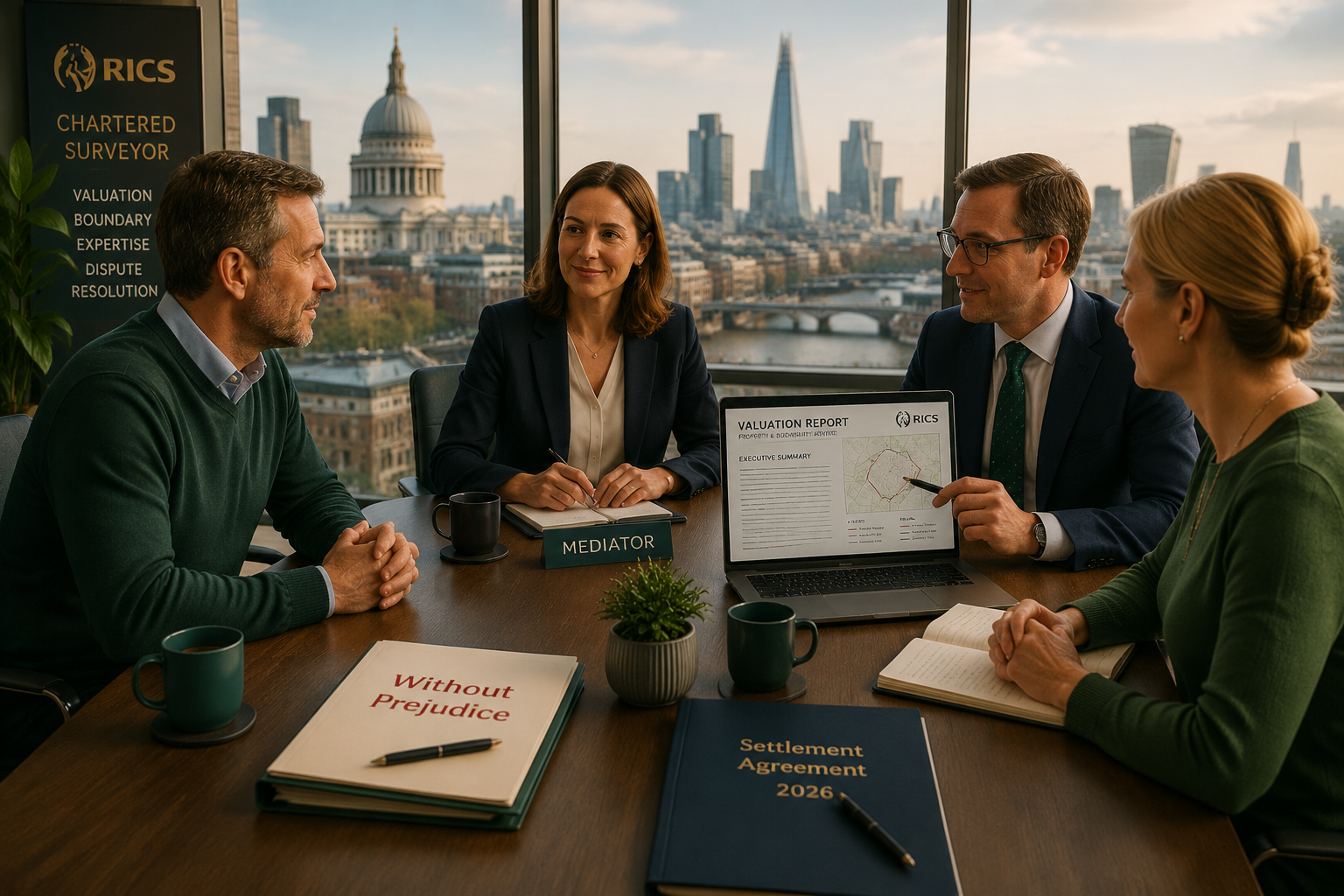
Not every chartered surveyor is qualified to act as an expert witness. The role demands a specific combination of technical expertise, legal knowledge, and communication skills.
Essential Qualifications and Experience
When selecting an expert witness surveyor for a boundary dispute, look for:
| Criteria | Why It Matters |
|---|---|
| RICS Membership (MRICS/FRICS) | Ensures adherence to professional standards and Red Book compliance |
| Registered Valuer status | Required for formal RICS valuations used in legal proceedings |
| Expert witness training | CPR Part 35 compliance requires specific knowledge of court procedures |
| Boundary dispute experience | Technical surveying skills differ from litigation support skills |
| Professional indemnity insurance | Essential for reports used in legal proceedings |
Questions to Ask Before Instructing
- Have you prepared expert witness reports under CPR Part 35 before?
- Are you a RICS Registered Valuer?
- Can you attend mediation and/or court hearings if required?
- Do you have experience with the specific type of boundary dispute involved?
- What is your approach if your findings are unfavourable to the instructing party?
That last question is telling. A genuinely independent expert will confirm they will report their honest findings regardless — because their duty is to the court, not to the client [1] [3].
Common Mistakes That Undermine Expert Evidence
❌ Instructing a surveyor who acts as an advocate — reports that read as one-sided arguments are routinely criticised by judges
❌ Missing the Part 35 declaration — technically fatal to the admissibility of the report
❌ Failing to disclose all relevant evidence — including evidence that undermines the instructing party's case
❌ Using outdated comparable evidence — valuations must reflect current market conditions
❌ Exceeding the expert's area of expertise — a valuation surveyor should not opine on legal title questions; that is for a solicitor [6]
For those involved in construction disputes resolution where boundary issues intersect with building works, the expert's scope of instruction must be carefully defined to avoid these pitfalls.
Practical Steps for Property Owners Facing Boundary Disputes in 2026
Whether a boundary dispute has just emerged or has been running for months, these steps can help achieve a faster, more cost-effective resolution:
- Gather all title documents — deeds, Land Registry plans, and any historical conveyances
- Commission a measured boundary survey early — before positions become entrenched
- Consider joint instruction of an expert — reduces costs and increases credibility of findings
- Engage a solicitor with property dispute experience — to advise on legal title and CPR compliance
- Propose mediation early — courts look favourably on parties who attempt ADR
- Ensure any expert report is CPR Part 35 compliant — check for the mandatory declaration
- Use valuation evidence to anchor settlement negotiations — objective figures break deadlocks
For disputes that also involve party wall notices or works near shared boundaries, addressing both the party wall and boundary aspects simultaneously can prevent the same dispute resurfacing under a different legal heading.
Conclusion: Turning Boundary Disputes Into Resolved Settlements
The combination of rigorous expert witness valuations and structured mediation represents the most effective pathway to resolving neighbour boundary disputes in 2026 — both financially and practically. Expert Witness Valuations in Neighbour Boundary Disputes: CPR Part 35 Compliance and Mediation Strategies for 2026 Settlements is not just a legal framework; it is a practical toolkit that transforms emotionally charged disputes into evidence-based negotiations.
The key insight is this: the cost of a properly scoped, CPR Part 35-compliant expert valuation report is almost always a fraction of the cost of contested litigation. When that evidence is used intelligently in mediation, most disputes settle — and settle faster.
Actionable Next Steps ✅
- If a boundary dispute has just arisen: commission a measured survey and review your title documents before taking any physical action
- If a dispute is already in progress: instruct a RICS-qualified expert witness surveyor to produce a Part 35-compliant valuation report
- If litigation has been threatened: propose mediation in writing immediately — this protects your position on costs
- If you are the responding party: obtain your own expert evidence rather than simply disputing the other side's figures
- In all cases: work with professionals who understand both the technical surveying requirements and the legal compliance obligations under CPR Part 35
Resolving a boundary dispute well is not about winning — it is about achieving a durable, cost-proportionate outcome that allows both neighbours to move forward. Expert valuation evidence, properly prepared and strategically deployed, makes that outcome achievable.
References
[1] Part 35 – https://www.justice.gov.uk/courts/procedure-rules/civil/rules/part35
[2] Neighbour Boundary Disputes – https://www.jspubs.com/expert-witness/si/n/neighbour-boundary-disputes/
[3] Expert Witness – https://www.frobishersuk.com/expert-witness
[5] Boundary Disputes – https://www.eastonbevins.co.uk/boundary-disputes/
[6] Boundary Disputes Expert Witness – https://seakexperts.com/keywords/boundary-disputes-expert-witness