
As property markets stabilize in 2026, with RICS surveys revealing a remarkable 12-month sales optimism rating of +35%, expert witnesses face a critical challenge: integrating the latest price stabilization data into court evidence while preparing for an anticipated surge in valuation disputes. The recovery phase brings not only optimism but also increased litigation as parties contest valuations made during volatile market conditions. Expert Witness Valuations Using RICS 2026 Market Data: Preparing for Increased Dispute Volumes in Recovery Phase requires professionals to master new documentation strategies, understand updated RICS standards, and deliver testimony that withstands rigorous cross-examination.
The landscape for expert witnesses has transformed significantly. With the RICS Valuation – Global Standards (Red Book) becoming effective on 31 January 2025, and the RICS Expert Witness Accreditation Service (EWAS) establishing universal standards across the property sector, professionals must navigate more stringent requirements while addressing the complexities of post-volatility market conditions[1].
Key Takeaways
- 📊 Market stabilization data from 2026 shows +35% sales optimism, requiring expert witnesses to incorporate current recovery phase metrics into dispute evidence
- 🎓 RICS accreditation standards now mandate four training modules, ethics testing, and interviews for expert witness qualification
- ⚖️ Dispute volume increases during recovery phases necessitate robust documentation strategies and testimony preparation protocols
- 📘 Red Book 2026 compliance is essential for all expert witness valuations, with updated standards effective since January 2025
- 💼 Fee structure clarity allows experts to work with solicitors on conditional arrangements while maintaining unconditional expert fees
Understanding RICS 2026 Standards for Expert Witness Valuations
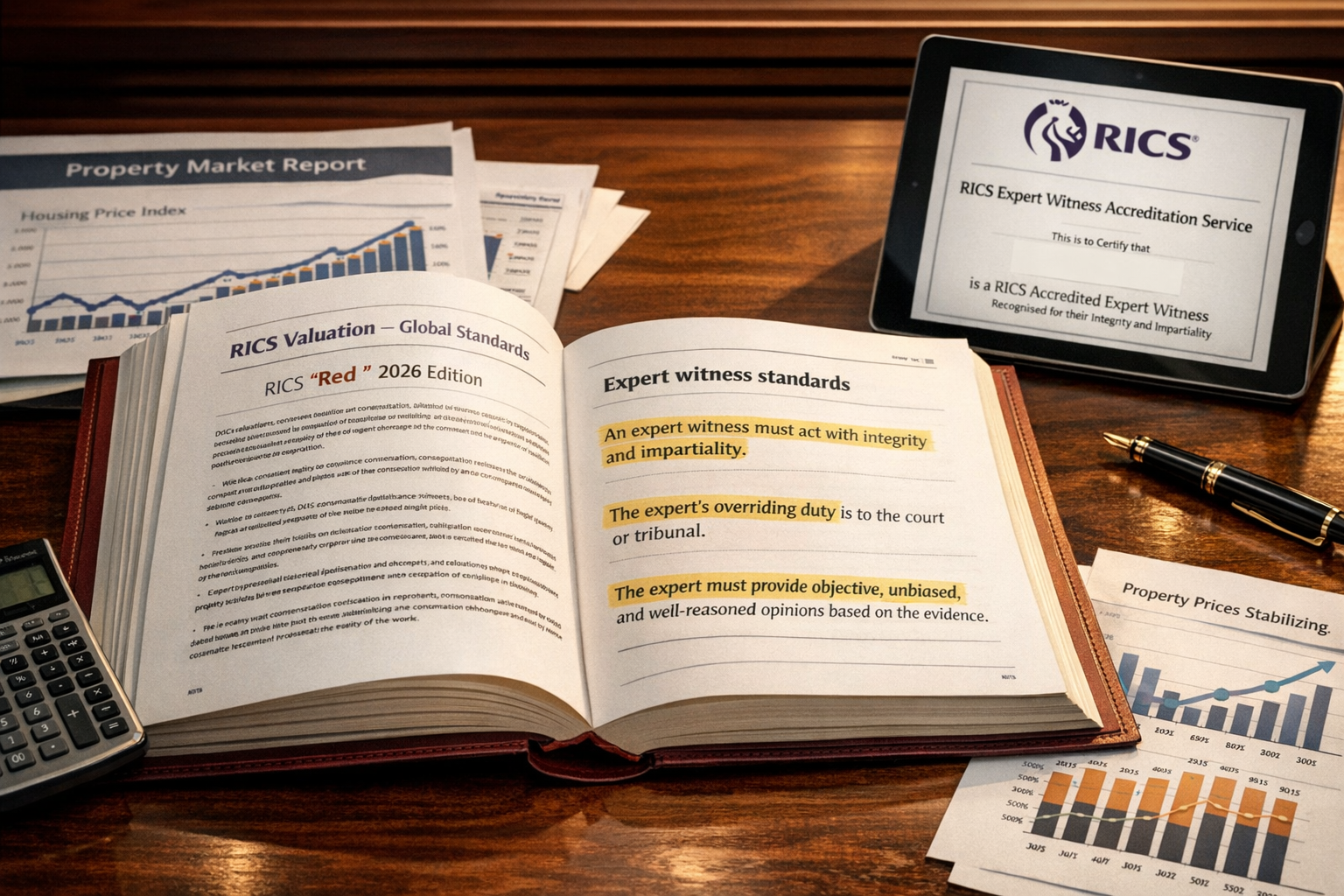
The foundation of credible Expert Witness Valuations Using RICS 2026 Market Data lies in understanding the comprehensive framework established by RICS professional standards. The organization has undertaken a major update to professional standards for members acting as expert witnesses, with particular emphasis on integrity, impartiality, and expertise within designated areas[2].
The RICS Expert Witness Accreditation Service (EWAS)
RICS EWAS represents a voluntary but increasingly essential credential for property professionals providing expert testimony. The service establishes universal standards through:
Comprehensive Training Requirements:
- Four mandatory training modules covering technical and procedural aspects
- Ethics examination testing understanding of professional conduct
- Personal interview assessing competency and suitability
- Ongoing professional development obligations
The accreditation process ensures expert witnesses possess not only technical valuation skills but also the procedural knowledge necessary for effective court testimony[4]. RICS registered valuers in London increasingly pursue this accreditation to differentiate their services in a competitive dispute resolution market.
Red Book 2026: Global Standards Application
The RICS Valuation – Global Standards (Red Book), effective since 31 January 2025, provides the authoritative framework for all professional valuations, including those prepared for litigation purposes[1]. Key provisions relevant to expert witnesses include:
| Standard Component | Expert Witness Application |
|---|---|
| VPS 1: Terms of Engagement | Must clearly define scope, basis of value, and assumptions |
| VPS 2: Inspections | Requires appropriate inspection level with documented limitations |
| VPS 3: Valuation Reports | Mandates transparency in methodology and supporting evidence |
| VPS 4: Bases of Value | Ensures appropriate basis selection for dispute context |
| VPS 5: Valuation Approaches | Requires justification of chosen methodology |
Conflict of Interest and Fee Arrangements
Recent amendments clarified a critical issue for expert witnesses: professionals can accept instructions from solicitors operating under conditional fee arrangements, provided the expert witness themselves is instructed on an unconditional fee basis[2]. This distinction maintains the expert's independence while accommodating modern legal practice structures.
Understanding RICS valuation costs helps both experts and instructing parties establish appropriate fee structures that comply with professional standards while reflecting the complexity of dispute work.
Integrating 2026 Market Stabilization Data into Expert Evidence

The recovery phase presents unique challenges for Expert Witness Valuations Using RICS 2026 Market Data: Preparing for Increased Dispute Volumes in Recovery Phase. Market stabilization after periods of volatility requires careful analysis and presentation of data that courts can rely upon.
Documenting Price Stabilization Trends
The +35% sales optimism rating reported in RICS surveys provides a critical benchmark for 2026 valuations, but expert witnesses must contextualize this data within broader market trends:
Essential Documentation Components:
- Historical volatility analysis showing price movements over 24-36 months
- Comparable sales evidence with adjustments for market timing
- Transaction volume data demonstrating market liquidity recovery
- Regional variation analysis accounting for geographic disparities
- Property type-specific trends recognizing differential recovery rates
For disputes involving matrimonial valuations or divorce property valuations, timing becomes particularly critical. A property valued at the height of market uncertainty may require retrospective analysis using 2026 stabilization data to establish fair division of assets.
Methodology for Recovery Phase Valuations
Expert witnesses must employ robust methodologies that account for market transitions:
Comparative Method Adjustments:
- Apply time-based adjustments reflecting recovery trajectory
- Weight recent transactions more heavily than historical data
- Document market sentiment shifts affecting buyer behavior
- Account for changing financing conditions and availability
Income Approach Considerations:
- Update capitalization rates reflecting current market expectations
- Adjust rental growth assumptions based on recovery indicators
- Consider tenant covenant strength in stabilizing economy
- Document yield compression or expansion trends
Residual Method Refinements:
- Revise development appraisal inputs for current cost environment
- Update sales value assumptions reflecting recovery phase pricing
- Adjust profit margins for changing risk perceptions
- Document planning and regulatory environment changes
Supporting Evidence Requirements
Courts expect expert witnesses to provide comprehensive supporting evidence. The valuation reports prepared for litigation must include:
✅ Market data sources with publication dates and reliability assessment
✅ Comparable transaction details including parties, timing, and circumstances
✅ Adjustment justifications with transparent calculation methodology
✅ Alternative scenarios demonstrating sensitivity to key assumptions
✅ Peer review documentation where appropriate for complex valuations
Preparing for Increased Dispute Volumes: Documentation and Testimony Strategies
The recovery phase historically generates increased litigation as parties dispute valuations made during uncertain periods. Expert Witness Valuations Using RICS 2026 Market Data: Preparing for Increased Dispute Volumes in Recovery Phase requires strategic preparation across multiple dimensions.
Common Dispute Categories in Recovery Phase
Understanding typical dispute types helps experts prepare appropriate evidence:
1. Mortgage Lending Disputes
Banks and borrowers frequently contest valuations when market recovery reveals significant discrepancies between loan-to-value ratios based on downturn valuations versus current values. These disputes often involve allegations of negligent valuation during volatile periods.
2. Development Appraisal Disagreements
Partnership disputes and contractor claims commonly arise when development valuations made during market uncertainty prove inaccurate as conditions stabilize. Commercial property surveyors frequently encounter these disputes.
3. Lease Renewal and Rent Review Conflicts
Recovery phase market movements create disputes over rent reviews and lease renewals, particularly where agreements reference market rent at specific dates during volatile periods.
4. Compulsory Purchase and Compensation Claims
Property acquisitions during market uncertainty generate disputes when owners claim inadequate compensation based on recovery phase values.
5. Tax-Related Valuation Disputes
Capital gains tax valuations, ATED valuations, and non-domicile tax valuations frequently face challenge when market recovery reveals substantial value changes.
Documentation Strategy Framework
"The strength of expert evidence lies not in the conclusion reached, but in the transparency and robustness of the process documented." – RICS Expert Witness Guidance
Pre-Instruction Phase:
- Conduct conflict checks using comprehensive database systems
- Establish clear terms of engagement defining scope and limitations
- Document independence and absence of contingent fee arrangements
- Clarify reporting requirements and court deadlines
Investigation Phase:
- Maintain detailed inspection notes with photographic evidence
- Record all data sources with access dates and reliability assessments
- Document communications with instructing parties
- Preserve all working papers and calculation spreadsheets
- Create contemporaneous notes of key decisions and assumptions
Report Preparation Phase:
- Follow Red Book requirements for structure and content
- Provide transparent methodology with step-by-step calculations
- Include sensitivity analysis showing impact of alternative assumptions
- Address known weaknesses or limitations in available data
- Anticipate opposing expert's likely criticisms
Pre-Hearing Phase:
- Prepare comprehensive exhibits and visual aids
- Review all source documents and refresh memory
- Conduct mock cross-examination with instructing solicitors
- Update market data to hearing date where appropriate
- Prepare for questions on methodology and assumptions
Testimony Excellence in Recovery Phase Disputes
Effective courtroom testimony requires specific skills beyond technical valuation competence:
🎯 Clarity and Accessibility
Courts require experts to explain complex valuation concepts in language accessible to non-specialists. Avoid jargon, use analogies, and provide context for technical terms.
🎯 Impartiality Demonstration
Explicitly acknowledge limitations, uncertainties, and alternative viewpoints. Courts value experts who demonstrate objectivity over advocacy.
🎯 Data Visualization
Use charts, graphs, and comparative tables to illustrate market trends and valuation conclusions. Visual evidence enhances comprehension and retention.
🎯 Assumption Transparency
Clearly distinguish between facts, assumptions, and professional judgment. Document the basis for each assumption with reference to market evidence.
🎯 Cross-Examination Preparation
Anticipate challenges to methodology, data sources, and conclusions. Prepare concise responses that reinforce rather than undermine credibility.
Technology Integration for Enhanced Evidence
Modern expert witnesses leverage technology to strengthen evidence presentation:
- Geographic Information Systems (GIS) for spatial analysis of comparables
- 3D modeling and visualization for property condition documentation
- Data analytics platforms for market trend analysis
- Digital evidence management systems for document organization
- Virtual inspection technology where physical access is limited
For complex disputes involving construction disputes resolution or commercial dilapidations, technology-enhanced evidence provides compelling visual support for technical arguments.
Specialized Valuation Contexts in Recovery Phase Disputes
Different property types and valuation purposes require tailored approaches when preparing Expert Witness Valuations Using RICS 2026 Market Data:
Residential Property Disputes
Recovery phase residential valuations must account for:
- Regional variation in recovery timing and magnitude
- Property type differentials with premium segments recovering faster
- Financing availability affecting achievable prices
- Buyer sentiment shifts from caution to confidence
Retrospective valuations become particularly important when establishing values at specific historical dates during volatile periods.
Commercial Property Valuations
Commercial property disputes in the recovery phase involve additional complexity:
- Tenant covenant analysis with changing business conditions
- Void period assumptions reflecting improved letting markets
- Yield movements as investor confidence returns
- Lease incentive packages reducing during recovery
Specialized Property Types
Certain property categories require expert knowledge of niche markets:
Charitable Properties:
Charities Act valuations must comply with specific statutory requirements while reflecting market recovery conditions.
Social Housing:
Right to buy valuations and shared ownership valuations involve statutory discount calculations affected by market movements.
Insurance Purposes:
Insurance reinstatement valuations require updating for construction cost inflation during recovery periods.
Professional Development and Accreditation Pathways
As dispute volumes increase, maintaining competitive advantage requires ongoing professional development:
RICS Accreditation Pathway
The RICS Expert Witness Register, updated regularly (most recently March 2026), provides recognition for qualified professionals[4]. Achieving accreditation involves:
- Module 1: Expert Witness Role and Responsibilities – Understanding legal framework and duties
- Module 2: Report Writing – Developing clear, defensible documentation
- Module 3: Giving Evidence – Mastering courtroom testimony skills
- Module 4: Cross-Examination Techniques – Handling adversarial questioning
Continuous Professional Development
Maintaining expertise requires:
- Regular attendance at valuation and dispute resolution seminars
- Subscription to market data services providing current transaction evidence
- Participation in peer review networks
- Study of recent case law affecting valuation methodology
- Technology skills development for evidence presentation
Building Expert Witness Practice
Professionals seeking to develop expert witness work should:
Establish Credentials:
- Obtain RICS EWAS accreditation
- Develop specialized knowledge in specific property sectors
- Build portfolio of successfully defended valuations
- Cultivate relationships with legal professionals
Market Services:
- Publish thought leadership on valuation methodology
- Present at legal and property conferences
- Maintain updated expert witness profile on RICS register
- Demonstrate track record of impartial, robust evidence
Quality Assurance:
- Implement systematic file management protocols
- Conduct internal peer review before report finalization
- Maintain professional indemnity insurance with adequate limits
- Document all continuing professional development activities
Conclusion
Expert Witness Valuations Using RICS 2026 Market Data: Preparing for Increased Dispute Volumes in Recovery Phase demands a sophisticated blend of technical valuation skills, procedural knowledge, and communication excellence. As markets stabilize with +35% sales optimism, the recovery phase will inevitably generate increased litigation as parties contest valuations made during volatile conditions.
Success in this environment requires professionals to:
✅ Master RICS 2026 standards including Red Book requirements and EWAS accreditation
✅ Integrate current market data reflecting stabilization trends into evidence
✅ Develop robust documentation that withstands rigorous cross-examination
✅ Prepare compelling testimony that communicates complex concepts clearly
✅ Maintain absolute impartiality while providing authoritative opinions
Actionable Next Steps
For property professionals seeking to excel in expert witness work:
- Pursue RICS EWAS accreditation to establish credentials and differentiate services
- Develop systematic documentation protocols ensuring comprehensive evidence trails
- Build market data resources providing current transaction evidence for recovery phase valuations
- Invest in presentation technology enhancing evidence clarity and impact
- Cultivate legal relationships with solicitors and barristers handling property disputes
- Maintain rigorous independence in all instructions and fee arrangements
The recovery phase presents both challenges and opportunities for expert witnesses. Those who combine technical excellence with procedural rigor and communication skills will find themselves well-positioned to serve courts effectively while building sustainable expert witness practices.
For expert surveyor advice on preparing valuations for dispute resolution, or to discuss specific valuation requirements in the current market environment, consulting with experienced professionals ensures compliance with RICS standards while maximizing the strength of your evidence position.
References
[1] Expert Witness Valuations In 2026s Stabilizing Market Rics Standards For Mortgage Disputes And Property Disagreements – https://nottinghillsurveyors.com/blog/expert-witness-valuations-in-2026s-stabilizing-market-rics-standards-for-mortgage-disputes-and-property-disagreements
[2] Valuation Standards – https://www.rics.org/profession-standards/rics-standards-and-guidance/sector-standards/valuation-standards