
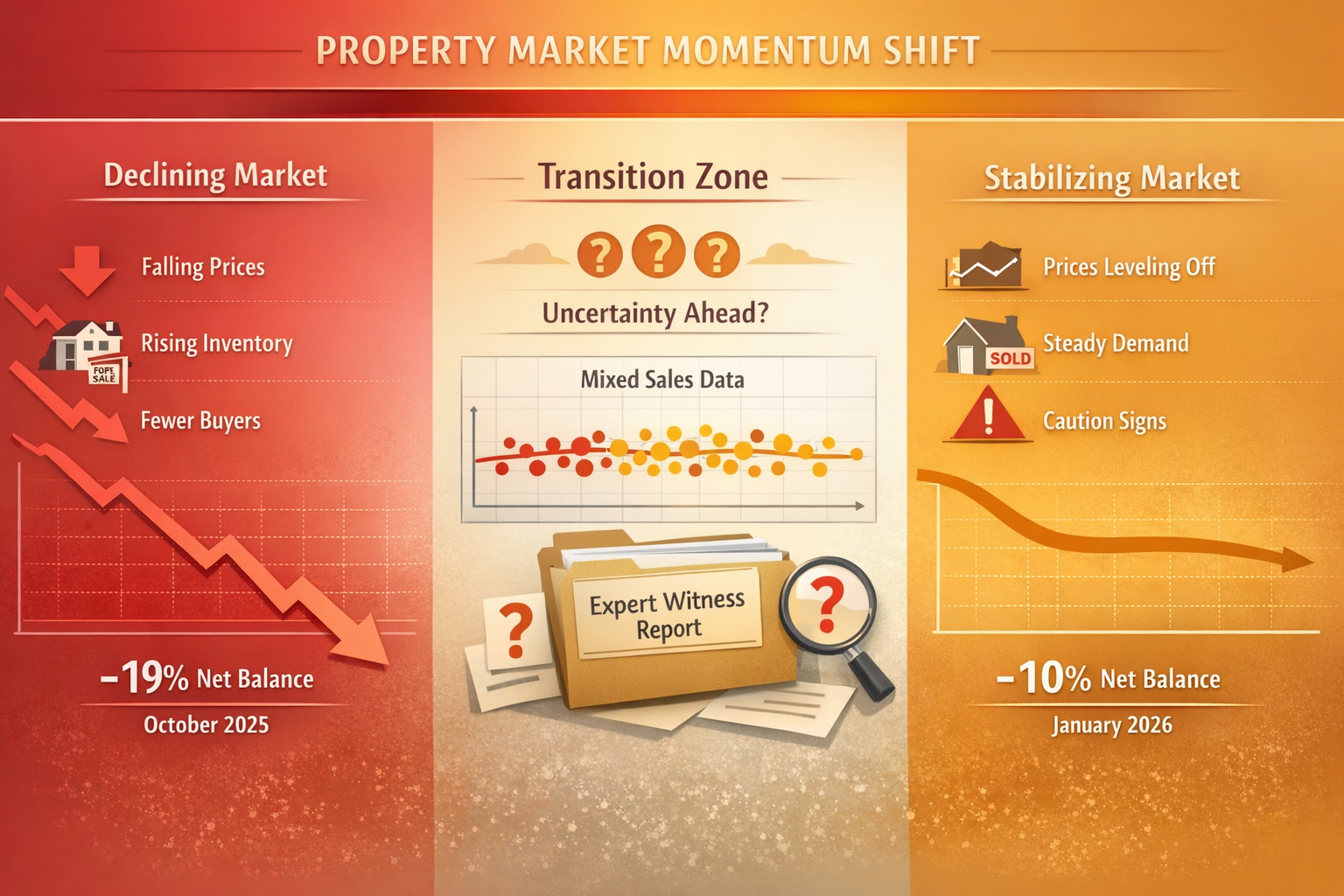
When property markets shift from sharp decline to uncertain stabilization, expert witnesses face their most challenging valuation scenarios. In 2026, as market indicators show movement from -19% net balance in October 2025 to -10% in January 2026, Expert Witness Valuations When Markets Stabilize: Building Credible Evidence as Price Momentum Shifts from Decline to Neutral becomes a critical skill for surveyors and valuation professionals. This transitional phase creates unique evidentiary challenges where comparable evidence is mixed, market direction remains uncertain, and opposing counsel will scrutinize every assumption.
The stakes are high. Courts demand credible, defensible valuations backed by rigorous methodology. Yet stabilizing markets offer few clear signals—some properties still reflect declining trends while others show early recovery. Expert witnesses must navigate this complexity while maintaining professional standards and building evidence that withstands cross-examination.
Key Takeaways
- Market stabilization creates mixed comparable evidence that requires sophisticated adjustment techniques and transparent methodology to defend in court
- Transitional periods demand multiple valuation approaches including retrospective analysis, momentum indicators, and sensitivity testing to build credible evidence
- Expert witness credibility depends on acknowledging uncertainty while providing clear, well-supported opinions that account for market volatility
- Documentation quality becomes paramount when defending valuations during stabilization phases where market signals conflict
- RICS standards and professional frameworks provide essential structure for building defensible expert witness reports during uncertain market conditions
Understanding Market Stabilization and Its Impact on Expert Witness Valuations
What Market Stabilization Means for Valuation Evidence
Market stabilization represents a critical inflection point where declining property prices begin to level off, but recovery remains uncertain. This phase differs fundamentally from both clear decline and confirmed growth periods. Price momentum shifts from negative to neutral, creating a complex evidentiary landscape for expert witnesses.
During stabilization, several market characteristics emerge:
📊 Mixed Transaction Data – Some properties sell at declining prices while others achieve stable or slightly improved values
📈 Reduced Transaction Volume – Buyers and sellers adopt wait-and-see attitudes, limiting comparable evidence
⚖️ Increased Valuation Variance – Different valuation approaches may yield wider ranges of opinion
🔍 Greater Scrutiny – Courts and opposing counsel challenge assumptions more rigorously during uncertain periods
For expert witnesses, this environment demands heightened attention to methodology and evidence quality. Traditional comparable sales approaches face challenges when recent transactions reflect different market phases. A property sold three months ago during peak decline may not provide reliable evidence for current stabilized conditions.
The Challenge of Mixed Comparable Evidence
When Expert Witness Valuations When Markets Stabilize: Building Credible Evidence as Price Momentum Shifts from Decline to Neutral becomes necessary, the fundamental challenge lies in comparable selection and adjustment. Consider a typical scenario in 2026:
Example Comparable Set:
- Property A: Sold January 2026, reflects stabilized market (-10% net balance)
- Property B: Sold October 2025, reflects declining market (-19% net balance)
- Property C: Sold July 2025, reflects steeper decline (-25% net balance)
- Property D: Under offer February 2026, potential early recovery signal
Which comparables provide the most reliable evidence? How should time adjustments account for rapidly changing market momentum? These questions require sophisticated analysis and transparent reasoning.
Expert witnesses must address several critical considerations:
- Time Adjustment Complexity – Standard time adjustments may not capture momentum shifts adequately
- Market Segmentation – Different property types and locations may stabilize at different rates
- Transaction Motivation – Distressed sales versus normal market transactions require different weighting
- Forward-Looking Indicators – Current asking prices and offers provide market sentiment data
Professional expert witness reports must articulate these considerations clearly, demonstrating awareness of market complexity while maintaining defensible conclusions.
Building Credible Evidence During Market Transitions
Methodological Frameworks for Stabilization Periods
Expert Witness Valuations When Markets Stabilize: Building Credible Evidence as Price Momentum Shifts from Decline to Neutral requires robust methodological frameworks that go beyond standard valuation approaches. Courts expect expert witnesses to demonstrate sophisticated understanding of market dynamics and apply appropriate techniques for transitional periods.
Multiple Valuation Approaches
During stabilization, relying on a single valuation method creates vulnerability to challenge. Expert witnesses should employ multiple approaches:
Comparative Method with Enhanced Adjustments
- Select comparables from different market phases
- Apply transparent time adjustments reflecting momentum shifts
- Weight recent transactions more heavily
- Document adjustment rationale comprehensively
Income Approach Validation
- Use rental yields to cross-check capital values
- Analyze yield compression or expansion trends
- Consider investor sentiment and market expectations
- Validate against long-term market norms
Residual Method for Development Properties
- Adjust development profit margins for market uncertainty
- Stress-test assumptions across scenarios
- Consider extended sales periods
- Factor in financing cost changes
Cost Approach as Ceiling Test
- Establish upper value limits using replacement cost
- Adjust for market conditions and obsolescence
- Validate against comparable and income approaches
Professional valuation reports should present multiple approaches transparently, explaining how different methods support or challenge primary conclusions.
Statistical Rigor and Market Analysis
Credible expert witness evidence during stabilization requires statistical sophistication beyond simple comparable averaging. Expert witnesses should incorporate:
Market Momentum Indicators:
- Transaction volume trends (month-over-month changes)
- Time on market statistics (increasing or decreasing)
- Price reduction frequency (percentage of listings reduced)
- Offer-to-asking price ratios (market negotiability)
- New listing volumes (supply-side indicators)
Confidence Intervals and Ranges:
Rather than presenting single-point valuations, expert witnesses should acknowledge uncertainty through ranges:
| Market Condition | Appropriate Range | Confidence Level |
|---|---|---|
| Stable Market | ±5% | High (85-90%) |
| Stabilizing Market | ±8-10% | Moderate (75-80%) |
| Declining Market | ±10-15% | Lower (70-75%) |
| Volatile Market | ±15%+ | Variable (60-70%) |
These ranges reflect genuine market uncertainty and demonstrate professional judgment. Courts appreciate honest acknowledgment of limitations rather than false precision.
Retrospective Valuation Considerations
Many legal disputes require retrospective valuations at specific historical dates that may fall during market transitions. This adds complexity to stabilization scenarios.
Key Retrospective Challenges:
🔄 Hindsight Bias – Avoiding the temptation to use subsequent market knowledge inappropriately
📅 Date-Specific Evidence – Identifying what information was reasonably available at the valuation date
📊 Market Sentiment – Reconstructing market psychology and expectations at the historical date
🎯 Comparable Selection – Using only transactions and data available before the valuation date
Expert witnesses must demonstrate they have valued properties using information and market understanding available at the specific date, not with benefit of hindsight. This requires meticulous research and clear documentation of information sources and their dates.

Defending Valuations Under Cross-Examination
Anticipating Challenges to Stabilization Evidence
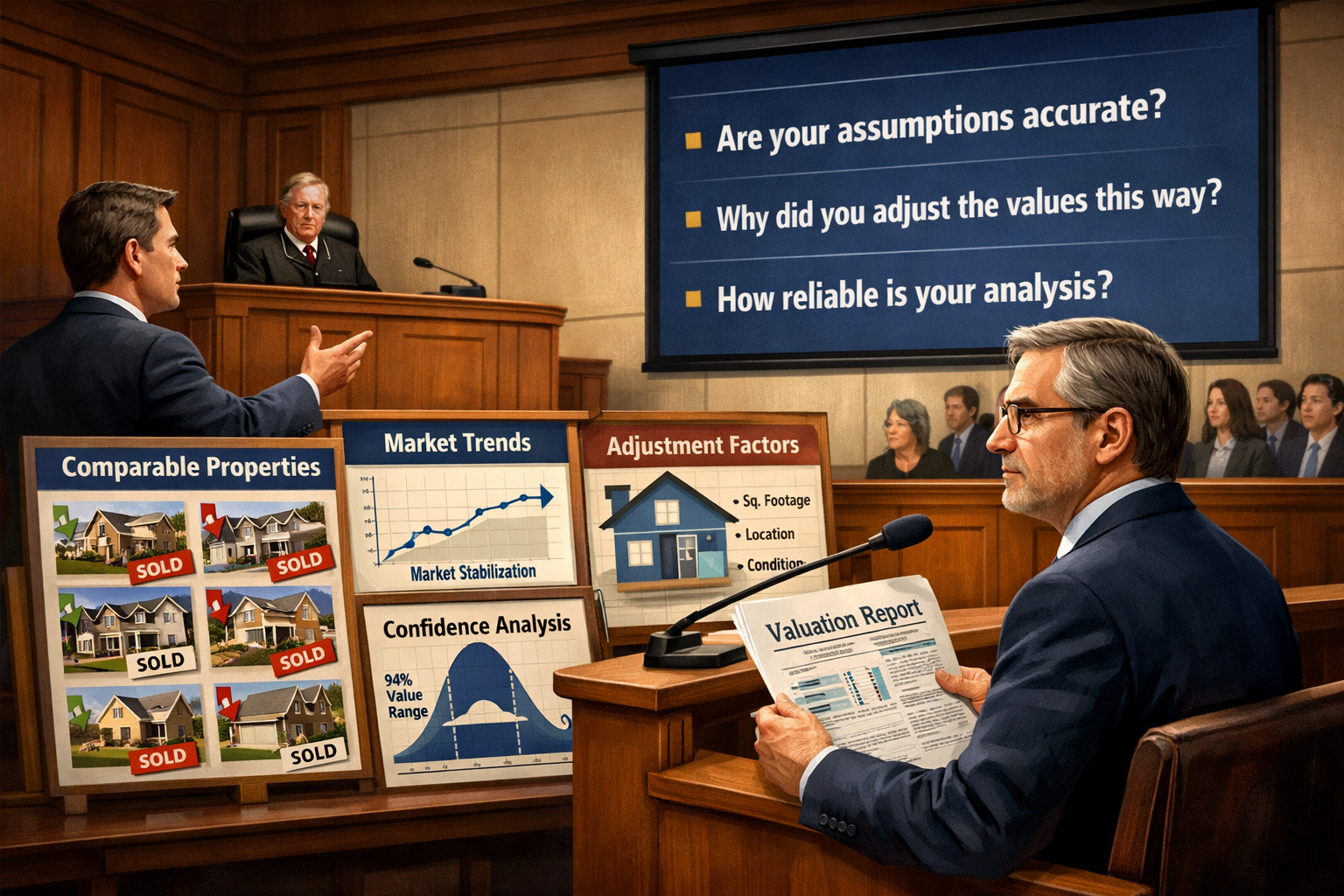
When Expert Witness Valuations When Markets Stabilize: Building Credible Evidence as Price Momentum Shifts from Decline to Neutral, expert witnesses must prepare for rigorous cross-examination. Opposing counsel will target methodology, comparable selection, and assumptions with particular intensity during uncertain market periods.
Common Cross-Examination Challenges:
"Why did you select these comparables over others?"
- Prepare transparent selection criteria
- Document all available comparables considered
- Explain rejections with clear reasoning
- Demonstrate consistency in selection approach
"Your time adjustments appear arbitrary—how did you calculate them?"
- Reference market indices and transaction data
- Show statistical analysis supporting adjustments
- Acknowledge uncertainty ranges
- Explain why alternative adjustments were rejected
"The market has moved since your valuation—doesn't that prove you were wrong?"
- Distinguish between valuation date conditions and subsequent changes
- Explain that valuations reflect specific date circumstances
- Reference professional standards on retrospective assessment
- Demonstrate opinion was reasonable based on available evidence
"Expert B valued this property 15% higher—why is your opinion correct?"
- Acknowledge legitimate differences in professional judgment
- Explain methodological differences transparently
- Demonstrate your approach follows professional standards
- Avoid attacking other experts personally
Documentation Standards for Credible Evidence
The foundation of defensible expert witness testimony lies in comprehensive documentation. During stabilization periods, documentation quality becomes even more critical as methodology faces greater scrutiny.
Essential Documentation Elements:
✅ Comparable Search Record – Evidence of systematic comparable search, including properties considered but rejected
✅ Market Analysis Memoranda – Contemporary market reports, indices, and commentary from the valuation date
✅ Adjustment Calculations – Detailed worksheets showing how adjustments were derived and applied
✅ Methodology Selection Rationale – Written explanation of why specific approaches were chosen
✅ Assumption Register – Clear list of all assumptions with supporting evidence or reasoning
✅ Sensitivity Analysis – Testing how value conclusions change with different assumptions
✅ Professional Standards Compliance – Cross-references to RICS Red Book and other applicable standards
Professional RICS valuation standards provide essential frameworks for documentation and methodology. Expert witnesses should demonstrate explicit compliance with these standards throughout their reports.
The Role of Professional Standards in Building Credibility
Courts place significant weight on adherence to professional standards when assessing expert witness credibility. [1] The RICS Red Book provides the authoritative framework for property valuations in the UK, and expert witnesses must demonstrate compliance.
Key RICS Red Book Requirements:
📘 Terms of Engagement – Clear scope definition and basis of value
📘 Competence and Objectivity – Demonstrable expertise and independence
📘 Valuation Approach – Appropriate methodology selection and application
📘 Reporting Standards – Comprehensive, clear, and transparent reports
📘 Assumptions and Special Assumptions – Explicit statement and justification
During market stabilization, expert witnesses should pay particular attention to:
- Market Uncertainty Disclosure – Explicitly acknowledging market conditions and their impact on valuation reliability
- Material Valuation Uncertainty Clauses – Considering whether formal uncertainty declarations are appropriate
- Departure Provisions – If departing from standard approaches, clear justification and disclosure
- Subsequent Events – Addressing market changes occurring after valuation date but before report completion
Case Study: Defending a Stabilization Valuation
Consider a practical example illustrating how expert witnesses can build and defend credible evidence during market transitions:
Scenario: Divorce proceedings requiring property valuation dated October 2025 (peak decline period), with report prepared in February 2026 (stabilization phase).
Challenges:
- Market has improved since valuation date
- Limited comparable sales from October 2025
- Opposing expert uses more recent (higher) comparables
- Client pressure to minimize value
Effective Expert Witness Approach:
- Clear Date Distinction – Report explicitly separates October 2025 valuation date from February 2026 report date
- Contemporary Evidence Focus – Uses comparables from August-November 2025 period, rejecting later transactions as post-valuation date
- Market Context Documentation – Includes market reports from October 2025 showing -19% net balance and declining sentiment
- Retrospective Integrity – Demonstrates opinion reflects information available in October 2025, not hindsight
- Sensitivity Analysis – Shows how value would differ if later market stabilization had been anticipated
- Professional Standards – Explicitly references RICS requirements for retrospective valuations
This approach builds credibility by demonstrating methodological rigor, professional integrity, and transparent reasoning. When cross-examined, the expert can defend each element with documented evidence and professional standards support.
For complex cases involving divorce valuations or other legal disputes, this level of preparation proves essential.
Advanced Techniques for Stabilization Period Valuations
Momentum Indicators and Forward-Looking Analysis
While expert witness valuations must reflect conditions at specific dates, understanding market momentum helps build credible evidence about stabilization. Expert Witness Valuations When Markets Stabilize: Building Credible Evidence as Price Momentum Shifts from Decline to Neutral benefits from incorporating momentum analysis.
Useful Momentum Indicators:
📈 Three-Month Rolling Averages – Smoothing transaction data to identify trend changes
📊 Volume-Weighted Price Indices – Accounting for both price and transaction volume shifts
🏘️ Micro-Market Analysis – Identifying which property types and locations stabilize first
💷 Mortgage Approval Rates – Leading indicator of market activity changes
🔍 Viewing-to-Offer Ratios – Buyer confidence and market competitiveness measures
Expert witnesses should incorporate these indicators to demonstrate sophisticated market understanding while maintaining focus on the specific valuation date requirements.
Dealing with Sparse Transaction Data
Stabilization periods often feature reduced transaction volumes, creating challenges for comparable-based valuations. Expert witnesses need strategies for sparse data environments:
Geographic Expansion:
- Extend comparable search radius while maintaining market similarity
- Adjust for location differences transparently
- Document why local comparables are insufficient
Temporal Expansion:
- Use older comparables with robust time adjustments
- Apply market indices to update historical transactions
- Explain adjustment methodology comprehensively
Property Type Flexibility:
- Consider similar property types with appropriate adjustments
- Document differences and adjustment rationale
- Maintain focus on key value-affecting characteristics
Alternative Evidence:
- Asking prices as market sentiment indicators (with appropriate discounting)
- Withdrawn listings as evidence of overpricing
- Properties under offer as current market testing
- Rental values and yields for income approach validation
Professional surveyors providing comprehensive valuation services routinely navigate these challenges, and expert witnesses should demonstrate similar sophistication.
Sector-Specific Considerations
Different property sectors experience market stabilization differently, requiring tailored approaches:
Residential Property:
- First-time buyer segment often stabilizes before luxury market
- Regional variations significant (London vs. regional markets)
- Help to Buy and other schemes affect specific segments differently
- Help to Buy valuations require particular attention to scheme-specific factors
Commercial Property:
- Office markets affected by remote work trends
- Retail sector faces structural challenges beyond cyclical movements
- Industrial and logistics sectors may show resilience
- Commercial building surveys provide essential due diligence context
Investment Property:
- Yield shifts reflect changing investor sentiment
- Rental market strength may differ from capital value trends
- Tax considerations (ATED, non-domicile rules) affect specific segments
- ATED valuations and non-domicile tax valuations require specialized knowledge
Expert witnesses must demonstrate sector-specific expertise relevant to the property being valued, as courts expect specialized knowledge beyond general valuation principles.
Ethical Considerations and Professional Integrity
Maintaining Independence Under Pressure
Expert witnesses face unique pressures during market stabilization periods when clients may have strong preferences for particular value conclusions. Professional integrity requires maintaining independence despite these pressures.
Common Pressure Scenarios:
⚠️ Client Advocacy Expectations – Clients may expect experts to "support their case" rather than provide independent opinions
⚠️ Value Target Pressure – Explicit or implicit pressure to reach specific value conclusions
⚠️ Methodology Shopping – Requests to use approaches that favor particular outcomes
⚠️ Selective Evidence – Pressure to emphasize favorable comparables while downplaying others
Maintaining Professional Independence:
✓ Clear Terms of Engagement – Establish independence requirements upfront
✓ Written Methodology – Document approach before knowing client preferences
✓ Transparent Limitations – Clearly state when evidence doesn't support client's desired outcome
✓ Professional Standards Reference – Rely on RICS and other standards to justify independence
✓ Withdrawal Option – Be prepared to withdraw if integrity is compromised
Courts recognize and value genuine independence. [2] Expert witnesses who demonstrate willingness to provide opinions contrary to client interests often gain enhanced credibility.
The Duty to the Court
Expert witnesses owe their primary duty to the court, not to the party instructing them. This fundamental principle becomes particularly important during stabilization periods when market uncertainty creates wider ranges of defensible opinion.
Key Duty-to-Court Principles:
🏛️ Objective Opinion – Providing honest, unbiased professional judgment
🏛️ Complete Disclosure – Revealing limitations, uncertainties, and contrary evidence
🏛️ Competence Boundaries – Acknowledging areas outside expertise
🏛️ Professional Standards – Following RICS and other applicable standards
🏛️ Assistance to Court – Helping judges understand technical issues clearly
Expert witnesses should include explicit duty-to-court declarations in their reports and maintain this focus throughout testimony. This approach builds credibility and demonstrates professional integrity.
Technology and Data in Modern Expert Witness Valuations
Leveraging Data Analytics for Credible Evidence
Modern expert witnesses increasingly rely on sophisticated data analytics to build credible evidence during market stabilization. Technology enhances traditional valuation approaches rather than replacing professional judgment.
Valuable Technology Applications:
💻 Transaction Databases – Comprehensive comparable search and analysis tools
📊 Statistical Software – Regression analysis, confidence intervals, and trend identification
📈 Market Indices – Real-time tracking of price movements and momentum shifts
🗺️ GIS Mapping – Spatial analysis of market variations and micro-market identification
🤖 Automated Valuation Models (AVMs) – Cross-checking and validation tools
Expert witnesses should leverage these technologies while maintaining transparency about their use and limitations. Courts appreciate data-driven approaches but expect experts to explain methodology clearly and acknowledge when technology has limitations.
Presenting Complex Data Effectively
During stabilization periods, expert witnesses often need to present complex market data and analysis to non-technical audiences. Effective presentation enhances credibility and helps courts understand key issues.
Presentation Best Practices:
📊 Visual Data Representation – Charts, graphs, and maps to illustrate trends and comparisons
📋 Summary Tables – Key data organized for easy comprehension
🎯 Executive Summaries – Clear, concise conclusions before detailed analysis
📝 Glossary Sections – Defining technical terms and concepts
🔢 Worked Examples – Showing calculations step-by-step
The goal is making complex analysis accessible without oversimplifying or losing technical accuracy. Expert witnesses should practice explaining technical concepts in plain language while maintaining professional precision.
Preparing for 2026 and Beyond: Evolving Market Conditions
Adapting to Continued Market Uncertainty
As 2026 progresses, property markets face continued uncertainty from interest rate volatility, economic conditions, and structural changes. [3] Expert witnesses must adapt their approaches to evolving conditions while maintaining methodological rigor.
Emerging Challenges:
🌍 Interest Rate Volatility – Rapid changes in financing costs affecting property values
🏢 Structural Market Shifts – Remote work, retail transformation, and sustainability requirements
📉 Regional Divergence – Increasing variation between different geographic markets
⚖️ Regulatory Changes – Tax, planning, and environmental regulations affecting values
💡 ESG Considerations – Energy efficiency and sustainability increasingly affecting valuations
Expert witnesses should stay current with market developments, regulatory changes, and evolving professional standards. Continuing professional development and market research become essential for maintaining credibility.
Building Long-Term Expert Witness Credibility
Successful expert witnesses build reputations over time through consistent professionalism, methodological rigor, and ethical conduct. During stabilization periods and market uncertainty, this reputation becomes particularly valuable.
Long-Term Credibility Factors:
⭐ Consistent Methodology – Applying similar approaches across cases rather than varying to suit clients
⭐ Professional Development – Maintaining current knowledge and skills
⭐ Published Thought Leadership – Contributing to professional discourse through articles and presentations
⭐ Peer Recognition – Engagement with professional bodies and industry organizations
⭐ Track Record – History of defensible opinions that withstand scrutiny
⭐ Professional Networks – Relationships with other experts, solicitors, and barristers
Expert witnesses should view each engagement as contributing to long-term professional reputation rather than as isolated assignments. This perspective encourages maintaining high standards even under pressure.
Conclusion
Expert Witness Valuations When Markets Stabilize: Building Credible Evidence as Price Momentum Shifts from Decline to Neutral represents one of the most challenging scenarios for property valuation professionals. The transition from declining markets (such as the -19% net balance in October 2025) to stabilizing conditions (-10% by January 2026) creates complex evidentiary challenges where comparable evidence is mixed, market direction remains uncertain, and methodology faces intense scrutiny.
Success in this environment requires:
✅ Sophisticated methodology that goes beyond standard approaches to address market complexity
✅ Comprehensive documentation that demonstrates rigorous analysis and professional standards compliance
✅ Statistical rigor including confidence intervals, sensitivity analysis, and momentum indicators
✅ Professional independence maintained despite client pressures and advocacy expectations
✅ Clear communication that makes complex analysis accessible to courts and non-technical audiences
✅ Ethical conduct prioritizing duty to the court over client preferences
✅ Sector expertise tailored to specific property types and market segments
✅ Technology integration leveraging data analytics while maintaining professional judgment
Expert witnesses who master these elements build credibility that withstands cross-examination and serves clients effectively while maintaining professional integrity. As markets continue evolving through 2026 and beyond, these skills become increasingly valuable for surveyors, valuers, and property professionals engaged in legal proceedings.
Actionable Next Steps
For property professionals seeking to strengthen their expert witness capabilities during market stabilization:
-
Review and update valuation methodologies to incorporate momentum indicators and sensitivity analysis appropriate for transitional markets
-
Enhance documentation practices to ensure comprehensive evidence trails supporting all opinions and assumptions
-
Invest in continuing professional development focused on expert witness skills, cross-examination preparation, and market analysis techniques
-
Develop technology competencies in data analytics, statistical analysis, and presentation tools
-
Engage with professional bodies to stay current with evolving standards and best practices
-
Seek mentoring or training from experienced expert witnesses who can share practical insights
-
Consider obtaining expert witness reports from qualified professionals when cases require specialized expertise
By focusing on these areas, property professionals can build the capabilities necessary to provide credible, defensible expert witness valuations during market stabilization and other challenging conditions.
References
[1] Valuation – https://www.cornerstone.com/practices/services/valuation/
[2] Utah Court Clarifies Standard For Business Financial Marketing Expert Witness Testimony In Investment Negligence Litigation – https://www.expertwitnessblog.com/utah-court-clarifies-standard-for-business-financial-marketing-expert-witness-testimony-in-investment-negligence-litigation/
[3] Expert Witness Challenges In 2026 Interest Rate Volatility Disputes Rics Data Driven Preparation – https://nottinghillsurveyors.com/blog/expert-witness-challenges-in-2026-interest-rate-volatility-disputes-rics-data-driven-preparation