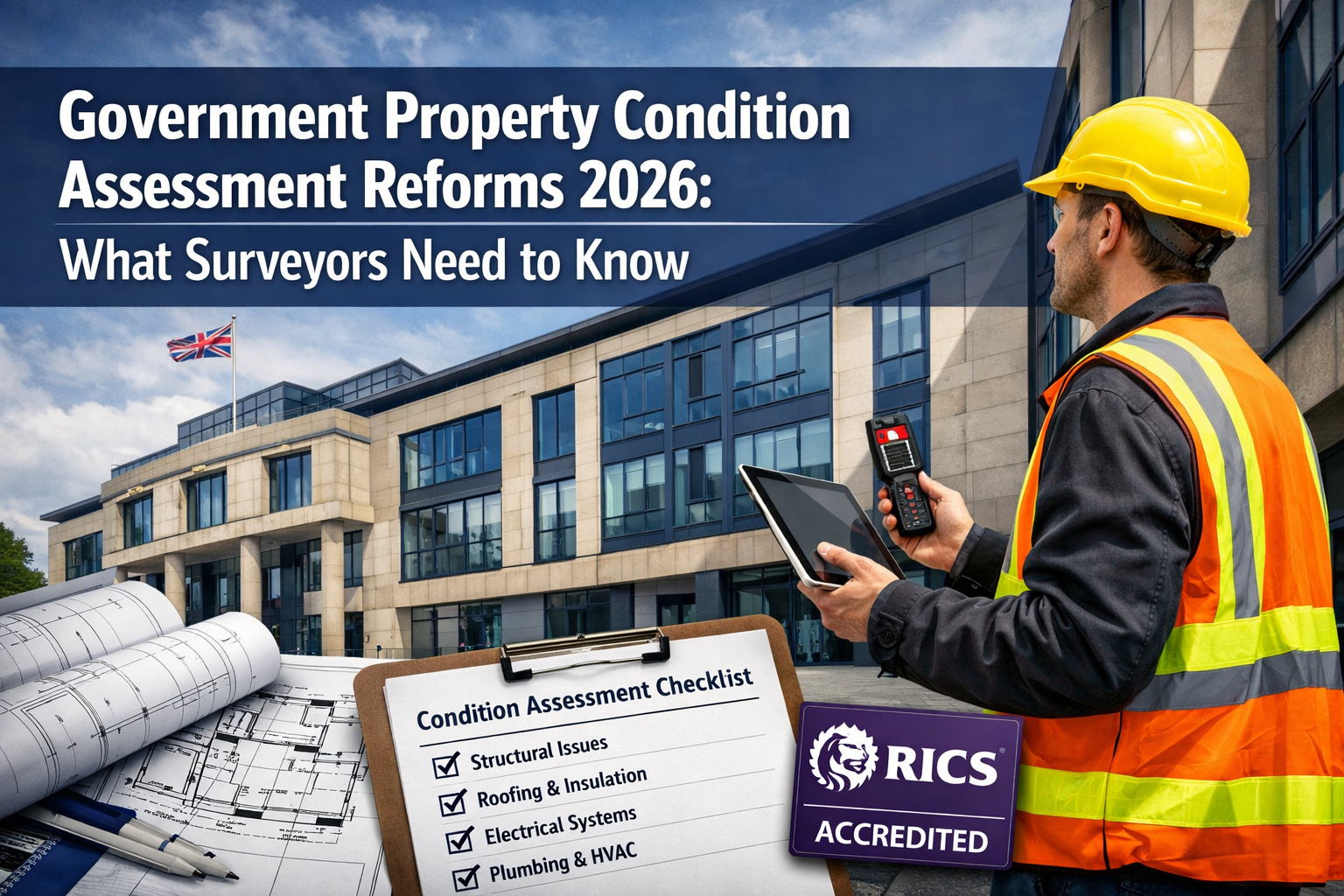

The UK property market stands on the brink of its most significant transformation in decades. Government Property Condition Assessment Reforms 2026: What Surveyors Need to Know represents a fundamental shift that could reshape how property transactions occur across the nation. With proposed mandatory property condition assessments before listing, surveyors face both unprecedented opportunities and new professional responsibilities that will define the industry's future.
The consultation launched in early 2026 has sent ripples through the surveying profession, prompting questions about implementation timelines, standardization requirements, and practical implications for building surveyor services. Understanding these reforms isn't optional—it's essential for every surveying professional who wants to remain competitive in the evolving marketplace.
Key Takeaways
- 🏛️ Mandatory pre-listing assessments could become law by late 2027, requiring property condition reports before properties enter the market
- 📊 Standardized reporting frameworks will establish consistent condition rating scales across all residential property assessments
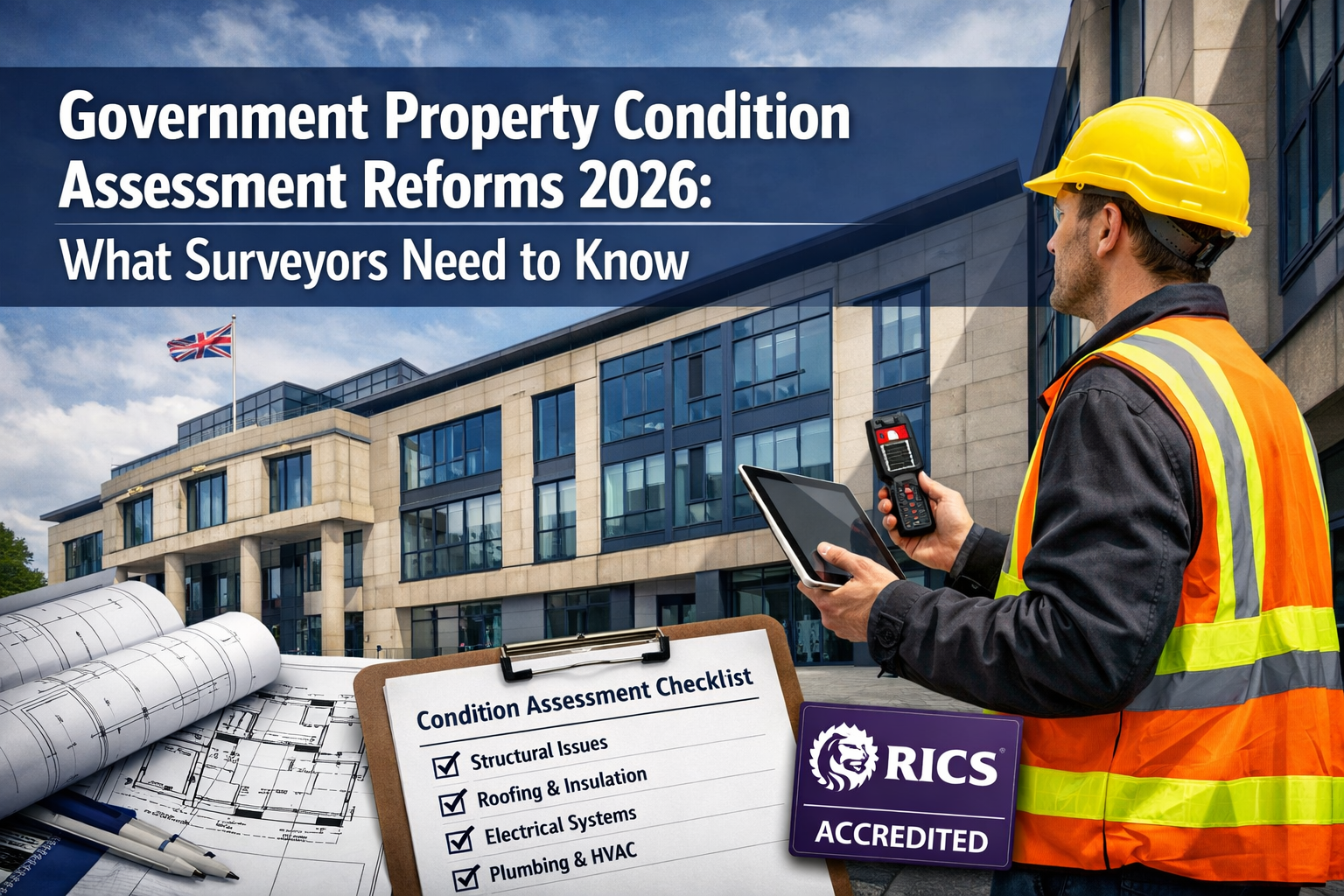
- ⏰ Implementation timeline spans 2026-2028, with consultation, legislative approval, pilot programs, and phased national rollout
- 💼 Surveyor demand will surge as every property listing requires a qualified professional assessment, creating significant business opportunities
- 🎓 New competency requirements mandate additional training and certification for surveyors conducting pre-listing condition assessments
Understanding the Government Property Condition Assessment Reforms 2026
What Are the Proposed Reforms?
The Government Property Condition Assessment Reforms 2026 introduce a mandatory requirement for sellers to commission a professional property condition assessment before listing residential properties for sale. This represents a dramatic departure from the current system where buyers typically arrange surveys after making offers.
The reforms aim to address several long-standing issues in the UK property market:
Current System Problems:
- Transaction failures: Approximately 30% of agreed sales fall through, often due to survey findings
- Wasted costs: Buyers spend millions annually on surveys for properties they ultimately don't purchase
- Information asymmetry: Sellers know property conditions while buyers remain uninformed until late in the process
- Delayed discoveries: Critical defects often emerge only after significant time and expense invested
Reformed System Benefits:
- ✅ Transparent property information available upfront
- ✅ Reduced transaction failures and chain collapses
- ✅ Faster, more efficient property sales
- ✅ Better-informed buyer decisions from the outset
- ✅ Reduced overall transaction costs across the market
The proposed framework requires sellers to engage chartered surveyors to conduct standardized condition assessments following newly established protocols. These reports would be made available to all prospective buyers, eliminating the need for multiple surveys on the same property.
The Consultation Process and Timeline
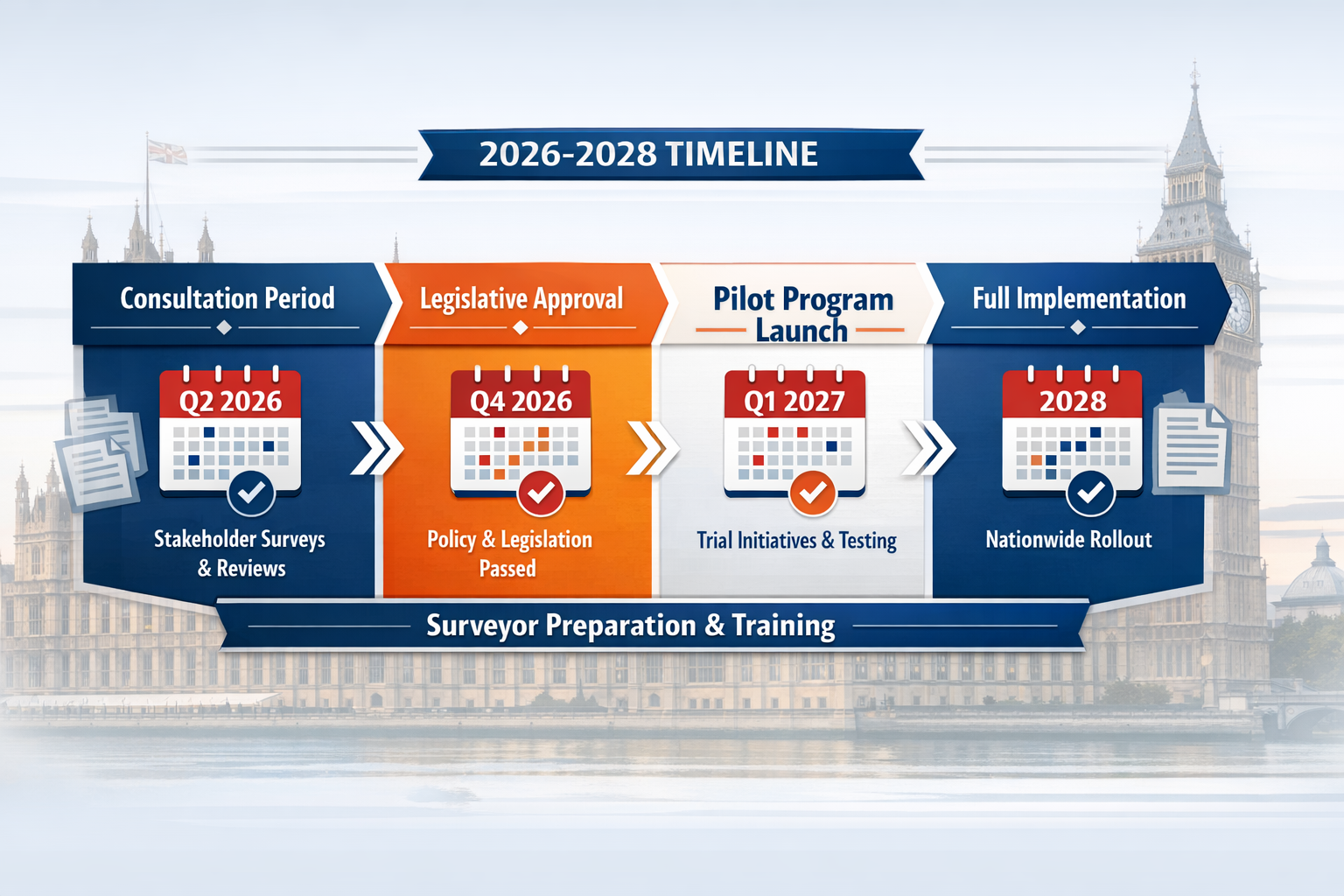
The government has structured the reform implementation across several carefully planned phases:
| Phase | Timeline | Key Activities |
|---|---|---|
| Consultation | Q2-Q3 2026 | Stakeholder feedback, industry input, public consultation |
| Legislative Development | Q4 2026 – Q2 2027 | Draft regulations, parliamentary review, amendments |
| Pilot Programs | Q3 2027 – Q1 2028 | Regional testing, protocol refinement, surveyor training |
| Phased Rollout | Q2 2028 onwards | Gradual national implementation, monitoring, adjustments |
The consultation phase actively seeks input from professional bodies including RICS (Royal Institution of Chartered Surveyors), surveying firms, estate agents, conveyancers, and consumer groups. This collaborative approach aims to create practical, workable standards that serve all market participants.
Key Consultation Questions:
- What should be included in standardized condition assessments?
- How should condition ratings be categorized and communicated?
- What qualifications should surveyors hold to conduct these assessments?
- Should different property types require different assessment protocols?
- How long should pre-listing assessments remain valid?
Standardization Requirements
Perhaps the most significant aspect of Government Property Condition Assessment Reforms 2026: What Surveyors Need to Know involves the creation of standardized reporting frameworks. Currently, survey reports vary considerably in format, detail, and condition rating systems between different surveyors and firms.
Proposed Standardization Elements:
1. Condition Rating Scale
The reforms propose a uniform five-point scale for assessing building elements:
- Rating 1: No repair currently needed
- Rating 2: Minor defects requiring routine maintenance
- Rating 3: Defects requiring repairs or replacement
- Rating 4: Serious defects requiring urgent attention
- Rating 5: Critical defects posing safety risks or requiring immediate action
2. Mandatory Assessment Categories
Every pre-listing assessment must evaluate:
- Structural elements (foundations, walls, roof structure)
- External envelope (roofing, windows, doors, cladding)
- Internal elements (floors, ceilings, internal walls)
- Services (electrical, plumbing, heating, drainage)
- Environmental factors (damp, ventilation, insulation)
- Grounds and boundaries (where applicable)
3. Report Format Requirements
Standardized reports will include:
- Executive summary with overall condition rating
- Detailed findings by category with photographic evidence
- Estimated repair costs for identified defects
- Recommendations for further specialist investigations
- Legal and regulatory compliance notes
This standardization ensures buyers receive consistent, comparable information regardless of which surveyor conducted the assessment—similar to how schedule of condition reports currently provide standardized documentation for commercial properties.
How the Reforms Impact Surveying Practice
Changes to Survey Workflow and Client Relationships
The Government Property Condition Assessment Reforms 2026 fundamentally alter the surveyor-client relationship and workflow processes. Understanding these changes is crucial for adapting business models and service delivery.
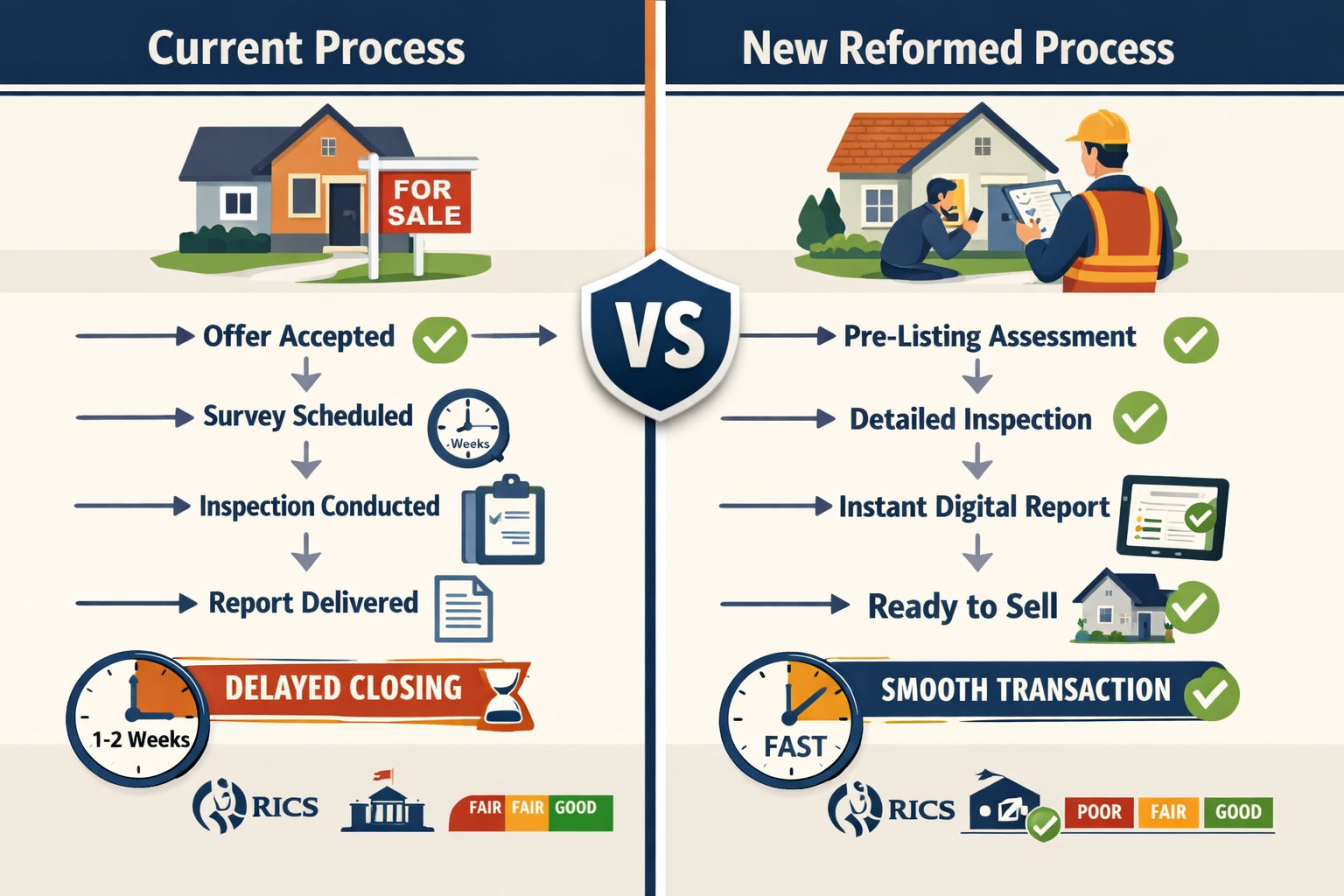
Traditional Workflow:
- Buyer identifies property of interest
- Buyer makes offer (often subject to survey)
- Buyer commissions surveyor
- Survey conducted post-offer
- Results may trigger renegotiation or withdrawal
Reformed Workflow:
- Seller commissions surveyor before listing
- Pre-listing assessment conducted
- Report made available to all prospective buyers
- Buyers make informed offers based on known condition
- Transactions proceed with fewer surprises
Key Relationship Changes:
Client Shift: Surveyors will increasingly work for sellers rather than buyers, creating different dynamics around report findings and recommendations. Professional objectivity becomes even more critical when the person paying for the survey may not welcome negative findings.
Liability Considerations: While sellers commission the reports, buyers rely on them for decision-making. This creates complex liability questions that the reforms address through:
- Clear disclaimers about report scope and limitations
- Professional indemnity insurance requirements
- Standardized terms of engagement
- Defined report validity periods (typically 6 months)
Volume vs. Individual Service: The market may shift toward higher-volume, standardized assessments rather than the current model of detailed, individualized surveys. This doesn't eliminate the need for specialized surveys—buyers may still commission their own building surveys for additional peace of mind—but it changes the baseline service expectation.
Technology and Digital Reporting Requirements
The reforms embrace digital transformation, mandating that pre-listing condition assessments be delivered in standardized digital formats accessible to all authorized parties.
Technology Requirements:
Digital Report Platforms
- Cloud-based report repositories
- Secure access controls for authorized viewers
- Mobile-responsive formats for easy viewing
- Integration with property listing platforms
Assessment Tools
- Digital measurement and documentation tools
- Photographic and video evidence capture
- Thermal imaging for moisture and insulation assessment
- Drone roof surveys for inaccessible areas
Data Standards
- Structured data formats enabling comparison and analysis
- API integration with property portals and conveyancing systems
- Standardized terminology and coding systems
- Machine-readable condition ratings
Surveyors who haven't yet embraced digital tools will need to invest in technology infrastructure to comply with the new requirements. This represents both a cost and an opportunity—firms that excel at digital delivery will gain competitive advantages.
New Competency and Training Requirements
Government Property Condition Assessment Reforms 2026: What Surveyors Need to Know includes enhanced competency requirements for professionals conducting pre-listing assessments.
Qualification Requirements:
✅ Minimum Qualifications
- RICS membership (AssocRICS or MRICS)
- Specific training in standardized assessment protocols
- Demonstrated competence in residential property assessment
- Professional indemnity insurance meeting minimum thresholds
✅ Specialized Training Modules
- Standardized condition rating application
- Digital reporting platform proficiency
- Legal and regulatory compliance
- Professional ethics in seller-commissioned reports
✅ Continuing Professional Development (CPD)
- Annual updates on protocol changes
- Emerging building pathology and materials
- Technology and assessment tool training
- Case study reviews and best practice sharing
RICS and other professional bodies are developing accreditation schemes specifically for pre-listing assessments. Surveyors should anticipate:
- Initial certification courses (2-3 days) covering reformed protocols
- Practical assessments demonstrating competency
- Annual CPD requirements (minimum 10 hours on reform-related topics)
- Quality assurance audits of completed assessments
Preparing Your Surveying Practice for the Reforms
Business Development Opportunities
The mandatory nature of pre-listing assessments creates substantial business opportunities for surveying practices. Every residential property sale will require a qualified professional assessment, dramatically expanding the market.
Market Size Projections:
Current UK residential property transactions: ~1.2 million annually
Potential new assessment market: £180-240 million annually
(Based on estimated assessment fees of £150-200 per property)
Strategic Positioning:
1. Estate Agent Partnerships
Develop relationships with estate agents who will guide sellers toward assessment requirements. Offer:
- Preferential pricing for their clients
- Fast turnaround times (24-48 hours)
- Digital reports integrated with their systems
- Co-branded marketing materials
2. Volume Service Models
Create efficient processes for handling increased assessment volumes:
- Streamlined booking and scheduling systems
- Template-based reporting with customization
- Team-based delivery models
- Geographic clustering for efficiency
3. Premium Add-On Services
While basic assessments become commoditized, offer premium services:
- Enhanced photography and videography
- Detailed repair cost estimates
- Energy efficiency assessments
- Specific defect investigations
- Pre-sale repair recommendations
4. Seller Advisory Services
Position as trusted advisors helping sellers prepare properties:
- Pre-assessment consultations identifying likely issues
- Repair prioritization guidance
- Contractor recommendations
- Post-repair verification assessments
Operational Preparation Checklist
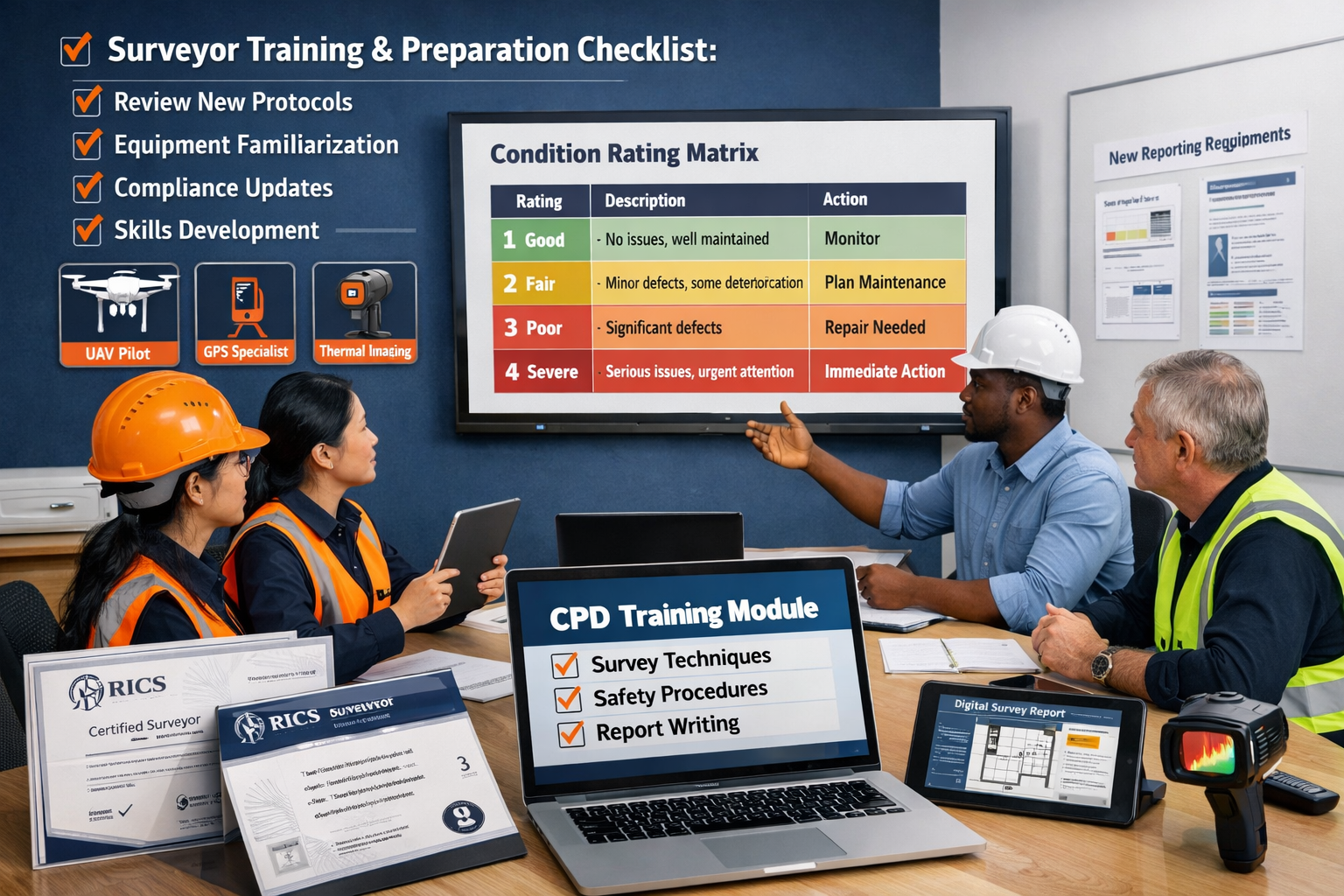
Practices should begin preparing now, even before final regulations are confirmed. This checklist ensures readiness:
📋 Technology and Systems
- Evaluate and select digital reporting platforms
- Implement cloud-based document management
- Acquire mobile assessment tools (tablets, apps)
- Establish secure client portals
- Integrate scheduling and CRM systems
📋 Training and Competency
- Identify staff requiring certification
- Enroll in RICS accreditation programs
- Conduct internal training on standardized protocols
- Develop quality assurance procedures
- Create assessment templates and checklists
📋 Business Processes
- Develop standardized terms of engagement
- Create pricing structures for different property types
- Establish turnaround time commitments
- Design marketing materials targeting sellers
- Build estate agent partnership programs
📋 Risk Management
- Review professional indemnity insurance coverage
- Update terms and conditions
- Implement quality control review processes
- Establish complaint handling procedures
- Create file retention and management protocols
📋 Market Positioning
- Update website with reform information
- Create educational content for sellers
- Develop case studies and examples
- Build referral networks
- Plan launch marketing campaigns
Financial Planning and Investment
Implementing the reforms requires upfront investment, but the returns can be substantial for well-prepared practices.
Investment Areas:
| Category | Estimated Cost | ROI Timeline |
|---|---|---|
| Digital platforms & software | £2,000-5,000 | 6-12 months |
| Training & certification | £500-1,500 per surveyor | Immediate |
| Marketing & positioning | £1,000-3,000 | 3-6 months |
| Equipment & tools | £1,000-3,000 | 12-18 months |
| Process development | £500-2,000 | Ongoing |
Revenue Projections:
A mid-sized practice conducting 10 assessments weekly at £175 average fee:
- Weekly revenue: £1,750
- Annual revenue: £91,000
- Less costs (30%): £63,700 net contribution
Scaling to 25 assessments weekly (achievable with efficient systems):
- Annual revenue: £227,500
- Net contribution: £159,250
These projections demonstrate why early preparation and strategic positioning matter. Practices that establish themselves as pre-listing assessment specialists before full implementation will capture market share while competitors scramble to adapt.
Regional Considerations and Implementation Variations
Geographic Rollout Strategy
The government recognizes that implementing Government Property Condition Assessment Reforms 2026 uniformly across all regions simultaneously would create capacity challenges. The phased approach considers regional variations:
Pilot Region Selection Criteria:
- Mix of urban and rural markets
- Variety of property types and price ranges
- Sufficient surveyor capacity
- Strong professional body presence
- Estate agent cooperation
Likely Pilot Regions (based on consultation discussions):
- Greater London boroughs
- Major regional cities (Manchester, Birmingham, Bristol)
- Selected rural counties
- New build development areas
Surveyors in pilot regions should prepare earlier and more intensively, as they'll establish best practices that inform national rollout. Those in later-phase regions benefit from learning from pilot experiences but must still begin preparation to avoid being overwhelmed when implementation arrives.
Property Type Variations
Not all properties will face identical assessment requirements. The reforms acknowledge that different property types require different approaches:
Standard Residential Properties
- Houses, flats, bungalows
- Full standardized assessment protocol
- Standard condition rating scale
- Typical turnaround: 3-5 working days
Heritage and Listed Properties
- Enhanced assessment requirements
- Specialist surveyor qualifications
- Conservation considerations
- Extended turnaround: 7-10 working days
New Build Properties
- Simplified assessment focusing on completion quality
- NHBC warranty verification
- Snagging identification
- Turnaround: 2-3 working days
Leasehold Flats
- Assessment scope limited to demised premises
- Building-wide issues noted but not assessed
- Service charge and lease considerations
- Turnaround: 2-4 working days
Understanding these variations helps practices specialize in particular property types or develop comprehensive capabilities across all categories. Chartered surveyors across London and surrounding regions should assess their local property mix to determine optimal service offerings.
Common Questions and Concerns About the Reforms
Will Buyers Still Commission Their Own Surveys?
Yes—and this is crucial to understand. The pre-listing assessment provides baseline information, but it doesn't eliminate buyers' rights or needs to conduct their own due diligence.
Reasons Buyers May Still Commission Surveys:
- Independent verification of seller-commissioned findings
- More detailed investigation of specific concerns
- Personal risk tolerance and peace of mind
- Mortgage lender requirements
- Older pre-listing reports (approaching validity expiry)
The market will likely evolve toward:
- Pre-listing assessments as standard baseline information
- Buyer surveys focused on specific concerns or higher-value properties
- Specialist investigations for particular defects identified in pre-listing reports
This creates a two-tier survey market rather than replacing buyer surveys entirely. Surveyors should position services for both seller-commissioned pre-listing assessments and buyer-commissioned detailed surveys.
How Will This Affect Property Values and Marketability?
Transparency about property condition could influence pricing dynamics:
Potential Impacts:
📉 Properties with Identified Issues
- May require price adjustments to reflect known defects
- Could face longer marketing periods
- Might attract renovation-focused buyers
- Sellers may choose to address issues before listing
📈 Properties in Excellent Condition
- Can command premium pricing with confidence
- Attract more buyer interest
- Experience faster sales
- Reduce negotiation friction
Market Efficiency Benefits:
- More accurate initial pricing
- Fewer failed transactions
- Reduced time on market overall
- Better matching of properties to buyers
Rather than depressing values, transparency should create more efficient price discovery—properties sell for what they're genuinely worth based on their actual condition, rather than what sellers hope they're worth or what buyers fear they might be worth.
What About Seller Liability for Disclosed Defects?
A common concern is whether sellers become liable for defects disclosed in pre-listing assessments. The reforms address this through:
Clear Legal Framework:
- Sellers must disclose known defects (already required)
- Pre-listing assessments formalize this disclosure
- Buyers purchase with full knowledge of disclosed conditions
- "As-is" sales remain possible with appropriate pricing
Protection Mechanisms:
- Standardized disclaimers in assessment reports
- Clear scope limitations
- Professional surveyor liability (not seller liability)
- Buyer acknowledgment of report receipt and review
Sellers are not liable for defects they disclose—they're liable for defects they conceal. The reforms actually reduce seller liability by creating a transparent, documented disclosure process.
The Broader Context: Why These Reforms Matter
Alignment with International Best Practices
The UK isn't pioneering this approach—several countries have successfully implemented similar systems:
🇫🇷 France: Diagnostics Immobiliers
- Mandatory seller-commissioned assessments since 2006
- Cover energy performance, asbestos, lead, termites, natural hazards
- Standardized reporting and qualified assessors
- Significantly reduced transaction failures
🇳🇱 Netherlands: Building Reports
- Voluntary but widely adopted seller reports
- Standardized NVM condition assessment
- Approximately 70% of properties sold with reports
- Faster transactions and fewer disputes
🇦🇺 Australia: Building and Pest Inspections
- Common practice for sellers to provide pre-listing inspections
- Reduces buyer uncertainty and negotiation friction
- Professional standards and licensing requirements
- Integrated with property marketing
The UK reforms draw on these international experiences, adapting successful elements to British market conditions and legal frameworks.
Consumer Protection and Market Confidence
Beyond transaction efficiency, the reforms serve important consumer protection objectives:
Protecting Buyers:
- Access to professional assessment before commitment
- Reduced risk of unexpected repair costs
- Better-informed decision-making
- Reduced pressure in competitive markets
Protecting Sellers:
- Clear documentation of property condition
- Reduced post-sale disputes
- Protection against claims of non-disclosure
- Smoother transaction processes
Market-Wide Benefits:
- Increased public confidence in property transactions
- Reduced economic waste from failed sales
- Better data on housing stock condition
- Informed maintenance and improvement decisions
These broader benefits explain why the reforms have cross-party political support and backing from consumer advocacy organizations, despite initial resistance from some industry participants.
Conclusion: Embracing the Opportunity
Government Property Condition Assessment Reforms 2026: What Surveyors Need to Know represents the most significant transformation of the UK property market in generations. While change always brings uncertainty, these reforms create substantial opportunities for surveying professionals who prepare strategically and position themselves effectively.
The shift to mandatory pre-listing assessments will:
✅ Dramatically expand the market for professional property assessments
✅ Standardize reporting and competency requirements
✅ Accelerate digital transformation in the surveying profession
✅ Create new service lines and revenue streams
✅ Enhance the professional status and public value of surveyors
Success in this new environment requires:
1. Early Preparation
Begin now—don't wait for final regulations. Invest in training, technology, and process development while competitors hesitate.
2. Strategic Positioning
Decide whether to compete on volume efficiency or premium quality. Build partnerships with estate agents and develop compelling value propositions for sellers.
3. Continuous Adaptation
The reforms will evolve through consultation, pilot programs, and early implementation. Stay informed, participate in professional body discussions, and adapt quickly to changes.
4. Quality Focus
As assessments become standardized, quality and reliability will differentiate successful practices. Invest in quality assurance, professional development, and client service excellence.
5. Embrace Technology
Digital delivery isn't optional—it's fundamental to the reformed system. Surveyors who excel at technology-enabled service delivery will thrive.
The property market needs professional, qualified surveyors now more than ever. Those who embrace these reforms, prepare thoroughly, and deliver excellent service will find themselves at the center of every property transaction in the UK—a position of influence, value, and professional satisfaction.
For surveyors seeking guidance on adapting to these changes, maintaining professional standards, and developing competitive service offerings, the time to act is now. The reforms are coming, the timeline is clear, and the opportunities are substantial for those who prepare effectively.
Whether you're a chartered surveyor in Central London, North London, or anywhere across the UK, understanding and preparing for Government Property Condition Assessment Reforms 2026 isn't just important—it's essential for your professional future.