

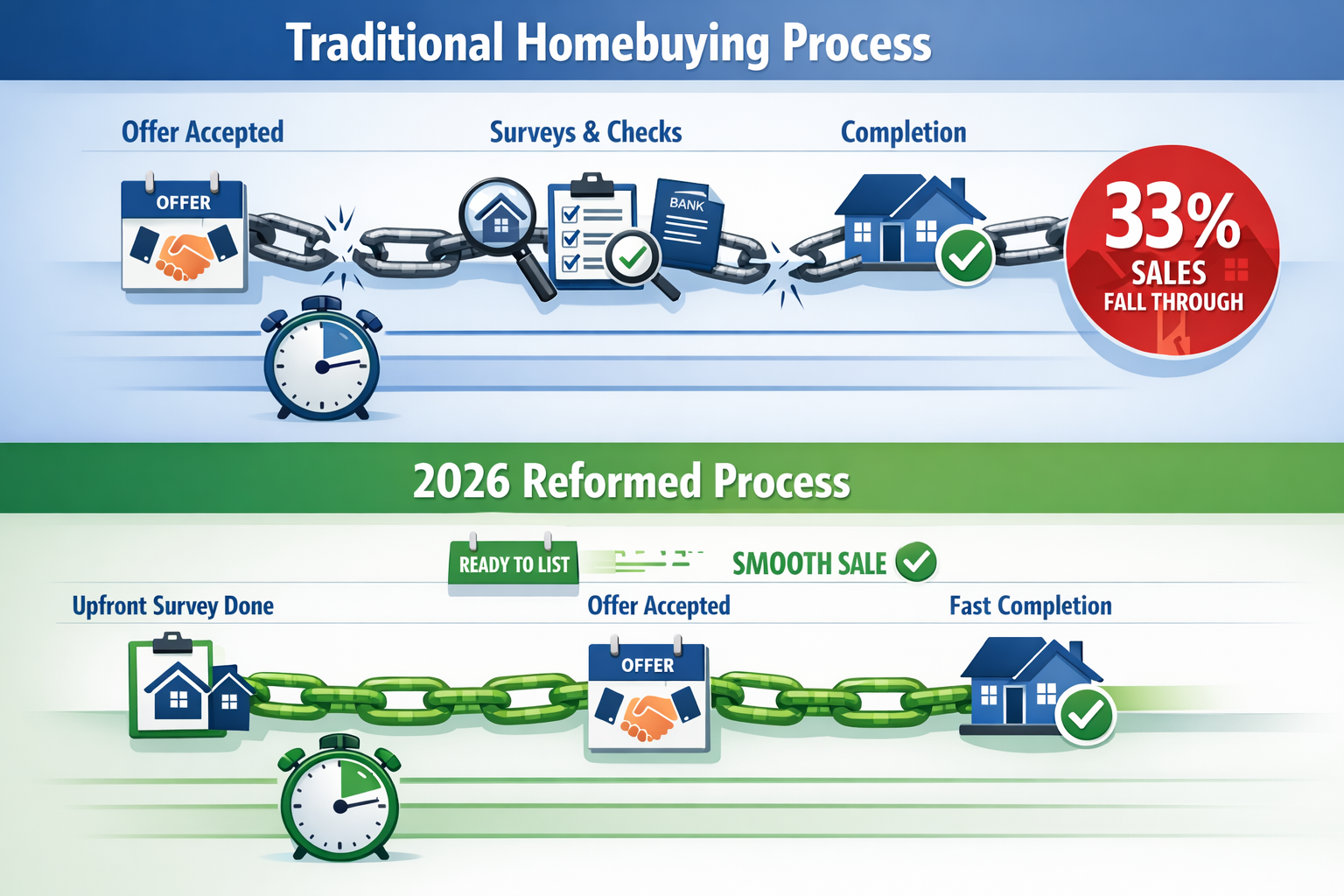
The UK property market is undergoing its most significant transformation in decades. As of 2026, Homebuying Reforms 2026: How Mandatory Upfront Building Surveys Will Reshape UK Property Transactions are fundamentally changing when and how properties are assessed, who pays for surveys, and what information buyers receive before making offers. For the first time in England and Wales, sellers must provide comprehensive building surveys before listing their properties—a seismic shift that promises to reduce the notorious 33% transaction collapse rate while creating new challenges and opportunities for building surveyors, estate agents, and homebuyers alike.[1]
This reform marks the end of the traditional "buyer beware" approach where critical structural information emerged only after offers were accepted, often leading to renegotiations, delays, or complete transaction failures. Instead, the new system mirrors Scotland's established Home Report framework, requiring sellers to commission detailed surveys that disclose structural conditions, known defects, financial obligations, and legal restrictions upfront.[1]

Key Takeaways
- Mandatory seller-provided surveys are now required before property listing in England and Wales, shifting survey costs and timing from buyers to sellers
- Transaction collapse rates are expected to decrease significantly from the current 33% as buyers receive comprehensive information before making offers
- Independent buyer surveys remain essential—seller surveys do not replace the need for impartial RICS Level 2 or Level 3 assessments, particularly for older properties
- Building surveyors face increased workload with earlier engagement in the transaction process and new compliance requirements
- Digital infrastructure modernization is central to implementation, standardizing how property information is collected, stored, and shared
Understanding the Homebuying Reforms 2026: What's Actually Changing
The Core Requirements of Mandatory Upfront Building Surveys
The 2026 reforms introduce a comprehensive package of changes designed to bring transparency and efficiency to property transactions. At the heart of these changes lies the mandatory seller-provided survey requirement—a fundamental departure from decades of established practice.[1]
Under the new framework, sellers must commission and provide:
- Structural condition assessment detailing the property's physical state
- Known defects disclosure identifying existing issues and potential concerns
- Financial charges documentation including leasehold terms, ground rent obligations, and service charges
- Legal restrictions and encumbrances affecting property use and development rights
- Energy performance certification and environmental considerations
This information must be made available to prospective buyers before they submit offers, creating a transparent foundation for negotiations and reducing the likelihood of surprises during the conveyancing process.[1]
How This Differs from Scotland's Home Report System
The reforms deliberately draw inspiration from Scotland's Home Report system, which has operated successfully since 2008. However, there are notable differences in implementation and scope.[1]
Scotland's Home Report includes:
- Single Survey (property condition report)
- Energy Report
- Property Questionnaire
England and Wales 2026 reforms add:
- Enhanced digital infrastructure requirements
- Stronger professional standards for surveyors
- Integration with early binding agreements
- More detailed material information disclosure
The phased rollout approach in England and Wales also differs from Scotland's immediate implementation, allowing the market and professionals time to adapt to new requirements and systems.[1]
Timeline and Phased Implementation
The reforms are being introduced gradually throughout 2026 rather than as a single "big bang" change. This phased approach allows:
📅 Early 2026: Initial survey requirement implementation for new listings
📅 Mid 2026: Digital infrastructure rollout and standardization
📅 Late 2026: Full enforcement of professional standards and compliance measures
📅 2027 onwards: Review and refinement based on initial implementation experience
This timeline gives building surveyors, estate agents, conveyancers, and other property professionals crucial months to prepare systems, train staff, and adjust business models to the new reality.[1]
Impact on Building Surveyors: Adapting to the New Survey Landscape
Fundamental Shifts in Surveyor Workload and Engagement
Building surveyors are experiencing perhaps the most dramatic operational transformation of any profession affected by these reforms. The traditional model—where surveyors were commissioned by buyers after offers were accepted—has been completely inverted.[3]
Traditional model:
- Buyer makes offer
- Offer accepted
- Buyer commissions survey
- Survey reveals issues
- Buyer renegotiates or withdraws
2026 reformed model:
- Seller commissions survey
- Survey completed before listing
- Property listed with survey available
- Buyers review survey before offering
- Offers made with full knowledge
This shift creates several immediate impacts for surveyors:
✅ Earlier engagement in the transaction timeline
✅ Increased volume of pre-listing survey requests
✅ New client relationships primarily with sellers rather than buyers
✅ Enhanced liability considerations as surveys inform multiple potential buyers
✅ Standardization pressure to ensure consistency across seller-commissioned reports
Professional chartered surveyors in London and throughout the UK are investing heavily in training and systems to manage this transition effectively.[3]
The Continuing Need for Independent Buyer Surveys
A critical misconception about the reforms is that seller-provided surveys eliminate the need for buyer-commissioned assessments. This is categorically false.[1]
Seller surveys serve a different purpose than buyer surveys:
| Seller Survey | Buyer Survey |
|---|---|
| General property overview | Buyer-specific concerns addressed |
| Standardized format | Tailored to property type and age |
| Seller's interests considered | Independent, buyer-focused analysis |
| Baseline information | Detailed defect investigation |
| Pre-offer transparency | Post-offer due diligence |
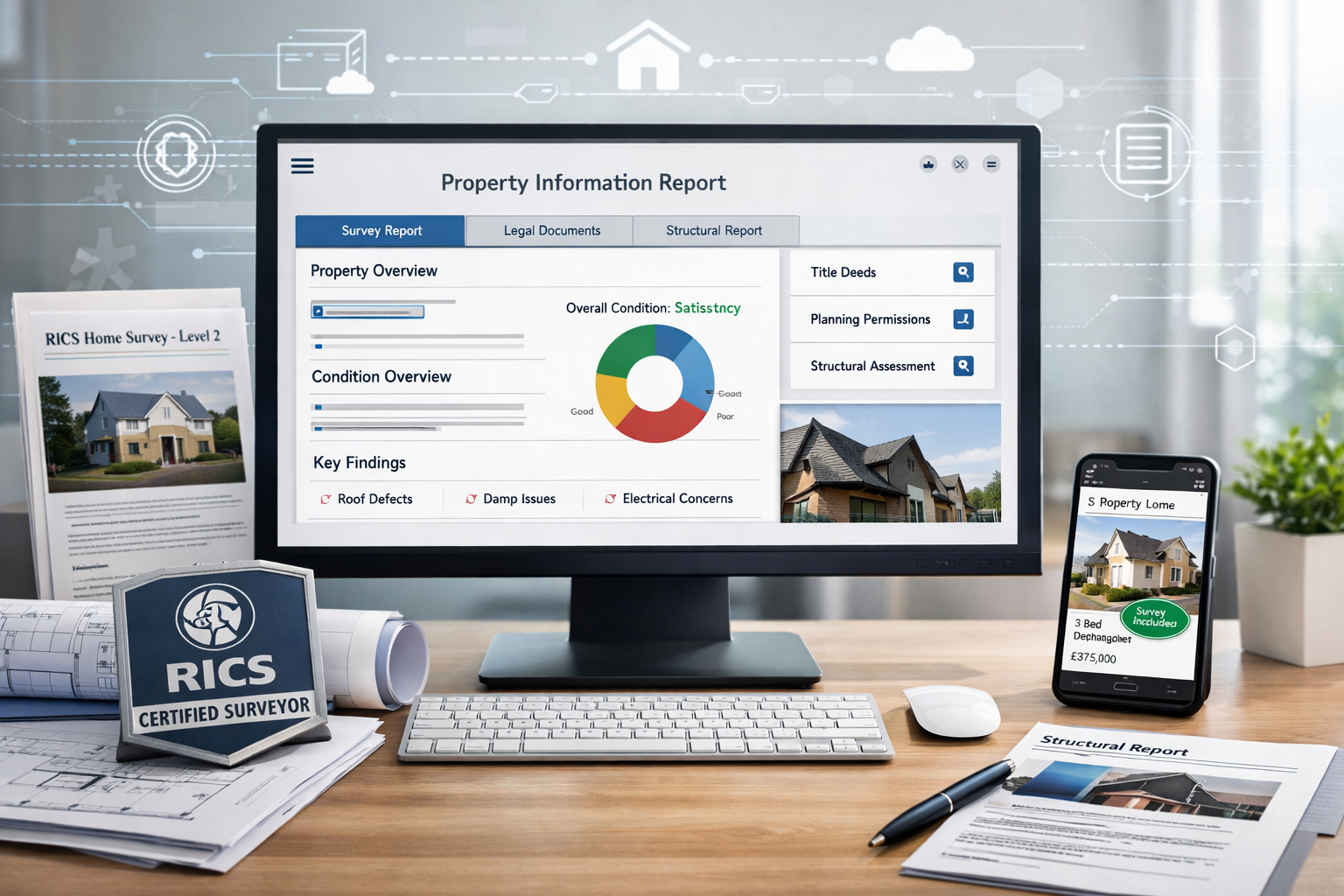
Buyers purchasing older properties, non-standard construction, or properties with visible defects should still commission independent surveys. A structural survey in London provides the comprehensive, impartial analysis necessary for informed decision-making, particularly for Victorian, Edwardian, or unusual properties.
Specific concerns like subsidence require specialist investigation beyond standard seller surveys. Similarly, buyers planning renovations benefit enormously from engaging residential structural engineers who can assess feasibility and costs for proposed alterations.
New Professional Standards and Compliance Requirements
The reforms include strengthened regulatory expectations for surveyors to ensure consistent competence and accountability across the industry.[1][2]
Key professional standards changes:
🎓 Enhanced qualification requirements for surveyors conducting seller surveys
📋 New Code of Practice establishing minimum standards for pre-listing assessments
🔍 Increased oversight from RICS and other professional bodies
💼 Professional indemnity insurance adjustments reflecting new liability profiles
📊 Standardized reporting formats ensuring consistency and comparability
RICS has been actively involved in shaping these standards, recognizing that professional credibility depends on maintaining high-quality, reliable assessments that serve both sellers and buyers effectively.[2]
Surveyors must now demonstrate competence not just in property assessment but also in understanding the legal and regulatory framework governing seller-provided surveys. This includes knowing what must be disclosed, how to present findings in standardized formats, and how to manage potential conflicts of interest when sellers commission reports that buyers will rely upon.
The Buyer's Perspective: Navigating Homebuying Reforms 2026
What Buyers Gain from Mandatory Upfront Surveys
The reforms deliver substantial benefits to property buyers, addressing long-standing frustrations with the traditional system.
🎯 Key advantages for buyers:
1. Reduced Transaction Collapse Risk
With comprehensive information available before offers are made, buyers can make informed decisions without the nasty surprises that previously caused 33% of transactions to collapse.[2] This represents significant savings in wasted survey fees, legal costs, and emotional stress.
2. Faster Transaction Timelines
When surveys are completed upfront, the post-offer period shortens considerably. Buyers can proceed more quickly to exchange and completion, reducing the window for gazumping or market fluctuations to derail purchases.
3. Stronger Negotiating Position
Armed with detailed condition information, buyers can negotiate prices based on actual defects and required repairs rather than discovering issues mid-transaction when leverage is weaker.
4. Cost Certainty Earlier
Understanding repair costs and property condition before committing allows buyers to budget accurately and avoid financial surprises that might strain their resources post-purchase.
5. Comparative Shopping
With standardized surveys available for multiple properties, buyers can compare condition and value more effectively, making better-informed choices about which property represents the best investment.
When Buyers Still Need Independent Surveys
Despite seller-provided surveys, buyers should commission their own assessments in several scenarios:
🏚️ Older properties (pre-1900) with complex construction and potential hidden defects
🏗️ Non-standard construction including timber frame, steel frame, or unusual materials
🔴 Visible defects requiring specialist investigation such as cracking, dampness, or structural movement
🔧 Renovation plans where detailed structural assessment informs feasibility and costs
📐 Boundary disputes or unclear property lines requiring boundary surveys
🏢 Leasehold properties with complex service charge or lease extension considerations
The seller's survey provides a foundation, but buyers with specific concerns or plans benefit enormously from independent professional advice. Understanding what survey you need depends on property type, age, condition, and your intended use.
Understanding Survey Limitations and Exclusions
Even comprehensive seller surveys have inherent limitations that buyers must understand:
⚠️ Common survey exclusions:
- Areas not accessible without causing damage (under floors, behind fixed units)
- Services not in use or turned off at inspection time
- Defects concealed by furniture, coverings, or stored items
- Future performance predictions (surveys assess current condition only)
- Compliance with building regulations for past alterations
- Specialist investigations (asbestos, Japanese knotweed, environmental contamination)
Buyers should read seller surveys carefully and ask questions about anything unclear or concerning. When surveys note limitations or recommend further investigation, taking that advice seriously can prevent expensive surprises after purchase.
For specific issues identified in seller surveys, buyers might need specific defect reports to understand the full extent and cost implications of problems before proceeding.
Practical Guidance: Adapting to the Reformed System
For Building Surveyors: Preparing for Increased Demand
Surveyors must adapt their business models and operations to thrive under the new framework.[3]
📈 Strategic adaptations for surveyors:
1. Capacity Planning
The shift to seller-commissioned surveys creates a front-loaded demand spike. Surveyors should assess capacity to handle increased pre-listing work while maintaining quality standards. This might require hiring additional qualified staff or partnering with other practices.
2. Marketing to Sellers
Traditional surveyor marketing focused on buyers. Now, building relationships with estate agents, solicitors, and directly with sellers becomes crucial. Surveyors should develop seller-focused messaging emphasizing how quality surveys facilitate faster sales at better prices.
3. Technology Investment
Digital infrastructure is central to the reforms.[1] Surveyors should invest in:
- Digital reporting platforms producing standardized formats
- Mobile inspection tools for efficient on-site data capture
- Client portals for secure survey delivery and access
- Integration with property listing platforms
4. Professional Development
Staying current with evolving standards and compliance requirements is non-negotiable. Surveyors should engage with RICS training programs, attend industry conferences, and participate in peer learning networks.[2][3]
5. Risk Management
Enhanced liability exposure requires careful attention to:
- Professional indemnity insurance adequacy
- Clear engagement terms defining scope and limitations
- Thorough documentation of inspection conditions
- Consistent application of professional standards
For Buyers: Making the Most of Available Information
Buyers can maximize the benefits of upfront surveys by approaching them strategically.
💡 Buyer best practices:
1. Request and Review Surveys Early
Don't wait until you're emotionally committed to a property. Review the seller's survey before viewing or immediately after initial interest. This prevents wasting time on properties with deal-breaking issues.
2. Understand Survey Levels
Familiarize yourself with RICS survey levels:
- Level 1 (Condition Report): Basic overview, suitable for new/excellent condition properties
- Level 2 (HomeBuyer Report): Standard survey for conventional properties in reasonable condition
- Level 3 (Building Survey): Comprehensive assessment for older, altered, or defective properties
Seller surveys typically approximate Level 2 assessments. Buyers of older or complex properties should still commission Level 3 surveys for comprehensive analysis.
3. Ask Questions
If the seller's survey raises concerns or is unclear, ask the estate agent or seller's surveyor for clarification. Understanding issues before offering prevents misunderstandings later.
4. Budget for Follow-Up
Set aside funds for independent surveys when appropriate. The seller's survey is a starting point, not necessarily the complete picture. For properties requiring specialist investigation, budget accordingly.
5. Negotiate Informed by Facts
Use survey findings to negotiate fairly. Documented defects provide objective evidence for price adjustments, but remember sellers have already invested in transparency by providing the survey.
For Estate Agents: Facilitating Smooth Transactions
Estate agents play a crucial intermediary role in the reformed system, ensuring surveys are commissioned, delivered, and understood by all parties.
🏡 Agent responsibilities and opportunities:
1. Educate Sellers
Many sellers won't immediately understand the new requirements. Agents should clearly explain:
- Why upfront surveys are mandatory
- What surveys cost and what they cover
- How surveys facilitate faster sales
- The consequences of non-compliance
2. Recommend Qualified Surveyors
Building relationships with reputable, responsive surveyors benefits everyone. Agents should maintain lists of qualified professionals who deliver timely, high-quality reports.
3. Integrate Surveys into Marketing
Properties with comprehensive, positive surveys should highlight this in marketing materials. "Survey available" becomes a selling point demonstrating transparency and confidence in property condition.
4. Manage Buyer Expectations
Agents should help buyers understand survey content and limitations, preventing unrealistic demands or panic over minor issues. Experienced agents add value by contextualizing survey findings.
5. Coordinate Timeline
Ensuring surveys are completed before listing requires coordination. Agents should build survey commissioning into their listing process checklist, allowing adequate time for thorough assessments.
Long-Term Implications: How Reforms Will Reshape the Market
Expected Impact on Transaction Success Rates
The primary goal of the reforms is reducing the 33% transaction collapse rate that has plagued the UK property market.[2] Early indicators from Scotland's Home Report system suggest this is achievable.
Projected improvements:
📊 Reduced fall-through rates from 33% to potentially below 20% within three years
⏱️ Faster completion times as post-offer surprises decrease
💰 Lower overall transaction costs despite upfront survey expenses
🤝 Increased market confidence as transparency becomes standard
📈 More stable pricing with fewer last-minute renegotiations
However, success depends on consistent implementation, professional competence, and market participants embracing the new culture of transparency rather than seeking ways to circumvent requirements.
Digital Transformation and Standardization
The reforms accelerate digital transformation across the property sector.[1] Standardized digital formats for surveys, searches, and legal documentation replace the current fragmented, paper-heavy processes.
Key digital developments:
🖥️ Centralized property information platforms storing surveys, searches, and documentation
📱 Mobile-first access allowing buyers to review comprehensive information on any device
🔗 API integrations connecting surveyors, agents, conveyancers, and lenders
🤖 Automated compliance checking ensuring surveys meet minimum standards
📊 Data analytics providing market insights from aggregated survey data
This digital infrastructure creates opportunities for PropTech companies while challenging traditional firms to modernize or risk obsolescence.
Professional Standards Evolution
The reforms represent a step-change in expectations for property professionals.[2] Surveyors, agents, and conveyancers face enhanced accountability and must demonstrate competence through formal qualifications and ongoing professional development.
Evolving standards include:
✅ Mandatory qualifications for professionals conducting seller surveys
📋 Standardized reporting formats ensuring consistency and comparability
🔍 Enhanced oversight from regulatory bodies with enforcement powers
💼 Professional indemnity requirements reflecting new liability profiles
📚 Continuing professional development obligations to maintain competence
These changes professionalize the industry, benefiting consumers through higher quality, more reliable services while raising barriers to entry for unqualified practitioners.
Geographic Variations and Considerations
The reforms apply only to England and Wales, creating interesting dynamics with Scotland (which already has Home Reports) and Northern Ireland (which operates its own framework).[1]
Regional considerations:
🏴 Scotland: Established system provides lessons for England and Wales implementation
🏴 Wales: Identical reforms to England despite separate property law in some areas
🏴 England: Largest market, greatest implementation challenge
⚠️ Northern Ireland: Different system continues, creating UK-wide inconsistency
Cross-border transactions may create complexity as buyers and sellers navigate different requirements depending on property location.
Challenges and Criticisms of the Homebuying Reforms 2026
Cost Implications for Sellers
The most immediate criticism of the reforms concerns upfront costs imposed on sellers. Comprehensive building surveys typically cost £500-£1,500 depending on property size and complexity—an expense sellers must bear before knowing whether their property will sell.[1]
Seller concerns include:
💸 Upfront financial burden particularly for sellers in financial difficulty
🔄 Multiple surveys if properties don't sell quickly and surveys become outdated
📉 Negative disclosure potentially reducing sale prices or deterring buyers
⏰ Listing delays while waiting for survey completion
🤔 Quality variation between surveyors affecting property presentation
However, proponents argue these costs are offset by faster sales, fewer fall-throughs, and reduced overall transaction costs when surveys prevent collapsed deals.
Implementation Complexity and Transition Period
The transition from a decades-old system to a fundamentally different approach creates inevitable challenges and uncertainties.
Implementation challenges:
🔧 System integration across multiple platforms and stakeholders
📚 Knowledge gaps among professionals unfamiliar with new requirements
⚖️ Legal uncertainties as case law develops around new obligations
🏢 Capacity constraints as surveyor demand spikes
📱 Digital exclusion for participants without technology access or skills
The phased rollout helps mitigate these challenges, but the transition period will inevitably involve confusion, mistakes, and learning curves for all participants.[1]
Potential Unintended Consequences
Critics warn of possible unintended effects that could undermine reform objectives.
Potential issues:
⚠️ Survey shopping: Sellers commissioning multiple surveys until receiving favorable results
📄 Minimal compliance: Surveyors producing basic reports meeting letter but not spirit of requirements
🎭 Cosmetic improvements: Sellers making superficial fixes to improve survey results while hiding deeper issues
💰 Price inflation: Survey costs being passed to buyers through higher asking prices
🚫 Market exclusion: Lower-value properties becoming uneconomical to sell with mandatory survey costs
Monitoring and addressing these risks requires active regulatory oversight and willingness to refine the framework based on real-world experience.
Conclusion: Embracing the Future of UK Property Transactions
The Homebuying Reforms 2026: How Mandatory Upfront Building Surveys Will Reshape UK Property Transactions represent the most significant change to the property market in generations. By requiring comprehensive seller-provided surveys before listing, the reforms promise greater transparency, reduced transaction failures, and a more efficient market benefiting buyers, sellers, and the broader economy.
For building surveyors, the reforms create both challenges and opportunities. Increased demand for pre-listing surveys requires capacity expansion, technological investment, and adaptation to new professional standards. However, surveyors who embrace these changes position themselves as essential facilitators of smoother, more transparent transactions.
Buyers gain access to unprecedented information before making offers, reducing the risk of expensive surprises and failed transactions. However, the availability of seller surveys doesn't eliminate the need for independent professional advice, particularly for older, complex, or defective properties.
The success of these reforms ultimately depends on all market participants—surveyors, agents, conveyancers, buyers, and sellers—embracing the culture of transparency and professionalism they're designed to foster.
Actionable Next Steps
For surveyors:
- Invest in RICS-approved training for 2026 compliance requirements
- Upgrade technology infrastructure for digital reporting and integration
- Develop marketing strategies targeting sellers and estate agents
- Review professional indemnity insurance coverage for new liability profiles
For buyers:
- Request and review seller surveys before making offers
- Commission independent surveys for older or complex properties
- Understand survey limitations and when specialist investigations are needed
- Use survey findings to negotiate fairly and informed by facts
For sellers:
- Commission surveys from qualified, reputable professionals early in the listing process
- Understand that transparent disclosure facilitates faster sales and reduces fall-through risk
- Budget for survey costs as part of selling expenses
- Address identified defects before listing or price accordingly
For estate agents:
- Educate sellers about mandatory survey requirements and benefits
- Build relationships with qualified surveyors for reliable service
- Integrate survey availability into property marketing
- Help buyers understand and contextualize survey findings
The reformed system requires adjustment, but the long-term benefits of reduced transaction failures, greater transparency, and increased market efficiency make these changes worthwhile. By preparing now and embracing the new framework, all market participants can thrive in the transformed UK property landscape of 2026 and beyond.
References
[1] Housing Reform 2026 Key Changes – https://www.cjbloor.co.uk/news/housing-reform-2026-key-changes/
[2] Rics Responds To Major Changes In Home Buying And Selling – https://www.rics.org/news-insights/rics-responds-to-major-changes-in-home-buying-and-selling
[3] Preparing Building Surveyors For 2026 Homebuying Reforms Rics Training And Compliance Essentials – https://nottinghillsurveyors.com/blog/preparing-building-surveyors-for-2026-homebuying-reforms-rics-training-and-compliance-essentials