

{"cover":"Professional landscape format (1536x1024) hero image featuring bold text overlay 'Impact of Homebuying Reforms on Building Survey Demand: Preparing for Mandatory Upfront Assessments in 2026' in extra large 70pt white sans-serif font with dark gradient shadow, positioned in upper third. Background shows modern UK residential property with surveyor conducting inspection using digital tablet and laser measuring device, architectural blueprints visible, split composition showing traditional home sale process transforming into streamlined digital workflow. Color scheme: deep navy blue, white, gold accents. High contrast, magazine cover quality, editorial style with professional depth of field, representing transformation in property transaction process and surveying industry evolution.","content":["Detailed landscape format (1536x1024) image showing comparative workflow diagram of traditional versus reformed homebuying process, split-screen composition with left side displaying old multi-step property transaction timeline with survey occurring late in process, right side showing new streamlined 2026 process with mandatory upfront building assessment at beginning, visual elements include calendar icons, property inspection checkpoints, digital document symbols, professional surveyor silhouettes, upward trending graph overlay showing increased survey demand volumes, clean infographic aesthetic with navy blue, white and gold color palette, annotations highlighting key reform milestones and timing differences","Detailed landscape format (1536x1024) image depicting surveyor training and operational scaling concept, showing modern training facility with multiple surveyors learning digital assessment technologies, large wall-mounted screens displaying building condition report templates and standardized assessment criteria, foreground features surveyor using drone technology for roof inspection, middle ground shows classroom setting with RICS-accredited instructors, background includes organizational chart showing expanded team structure, visual elements include certification badges, technology icons, capacity planning graphs, professional corporate aesthetic with warm lighting, representing industry adaptation and workforce development for increased demand","Detailed landscape format (1536x1024) image illustrating regional variation in survey demand across UK property markets, detailed heat map of United Kingdom showing color-coded intensity of building survey activity by region, major cities labeled including London, Manchester, Birmingham with data visualization overlays, foreground features diverse UK property types from Victorian terraces to modern apartments each with inspection status indicators, side panel displays bar charts comparing regional price trends and survey volumes, professional data visualization aesthetic with gradient color scheme from cool blues to warm oranges, clean typography, representing geographic distribution of reform impact and market dynamics across different areas"}
The UK property market stands at a pivotal moment. As government proposals for mandatory upfront building assessments gain momentum, the surveying industry faces its most significant transformation in decades. The Impact of Homebuying Reforms on Building Survey Demand: Preparing for Mandatory Upfront Assessments in 2026 represents more than just regulatory change—it signals a fundamental shift in how properties change hands and how surveyors must operate. 🏠
Government analysis suggests that introducing standard condition reports early in the sales process could dramatically reduce transaction failures, streamline property purchases, and create unprecedented demand for building surveys. For surveyors, this means preparing for a surge in workload, adapting business models, and retraining teams to meet new standardized requirements.
Key Takeaways
- Mandatory upfront assessments could shift building surveys from optional to essential, occurring before properties are marketed rather than after offers are accepted
- Survey demand volumes are projected to increase significantly as every listed property would require a standardized condition report
- Operational scaling will be critical—surveying firms must expand capacity, invest in technology, and streamline workflows to handle increased volumes
- Standardization requirements mean surveyors need retraining on new assessment criteria, reporting templates, and digital submission systems
- Regional variations in property market activity will create uneven demand patterns, requiring strategic resource allocation across different areas
Understanding the Proposed Homebuying Reforms for 2026
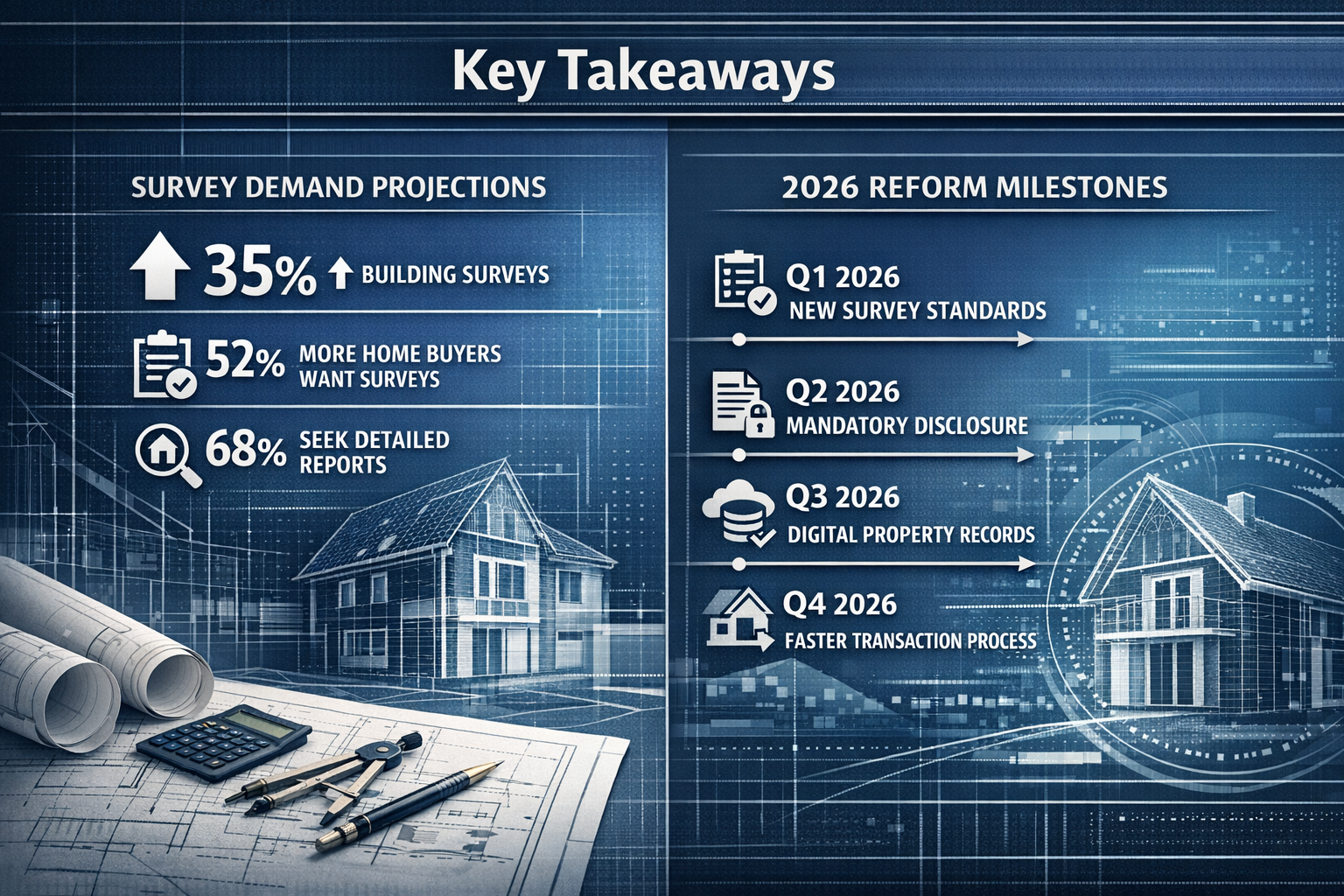
The UK government's proposed reforms aim to address long-standing inefficiencies in the property transaction process. Currently, building surveys typically occur after an offer has been accepted, leading to deal collapses when significant defects are discovered. This creates frustration for buyers and sellers alike, with an estimated 30% of property transactions falling through before completion.
What Are Mandatory Upfront Assessments?
Mandatory upfront assessments would require sellers to commission a standardized building condition report before listing their property for sale. This report would:
- Provide prospective buyers with transparent information about the property's condition
- Identify structural issues, damp problems, and necessary repairs before marketing begins
- Follow a standardized format ensuring consistency across all property transactions
- Be conducted by qualified chartered surveyors meeting specific accreditation requirements
The reform draws inspiration from similar systems in other countries where upfront disclosure has reduced transaction times and increased market efficiency.
Timeline and Implementation Expectations
While specific legislation has not yet been finalized, industry consultations and government statements point toward a phased implementation beginning in 2026. The proposed timeline includes:
| Phase | Timeline | Key Activities |
|---|---|---|
| Consultation | Q1-Q2 2026 | Final stakeholder feedback and regulatory framework development |
| Pilot Programs | Q3 2026 | Testing in select regions with voluntary participation |
| Gradual Rollout | Q4 2026-2027 | Mandatory requirements introduced for specific property types |
| Full Implementation | 2027-2028 | Universal application across all residential property sales |
This gradual approach allows the surveying industry time to scale operations, though preparation must begin immediately to meet anticipated demand.
Impact of Homebuying Reforms on Building Survey Demand: Market Volume Projections
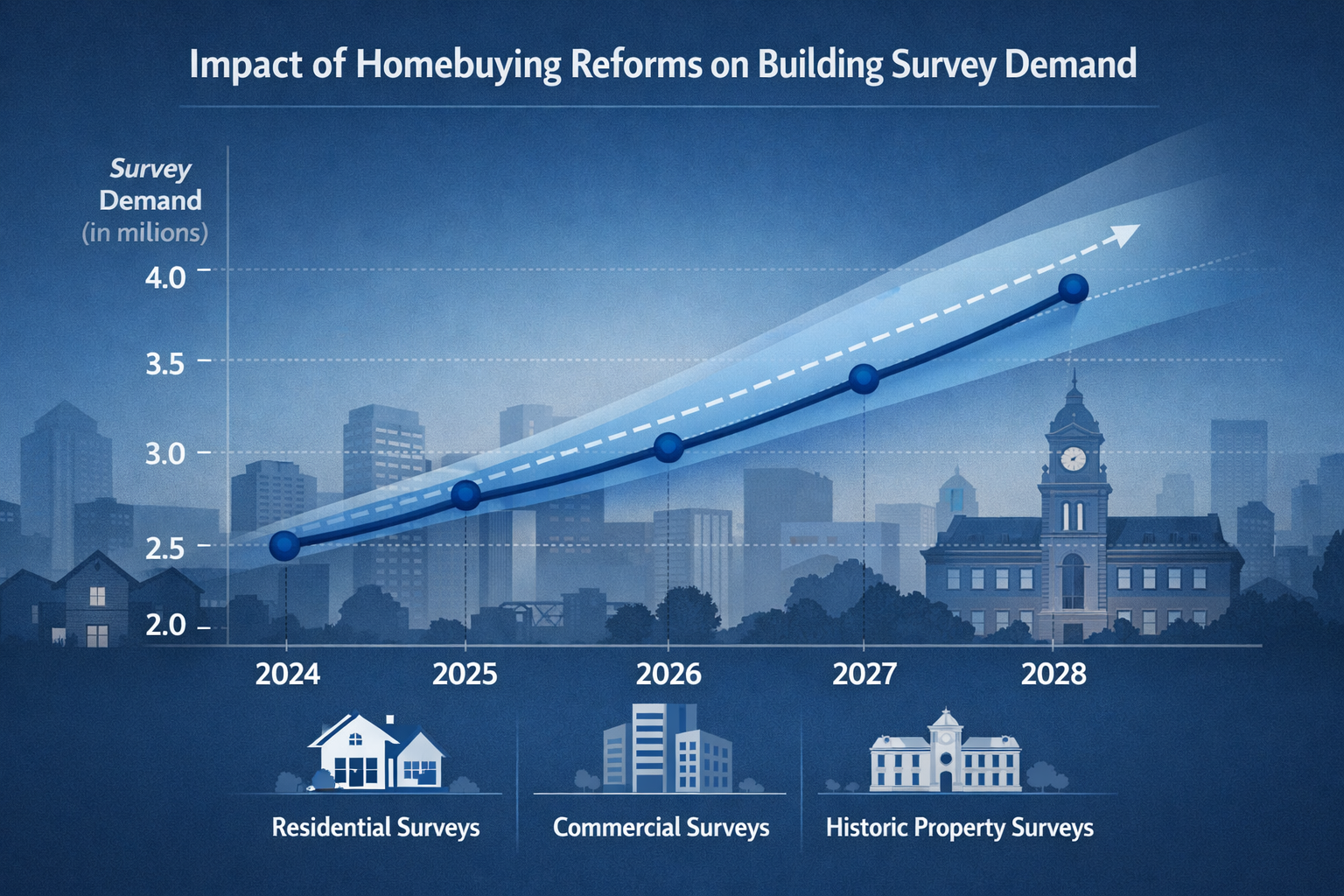
The introduction of mandatory upfront assessments will fundamentally alter building survey demand patterns. Currently, surveys are commissioned by buyers on a discretionary basis, with approximately 40-50% of property purchases involving a professional building survey. Under the new system, 100% of properties listed for sale would require a standardized assessment.
Quantifying the Demand Surge
Based on current UK property transaction volumes, the reform could create the following demand increases:
Current Annual Survey Volume: Approximately 600,000-700,000 building surveys conducted annually (based on discretionary buyer commissioning)
Projected Post-Reform Volume: 1.2-1.4 million surveys annually (based on all properties listed requiring upfront assessment)
This represents a potential doubling of survey demand, though actual figures will depend on final regulatory requirements and market conditions. The RICS UK Residential Market Survey indicates continued activity in the property market, with new buyer enquiries showing resilience despite economic uncertainties [1].
Regional Variations in Demand
The impact will not be uniform across the UK. Areas with higher property turnover will experience more significant demand increases:
- Central London and prime markets: High-value properties with complex building characteristics requiring detailed assessments
- South East regions including Surrey and Sussex: Strong transaction volumes driven by commuter demand
- North London and surrounding areas: Diverse property stock requiring varied survey approaches
- Regional markets in Hertfordshire, Essex, and Buckinghamshire: Growing demand from first-time buyers and relocating families
Market outlook reports suggest regional price divergence will continue, with London and the South East showing different dynamics compared to other UK regions [3]. This geographic variation requires surveying firms to strategically position resources where demand will be strongest.
Operational Challenges and Capacity Planning for Surveyors
The Impact of Homebuying Reforms on Building Survey Demand: Preparing for Mandatory Upfront Assessments in 2026 presents significant operational challenges for surveying practices. Meeting doubled demand requires strategic planning across multiple dimensions.
Workforce Expansion and Recruitment
Current surveyor capacity is already stretched during peak market periods. To handle increased volumes, firms must:
✅ Recruit additional qualified surveyors – Begin hiring campaigns now to build teams ahead of implementation
✅ Accelerate training programs – Develop fast-track pathways for junior surveyors to gain necessary qualifications
✅ Leverage technology – Implement digital tools to improve surveyor productivity and reduce time per assessment
✅ Consider strategic partnerships – Collaborate with other practices to share workload during peak periods
The construction industry outlook indicates continued skills shortages across the sector, making early recruitment critical [4]. Firms that begin building capacity now will have competitive advantages when reforms take effect.
Technology Investment Requirements
Meeting increased demand efficiently requires significant technology adoption:
- Digital reporting platforms for standardized condition report generation
- Drone roof survey technology to expedite external inspections
- Mobile inspection apps enabling on-site data capture and real-time report compilation
- Scheduling and workflow management systems to optimize surveyor utilization
- Client portals for seamless report delivery and communication
These investments represent substantial upfront costs but are essential for maintaining service quality while handling higher volumes.
Quality Control and Standardization
With standardized reporting requirements, surveyors must ensure:
Consistent assessment criteria – All team members apply the same standards when evaluating property conditions
Template compliance – Reports follow prescribed formats and include all mandatory elements
Quality assurance processes – Internal review systems catch errors before reports reach clients
Continuing professional development – Regular training on updated standards and assessment methodologies
Maintaining quality while increasing throughput is perhaps the greatest operational challenge facing the industry.
Training and Accreditation Requirements for the New System

The shift toward mandatory upfront assessments will likely introduce new accreditation requirements for surveyors conducting these reports. Understanding and preparing for these requirements is essential.
Expected Competency Standards
While final requirements await regulatory confirmation, anticipated competency areas include:
- Standardized assessment methodology – Understanding prescribed inspection protocols and evaluation criteria
- Report template proficiency – Ability to complete standardized forms accurately and comprehensively
- Defect identification and classification – Consistent categorization of building issues by severity
- Legal and regulatory knowledge – Understanding disclosure requirements and surveyor liability under the new system
- Digital platform competency – Proficiency with mandated reporting and submission systems
Surveyors currently offering specific defect reports or comprehensive building surveys already possess many relevant skills, but formal certification for upfront assessments may require additional training.
Retraining Existing Workforce
For established surveyors, adapting to the new system involves:
📚 Formal training courses on standardized assessment protocols
📚 Certification examinations demonstrating competency in new requirements
📚 Practical workshops on using digital reporting platforms
📚 Legal briefings on surveyor responsibilities under reformed regulations
📚 Quality benchmarking to ensure consistency with industry standards
Professional bodies like RICS will likely develop accredited training programs, making it essential for surveyors to engage early with these offerings.
Building Survey Specializations
The reform may create opportunities for specialization:
- Period property specialists with expertise in Victorian, Edwardian, and Georgian buildings
- Modern construction experts familiar with contemporary building methods and materials
- Leasehold assessment specialists understanding leasehold-specific issues
- Technology-focused surveyors utilizing advanced inspection equipment
Developing niche expertise can differentiate practices in an increasingly competitive market.
Business Model Adaptations and Pricing Strategies
The Impact of Homebuying Reforms on Building Survey Demand: Preparing for Mandatory Upfront Assessments in 2026 will force surveying practices to reconsider their business models and pricing approaches.
Shifting from Buyer to Seller Commissioning
Currently, buyers commission building surveys, creating a direct client relationship. Under mandatory upfront assessments, sellers become the primary clients, fundamentally changing the business dynamic:
Marketing focus shifts from buyers to estate agents and sellers
Volume opportunities emerge through partnerships with estate agencies and property listing platforms
Pricing pressure may increase as sellers seek cost-effective compliance rather than comprehensive assessments
Service bundling opportunities arise, combining surveys with valuation services or other property reports
This shift requires surveyors to develop new client acquisition strategies and potentially restructure their service offerings.
Pricing Model Considerations
Standardized upfront assessments may command different pricing than traditional buyer-commissioned surveys:
| Pricing Approach | Advantages | Challenges |
|---|---|---|
| Fixed standardized pricing | Transparency, easy comparison, scalable | May not reflect property complexity |
| Tiered pricing by property type | Accounts for different assessment requirements | Requires clear categorization system |
| Volume discount partnerships | Secures estate agency relationships | Pressure on margins |
| Premium add-on services | Revenue enhancement beyond basic assessment | Risk of commoditizing core service |
Successful practices will likely employ hybrid approaches, offering competitive base pricing for mandatory assessments while providing premium options for buyers seeking more detailed investigations.
Revenue Diversification Opportunities
While mandatory assessments create volume opportunities, smart practices will diversify revenue streams:
💰 Buyer-commissioned supplementary surveys for those wanting deeper analysis beyond the standard report
💰 Structural engineering consultations for properties with identified defects
💰 Party wall services for buyers planning renovations
💰 Reinstatement valuations for insurance purposes
💰 Post-purchase snagging reports for new-build properties
This diversification protects against commoditization of the mandatory assessment while providing comprehensive service to clients throughout the property transaction journey.
Regional Market Dynamics and Strategic Positioning
Understanding regional variations in the Impact of Homebuying Reforms on Building Survey Demand: Preparing for Mandatory Upfront Assessments in 2026 enables strategic resource allocation.
High-Demand Metropolitan Areas
Major urban centers will experience the most significant volume increases:
London and surrounding boroughs including Kingston, Islington, Camden, Chelsea, and Hammersmith represent the highest transaction volumes and most diverse property stock.
West London areas such as Chiswick, Ealing, and Fulham maintain strong market activity with premium property values.
South West London including Putney, Battersea, and Barnes offer consistent demand from affluent buyers.
The RICS survey data shows London markets demonstrating resilience with improving sentiment among professionals [2], suggesting sustained transaction volumes that will drive survey demand.
Commuter Belt and Regional Centers
Areas within commuting distance of major cities present growth opportunities:
- Hertfordshire towns like Watford, St Albans, Harpenden, and Hemel Hempstead
- Surrey locations including Guildford, Epsom, and Godalming
- Sussex and Hampshire coastal and rural markets
These areas combine significant transaction volumes with diverse property types, requiring surveyors with broad expertise.
Strategic Coverage Planning
Successful firms will strategically position resources:
🎯 Hub-and-spoke models with central offices serving multiple regions
🎯 Local partnerships with regional practices for overflow capacity
🎯 Mobile surveyor teams able to cover multiple adjacent areas
🎯 Technology-enabled remote working reducing travel time and increasing daily capacity
Geographic positioning should align with projected transaction volumes and competition levels in each market.
Preparing Your Surveying Practice for 2026 Reforms
With implementation approaching, surveying practices must take concrete preparatory steps now to capitalize on opportunities while managing challenges.
Immediate Action Steps (2026)
Q1-Q2 2026:
- ✓ Assess current capacity and identify gaps
- ✓ Begin recruitment for additional surveyors
- ✓ Research and select digital reporting platforms
- ✓ Engage with RICS and regulatory bodies on emerging standards
- ✓ Review and update service offerings and pricing structures
Q3-Q4 2026:
- ✓ Implement new technology systems and train staff
- ✓ Develop standardized internal processes and quality controls
- ✓ Build partnerships with estate agencies and property platforms
- ✓ Launch marketing campaigns targeting sellers and agents
- ✓ Participate in pilot programs if available
Medium-Term Strategic Planning (2027-2028)
As reforms roll out, practices should:
Monitor regulatory developments closely and adapt procedures accordingly
Track performance metrics including survey volumes, completion times, and client satisfaction
Refine operational processes based on real-world experience and feedback
Expand service offerings to capture additional revenue opportunities
Invest in continuing education ensuring team remains current with evolving standards
Building Competitive Advantages
Practices that thrive under the new system will differentiate through:
🏆 Speed and efficiency – Fastest turnaround times from booking to report delivery
🏆 Technology leadership – Most advanced inspection and reporting capabilities
🏆 Quality reputation – Consistently accurate, comprehensive assessments
🏆 Strategic partnerships – Preferred provider relationships with major estate agencies
🏆 Specialized expertise – Deep knowledge in specific property types or regions
Early preparation creates first-mover advantages that establish market position before competition intensifies.
Conclusion
The Impact of Homebuying Reforms on Building Survey Demand: Preparing for Mandatory Upfront Assessments in 2026 represents a watershed moment for the UK surveying industry. Government proposals for standardized condition reports promise to transform the homebuying process, creating unprecedented demand for building surveys while fundamentally reshaping how surveying practices operate.
For surveyors, the message is clear: preparation must begin now. Doubling of survey volumes requires immediate action on workforce expansion, technology investment, and operational scaling. Firms that proactively build capacity, embrace standardization, and position themselves strategically across high-demand regions will capture significant market share and establish leadership positions.
The reforms also present opportunities for innovation—developing specialized expertise, leveraging advanced inspection technologies, and creating value-added services that extend beyond mandatory compliance. While standardization may commoditize basic assessments, savvy practices will differentiate through quality, speed, and comprehensive service offerings.
Next Steps for Surveying Practices
- Conduct a capacity audit – Assess current resources against projected demand increases
- Develop a scaling roadmap – Create detailed plans for recruitment, training, and technology adoption
- Engage with industry bodies – Participate in consultations and stay informed on regulatory developments
- Build strategic partnerships – Establish relationships with estate agencies and property platforms
- Invest in your team – Prioritize training and professional development for existing surveyors
- Monitor pilot programs – Learn from early implementations and adapt strategies accordingly
The transition to mandatory upfront assessments will challenge the surveying industry, but those who prepare thoughtfully will find substantial opportunities for growth and market leadership. The time to act is now—2026 is already here, and the reforms are approaching rapidly.
References
[1] Uk Residential Market Survey January 2026 – https://www.rics.org/content/dam/ricsglobal/documents/market-surveys/uk-residential-market-survey/UK-Residential-Market-Survey_January-2026.pdf
[2] Uk Resi Survey Jan 2026 Report Shows Early Signs Market Recovery Despite Caution – https://www.rics.org/news-insights/uk-resi-survey-jan-2026-report-shows-early-signs-market-recovery-despite-caution
[3] Uk Real Estate Market Outlook Q1 2026 – https://www.aberdeeninvestments.com/en-gb/professional/insights-and-research/uk-real-estate-market-outlook-q1-2026
[4] Construction Industry Market Outlook February 2026 – https://www.thomsongray.com/news/construction-industry-market-outlook-february-2026