The institutional buy-to-let market is experiencing unprecedented growth in 2026, with professional landlords and investment firms demanding sophisticated due diligence that goes far beyond traditional property surveys. As Institutional Buy-to-Let Surge: Building Surveyors' Risk Assessment Protocols for Professional Landlord Portfolios becomes the new standard for property assessment, building surveyors face a critical opportunity to differentiate their services through robust, data-driven risk frameworks that meet the exacting requirements of institutional investors managing multi-property portfolios worth millions of pounds.

With buy-to-let lending growing 28% year-on-year and £6.6 billion lent in Q3 2025 alone—representing a 26% increase compared to the same period in 2024—the market signals sustained institutional confidence despite regulatory pressures [1]. Professional landlords now expect comprehensive risk assessment protocols that evaluate not just structural integrity, but financial viability, regulatory compliance, and long-term portfolio performance across diverse geographic markets.
Key Takeaways
- 📈 Buy-to-let lending surged 28% year-on-year with £6.6 billion lent in Q3 2025, demonstrating strong institutional investor appetite for professional landlord portfolios
- 🏗️ Building surveyors must develop multi-layered risk assessment frameworks that evaluate structural, financial, regulatory, and portfolio-level risks for institutional clients
- 💰 Rental yields consistently exceeding 7% combined with projected 22.2% property value increases over five years create compelling returns requiring sophisticated due diligence
- 🎯 Regional diversification strategies focus on Yorkshire (+28.8% projected growth), North West, Scotland, and Wales (+27.6% growth) requiring location-specific survey protocols
- ✅ Comprehensive risk matrices covering building condition, tenant safety, regulatory compliance, and financial modeling differentiate professional surveying services in the institutional market
Understanding the Institutional Buy-to-Let Market Transformation in 2026
The buy-to-let sector has undergone dramatic transformation, evolving from individual landlord investments to sophisticated institutional portfolios managed with corporate precision. This shift demands equally sophisticated surveying approaches that align with institutional risk management frameworks.
Market Growth Indicators and Investment Trends
The numbers tell a compelling story. Buy-to-let lending has reached quarterly growth rates of 7%, matching first-time buyers and home movers for the first time in recent years [2]. This parity demonstrates the sector's recovery and resilience despite regulatory headwinds including tax changes and enhanced tenant protections.
Key market metrics for 2026 include:
| Metric | Value | Year-on-Year Change |
|---|---|---|
| Q3 2025 Lending Volume | £6.6 billion | +26% |
| New Loans Issued | – | +23% |
| Average Quarterly Growth | 7% | Matches other segments |
| Market Share of Total Lending | 8.2% | Stable |
| Average Rental Yields | 7%+ | Sustained |
Professional landlords and institutional investors are capitalizing on interest rate expectations pointing toward a 50-basis-point reduction toward 3% [5], improving affordability metrics and enhancing rental yield sustainability across portfolios.
Geographic Diversification and Regional Performance
Savills' 2026 outlook reveals significant regional variation in projected returns, requiring building surveyors to develop location-specific assessment protocols. Yorkshire and The Humber lead with projected +28.8% property value gains over five years, while the North West, Scotland, Wales, and North East forecast +27.6% increases [4].
This geographic dispersion means institutional portfolios increasingly span multiple regions, each with distinct:
- Building stock characteristics (Victorian terraces vs. modern apartment blocks)
- Regulatory environments (varying local authority requirements)
- Tenant demographics (students, professionals, families)
- Market dynamics (supply constraints, rental demand patterns)
Building surveyors serving institutional clients must understand these regional nuances and incorporate them into comprehensive risk assessments. A chartered surveyor in Hertfordshire may encounter different structural challenges than one working in Essex or Surrey.
Why Institutional Investors Require Enhanced Due Diligence
Unlike individual landlords purchasing single properties, institutional investors manage portfolios as integrated assets with interconnected risks. A structural defect in one property doesn't just affect that unit—it impacts portfolio-wide insurance premiums, reputation with lenders, and overall return calculations.
Professional landlords in 2026 expect surveyors to answer questions such as:
- What is the aggregate maintenance liability across a 50-property portfolio over the next decade?
- Which properties present regulatory compliance risks that could trigger enforcement action?
- How do energy efficiency ratings across the portfolio compare to upcoming minimum standards?
- What capital expenditure schedule optimizes long-term returns while maintaining tenant satisfaction?
These questions demand sophisticated analytical frameworks that go beyond traditional homebuyer reports or building surveys.

Developing Comprehensive Risk Assessment Protocols for Institutional Buy-to-Let Portfolios
The Institutional Buy-to-Let Surge: Building Surveyors' Risk Assessment Protocols for Professional Landlord Portfolios framework requires multi-dimensional analysis that evaluates properties through several critical lenses simultaneously.
Structural and Building Condition Assessment
At the foundation of any institutional survey lies thorough structural evaluation, but with enhanced documentation and standardization requirements that enable portfolio-level analysis.
Core structural assessment components include:
🏗️ Foundation and Structural Integrity
- Subsidence risk evaluation using historical data and soil analysis
- Load-bearing wall condition and structural movement monitoring
- Basement and below-ground waterproofing effectiveness
- Structural engineer consultation for properties showing movement indicators
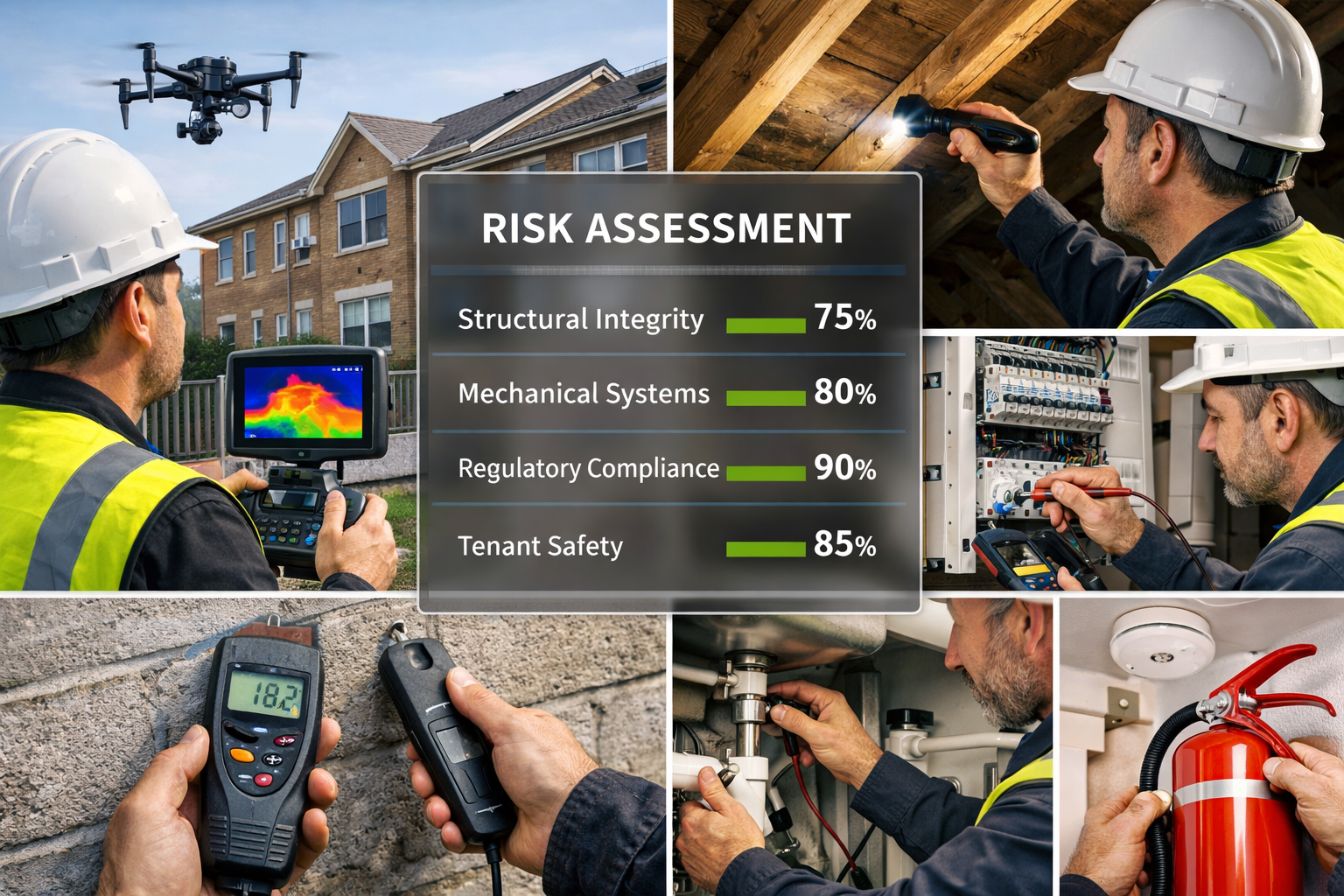
Professional surveyors should utilize advanced diagnostic tools including drone roof surveys for multi-story buildings and thermal imaging to identify hidden defects that could escalate into major liabilities.
🏠 Building Envelope and Weather Protection
- Roof condition assessment with remaining service life projections
- External wall integrity, pointing condition, and render stability
- Window and door weatherproofing and security standards
- Gutter, downpipe, and drainage system functionality
For institutional portfolios, roof surveys should include detailed photographic documentation and replacement cost estimates that feed into capital expenditure planning.
⚙️ Mechanical and Electrical Systems
- Boiler age, efficiency ratings, and replacement schedules
- Electrical system compliance with current regulations
- Plumbing infrastructure condition and water pressure adequacy
- Ventilation systems and condensation risk assessment
Regulatory Compliance and Safety Standards
Regulatory compliance represents a critical risk category for institutional landlords, where non-compliance can trigger enforcement action, fines, and reputational damage affecting entire portfolios.
Essential compliance areas include:
| Compliance Category | Key Requirements | Risk Level |
|---|---|---|
| Fire Safety | Smoke/CO detectors, escape routes, fire doors | Critical |
| Gas Safety | Annual certificates, appliance inspection | Critical |
| Electrical Safety | 5-year EICR certificates | High |
| Energy Performance | Minimum EPC rating requirements | High |
| HMO Licensing | Occupancy limits, amenity standards | High |
| Selective Licensing | Local authority registration | Medium |
Building surveyors must identify compliance gaps and provide detailed remediation cost estimates. For properties in areas like West London or South West London, selective licensing requirements may vary significantly between boroughs.
Financial Modeling and Return Projections
Institutional investors require surveyors to connect building condition findings to financial performance metrics. This integration transforms traditional surveys into investment decision tools.
Financial assessment components include:
💷 Immediate Capital Requirements
- Essential repairs requiring immediate attention (safety-critical)
- Compliance upgrades necessary before letting
- Cosmetic improvements to achieve target rental rates
- Total acquisition cost including purchase price plus remediation
💰 Medium-Term Capital Expenditure (Years 1-5)
- Boiler replacement schedules based on age and condition
- Roof renewal projections using remaining service life estimates
- Window replacement programs for failing units
- Major system upgrades (rewiring, replumbing)
📊 Long-Term Maintenance Reserves (Years 6-10)
- Structural maintenance provisions based on building age
- External redecoration and weatherproofing cycles
- Contingency reserves for unforeseen issues
- Portfolio-wide maintenance cost benchmarking
These projections enable institutional investors to calculate true net yields after accounting for capital expenditure, not just gross rental income minus operating costs.
Tenant Safety and Habitability Standards
Professional landlords recognize that tenant satisfaction and retention directly impact portfolio returns. Building surveyors should evaluate properties through the tenant experience lens.
Habitability assessment criteria:
✅ Thermal Comfort and Energy Efficiency
- Insulation adequacy (loft, cavity walls, solid walls)
- Heating system responsiveness and zone control
- Draft exclusion and air tightness
- EPC rating and improvement recommendations
✅ Health and Wellbeing Factors
- Damp, mold, and condensation risk assessment
- Natural light and ventilation adequacy
- Noise insulation between units (for multi-occupancy)
- Water quality and pressure consistency
✅ Security and Access
- Entry security systems and door locks
- Window security and ground-floor vulnerability
- External lighting and common area safety
- Emergency access and egress routes
Properties scoring poorly on habitability factors face higher tenant turnover, void periods, and reduced rental premiums—all factors that institutional investors quantify in their return models.
Implementing Portfolio-Level Risk Assessment Frameworks
Individual property surveys provide the data foundation, but institutional clients require aggregated portfolio analysis that identifies systemic risks and optimization opportunities across multiple properties.
Risk Categorization and Scoring Methodologies
Professional surveyors should develop standardized risk scoring systems that enable portfolio managers to prioritize capital allocation and remediation efforts.
Sample risk matrix framework:
Risk Categories:
- Critical (Red) – Immediate safety hazards or regulatory non-compliance requiring urgent action
- High (Amber) – Significant defects likely to deteriorate or compliance issues with enforcement risk
- Medium (Yellow) – Maintenance items requiring attention within 12-24 months
- Low (Green) – Minor cosmetic issues or routine maintenance items
Scoring Dimensions:
- Severity – Potential impact on safety, compliance, or property value (1-5 scale)
- Urgency – Timeframe for required action (1-5 scale)
- Cost – Estimated remediation expense (1-5 scale)
- Probability – Likelihood of issue escalating if unaddressed (1-5 scale)
This standardized approach enables institutional investors to compare properties across their portfolio using objective criteria and make data-driven capital allocation decisions.
Portfolio Optimization Strategies
Beyond identifying risks, surveyors can add value by recommending portfolio-level optimization strategies based on aggregated survey findings.
Strategic recommendations might include:
🎯 Selective Disposal
- Identifying properties with disproportionate capital requirements
- Highlighting assets in declining markets or with structural limitations
- Recommending disposal to fund higher-performing acquisitions
🔄 Repositioning Opportunities
- Properties suitable for HMO conversion to increase yields
- Units capable of upgrading to higher rental brackets with targeted investment
- Buildings with development potential (loft conversions, extensions)
📈 Preventive Maintenance Programs
- Developing portfolio-wide maintenance schedules to prevent deterioration
- Identifying common defects across similar property types
- Recommending bulk procurement for recurring repairs (economies of scale)
Technology Integration and Data Management
Modern institutional investors expect digital delivery of survey data in formats compatible with their property management systems and analytics platforms.
Technology considerations for surveyors:
💻 Digital Survey Reports
- Cloud-based report delivery with secure access controls
- Interactive floor plans with defect location markers
- Photographic evidence with date/location metadata
- Exportable data tables for financial modeling
📱 Mobile Inspection Tools
- Tablet-based survey capture with real-time synchronization
- Standardized inspection checklists ensuring consistency
- Voice-to-text notation for efficiency
- Offline capability for properties with poor connectivity
📊 Portfolio Dashboards
- Aggregated risk scoring across entire portfolios
- Capital expenditure forecasting and scheduling tools
- Compliance tracking with renewal date alerts
- Benchmarking against industry standards
Professional surveying firms serving institutional clients should invest in technology infrastructure that delivers survey data in actionable formats, not just PDF reports.
Case Study: Regional Portfolio Risk Assessment
Consider an institutional investor acquiring a 50-property portfolio spanning Yorkshire, the North West, and the Midlands—regions projected for strong growth [4]. The building surveyor's risk assessment reveals:
Portfolio Composition:
- 20 Victorian terraced houses (Yorkshire)
- 15 1960s apartment blocks (North West)
- 15 modern townhouses (Midlands)
Aggregated Risk Findings:
- 12 properties (24%) require immediate electrical compliance work (Critical)
- 8 properties (16%) show early-stage roof deterioration (High)
- 18 properties (36%) need boiler replacement within 3 years (Medium)
- 35 properties (70%) could improve EPC ratings cost-effectively (Medium)
Capital Expenditure Projection:
- Immediate (Year 1): £180,000 (electrical compliance, critical repairs)
- Years 2-3: £240,000 (roof renewals, boiler replacements)
- Years 4-5: £150,000 (EPC improvements, preventive maintenance)
- Total 5-Year CapEx: £570,000 (£11,400 per property average)
This analysis enables the investor to:
- Adjust acquisition pricing to reflect true capital requirements
- Develop realistic return projections incorporating maintenance costs
- Prioritize properties for remediation based on risk scores
- Plan financing to accommodate capital expenditure schedules
Such comprehensive analysis demonstrates how Institutional Buy-to-Let Surge: Building Surveyors' Risk Assessment Protocols for Professional Landlord Portfolios creates tangible value for professional landlords.

Best Practices for Building Surveyors Serving Institutional Clients
Differentiating surveying services in the competitive institutional market requires adopting professional practices that align with corporate client expectations.
Standardization and Quality Assurance
Institutional clients value consistency and repeatability across multiple properties and survey engagements.
Quality assurance protocols should include:
- Standardized inspection checklists ensuring no critical elements are overlooked
- Peer review processes for high-value or complex properties
- Calibration exercises ensuring consistent risk scoring across different surveyors
- Continuous professional development on regulatory changes and emerging risks
Firms should develop proprietary survey methodologies that become recognizable quality markers in the institutional market, similar to how RICS Red Book valuations provide standardized valuation frameworks.
Communication and Stakeholder Management
Institutional buy-to-let transactions involve multiple stakeholders including asset managers, lenders, legal teams, and property managers. Building surveyors must communicate effectively with diverse audiences.
Communication best practices:
📧 Executive Summaries
- One-page overview highlighting critical findings and financial implications
- Risk dashboard with visual indicators (red/amber/green)
- Clear recommendations with priority rankings
- Total capital expenditure summary
📋 Detailed Technical Reports
- Comprehensive documentation for due diligence records
- Photographic evidence supporting all significant findings
- Compliance checklists with regulatory references
- Methodology explanations and limitations disclosure
🤝 Stakeholder Presentations
- In-person or virtual briefings for investment committees
- Ability to answer technical questions from diverse audiences
- Collaborative approach to remediation planning
- Post-survey support during negotiation phases
Continuing Education and Market Intelligence
The regulatory environment for buy-to-let properties continues evolving, with new energy efficiency requirements, tenant protection legislation, and safety standards emerging regularly.
Professional development priorities for 2026:
- Regulatory updates – Energy Performance Certificate minimum standards, selective licensing expansion
- Construction technology – Modern methods of construction, retrofit solutions
- Market analysis – Regional performance trends, rental yield benchmarking
- Risk management – Emerging issues like climate resilience and flood risk
Surveyors who position themselves as strategic advisors rather than just technical inspectors create lasting relationships with institutional clients managing growing portfolios.
Insurance and Professional Indemnity
Given the financial stakes involved in institutional portfolios, building surveyors must maintain robust professional indemnity insurance with coverage limits appropriate to client portfolio values.
Risk management considerations:
- Coverage limits adequate for portfolio-level claims (£5-10 million minimum)
- Retroactive coverage protecting against claims from previous work
- Cyber liability coverage for data breaches or digital report security
- Clear scope definitions in engagement letters limiting liability to survey scope
Professional surveyors should work with specialist insurance brokers familiar with institutional property work to ensure appropriate coverage.
Emerging Trends and Future Outlook
The institutional buy-to-let surge shows no signs of slowing, with development viability remaining challenging throughout 2026 [5], ensuring sustained rental growth through supply shortages. This supply-demand imbalance reduces tenant default risk and supports continued institutional investment.
Sustainability and ESG Integration
Environmental, Social, and Governance (ESG) considerations increasingly influence institutional investment decisions. Building surveyors must incorporate sustainability assessments into risk protocols.
ESG assessment components:
🌱 Environmental Factors
- Carbon footprint and pathway to net-zero
- Energy efficiency improvement potential
- Renewable energy installation feasibility (solar, heat pumps)
- Climate resilience and flood risk assessment
👥 Social Factors
- Tenant wellbeing and health considerations
- Accessibility for disabled tenants
- Community impact and local employment
- Affordable housing contribution
🏛️ Governance Factors
- Regulatory compliance documentation
- Transparent reporting and data quality
- Ethical business practices in property management
- Stakeholder engagement processes
Forward-thinking surveyors who integrate ESG analysis into standard protocols will differentiate themselves as the institutional market increasingly prioritizes sustainable investment.
Technology-Enabled Surveying
Advanced technologies continue transforming building survey capabilities, enabling more comprehensive risk assessment with greater efficiency.
Emerging technologies include:
- Artificial intelligence – Defect pattern recognition in photographic analysis
- Building Information Modeling (BIM) – Digital twin creation for ongoing monitoring
- IoT sensors – Continuous monitoring of moisture, temperature, and structural movement
- Predictive analytics – Machine learning models forecasting maintenance requirements
Surveyors who adopt these technologies while maintaining rigorous professional standards will lead the institutional market.
Conclusion
The Institutional Buy-to-Let Surge: Building Surveyors' Risk Assessment Protocols for Professional Landlord Portfolios represents both a significant market opportunity and a professional challenge for building surveyors in 2026. With buy-to-let lending growing 28% year-on-year and £6.6 billion deployed in Q3 2025 alone, institutional investors require sophisticated due diligence that goes far beyond traditional property surveys [1].
Building surveyors who develop comprehensive risk assessment frameworks addressing structural integrity, regulatory compliance, financial modeling, and portfolio-level optimization will differentiate themselves in this expanding market. The combination of rental yields exceeding 7% and projected 22.2% property value increases over five years creates compelling returns that demand equally compelling risk management [3][4].
Success in the institutional market requires:
✅ Standardized methodologies ensuring consistency across multiple properties
✅ Multi-dimensional risk analysis covering structural, financial, regulatory, and ESG factors
✅ Technology integration delivering data in actionable formats for portfolio management
✅ Strategic advisory capabilities positioning surveyors as partners, not just service providers
✅ Continuous professional development maintaining expertise amid evolving regulations
Actionable Next Steps
For building surveyors seeking to capture institutional buy-to-let opportunities:
- Develop portfolio-level survey frameworks that aggregate individual property data into strategic insights
- Invest in technology infrastructure enabling digital report delivery and data integration
- Build regional expertise in high-growth markets like Yorkshire, North West, and Scotland
- Establish institutional client relationships through targeted marketing and thought leadership
- Enhance professional indemnity coverage appropriate for high-value portfolio work
- Create standardized risk scoring methodologies that enable objective property comparison
The institutional buy-to-let surge presents a defining opportunity for building surveyors willing to evolve their practices to meet the sophisticated requirements of professional landlords. Those who successfully develop robust risk assessment protocols will establish themselves as essential partners in one of the UK's fastest-growing property investment sectors.
For professional surveying services tailored to institutional requirements, consider consulting chartered surveyors in London or specialists in structural surveys who understand the complexities of professional landlord portfolios.
References
[1] Buy To Let Lending Figures Reveal Landlord Investment Holding Firm In Face Of Rule Changes – https://www.buyassociationgroup.com/en-gb/news/buy-to-let-lending-figures-reveal-landlord-investment-holding-firm-in-face-of-rule-changes/
[2] Uk Buy To Let Lending Growth Signals A Stronger More Confident Uk Property Market 2026 – https://blog.magnateassets.com/uk-buy-to-let-lending-growth-signals-a-stronger-more-confident-uk-property-market-2026
[3] Surveying The 2026 Buy To Let Boom Building Survey Protocols For Institutional Landlord Investments – https://nottinghillsurveyors.com/blog/surveying-the-2026-buy-to-let-boom-building-survey-protocols-for-institutional-landlord-investments
[4] Why Buy To Let Is Still Worth It In 2026 – https://www.propertynotify.co.uk/investment/why-buy-to-let-is-still-worth-it-in-2026/
[5] Commercial Real Estate Volumes To Lift 10 In 2026 Savills Predicts – https://www.costar.com/article/987115200/commercial-real-estate-volumes-to-lift-10-in-2026-savills-predicts