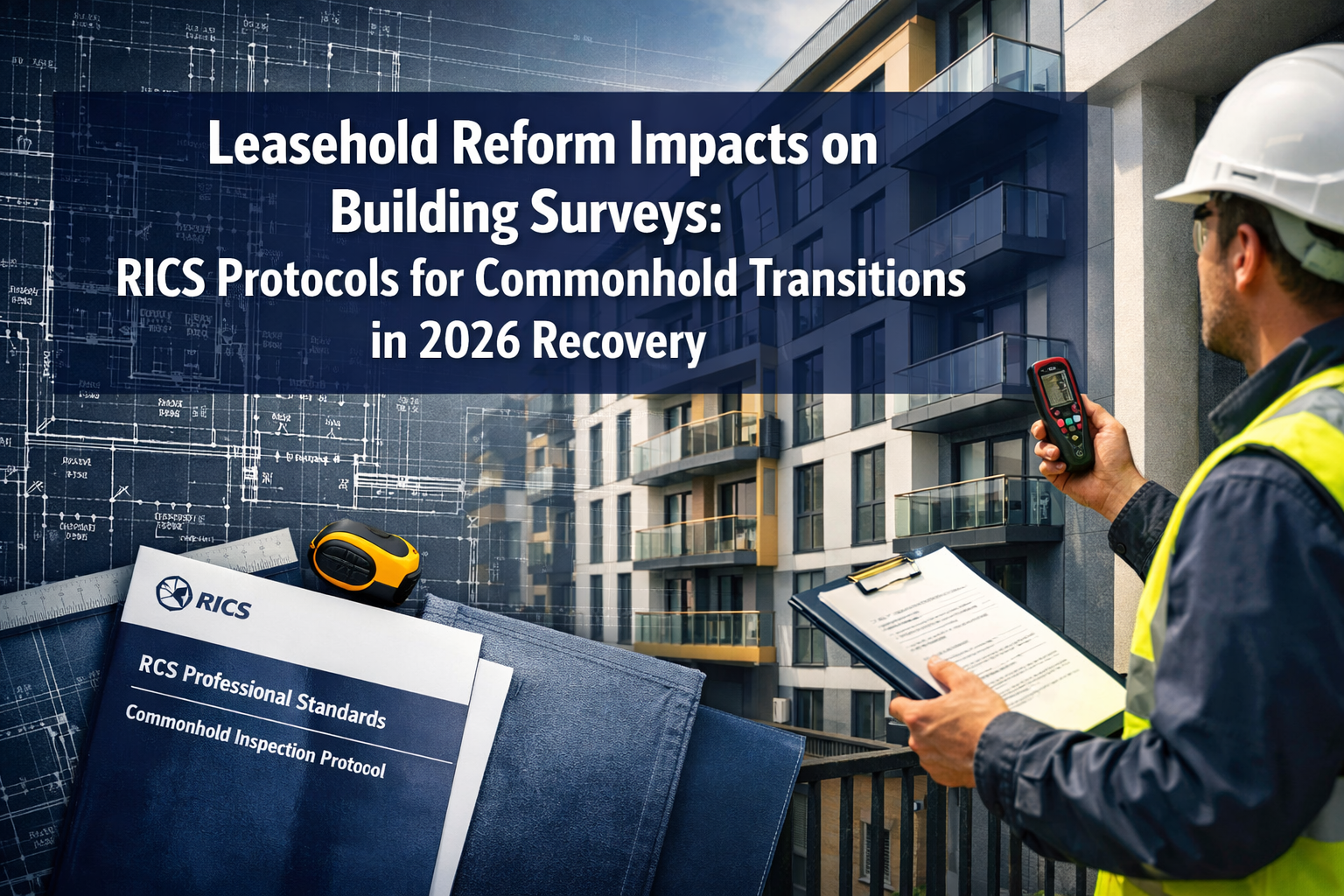
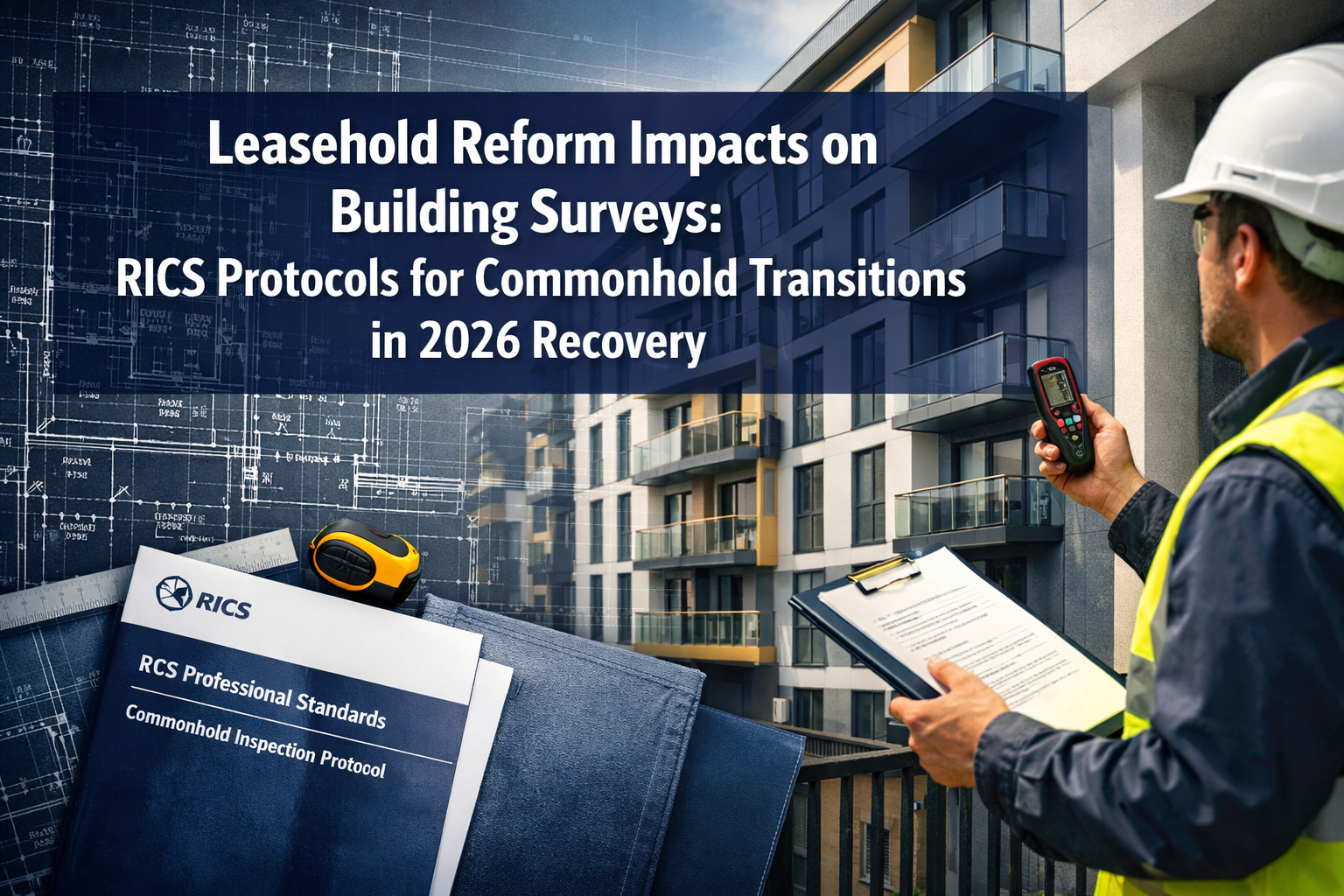
The UK property market stands at a pivotal moment. With the government's draft Commonhold and Leasehold Reform Bill published in January 2026, surveyors face unprecedented challenges in adapting their building survey methodologies for properties undergoing commonhold conversions. As transaction volumes surge amid economic recovery, the need for robust protocols has never been more critical. The Leasehold Reform Impacts on Building Surveys: RICS Protocols for Commonhold Transitions in 2026 Recovery represents a fundamental shift in how professionals assess shared structures, allocate maintenance responsibilities, and protect both buyers and existing residents during this historic transition.
Key Takeaways
✅ Mandatory commonhold for new flats requires developers to sell all new residential units on a commonhold basis from 2026, eliminating traditional leasehold structures [2]
✅ 50% conversion threshold now allows existing leasehold buildings to transition to commonhold with consent from only half of leaseholders, down from the previous 100% requirement [6]
✅ Level 3 building surveys must now identify defects in shared structures with enhanced scrutiny, as commonhold transitions create complex maintenance responsibility allocations
✅ RICS mandatory reserve funds will protect residents from unexpected major works costs, requiring surveyors to assess long-term capital expenditure needs during inspections [1]
✅ Ground rent caps at £250 annually for existing leaseholders will phase to peppercorn levels over 40 years, fundamentally altering property valuations and survey considerations [4]
Understanding the 2026 Leasehold Reform Landscape
The Draft Commonhold and Leasehold Reform Bill
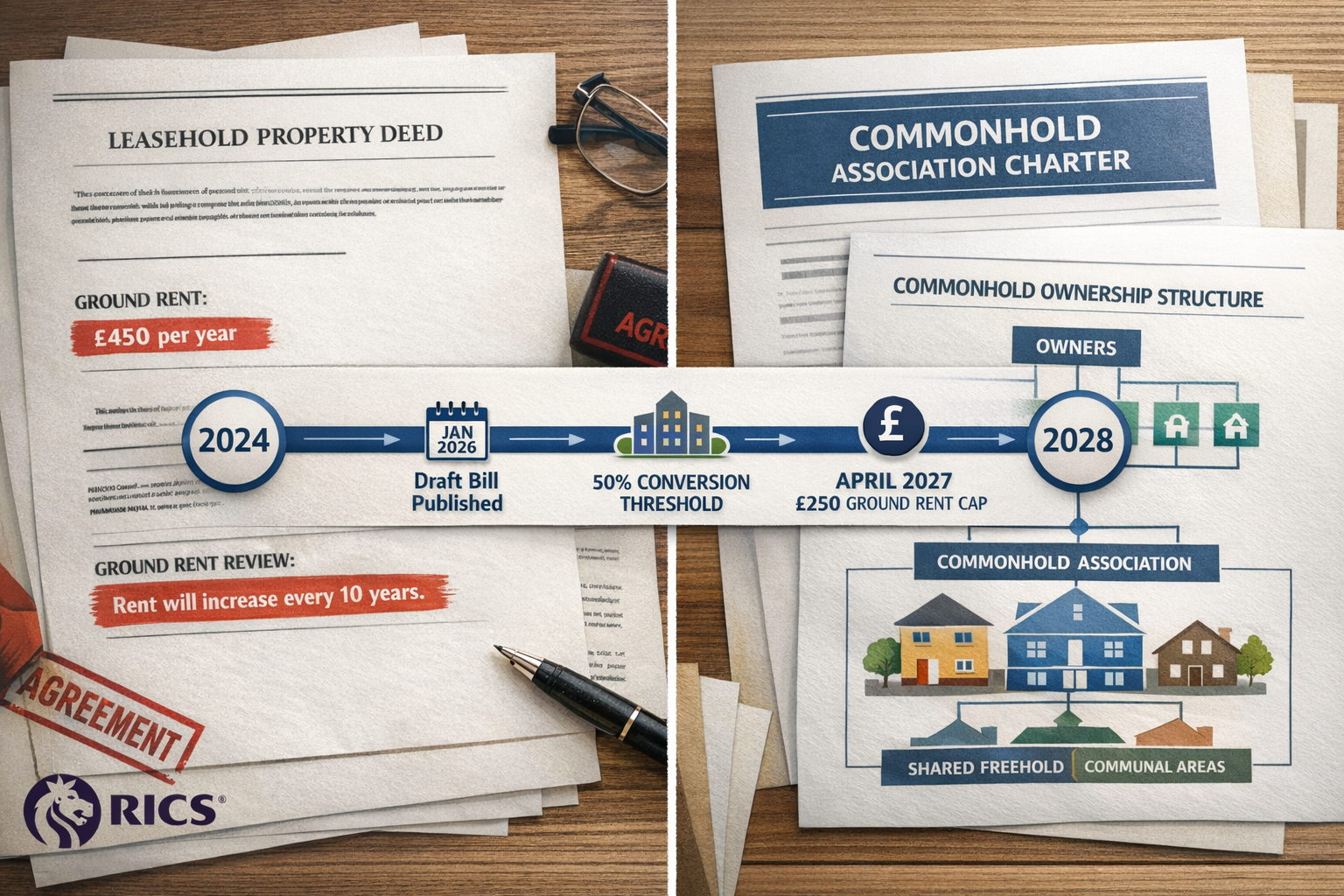
On January 27, 2026, the government published the draft Commonhold and Leasehold Reform Bill alongside a consultation titled "Moving to commonhold: banning leasehold for new flats" [2]. This legislation marks the most significant property ownership reform in decades, with consultation remaining open until April 2026.
The bill introduces three fundamental changes that directly impact building survey protocols:
-
Mandatory commonhold for new developments – All new flats must be sold on a commonhold basis, including purpose-built blocks, flats over commercial units, and converted house flats, with no exemptions currently identified [2]
-
Simplified conversion process – The threshold for converting existing leasehold buildings has been lowered from 100% to just 50% of leaseholders, plus freeholder and lender consent [6]
-
Ground rent restrictions – An immediate £250 annual cap on ground rent for existing leaseholders, phasing to nominal peppercorn levels over 40 years, with full implementation expected by late 2028 [4]
For chartered surveyors in London and across the UK, these reforms necessitate a complete reassessment of survey methodologies, particularly for Level 3 building surveys where detailed defect identification becomes critical for commonhold transitions.
RICS Response and Professional Standards
The Royal Institution of Chartered Surveyors (RICS) has taken a proactive stance on the reforms, emphasizing the need for clear professional standards and robust guidance [1]. Vanessa Griffiths MRICS, Partner at Knight Frank and RICS Residential Professional Group Panel member, provided oral evidence to Parliament highlighting critical implementation challenges.
RICS strongly supports several key provisions:
- Mandatory reserve funds for both commonhold and leasehold properties to protect residents from unexpected major works [1]
- Consistent professional standards across managing agents, valuation methodology, and dispute resolution activity [1]
- Clear implementation sequencing between the new Bill and the Leasehold and Freehold Reform Act 2024 [1]
However, RICS has also identified significant concerns, particularly around lender readiness for commonhold mortgages, which remains a critical implementation challenge requiring substantial preparation across lenders, estate agents, and conveyancers [1].
Leasehold Reform Impacts on Building Surveys: Adapting Survey Methodologies
Enhanced Level 3 Building Survey Requirements
The transition to commonhold fundamentally changes how surveyors must approach building inspections. Traditional Level 3 surveys focused primarily on individual unit conditions, but commonhold conversions demand comprehensive assessment of shared structures and their long-term maintenance implications.
Key survey adaptations include:
| Survey Element | Traditional Leasehold Approach | New Commonhold Requirements |
|---|---|---|
| Structural Elements | Individual unit focus | Comprehensive shared structure analysis |
| Maintenance Liability | Freeholder responsibility | Commonhold association allocation |
| Reserve Fund Assessment | Optional consideration | Mandatory long-term capital expenditure projection |
| Defect Prioritization | Unit-specific urgency | Shared infrastructure criticality |
| Valuation Impact | Ground rent deduction | Commonhold unit share calculation |
Surveyors conducting RICS registered valuations in London must now incorporate commonhold-specific considerations into their assessments, particularly when properties are undergoing or considering conversion.
Identifying Defects in Shared Structures
The 50% conversion threshold creates a unique challenge: buildings may contain both commonhold and leasehold units simultaneously [2]. This hybrid structure requires surveyors to meticulously identify which defects affect shared elements versus individual units.
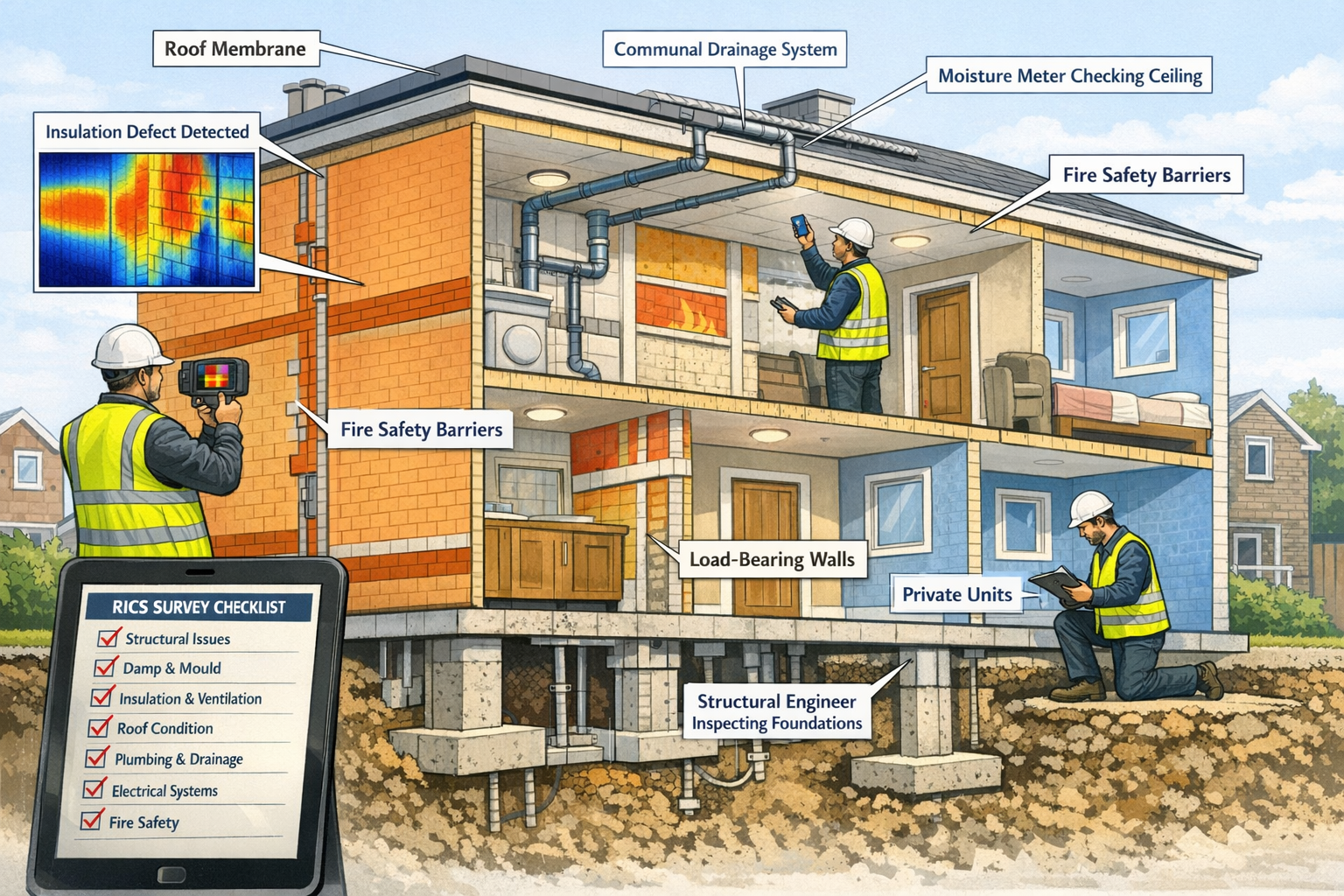
Critical shared structure elements requiring enhanced scrutiny:
🏗️ Roof systems – Membrane integrity, drainage, insulation performance (roof survey specialists may need engagement)
🏗️ External walls – Cladding, weatherproofing, thermal performance, fire safety barriers
🏗️ Common areas – Hallways, staircases, lift mechanisms, emergency lighting
🏗️ Building services – Communal heating, water supply, drainage, electrical distribution
🏗️ Foundations and structure – Load-bearing walls, floor joists, subsidence indicators
For properties with complex defect patterns, residential structural engineers in London provide specialized assessments that complement standard building surveys during commonhold transitions.
Reserve Fund Projections and Long-Term Planning
RICS's support for mandatory reserve funds [1] means surveyors must now project long-term capital expenditure needs as part of comprehensive building surveys. This represents a significant expansion of traditional survey scope.
Surveyors should assess and document:
- Remaining useful life of major building components (roof, windows, heating systems)
- Anticipated replacement costs at current market rates with inflation projections
- Phased maintenance schedules for preventative works
- Emergency fund adequacy for unexpected structural failures
- Insurance reinstatement values for comprehensive coverage (insurance reinstatement valuation services provide specialized assessments)
This forward-looking approach protects both existing residents and prospective buyers from unexpected financial burdens, aligning with RICS's emphasis on resident protection [1].
RICS Protocols for Commonhold Transitions in 2026 Recovery
Valuation Methodology for Commonhold Properties
The shift from leasehold to commonhold fundamentally alters property valuation principles. Traditional leasehold valuations deducted ground rent capitalization and considered lease length depreciation. Commonhold eliminates these factors while introducing new considerations.
Commonhold valuation framework:
Traditional Leasehold Deductions (Now Obsolete):
- Ground rent capitalization
- Lease length depreciation (particularly under 80 years)
- Enfranchisement costs for lease extensions
New Commonhold Considerations:
- Commonhold unit share percentage
- Reserve fund contribution obligations
- Commonhold association financial health
- Shared maintenance liability allocation
- Conversion cost apportionment (for existing buildings)
RICS registered valuers in London must now develop expertise in commonhold valuation methodologies, particularly as the market transitions during the 2026 recovery period. The absence of extensive commonhold precedent in the UK market creates initial valuation uncertainty that professional standards must address.
Lender Requirements and Mortgage Readiness
RICS has identified lender readiness as a critical implementation challenge [1]. Mortgage providers require comprehensive building survey information to assess commonhold property risks, particularly during the transition period when market precedents remain limited.
Surveyors should provide lenders with:
✔️ Detailed building condition reports highlighting shared structure integrity
✔️ Reserve fund adequacy assessments demonstrating financial preparedness for major works
✔️ Commonhold association governance review confirming professional management standards
✔️ Defect prioritization schedules with cost estimates and urgency classifications
✔️ Conversion status documentation for properties undergoing leasehold-to-commonhold transition
For properties requiring freehold valuation in London, surveyors must now distinguish between traditional freehold and commonhold ownership structures, as they carry different rights and responsibilities.
Dispute Resolution and Professional Standards
The bill introduces enhanced tribunal powers to appoint and remove commonhold association directors where they fail compliance obligations [2]. This governance framework requires surveyors to understand dispute resolution protocols when defects or maintenance disagreements arise.
RICS emphasizes the need for consistent professional standards across managing agents and dispute resolution activity [1]. Surveyors may be called upon to provide expert witness reports in London when disputes escalate to tribunal proceedings.
Common dispute scenarios requiring surveyor expertise:
⚖️ Defect responsibility allocation – Determining whether defects affect shared structures or individual units
⚖️ Major works necessity – Assessing whether proposed remedial works are essential or discretionary
⚖️ Cost apportionment fairness – Evaluating whether maintenance costs are equitably distributed
⚖️ Reserve fund adequacy – Determining appropriate contribution levels for long-term maintenance
⚖️ Conversion feasibility – Assessing whether buildings are suitable for commonhold transition
The professional standards gap that RICS has highlighted [1] means early adopters of commonhold protocols will establish market-leading expertise during the 2026 recovery period.
Implementation Timeline and Market Readiness
Phased Reform Implementation
The leasehold reform legislation follows a phased implementation schedule that surveyors must track carefully:
2026 Timeline:
- ✅ January 27 – Draft bill published with consultation opening [2]
- 📅 April 2026 – Consultation closes
- 📅 Mid-2026 – Expected bill passage through Parliament
- 📅 Late 2026 – Mandatory commonhold for new developments begins
2027-2028 Timeline:
- 📅 2027 – Conversion framework operational for existing buildings
- 📅 Late 2028 – Ground rent cap fully implemented [4]
2030+ Timeline:
- 📅 40-year phase – Ground rent reduction to peppercorn levels [4]
This extended timeline means surveyors will operate in a hybrid market for decades, requiring expertise in both leasehold and commonhold assessment methodologies.
Secondary Legislation Coordination
RICS has emphasized the need for clear implementation sequencing between the new bill and the Leasehold and Freehold Reform Act 2024, with parts of the 2024 Act still awaiting secondary legislation [1]. This regulatory complexity creates uncertainty for surveyors developing standardized protocols.
Professional surveyors should monitor:
- RICS guidance updates on commonhold survey standards
- Lender policy changes for commonhold mortgage requirements
- Tribunal precedents establishing defect responsibility frameworks
- Insurance industry adaptations for commonhold risk assessment
- Valuation methodology consensus among professional bodies
For properties requiring Red Book valuations in London, compliance with evolving RICS standards during the transition period becomes paramount.
Developer and Conversion Market Impacts
The mandatory commonhold requirement for new flats [2] creates immediate implications for developers and the conversion market. Surveyors working with developers must assess:
New Development Considerations:
- Commonhold association establishment costs
- Reserve fund initial capitalization requirements
- Marketing challenges in an unfamiliar ownership structure
- Buyer education needs and transaction timeline impacts
Conversion Market Opportunities:
- Properties with short leases become conversion candidates
- Buildings with high ground rents see enhanced conversion incentives
- The 50% threshold enables conversions previously blocked by minority objections [6]
- Buying the freehold in London becomes less necessary as commonhold offers superior alternative
The abolition of forfeiture provisions [4] – removing freeholders' ability to seize properties for small debts as low as £350 – provides additional conversion incentive by eliminating this significant leaseholder risk.
Practical Guidance for Surveyors and Property Professionals
Building Survey Checklist for Commonhold Transitions
Surveyors conducting building surveys on properties undergoing or considering commonhold conversion should follow this enhanced protocol:
Pre-Inspection Phase:
- Review existing leasehold documentation and service charge history
- Obtain commonhold association draft or existing constitution
- Assess leaseholder consent status (tracking toward 50% threshold)
- Verify freeholder and lender preliminary consent positions
- Review any previous building surveys or maintenance records
Inspection Phase – Shared Structures Priority:
- Roof and external envelope – Comprehensive condition assessment with remaining life projections
- Structural elements – Foundation integrity, load-bearing walls, floor systems
- Building services – Communal heating, water, drainage, electrical distribution
- Fire safety systems – Barriers, detection, suppression, emergency access
- Common areas – Hallways, staircases, lifts, external grounds
Inspection Phase – Individual Units:
- Internal condition relative to shared structure dependencies
- Alterations requiring licence to alter that may affect shared elements
- Service connections from communal systems
- Boundary definitions between individual and shared responsibility
Post-Inspection Analysis:
- Defect categorization by urgency and shared versus individual responsibility
- Reserve fund projection for 10-year capital expenditure cycle
- Conversion cost estimation (if applicable)
- Valuation impact assessment incorporating commonhold factors
- Lender-specific risk evaluation and recommendations
Client Communication and Education
The unfamiliarity of commonhold in the UK market requires surveyors to adopt an educational approach with clients. Most buyers and existing leaseholders have limited understanding of commonhold ownership structures.
Key client education points:
💡 Ownership structure – Commonhold provides freehold ownership of individual units plus shared ownership of common parts through the commonhold association
💡 No ground rent or lease length concerns – Eliminates traditional leasehold anxieties about diminishing lease terms and escalating ground rents
💡 Democratic governance – All unit owners participate in commonhold association decisions, unlike leasehold where freeholders control management
💡 Maintenance responsibility clarity – Commonhold Community Statement defines precisely which elements are individual versus shared responsibility
💡 Reserve fund contributions – Mandatory contributions protect against unexpected major works bills but represent ongoing ownership costs
For clients considering RICS valuation costs, explaining the enhanced scope required for commonhold assessments justifies appropriate fee structures.
Professional Development and Expertise Building
The 2026 recovery period offers surveyors a unique opportunity to establish market-leading commonhold expertise. RICS's emphasis on professional standards [1] suggests formal guidance and training programs will emerge as the market matures.
Recommended professional development:
📚 Technical training – Commonhold association governance, reserve fund modeling, conversion feasibility assessment
📚 Legal framework understanding – Commonhold Community Statement interpretation, tribunal procedures, dispute resolution protocols
📚 Valuation methodology – Commonhold-specific valuation approaches, market precedent analysis, lender requirement navigation
📚 Cross-disciplinary collaboration – Working with solicitors, managing agents, structural engineers, and financial advisors on complex conversions
📚 Market intelligence – Tracking early commonhold transactions, lender policy evolution, buyer sentiment, and pricing trends
Surveyors who invest in commonhold expertise during 2026 will be positioned as trusted advisors as the market transitions over the coming decades.
Conclusion
The Leasehold Reform Impacts on Building Surveys: RICS Protocols for Commonhold Transitions in 2026 Recovery represents a fundamental transformation in UK property ownership and surveying practice. With the draft Commonhold and Leasehold Reform Bill published in January 2026, mandatory commonhold for new flats, and a simplified 50% conversion threshold for existing buildings, surveyors face unprecedented challenges in adapting their methodologies.
The shift requires enhanced Level 3 building survey protocols that prioritize shared structure assessment, incorporate reserve fund projections, and address the complex maintenance responsibility allocations inherent in commonhold ownership. RICS's support for mandatory reserve funds and consistent professional standards provides a framework, but significant implementation challenges remain – particularly around lender readiness and the absence of established market precedents.
For property professionals, the 2026 recovery period offers both challenges and opportunities. Surveyors who develop commonhold expertise, adapt their survey methodologies to address shared structure defects, and educate clients about this unfamiliar ownership structure will establish market-leading positions as the decades-long transition unfolds.
Actionable Next Steps
For Surveyors:
- Review RICS guidance updates on commonhold protocols as they emerge
- Develop enhanced building survey templates incorporating shared structure assessment and reserve fund projections
- Establish relationships with commonhold specialists in legal and management fields
- Track early commonhold transactions to build valuation precedent databases
For Property Buyers:
5. Engage chartered surveyors in London with commonhold expertise when considering properties undergoing conversion
6. Request comprehensive building surveys that assess both individual unit condition and shared structure integrity
7. Verify commonhold association financial health and reserve fund adequacy before purchase
For Existing Leaseholders:
8. Assess conversion feasibility if your building has high ground rents or short remaining lease terms
9. Commission building surveys to identify shared structure defects before conversion discussions
10. Understand the 50% consent threshold and engage neighbors about collective conversion benefits
The leasehold reform represents the most significant property ownership change in generations. Professional surveyors who embrace the challenge, develop robust protocols, and guide clients through this transition will play a crucial role in the 2026 recovery and beyond.
References
[1] Rics Responds To Latest Government Reforms On Leasehold And Commonhold – https://www.rics.org/news-insights/rics-responds-to-latest-government-reforms-on-leasehold-and-commonhold
[2] Taking A Deeper Dive Into The Draft Commonhold And Leasehold Reform Bill What Do Landlords And Developers Need To Know – https://www.charlesrussellspeechlys.com/en/insights/expert-insights/real-estate/2026/taking-a-deeper-dive-into-the-draft-commonhold-and-leasehold-reform-bill-what-do-landlords-and-developers-need-to-know/
[4] Leasehold Reform Update January 2026 What The New Ground Rent Cap Means For Leaseholders – https://www.peterbarry.co.uk/blog/leasehold-reform-update-january-2026-what-the-new-ground-rent-cap-means-for-leaseholders/
[6] Spring Awakening In Real Estate Key Uk Developments For 2026 – https://www.farrer.co.uk/news-and-insights/spring-awakening-in-real-estate-key-uk-developments-for-2026/