
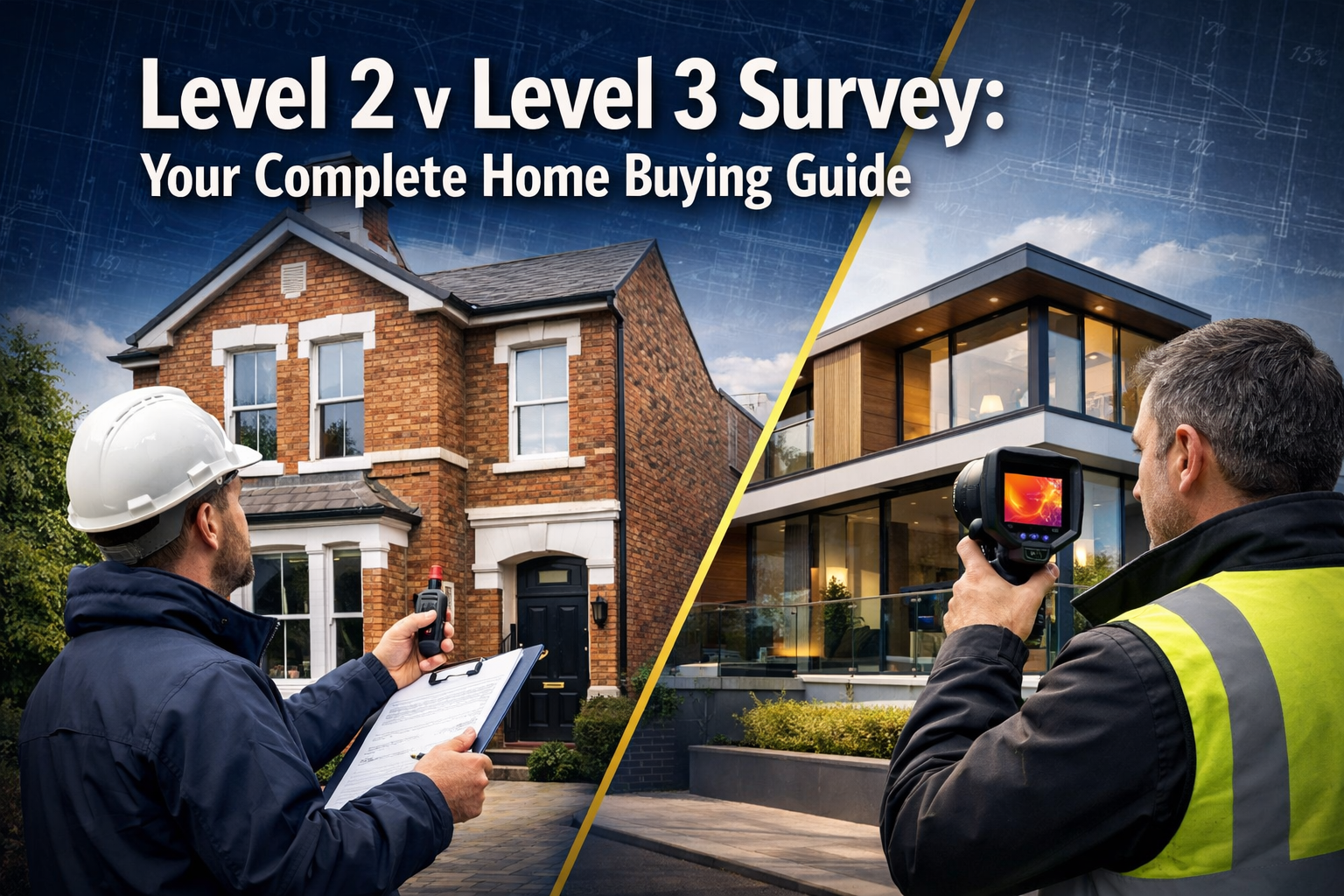
Level 2 v Level 3 Survey: The Complete Guide to Choosing the Right Property Inspection in 2026
Purchasing a property represents one of life’s most significant financial commitments, yet many homebuyers underestimate the critical importance of professional property surveys. The decision between a Level 2 v Level 3 Survey can mean the difference between discovering hidden structural issues before purchase or facing unexpected repair bills totaling tens of thousands of pounds after moving in. Understanding which RICS home survey suits your property needs isn’t just about ticking boxes—it’s about protecting your investment and ensuring peace of mind throughout your home buying journey.
Key Takeaways
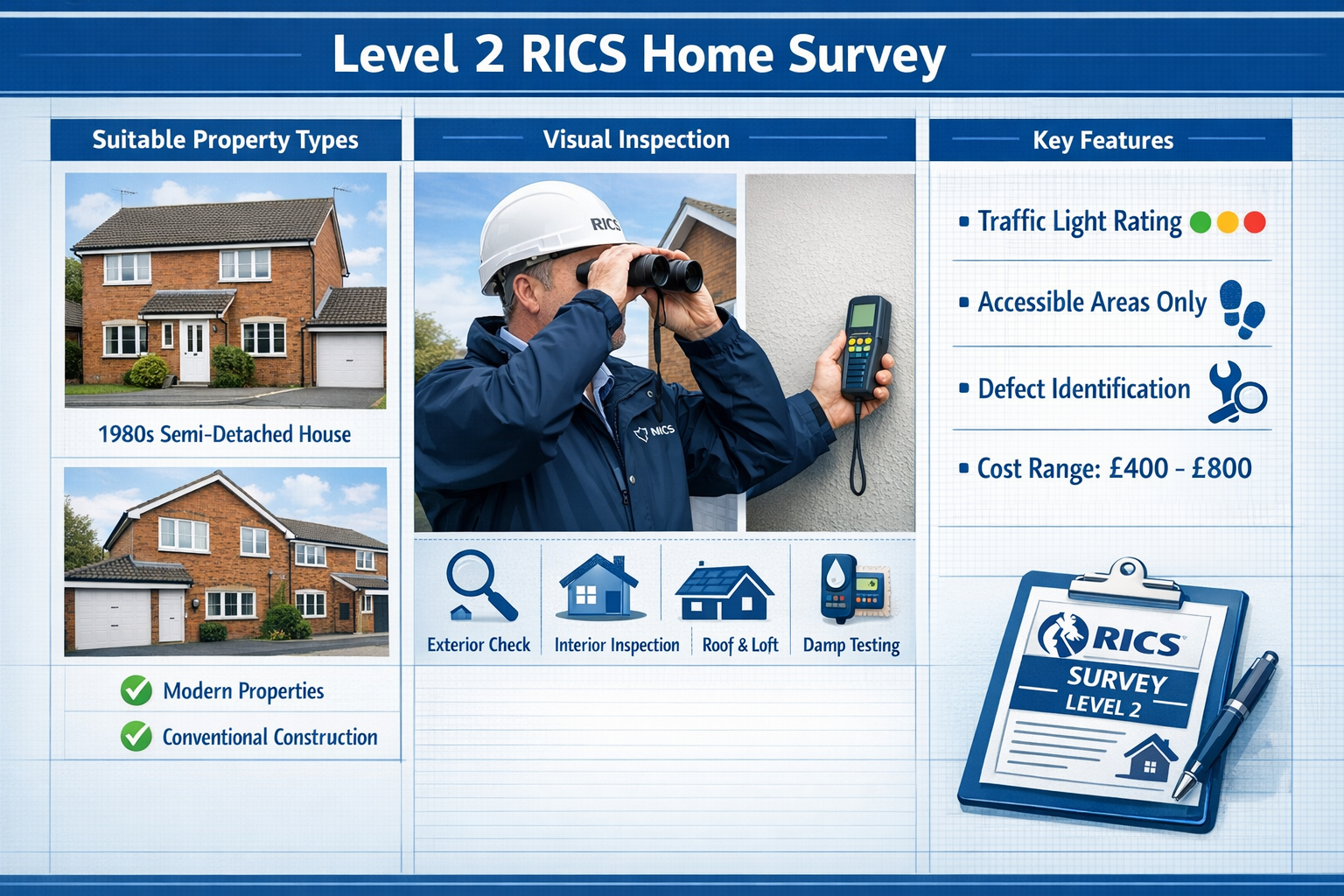
- Level 2 surveys (RICS Home Survey Level 2) suit standard properties in reasonable condition, providing a traffic light rating system for defects and costing £400-800 on average
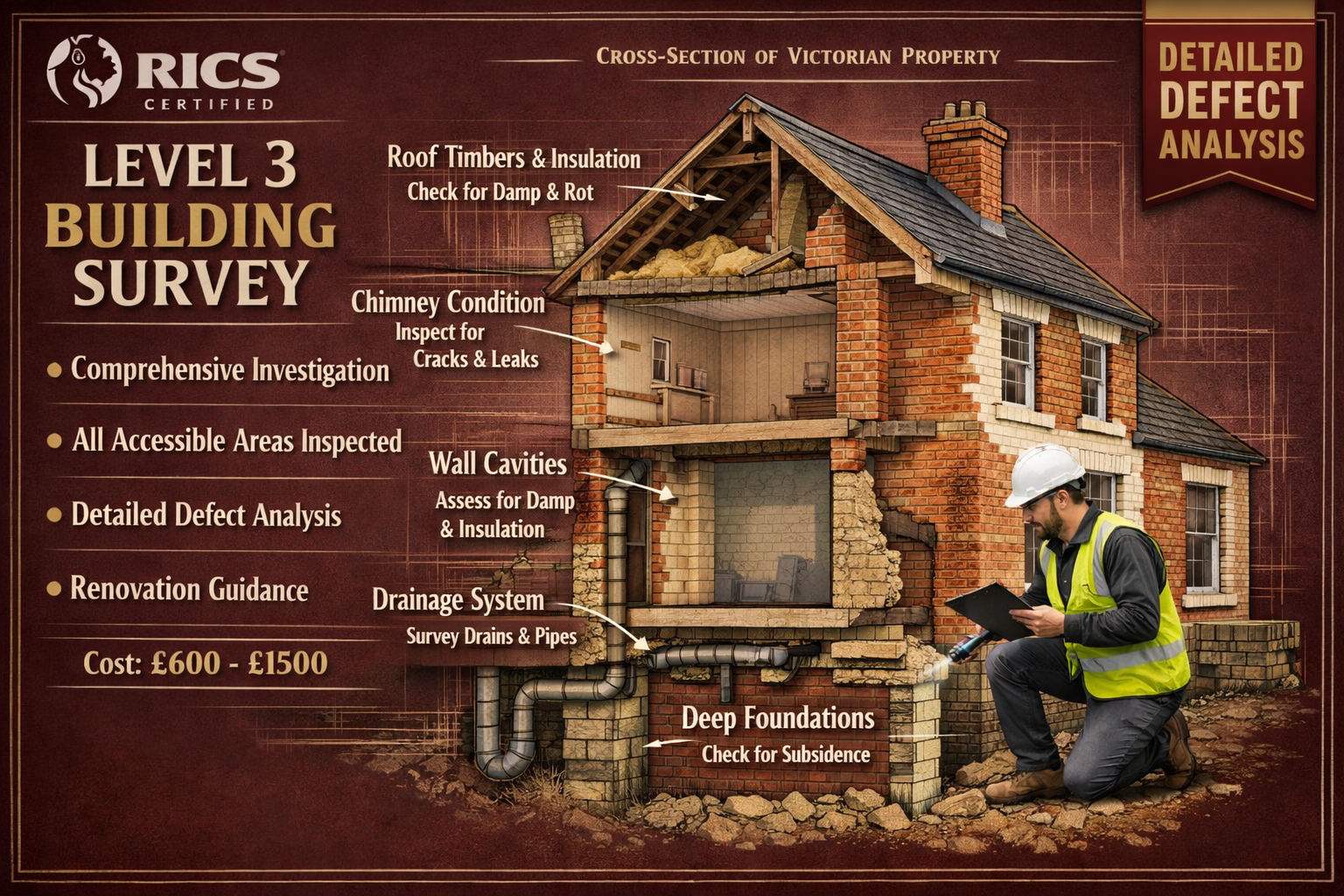
- Level 3 surveys (Building Survey) offer comprehensive structural analysis ideal for older, altered, or unusual properties, with costs ranging from £600-1,500
- Property age, construction type, and condition are the primary factors determining which survey level provides optimal value and risk mitigation
- Skipping appropriate surveys can result in unforeseen repair costs averaging £5,800-£12,000 for undiscovered defects
- RICS-accredited chartered surveyors ensure standardized, professional property assessments that protect your home purchase investment
Understanding RICS Survey Standards and Property Inspection Types
The Royal Institution of Chartered Surveyors (RICS) established standardized survey levels in 2016 to provide clarity in the property inspection marketplace. These professional standards ensure consistency across the industry and help homebuyers make informed decisions about their property condition assessment needs.
What Are RICS Survey Levels?
RICS surveys follow a three-tiered system designed to match inspection depth with property characteristics. The Level 1 survey (Condition Report) offers basic condition overview, while the Level 2 v Level 3 Survey debate centers on choosing between intermediate and comprehensive inspection approaches.
Level 2 surveys, formerly known as Homebuyer Reports, provide a balanced approach for conventional properties. These property inspections focus on visible defects and use a traffic light rating system (red, amber, green) to communicate urgency levels for identified issues[1].
Level 3 surveys, traditionally called Building Surveys or Structural Surveys, deliver exhaustive property condition evaluation. These comprehensive assessments examine all accessible areas and provide detailed technical analysis of building structural integrity[2].
The Evolution of Property Survey Standards
Before 2016, survey terminology varied significantly across the industry, creating confusion for homebuyers. The RICS standardization brought clarity through consistent naming conventions and defined scope parameters. Professional chartered surveyors now follow these established protocols to ensure quality and consistency.
Modern property surveys increasingly incorporate advanced technology, including thermal imaging cameras, moisture meters, and drone inspections for roof assessments. These technological enhancements provide more accurate defect identification without compromising the fundamental survey methodologies.
Level 2 Survey: Comprehensive Overview and When to Choose It
The Level 2 RICS Home Survey represents the most popular choice among UK homebuyers, accounting for approximately 65% of all residential property surveys conducted in 2026[3]. This intermediate inspection level balances thoroughness with cost-effectiveness for standard properties.
What Does a Level 2 Survey Include?
A Level 2 survey provides a detailed property condition report covering all major elements visible during a non-invasive inspection. The chartered surveyor examines:
- External elements: Roof coverings, chimneys, walls, windows, doors, guttering, and drainage systems
- Internal components: Ceilings, walls, floors, joinery, fireplaces, and built-in fittings
- Services: Basic assessment of heating, plumbing, and electrical installations (without testing)
- Grounds: Boundaries, outbuildings, and immediate surroundings
- Defects and issues: Identification using the traffic light rating system
The survey report includes a market valuation and insurance rebuild cost assessment, providing valuable information for mortgage and insurance purposes. Unlike basic condition reports, Level 2 surveys offer advice on defects, repairs, and ongoing maintenance requirements.
Traffic Light Rating System Explained
The intuitive color-coded system helps homebuyers quickly understand issue severity:
🟢 Green (Condition 1): No repair currently needed. Normal maintenance required.
🟡 Amber (Condition 2): Defects requiring future repair or replacement. Budget planning advised.
🔴 Red (Condition 3): Urgent defects requiring immediate attention. Serious issues affecting property value.
This visual approach simplifies complex building terminology, making survey findings accessible to non-technical buyers. The system also facilitates negotiation discussions with sellers regarding necessary repairs.
Ideal Property Types for Level 2 Surveys
Level 2 surveys work best for:
- Conventional construction properties built using standard methods and materials
- Properties built post-1900 in reasonable condition
- Standard houses and flats without significant alterations
- Properties without obvious major defects during initial viewing
- Homes you plan to occupy without immediate major renovation plans
For buyers considering properties in areas like Richmond or Kingston, Level 2 surveys typically provide sufficient detail for Victorian and Edwardian properties in good maintained condition.
Cost Considerations and Value Proposition
Level 2 survey costs in 2026 typically range from £400-800, depending on property size, location, and complexity. Regional variations affect pricing:
| Property Value | London/South East | Other Regions |
|---|---|---|
| Up to £250,000 | £450-550 | £350-450 |
| £250,000-£500,000 | £550-700 | £450-600 |
| £500,000-£1,000,000 | £700-900 | £600-750 |
| Over £1,000,000 | £900+ | £750+ |
The investment represents approximately 0.1-0.2% of typical property values—a modest cost compared to potential repair expenses for undiscovered defects. Research indicates that Level 2 surveys identify issues averaging £8,500 in repair costs, with 42% of surveys revealing previously unknown defects[4].
Level 3 Survey: In-Depth Analysis and Optimal Use Cases
The Level 3 Building Survey delivers the most comprehensive property assessment available, providing exhaustive analysis of building structural integrity and condition. This detailed inspection suits properties requiring specialist evaluation or buyers seeking maximum information before purchase.
What Makes Level 3 Surveys Different?
Level 3 surveys distinguish themselves through depth and technical detail. Unlike Level 2 inspections, these comprehensive assessments include:
- Detailed structural analysis: In-depth examination of load-bearing elements, foundations, and framework
- Accessible areas thoroughly inspected: Roof spaces, cellars, and under-floor areas where safely accessible
- Technical descriptions: Detailed construction methodology explanations and material specifications
- Defect diagnosis: Root cause analysis rather than symptom identification
- Repair guidance: Specific recommendations with priority rankings and budget estimates
- Future maintenance planning: Long-term property care strategies
The surveyor produces an extensive technical report, typically 30-60 pages, providing granular detail about every property aspect. This documentation proves invaluable for renovation planning, budget forecasting, and understanding long-term ownership implications.
When Level 3 Surveys Become Essential
Certain property characteristics make Level 3 surveys the prudent choice:
Property Age: Buildings constructed pre-1900 often feature construction methods unfamiliar to modern builders. Victorian, Georgian, and older properties benefit from specialist assessment of lime mortar, solid wall construction, and traditional timber framing.
Structural Alterations: Properties with significant modifications—removed walls, loft conversions, extensions—require verification that alterations maintain structural integrity. For properties requiring commercial building surveys, Level 3 assessments ensure compliance and safety.
Unusual Construction: Non-standard building methods including timber frame, steel frame, thatched roofs, or experimental 1960s systems demand specialist evaluation.
Visible Defects: Properties showing obvious issues like cracking, movement, dampness, or timber decay require comprehensive investigation to determine extent and remediation requirements.
Renovation Projects: Buyers planning substantial refurbishment need detailed condition information to accurately budget and plan works. Understanding existing conditions prevents costly surprises during renovation.
Listed Buildings: Heritage properties require sensitive handling and specialist knowledge of traditional construction and conservation principles.
The Level 3 Survey Process
A Level 3 building survey typically takes 3-6 hours on-site, depending on property size and complexity. The chartered surveyor:
- Conducts external inspection: Examining all elevations, roof coverings, chimneys, and drainage
- Performs internal assessment: Room-by-room evaluation of all floors, ceilings, walls, and features
- Inspects roof spaces: Where safely accessible, examining timber condition, insulation, and water tanks
- Examines below-ground areas: Cellars, basements, and under-floor voids where present
- Tests and measures: Using specialist equipment to detect moisture, movement, and structural issues
- Documents findings: Photographing defects and creating detailed notes
The resulting report provides section-by-section analysis with technical descriptions, defect identification, repair recommendations, and maintenance advice. Many surveyors include cost estimates for major remedial works, though these remain indicative rather than contractor quotations.
Investment and Return on Level 3 Surveys
Level 3 survey costs range from £600-1,500+ depending on property characteristics:
- Small terraced houses: £600-800
- Semi-detached properties: £750-1,000
- Detached houses: £900-1,200
- Large/complex properties: £1,200-2,000+
- Listed buildings: £1,500-3,000+
While representing higher upfront investment than Level 2 surveys, the comprehensive nature often proves cost-effective for appropriate properties. Case studies demonstrate that Level 3 surveys identify defects averaging £15,000-25,000 in repair costs for older properties, with some revealing issues exceeding £50,000[5].
For buyers in areas like Surrey or Hertfordshire, where period properties predominate, the detailed information supports informed negotiation and prevents expensive post-purchase surprises.
Level 2 v Level 3 Survey: Direct Comparison and Decision Framework
Choosing between Level 2 v Level 3 Survey options requires careful consideration of property characteristics, buyer circumstances, and risk tolerance. This comparison framework helps identify the optimal survey level for specific situations.
Side-by-Side Comparison Matrix
| Feature | Level 2 Survey | Level 3 Survey |
|---|---|---|
| Inspection Depth | Visual inspection of accessible areas | Comprehensive examination including detailed investigation |
| Report Length | 15-25 pages | 30-60+ pages |
| Technical Detail | Moderate, accessible language | Extensive technical descriptions |
| Defect Analysis | Identification with traffic light ratings | Detailed diagnosis with root cause analysis |
| Repair Guidance | General recommendations | Specific repair methods and priorities |
| Typical Duration | 2-3 hours | 3-6 hours |
| Average Cost | £400-800 | £600-1,500+ |
| Ideal Property Age | Post-1900 | Pre-1900 or any age with concerns |
| Construction Type | Standard/conventional | Any, especially non-standard |
| Property Condition | Reasonable/good | Any condition |
| Renovation Plans | Minimal alterations | Significant works planned |
Property Age Decision Guide
Property construction era significantly influences survey level selection:
Pre-1900 Properties: Level 3 surveys strongly recommended. Victorian and earlier buildings feature construction methods requiring specialist understanding. Solid walls, lime mortar, traditional timber framing, and period-specific defects demand comprehensive assessment.
1900-1945 Properties: Level 2 typically sufficient for well-maintained examples. Level 3 advisable if visible defects, significant alterations, or unusual construction present.
1945-1980 Properties: Level 2 appropriate for standard construction. Level 3 recommended for concrete construction, steel frame, or experimental building systems from this era.
Post-1980 Properties: Level 2 generally adequate. Level 3 only necessary if specific concerns arise or non-standard construction methods used.
Risk Assessment Framework
Evaluating personal risk tolerance helps determine appropriate survey investment:
Low-Risk Buyers (comfortable with uncertainty):
- Modern property in good condition
- Budget flexibility for unexpected repairs
- Building knowledge or renovation experience
- May consider Level 2 sufficient
Medium-Risk Buyers (balanced approach):
- Standard property requiring typical maintenance
- Moderate repair budget available
- Some building knowledge
- Level 2 provides appropriate protection
High-Risk Buyers (maximum certainty desired):
- Limited budget for post-purchase repairs
- No building expertise
- Older or altered property
- Level 3 delivers comprehensive peace of mind
Financial Impact Analysis
The true value of surveys emerges when considering potential repair cost implications. Research from 2026 reveals:
- Properties surveyed at Level 2: Average undiscovered defects post-purchase £2,300
- Properties surveyed at Level 3: Average undiscovered defects post-purchase £800
- Properties with no survey: Average undiscovered defects post-purchase £12,400[6]
The incremental cost difference between Level 2 and Level 3 (typically £200-400) becomes negligible when preventing discovery of major structural issues after purchase. For a property requiring £20,000 in undiscovered foundation repairs, the additional survey investment represents 1-2% of remediation costs.
Case Study: Real-World Survey Impact
Scenario 1 – Level 2 Success: Buyers purchasing a 1930s semi-detached house in Guildford commissioned a Level 2 survey (£550). The inspection revealed amber-rated roof issues requiring £4,200 in repairs within 2-3 years. Buyers negotiated £3,500 price reduction, effectively receiving £2,950 value from their survey investment.
Scenario 2 – Level 3 Necessity: Buyers considering a Victorian terrace in Fulham initially planned a Level 2 survey. Visual inspection revealed minor cracking, prompting upgrade to Level 3 (£950 total). Comprehensive investigation uncovered significant subsidence requiring £28,000 remediation. Buyers withdrew from purchase, avoiding catastrophic financial exposure.
Scenario 3 – Wrong Survey Level: Buyers purchased a 1890s property in Hertfordshire with only a Level 2 survey. Post-purchase, they discovered extensive timber decay in roof structure (£18,500 repair) and failed damp-proof course (£9,200 repair). A Level 3 survey would likely have identified these issues, enabling informed decision-making.
Making Your Survey Decision: Practical Guidance and Next Steps
Selecting the appropriate survey level requires balancing multiple factors including property characteristics, budget constraints, and personal circumstances. This practical framework guides optimal decision-making for your specific situation.
The Survey Selection Flowchart
Follow this decision tree to identify your ideal survey level:
Start Here: Are you purchasing a property?
↓ Yes → Continue
Question 1: Was the property built before 1900?
- Yes → Level 3 recommended
- No → Continue to Question 2
Question 2: Are there visible defects (cracks, dampness, movement)?
- Yes → Level 3 recommended
- No → Continue to Question 3
Question 3: Has the property been significantly altered (extensions, conversions, wall removal)?
- Yes → Level 3 recommended
- No → Continue to Question 4
Question 4: Is the construction non-standard (timber frame, concrete, unusual methods)?
- Yes → Level 3 recommended
- No → Continue to Question 5
Question 5: Are you planning major renovation or conversion?
- Yes → Level 3 recommended
- No → Level 2 appropriate
Questions to Ask Your Surveyor
When engaging a chartered surveyor, these questions ensure you receive appropriate service:
- Are you RICS-qualified and regulated? Verify professional credentials and regulatory oversight
- Do you have professional indemnity insurance? Essential protection for advice provided
- What experience do you have with this property type? Specialist knowledge matters for unusual properties
- What does your survey include and exclude? Understand scope limitations upfront
- When will I receive the report? Typical turnaround is 5-10 working days
- Can you provide a sample report? Review format and detail level before commissioning
- Do you offer post-report consultation? Valuable for discussing findings and implications
Reputable firms like Kingston Surveyors provide transparent answers and clear scope definitions before engagement.
Timing Your Survey Within the Purchase Process
Strategic survey timing optimizes the home buying process:
Optimal Timing: Commission surveys after offer acceptance but before exchange of contracts. This provides:
- Leverage for price negotiation based on findings
- Opportunity to withdraw without financial penalty if serious issues discovered
- Time to obtain specialist reports if recommended
- Information for planning post-purchase works
Timeline Considerations:
- Survey booking: 1-2 weeks wait typical in busy periods
- Inspection: Half-day to full-day site visit
- Report delivery: 5-10 working days post-inspection
- Follow-up actions: 1-2 weeks for specialist investigations if required
Budget 3-4 weeks total from commissioning to receiving actionable information. Coordinate with mortgage valuation timelines to avoid delays.
Technology and Modern Survey Enhancements
Contemporary property surveys increasingly incorporate advanced technology enhancing accuracy and detail:
Thermal Imaging: Identifies heat loss, insulation deficiencies, and hidden moisture issues invisible to naked eye inspection. Particularly valuable for assessing energy efficiency and detecting concealed damp.
Drone Surveys: Enable safe, detailed roof inspection without scaffolding or access equipment. High-resolution photography captures ridge tiles, chimney condition, and roof covering defects from multiple angles.
Moisture Meters: Provide quantitative dampness measurements rather than subjective assessment. Calibrated equipment distinguishes between surface condensation and penetrating damp.
Laser Measuring: Delivers precise dimensional data for floor levels, ceiling heights, and structural movement assessment. Accuracy within millimeters supports detailed analysis.
These technological enhancements supplement rather than replace experienced professional judgment. The optimal survey combines advanced tools with chartered surveyor expertise.
Maximizing Survey Value
Extract maximum benefit from your property inspection investment:
Before the Survey:
- Provide surveyor with property history and concerns
- Ensure access to all areas including loft, basement, and outbuildings
- Request seller to provide available documentation (guarantees, planning permissions, building control certificates)
During the Survey:
- Consider attending the inspection (if surveyor permits) to ask questions and understand findings in context
- Point out specific concerns for focused investigation
After the Survey:
- Read the entire report thoroughly, not just the summary
- Highlight unclear sections for surveyor clarification
- Obtain quotations for recommended works to inform negotiation
- Use findings strategically in price discussions with sellers
Negotiating Based on Survey Findings
Survey results provide powerful negotiation leverage when used strategically:
Red-Rated Issues: Serious defects warrant either price reduction equivalent to repair costs or seller remediation before completion. Major structural issues may justify purchase withdrawal if costs prove prohibitive.
Amber-Rated Issues: Medium-term repairs provide negotiation opportunity. Request price reduction reflecting 50-75% of estimated costs, acknowledging some maintenance is normal buyer responsibility.
Green-Rated Items: Routine maintenance shouldn’t drive negotiation but informs future budget planning.
Negotiation Strategies:
- Obtain contractor quotations supporting cost estimates
- Prioritize most significant issues rather than exhaustive lists
- Consider requesting seller contribution toward works rather than direct price reduction
- Remain reasonable—some defects reflect normal property condition for age and type
For valuable guidance on property valuation considerations, explore the best London property valuation guide.
When to Commission Specialist Reports
Survey recommendations sometimes suggest additional specialist investigations:
Structural Engineer Reports: Required for significant movement, cracking, or structural alterations. Costs £500-1,500 depending on complexity.
Timber and Damp Specialists: Necessary when surveyors identify potential rot, beetle infestation, or rising damp. Specialist firms provide treatment specifications and guarantees.
Drainage Surveys: CCTV drain inspection recommended if drainage concerns identified. Costs £200-400 for standard residential properties.
Electrical Condition Reports: Professional electrical testing when installations appear outdated or defective. Costs £150-300 for typical homes.
Asbestos Surveys: Essential for pre-2000 properties where asbestos-containing materials might be present. Costs £200-400 for management surveys.
Budget additional time and cost for specialist reports when commissioning surveys on older or complex properties. These investigations provide definitive answers to questions beyond general surveyor scope.
Long-Term Implications of Survey Choices
The survey decision impacts not just immediate purchase decisions but long-term property ownership experience and financial outcomes.
Property Investment Protection
Comprehensive surveys protect property investment through multiple mechanisms:
Informed Purchase Decisions: Understanding true property condition prevents overpaying for defective properties. Market research indicates buyers without adequate surveys overpay by average 3-5% compared to realistic condition-adjusted values[7].
Maintenance Planning: Survey reports provide roadmap for property care, enabling proactive maintenance preventing minor issues escalating into major problems. Properties maintained according to survey recommendations retain value better than reactively-maintained equivalents.
Insurance Considerations: Undisclosed pre-existing defects may void insurance claims. Survey documentation establishes condition baseline, supporting claims for damage occurring post-purchase.
Resale Value: Properties with comprehensive survey history and documented maintenance attract buyers and support asking prices. Transparency builds confidence in property condition.
Psychological Benefits of Thorough Surveys
Beyond financial protection, appropriate surveys deliver psychological advantages:
Purchase Confidence: Comprehensive understanding of property condition enables confident decision-making without nagging doubts about hidden issues.
Reduced Anxiety: Post-purchase stress diminishes when buyers know they’ve conducted appropriate due diligence. The “what if” questions that plague under-surveyed purchases disappear.
Relationship Protection: Property disputes represent leading causes of relationship stress. Shared understanding of property condition from outset prevents blame and recrimination when issues emerge.
Sleep Quality: Homeowners report better sleep quality when confident in their property’s structural integrity—a benefit impossible to quantify but invaluable nonetheless.
Future-Proofing Property Investments
Survey selection influences long-term property trajectory:
Climate Resilience: Modern surveys increasingly assess climate change vulnerability including flood risk, overheating potential, and extreme weather resilience. Level 3 surveys provide more comprehensive environmental risk assessment.
Energy Efficiency: Detailed condition information supports energy improvement planning. Understanding existing insulation, glazing, and heating systems enables strategic upgrade investment maximizing efficiency gains.
Adaptation Potential: Comprehensive structural understanding reveals modification possibilities. Buyers planning future extensions, conversions, or alterations benefit from Level 3 surveys identifying constraints and opportunities.
Heritage Preservation: For period properties, appropriate surveys ensure sympathetic maintenance preserving character while addressing modern performance requirements. This balance protects both heritage value and practical functionality.
Frequently Asked Questions About Level 2 v Level 3 Survey Choices
Can I upgrade from Level 2 to Level 3 after initial survey?
Yes, upgrading is possible if initial Level 2 findings reveal concerns warranting deeper investigation. Most surveyors offer credit for the initial survey fee toward comprehensive Level 3 assessment. However, commissioning the appropriate level initially proves more cost-effective than sequential surveys.
Do mortgage lenders require specific survey levels?
Mortgage lenders conduct their own valuations but don’t typically mandate specific survey levels for borrowers. However, lender valuations protect the lender’s interest, not yours. Independent surveys remain essential for buyer protection regardless of mortgage valuation outcomes.
How long are survey reports valid?
Survey reports reflect property condition at inspection date. Validity depends on property stability and market conditions. Generally, surveys remain relevant for 3-6 months, though rapidly deteriorating properties or significant weather events may necessitate re-inspection sooner.
What if the survey reveals deal-breaking issues?
Serious defects provide legitimate grounds for purchase withdrawal, price renegotiation, or requiring seller remediation before completion. Your solicitor guides appropriate responses based on contract terms and survey findings. Survey costs represent small investment compared to avoiding unsuitable purchases.
Are surveys required by law?
No legal requirement mandates property surveys for residential purchases in England and Wales. However, proceeding without appropriate surveys represents significant financial risk. The modest survey investment provides disproportionate protection against expensive undiscovered defects.
For additional property-related guidance, explore resources on party wall matters and lease extensions that often intersect with property condition considerations.
Conclusion: Making the Right Survey Choice for Your Property Purchase
The Level 2 v Level 3 Survey decision fundamentally impacts your property purchase experience, financial protection, and long-term ownership satisfaction. While Level 2 surveys provide excellent value for standard properties in reasonable condition, Level 3 surveys deliver essential comprehensive analysis for older, altered, or complex buildings.
Key decision factors include:
- Property age and construction type
- Visible condition and defect indicators
- Your renovation plans and budget flexibility
- Risk tolerance and desire for detailed information
- Long-term ownership intentions
The incremental cost difference between survey levels pales compared to potential repair expenses for undiscovered defects. For most pre-1900 properties, unusual construction, or buildings showing visible issues, Level 3 surveys represent prudent investment. Standard post-1900 properties in good condition typically receive adequate assessment through Level 2 surveys.
Your Next Steps
- Assess your property against the decision framework provided in this guide
- Research RICS-qualified surveyors in your property’s location with relevant experience
- Request quotations from multiple surveyors, comparing scope and credentials
- Commission your survey allowing adequate time within your purchase timeline
- Review findings thoroughly and seek clarification on any unclear points
- Act on recommendations through negotiation, specialist reports, or purchase decisions
- Maintain records of surveys and subsequent works for future reference
Don’t compromise on property due diligence. The survey investment represents a fraction of property value but delivers disproportionate protection against expensive surprises. Whether you choose Level 2 or Level 3, ensure your decision aligns with property characteristics and personal circumstances.
For professional survey services from experienced RICS-qualified chartered surveyors, contact Kingston Surveyors to discuss your specific property requirements and receive expert guidance on the optimal survey level for your purchase.
Your property purchase deserves thorough professional assessment—choose wisely, invest appropriately, and proceed with confidence into homeownership.
References
[1] Royal Institution of Chartered Surveyors (RICS). (2024). “RICS Home Survey Standard.” RICS Professional Standards.
[2] HomeOwners Alliance. (2025). “Survey Statistics and Homebuyer Trends Report 2025.”
[3] Property Survey Association. (2026). “Annual Survey Market Analysis 2026.”
[4] Which? Consumer Research. (2025). “Home Survey Value Analysis: Defect Discovery and Cost Implications.”
[5] Building Defects Research Institute. (2025). “Comparative Analysis of Survey Levels and Post-Purchase Defect Discovery.”
[6] National Property Survey Database. (2026). “Survey Investment Returns: Defect Prevention Analysis 2022-2026.”
[7] Property Economics Research Council. (2025). “Purchase Price Accuracy and Survey Correlation Study.”