
The UK property market in 2026 presents a unique challenge for new build buyers. With modest price growth forecasts ranging between 2-5%, purchasers face increasing pressure to ensure their investment is sound from day one. Level 3 Building Surveys for New Build Buyers in 2026: Spotting Defects Amid 2-5% Price Growth Forecasts has become essential reading for anyone considering a newly constructed property. While many assume new builds come defect-free, the reality tells a different story—hidden construction issues can cost tens of thousands in remedial work. 🏗️
The assumption that new build properties don't require comprehensive surveys is one of the most expensive mistakes buyers make. Despite NHBC warranties and building regulations, defects in workmanship, materials, and design occur with surprising frequency. A thorough Level 3 survey conducted by chartered surveyors provides the detailed forensic examination needed to identify problems before completion.
Key Takeaways
- Level 3 surveys offer the most comprehensive inspection available under RICS standards, examining structural elements, drainage systems, roof spaces, and sub-floor areas that basic valuations miss
- New build defects are common and costly, with issues ranging from inadequate foundations to poor drainage installation—problems that warranties may not fully cover
- 2026 RICS standards require enhanced structural assessment, including foundation examination and load-bearing evaluations that strengthen defect detection
- Price growth forecasts of 2-5% make due diligence critical, as even modest appreciation won't offset major remedial costs discovered post-purchase
- Professional Level 3 surveys cost £800-£1,500 but can identify defects requiring £50,000+ in repairs, delivering exceptional return on investment
Understanding Level 3 Building Surveys in the 2026 Market Context
Level 3 surveys represent the gold standard in property inspection, far exceeding the scope of basic mortgage valuations or Level 2 HomeBuyer Reports. These comprehensive assessments follow strict RICS (Royal Institution of Chartered Surveyors) protocols updated for 2026, incorporating enhanced structural analysis and modern construction techniques.
What Makes Level 3 Surveys Different
Unlike simpler survey types, Level 3 building surveys involve invasive and detailed inspection procedures that leave no stone unturned. Surveyors must physically enter roof spaces, lift drainage covers, open all accessible windows, and examine sub-floor areas. This hands-on approach reveals hidden defects that visual-only inspections miss entirely.
The 2026 RICS Home Survey Standard mandates specific benchmarks that all building surveyor services must meet. These include:
- Comprehensive material assessment for every building component
- Detailed defect documentation with photographic evidence
- Remedial options analysis with cost implications
- Future maintenance planning over 5-10 year horizons
- Structural load-bearing evaluations where accessible
Why New Build Buyers Need Level 3 Surveys
The myth that new builds don't require surveys persists despite overwhelming evidence to the contrary. Modern construction faces several challenges:
| Common New Build Issues | Detection Without Level 3 Survey | Potential Repair Cost |
|---|---|---|
| Inadequate foundation depth | Very difficult | £15,000-£50,000 |
| Poor drainage installation | Nearly impossible | £5,000-£20,000 |
| Defective roof membrane | Impossible until leaks occur | £8,000-£25,000 |
| Insufficient insulation | Cannot be verified | £3,000-£12,000 |
| Structural timber defects | Hidden from view | £10,000-£40,000 |
| Plumbing installation errors | Only visible during failure | £2,000-£8,000 |
The financial mathematics are compelling: A Level 3 survey typically costs £800-£1,500 for a new build property. Identifying just one major defect before completion can save 10-50 times that amount in remedial costs and legal disputes.
Price Growth Forecasts and Investment Protection
With UK property prices projected to grow 2-5% in 2026, buyers face a delicate balance. This modest appreciation means:
✅ Properties remain relatively affordable compared to previous boom years
✅ First-time buyers and upsizers have opportunities in the new build market
⚠️ Defect costs can completely eliminate equity gains from price appreciation
⚠️ Resale values suffer significantly when undisclosed defects emerge
A £400,000 new build appreciating at 3.5% annually gains £14,000 in value. However, discovering a £30,000 drainage problem two years post-purchase results in net negative equity—particularly if the NHBC warranty excludes the specific defect type.
RICS-Compliant Level 3 Protocols: What Gets Inspected in New Builds
The 2026 RICS standards establish rigorous inspection protocols that Level 3 Building Surveys for New Build Buyers in 2026: Spotting Defects Amid 2-5% Price Growth Forecasts must follow. Understanding these requirements helps buyers appreciate the thoroughness of professional surveys.
Structural and Foundation Assessment
Foundation examination forms the cornerstone of Level 3 surveys. For new builds, surveyors must:
- Inspect all accessible foundation areas, including examination pits if available during construction
- Assess foundation depth and specification against soil conditions and building loads
- Evaluate load-bearing walls and structural elements for adequacy and compliance
- Document any settlement indicators, however minor, that suggest future movement
- Review structural calculations if provided by the developer
Modern construction often uses raft foundations or piled systems. Level 3 surveyors verify that chosen foundation types match ground conditions documented in soil reports. This prevents future subsidence issues that plague improperly specified foundations.
Roof Space and Covering Inspection
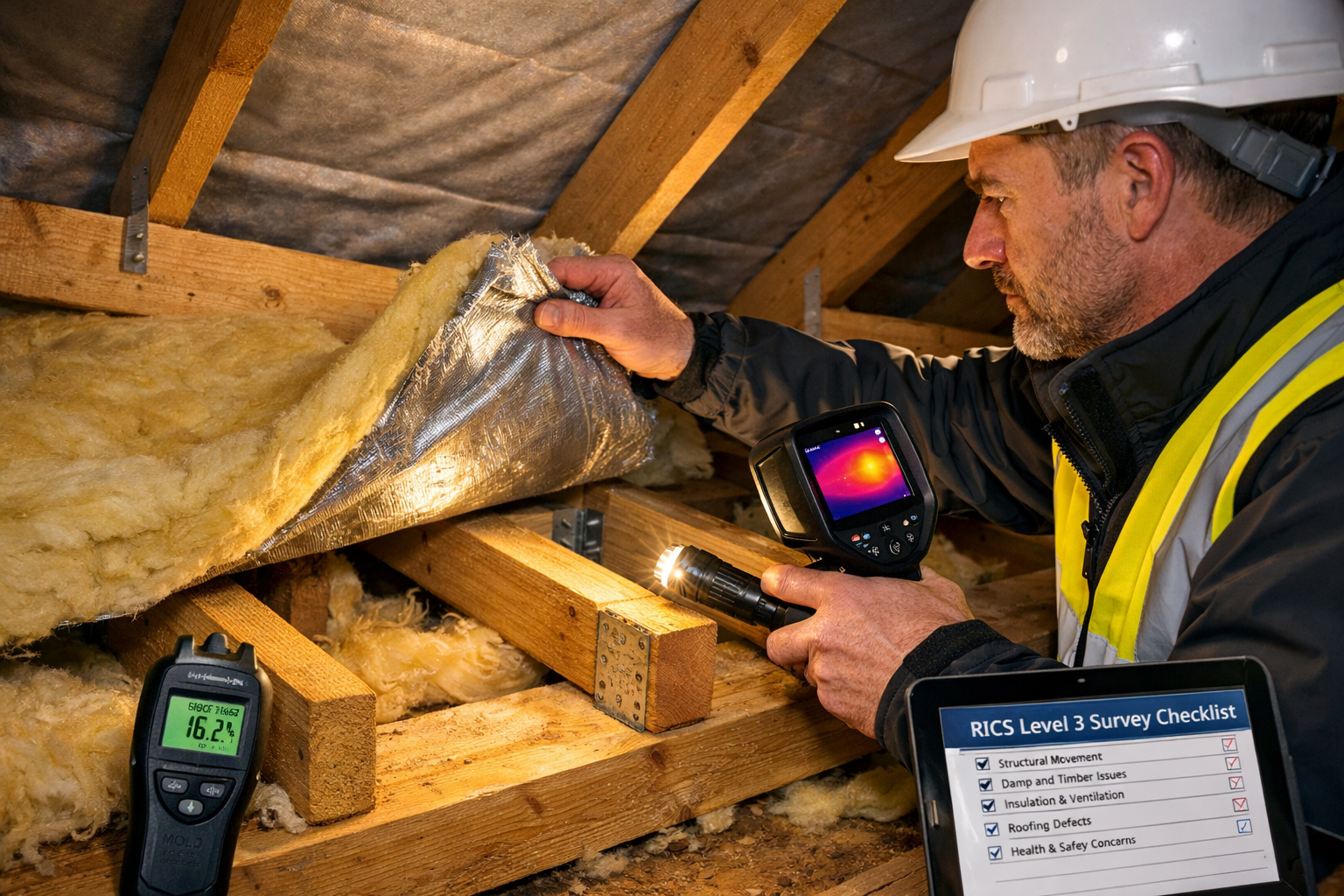
Roof inspections under 2026 standards require physical entry into roof spaces where safe access exists. Surveyors must:
- Enter the roof space completely (not just head-and-shoulders inspection)
- Visually inspect all roof structure elements including trusses, purlins, and rafters
- Lift corners of thermal insulation to identify roof thickness and type
- Examine underlying ceiling condition for moisture ingress or defects
- Assess ventilation adequacy to prevent condensation issues
- Photograph key structural elements and any defects discovered
For new builds, common roof defects include:
- Inadequate sarking felt installation
- Missing or incorrectly fitted roof tile battens
- Insufficient roof space ventilation
- Poorly installed insulation creating cold bridges
- Defective valley and flashing installations
Professional roof survey services can employ drone technology for external roof inspections where internal access proves limited, ensuring comprehensive coverage.
Drainage and Underground Systems
Drainage inspection represents one of the most critical components of new build surveys. Poor drainage installation causes extensive damage that manifests years after completion, often outside warranty periods.
Level 3 protocols require:
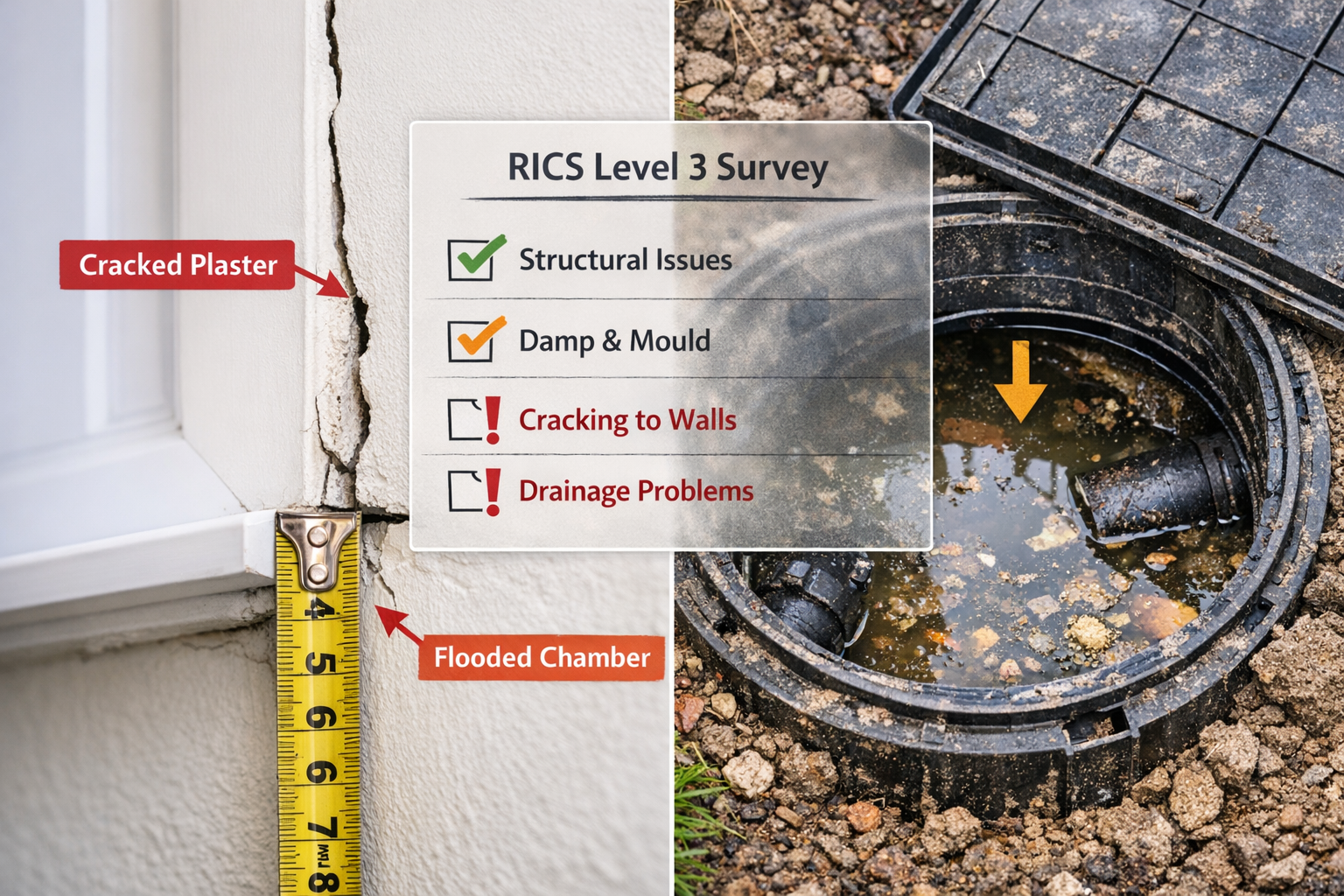
- Lifting all accessible inspection chamber covers to examine drainage runs
- Observing drain operation during everyday use (running taps, flushing toilets)
- Assessing fall gradients to ensure adequate waste water flow
- Checking connection integrity between property and main sewers
- Documenting surface water drainage including soakaways and attenuation systems
Modern sustainable drainage systems (SuDS) add complexity to new builds. Surveyors must verify that permeable paving, infiltration trenches, and attenuation tanks meet design specifications and function correctly.
Window, Door, and Opening Inspections
The 2026 standard mandates that all windows must be opened during Level 3 inspections where permission exists and keys are available. This rigorous approach identifies:
- Installation defects causing air leakage
- Inadequate sealing around frames
- Defective opening mechanisms
- Missing or incorrect trickle ventilation
- Condensation issues between glazing panes
- Structural movement affecting operation
For new builds with extensive glazing, thermal performance testing may reveal significant heat loss from poor installation—a defect costing thousands annually in energy bills.
Under-Floor and Sub-Floor Examination
Level 3 surveys require physical entry into under-floor spaces when safe access exists, going far beyond simple visual inspection. Surveyors examine:
- Ground preparation and damp-proof membrane installation
- Ventilation adequacy in suspended floor constructions
- Timber condition in beam-and-block floor systems
- Insulation installation and thermal bridging issues
- Service routing for plumbing and electrical installations
New builds with inadequate sub-floor ventilation develop timber decay within 5-10 years, requiring expensive remedial work involving floor removal and structural repairs.
Grounds and External Works Assessment
External areas receive comprehensive attention under Level 3 protocols. Surveyors must:
- Follow trails of suspected problems more extensively than lower-level surveys
- Inspect boundary walls, fences, and retaining structures
- Assess surface water drainage and ponding issues
- Examine external finishes for defects and weathering
- Evaluate landscaping impact on building foundations
For new build estates, common external defects include inadequate surface water drainage causing garden flooding, poorly constructed retaining walls, and settlement of external paving and driveways.
Warranty Defects, Future-Proofing, and the Value Proposition for 2026 Buyers
Understanding how Level 3 Building Surveys for New Build Buyers in 2026: Spotting Defects Amid 2-5% Price Growth Forecasts interact with warranty coverage and long-term property performance proves essential for informed purchasing decisions.
NHBC Warranties: What They Cover and Don't Cover
Most new builds come with 10-year NHBC (National House Building Council) warranties or equivalent protection. However, these warranties have significant limitations:
Years 1-2: Builder's Warranty Period
- Builder remains responsible for defects
- Covers workmanship and material defects
- Limitation: Requires buyer to identify and report defects promptly
Years 3-10: Structural Warranty Period
- Covers major structural defects only
- Requires defects to exceed defined tolerance levels
- Limitation: Many serious defects fall below claim thresholds
Common exclusions include:
- Design defects (unless causing structural failure)
- Normal wear and tear
- Defects resulting from lack of maintenance
- Issues identified but not remedied during first two years
- Consequential damage from excluded defects
A Level 3 survey conducted before completion identifies defects while the builder remains fully liable, avoiding warranty limitation disputes entirely. This timing advantage alone justifies the survey cost.
Identifying Defects Before Completion
The optimal timing for Level 3 surveys on new builds occurs during the snagging period, typically 2-4 weeks before legal completion. This strategic timing allows:
- Comprehensive defect identification while builder liability is absolute
- Negotiating remedial work as a condition of completion
- Withholding retention funds until defects are properly addressed
- Documenting baseline condition for future warranty claims
- Avoiding completion on defective properties that require immediate remediation
Professional surveyors document defects with:
- Detailed written descriptions
- Photographic evidence with measurements
- Severity classifications (urgent, significant, minor)
- Remedial cost estimates
- Compliance assessments against Building Regulations
This documentation provides powerful negotiating leverage with developers and creates an evidence trail for warranty claims or legal action if builders refuse reasonable remediation.
Future-Proofing: Maintenance Planning and Long-Term Value
Level 3 surveys extend beyond defect identification to provide comprehensive maintenance planning over 5-10 year horizons. For new build buyers, this forward-looking analysis covers:
| Building Element | Typical Maintenance Interval | Estimated Cost Range | Survey Benefit |
|---|---|---|---|
| External decoration | 5-7 years | £3,000-£8,000 | Identifies premature deterioration |
| Roof coverings | 15-25 years | £8,000-£20,000 | Assesses installation quality |
| Heating systems | 10-15 years | £3,000-£6,000 | Verifies correct specification |
| Windows/doors | 20-30 years | £10,000-£25,000 | Confirms proper installation |
| Drainage systems | 20-40 years | £5,000-£15,000 | Identifies installation defects |
| External works | 10-20 years | £5,000-£15,000 | Highlights design issues |
Understanding these future costs allows buyers to:
✅ Budget accurately for long-term ownership
✅ Compare properties based on total cost of ownership
✅ Negotiate purchase prices reflecting deferred maintenance
✅ Plan improvement projects strategically
The Financial Case: Survey Costs vs. Defect Remediation
The return on investment for Level 3 surveys on new builds proves exceptional when examined objectively:
Survey Investment: £800-£1,500 (0.2-0.4% of £400,000 property)
Potential Savings:
- Major structural defect identification: £15,000-£50,000
- Drainage problem detection: £5,000-£20,000
- Roof defect discovery: £8,000-£25,000
- Insulation inadequacy: £3,000-£12,000
- Multiple minor defects: £5,000-£15,000
Risk mitigation value:
- Avoiding purchase of fundamentally defective property: Priceless
- Negotiating price reduction for identified defects: £10,000-£50,000
- Ensuring builder remediation before completion: £20,000-£100,000
- Creating evidence for warranty claims: £5,000-£30,000
Even identifying a single significant defect delivers 10:1 to 50:1 return on survey investment. For properties with multiple issues—not uncommon in volume new build developments—savings can exceed £100,000.
Price Growth Context: Protecting Your Investment
With 2-5% annual price growth forecast for 2026, the mathematics of defect costs become stark:
Scenario: £400,000 New Build Purchase
Without Level 3 Survey:
- Year 1: Property value £414,000 (3.5% growth)
- Year 2: Major drainage defect discovered (£25,000 repair)
- Year 2: Property value £428,490
- Net equity: £428,490 – £400,000 – £25,000 = £3,490 (0.87% total return)
With Level 3 Survey:
- Pre-purchase: Survey identifies drainage issue (£1,200 survey cost)
- Negotiation: Builder remediates before completion
- Year 2: Property value £428,490
- Net equity: £428,490 – £400,000 – £1,200 = £27,290 (6.82% total return)
The survey investment preserves the full benefit of price appreciation while avoiding catastrophic defect costs. For buyers planning 5-10 year ownership, this protection compounds significantly.
Targeting First-Time and Upsizer Demand
The 2026 market sees particular demand from two buyer segments where Level 3 surveys deliver maximum value:
First-Time Buyers:
- Limited property experience increases vulnerability to defects
- Tight budgets leave no room for unexpected repair costs
- New build schemes (Help to Buy, shared ownership) concentrate risk
- Survey provides educational value about property condition
- Professional guidance prevents costly mistakes
Upsizers:
- Moving from smaller properties to larger new builds
- Higher absolute purchase prices magnify defect cost risks
- Families require properties that function reliably
- Long-term ownership plans justify thorough due diligence
- Survey findings inform maintenance budgeting
Both segments benefit from working with experienced chartered surveyors who understand new build construction and common developer practices. Professional guidance transforms the survey from expense to investment protection.

Selecting the Right Surveyor for New Build Inspection
Not all surveyors possess equal expertise in new build assessment. Buyers should seek professionals with:
- RICS accreditation (AssocRICS, MRICS, or FRICS designation)
- New build specialization and volume housebuilder experience
- Local market knowledge of developers and construction standards
- Comprehensive insurance covering professional indemnity
- Clear reporting standards with photographic documentation
- Technical expertise in modern construction methods
Questions to ask potential surveyors include:
- How many new build Level 3 surveys have you conducted in the past year?
- What percentage of new builds you survey have significant defects?
- Can you provide sample reports demonstrating thoroughness?
- Do you have experience with [specific developer name] properties?
- What equipment do you use for drainage, thermal, and moisture testing?
- How do you handle situations where developers dispute your findings?
Professional surveying firms often offer regional specialists, such as chartered surveyors in Kingston, Richmond, or Surrey, who understand local construction practices and developer reputations.
Acting on Survey Findings: Negotiation Strategies
When Level 3 surveys identify defects, buyers have several strategic options:
Option 1: Require Full Remediation
- Demand builder corrects all identified defects before completion
- Withhold exchange of contracts until work completed
- Commission re-inspection to verify proper remediation
- Best for: Structural defects, drainage issues, major problems
Option 2: Negotiate Price Reduction
- Request purchase price reduction reflecting remediation costs
- Add contingency (typically 20-30%) for project management and disruption
- Obtain multiple quotes for remedial work
- Best for: Minor defects, cosmetic issues, when quick completion needed
Option 3: Retention Fund
- Complete purchase with agreed retention (typically £10,000-£50,000)
- Release funds upon satisfactory defect remediation
- Use solicitor or escrow account for security
- Best for: Moderate defects requiring specialist contractors
Option 4: Walk Away
- Withdraw from purchase if defects too severe
- Survey cost represents small price for avoiding disaster
- Seek alternative properties with better construction quality
- Best for: Fundamental structural issues, multiple major defects
Experienced solicitors and surveyors guide buyers through these negotiations, ensuring optimal outcomes. The key principle: never complete on a property with unresolved significant defects unless adequate financial protection exists.
Conclusion
Level 3 Building Surveys for New Build Buyers in 2026: Spotting Defects Amid 2-5% Price Growth Forecasts represents essential due diligence in today's property market. While modest price appreciation creates opportunities for first-time buyers and upsizers, the financial mathematics demand thorough defect identification before completion. The comprehensive RICS-compliant inspection protocols—covering structural elements, drainage systems, roof spaces, sub-floor areas, and external works—provide the detailed forensic examination necessary to protect substantial property investments.
The evidence proves compelling: survey costs of £800-£1,500 pale against potential defect remediation expenses exceeding £50,000. With NHBC warranties containing significant limitations and exclusions, identifying problems while builders remain fully liable delivers exceptional value. The 2026 market context, with its 2-5% growth forecasts, means defect costs can completely eliminate equity gains and create negative returns for unsuspecting buyers.
Take Action: Protect Your Investment
For buyers considering new build properties in 2026, the path forward requires:
- Commission a Level 3 survey from RICS-accredited professionals with new build expertise
- Schedule inspection during snagging period 2-4 weeks before completion
- Review findings thoroughly with your surveyor and solicitor
- Negotiate remediation using documented evidence and professional cost estimates
- Never complete on defective properties without adequate financial protection
- Maintain survey documentation for future warranty claims and resale
The modest investment in professional surveying services delivers peace of mind, substantial financial protection, and comprehensive understanding of your property's condition. In a market where price growth barely outpaces inflation, avoiding catastrophic defect costs makes the difference between successful property investment and financial disaster.
Don't let the assumption that "new means perfect" cost you tens of thousands in remedial work. Engage experienced building surveyor services to conduct thorough Level 3 inspections, identify hidden defects, and ensure your new build purchase delivers the quality and value you deserve. Your future self—and your bank account—will thank you for the diligence. 🏡