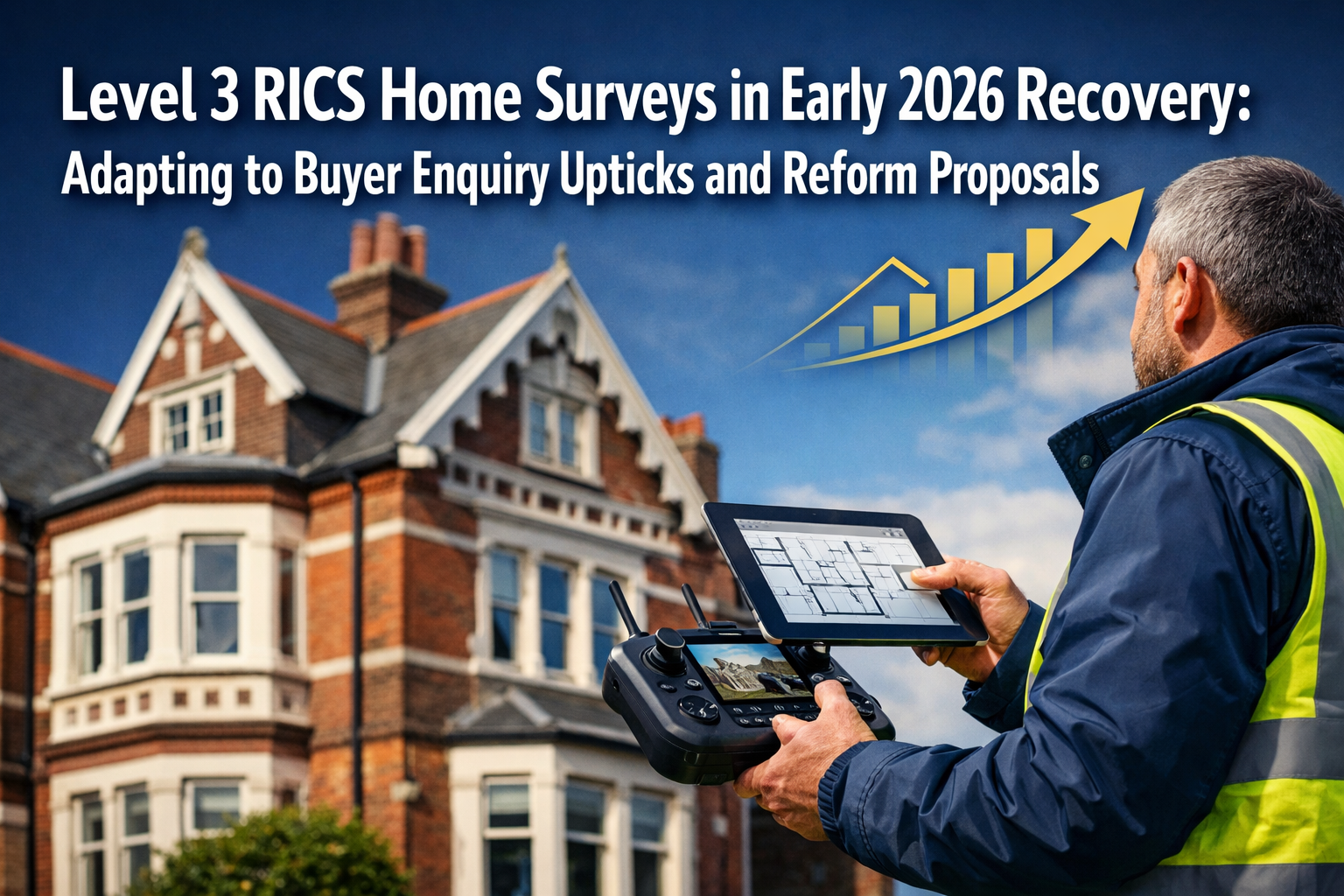

The UK property market is showing promising signs of recovery in early 2026, with buyer enquiries improving significantly from the challenging conditions of 2024-2025. As Level 3 RICS Home Surveys in Early 2026 Recovery: Adapting to Buyer Enquiry Upticks and Reform Proposals becomes increasingly relevant, chartered surveyors face a unique opportunity to align their practices with both market momentum and substantial regulatory changes. January 2026 data reveals a notable improvement in buyer enquiries, with the net balance rising to -15%, signaling renewed confidence in the residential sector. Simultaneously, RICS is finalizing the second edition of its Home Survey Standard, introducing technological innovations and clearer service frameworks that will reshape how Level 3 surveys are conducted and presented to clients.
This convergence of market recovery and regulatory reform creates both challenges and opportunities for surveying professionals. Property buyers are becoming more sophisticated in their requirements, demanding comprehensive assessments that address climate concerns, retrofit potential, and long-term structural integrity—precisely the areas where Level 3 surveys excel.
Key Takeaways
✅ Market Recovery Momentum: Buyer enquiries improved to -15% net balance in January 2026, creating increased demand for comprehensive Level 3 surveys as confidence returns to the property market.
✅ Technology Integration: The revised RICS Home Survey Standard incorporates AI, drones, and camera poles as surveying tools, modernizing Level 3 inspection capabilities and expanding service offerings.[1]
✅ Clearer Service Framework: Proposed reforms redesignate survey levels as 'basic' (Level 1), 'intermediate' (Level 2), and 'advanced' (Level 3), improving consumer understanding of service differences.[2]
✅ Expanded Valuation Services: VRS-regulated surveyors can now undertake valuations across all survey levels, creating integrated service opportunities that enhance client value.[1]
✅ Climate and Retrofit Focus: Updated standards include guidance for retrofit building assessments and 'additional risk' dwellings, reflecting evolving homebuyer priorities around energy efficiency and sustainability.[1]
Understanding Level 3 RICS Surveys in the Current Market Context
What Makes Level 3 Surveys Essential in 2026
Level 3 surveys, traditionally known as Building Surveys, represent the most comprehensive inspection service available to property buyers. These detailed assessments are particularly suited to older properties, those in poor condition, buildings with unusual construction, or homes undergoing significant renovation.[3] In the current market recovery, demand for Level 3 surveys is increasing as buyers seek thorough due diligence before committing to significant property investments.
The comprehensive nature of Level 3 surveys addresses several critical buyer concerns:
- Structural integrity assessment across all accessible areas
- Detailed defect identification with severity ratings
- Repair cost guidance to inform negotiation strategies
- Long-term maintenance planning for budget forecasting
- Retrofit and energy efficiency potential evaluation
For those considering comprehensive property assessments, understanding the difference between homebuyer reports and building surveys helps clarify which service level best suits specific property circumstances.
The Early 2026 Market Recovery Landscape
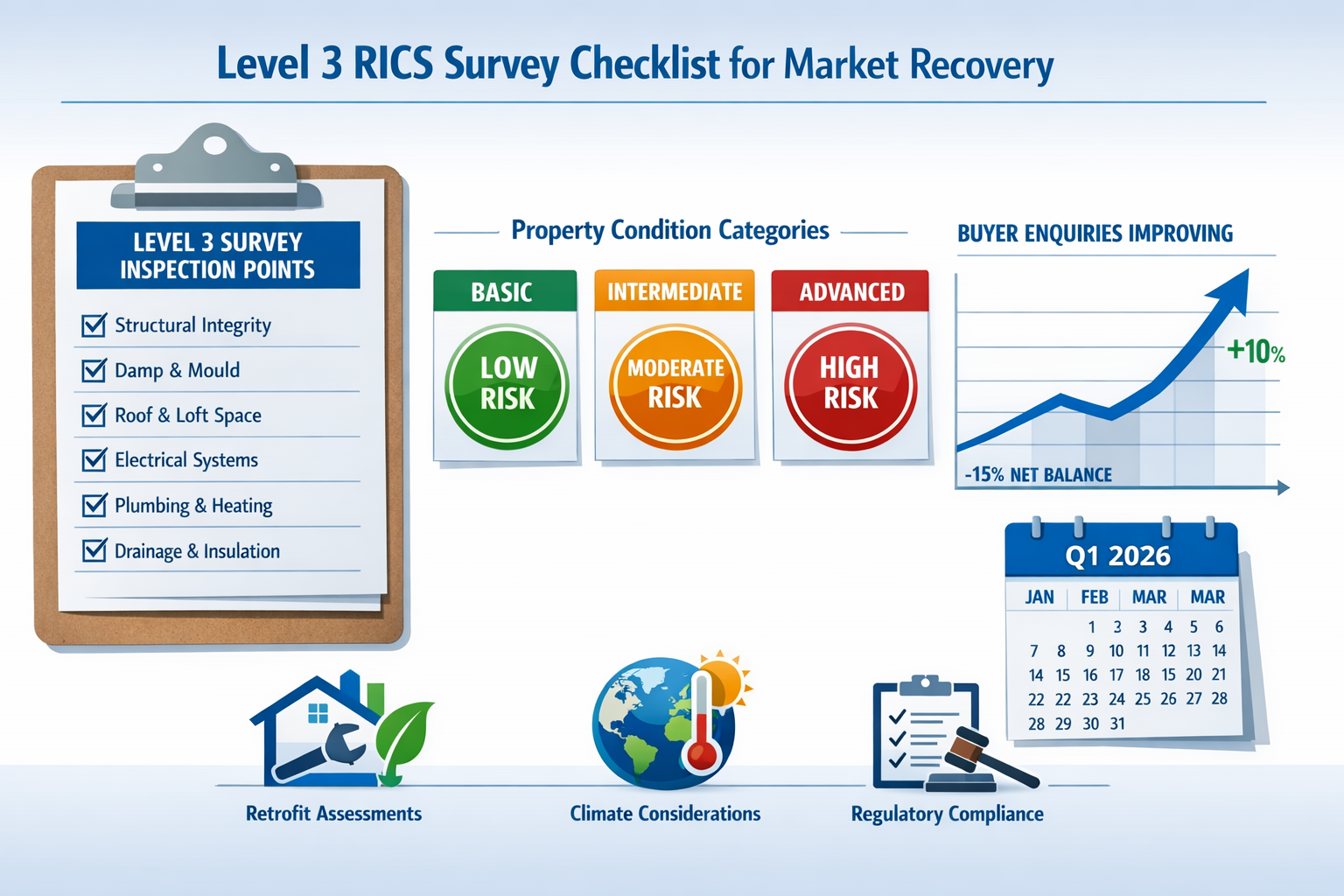
The improvement in buyer enquiries to -15% net balance represents a significant shift from the constrained market conditions of 2024-2025. This recovery is driven by several factors:
Interest Rate Stabilization 💰
After the volatility of previous years, mortgage rates have begun to stabilize, improving affordability calculations and buyer confidence.
Pent-Up Demand Release 🏠
Many buyers who delayed purchases during uncertain periods are now re-entering the market with clearer financial planning and more realistic expectations.
Government Policy Clarity 📋
Increased clarity around property taxation, energy efficiency requirements, and planning regulations has reduced uncertainty for buyers and sellers alike.
This market recovery creates heightened demand for quality surveying services, particularly Level 3 assessments that provide the comprehensive information sophisticated buyers require. For properties requiring specialist attention, services such as structural surveys in London and subsidence surveys complement standard Level 3 offerings.
Buyer Expectations in the Recovery Phase
Today's property buyers are more informed and demanding than previous generations. They expect:
- Technology-Enhanced Reporting: Digital reports with photographs, thermal imaging, and drone footage
- Climate Considerations: Assessment of energy efficiency, retrofit potential, and long-term sustainability
- Comprehensive Risk Analysis: Clear identification of immediate concerns versus long-term maintenance issues
- Valuation Integration: Understanding how identified defects impact property value
These expectations align perfectly with the proposed reforms to RICS standards, which explicitly incorporate technological advances and expanded service offerings.
Level 3 RICS Home Surveys in Early 2026 Recovery: Key Reform Proposals
The RICS Home Survey Standard 2nd Edition
The Royal Institution of Chartered Surveyors published a progress update on February 10, 2026, indicating substantial advancement in developing the second edition of the Home Survey Standard.[1] This revision, informed by surveys of 325 RICS members and over 1,400 UK homeowners, represents the most comprehensive update since the original 2019 standard.
The Standards and Regulation Board committed to providing substantive updates to members in Q1 2026, with final recommendations being assessed by the independently led board.[1] This timeline aligns perfectly with the market recovery, allowing surveyors to adapt their practices as demand increases.
Technology Integration in Level 3 Surveys
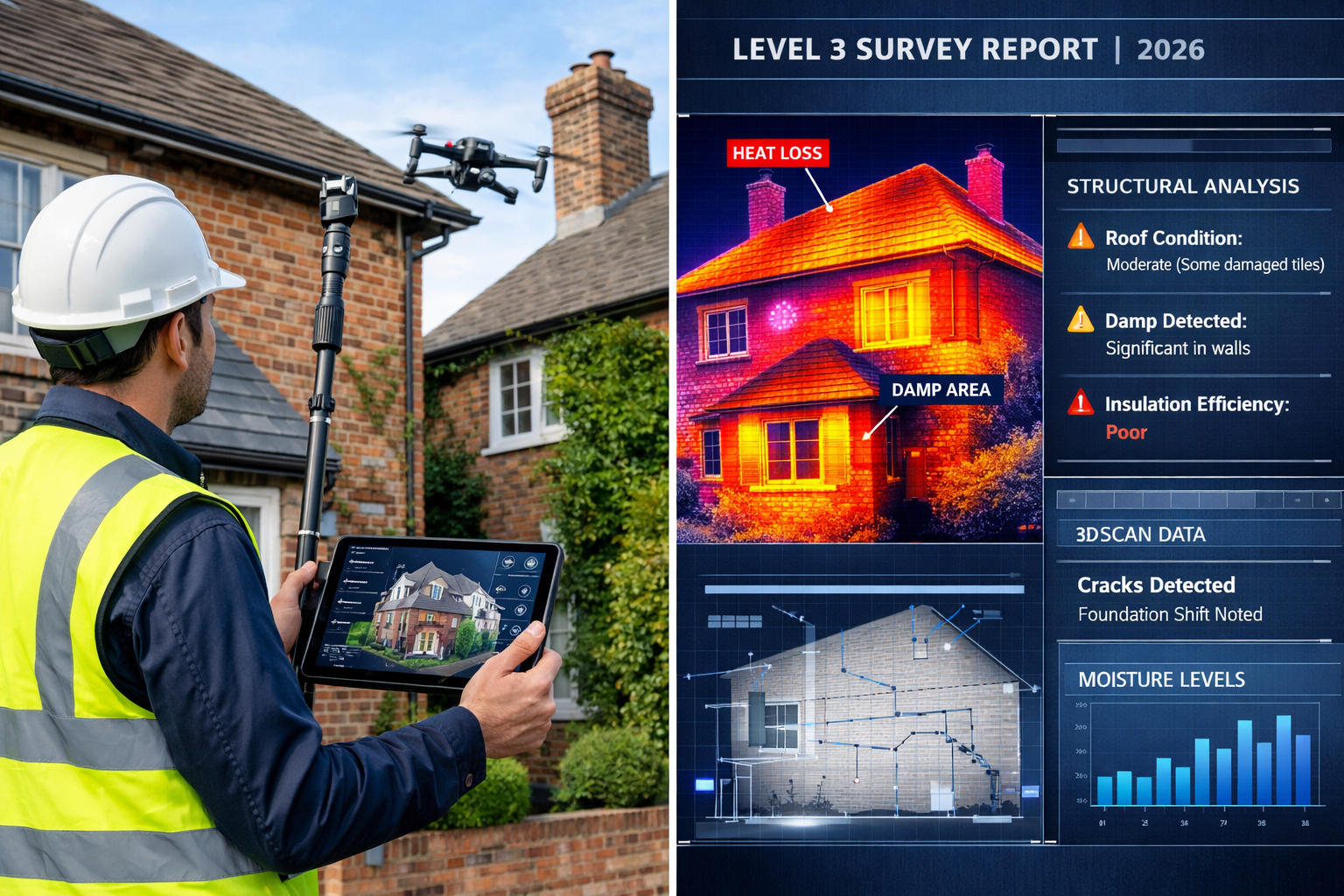
One of the most significant aspects of Level 3 RICS Home Surveys in Early 2026 Recovery: Adapting to Buyer Enquiry Upticks and Reform Proposals is the formal recognition of technological tools in survey methodology.
Approved Technologies Include:
| Technology | Application in Level 3 Surveys | Benefits |
|---|---|---|
| AI Analysis | Pattern recognition for defect identification | Improved consistency and thoroughness |
| Drones | Roof and chimney inspection without access equipment | Safer, more comprehensive coverage |
| Camera Poles | High-level inspection of guttering and eaves | Cost-effective alternative to scaffolding |
| Thermal Imaging | Insulation defects and moisture detection | Enhanced diagnostic capability |
The explicit inclusion of drone inspections as an additional service option reflects technological advancement in the sector.[1] This modernization enables surveyors to provide more comprehensive assessments while improving safety and efficiency.
Clearer Service Level Definitions
The revised standard redesignates survey levels with more intuitive terminology:[2]
- Level 1 (Basic): Condition Report for newer, conventional properties
- Level 2 (Intermediate): Homebuyer Report for standard properties in reasonable condition
- Level 3 (Advanced): Building Survey for older, complex, or problematic properties
This clearer framework helps consumers understand service differences and select appropriate survey levels. For buyers uncertain about requirements, guidance on what survey you need provides valuable decision-making support.
Enhanced 'Check vs. Test' Definitions
A critical refinement in the proposed standards clarifies the distinction between 'checking' services and 'testing.'[2] For Level 3 surveys, this means:
Checking Activities (Included in Standard Level 3):
- Operating a gas hob to verify gas connection
- Running taps to check water supply and drainage
- Testing light switches to confirm electrical circuits
- Opening windows and doors to assess operation
Testing Activities (Additional Services):
- Electrical installation condition reports
- Gas safety certificates
- Drainage CCTV surveys
- Structural load calculations
This clarity helps manage client expectations and ensures surveyors can clearly delineate core services from specialist testing that requires additional qualifications or equipment.
Expanded Valuation Services
A significant reform allows VRS-regulated surveyors to undertake valuations across all survey levels from Level 1 to Level 3.[1] This integration creates opportunities for:
✨ Comprehensive Service Packages: Combining inspection and valuation in single appointments
✨ Enhanced Client Value: Providing both condition assessment and market value guidance
✨ Improved Efficiency: Reducing duplication of property visits and information gathering
For surveyors offering valuation services, understanding RICS valuation costs and Red Book valuation requirements ensures compliance with professional standards.
Retrofit and Climate Considerations
The proposed updates include guidance for 'additional risk' dwellings and expanded services covering retrofit building assessments.[1] This reflects evolving homebuyer priorities around:
- Energy Performance: Current EPC ratings and improvement potential
- Retrofit Feasibility: Insulation, heating system upgrades, and renewable energy integration
- Climate Resilience: Flood risk, overheating potential, and extreme weather vulnerability
- Long-Term Sustainability: Lifecycle costs and environmental impact
These considerations are particularly relevant for Level 3 surveys of older properties where retrofit potential significantly impacts long-term value and running costs.
Adapting Level 3 Survey Practices for Increased Demand
Preparation Checklist for Surveying Firms
As buyer enquiries continue improving throughout 2026, surveying practices must prepare for increased demand. This comprehensive checklist ensures readiness:
🔧 Technical Capability Enhancement
- Invest in approved drone equipment and operator training
- Acquire thermal imaging cameras and interpretation skills
- Implement AI-assisted defect recognition software
- Update camera pole equipment for high-level inspections
- Establish partnerships with specialist testing providers
📋 Process Optimization
- Develop standardized Level 3 inspection protocols incorporating new technologies
- Create template sections for retrofit and climate assessments
- Establish clear workflows for integrated survey-valuation services
- Implement quality assurance reviews for all Level 3 reports
- Design client questionnaires to identify additional service requirements
👥 Team Development
- Train surveyors on revised RICS standards terminology and requirements
- Develop expertise in retrofit assessment methodologies
- Ensure VRS-regulated staff are prepared for expanded valuation services
- Create mentoring programs for less experienced surveyors
- Establish continuing professional development schedules
💻 Client Communication
- Update website content explaining 'advanced' Level 3 services
- Create comparison materials showing Level 1, 2, and 3 differences
- Develop case studies demonstrating technology-enhanced survey benefits
- Prepare FAQ documents addressing common Level 3 survey questions
- Design clear quotation templates showing core and additional services
📊 Business Systems
- Implement scheduling systems to manage increased enquiry volumes
- Develop pricing structures for technology-enhanced services
- Create reporting templates compliant with revised standards
- Establish document management for drone footage and thermal images
- Design client portals for digital report delivery
Positioning Level 3 Services for Market Recovery
Strategic Marketing Approaches:
Emphasize Comprehensive Risk Mitigation 🛡️
In a recovering market, buyers are cautious about making expensive mistakes. Position Level 3 surveys as essential risk management tools that identify problems before completion, potentially saving tens of thousands in unexpected repairs.
Highlight Technology Advantages 📱
Showcase how drone inspections, thermal imaging, and AI analysis provide insights impossible with traditional methods alone. Visual evidence of technology-enhanced surveys differentiates services in competitive markets.
Address Climate and Retrofit Concerns 🌱
Proactively offer retrofit assessments as part of Level 3 services, addressing the growing buyer concern about long-term energy costs and environmental impact. This forward-thinking approach appeals to environmentally conscious buyers.
Integrate Valuation Services 💷
For VRS-regulated practices, promote integrated survey-valuation packages that provide both condition assessment and market value guidance in single, efficient appointments.
Target Appropriate Property Types 🏛️
Focus marketing on property categories where Level 3 surveys are most appropriate: pre-1970s properties, listed buildings, properties with known defects, unusual construction types, and homes undergoing renovation.
Managing Increased Enquiry Volumes
The improvement to -15% net balance in buyer enquiries suggests sustained demand increases throughout 2026. Effective capacity management strategies include:
Tiered Service Offerings
Develop clear service tiers within Level 3 surveys: standard advanced surveys, technology-enhanced surveys with drone and thermal imaging, and comprehensive surveys including retrofit assessments and integrated valuations.
Strategic Scheduling
Implement booking systems that balance workload across teams, allowing for the extended time required for thorough Level 3 inspections while maintaining service quality.
Quality Over Volume
Resist pressure to compromise inspection thoroughness for volume. Level 3 surveys require adequate time for comprehensive assessment—typically 4-6 hours for average properties, longer for complex buildings.
Subcontractor Networks
Establish relationships with qualified surveyors who can handle overflow work during peak periods while maintaining quality standards and brand reputation.
Level 3 RICS Home Surveys in Early 2026 Recovery: Regulatory Compliance Considerations
Proposed Regulatory Compliance Scheme
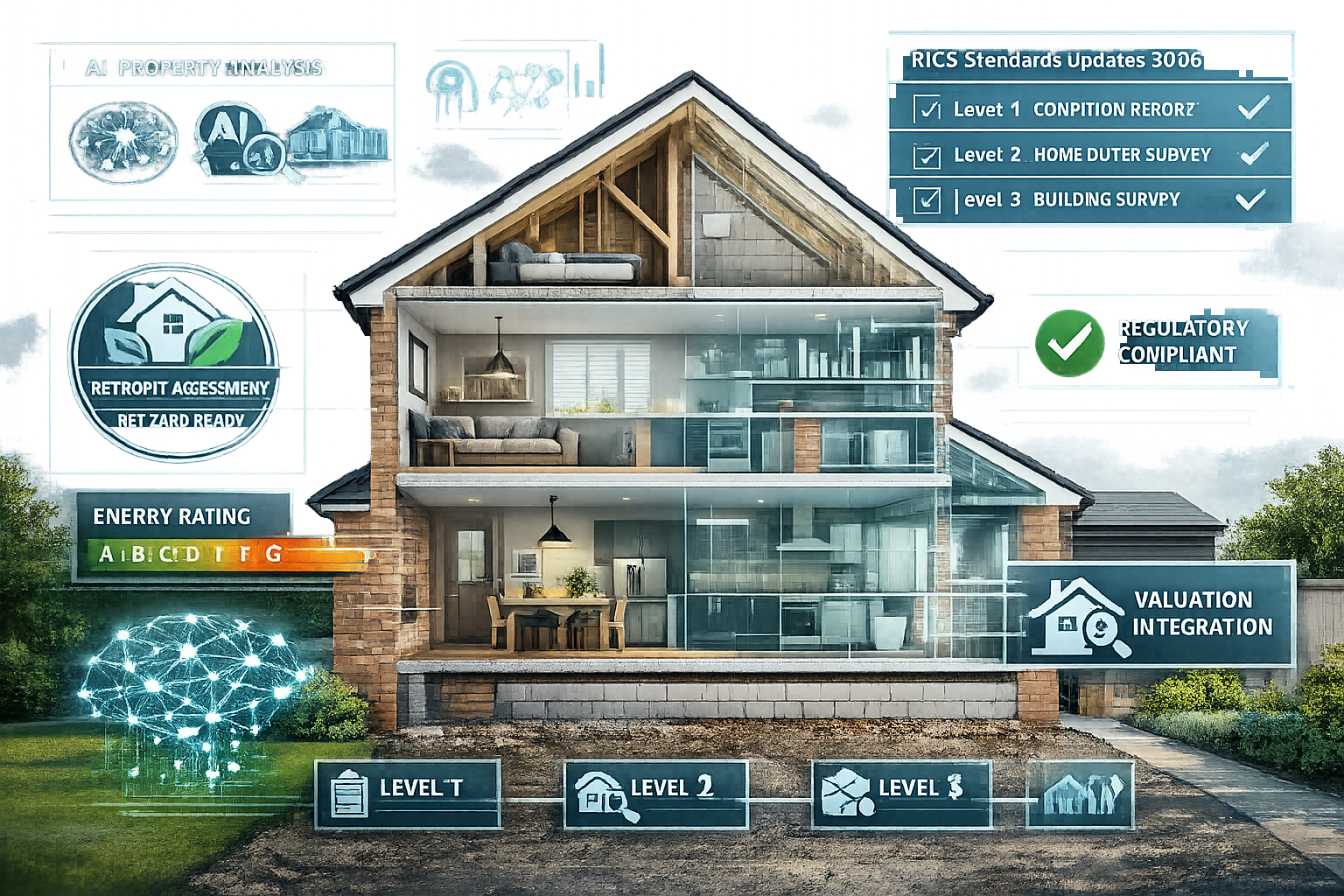
The revised RICS standards include proposals for a regulatory compliance scheme requiring members conducting home surveys to meet specific requirements.[1] This scheme would include:
Dedicated Compliance Resources 📋
Practices may need to designate compliance officers responsible for ensuring adherence to revised standards, maintaining documentation, and managing audit requirements.
Enhanced Reporting Requirements 📊
Additional reporting to RICS regarding survey volumes, client complaints, and quality assurance measures may become mandatory, increasing administrative responsibilities.
Regular Audit Protocols 🔍
Periodic audits of survey reports and practices could become standard, requiring firms to maintain exemplary documentation and quality control processes.
Consumer Confidence Measures ✅
The scheme aims to increase consumer confidence in RICS-regulated surveys, potentially creating competitive advantages for compliant practices while raising operational standards across the sector.
Preparing for Standards Implementation
While final implementation timelines remain subject to Standards and Regulation Board approval, proactive preparation ensures smooth transition:
- Review Current Practices: Audit existing Level 3 survey methodologies against proposed standards
- Identify Gaps: Determine where current practices fall short of proposed requirements
- Develop Action Plans: Create specific, timebound plans to address identified gaps
- Invest in Training: Ensure all surveyors understand revised standards before implementation
- Update Templates: Revise report templates to reflect new terminology and requirements
- Test New Approaches: Pilot technology-enhanced surveys and integrated services before full rollout
Professional Indemnity Considerations
Technology integration and expanded service offerings may impact professional indemnity insurance requirements. Consider:
- Drone Operation Coverage: Ensure policies cover drone-related incidents and liabilities
- Valuation Integration: Verify coverage extends to integrated survey-valuation services
- Technology Reliance: Clarify insurer expectations regarding AI and automated analysis tools
- Retrofit Advice: Confirm coverage for retrofit feasibility assessments and energy efficiency guidance
Consult with specialist insurance brokers to ensure adequate coverage for expanded Level 3 service offerings.
Best Practices for Technology-Enhanced Level 3 Surveys
Drone Integration Protocols
Drone inspections offer significant advantages for Level 3 surveys, but require careful implementation:
Pre-Flight Planning ✈️
- Conduct site risk assessments identifying obstacles, restricted airspace, and safety concerns
- Obtain necessary permissions for flights near airports or controlled airspace
- Inform property occupants and neighbors about drone operations
- Plan flight paths ensuring comprehensive coverage of roofs, chimneys, and high-level features
Operational Standards 📸
- Maintain current CAA certifications and insurance coverage
- Follow manufacturer guidelines for equipment maintenance and operation
- Capture both overview footage and detailed close-ups of specific features
- Record metadata including flight dates, times, and weather conditions
Report Integration 📝
- Include representative drone images in survey reports with clear annotations
- Provide context for drone findings within overall property condition assessment
- Maintain secure storage of full drone footage for potential future reference
- Clearly identify drone-captured images in reports for transparency
AI and Automated Analysis
Artificial intelligence tools can enhance Level 3 survey consistency and thoroughness:
Appropriate Applications
- Pattern recognition for common defects (cracking, dampness, deterioration)
- Comparative analysis against databases of similar properties
- Preliminary sorting of photographs by defect type or severity
- Quality assurance checking for report completeness
Critical Limitations
- AI cannot replace professional judgment and contextual understanding
- Automated tools require human verification of all findings
- Unusual or complex defects may not be recognized by standard algorithms
- Professional liability remains with the surveyor, not the technology
"Technology should enhance, not replace, professional expertise. AI tools are valuable assistants, but the surveyor's judgment, experience, and contextual understanding remain irreplaceable in Level 3 assessments."
Thermal Imaging Best Practices
Thermal imaging provides valuable diagnostic information for Level 3 surveys when used appropriately:
Optimal Conditions
- Conduct thermal surveys during appropriate weather conditions (temperature differentials required)
- Ensure properties have been heated for adequate periods before imaging
- Avoid direct sunlight on external walls which creates false readings
- Document environmental conditions affecting thermal imaging results
Interpretation Guidelines
- Correlate thermal anomalies with visual inspection findings
- Distinguish between thermal patterns and actual defects
- Provide clear explanations of thermal imaging limitations in reports
- Recommend specialist investigation where thermal imaging suggests significant concerns
Future-Proofing Level 3 Survey Services
Anticipating Further Regulatory Evolution
The second edition of the RICS Home Survey Standard represents significant progress, but regulatory evolution will continue. Forward-thinking practices should:
Monitor Regulatory Developments 👀
Maintain awareness of RICS consultations, Standards and Regulation Board updates, and industry discussions about future changes.
Participate in Industry Consultation 💬
Contribute to RICS consultations and industry body discussions, helping shape future standards based on practical surveying experience.
Invest in Continuing Development 📚
Prioritize ongoing professional development for all surveyors, ensuring skills remain current with evolving standards and technologies.
Build Flexible Systems 🔄
Develop business systems and processes that can adapt to regulatory changes without requiring complete overhauls.
Expanding Service Offerings
The market recovery and revised standards create opportunities for expanded Level 3 service offerings:
Specialist Property Types
- Listed building surveys requiring heritage expertise
- New-build snagging surveys for recently completed properties
- Pre-purchase surveys for properties with planning permission for development
- Condition surveys for properties in probate or estate administration
Integrated Service Packages
- Survey plus valuation for mortgage and purchase purposes
- Survey plus energy assessment with retrofit recommendations
- Survey plus planning feasibility for renovation projects
- Survey plus maintenance planning for long-term ownership
Additional Technical Services
- Detailed subsidence investigations beyond standard survey scope
- Boundary surveys addressing property extent disputes
- Expert witness services for properties with litigation issues
- Specialist assessments for unusual construction or materials
Building Client Relationships in Recovery Markets
Sustained market recovery depends on maintaining buyer confidence. Level 3 surveyors can contribute by:
Transparent Communication 💡
Clearly explain what Level 3 surveys include, what they don't cover, and when additional specialist investigations are recommended.
Educational Approach 📖
Help clients understand property condition findings, repair priorities, and long-term maintenance requirements, empowering informed decision-making.
Realistic Expectations ⚖️
Set appropriate expectations about older property characteristics, distinguishing between defects requiring immediate attention and normal age-related wear.
Follow-Up Support 🤝
Offer post-survey consultations to discuss findings, answer questions, and provide guidance on obtaining repair quotations or specialist investigations.
Long-Term Value 🎯
Position Level 3 surveys as investments in informed property decisions that potentially save significant costs through early defect identification and negotiation leverage.
Conclusion
Level 3 RICS Home Surveys in Early 2026 Recovery: Adapting to Buyer Enquiry Upticks and Reform Proposals represents a pivotal moment for the surveying profession. The convergence of market recovery—evidenced by improved buyer enquiries to -15% net balance—and substantial regulatory reform creates both opportunities and responsibilities for chartered surveyors.
The proposed second edition of the RICS Home Survey Standard, with its technology integration, clearer service frameworks, and expanded offerings, positions Level 3 surveys to meet evolving buyer expectations. Drone inspections, AI-assisted analysis, and thermal imaging enhance traditional survey methodologies, providing more comprehensive assessments while improving efficiency and safety.[1]
The redesignation of survey levels as 'basic,' 'intermediate,' and 'advanced' improves consumer understanding, helping buyers select appropriate services for their circumstances.[2] Meanwhile, expanded valuation services and retrofit assessments create integrated offerings that deliver enhanced client value.[1]
For surveying practices, success in this recovery period requires proactive adaptation:
Actionable Next Steps
Immediate Actions (Next 30 Days):
- ✅ Review current Level 3 survey methodologies against proposed RICS standards
- ✅ Assess technology capabilities and identify investment priorities
- ✅ Update marketing materials to reflect 'advanced' Level 3 terminology
- ✅ Develop pricing structures for technology-enhanced services
- ✅ Create client communication materials explaining service differences
Short-Term Actions (Next 90 Days):
- 🔧 Invest in approved drone equipment and operator training
- 🔧 Implement AI-assisted analysis tools with appropriate quality controls
- 🔧 Develop standardized protocols for retrofit and climate assessments
- 🔧 Train staff on revised standards and expanded service offerings
- 🔧 Establish partnerships with specialist testing providers
Long-Term Strategic Actions:
- 🎯 Build flexible business systems adaptable to ongoing regulatory evolution
- 🎯 Develop expertise in emerging areas like retrofit assessment and climate resilience
- 🎯 Create comprehensive service packages integrating surveys, valuations, and specialist assessments
- 🎯 Establish quality assurance processes exceeding proposed compliance requirements
- 🎯 Position practice as technology-forward leader in Level 3 survey provision
The early 2026 market recovery provides momentum for growth, but sustained success requires commitment to professional excellence, technological innovation, and client-focused service delivery. Practices that embrace these reforms while maintaining the rigorous inspection standards that define Level 3 surveys will thrive in the evolving property market.
By aligning surveying practices with both market demands and regulatory expectations, chartered surveyors can ensure Level 3 RICS home surveys remain the gold standard for comprehensive property assessment, protecting buyers' interests while supporting informed decision-making in the recovering property market.
For professional guidance on comprehensive property assessments tailored to your specific circumstances, consider consulting qualified chartered surveyors who understand both traditional inspection methodologies and modern technological enhancements that define Level 3 surveys in 2026.
References
[1] Home Survey Standards – https://www.rics.org/profession-standards/rics-standards-and-guidance/sector-standards/building-surveying-standards/home-surveys/home-survey-standards
[2] Understanding The Rics Home Survey Standard Proposal – https://www.rics.org/news-insights/understanding-the-rics-home-survey-standard-proposal
[3] What Sort Of Survey Should I Have – https://hoa.org.uk/advice/guides-for-homeowners/i-am-buying/what-sort-of-survey-should-i-have/