

The homebuying landscape in England and Wales is undergoing its most significant transformation in decades. For buyers, sellers, and property professionals alike, 2026 marks a watershed moment that fundamentally changes when, how, and why building surveys are commissioned. Gone are the days of discovering critical structural defects weeks after making an offer—Navigating 2026 Homebuying Reforms: Essential Building Surveys for Upfront Property Condition Checks has become the new reality for anyone involved in residential property transactions.
These government-mandated reforms introduce a radical shift: sellers must now provide comprehensive condition surveys before marketing their properties, not after accepting offers. This upfront transparency aims to slash the £1.5 billion annual cost of failed transactions while giving buyers the critical information they need from day one.[2]
Key Takeaways
- ✅ Mandatory upfront surveys: Sellers in England and Wales must commission condition surveys or provide verified material information before listing properties in 2026
- 📊 Economic impact: The reforms are projected to halve the number of failed sales, saving the UK economy approximately £750 million annually
- 🏠 Comprehensive disclosure: Seller information packs must include structural condition, known defects, leasehold charges, and legal restrictions before any offers are received
- ⏰ Strict timelines: Local authority searches must be completed within 3 weeks (down from current 6-10 week delays), and buyers must order surveys within 2 weeks of offer acceptance
- 💷 Financial commitment: A standard £500 reservation fee now secures offers and prevents either party from withdrawing without consequence
Understanding the 2026 Homebuying Reform Framework
What Has Changed in England and Wales?
The Housing Reform 2026 represents the most comprehensive overhaul of the property transaction process in the country's history. Unlike Scotland, which implemented mandatory Home Reports in 2008, England and Wales have historically operated on a "buyer beware" principle where purchasers commissioned surveys after offers were accepted—often discovering deal-breaking defects late in the process.[1]
The core changes include:
- Pre-marketing condition surveys: Sellers must arrange professional property assessments before listing
- Digital information packs: All material information, including surveys, searches, and legal documents, must be available online alongside property listings
- Binding reservation agreements: A £500 fee locks in both parties after offer acceptance[2]
- Accelerated search timelines: Local authorities must deliver searches within 3 weeks maximum
- Mandatory survey ordering: Buyers must commission their own survey within 2 weeks of offer acceptance[2]
Geographic Scope and Phased Implementation
It's crucial to understand that these reforms apply only to England and Wales. Scotland continues to operate under its existing Home Report system, while Northern Ireland maintains its separate framework.[1] The rollout is occurring in phases throughout 2026, with gradual implementation of survey requirements, early binding agreements, and supporting digital infrastructure.[1]
"The government estimates the reforms will halve the number of failed sales, which currently cost the UK economy £1.5 billion annually." [2]
This phased approach allows the property industry—including chartered surveyors, estate agents, solicitors, and technology providers—to adapt their systems and workflows progressively rather than facing a single disruptive deadline.
The Critical Role of Building Surveys in Navigating 2026 Homebuying Reforms
Why Upfront Property Condition Checks Matter
The shift from post-offer to pre-listing surveys fundamentally changes the risk profile for all parties. Traditionally, buyers discovered structural issues, subsidence concerns, or hidden defects only after investing time and money in legal fees and mortgage applications. This late-stage revelation frequently led to renegotiations, reduced offers, or complete transaction failures.[1]
Benefits of upfront condition checks:
| Stakeholder | Key Benefits |
|---|---|
| Sellers | Realistic pricing, fewer renegotiations, faster sales, reduced fall-through risk |
| Buyers | Informed decision-making, accurate budgeting, negotiating power, reduced survey duplication |
| Estate Agents | Qualified leads, smoother transactions, improved conversion rates |
| Conveyancers | Fewer aborted transactions, streamlined processes, predictable timelines |
The Royal Institute of Chartered Surveyors (RICS) officially welcomed these proposals, stating they would "ensure clarity at the beginning of the process and reduce the risk of failed transactions."[2] This professional endorsement underscores the surveying sector's confidence that upfront transparency benefits the entire market.
What Must Be Included in Seller Information Packs
Navigating 2026 Homebuying Reforms: Essential Building Surveys for Upfront Property Condition Checks requires understanding exactly what information sellers must provide. The mandatory upfront information pack extends well beyond basic property condition:[1]
Required disclosures:
- 🏗️ Structural condition assessment: Comprehensive survey identifying defects, repairs needed, and maintenance issues
- ⚠️ Known defects: Full disclosure of any problems the seller is aware of, including past repairs
- 📋 Leasehold information: Ground rent, service charges, lease terms, and management company details (where applicable)
- ⚖️ Legal matters: Restrictions, easements, covenants, and boundary information
- 🌊 Environmental risks: Flood risk assessments and contamination reports
- 🔍 Local authority searches: Planning permissions, building control approvals, and local development plans[2]
This comprehensive transparency ensures buyers can make fully informed decisions before submitting offers, dramatically reducing the likelihood of post-offer surprises that derail transactions.

Essential Building Survey Types for 2026 Compliance
Level 3 Building Surveys: The Gold Standard
For most residential properties, particularly older homes or those with visible defects, a Level 3 Building Survey (formerly known as a Full Structural Survey) represents the most comprehensive option. This detailed inspection examines every accessible part of the property and provides extensive reporting on:[1]
- Structural integrity: Foundations, walls, floors, and load-bearing elements
- Roof condition: Coverings, timbers, chimneys, and weatherproofing
- Dampness and moisture: Rising damp, penetrating damp, and condensation issues
- Subsidence and movement: Cracks, settlement patterns, and structural movement indicators
- Services: Electrical, plumbing, heating, and drainage systems
- Defects and repairs: Detailed descriptions with severity ratings and cost estimates
Professional building surveyor services typically deliver Level 3 reports running 30-50 pages with photographic evidence, technical diagrams, and prioritized repair recommendations. These comprehensive assessments satisfy the upfront disclosure requirements while giving sellers clear understanding of their property's condition before setting asking prices.
Specialized Survey Types for Specific Concerns
Beyond standard building surveys, certain properties or situations require additional specialist assessments:
Subsidence and Structural Movement Surveys
Properties showing crack patterns, door misalignment, or historic movement issues benefit from dedicated subsidence surveys conducted by residential structural engineers. These investigations include:
- Detailed crack monitoring and mapping
- Ground investigation and soil analysis
- Structural calculations and stability assessments
- Remediation recommendations and cost estimates
Specific Defect Reports
When sellers are aware of particular issues—a leaking roof, electrical problems, or drainage concerns—commissioning a specific defect report provides targeted analysis of that problem. This focused approach can be more cost-effective than a full survey while still meeting disclosure obligations for known defects.
Drone Roof Surveys
For properties with difficult-to-access roofs, drone roof surveys offer safe, comprehensive inspection using high-resolution aerial photography and thermal imaging. This technology-driven approach is particularly valuable for:
- Multi-story buildings
- Properties with steep or fragile roof coverings
- Historic buildings where physical access could cause damage
- Rapid assessment requirements under tight 2026 timelines
Commercial Property Considerations
While the 2026 reforms primarily target residential transactions, commercial property owners should also consider how upfront transparency might benefit their sales. Commercial building surveys provide similar comprehensive assessments tailored to business premises, including specialized systems, compliance issues, and investment-grade reporting.
Practical Guidance for Navigating 2026 Homebuying Reforms: Essential Building Surveys for Upfront Property Condition Checks
For Sellers: Preparing Your Property for Market
Step 1: Commission Your Survey Early ⏰
Don't wait until you're ready to list. Engage a qualified surveyor 4-6 weeks before your intended marketing date to allow time for:
- Comprehensive inspection (typically 2-4 hours on-site)
- Report preparation (5-10 working days)
- Review of findings and decision-making
- Any urgent repairs you choose to address before listing
Step 2: Choose the Right Survey Level 📋
Work with your surveyor to determine the appropriate assessment type based on:
- Property age and construction type
- Known or suspected defects
- Budget considerations
- Buyer expectations in your market segment
Step 3: Gather Supporting Documentation 📑
Compile all relevant paperwork to accompany your survey:
- Building control certificates for alterations
- Planning permissions
- Guarantees for recent work (roofing, damp-proofing, electrical)
- Service records for heating systems
- Warranties for windows, doors, or extensions
Step 4: Address Critical Issues 🔧
Review survey findings with your estate agent and decide which defects to repair before marketing. Focus on:
- Safety hazards (electrical faults, structural instability)
- Deal-breakers for most buyers (severe damp, roof failures)
- Cost-effective repairs that significantly improve marketability
- Issues that might trigger mortgage lender concerns
Step 5: Price Realistically 💰
Use survey findings to set an asking price that reflects the property's true condition. Transparent pricing based on comprehensive condition data reduces negotiation friction and accelerates sales.
For Buyers: Making the Most of Upfront Information
Review Seller-Provided Surveys Thoroughly 🔍
Even though sellers must provide condition surveys, approach these documents with appropriate skepticism:
- Verify the surveyor's qualifications and independence
- Check the survey date (information should be recent)
- Look for any scope limitations or areas not inspected
- Note the severity ratings for identified defects
Commission Your Own Survey 📊
The 2026 reforms require buyers to order their own survey within 2 weeks of offer acceptance.[2] This dual-survey approach provides:
- Independent verification of seller disclosures
- Fresh assessment by your chosen surveyor
- Opportunity to investigate specific concerns in detail
- Basis for informed negotiation if new issues emerge
Use Information to Negotiate Effectively 💬
Armed with comprehensive condition data from both seller and buyer surveys, you can:
- Make realistic offers reflecting repair costs
- Request specific remedial work before completion
- Negotiate price reductions for defects you'll accept
- Walk away confidently if issues exceed your tolerance
Budget for Repairs and Maintenance 💷
Survey reports provide invaluable planning tools for home renovation projects. Use findings to:
- Create prioritized repair schedules
- Obtain contractor quotes before completion
- Reserve funds for urgent versus long-term maintenance
- Plan improvements strategically over time

For Property Professionals: Adapting Workflows and Services
Surveyors: Preparing for Volume Increases 📈
Industry analysts project that 2026 will see significant growth in survey demand earlier in the transaction process.[3] To capitalize on this shift:
- Expand capacity: Recruit additional surveyors or form strategic partnerships
- Streamline processes: Implement digital reporting tools and standardized templates
- Educate sellers: Develop marketing materials explaining survey requirements and benefits
- Offer package pricing: Create bundled services combining surveys with valuation reports
- Enhance turnaround: Aim for 5-7 day report delivery to meet tight 2026 timelines
Estate Agents: Positioning Properties Effectively 🏘️
The requirement to publish survey information alongside listings transforms marketing strategies:
- Transparency as selling point: Highlight comprehensive disclosure as evidence of seller confidence
- Manage expectations: Use survey findings to justify pricing and prevent wasted viewings
- Qualify buyers: Ensure prospects review condition information before booking viewings
- Coordinate timelines: Work with surveyors and solicitors to align information pack completion
Solicitors and Conveyancers: Leveraging Early Information ⚖️
With searches and surveys available upfront, legal professionals can:
- Front-load due diligence: Begin substantive work before offer acceptance
- Reduce post-offer delays: Minimize the traditional "waiting for searches" bottleneck
- Advise more effectively: Provide informed guidance based on comprehensive property data
- Streamline exchange: Accelerate progression from offer to completion with fewer surprises
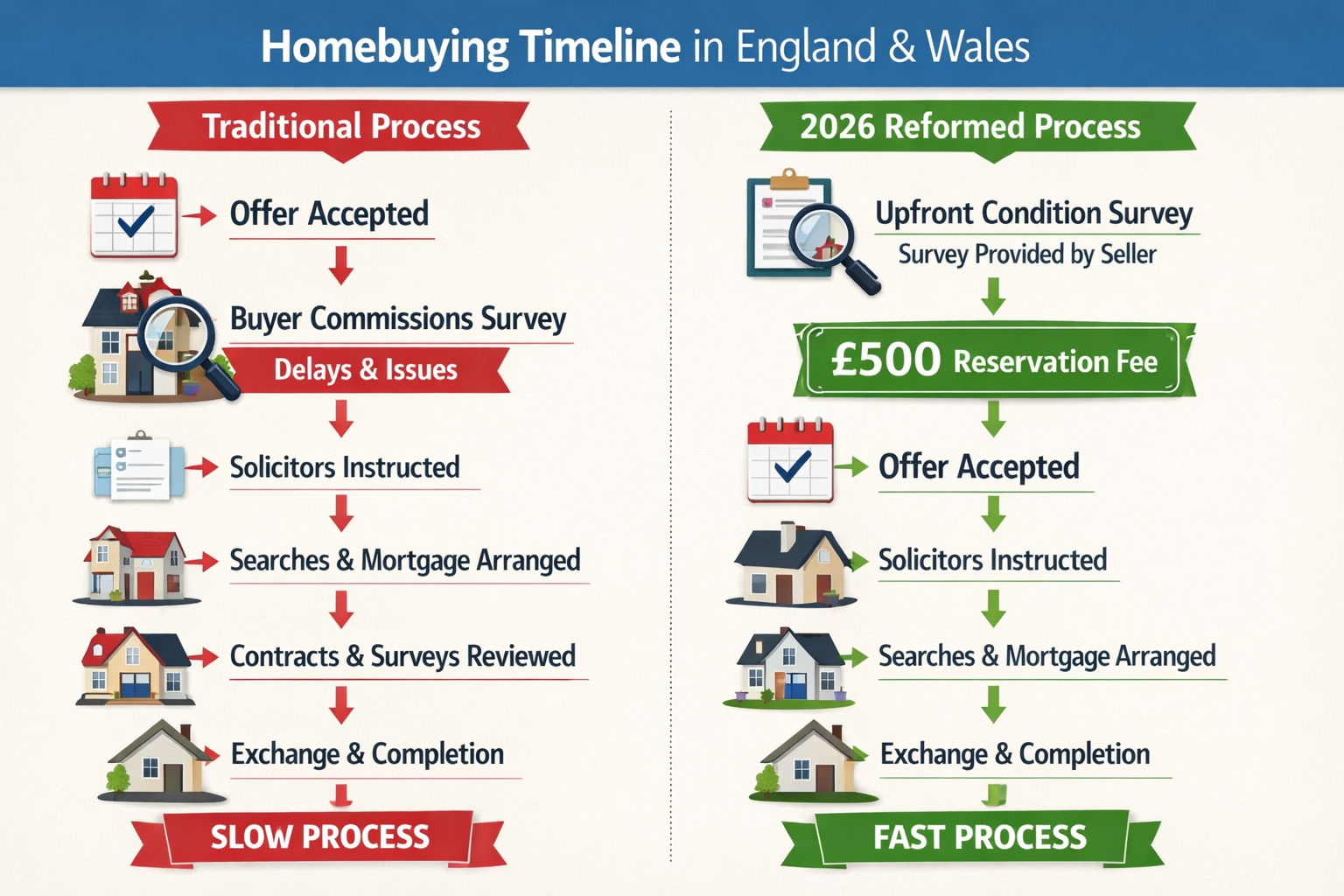
Timeline and Procedural Requirements Under the New System
The Reformed Transaction Journey
Understanding the new chronology is essential for navigating 2026 homebuying reforms effectively:
Pre-Marketing Phase (Seller Responsibilities)
- Commission condition survey (4-6 weeks before listing)
- Order local authority searches (must complete within 3 weeks)[2]
- Compile information pack (surveys, searches, legal documents)
- Publish information online alongside property listing[2]
Offer and Reservation Phase
- Buyer reviews upfront information before making offer
- Offer acceptance triggers £500 reservation fee[2]
- Reservation agreement binds both parties with financial consequences for withdrawal
- Buyer must order own survey within 2 weeks[2]
Completion Phase
- Buyer's survey completed and findings reviewed
- Negotiation or confirmation based on comparative survey results
- Legal work progresses with all information already available
- Exchange and completion proceed on accelerated timeline
Key Deadlines and Penalties
The 2026 framework introduces specific timeframes designed to prevent delays:
| Requirement | Timeline | Consequence of Non-Compliance |
|---|---|---|
| Local authority searches | 3 weeks maximum[2] | Authority must refund fees or expedite |
| Buyer survey ordering | Within 2 weeks of offer[2] | Potential reservation agreement breach |
| Search validity | 12 months[2] | Sellers can reuse for multiple buyers |
| Reservation fee | Upon offer acceptance | £500 standard fee[2] |
These structured timelines create predictability and accountability throughout the transaction process, reducing the uncertainty that previously plagued property purchases.
Cost Considerations and Return on Investment
Survey Costs in the 2026 Market
Professional building survey fees vary based on property value, size, age, and complexity:
Typical pricing ranges:
- Level 2 HomeBuyer Report: £400-£800
- Level 3 Building Survey: £600-£1,500+
- Specialist surveys (subsidence, structural): £800-£2,500
- Commercial surveys: £1,000-£5,000+
For sellers, commissioning an upfront survey represents an investment that typically delivers returns through:
- ✅ Faster sales (reduced time on market)
- ✅ Fewer fall-throughs (informed buyers commit confidently)
- ✅ Reduced renegotiation (transparent pricing from the start)
- ✅ Competitive advantage (professional presentation inspires confidence)
The £1.5 Billion Question: Economic Impact
The government's projection that reforms will halve failed sales—currently costing £1.5 billion annually—provides powerful justification for upfront survey requirements.[2] This economic analysis suggests:
- £750 million annual savings across the market
- Reduced wasted costs for buyers (aborted legal fees, mortgage applications)
- Lower emotional toll from collapsed transactions
- Improved market efficiency and transaction velocity
For individual transactions, avoiding a failed sale saves buyers and sellers:
- £1,500-£3,000 in wasted legal fees
- £500-£1,000 in survey costs (if duplicated)
- £300-£500 in mortgage application fees
- Weeks or months of lost time and opportunity cost
Regional Considerations and Service Availability
London and Southeast England
The concentration of property professionals in London and surrounding areas means robust service availability for implementing 2026 reforms. Whether you're buying in Central London, West London, North London, or South West London, qualified surveyors can meet the new upfront assessment requirements.
Specific areas with strong surveying infrastructure include:
Home Counties and Beyond
The reforms apply equally across England and Wales, with service availability extending to:
Rural and suburban markets may experience initial capacity constraints as surveying firms scale to meet increased upfront demand, making early booking essential during the 2026 transition period.
Common Questions and Misconceptions
"Do I Still Need My Own Survey If the Seller Provides One?"
Yes, absolutely. While seller-provided surveys offer valuable baseline information, buyers should always commission independent assessments for several reasons:
- Seller surveys may have been conducted months earlier
- Different surveyors may identify different issues
- Your surveyor works exclusively for your interests
- Lender requirements may mandate a fresh valuation
- Independent verification protects your investment
The 2026 reforms explicitly require buyers to order surveys within 2 weeks of offer acceptance,[2] recognizing the importance of independent professional advice.
"What If the Seller's Survey Misses Major Defects?"
Survey reports include professional indemnity insurance and clearly define scope limitations. If a surveyor negligently fails to identify defects that should have been apparent during a competent inspection, buyers may have recourse through:
- Professional negligence claims
- RICS complaints procedures
- Insurance claims against the surveyor's policy
However, surveys are non-invasive visual inspections with inherent limitations. Surveyors cannot see through walls, lift floorboards (unless agreed), or predict future failures. Understanding these limitations is crucial for managing expectations.
"Can Sellers Refuse to Provide Upfront Surveys?"
Under the 2026 reforms, sellers must provide "a condition survey or equivalent verified material information" before marketing.[1] While the exact enforcement mechanisms continue to evolve during the phased implementation, the practical reality is that:
- Estate agents will require information packs before listing
- Buyers will avoid properties without transparency
- Market pressure will enforce compliance even before legal penalties
- Properties without upfront information will struggle to sell
Future Outlook: Beyond 2026
Digital Innovation and PropTech Integration
The mandatory upfront information requirement is driving significant investment in digital platforms that:
- Centralize property data: Single portals housing surveys, searches, and legal documents
- Enable instant access: Buyers view comprehensive information before viewings
- Standardize reporting: Consistent formats improve comparability
- Facilitate updates: Real-time amendments as new information emerges
These technological advances promise to make property transactions more efficient, transparent, and user-friendly than ever before.
Potential for Further Reform
The 2026 changes represent the first phase of ongoing modernization. Future developments may include:
- Standardized survey templates: Industry-wide reporting formats
- Mandatory defect disclosure registers: Permanent property history records
- Extended warranty schemes: Insurance products based on survey findings
- Automated valuation models: AI-enhanced property assessments
The surveying sector's positive response to 2026 reforms suggests continued collaboration between government, industry bodies, and property professionals to refine and enhance the system.[3]
Conclusion
Navigating 2026 Homebuying Reforms: Essential Building Surveys for Upfront Property Condition Checks represents a fundamental shift in how England and Wales conduct property transactions. The mandatory requirement for sellers to provide comprehensive condition assessments before marketing transforms surveys from optional buyer protections into essential pre-listing requirements.
These reforms deliver tangible benefits across the property ecosystem:
- Sellers gain realistic pricing guidance, reduced renegotiation, and faster sales
- Buyers receive critical information upfront, enabling informed decision-making and confident offers
- Property professionals benefit from streamlined processes, reduced fall-throughs, and earlier engagement
- The economy saves approximately £750 million annually through halved transaction failures[2]
Your Next Steps
If you're selling in 2026:
- ✅ Contact a qualified surveyor 4-6 weeks before your intended listing date
- ✅ Commission a Level 3 Building Survey for comprehensive assessment
- ✅ Order local authority searches immediately (3-week turnaround)[2]
- ✅ Compile all supporting documentation and warranties
- ✅ Work with your estate agent to present information professionally
If you're buying in 2026:
- ✅ Thoroughly review seller-provided surveys before making offers
- ✅ Verify surveyor credentials and report dates
- ✅ Commission your own independent survey within 2 weeks of offer acceptance[2]
- ✅ Compare findings between seller and buyer surveys
- ✅ Use comprehensive information to negotiate confidently
If you're a property professional:
- ✅ Update systems and workflows to accommodate upfront information requirements
- ✅ Educate clients about new timelines and obligations
- ✅ Build capacity to handle increased early-stage survey demand[3]
- ✅ Invest in digital tools for efficient information management
- ✅ Position transparency as a competitive advantage
The 2026 homebuying reforms mark the beginning of a more transparent, efficient, and reliable property market. By understanding the essential role of building surveys in this new landscape and taking proactive steps to comply with upfront disclosure requirements, all stakeholders can navigate these changes successfully and benefit from reduced transaction failures, accelerated timelines, and greater confidence throughout the buying and selling process.
References
[1] Housing Reform 2026 Key Changes – https://www.cjbloor.co.uk/news/housing-reform-2026-key-changes/
[2] Government Announces Biggest Shake Home Buying Process Countrys History – https://todaysconveyancer.co.uk/government-announces-biggest-shake-home-buying-process-countrys-history/
[3] Surveying In 2026 Reform Recovery And Renewed Demand – https://www.lrg.co.uk/news-and-insights/surveying-in-2026-reform-recovery-and-renewed-demand/