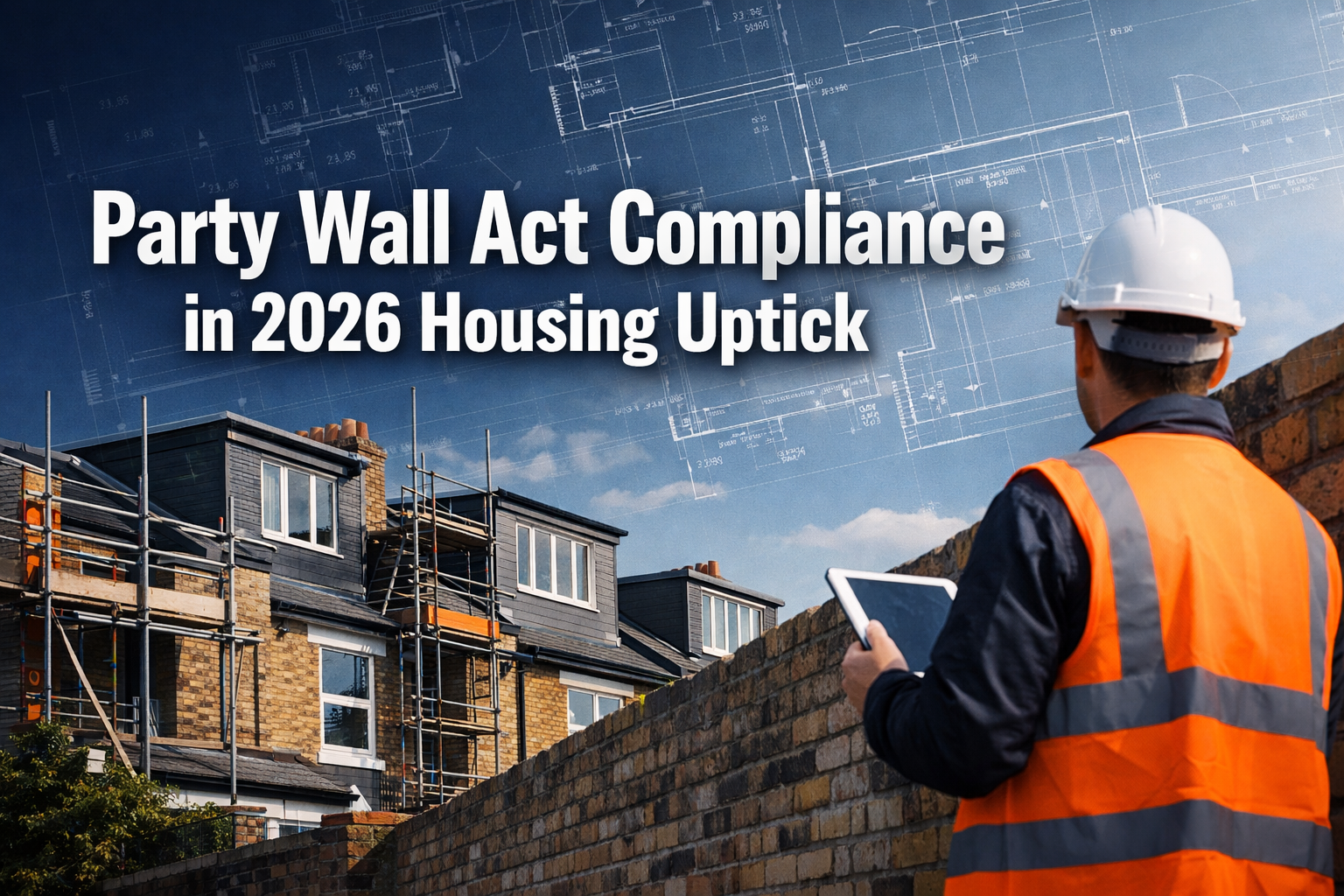

As the UK housing market shows renewed vitality in 2026, homeowners across England and Wales are seizing opportunities to enhance their properties through loft conversions and extensions. With buyer enquiries rising and sales expectations climbing according to RICS data, the property improvement sector is experiencing unprecedented demand. This surge brings a critical challenge for surveyors: managing the increasing volume of Party Wall Act compliance requirements that accompany these home renovation projects. Understanding Party Wall Act Compliance in 2026 Housing Uptick: Surveying Strategies for Surging Loft and Extension Projects has become essential for professionals navigating this recovering market.
The recovery creates a perfect storm of activity. Homeowners who postponed improvements during economic uncertainty are now proceeding with projects, while rising property values justify substantial investments in extensions and conversions. For surveyors, this means handling more party wall matters than ever before—each requiring meticulous attention to statutory timelines, neighbour relations, and documentation standards.
Key Takeaways
- 🏗️ Timeline Planning is Critical: The complete party wall process requires a minimum of 2-4 months from surveyor appointment through Award service, demanding immediate action after planning approval rather than waiting until construction starts
- 💰 Budget for Dual Surveyor Costs: Party wall agreement costs range from £750-£1,800 per surveyor per affected neighbour, with homeowners responsible for funding both their own surveyor and the neighbour's surveyor
- 📋 Schedule of Condition Protects All Parties: Comprehensive pre-work documentation of adjoining properties prevents disputes and establishes baseline evidence, particularly crucial when neighbours consent without appointing their own surveyor
- ⚖️ Neighbour Dissent Doesn't Stop Projects: Homeowners retain legal rights to proceed with approved work even when neighbours refuse consent, though dissent triggers formal Award processes and additional costs
- 📅 Notice Validity Extends One Year: Once served, party wall notices remain valid for twelve months, allowing strategic timing flexibility for project commencement
Understanding the Party Wall Act Framework in 2026
The Party Wall etc. Act 1996 remains the statutory foundation governing building work affecting shared walls, boundaries, and excavations near neighbouring properties. Despite being nearly three decades old, this legislation continues unchanged in 2026, applying exclusively to England and Wales[2]. What evolves annually are surveyor fees, dispute rates, and how individual London boroughs integrate party wall requirements with planning processes.
What Triggers Party Wall Compliance?
Three primary scenarios require party wall notices:
Building on or at a Boundary (Line of Junction Notice): Constructing new walls or extensions directly on the boundary line between properties requires two months' notice to neighbours[1].
Work on Existing Party Walls: Cutting into, raising, or underpinning shared walls demands one month's notice, even for seemingly minor alterations[1].
Excavation Near Foundations: Digging within three metres of a neighbour's structure (and deeper than their foundations) or within six metres (and below a 45-degree plane from their foundation base) triggers excavation notice requirements[1].
Importantly, the Act applies to Permitted Development projects that bypass planning permission. Even extensions proceeding under permitted development rights must comply with party wall legislation if they involve boundary construction, party wall alterations, or excavation near neighbouring foundations[1].
What Doesn't Require Party Wall Agreements?
Minor internal works remain exempt, providing practical relief for routine improvements. Plastering, electrical installations, and drilling internal walls for kitchen units or shelving do not trigger party wall requirements[2]. This exemption allows homeowners to proceed with cosmetic renovations without formal neighbour notification.
Party Wall Act Compliance in 2026 Housing Uptick: Notice Procedures and Timelines
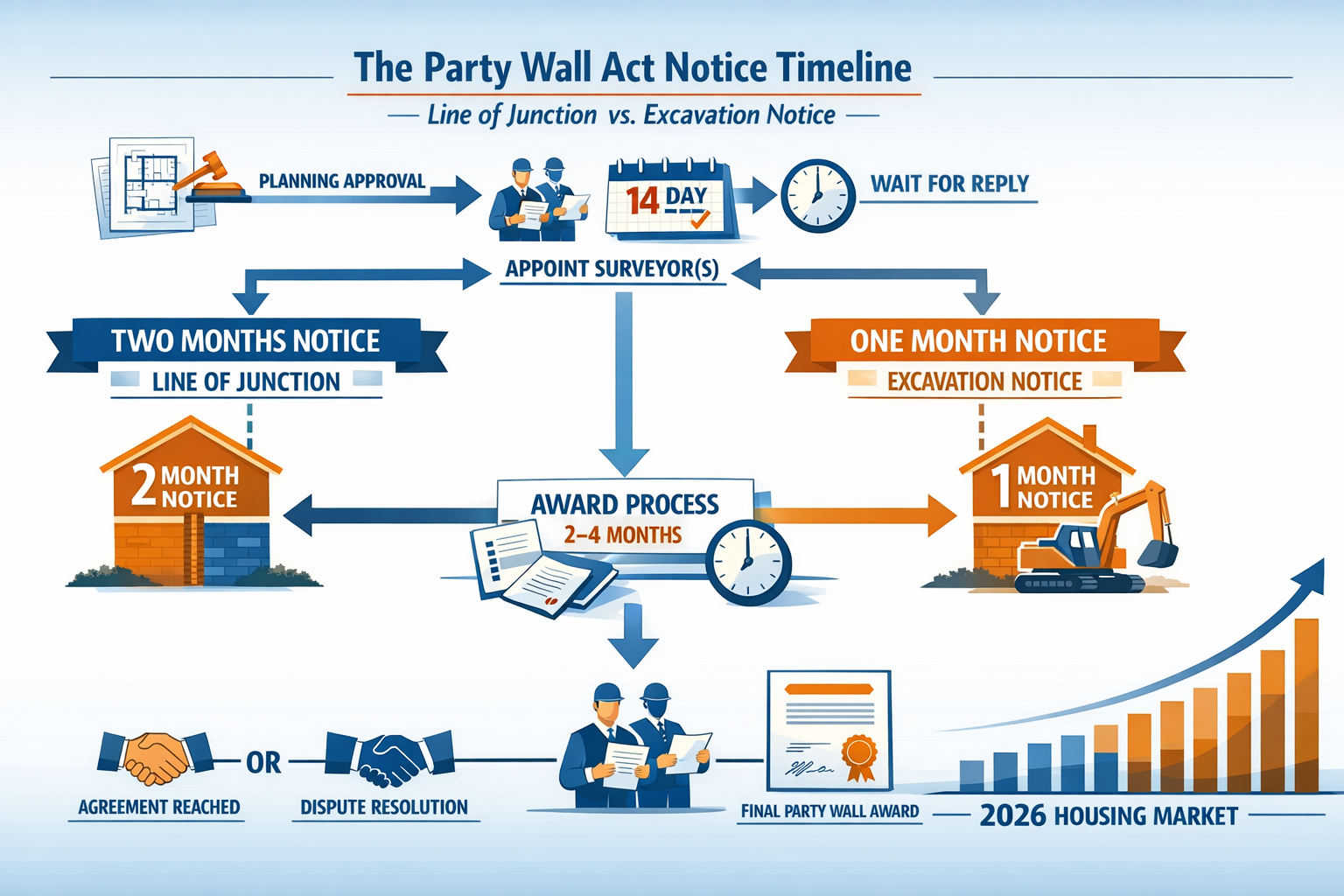
The statutory notice framework operates on strict timelines that surveyors must master to serve clients effectively during the 2026 housing uptick. Understanding these deadlines prevents project delays and ensures legal compliance.
Dual-Track Notice Periods
The Act establishes two distinct notice periods based on work type:
- Two Months' Notice: Required for Line of Junction notices when building new walls on or at boundaries
- One Month's Notice: Applies to work on existing party walls or excavation notices near neighbouring foundations[1]
These periods represent minimum statutory requirements. Savvy surveyors advise clients to serve notices immediately after securing planning approval rather than waiting until construction is scheduled to begin. This proactive approach accommodates the complete 2-4 month process from surveyor appointment through Award service[1].
The 14-Day Neighbour Response Window
Following notice service, neighbours have exactly 14 days to respond with either consent or dissent[1]. This statutory window creates three possible outcomes:
- Express Consent: Neighbour signs the notice, agreeing to the work
- Express Dissent: Neighbour formally objects, triggering the Award process
- Deemed Dissent: Silence after 14 days constitutes automatic dissent, allowing the homeowner to appoint a surveyor on the neighbour's behalf[1]
Understanding deemed dissent proves particularly valuable during high-volume periods. Rather than viewing neighbour silence as problematic, surveyors can proceed with appointments, maintaining project momentum.
Notice Validity and Project Flexibility
Once served, party wall notices remain valid for one year, providing substantial scheduling flexibility[2]. This extended validity allows homeowners to:
- Secure party wall agreements well in advance of actual construction
- Accommodate contractor availability fluctuations
- Adjust project timing based on market conditions
- Avoid re-serving notices if minor delays occur
For surveyors managing multiple clients during the 2026 uptick, this one-year validity enables strategic batching of notices and efficient resource allocation across projects.
Consequences of Failing to Serve Notice
The penalties for bypassing party wall procedures can devastate projects. Neighbours can apply for party wall injunctions to immediately halt work if proper notice hasn't been served[2]. Additionally, without an independent Schedule of Condition documenting pre-existing conditions, establishing which damage resulted from construction versus prior deterioration becomes nearly impossible, exposing homeowners to inflated damage claims.
Surveying Strategies for Loft Conversions in the 2026 Market
Loft conversions represent a significant portion of the 2026 housing uptick, offering homeowners cost-effective space expansion without extending property footprints. However, these projects frequently trigger party wall requirements, particularly in terraced and semi-detached properties where roof structures and party walls intersect.
Party Wall Considerations for Loft Projects
Loft conversions typically involve several party wall triggers:
- Raising Party Walls: Extending shared walls upward to accommodate increased headroom
- Cutting into Party Walls: Creating openings for staircases or structural beams
- Steel Beam Installation: Inserting structural support that penetrates or rests on party walls
- Roof Alterations: Modifying shared roof structures in terraced properties
Each element requires careful assessment to determine notice requirements and potential neighbour impacts.
The 3-Metre Rule and Excavation Notices
While loft conversions occur above ground, foundation work sometimes accompanies these projects. The 3-metre rule becomes relevant when underpinning or foundation strengthening is necessary. Surveyors must evaluate whether excavation occurs within three metres of a neighbour's structure and extends deeper than their foundations, triggering additional notice requirements[1].
Insulation and Party Wall Compliance
Modern loft conversions prioritize energy efficiency, often incorporating party wall insulation improvements. While adding insulation to one's own side of a party wall typically doesn't require notice, cutting into the wall to install cavity insulation or creating recesses for insulation boards does trigger compliance requirements. Surveyors must carefully distinguish between surface-applied improvements and invasive alterations.
Schedule of Condition: Essential Protection
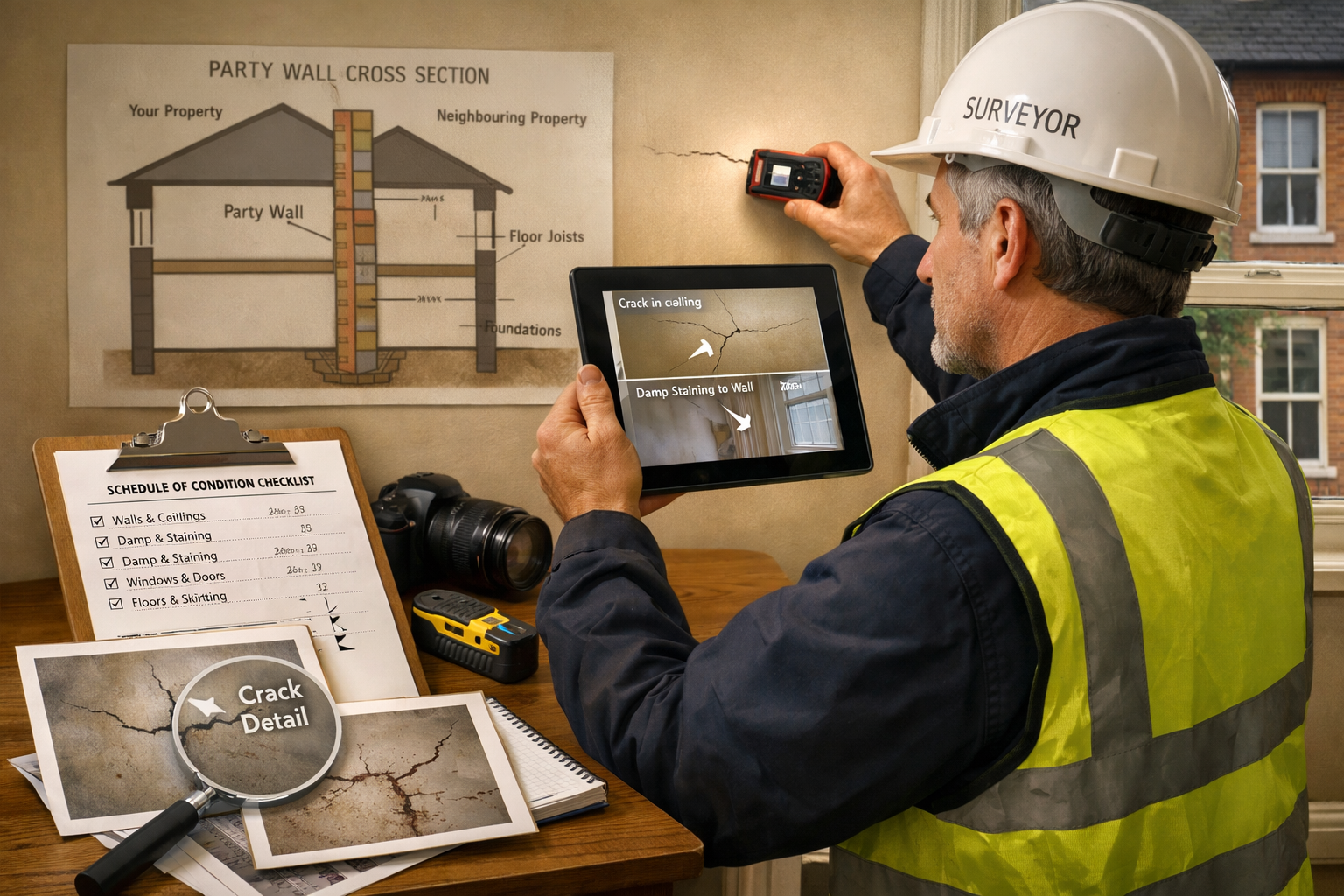
For loft conversions, comprehensive Schedule of Condition documentation proves invaluable. Surveyors should photograph and document:
- Ceiling conditions in neighbouring properties directly below the conversion area
- Wall plasterwork adjacent to shared walls being raised or altered
- Existing cracks in party walls or neighbouring structures
- External roof conditions visible from neighbouring properties
This evidence baseline protects both building owners and neighbours, establishing clear pre-work conditions that prevent disputes about construction-related damage versus pre-existing deterioration.
Extension Projects and Party Wall Act Compliance in 2026 Housing Uptick
Single-storey and two-storey extensions dominate the 2026 housing improvement landscape, driven by homeowners seeking additional living space without relocating. These projects present complex party wall scenarios requiring strategic surveying approaches.
Boundary Extensions and Line of Junction Notices
Extensions built directly on boundary lines require meticulous planning. The two-month Line of Junction notice period means surveyors must initiate the process significantly earlier than for party wall alterations[1]. Key considerations include:
- Foundation depth relative to neighbouring properties
- Wall height and potential overshadowing concerns
- Drainage and water runoff impacts on adjoining land
- Access requirements for construction from neighbouring property
Excavation Considerations for Extension Foundations
Extension foundations frequently trigger excavation notices. Surveyors must calculate whether digging occurs:
- Within three metres of a neighbour's structure and deeper than their foundations
- Within six metres and below a 45-degree plane extending from the neighbour's foundation base[1]
These geometric calculations determine whether additional notices beyond basic party wall notifications are necessary.
Managing Neighbour Relations During High-Volume Periods
The 2026 housing uptick means neighbours may receive multiple party wall notices simultaneously—for their own projects and from adjoining properties. Surveyors can differentiate their service by:
- Clear communication: Explaining processes in accessible language rather than statutory jargon
- Proactive updates: Keeping all parties informed throughout the Award process
- Realistic timelines: Setting accurate expectations about the 2-4 month minimum process duration[1]
- Professional documentation: Delivering comprehensive Schedules of Condition that demonstrate thoroughness
The Right to Proceed Despite Dissent
A critical principle that surveyors must communicate clearly: neighbour consent is not required to proceed with lawfully approved projects[1]. Even when neighbours refuse to sign or formally dissent, homeowners retain legal rights to advance their extensions. Dissent triggers the formal Award process and requires the property owner to fund the neighbour's surveyor costs, but it cannot stop legitimate development.
This principle becomes particularly important during market upturns when neighbour objections may stem from general construction fatigue rather than specific concerns about the proposed work.
Cost Considerations and Surveyor Fee Structures in 2026
Understanding cost structures enables surveyors to provide accurate client guidance and manage expectations during the 2026 housing uptick. Party wall surveyor costs remain a significant project expense that homeowners must budget for alongside construction costs.
Current Fee Ranges
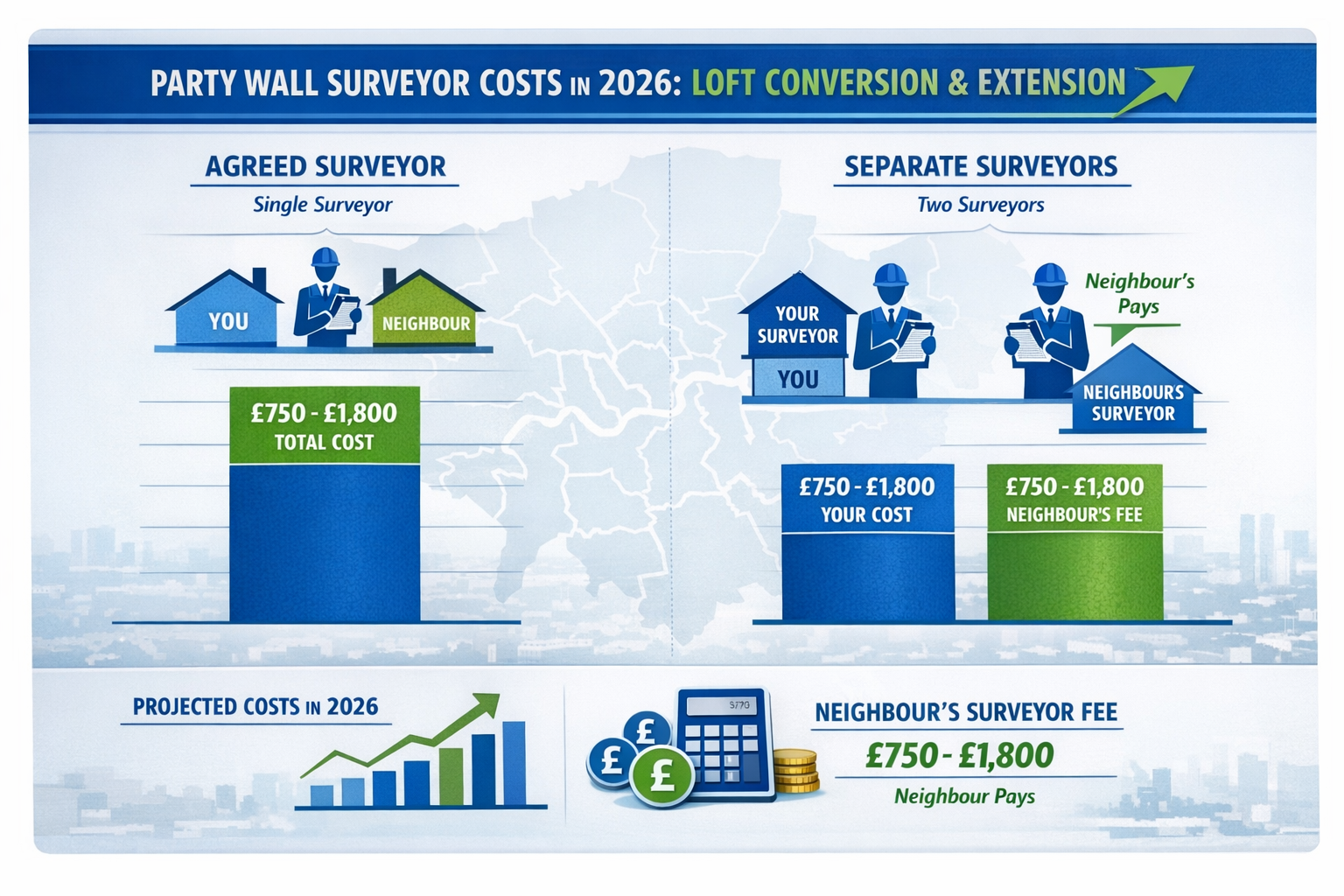
As of March 2026, party wall agreement costs in London range from £750 to £1,800 per surveyor per affected neighbour[1]. These fees have remained relatively stable compared to previous years, though individual surveyors may adjust rates based on project complexity and market demand.
The Dual Surveyor Cost Reality
A critical financial reality: homeowners must pay for both their own surveyor and the neighbour's surveyor[1]. This dual responsibility often surprises clients, making clear upfront communication essential. For a typical extension affecting two neighbouring properties, total surveyor costs could range from £3,000 to £7,200 (four surveyors at £750-£1,800 each).
Agreed Surveyor Arrangements
One cost-saving option involves appointing a single "agreed surveyor" acceptable to both parties. This arrangement reduces total costs by eliminating duplicate surveyor fees. However, it requires neighbour cooperation and may not be feasible when relationships are strained or neighbours prefer independent representation.
Fee Variables Affecting Costs
Several factors influence where specific projects fall within the £750-£1,800 range:
- Project complexity: Simple single-wall extensions cost less than multi-wall loft conversions
- Number of neighbours: Each affected neighbour requires separate surveyor appointments
- Dispute likelihood: Higher-risk situations command premium fees
- Geographic location: Central London typically exceeds outer borough rates
- Surveyor experience: Chartered surveyors with extensive party wall expertise may charge higher fees
Budget Planning for Clients
Surveyors should advise clients to budget party wall costs during initial project planning rather than treating them as afterthoughts. Recommended budget allocation:
- Surveyor fees: £750-£1,800 per surveyor × number of surveyors required
- Schedule of Condition: Often included in surveyor fees but may be separate
- Contingency: 20% additional for unexpected complications or disputes
- Timeline buffer: Account for the 2-4 month process in overall project scheduling[1]
Dispute Prevention and Resolution Strategies
The 2026 housing uptick increases dispute potential simply through volume—more projects mean more opportunities for disagreement. Proactive surveyors implement strategies that prevent conflicts before they escalate.
Pre-Notice Neighbour Engagement
While not statutorily required, informal pre-notice conversations often smooth the formal process. Surveyors can advise clients to:
- Explain project scope to neighbours before serving official notices
- Share architectural plans showing proposed work
- Address concerns about noise, access, or potential damage
- Establish communication channels for ongoing updates
This goodwill foundation reduces adversarial responses when formal notices arrive.
Comprehensive Schedule of Condition Documentation
The Schedule of Condition serves as the primary dispute prevention tool. Best practices include:
- Photographic evidence: High-resolution images of all potentially affected areas
- Written descriptions: Detailed notes accompanying each photograph
- Date stamping: Clear documentation of inspection timing
- Neighbour involvement: Inviting neighbours to participate in the inspection when possible
- Professional presentation: Organized reports that withstand scrutiny if disputes arise
Clear Award Documentation
Party Wall Awards should specify:
- Permitted work scope: Exact descriptions of authorized activities
- Working hours: Acceptable construction times
- Access rights: When and how building owners may access neighbouring property
- Damage remediation: Procedures for addressing construction-related damage
- Dispute resolution: Mechanisms for addressing disagreements during construction
Handling Deemed Dissent Situations
When neighbours fail to respond within 14 days, deemed dissent occurs[1]. Surveyors should:
- Document silence: Keep records of notice service and the 14-day period expiration
- Appoint on behalf: Exercise the right to appoint a surveyor for the non-responding neighbour
- Select appropriately: Choose qualified, impartial surveyors for neighbour representation
- Communicate appointment: Inform neighbours of the surveyor appointed on their behalf
- Proceed professionally: Maintain high standards despite neighbour non-engagement
When Disputes Escalate
Despite prevention efforts, some disputes require formal resolution. Resources include:
- Third surveyor appointment: Awards can specify a third surveyor to resolve disagreements between the two appointed surveyors
- Professional mediation: Alternative dispute resolution before legal proceedings
- Legal proceedings: Court intervention as a last resort for intractable conflicts
Understanding these escalation pathways helps surveyors guide clients through challenging situations while maintaining professional standards.
Technology and Efficiency in High-Volume Party Wall Surveying
The 2026 housing uptick demands operational efficiency from surveyors managing increased caseloads. Technology adoption separates high-performing practices from those struggling with volume.
Digital Documentation Systems
Modern surveying practices leverage:
- Cloud-based storage: Centralized access to Schedules of Condition, notices, and Awards
- Mobile inspection apps: On-site documentation using tablets with integrated photography and note-taking
- Template libraries: Standardized notice and Award templates that maintain consistency while reducing drafting time
- Client portals: Secure platforms where clients access documents and track progress
Drone Surveys for Roof and Elevation Documentation
Drone roof surveys provide comprehensive elevation documentation without scaffolding or access challenges. For loft conversions and two-storey extensions, drone photography captures:
- Existing roof conditions before work commences
- Party wall heights and configurations
- Neighbouring property elevations potentially affected by work
- Site context showing relationship between properties
Workflow Management for Multiple Concurrent Projects
Surveyors handling numerous party wall matters simultaneously require robust project management:
- Timeline tracking: Monitoring 14-day response windows, notice periods, and Award deadlines across multiple projects
- Automated reminders: System-generated alerts for critical dates and required actions
- Status dashboards: Visual overview of all active party wall matters and their stages
- Resource allocation: Efficient scheduling of site visits and inspections
Communication Platforms
Effective communication becomes challenging with high caseloads. Solutions include:
- Email automation: Templated updates for common scenarios (notice served, Award issued, etc.)
- Video consultations: Remote meetings reducing travel time while maintaining personal connection
- Secure messaging: Quick responses to client questions without phone tag
- Stakeholder portals: Centralized communication hubs for all parties (building owner, neighbours, contractors)
Regulatory Compliance and Professional Standards
Maintaining compliance with professional standards remains paramount during high-volume periods when time pressures intensify.
RICS Standards and Guidelines
Chartered surveyors must adhere to Royal Institution of Chartered Surveyors (RICS) standards governing party wall work. Key requirements include:
- Professional indemnity insurance: Adequate coverage for party wall surveying activities
- Continuing professional development: Ongoing education about legislative updates and best practices
- Conflict of interest management: Avoiding situations where impartiality could be compromised
- Fee transparency: Clear communication about costs before engagement
Independence and Impartiality
Party wall surveyors must maintain independence even when appointed and paid by one party. This principle ensures:
- Fair Awards: Balanced consideration of both parties' interests
- Professional credibility: Reputation protection essential for ongoing referrals
- Legal defensibility: Awards that withstand challenge if disputes escalate
- Ethical practice: Alignment with professional codes of conduct
Record Retention Requirements
Surveyors should maintain comprehensive records for:
- Statutory periods: Minimum retention aligned with limitation periods for legal claims
- Professional standards: RICS guidelines on document retention
- Client service: Availability of historical records if questions arise years later
- Dispute resolution: Evidence if past Awards become subjects of disagreement
Insurance Considerations
Professional indemnity insurance specifically covering party wall surveying protects against:
- Award challenges: Legal costs if Awards are disputed
- Negligence claims: Allegations of inadequate inspections or documentation
- Breach of duty: Claims of failing to protect client interests appropriately
- Financial losses: Compensation for damages resulting from surveying errors
Common Questions and Client Education
Educating clients about party wall processes reduces anxiety and improves project outcomes. Surveyors should proactively address common party wall questions before clients ask.
"Can My Neighbour Stop My Extension?"
No. Neighbours cannot prevent lawfully approved development. They can dissent to party wall notices, triggering the Award process, but this doesn't stop the project—it formalizes the process and requires the building owner to fund the neighbour's surveyor[1].
"What If My Neighbour Ignores the Notice?"
After 14 days of silence, deemed dissent occurs, allowing the building owner to appoint a surveyor on the neighbour's behalf[1]. This mechanism prevents neighbour inaction from blocking legitimate projects.
"Do I Need Party Wall Agreement for Permitted Development?"
Yes. The Party Wall Act applies regardless of whether planning permission is required. Permitted development projects involving boundary construction, party wall alterations, or excavation near foundations must comply with party wall legislation[1].
"How Long Does the Process Take?"
The complete process requires a minimum of 2-4 months from surveyor appointment through Award service[1]. Clients should initiate procedures immediately after planning approval rather than waiting until construction is scheduled to begin.
"What Happens If Damage Occurs During Construction?"
The Schedule of Condition provides baseline evidence. If damage occurs, the Award typically specifies remediation procedures. Building owners are responsible for repairing damage caused by their work, making comprehensive pre-work documentation essential[2].
"Can I Use the Same Surveyor as My Neighbour?"
Yes, through an "agreed surveyor" arrangement. This single surveyor represents both parties' interests, reducing costs. However, it requires mutual agreement and may not be appropriate when relationships are strained.
Future Outlook: Party Wall Surveying Beyond 2026
While the Party Wall Act itself remains unchanged since 1996, the practice of party wall surveying continues evolving. Looking beyond the immediate 2026 housing uptick, several trends merit attention.
Sustainability and Energy Efficiency Integration
Future party wall work will increasingly intersect with sustainability improvements:
- Retrofit insulation: Party wall insulation projects improving energy performance
- Solar installations: Roof work affecting shared structures
- Heat pump installations: Ground works triggering excavation notices
- Whole-house renovations: Comprehensive improvements involving multiple party wall triggers
Surveyors who understand both party wall legislation and sustainability technologies will command premium positioning.
Demographic Shifts and Housing Density
Urban densification continues, particularly in London and the South East. This trend increases:
- Terraced property conversions: More properties sharing party walls
- Vertical extensions: Upward expansion in constrained urban environments
- Basement excavations: Downward expansion triggering complex excavation notices
- Infill development: New construction on tight urban plots affecting multiple neighbours
Technology Adoption Acceleration
Digital transformation will continue reshaping surveying practices:
- Building Information Modeling (BIM): 3D models showing party wall relationships
- AI-assisted documentation: Automated Schedule of Condition generation from photographs
- Blockchain verification: Immutable records of notices and Awards
- Virtual reality inspections: Remote participation in condition surveys
Professional Specialization
As party wall work becomes more complex, specialization increases. Surveyors may focus on:
- High-value residential: Luxury property conversions with complex party wall scenarios
- Commercial developments: Large-scale projects affecting multiple properties
- Heritage properties: Listed buildings requiring specialized knowledge
- Dispute resolution: Expert witness work and third surveyor appointments
Conclusion
Party Wall Act Compliance in 2026 Housing Uptick: Surveying Strategies for Surging Loft and Extension Projects demands professional excellence, operational efficiency, and client-focused service. As the housing market recovers and homeowners invest in property improvements, surveyors play a critical role in facilitating these projects while protecting all parties' interests.
The fundamental principles remain constant: serve proper notices, maintain independence, document thoroughly, and communicate clearly. However, the 2026 market context—characterized by increased volume, compressed timelines, and heightened neighbour sensitivity—requires strategic adaptation.
Actionable Next Steps for Surveyors
- Streamline processes: Implement digital documentation systems and workflow management tools to handle increased caseloads efficiently
- Educate proactively: Develop client resources explaining the 2-4 month timeline and dual surveyor cost requirements upfront
- Invest in technology: Adopt drone surveys, mobile inspection apps, and cloud-based collaboration platforms
- Build referral networks: Establish relationships with architects, contractors, and planning consultants who can refer party wall work
- Maintain professional standards: Ensure RICS compliance, adequate insurance, and continuing professional development
- Prioritize Schedule of Condition quality: Comprehensive pre-work documentation prevents disputes and protects professional reputation
For Homeowners Planning Extensions or Loft Conversions
- Start early: Initiate party wall procedures immediately after planning approval, not when construction is scheduled to begin
- Budget appropriately: Allocate £750-£1,800 per surveyor × number of surveyors required, plus 20% contingency
- Engage neighbours proactively: Informal conversations before formal notices often smooth the process
- Choose qualified surveyors: Select experienced professionals with party wall specialization and RICS accreditation
- Understand your rights: Neighbour dissent doesn't stop lawful projects—it formalizes the process
- Document everything: Maintain records of all communications, notices, and agreements
The 2026 housing uptick presents both opportunity and challenge. Surveyors who combine statutory compliance with strategic efficiency, technological adoption, and exceptional client service will thrive in this dynamic market. The Party Wall Act framework, though unchanged since 1996, continues providing the essential structure that enables neighbours to coexist while pursuing legitimate property improvements.
By mastering the surveying strategies outlined in this guide—from notice timing and cost management to dispute prevention and technology integration—professionals can deliver outstanding service during this period of surging demand. The result benefits everyone: homeowners achieve their improvement goals, neighbours receive appropriate protection, and surveyors build sustainable practices positioned for long-term success.
For comprehensive support with party wall matters, including loft conversions, extensions, and boundary disputes, professional chartered surveyors provide the expertise necessary to navigate the 2026 housing market's opportunities while maintaining full statutory compliance.
References
[1] Party Wall Agreement London 2026 – https://www.mayfairstudio.co.uk/blog/party-wall-agreement-london-2026
[2] Party Wall Agreement – https://hoa.org.uk/advice/guides-for-homeowners/i-am-improving/party-wall-agreement/
[3] What London Property Developers Need To Know About The Party Wall Act Before They Break Ground – https://dailybusinessgroup.co.uk/2026/02/what-london-property-developers-need-to-know-about-the-party-wall-act-before-they-break-ground/