
Party Wall Agreed Surveyor: Your Complete Guide for 2025
When planning construction work that affects a shared wall with your neighbor, the decision to appoint a party wall agreed surveyor can save thousands of pounds and prevent months of unnecessary conflict. This single appointment, accepted by both property owners, streamlines the entire party wall process while ensuring legal compliance and protecting everyone’s interests.
Understanding how a party wall agreed surveyor works represents one of the most important decisions you’ll make during your building project. Whether you’re planning a loft conversion, basement excavation, or extension in London or Surrey, this comprehensive guide explains everything you need to know about agreed surveyors and how they can benefit your project.
Key Takeaways
- 🤝 A party wall agreed surveyor is a single professional appointed by both the building owner and adjoining owner to oversee party wall matters, reducing costs and complexity
- 💰 Using an agreed surveyor typically costs 40-60% less than appointing separate surveyors for each party
- ⚖️ Agreed surveyors must remain impartial and act in the interests of both property owners equally under the Party Wall Act 1996
- 📋 The agreed surveyor produces a single Party Wall Award that is legally binding on both parties
- ✅ Both neighbors must consent in writing to the appointment of an agreed surveyor for this arrangement to proceed
What Is a Party Wall Agreed Surveyor?
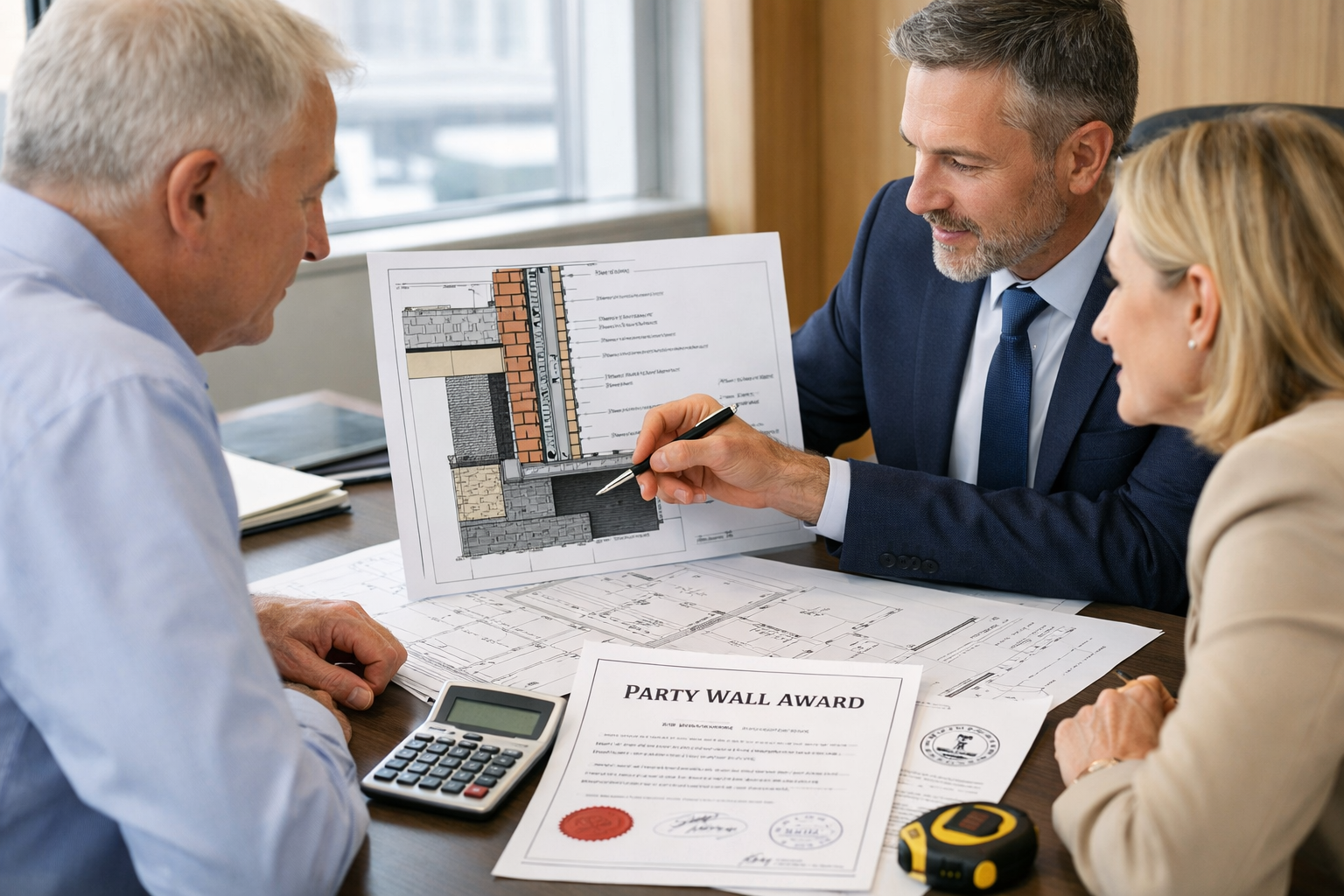
A party wall agreed surveyor is a qualified professional appointed jointly by both the building owner (the person carrying out the work) and the adjoining owner (the neighbor) to administer matters arising under the Party Wall etc. Act 1996. This single surveyor acts impartially for both parties, inspecting properties, assessing proposed works, and producing a legally binding Party Wall Award that protects everyone’s interests.
Unlike the alternative arrangement where each party appoints their own surveyor, the agreed surveyor model creates a streamlined process with one professional managing the entire procedure. This individual must be completely neutral, applying the same rigorous standards they would use if representing either party separately.
The Legal Framework Behind Agreed Surveyors
The Party Wall etc. Act 1996 specifically provides for the appointment of an agreed surveyor as one of three possible routes for resolving party wall matters. Section 10 of the Act outlines that when a party wall notice is served, the adjoining owner has 14 days to either:
- Consent to the proposed works in writing
- Dissent and trigger the dispute resolution process
- Agree to appoint a single surveyor with the building owner
When both parties select the agreed surveyor route, they effectively choose efficiency and cost-effectiveness while maintaining full legal protection. The agreed surveyor holds exactly the same powers and responsibilities as two separate surveyors would have, ensuring the process remains thorough and compliant.
How a Party Wall Agreed Surveyor Differs from Separate Surveyors
Understanding the distinction between an agreed surveyor and the separate surveyor model helps property owners make informed decisions about their party wall matters.
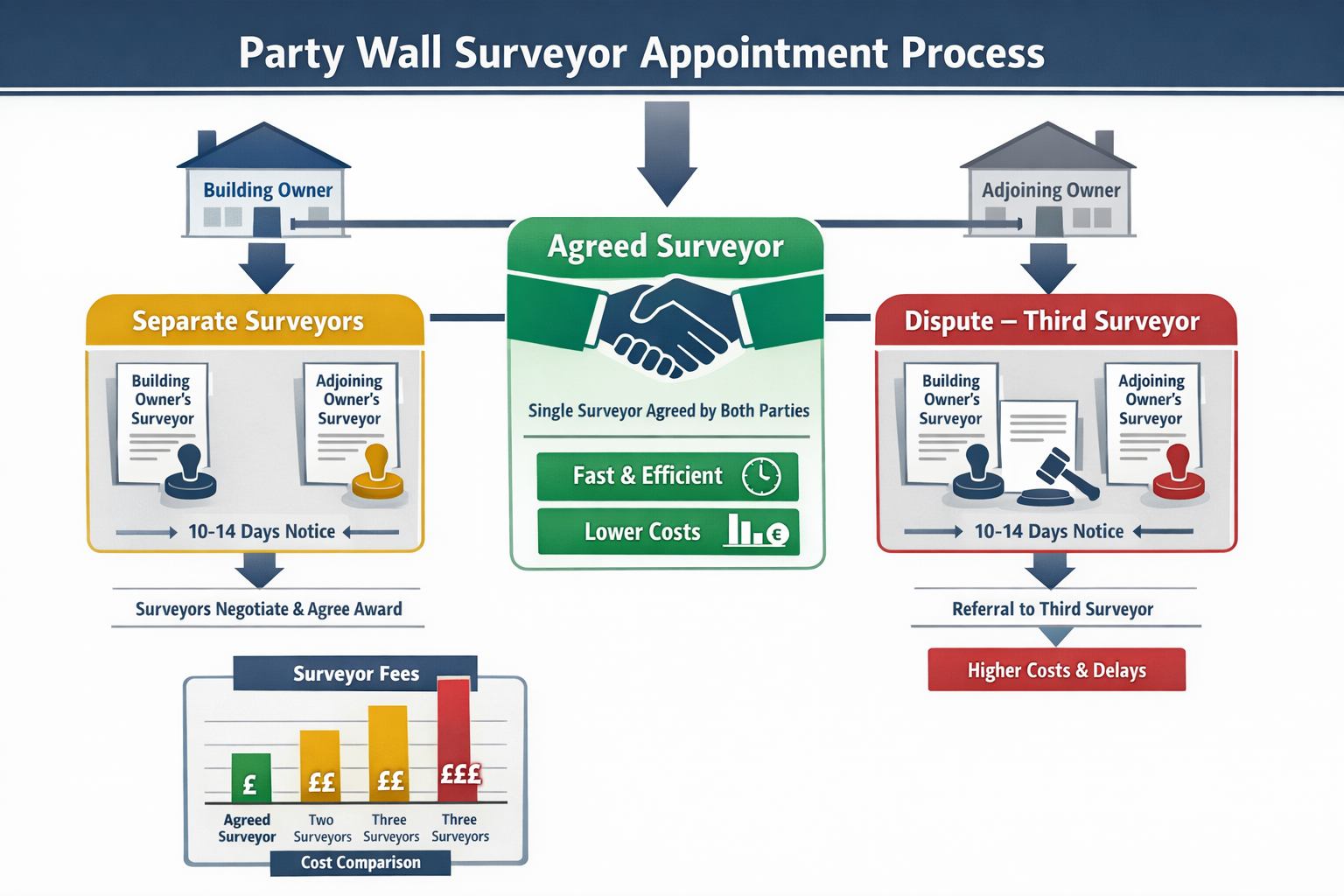
The Agreed Surveyor Model
In this arrangement:
- One professional handles the entire process
- Both parties jointly appoint and instruct the surveyor
- Single fee structure is shared between the parties (though typically paid by the building owner)
- One Award is produced covering all necessary provisions
- Faster timeline due to streamlined communication
- Lower overall costs compared to dual appointments
The Separate Surveyor Model
Alternatively, when each party appoints their own surveyor:
- Two professionals work independently
- Each surveyor represents their appointing owner’s interests
- Two separate fees are charged (both typically paid by the building owner)
- Joint Award requires agreement between both surveyors
- Third surveyor may be needed if the two cannot agree
- Higher costs due to multiple professional fees
| Feature | Agreed Surveyor | Separate Surveyors |
|---|---|---|
| Number of Professionals | 1 | 2 (potentially 3) |
| Typical Cost | £800-£1,500 | £2,000-£4,000+ |
| Timeline | 4-6 weeks | 6-10 weeks |
| Complexity | Lower | Higher |
| Impartiality | Required by law | Each represents their client |
| Award Production | Single document | Joint document requiring agreement |
When Should You Use a Party Wall Agreed Surveyor?
The agreed surveyor route works exceptionally well in specific circumstances. Recognizing when this approach suits your situation helps ensure a smooth party wall process.
Ideal Scenarios for Agreed Surveyors
Amicable Neighbor Relations 🤝
When you maintain a positive relationship with your neighbor and both parties trust the same professional, an agreed surveyor represents the most efficient choice. This approach reinforces cooperation and demonstrates mutual respect.
Straightforward Building Projects
For standard domestic works like loft conversions, single-story extensions, or minor structural alterations, an agreed surveyor can efficiently handle the assessment and documentation without the complexity of dual appointments.
Cost-Conscious Projects
Property owners working within tight budgets benefit significantly from the agreed surveyor model. The cost savings—often £1,000-£2,500—can be redirected toward the actual construction work.
Time-Sensitive Developments
When project timelines are critical, the streamlined communication and decision-making of a single surveyor accelerates the party wall process considerably. For those seeking guidance on party wall agreements, this efficiency proves invaluable.
When Separate Surveyors May Be Preferable
Complex or Contentious Projects
Large-scale developments, deep basement excavations, or projects with significant structural implications may warrant separate representation. Each party having dedicated advocacy ensures thorough scrutiny of complex technical matters.
Pre-existing Disputes
If party wall disputes already exist or neighbor relations are strained, separate surveyors provide independent representation that can help rebuild trust through formal processes.
Significant Property Value Differences
When adjoining properties have vastly different values or conditions, separate surveyors ensure each owner’s specific concerns receive dedicated attention.
Previous Damage Concerns
If the adjoining owner has experienced damage to property in party wall situations before, they may prefer independent representation to ensure comprehensive protection.
The Appointment Process for a Party Wall Agreed Surveyor
Appointing an agreed surveyor follows a specific sequence that ensures legal compliance while maintaining fairness for all parties involved.
Step 1: Serve the Party Wall Notice
The building owner must first serve appropriate notice under the Party Wall Act. Depending on the work type, this could be:
- Line of Junction Notice (for new walls on boundaries)
- Party Structure Notice (for work to existing party walls)
- Notice of Adjacent Excavation (for excavations within 3 or 6 meters of neighboring structures)
Understanding the Party Wall Act 3 metre rule helps determine which notice applies to excavation work. Professional chartered surveyors in London can guide you through this critical first step.
Step 2: Neighbor Response Period
The adjoining owner has 14 days from receiving the notice to respond. During this period, they should:
- Review the proposed works carefully
- Consider the implications for their property
- Decide whether to consent or dissent
- If dissenting, consider whether an agreed surveyor suits their needs
Step 3: Mutual Agreement on Surveyor Selection
Both parties must agree in writing to appoint the same surveyor. This agreement should specify:
- The surveyor’s name and qualifications
- Their professional address and contact details
- Confirmation that both parties jointly appoint them
- Acknowledgment of their impartial role
Important: The building owner cannot unilaterally impose an agreed surveyor. The adjoining owner must genuinely consent to the appointment, and they have every right to appoint their own surveyor instead.
Step 4: Formal Appointment Documentation
The agreed surveyor should provide both parties with:
- Terms of engagement outlining their scope of work
- Fee estimate showing anticipated costs
- Timeline for completing the Award
- Confirmation of their impartiality and professional qualifications
Step 5: Surveyor’s Assessment and Award Preparation
Once appointed, the agreed surveyor will:
- Inspect both properties to establish their condition
- Review architectural plans and structural calculations
- Assess the proposed works against Party Wall Act requirements
- Prepare a Schedule of Condition documenting the adjoining property
- Draft the Party Wall Award including all necessary provisions
- Serve the Award on both parties
The Award becomes legally binding 14 days after service, unless either party appeals to the County Court.
Essential Qualifications and Qualities of a Party Wall Agreed Surveyor
Selecting the right professional requires understanding what qualifications and characteristics define an effective party wall agreed surveyor.
Professional Qualifications
Chartered Status ✅
Look for surveyors who are members of the Royal Institution of Chartered Surveyors (RICS). This membership indicates adherence to professional standards and ongoing education requirements. Chartered surveyors in Surrey and across the UK maintain these high standards.
Specialist Experience
Party wall work requires specific expertise beyond general surveying. The ideal agreed surveyor should have:
- Extensive experience with the Party Wall Act 1996
- Track record of producing Awards that withstand scrutiny
- Understanding of construction methods and structural engineering
- Knowledge of local building practices and regulations
Professional Indemnity Insurance
Comprehensive insurance coverage protects both parties if errors occur during the surveyor’s work. Verify that coverage extends specifically to party wall matters.
Critical Personal Qualities
Impartiality and Independence ⚖️
An agreed surveyor must demonstrate absolute neutrality. They cannot favor either party or allow personal relationships to influence their professional judgment. This impartiality forms the cornerstone of the agreed surveyor model.
Communication Skills
Effective agreed surveyors explain complex technical matters in accessible language. They keep both parties informed throughout the process and respond promptly to queries.
Attention to Detail
Party Wall Awards must be precise and comprehensive. The surveyor should meticulously document existing conditions, specify work parameters, and include all necessary protective provisions.
Problem-Solving Ability
When concerns arise during the process, skilled agreed surveyors find practical solutions that satisfy legal requirements while accommodating both parties’ legitimate interests.
Local Knowledge
Familiarity with local building practices, ground conditions, and typical property construction proves invaluable. Surveyors working in specific areas like chartered surveyors in Richmond or chartered surveyors in Kingston bring this essential local expertise.
Cost Implications of Using a Party Wall Agreed Surveyor
Understanding the financial aspects of the agreed surveyor model helps property owners budget accurately and appreciate the cost benefits this approach offers.
Typical Fee Structures
Standard Agreed Surveyor Fees (2025)
- Simple projects (minor alterations, single-story extensions): £800-£1,200
- Moderate complexity (loft conversions, two-story extensions): £1,200-£1,800
- Complex projects (basement excavations, significant structural work): £1,800-£2,500+
These fees typically cover:
- Initial consultations with both parties
- Site inspections and condition surveys
- Review of architectural and structural documents
- Preparation and service of the Party Wall Award
- Reasonable correspondence during the process
Cost Comparison: Agreed vs. Separate Surveyors
Agreed Surveyor Total Cost: £1,200 (example)
Separate Surveyors Total Cost:
- Building owner’s surveyor: £1,500
- Adjoining owner’s surveyor: £1,200
- Third surveyor (if needed): £800-£1,500
- Total: £2,700-£4,200
Potential Savings: £1,500-£3,000 (56-71% reduction)
Who Pays the Surveyor Fees?
Under the Party Wall Act, the building owner (the person carrying out the work) typically bears all reasonable costs associated with the party wall process. This includes:
- The agreed surveyor’s fees
- Any specialist reports required (structural engineers, etc.)
- Reasonable expenses incurred during the process
However, if the adjoining owner causes unreasonable delays or requests unnecessary additional work, they may be required to cover those specific costs.
Additional Costs to Consider
Schedule of Condition
Professional photographic documentation of the adjoining property typically costs £200-£400 and provides crucial evidence of pre-work condition.
Monitoring Fees
If the Award requires ongoing inspections during construction, additional fees may apply (typically £150-£300 per visit).
Dispute Resolution
Should either party appeal the Award to the County Court, legal costs can escalate significantly (£2,000-£10,000+), making the initial agreed surveyor investment even more valuable.
The Party Wall Award: What an Agreed Surveyor Produces
The Party Wall Award represents the formal legal document that an agreed surveyor creates to govern the building work and protect both properties.
Essential Components of a Party Wall Award
1. Description of the Works 📋
Detailed specification of all proposed work affecting the party wall or adjacent structures, referencing architectural drawings and structural calculations.
2. Time and Manner of Execution
Specific provisions about when work can occur, access arrangements, and construction methods to minimize disruption and risk.
3. Schedule of Condition
Comprehensive photographic and written record of the adjoining owner’s property before work commences, establishing baseline condition for any future damage claims.
4. Rights of Access
Clear terms for when and how the building owner and contractors can access the adjoining property for necessary inspections or work.
5. Special Foundations Protection
For excavation work, provisions ensuring the adjoining property’s foundations remain supported and undamaged.
6. Security for Expenses
In some cases, requirements for the building owner to provide financial security (deposit or bond) to cover potential damage repairs.
7. Dispute Resolution Mechanisms
Procedures for addressing disagreements that arise during the work, including provisions for additional inspections or expert opinions.
Legal Status and Enforceability
Once served on both parties, the Award becomes legally binding after 14 days (the appeal period). Both owners must comply with its terms, and failure to do so can result in:
- Injunctions to stop non-compliant work
- Court orders requiring compliance
- Financial penalties and cost awards
- Liability for damages caused by non-compliance
The Award remains in effect for the duration specified (typically the construction period plus a reasonable monitoring period, often 12 months post-completion).
Common Misconceptions About Party Wall Agreed Surveyors
Several myths surround the agreed surveyor model. Clarifying these misconceptions helps property owners make informed decisions.
Myth 1: “Agreed Surveyors Favor the Building Owner”
Reality: Professional agreed surveyors maintain strict impartiality. Their RICS membership and professional reputation depend on treating both parties fairly. Any bias would constitute professional misconduct and could result in disciplinary action.
Myth 2: “You Must Accept the Building Owner’s Suggested Surveyor”
Reality: The adjoining owner has absolute right to appoint their own surveyor. The “agreed surveyor” arrangement only proceeds if both parties genuinely consent. No one can be forced into this model.
Myth 3: “Agreed Surveyors Produce Less Thorough Awards”
Reality: The Award produced by an agreed surveyor must meet exactly the same legal standards as one produced by separate surveyors. The thoroughness depends on the individual surveyor’s competence, not the appointment model.
Myth 4: “Using an Agreed Surveyor Means Giving Up Your Rights”
Reality: Both parties retain full legal protection under the Party Wall Act regardless of whether they use an agreed surveyor or separate surveyors. The Act’s provisions apply equally in both scenarios.
Myth 5: “Agreed Surveyors Are Only for Small Projects”
Reality: While agreed surveyors work particularly well for straightforward projects, experienced professionals successfully handle complex developments including substantial basement excavations and major structural alterations.
Regional Considerations: Party Wall Agreed Surveyors Across London and Surrey
Geographic location influences party wall matters in several important ways, making local expertise particularly valuable.
Urban Density and Party Wall Frequency
In densely built areas like Central London, Battersea, and Chelsea, terraced and semi-detached properties predominate. This architectural character means party wall procedures apply to the vast majority of building projects.
Agreed surveyors familiar with these areas understand:
- Typical construction methods used in Victorian, Edwardian, and Georgian properties
- Common structural issues affecting older buildings
- Local authority requirements and planning considerations
- Neighbor expectations and communication preferences
Suburban and Semi-Rural Variations
In areas like Surrey, Berkshire, and Buckinghamshire, properties often have more space between them, but party wall procedures still apply to:
- Semi-detached properties sharing a party wall
- Boundary wall construction or repair
- Excavations near neighboring foundations
- Work to shared garden walls
Surveyors practicing in these regions bring different expertise regarding:
- Larger plot boundaries and access considerations
- Different soil conditions and foundation types
- Rural building traditions and materials
- Longer-established neighbor relationships
Choosing a Locally-Based Agreed Surveyor
Selecting a surveyor with specific geographic expertise offers several advantages:
✅ Faster site visits and reduced travel costs
✅ Knowledge of local building styles and common issues
✅ Established relationships with local contractors and authorities
✅ Understanding of area-specific property values and concerns
✅ Familiarity with local dispute resolution practices
Whether you’re in West London, South West London, or Hertfordshire, finding a surveyor with local presence ensures they understand your specific context.
How to Find and Select the Right Party Wall Agreed Surveyor
Choosing the appropriate professional requires systematic evaluation and due diligence.
Research and Shortlisting
1. Professional Body Directories
Start with the RICS Find a Surveyor service, which lists qualified professionals by location and specialty. Filter for party wall expertise specifically.
2. Local Recommendations
Ask neighbors who have recently completed building work about their experiences. Architects and builders often work regularly with party wall surveyors and can provide informed recommendations.
3. Online Research
Review surveyor websites for evidence of party wall specialization, client testimonials, and published expertise. Look for firms like Kingston Surveyors that demonstrate comprehensive party wall knowledge.
4. Professional Networks
The Pyramus & Thisbe Club (the party wall surveyors’ professional association) maintains a directory of specialist practitioners.
Evaluation Criteria
When comparing potential agreed surveyors, assess:
Experience Level 📊
- How many party wall Awards have they produced?
- What types of projects have they handled?
- Do they have experience with your specific work type?
Response Quality
- How quickly do they respond to initial inquiries?
- Do they explain the process clearly?
- Are they willing to answer questions thoroughly?
Fee Transparency
- Do they provide clear, written fee estimates?
- Are there any hidden costs or additional charges?
- What does their fee include and exclude?
Availability
- Can they accommodate your project timeline?
- How many other projects are they currently handling?
- Will they personally handle your matter or delegate to junior staff?
References
- Can they provide references from recent clients?
- Do they have testimonials from both building and adjoining owners?
- What do previous clients say about their impartiality?
Interview Questions to Ask
Before appointing an agreed surveyor, consider asking:
- “How many party wall Awards have you prepared in the past year?”
- “What is your typical timeline from appointment to Award service?”
- “Have any of your Awards been appealed, and what were the outcomes?”
- “How do you ensure impartiality when acting as an agreed surveyor?”
- “What happens if one party becomes dissatisfied during the process?”
- “Do you carry professional indemnity insurance, and what is the coverage level?”
- “Will you personally handle this matter, or will it be assigned to a colleague?”
Red Flags to Avoid
Be cautious of surveyors who:
- ❌ Suggest they can “speed up” the process by cutting corners
- ❌ Seem to favor the building owner’s position during initial discussions
- ❌ Cannot provide clear examples of previous party wall work
- ❌ Offer suspiciously low fees that may indicate inexperience
- ❌ Lack proper professional qualifications or insurance
- ❌ Have poor communication skills or delayed responses
The Agreed Surveyor Process: Timeline and Milestones
Understanding the typical timeline helps property owners plan their building projects effectively.
Phase 1: Notice and Appointment (Weeks 1-3)
Week 1
- Building owner serves party wall notice
- Adjoining owner receives and reviews notice
- Initial discussions about surveyor appointment begin
Weeks 2-3
- Both parties agree on agreed surveyor selection
- Surveyor provides terms of engagement
- Formal appointment documentation completed
Phase 2: Assessment and Documentation (Weeks 4-6)
Week 4
- Agreed surveyor conducts initial site visits to both properties
- Reviews architectural plans and structural calculations
- Identifies any concerns or additional information needed
Week 5
- Schedule of Condition prepared for adjoining property
- Detailed photographic and written documentation completed
- Technical review of proposed construction methods
Week 6
- Surveyor addresses any technical queries
- Correspondence with both parties regarding specific provisions
- Draft Award preparation begins
Phase 3: Award Preparation and Service (Weeks 7-8)
Week 7
- Draft Party Wall Award completed
- Internal review and quality assurance
- Final checks against Party Wall Act requirements
Week 8
- Award formally served on both parties
- 14-day appeal period commences
- Surveyor available to answer questions about Award terms
Phase 4: Appeal Period and Finalization (Weeks 9-10)
Weeks 9-10
- Both parties review Award terms
- Any appeals must be lodged with County Court within 14 days
- If no appeals, Award becomes binding and work can proceed
Total Timeline: 8-10 Weeks
This represents a typical timeline for straightforward projects. Complex developments may require additional time for:
- Specialist structural engineer reports
- Extended negotiations over specific provisions
- Additional site investigations
- Resolution of technical queries
Comparison: Using separate surveyors typically extends this timeline by 2-4 weeks due to coordination requirements and potential disagreements requiring third surveyor involvement.
Party Wall Agreed Surveyors and Specific Building Projects
Different types of construction work present unique party wall considerations that agreed surveyors must address.
Loft Conversions
Loft conversions frequently require party wall procedures when:
- The party wall extends into the roof space
- New steel beams bear on the party wall
- Chimney breasts on the party wall require removal
- The conversion affects the structural loading on shared walls
Agreed Surveyor Considerations:
- Assessing increased load on party structures
- Ensuring adequate sound insulation between properties
- Protecting against vibration damage during construction
- Verifying that new structural elements don’t compromise the party wall
Basement Excavations
Basement work represents one of the most technically challenging party wall scenarios, requiring careful assessment of:
- Foundation depth relative to adjoining properties
- Underpinning requirements and methodologies
- Ground movement risks and monitoring protocols
- Temporary support systems during excavation
Agreed Surveyor Responsibilities:
- Specifying appropriate foundation protection measures
- Requiring structural engineer calculations
- Establishing monitoring regimes for ground movement
- Setting clear limits on excavation methods and sequences
Understanding the party wall excavation notice requirements proves essential for these projects.
Extensions and Structural Alterations
Single or multi-story extensions commonly affect party walls through:
- New foundations near the boundary
- Structural connections to existing party walls
- Removal of chimney breasts or other party wall elements
- Installation of new openings or alterations to party structures
Agreed Surveyor Focus Areas:
- Ensuring new foundations don’t undermine adjoining property
- Specifying appropriate damp-proof courses and weatherproofing
- Protecting against damage during demolition work
- Verifying compliance with building regulations
Boundary Walls and Fencing
Construction or repair of boundary walls triggers party wall procedures when:
- Building a new wall astride the boundary line
- Raising the height of an existing party wall
- Repairing or rebuilding a damaged party fence wall
- Excavating for wall foundations near the boundary
Agreed Surveyor Considerations:
- Determining fair cost allocation for shared benefit works
- Ensuring wall design suits both properties’ needs
- Addressing aesthetic concerns and material choices
- Clarifying future maintenance responsibilities
Potential Challenges and How Agreed Surveyors Address Them
Even with an agreed surveyor, certain challenges may arise during the party wall process. Understanding these scenarios and their resolutions helps set realistic expectations.
Challenge 1: Mid-Process Disagreement
Scenario: After appointing an agreed surveyor, one party becomes concerned that the surveyor favors the other party’s interests.
Resolution:
- The concerned party can request a meeting with the surveyor to discuss specific concerns
- The surveyor should provide clear explanations of their reasoning and demonstrate impartiality
- If concerns persist, the party can exercise their right to appoint their own surveyor, converting the process to the separate surveyor model
- The Party Wall Act allows this conversion at any point before the Award is served
Challenge 2: Scope Creep and Additional Work
Scenario: During the project, the building owner proposes additional work not covered in the original notice.
Resolution:
- The agreed surveyor assesses whether new work falls within the original Award scope
- If new work requires party wall procedures, additional notices must be served
- The existing agreed surveyor can continue if both parties consent
- Supplementary Awards may be prepared covering the additional work
Challenge 3: Construction Damage Disputes
Scenario: The adjoining owner claims the building work has caused damage to their property.
Resolution:
- The agreed surveyor inspects the alleged damage and compares it to the Schedule of Condition
- They determine whether damage resulted from the party wall work or other causes
- If damage is work-related, the surveyor specifies appropriate remedial work
- The building owner must arrange and fund necessary repairs
- If parties disagree on causation, independent expert assessment may be required
Challenge 4: Contractor Non-Compliance
Scenario: The building owner’s contractors fail to follow the Award provisions.
Resolution:
- Either party can notify the agreed surveyor of non-compliance
- The surveyor contacts the building owner to require immediate compliance
- If non-compliance continues, the adjoining owner may seek injunctive relief
- The building owner remains legally responsible for ensuring contractor compliance
Challenge 5: Access Refusal
Scenario: The adjoining owner refuses access granted in the Award for necessary inspections.
Resolution:
- The agreed surveyor reminds the adjoining owner of their legal obligations under the Award
- Reasonable notice and timing should be provided for access requests
- If refusal continues, the building owner may seek court enforcement
- The Award’s access provisions are legally binding on both parties
The Future of Party Wall Agreed Surveyors in 2025 and Beyond
The party wall surveying profession continues to evolve, with several trends shaping how agreed surveyors operate in 2025.
Technology Integration
Digital Documentation 💻
Modern agreed surveyors increasingly use:
- Tablet-based condition surveys with instant photo uploads
- 3D scanning technology for precise property documentation
- Digital Award preparation and electronic service
- Cloud-based client portals for document sharing
These technologies improve accuracy, reduce timelines, and enhance transparency for both parties.
Virtual Inspections
While physical site visits remain essential, supplementary virtual inspections via video calls help:
- Address minor queries without scheduling delays
- Involve parties who cannot attend in-person meetings
- Provide remote monitoring during construction phases
- Reduce overall costs and environmental impact
Regulatory Developments
Potential Act Amendments
Industry discussions continue regarding possible Party Wall Act reforms, including:
- Clarification of notice requirements for certain work types
- Enhanced consumer protection provisions
- Streamlined dispute resolution mechanisms
- Updated fee recovery provisions
Agreed surveyors must stay informed about legislative changes that could affect their practice and client obligations.
Professional Standards Evolution
Enhanced Competency Requirements
RICS continues developing specialized party wall competency frameworks, requiring:
- Demonstrated expertise through case studies and examinations
- Continuing professional development in party wall matters
- Higher insurance coverage levels for complex projects
- Peer review and quality assurance processes
These developments raise professional standards while ensuring agreed surveyors maintain the expertise necessary for effective impartial service.
Market Trends
Increased Basement Development
London’s constrained development opportunities drive continued basement excavation growth, increasing demand for experienced party wall surveyors who understand complex foundation issues.
Sustainability Considerations
Party wall work increasingly involves:
- Retrofit insulation affecting party walls
- Solar panel installations requiring structural assessment
- Heat pump installations with vibration implications
- Energy efficiency upgrades to shared structures
Agreed surveyors must develop expertise in these emerging areas while maintaining traditional party wall knowledge.
Maximizing the Benefits of Your Party Wall Agreed Surveyor
Property owners can take specific actions to ensure they receive maximum value from the agreed surveyor model.
For Building Owners
1. Early Engagement 🎯
Contact potential agreed surveyors during project planning, not after serving notices. Early involvement allows:
- Preliminary assessment of party wall implications
- Identification of potential issues before design finalization
- More accurate project timeline and budget development
- Opportunity to address neighbor concerns proactively
2. Complete Documentation
Provide your agreed surveyor with:
- Comprehensive architectural drawings showing all party wall work
- Structural engineer calculations for load-bearing alterations
- Construction methodology statements
- Contractor contact information and credentials
3. Transparent Communication
Keep your agreed surveyor informed about:
- Any project changes affecting party walls
- Construction timeline updates
- Contractor changes or issues
- Neighbor communications or concerns
4. Contractor Briefing
Ensure your contractors:
- Receive and understand the Party Wall Award
- Know the agreed surveyor’s contact details
- Understand their obligations regarding access and compliance
- Report any issues or deviations immediately
For Adjoining Owners
1. Thorough Notice Review 📄
When receiving a party wall notice:
- Read it carefully and identify all proposed work
- Ask questions about anything unclear
- Consider the work’s potential impact on your property
- Respond within the 14-day period
2. Property Documentation
Before agreeing to an agreed surveyor:
- Photograph your property’s current condition yourself
- Note any existing cracks, damage, or concerns
- Document valuable or delicate items near the party wall
- Keep records of any previous party wall issues
3. Active Participation
During the agreed surveyor process:
- Attend site inspections and ask questions
- Review the Schedule of Condition thoroughly
- Raise any concerns about proposed work methods
- Request clarification of any Award provisions you don’t understand
4. Monitoring During Construction
While work proceeds:
- Periodically check for new cracks or damage
- Document any concerns with dated photographs
- Report issues to the agreed surveyor promptly
- Maintain communication records
Conclusion: Making the Right Choice for Your Party Wall Matters
The decision to appoint a party wall agreed surveyor represents a strategic choice that can significantly impact your building project’s cost, timeline, and neighbor relations. When both property owners trust the same qualified professional to act impartially, the agreed surveyor model delivers substantial benefits including reduced costs, faster timelines, and simplified communication.
However, this approach requires genuine mutual consent and works best when neighbor relations are positive and projects are relatively straightforward. Property owners should never feel pressured into the agreed surveyor model if they have concerns about impartiality or prefer independent representation.
Key Decision Factors
✅ Choose an agreed surveyor when:
- You maintain good relations with your neighbor
- Both parties trust the same professional
- The project is relatively straightforward
- Cost efficiency is important
- Timeline matters significantly
❌ Consider separate surveyors when:
- Pre-existing disputes or tensions exist
- The project is highly complex or contentious
- Significant property value differences exist
- Either party prefers independent representation
- Previous damage concerns require dedicated advocacy
Your Next Steps
1. Assess Your Situation
Evaluate your neighbor relationship, project complexity, and budget constraints to determine which surveyor model suits your circumstances.
2. Engage Early
Contact qualified party wall surveyors during project planning, not after issues arise. Early professional guidance prevents problems and ensures compliance.
3. Research Thoroughly
Investigate potential agreed surveyors’ qualifications, experience, and reputation. Request references and verify professional credentials.
4. Communicate Openly
Discuss the agreed surveyor option with your neighbor honestly. Mutual understanding and genuine consent form the foundation of successful agreed surveyor appointments.
5. Seek Expert Guidance
For personalized advice on your specific party wall situation, consult with experienced professionals who understand both the legal requirements and practical realities of party wall work. Kingston Surveyors offers comprehensive party wall services throughout London and Surrey, helping property owners navigate these complex matters with confidence.
The party wall process need not be adversarial or prohibitively expensive. With the right agreed surveyor, both property owners can achieve their objectives while maintaining positive neighbor relations and full legal protection. By understanding how party wall agreed surveyors work, their benefits and limitations, and how to select the right professional, you’re well-equipped to make informed decisions that serve your project’s success and your neighbor’s legitimate interests.
Whether you’re planning a loft conversion in Putney, a basement excavation in Hampstead, or an extension in Guildford, understanding your party wall obligations and options ensures your building project proceeds smoothly, legally, and with minimal conflict.