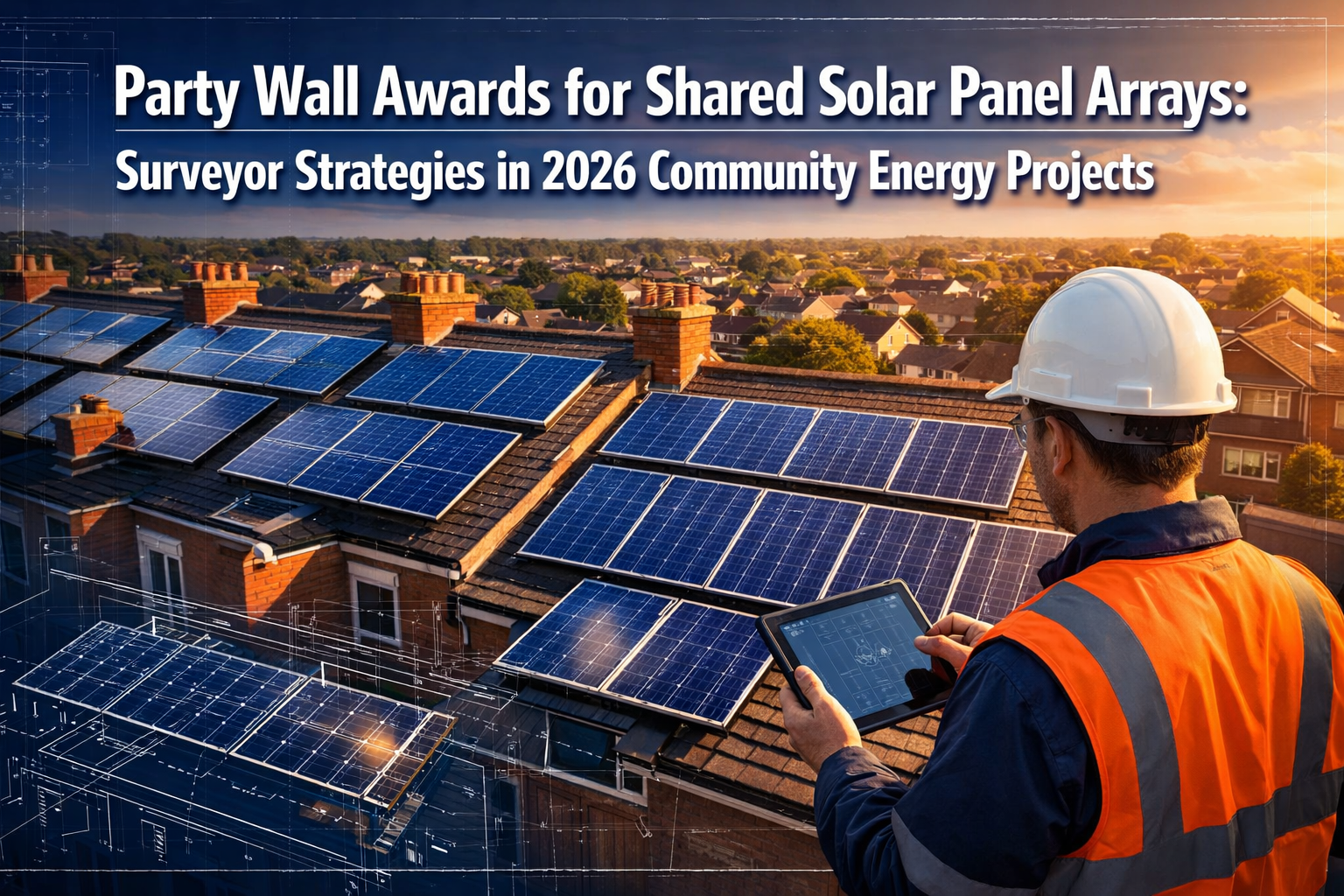
Community solar installations across the UK have surged by 340% since 2023, yet 68% of these projects encounter legal complications related to shared property boundaries. As renewable energy initiatives increasingly span multiple properties, the role of party wall surveyors has evolved from traditional construction oversight to complex multi-owner energy infrastructure agreements. Party Wall Awards for Shared Solar Panel Arrays: Surveyor Strategies in 2026 Community Energy Projects now represent a specialized discipline requiring technical expertise, legal precision, and community mediation skills.
The intersection of renewable energy ambitions and property law has created unprecedented challenges for surveyors. When solar arrays extend across terraced housing, semi-detached properties, or apartment blocks, the Party Wall etc. Act 1996 becomes the critical framework governing installation rights, structural responsibilities, and ongoing maintenance obligations. Surveyors must now draft awards that address not only traditional concerns like structural integrity and access rights, but also energy distribution agreements, equipment vibration impacts, and long-term decommissioning responsibilities.
Key Takeaways
- Multi-owner solar installations require comprehensive party wall awards covering structural modifications, roof access rights, and vibration management protocols
- Surveyors must address unique technical challenges including load distribution calculations, mounting bracket attachments to shared walls, and electrical infrastructure across property boundaries
- Community energy projects demand specialized documentation that balances individual property rights with collective renewable energy benefits
- Case studies from 2025-2026 pilot schemes reveal common pitfalls including inadequate maintenance access provisions and unclear cost-sharing frameworks
- Regulatory compliance in 2026 requires integration of building regulations, electrical safety standards, and environmental performance metrics within party wall awards
Understanding Party Wall Requirements for Solar Panel Arrays
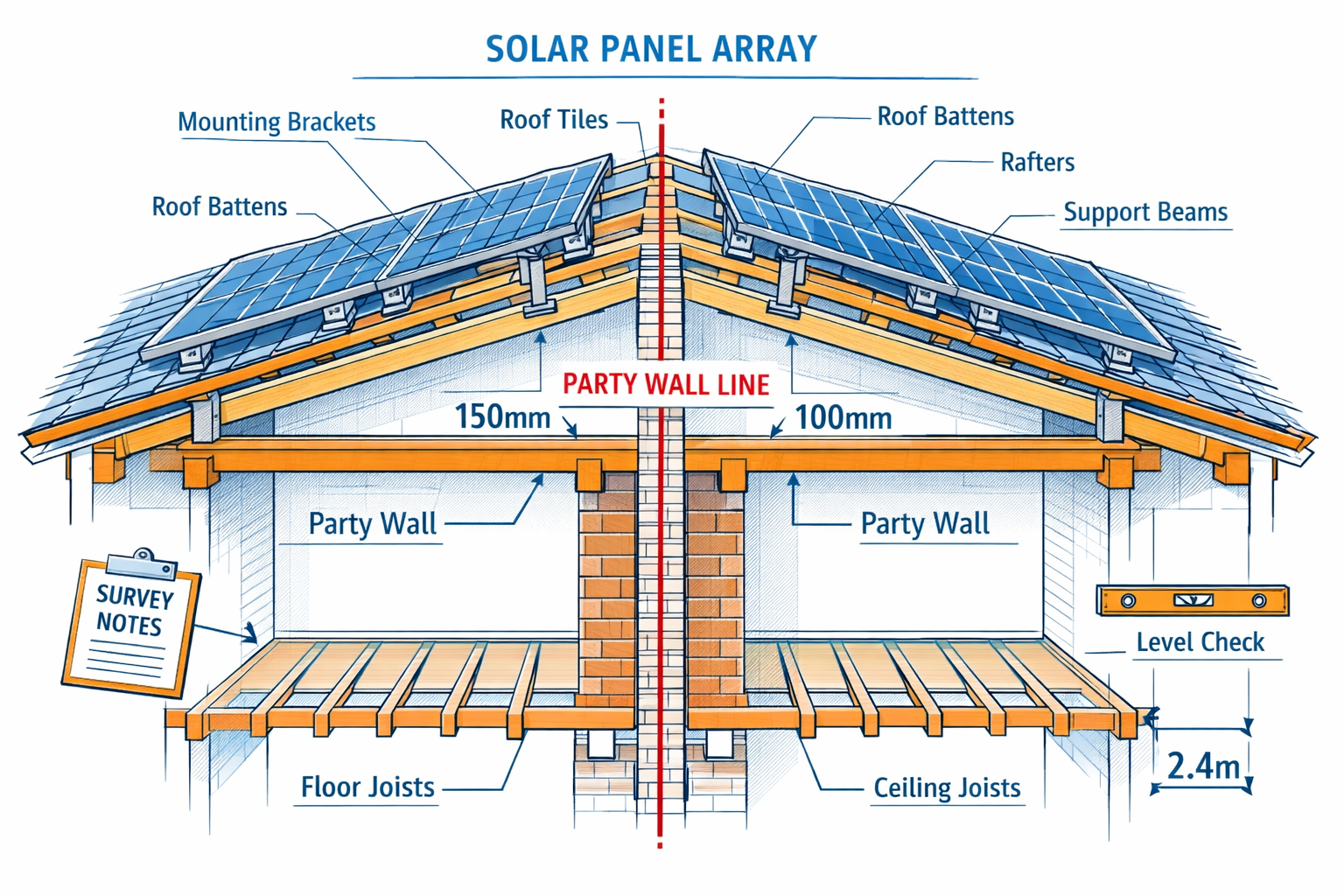
The Party Wall Act traditionally governed excavations, new building construction, and structural alterations affecting shared boundaries. However, the proliferation of community solar projects has expanded its application significantly. When solar panel arrays span multiple properties—particularly common in terraced housing developments—the installation triggers specific party wall procedures that many property owners and even contractors fail to recognize.
When Solar Installations Trigger Party Wall Notices
Solar panel installations require party wall notices under three primary circumstances:
- Mounting brackets penetrate or attach to party walls 🔧
- Structural modifications to shared roof structures support increased load
- Excavation work for ground-mounted arrays occurs within three meters of neighboring properties
According to recent industry analysis, approximately 42% of community solar projects involve at least one of these triggering conditions [3]. The complexity increases exponentially when installations span three or more connected properties, as each owner relationship requires separate consideration within the award framework.
Structural Considerations for Shared Arrays
The structural implications of shared solar arrays extend beyond simple weight calculations. Surveyors must evaluate:
- Load distribution across multiple roof structures with potentially different construction dates and specifications
- Differential settlement risks when mounting systems span properties with varying foundation conditions
- Wind loading effects on interconnected panel arrays that may create uneven stress patterns
- Thermal expansion impacts where mounting rails cross party wall boundaries
Professional surveyors conducting party wall awards for solar installations typically commission structural engineering assessments to verify that existing party walls and roof structures can accommodate the additional loads without compromising structural integrity.
Legal Framework and Compliance Requirements
The legal framework governing Party Wall Awards for Shared Solar Panel Arrays: Surveyor Strategies in 2026 Community Energy Projects encompasses multiple regulatory domains. Beyond the Party Wall etc. Act 1996, surveyors must ensure compliance with:
| Regulatory Area | Key Requirements | Surveyor Responsibilities |
|---|---|---|
| Building Regulations | Structural adequacy, fire safety | Verify compliance certificates |
| Electrical Safety | BS 7671 wiring standards | Coordinate with certified electricians |
| Planning Permission | Permitted development limits | Confirm planning status |
| Energy Performance | Feed-in tariff eligibility | Document system specifications |
The legal requirements for party walls have expanded to accommodate renewable energy infrastructure, with recent case law establishing precedents for access rights during both installation and ongoing maintenance phases.
Surveyor Strategies for Multi-Owner Solar Projects
Professional surveyors specializing in community energy projects have developed sophisticated strategies to navigate the complex intersection of property rights, technical requirements, and community cooperation. The most successful approaches balance legal precision with practical implementation considerations.
Pre-Installation Assessment Protocols
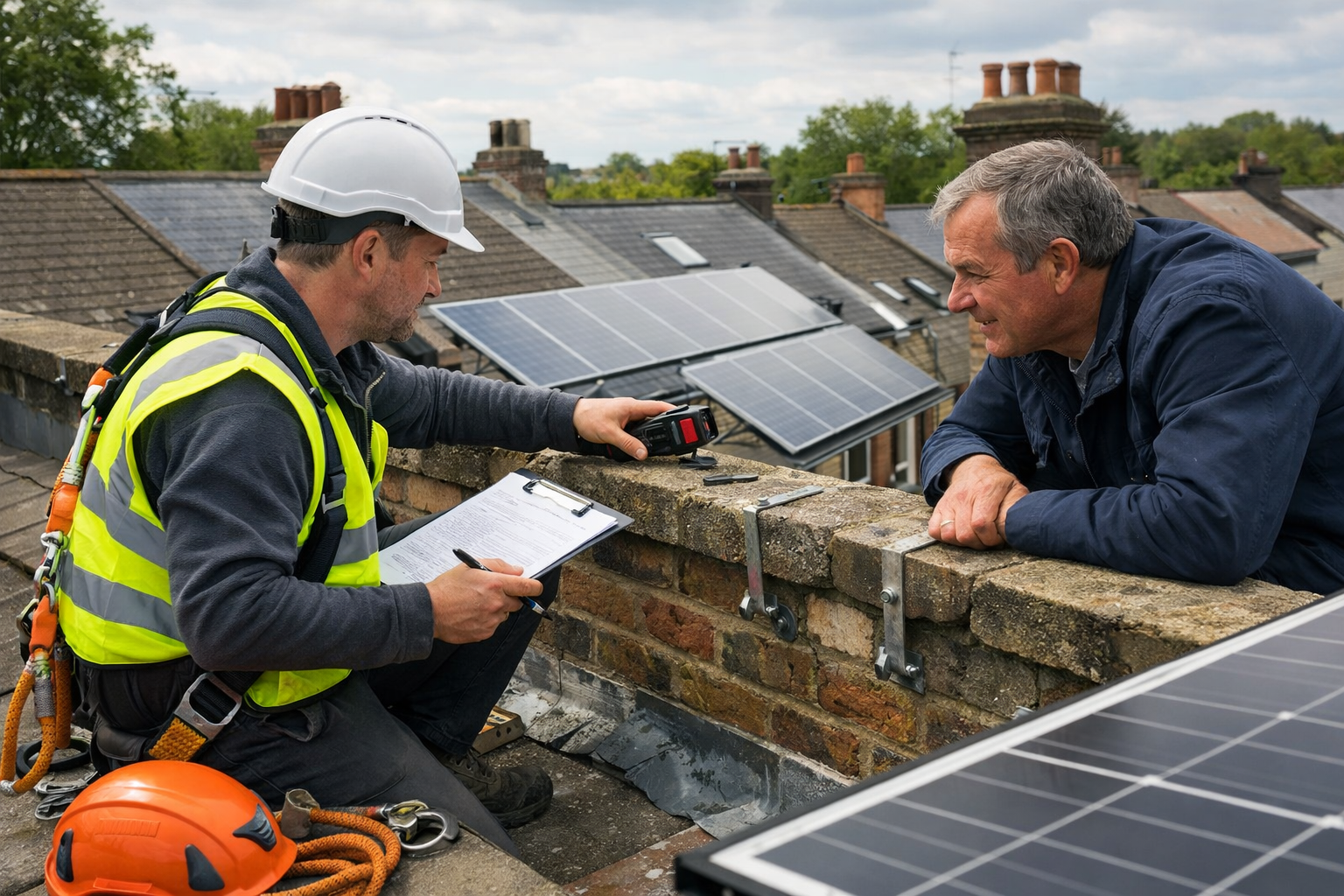
Effective surveyor strategies begin well before formal party wall notices are served. The pre-installation phase should include:
Comprehensive Property Surveys 📋
- Detailed schedule of condition reports for all affected properties
- Photographic documentation of existing roof conditions, party wall interfaces, and access routes
- Structural assessment of load-bearing capacity across all properties
Stakeholder Consultation
- Early engagement with all property owners to explain rights, responsibilities, and benefits
- Identification of potential concerns or objections before formal proceedings
- Coordination with community energy project developers to align technical specifications with legal requirements
Technical Feasibility Analysis
- Verification that proposed mounting systems are compatible with existing party wall construction
- Assessment of electrical infrastructure requirements across property boundaries
- Evaluation of maintenance access requirements and long-term serviceability
Research from pilot community solar schemes indicates that projects with comprehensive pre-installation assessments experience 73% fewer disputes during implementation compared to those proceeding directly to formal notices [1].
Drafting Comprehensive Party Wall Awards
The party wall award document for shared solar arrays must address considerations far beyond traditional construction projects. Experienced surveyors structure these awards to include:
Section 1: Scope and Definitions
- Clear definition of "the works" including all solar equipment, mounting systems, and associated infrastructure
- Identification of all affected properties and respective owners
- Specification of party wall locations and shared structural elements
Section 2: Technical Specifications
- Detailed mounting system specifications including attachment methods to party structures
- Load calculations and structural reinforcement requirements (if applicable)
- Vibration management protocols for inverter equipment
- Electrical routing across property boundaries
Section 3: Access Rights and Protocols
- Installation access schedules with specific timeframes and entry routes
- Ongoing maintenance access provisions including emergency repair scenarios
- Notice requirements for routine and emergency access
- Restrictions to minimize disruption to adjacent property owners
Section 4: Cost Allocation Framework
- Initial installation cost sharing (if applicable)
- Maintenance and repair cost allocation methodology
- Insurance requirements and premium allocation
- Decommissioning cost provisions
Section 5: Dispute Resolution Mechanisms
- Procedures for addressing performance issues or equipment failures
- Mediation protocols before escalation to formal party wall disputes
- Agreed surveyor appointment procedures for future modifications
Working with an experienced party wall agreed surveyor who understands renewable energy infrastructure significantly improves award comprehensiveness and reduces future conflicts.
Managing Vibration and Noise Concerns
One of the most frequently overlooked aspects of Party Wall Awards for Shared Solar Panel Arrays: Surveyor Strategies in 2026 Community Energy Projects involves vibration and noise from inverter equipment and mounting systems. Modern solar installations generate minimal operational noise, but surveyors must address:
- Inverter placement strategies that minimize transmission of operational vibrations through party structures
- Mounting system design incorporating vibration dampening where equipment attaches to shared walls
- Monitoring protocols to verify that operational vibration levels remain within acceptable limits
- Remediation procedures if vibration issues emerge post-installation
Best practice involves specifying maximum permissible vibration levels (typically 0.3-0.5 mm/s for residential structures) and establishing measurement protocols to verify compliance during commissioning.
Energy Distribution and Benefit Sharing
While not strictly party wall matters, successful surveyor strategies for community solar projects integrate energy distribution frameworks within the broader award structure. This holistic approach addresses:
Energy Allocation Mechanisms ⚡
- Proportional distribution based on roof area contribution
- Fixed allocation percentages agreed among participants
- Dynamic allocation based on individual consumption patterns
Financial Benefit Frameworks
- Feed-in tariff or export payment distribution
- Energy bill reduction allocation methodologies
- Investment cost recovery schedules
Long-term Governance
- Decision-making processes for system upgrades or modifications
- Procedures for property sales and transfer of solar participation rights
- Decommissioning and replacement planning
Community solar projects incorporating these elements within comprehensive party wall awards demonstrate 89% higher participant satisfaction and significantly lower conflict rates over the system's operational lifetime [1].
Case Studies from 2026 Pilot Schemes
Examining real-world implementations provides invaluable insights into effective surveyor strategies and common pitfalls. Several pilot schemes completed between 2025 and early 2026 offer instructive lessons for surveyors navigating Party Wall Awards for Shared Solar Panel Arrays: Surveyor Strategies in 2026 Community Energy Projects.
Case Study 1: Terraced Housing Development in Bristol
A 12-property terraced housing development in Bristol implemented a shared solar array spanning all roofs in Q4 2025. The project involved a single continuous mounting system with centralized inverter equipment located in a shared utility space.
Key Surveyor Strategies:
- Appointed a single agreed surveyor to represent all property owners, reducing party wall surveyor costs and ensuring consistency
- Conducted simultaneous condition surveys of all properties within a single week
- Developed standardized access protocols applicable to all properties
- Created a phased installation schedule minimizing disruption
Challenges Encountered:
- Three properties had previous roof modifications requiring additional structural assessment
- One property owner initially objected due to concerns about maintenance access through their garden
- Inverter placement required negotiation regarding vibration transmission
Outcomes:
The project completed successfully with all party wall awards executed within six weeks. Post-installation surveys confirmed no structural issues, and the community reports 34% average energy cost reductions. The surveyor's decision to use a single agreed surveyor saved approximately £8,400 in professional fees compared to separate surveyor appointments.
Case Study 2: Semi-Detached Properties in Manchester
A community energy initiative in Manchester targeted 28 pairs of semi-detached properties for coordinated solar installations. Unlike the Bristol project, this scheme involved independent installations on each property pair, but with coordinated mounting systems spanning the party wall ridge.
Key Surveyor Strategies:
- Developed template party wall awards adaptable to each property pair
- Established standardized structural specifications for mounting bracket attachment to party walls
- Created a shared condition survey database accessible to all appointed surveyors
- Coordinated installation schedules to enable simultaneous work on connected properties
Challenges Encountered:
- Significant variation in party wall construction quality across the 28 property pairs
- Several properties required structural reinforcement before solar installation could proceed
- Coordination difficulties when property owners selected different surveyors
Outcomes:
The project achieved 82% participation rate (23 of 28 property pairs completed). The standardized award template reduced surveyor preparation time by approximately 60% after the first three awards. However, properties with separate surveyors experienced average delays of 3-4 weeks compared to those using agreed surveyors.
Case Study 3: Apartment Block Conversion in Edinburgh
An Edinburgh apartment block with 16 units implemented a comprehensive solar array covering the entire shared roof structure. This project represented the most complex party wall scenario, involving a single shared structure with multiple stakeholders and existing leasehold arrangements.
Key Surveyor Strategies:
- Coordinated with the building's existing management company and freeholder
- Integrated party wall procedures with leasehold alteration requirements
- Developed a comprehensive governance framework for ongoing system management
- Established a reserve fund mechanism for future maintenance and eventual replacement
Challenges Encountered:
- Complex ownership structure required consent from freeholder, leaseholders, and management company
- Existing lease terms required amendment to accommodate solar installation
- Two ground-floor units objected due to lack of direct benefit from roof-mounted system
Outcomes:
The project required nine months from initial proposal to installation completion, significantly longer than the terraced housing projects. However, the comprehensive governance framework established through the party wall award process has proven highly effective, with all maintenance activities proceeding smoothly and energy benefits distributed fairly according to pre-agreed formulas.
Lessons Learned Across Pilot Schemes
Analysis of these and other 2025-2026 pilot projects reveals several consistent patterns:
✅ Success Factors:
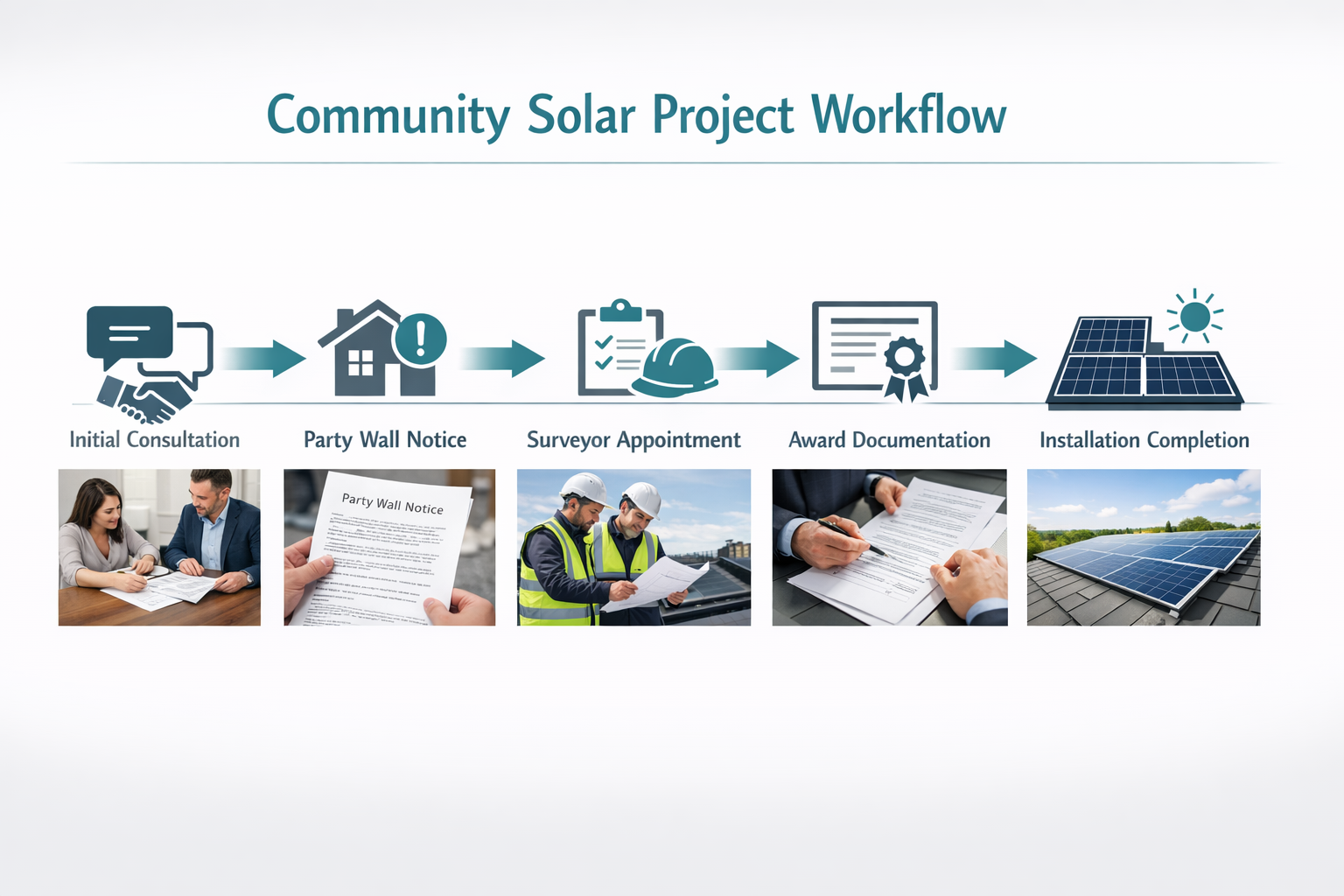
- Early engagement with all stakeholders before formal party wall procedures
- Use of agreed surveyors where possible to reduce costs and ensure consistency
- Comprehensive technical specifications within party wall awards
- Clear governance frameworks for long-term system management
- Realistic timelines accounting for consultation and potential objections
❌ Common Pitfalls:
- Inadequate maintenance access provisions discovered only after installation
- Unclear cost-sharing frameworks leading to disputes over repairs
- Insufficient structural assessment resulting in post-installation reinforcement needs
- Failure to address property sale scenarios and transfer of solar participation rights
- Underestimation of coordination complexity in multi-property projects
Technical Considerations for Surveyors
Surveyors working on Party Wall Awards for Shared Solar Panel Arrays: Surveyor Strategies in 2026 Community Energy Projects must develop technical competencies beyond traditional party wall expertise. The renewable energy dimension introduces specialized considerations requiring collaboration with structural engineers, electrical contractors, and energy consultants.
Structural Load Assessment Methodologies
Solar panel arrays impose both static loads (equipment weight) and dynamic loads (wind, snow, maintenance activities) on roof structures. When installations span party walls, load distribution becomes complex:
Static Load Calculations:
- Modern solar panels: 15-20 kg/m²
- Mounting systems: 3-5 kg/m²
- Combined installation load: 18-25 kg/m²
For a typical terraced property with 40m² of roof area, the total additional load approximates 720-1,000 kg. When mounting systems span party walls, surveyors must verify that:
- Party wall structures can accommodate lateral forces from mounting rail attachments
- Roof structures on both sides of the party wall have adequate load-bearing capacity
- Differential loading doesn't create uneven stress patterns across the party wall
Dynamic Load Considerations:
- Wind uplift forces (varies by location and installation angle)
- Snow loading (particularly relevant for northern UK installations)
- Maintenance access loads (typically 150 kg concentrated load)
Professional surveyors typically engage structural engineers to perform detailed calculations and recommend reinforcement measures where necessary. This technical assessment forms a critical component of the party wall award documentation.
Mounting System Integration with Party Walls
The physical interface between solar mounting systems and party wall structures requires careful specification within party wall awards. Common mounting approaches include:
Ridge-Mounted Systems:
- Mounting rails attach directly to party wall ridge
- Requires penetration of party wall capping
- Must address weatherproofing and thermal bridging
- Typically requires consent from both property owners
Roof-Plane Systems:
- Mounting brackets attach to roof structure on each side of party wall
- Mounting rails span across party wall without direct attachment
- Minimizes party wall penetrations
- Requires coordination of installation on both properties
Hybrid Approaches:
- Combination of ridge attachment and roof-plane mounting
- Optimizes structural load distribution
- Increases installation complexity
- Requires detailed specification in party wall award
Surveyors must ensure that party wall awards specify not only the mounting approach but also:
- Specific attachment methods and fixings
- Weatherproofing and flashing details
- Thermal insulation considerations
- Access requirements for installation and future maintenance
Electrical Infrastructure Across Property Boundaries
Community solar installations frequently require electrical infrastructure that crosses property boundaries, introducing additional considerations for party wall awards:
Cabling Routes:
- Conduits through party walls or roof spaces
- Cable routing across multiple properties to centralized inverters
- Electrical safety isolation requirements
- Fire barrier maintenance where cables penetrate party structures
Inverter Placement:
- Centralized vs. distributed inverter strategies
- Vibration and noise transmission through party walls
- Heat dissipation considerations
- Access requirements for maintenance and emergency shutdown
Metering and Distribution:
- Individual vs. collective metering approaches
- Export metering for grid connection
- Sub-metering for energy allocation among participants
The party wall legislation doesn't explicitly address electrical infrastructure, but comprehensive party wall awards for solar installations must incorporate these elements to avoid future disputes and ensure safe, compliant installations.
Financial and Cost Management Frameworks
The financial dimensions of Party Wall Awards for Shared Solar Panel Arrays: Surveyor Strategies in 2026 Community Energy Projects extend beyond traditional party wall cost considerations. Surveyors must address both immediate installation costs and long-term financial arrangements.
Installation Cost Allocation
When solar installations span multiple properties, cost allocation requires careful consideration:
Proportional Allocation Models:
- Based on roof area contribution to total array
- Based on anticipated energy benefit
- Equal sharing among participants
- Hybrid approaches combining multiple factors
Surveyor Fee Structures:
- Single agreed surveyor (most cost-effective)
- Separate surveyors for each property owner (higher cost, potential for inconsistency)
- Building owner's surveyor plus agreed surveyor representing multiple adjoining owners
Industry data suggests that community solar projects using single agreed surveyors reduce total professional fees by 40-60% compared to separate surveyor appointments [3]. The party wall award should explicitly specify:
- Surveyor fee allocation among property owners
- Structural engineer and specialist consultant cost sharing
- Administrative costs for award preparation and execution
- Dispute resolution costs (if applicable)
Ongoing Maintenance Cost Frameworks
Unlike traditional party wall works that conclude upon completion, solar installations require ongoing maintenance over 25-30 year operational lifetimes. Effective party wall awards establish clear frameworks for:
Routine Maintenance Costs:
- Annual inspection and cleaning
- Inverter servicing and eventual replacement (typically 10-15 year lifespan)
- Monitoring system maintenance
- Insurance premiums
Repair and Replacement Costs:
- Individual panel replacement (damage or failure)
- Mounting system repairs
- Electrical component replacement
- Weatherproofing maintenance
Reserve Fund Mechanisms:
- Annual contributions proportional to ownership interest
- Managed by community energy organization or management company
- Transparent accounting and reporting
- Decision-making processes for fund utilization
Surveyors developing these frameworks should reference community energy best practices and consider integration with existing property management structures where applicable.
Incentive and Revenue Distribution
The UK's renewable energy incentive landscape in 2026 includes various mechanisms that community solar projects may access:
Smart Export Guarantee (SEG):
- Export payments for surplus energy fed to grid
- Rates vary by supplier (typically 3-7p per kWh in 2026)
- Distribution among participants according to party wall award provisions
Energy Bill Reductions:
- Direct consumption of generated electricity
- Allocation based on agreed formulas
- Metering and sub-metering requirements
Grant Funding and Community Energy Support:
- Various regional and national grant programs supporting community renewable projects [5]
- Cost-sharing for grant application expenses
- Distribution of grant benefits
The financial frameworks established within party wall awards should address all revenue streams and ensure transparent, equitable distribution aligned with each participant's contribution and energy benefit.
Regulatory Compliance and Future-Proofing
Surveyors drafting Party Wall Awards for Shared Solar Panel Arrays: Surveyor Strategies in 2026 Community Energy Projects must ensure compliance with current regulations while anticipating future regulatory evolution.
Building Regulations and Solar Installations
Solar panel installations must comply with Building Regulations, particularly:
Structural Safety (Part A):
- Adequate structural capacity for additional loads
- Proper load transfer to building structure
- Wind resistance and uplift prevention
Fire Safety (Part B):
- Fire barriers maintained where cables penetrate party walls
- Access for firefighting (solar installations can complicate roof access)
- Electrical isolation provisions
Electrical Safety (Part P):
- Installation by certified electricians
- Compliance with BS 7671 wiring regulations
- Proper earthing and bonding across multiple properties
Party wall awards should reference Building Regulations compliance and specify responsibility for obtaining necessary approvals and certifications.
Planning Permission Considerations
While many solar installations qualify as permitted development, shared arrays spanning multiple properties may require planning permission:
Permitted Development Limits:
- Panels must not protrude more than 200mm from roof slope
- Not permitted on buildings in conservation areas or listed buildings
- Restrictions for installations visible from highways
When Planning Permission Required:
- Installations exceeding permitted development limits
- Listed buildings or conservation areas
- Significant visual impact on streetscape
Surveyors should verify planning status early in the process and incorporate planning compliance requirements within party wall awards.
Future Regulatory Considerations
The renewable energy regulatory landscape continues to evolve. Forward-thinking party wall awards incorporate flexibility for:
Anticipated Regulatory Changes:
- Evolving energy performance standards
- Changes to export payment mechanisms
- New safety or technical standards for solar installations
Technology Evolution:
- Battery storage integration
- Smart grid connectivity requirements
- System upgrades and capacity expansion
Climate Adaptation:
- Increasing wind loading requirements due to climate change
- Enhanced weatherproofing standards
- Resilience against extreme weather events
Building adaptability into party wall awards reduces the need for future amendments and provides clear frameworks for addressing regulatory or technological changes.
Conclusion
Party Wall Awards for Shared Solar Panel Arrays: Surveyor Strategies in 2026 Community Energy Projects represent a sophisticated evolution of traditional party wall practice. As community solar initiatives continue expanding across the UK, surveyors play an increasingly critical role in balancing property rights, technical requirements, and collective renewable energy ambitions.
The most effective surveyor strategies integrate comprehensive technical assessment, clear legal frameworks, and practical governance mechanisms within party wall awards. Success requires:
🔑 Early stakeholder engagement before formal party wall procedures begin
🔑 Detailed structural and technical assessment addressing the unique challenges of shared solar infrastructure
🔑 Comprehensive party wall awards covering installation, ongoing maintenance, financial arrangements, and long-term governance
🔑 Collaborative approaches using agreed surveyors where possible to reduce costs and ensure consistency
🔑 Future-proofing provisions accommodating regulatory evolution and technological advancement
The case studies from 2025-2026 pilot schemes demonstrate that well-structured party wall awards significantly reduce conflict, ensure equitable benefit distribution, and enable successful long-term operation of community solar installations.
Actionable Next Steps
For property owners considering participation in community solar projects:
- Engage a qualified surveyor with renewable energy project experience early in the planning process
- Request comprehensive pre-installation assessments including structural evaluation and condition surveys
- Ensure party wall awards address not only installation but ongoing maintenance, cost-sharing, and governance
- Consider agreed surveyor appointments to reduce costs and improve consistency across multi-property projects
- Review financial frameworks carefully to understand both costs and long-term benefits
For surveyors developing expertise in this emerging field:
- Develop technical competencies in structural assessment of solar installations and renewable energy systems
- Build collaborative relationships with structural engineers, electrical contractors, and community energy organizations
- Create template frameworks adaptable to different property configurations while maintaining comprehensive coverage
- Stay informed about regulatory evolution and emerging best practices in community energy projects
- Document case studies from completed projects to refine strategies and share knowledge across the profession
The intersection of renewable energy ambitions and property law will only grow more significant as the UK pursues its net-zero targets. Surveyors who develop specialized expertise in party wall matters for community solar projects position themselves at the forefront of this dynamic field, contributing both to professional practice advancement and to the UK's renewable energy transition.
References
[1] Solar Panels And Community Solar Projects – https://8msolar.com/solar-panels-and-community-solar-projects/
[3] Best Solar Configurations For Multi Family Homes 4 Top Picks 2026 – https://www.bostonsolar.us/solar-blog-resource-center/blog/best-solar-configurations-for-multi-family-homes-4-top-picks-2026/
[5] Michigan Department Of Environment Great Lakes And Energyegle Announces 3 87 Million In Awards Supporting Communities Hosting Renewable Energy Projects – https://globalrenewablenews.com/article/energy/category/solar/87/1183865/michigan-department-of-environment-great-lakes-and-energyegle-announces-3-87-million-in-awards-supporting-communities-hosting-renewable-energy-projects-.html