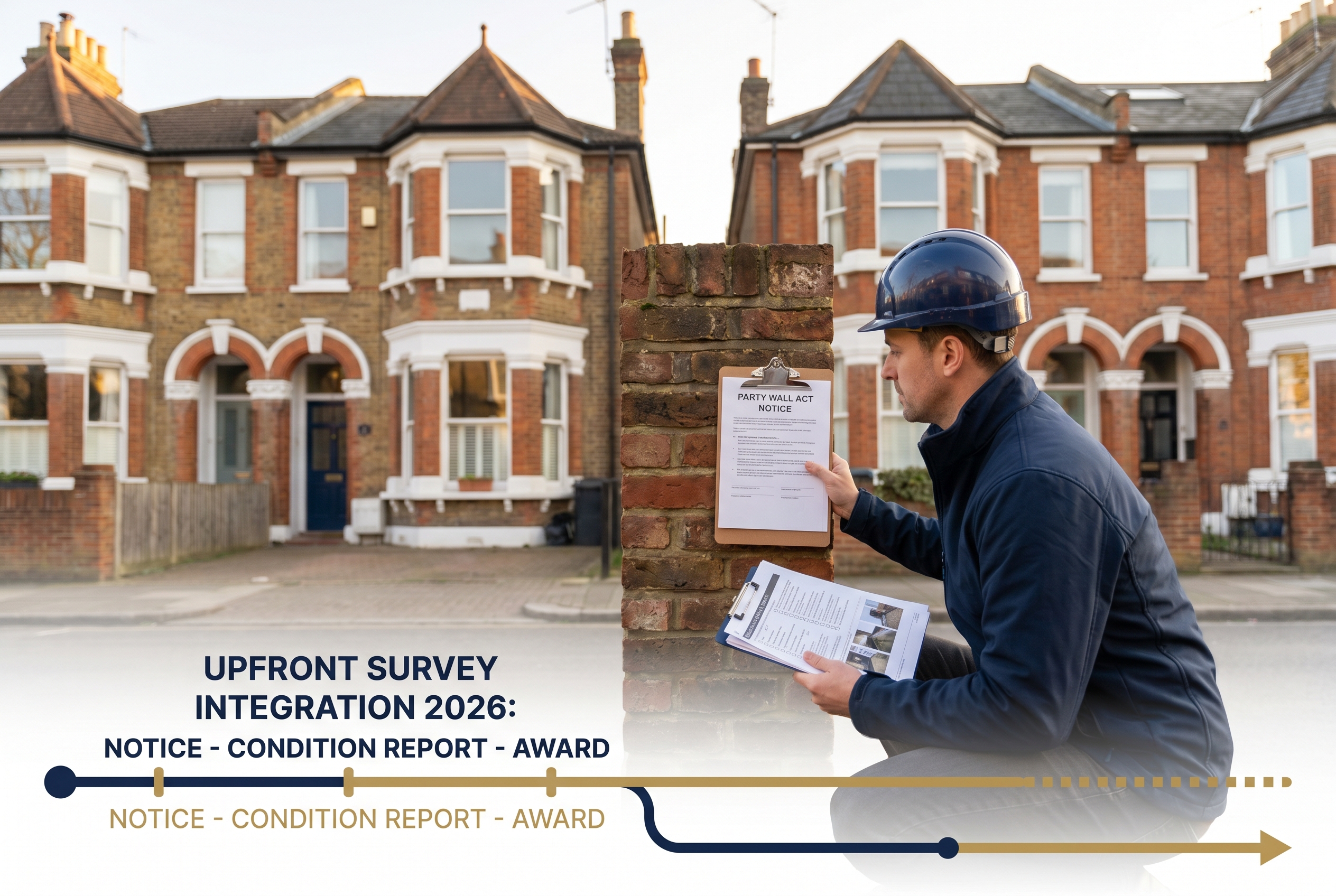
Roughly one in three property transactions in England and Wales still collapses after an offer is accepted — and a significant share of those failures trace back to information that could have been disclosed weeks earlier. The push to fix this has made Party Wall Awards Under Homebuying Reforms: Integrating Surveys into 2026 Upfront Processes one of the most consequential topics for surveyors, conveyancers, and buyers navigating the market in 2026. As policymakers and industry bodies accelerate the shift toward mandatory upfront disclosure packs, the question is no longer whether party wall compliance should be front-loaded — it is how to do it efficiently.
Key Takeaways
- Upfront survey reforms in 2026 create a clear opportunity to integrate Party Wall Act notices and condition reports into pre-sale disclosure packs, reducing late-stage transaction failures.
- A survey by LRG found 90% of sellers are willing to pay around £300 for upfront property information if it speeds up the sale process, signalling strong market readiness [1].
- Combining a schedule of condition with a party wall notice at the earliest stage protects both sellers and buyers from disputed damage claims after works begin.
- Surveyors who adopt a dual-workflow model — issuing notices and condition reports simultaneously — can compress party wall timelines by several weeks.
- Buyers and sellers both benefit from transparency: the 2026 ServiceLink State of Homebuying Report confirms that simplicity, affordability, and stability are the core demands of today's buyers [4].
Why Upfront Disclosure and Party Wall Compliance Must Now Work Together
The traditional sequence of a UK property transaction places surveys, legal searches, and party wall matters firmly in the post-offer phase. This creates a bottleneck. A buyer agrees a price, instructs a solicitor, and only then discovers that the seller's recent rear extension triggered a Party Wall Act obligation that was never formally resolved — or that a neighbour has already served a counter-notice on planned works. At that point, weeks of delay and potential renegotiation follow.
The 2026 reform agenda, shaped by the Law Commission's ongoing work and momentum from the National Trading Standards Material Information guidance, is pushing sellers to assemble a property information pack before listing. This pack is expected to include title documents, planning history, building regulation certificates, and — critically — any existing party wall awards or outstanding notices.
Research by conveyancing firm LRG found that 90% of sellers are willing to pay approximately £300 for upfront property information if it accelerates the sales process, and 80% support making offers legally binding [1]. That willingness is a green light for surveyors to position party wall due diligence as a standard component of the pre-listing workflow rather than a reactive measure.
Understanding what a party wall dispute involves is the starting point for any seller or buyer who wants to avoid late-stage surprises. Disputes arise not just from active construction but from undocumented historic works — precisely the kind of information that upfront disclosure is designed to surface.
The Party Wall Act Framework: What Buyers and Sellers Need to Know in 2026
The Party Wall etc. Act 1996 governs works that affect shared walls, boundary structures, and excavations near neighbouring foundations. Three categories of work trigger the Act:
| Trigger Type | Example Works | Notice Period Required |
|---|---|---|
| Section 1 — New wall on boundary | Building a new wall astride or adjacent to the boundary | 1 month |
| Section 3 — Party wall works | Loft conversions, underpinning, cutting into a shared wall | 2 months |
| Section 6 — Excavation near foundations | Basement extensions, deep footings within 3-6 metres | 1 month |
When a neighbour does not consent to proposed works, the Act requires the appointment of surveyors and the preparation of a Party Wall Award — a legally binding document that sets out the scope of works, hours of operation, access arrangements, and the condition of the adjoining property before works begin.
The condition record embedded in that award is typically produced as a party wall schedule of condition, a photographic and written record of the neighbouring property's state prior to construction. Without it, attributing post-works damage becomes a contested and expensive exercise.
For buyers purchasing a property where the seller has recently carried out an extension or loft conversion, the absence of a properly executed award is a material risk. If the award was never obtained, the buyer inherits that liability. If it was obtained but not disclosed, the transaction may proceed on a false assumption of compliance.
Knowing the legal requirements for party walls is no longer optional knowledge reserved for builders — it is becoming baseline literacy for anyone buying or selling a period property in urban areas.
Integrating Surveys into 2026 Upfront Processes: A Practical Surveyor Workflow
The core innovation that Party Wall Awards Under Homebuying Reforms: Integrating Surveys into 2026 Upfront Processes demands is a dual-workflow model. Instead of treating party wall compliance and building surveys as sequential tasks, surveyors can run them in parallel from the moment a property is listed — or even before.
Step 1: Pre-Listing Party Wall Audit
Before a seller lists the property, a chartered surveyor conducts a brief audit covering:
- Whether any notifiable works have been carried out in the last 6-10 years
- Whether valid notices were served and awards obtained
- Whether any outstanding notices from neighbours are in force
- The current condition of shared walls, chimneys, and boundary structures
This audit takes a fraction of the time a full award process requires, but it identifies gaps that could derail a sale. Issues such as damage to property under party wall works that were never formally recorded become visible at this stage rather than during the buyer's survey.
Step 2: Simultaneous Notice Service and Condition Recording
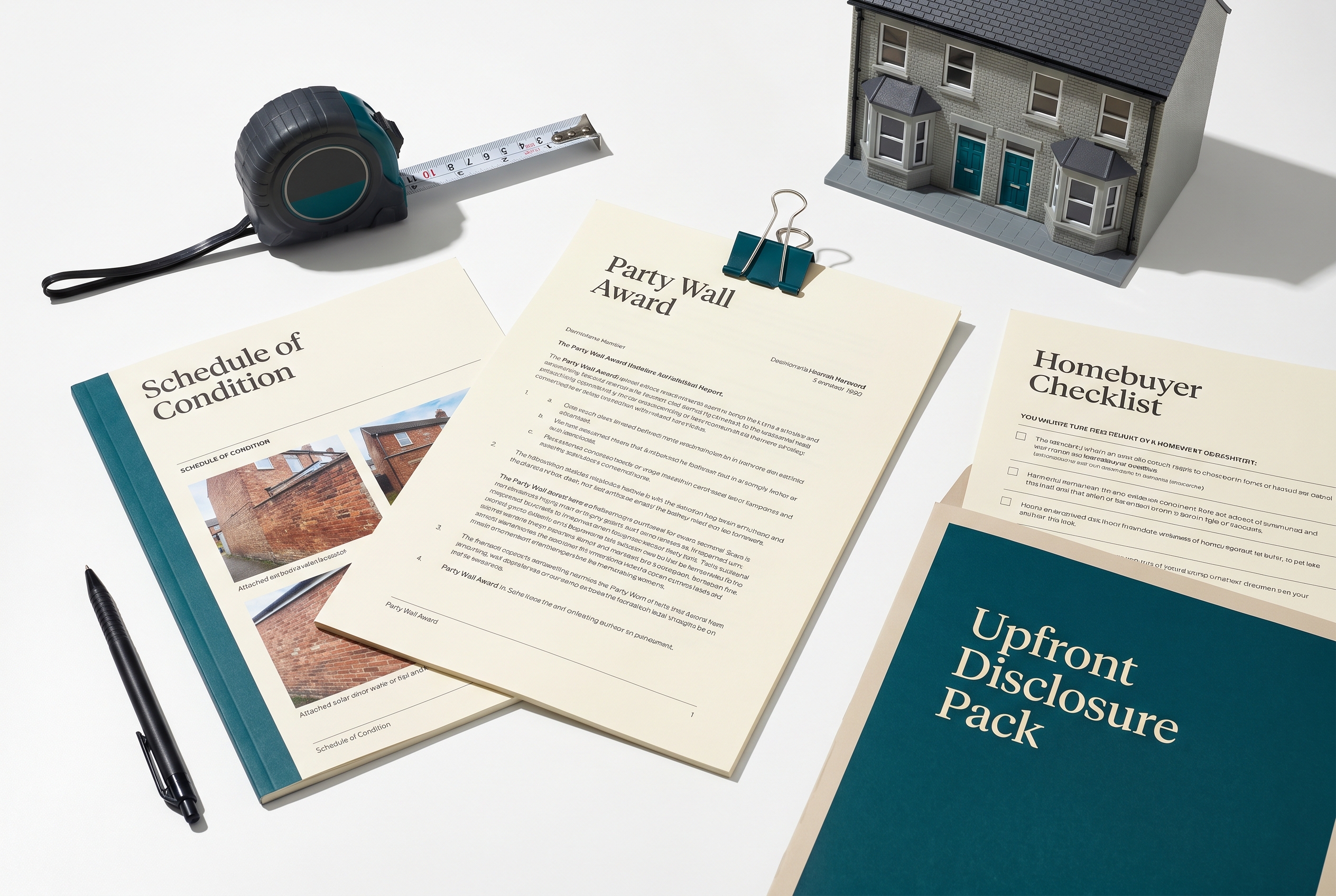
Where works are planned by the buyer post-purchase — or where the seller intends to complete works before exchange — the surveyor can serve the relevant party wall consent notice and prepare the schedule of condition at the same time. This eliminates the gap that typically exists between notice service (which starts the statutory clock) and the condition survey (which is often deferred until the award is being drafted).
The practical benefit: the statutory two-month notice period for Section 3 works runs concurrently with the conveyancing process rather than after exchange.
Step 3: Award Preparation as Part of the Disclosure Pack
Where a dispute procedure is triggered — because a neighbour dissents — the resulting award can be prepared and included in the upfront disclosure pack as a completed document. Buyers receive it alongside the title register and planning history. They can assess the scope of permitted works, the agreed methodology, and the recorded condition of the adjoining property before they commit to a purchase.
This approach directly addresses the transparency demand identified in the 2026 ServiceLink State of Homebuying Report, which found that buyers seek a process that is simple, affordable, transparent, and stable [4]. An upfront award removes one of the most opaque elements of buying a property with planned or recent works.
Step 4: Post-Award Monitoring Handover
When a property sells with an active award in place — meaning works are ongoing or scheduled — the surveyor prepares a monitoring handover note for the buyer's own surveyor. This document summarises the award conditions, the access schedule, and any interim condition updates. It prevents the new owner from being caught unaware of obligations they have inherited.
What the Data Says About Buyer and Seller Readiness for Reform
The market evidence for upfront reform is compelling. Beyond the 90% seller willingness cited above [1], 85% of homeowners with mortgages wish they had known more before starting the homebuying process [3]. That regret is not abstract — it translates directly into the kind of post-exchange disputes and abortive costs that party wall issues generate.
The 2026 Mintel US Home Purchasing report noted that elevated costs and constrained supply are extending purchase timelines and reshaping buyer engagement [5]. While that data reflects the US market, the dynamic is recognisable in the UK: buyers are taking longer, scrutinising more carefully, and expecting more information earlier. Sellers who front-load compliance documentation — including party wall awards — are better positioned to retain cautious buyers through to exchange.
A REMAX survey found that 88% of prospective buyers plan to purchase a home in 2026 despite affordability pressures [2], confirming that demand remains strong. The buyers who succeed will be those who encounter fewer late-stage obstacles. For sellers, removing party wall uncertainty from the post-offer phase is one of the most direct ways to protect a sale.
However, 68% of sellers in the LRG survey want evidence of tangible benefits before committing upfront costs [1]. This is where surveyor communication matters. The case for a pre-listing party wall audit is not abstract — it is a quantifiable risk reduction. A single abortive transaction costs a seller far more than the fee for an early audit.
Specific Scenarios Where Upfront Integration Delivers the Most Value
Loft conversions and rear extensions are the most common triggers. A party wall for loft conversions typically requires a Section 3 notice affecting the shared wall. If the seller completed the loft conversion three years ago without serving notice, that non-compliance is a latent defect. Upfront disclosure forces it into the open where it can be resolved — through a retrospective agreement or a price adjustment — rather than discovered by the buyer's solicitor at week eight of a twelve-week conveyancing process.
Excavation works present a different risk profile. A party wall excavation notice is required for basement extensions and deep footings. These works carry the highest risk of structural impact on neighbouring properties. Buyers purchasing a property adjacent to a recently excavated basement need to know whether a Section 6 notice was served and whether a condition survey was carried out before works began.
Shared chimneys are frequently overlooked. Issues with party wall shared chimneys — particularly in Victorian and Edwardian terraces — can affect both structural integrity and energy performance. An upfront condition record that includes the chimney stack gives buyers a baseline against which future deterioration can be measured.
How Surveyors Can Position Party Wall Services Within the 2026 Reform Landscape
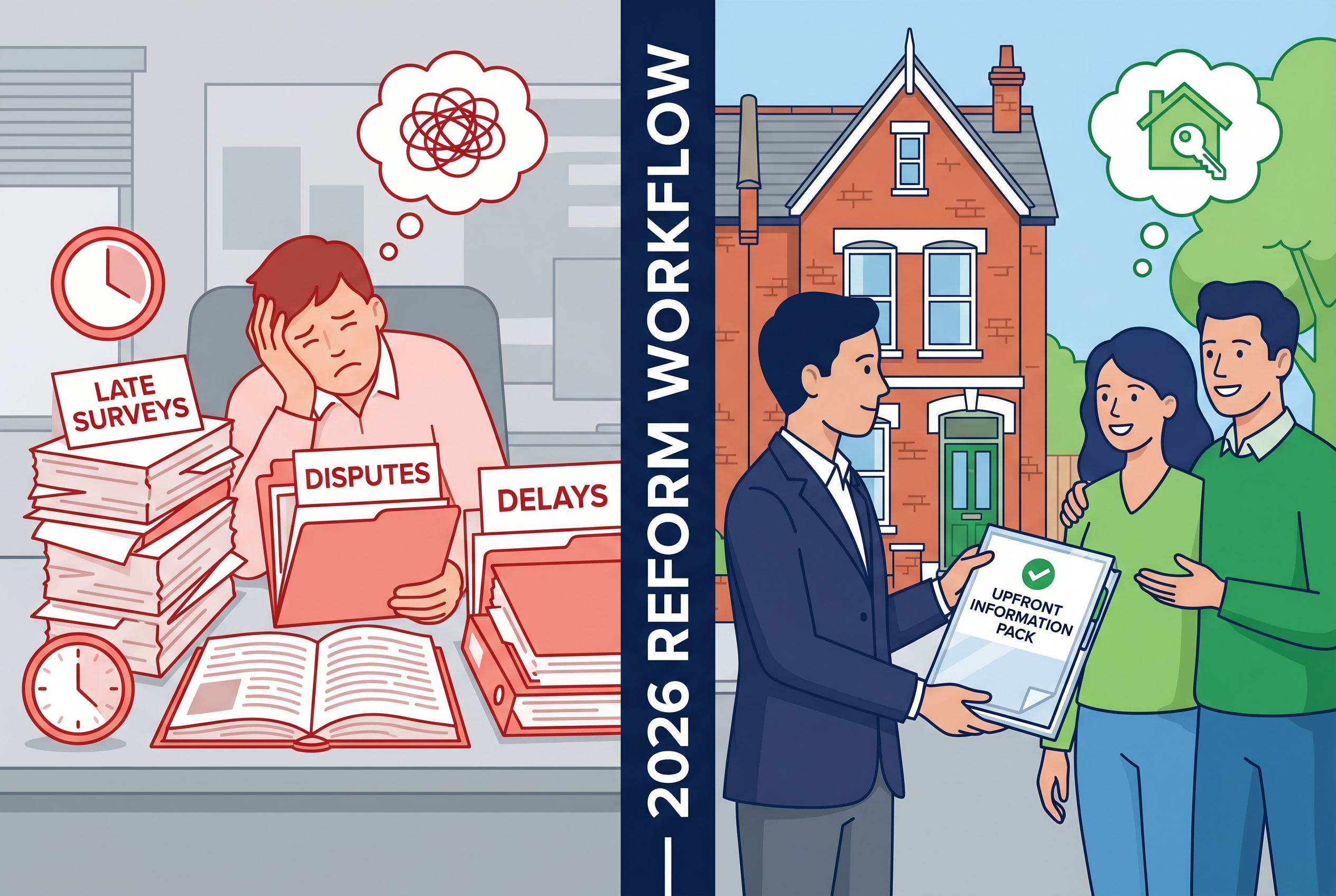
Surveyors who understand Party Wall Awards Under Homebuying Reforms: Integrating Surveys into 2026 Upfront Processes as a business opportunity — not just a compliance obligation — are well placed to expand their service offering. The practical steps include:
- Packaging pre-listing audits as a fixed-fee service that can be marketed directly to estate agents and conveyancers as part of their upfront pack offering
- Combining the schedule of condition with the homebuyer report or building survey where the buyer is instructing a survey anyway — reducing duplication and cost
- Educating sellers on the cost of non-compliance versus the cost of early resolution, using the LRG data point that 68% of sellers need evidence of benefit before paying upfront [1]
- Collaborating with conveyancers to ensure party wall documentation is flagged in the TA6 property information form at the earliest stage
The party wall surveyor cost question is often the first barrier sellers raise. Framing the fee as insurance against a collapsed transaction — rather than an additional expense — shifts the conversation. A pre-listing audit that prevents a £5,000 price reduction or a failed sale pays for itself many times over.
Common Obstacles and How to Overcome Them
Neighbour non-engagement remains the most frequent practical challenge. When a neighbouring owner ignores a notice, the Act provides a default mechanism: after 14 days without response, a dispute is deemed to have arisen and surveyors are appointed. Upfront integration does not eliminate this delay, but it starts the clock earlier — during the listing phase rather than after exchange.
Historic non-compliance is harder to resolve quickly. Where works were carried out without notices, a retrospective party wall agreement may be possible, but it requires the cooperation of the adjoining owner. If that cooperation is withheld, the seller must disclose the non-compliance and accept that buyers will factor it into their offer or walk away.
Buyer misconceptions about what a party wall award covers are common. Many buyers assume that an award means all works are approved and no further action is needed. In reality, the award governs the process and protection measures — it does not replace building regulations approval or planning permission. Clear communication from surveyors at the point of disclosure prevents misunderstandings that can derail exchange.
Conclusion
The convergence of upfront disclosure reform and party wall compliance is not a future possibility — it is the operational reality of the 2026 property market. Sellers who assemble complete disclosure packs, including party wall awards and schedules of condition, are demonstrably better positioned to complete transactions without costly delays. Buyers who receive that information upfront make better decisions and are less likely to withdraw after offer.
Actionable next steps for sellers: Commission a pre-listing party wall audit before instructing an estate agent. Identify any works carried out in the last decade and confirm whether notices were served. If gaps exist, address them before the property goes to market.
Actionable next steps for buyers: Ask specifically whether any party wall notices or awards exist as part of your pre-offer due diligence. If the seller cannot provide documentation for a recent extension, treat it as a material gap and instruct a surveyor to assess the risk before exchange.
Actionable next steps for surveyors: Develop a pre-listing party wall audit product, build relationships with local estate agents and conveyancers, and position the schedule of condition as a standard component of any upfront information pack. The reform agenda is creating demand — the surveyors who respond first will capture it.
The goal is a transaction process that is transparent from day one. Party wall compliance, properly integrated into upfront surveying workflows, is one of the most practical ways to get there.
References
[1] Survey Finds 90 Of Sellers Willing To Pay For Sale Reforms – https://www.propertywire.com/news/survey-finds-90-of-sellers-willing-to-pay-for-sale-reforms/?utm_source=openai
[2] Remax Survey Reveals Strong Demand 88 Of Prospective Buyers Plan To Purchase A Home In 2026 – https://news.remax.com/press-release/remax-survey-reveals-strong-demand-88-of-prospective-buyers-plan-to-purchase-a-home-in-2026?utm_source=openai
[3] Survey Reveals Biggest Misconceptions Consumers Have Homebuying Process – https://www.rismedia.com/2026/04/21/survey-reveals-biggest-misconceptions-consumers-have-homebuying-process/?utm_source=openai
[4] Servicelink Report Uncovers Psychology Todays Homebuyer 2026 04 14 – https://www.nasdaq.com/press-release/servicelink-report-uncovers-psychology-todays-homebuyer-2026-04-14?utm_source=openai
[5] Us Home Purchasing Market Report – https://store.mintel.com/report/us-home-purchasing-market-report?utm_source=openai