
The northern housing market is experiencing an unprecedented surge in bungalow demand as buyers seek affordable, single-story living in undersupplied regions. This spike has triggered a wave of retrofit projects—loft conversions, extensions, and EV charging installations—that bring party wall agreements into sharp focus. With property owners eager to maximize value in tight markets, understanding Party Wall Essentials for 2026 Bungalow Retrofits: Surveys in Undersupplied Northern Markets has become critical for avoiding costly disputes and project delays.
As renovation activity accelerates across northern England, Scotland, and Wales, surveyors are fielding more complex questions about party wall requirements for bungalow modifications. The unique challenges of single-story properties—shallow foundations, shared chimneys, and limited vertical space—demand specialized knowledge when navigating the Party Wall etc. Act 1996.
Key Takeaways
- 🏗️ Notice requirements are mandatory: Building owners must serve party wall notices 1-2 months before starting bungalow retrofit works that affect shared structures[1]
- 📋 Surveyor appointments become necessary when neighbours don't consent within 14 days, with typical awards costing approximately £1,000[2]
- 🔨 Common bungalow retrofits trigger party wall procedures, including loft conversions, foundation excavations, and structural alterations to shared walls
- 📍 Northern market undersupply is driving intensive retrofit activity, increasing the volume and complexity of party wall agreements
- ⚡ Minor works exemptions exist for plastering, electrical installations, and fitting kitchen units, which don't require formal agreements[2]
Understanding Party Wall Essentials for 2026 Bungalow Retrofits in Northern Markets
The northern housing shortage has created unique pressures on existing bungalow stock. With new construction failing to meet demand, homeowners are increasingly turning to retrofits to add value and functionality. This trend directly impacts party wall requirements, as most bungalow modifications involve work on or near shared boundaries.
The Northern Bungalow Boom: Market Context
Northern regions are experiencing housing undersupply that exceeds national averages. Bungalows—traditionally popular with downsizers and accessibility-focused buyers—represent a significant portion of this constrained inventory. The result? Property owners are investing heavily in extensions, loft conversions, and modernization projects to extract maximum value from limited stock.
This retrofit surge mirrors broader investment trends observed across the property sector. As institutional investors increase activity in residential markets, the importance of proper surveying protocols has intensified[4]. For individual homeowners undertaking bungalow retrofits, the same professional standards apply—particularly regarding party wall compliance.
What Triggers Party Wall Requirements for Bungalow Retrofits?
Understanding when party wall procedures apply is the first essential step. The Party Wall etc. Act 1996 covers three main categories of work[1]:
1. Works Directly to Party Walls
- Cutting into party walls for new beams or structural supports
- Raising party walls for loft conversions
- Underpinning existing party walls
- Inserting damp-proof courses
- Demolishing and rebuilding party walls
2. New Building at Boundaries
- Constructing new walls at or astride boundary lines
- Building extensions that touch or cross the property line
- Installing foundations for new structures
3. Excavation Near Neighbouring Structures
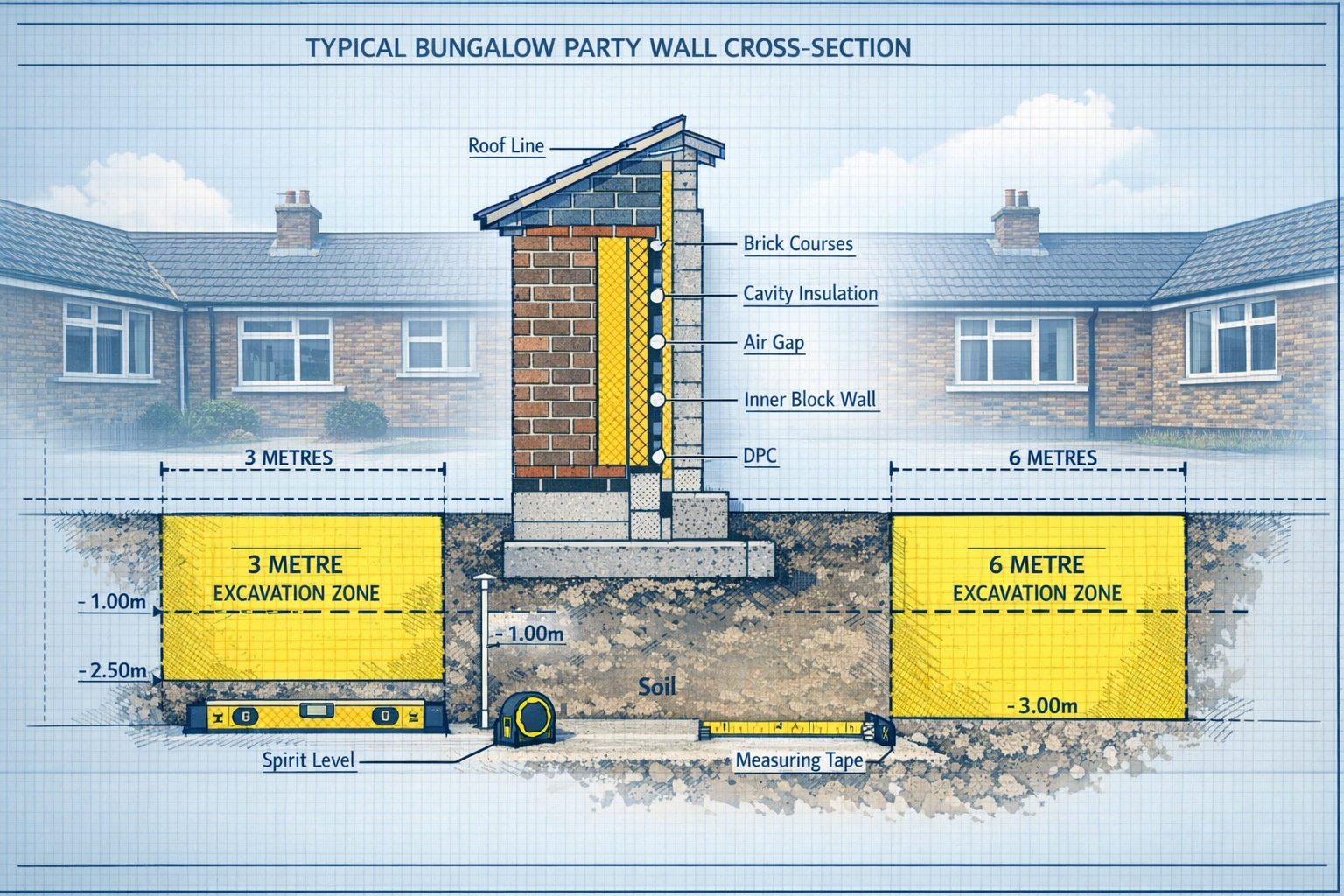
- Digging within 3 metres of a neighbour's structure if going deeper than their foundations
- Excavating within 6 metres if cutting a line at 45 degrees down from the bottom of their foundations
For bungalow retrofits specifically, loft conversions frequently trigger party wall requirements when raising shared walls. Foundation work for single-story extensions often falls within the excavation distance thresholds, while structural modifications to support new loads require cutting into party walls. Understanding these legal requirements for party walls prevents costly mid-project complications.
Bungalow-Specific Challenges
Single-story properties present distinct party wall considerations:
Shallow Foundations: Many older bungalows have minimal foundation depth, making the 3-metre and 6-metre excavation rules particularly relevant. Even modest extension projects can trigger notification requirements.
Shared Chimneys: Bungalows commonly feature shared chimney structures that require careful consideration during retrofit work, especially when installing flues or removing fireplaces.
Limited Vertical Space: Loft conversions in semi-detached or terraced bungalows almost always involve raising party walls, necessitating formal agreements with neighbours.
EV Charging Installations: While electrical work itself doesn't require party wall consent[2], associated foundation work for dedicated charging stations or garage modifications may trigger requirements.
Party Wall Essentials for 2026 Bungalow Retrofits: The Survey and Notice Process
Navigating party wall procedures requires systematic compliance with statutory timelines and documentation. For bungalow retrofits in high-activity northern markets, getting the process right from the start prevents disputes that can delay projects for months.
Step-by-Step Guide to Party Wall Compliance
Step 1: Identify Affected Neighbours (Weeks 1-2)
Before any design work finalizes, determine which neighbours share party walls or fall within excavation distance thresholds. For bungalow properties:
- Survey all shared walls (including garden walls and boundary structures)
- Measure distances from proposed excavation to neighbouring foundations
- Identify shared chimney stacks or service entries
- Document existing conditions with photographs
Step 2: Serve Formal Party Wall Notices (Months 1-2 Before Works)
The Act requires specific notice periods[1]:
| Work Type | Notice Period |
|---|---|
| Party wall works | 2 months minimum |
| New building on boundary | 1 month minimum |
| Excavation work | 1 month minimum |
Notices must be in writing and include:
✅ Your name and address
✅ Details of proposed works
✅ Planned start date
✅ Drawings or plans showing work scope
✅ Statement of rights under the Act
Serving a party wall notice correctly is crucial—defective notices can invalidate the entire process.
Step 3: Await Neighbour Response (14-Day Window)
Neighbours have 14 days to respond with either:
Consent: Written agreement allowing works to proceed without formal award. This is the simplest outcome but relatively rare for significant bungalow retrofits.
Dissent or No Response: Triggers the surveyor appointment process. Importantly, dissent doesn't mean opposition—it simply activates the formal procedure to protect both parties' interests.
Step 4: Appoint Party Wall Surveyors
When consent isn't forthcoming, the Act requires surveyor involvement. Three appointment options exist:
- Agreed Surveyor: Both parties use a single, mutually acceptable surveyor
- Two Surveyors: Each party appoints their own surveyor, who then work together
- Third Surveyor: Appointed to resolve disputes between the two surveyors
For cost-conscious bungalow retrofits, an agreed surveyor often provides the most economical solution. However, neighbours retain the right to appoint separate representation.
Understanding party wall surveyor costs helps budget appropriately. Typical rates range from £150-£200 per hour, with complete awards averaging around £1,000[2].
Step 5: Schedule of Condition Survey
Before works commence, surveyors prepare a detailed Schedule of Condition documenting the neighbouring property's current state. This critical step:
- Records existing cracks, defects, and structural conditions
- Provides photographic evidence
- Establishes baseline for assessing any damage claims
- Protects both building owner and neighbour
For bungalow retrofits involving foundation work or structural modifications, thorough condition surveys prevent spurious damage allegations.
Step 6: Party Wall Award Preparation
Surveyors prepare a formal Party Wall Award that legally permits works while protecting neighbours' interests. Awards typically include:
📄 Work Scope: Detailed description of permitted activities
📄 Access Rights: Times and conditions for accessing neighbouring property
📄 Working Hours: Restrictions on noisy operations
📄 Damage Provisions: Procedures if damage occurs
📄 Cost Allocation: Who pays for what (typically building owner covers all surveyor fees)
Once served, the Award becomes legally binding on both parties.
Common Pitfalls in Northern Market Bungalow Retrofits
Rising activity levels in undersupplied markets have exposed recurring compliance issues:
❌ Late Notice Service: Serving notices too close to planned start dates forces project delays. Plan for the full 2-month period.
❌ Incomplete Documentation: Vague descriptions of proposed works lead to disputes. Include detailed plans and specifications with notices.
❌ Assuming Minor Works Don't Apply: While plastering and electrical work are exempt[2], associated structural modifications may still trigger requirements.
❌ Ignoring Excavation Rules: The Party Wall Act 3-metre rule catches many bungalow extension projects by surprise due to shallow existing foundations.
❌ Proceeding Without Consent or Award: Starting work without proper authorization exposes building owners to injunctions and costly legal action.
Party Wall Essentials for 2026 Bungalow Retrofits: Specialized Scenarios and Expert Solutions
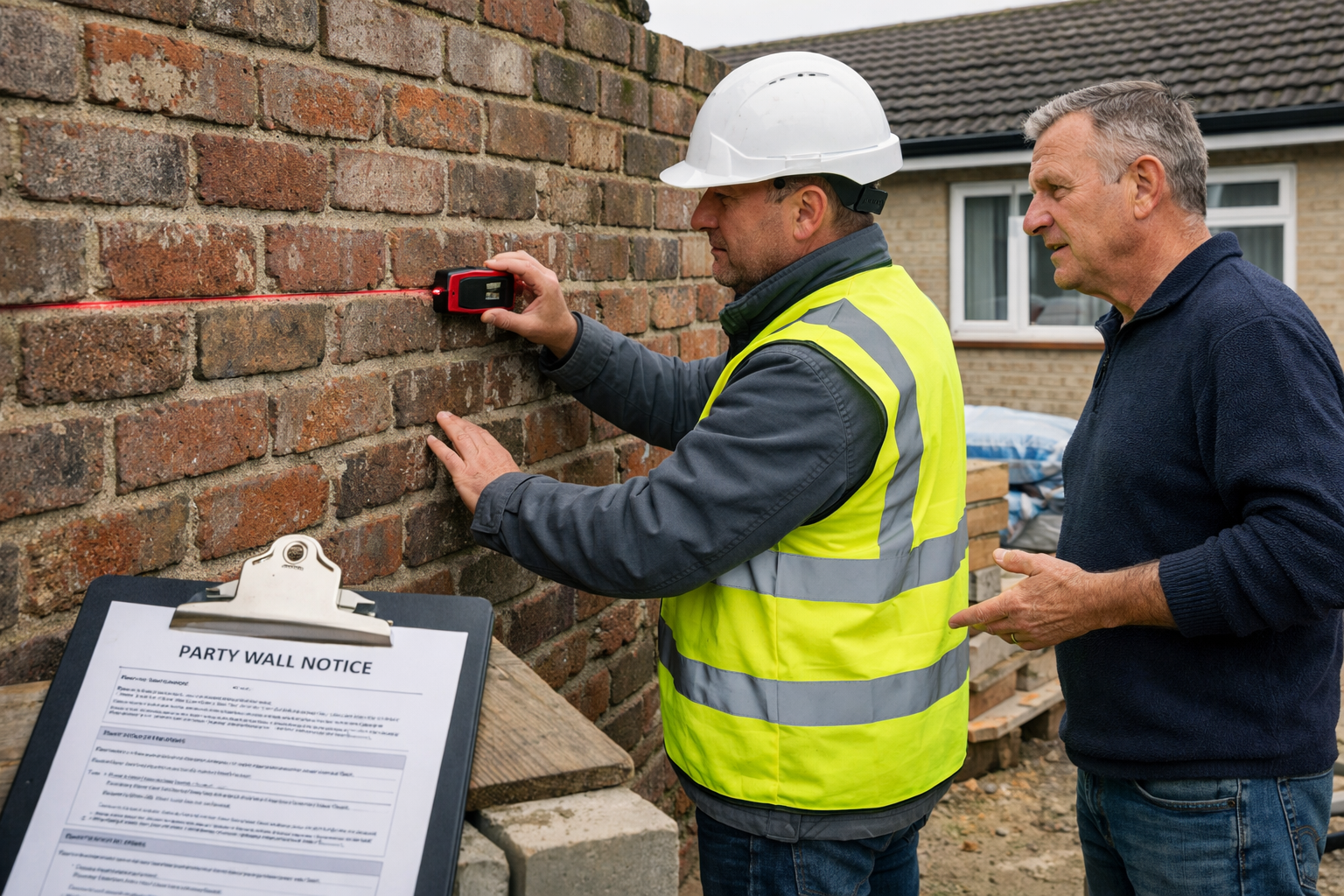
Beyond standard procedures, bungalow retrofits in northern markets present specialized scenarios requiring expert surveyor input. Understanding these situations helps property owners anticipate challenges and budget accordingly.
Loft Conversions: The Most Common Party Wall Trigger
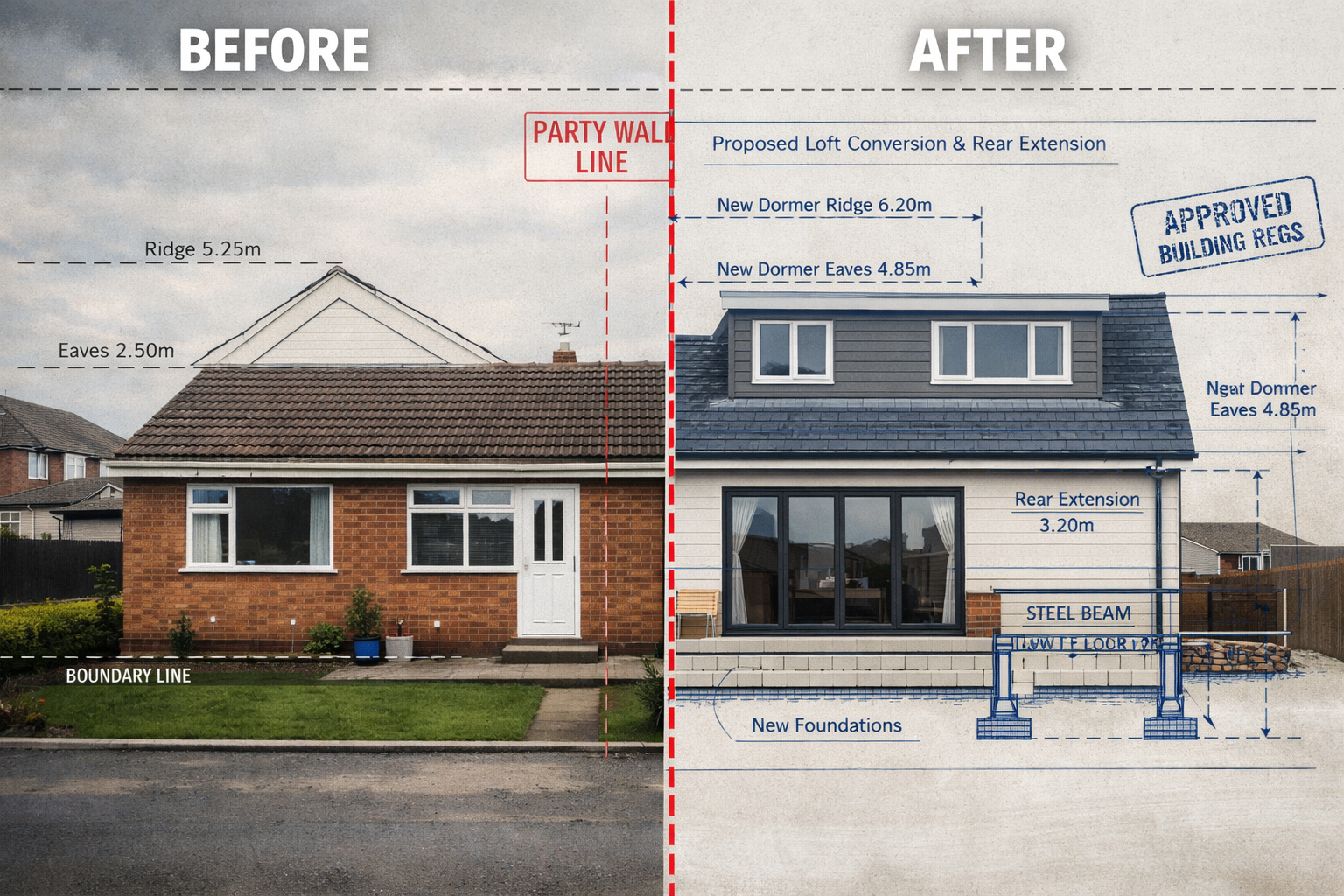
Loft conversions in semi-detached or terraced bungalows almost invariably require party wall procedures. The work typically involves:
- Raising Party Walls: Extending shared walls upward to accommodate new roof height
- Steel Beam Installation: Cutting into party walls to insert structural supports
- Foundation Reinforcement: Strengthening existing foundations to carry additional load
Each element triggers separate notice requirements. Surveyors must assess:
✓ Structural capacity of existing party wall
✓ Impact on neighbour's roof structure
✓ Drainage and rainwater management changes
✓ Fire safety compliance at party wall junctions
The complexity explains why loft conversion party wall awards often exceed baseline costs, particularly when structural calculations and engineering input are required.
Foundation Work and Excavation Challenges
Bungalow extensions frequently encounter excavation thresholds due to shallow original foundations. Consider this scenario:
Example: A 1960s semi-detached bungalow with 600mm-deep foundations. The owner plans a single-story rear extension requiring 900mm-deep foundations. The excavation will occur 2.5 metres from the neighbour's property.
Analysis: This triggers party wall requirements because:
- Excavation is within 3 metres of the neighbour's structure
- New foundations go deeper than existing foundations
The building owner must serve notice and potentially appoint surveyors, even though the extension itself doesn't touch the party wall.
Dispute Resolution and Agreed Surveyor Benefits
When neighbours raise concerns, early surveyor involvement can prevent escalation. Party wall disputes often stem from communication breakdowns rather than genuine conflicts of interest.
Professional surveyors provide:
🤝 Neutral Mediation: Explaining technical aspects to both parties
🤝 Realistic Expectations: Clarifying what the Act requires versus optional accommodations
🤝 Protective Documentation: Ensuring both parties' interests are legally safeguarded
In undersupplied northern markets where property values are rising rapidly, protecting investment through proper surveying becomes even more critical.
EV Charging and Modern Retrofit Considerations
The 2026 push toward electric vehicle adoption has introduced new party wall considerations for bungalow owners. While installing a simple wall-mounted charger rarely triggers requirements, associated works might:
Potential Triggers:
- Foundation work for dedicated charging stations
- Excavation for underground cable runs near boundaries
- Structural modifications to garages sharing party walls
- Removal of shared chimney breasts to create charging equipment space
Exemptions:
- Surface-mounted electrical installations
- Cable routing through existing conduits
- Wall fixings for charging units (similar to kitchen units)[2]
Understanding these distinctions prevents unnecessary compliance costs while ensuring legal obligations are met.
Working with Institutional Buyers and Developers
The northern bungalow market increasingly attracts institutional investors seeking retrofit opportunities. These buyers demand rigorous surveying protocols[4] that exceed minimum statutory requirements.
Professional surveyors serving this market segment provide:
📊 Enhanced Due Diligence: Comprehensive party wall risk assessments before purchase
📊 Portfolio-Level Compliance: Standardized procedures across multiple retrofit projects
📊 Stakeholder Communication: Managing relationships with multiple neighbouring properties
📊 Documentation Standards: Audit-ready records for institutional governance requirements
Individual homeowners benefit from adopting similar professional standards, particularly when planning future sales to institutional buyers.
Cost Management Strategies for Party Wall Compliance
With surveyor fees representing a meaningful budget item, strategic approaches can optimize costs:
1. Early Engagement: Consulting surveyors during design phases identifies issues before expensive changes become necessary.
2. Agreed Surveyor Arrangements: When relationships with neighbours are positive, a single agreed surveyor reduces total fees significantly.
3. Bundled Services: Many surveyors offer package pricing for party wall work combined with structural surveys or building inspections.
4. Clear Scope Definition: Precisely defining work scope in initial notices minimizes subsequent variations and additional surveyor time.
5. Proactive Communication: Maintaining good neighbour relations reduces the likelihood of formal disputes requiring extended surveyor involvement.
Regional Variations and Northern Market Specifics
While the Party Wall etc. Act 1996 applies uniformly across England and Wales, northern markets present distinct characteristics:
Property Age: Northern bungalow stock includes significant 1950s-1970s construction with varying foundation standards, requiring careful assessment.
Construction Methods: Regional building practices affect party wall construction details, influencing retrofit approaches.
Market Velocity: Undersupply creates urgency that can tempt shortcuts—professional surveyors ensure compliance isn't sacrificed for speed.
Value Optimization: In constrained markets, maximizing property value through compliant retrofits delivers stronger returns than in oversupplied regions.
Surveyors with specific northern market experience understand these nuances and provide more relevant guidance.
Conclusion
Party Wall Essentials for 2026 Bungalow Retrofits: Surveys in Undersupplied Northern Markets represents a critical knowledge area as renovation activity accelerates across northern England, Scotland, and Wales. The combination of housing undersupply, aging bungalow stock, and rising property values creates perfect conditions for retrofit investment—but only when party wall compliance is properly managed.
The fundamentals remain clear: serve proper notices 1-2 months before works commence[1], appoint qualified surveyors when neighbours don't consent within 14 days, and obtain formal awards before starting construction. For bungalow-specific challenges—shallow foundations, loft conversions, shared chimneys—professional surveyor input becomes invaluable.
Actionable Next Steps
For property owners planning bungalow retrofits in northern markets:
✅ Step 1: Assess your proposed works against party wall triggers (direct wall works, boundary building, excavation thresholds)
✅ Step 2: Identify all affected neighbours and measure distances from planned excavation to their foundations
✅ Step 3: Engage a qualified party wall surveyor for initial consultation—early advice prevents costly mistakes
✅ Step 4: Prepare and serve formal notices with complete documentation at least 2 months before planned start dates
✅ Step 5: Budget appropriately for surveyor fees (approximately £1,000 for standard awards[2]) and factor compliance timelines into project schedules
✅ Step 6: Maintain open communication with neighbours throughout the process—professional relationships reduce dispute risk
The northern bungalow retrofit boom presents significant opportunities for value creation in undersupplied markets. Success requires balancing renovation ambition with rigorous party wall compliance. By understanding the essentials, following statutory procedures, and engaging qualified surveyors, property owners can navigate these requirements confidently while protecting both their investments and neighbour relationships.
For complex projects involving multiple triggers—loft conversions, foundation work, and structural modifications—professional surveyor guidance isn't just advisable, it's essential. The modest investment in proper party wall procedures delivers substantial returns through dispute avoidance, legal protection, and smooth project execution.
As 2026 unfolds and northern market activity continues accelerating, mastering these party wall essentials will separate successful retrofit projects from costly, delayed failures. The framework exists to protect all parties—using it properly ensures everyone benefits from the northern bungalow renaissance.
References
[1] Party Walls – https://www.rics.org/consumer-guides/party-walls
[2] Party Wall Agreement – https://hoa.org.uk/advice/guides-for-homeowners/i-am-improving/party-wall-agreement/
[3] Party Wall Surveys For Data Centre Expansions Navigating Agreements In The 2026 Investment Surge – https://nottinghillsurveyors.com/blog/party-wall-surveys-for-data-centre-expansions-navigating-agreements-in-the-2026-investment-surge
[4] Surveying The 2026 Buy To Let Boom Building Survey Protocols For Institutional Landlord Investments – https://nottinghillsurveyors.com/blog/surveying-the-2026-buy-to-let-boom-building-survey-protocols-for-institutional-landlord-investments