
As homeowner confidence returns in 2026 and property improvement investments surge, surveyors across England and Wales are experiencing unprecedented demand for party wall services. With loft conversions and extensions dominating renovation projects, understanding Party Wall Notices for Loft Conversions and Extensions: Compliance Essentials as DIY Renovation Activity Accelerates in 2026 has never been more critical for both property owners and construction professionals.
The Party Wall etc. Act 1996 governs all building work that affects shared walls, boundaries, and nearby structures. Yet many enthusiastic homeowners embarking on DIY renovations remain unaware of their legal obligations—a knowledge gap that can lead to costly delays, neighbour disputes, and even court injunctions halting construction. This comprehensive guide explains when notices are required, proper serving procedures, surveyor roles, and strategies for avoiding common compliance pitfalls.
Key Takeaways
- Loft conversions and extensions frequently trigger party wall notice requirements when work involves shared walls, reaches boundaries, or includes excavation within 3-6 metres of neighbouring foundations
- Two distinct notice periods apply: two months for building on or at boundary lines, and one month for work on existing party walls
- Professional surveyor involvement is essential when neighbours dissent or fail to respond, with 2026 fees ranging £750-£1,800 per neighbour in London
- Non-compliance carries serious consequences including legal action, construction delays, and financial liability for damages
- The complete process timeline extends 2-4 months from initial notice to final agreement, requiring careful project planning
Understanding When Party Wall Notices for Loft Conversions and Extensions Are Required
The Party Wall etc. Act 1996 establishes clear triggers for when property owners must serve formal notice to neighbours. Understanding these requirements prevents costly mistakes and project delays.
Work Types Requiring Formal Notice
Loft conversions typically require party wall notice when the work involves:
- Building new walls that reach or sit on the boundary line between properties
- Strengthening or modifying existing shared walls (party walls)
- Installing steel beams that penetrate shared walls
- Excavating foundations within specified distances of neighbouring structures
Extensions almost always trigger notice requirements, particularly:
- Rear extensions that extend to the side boundary line
- Side return extensions which inherently touch the boundary
- New boundary walls constructed as part of the extension
- Foundation excavation for the extension structure[1]
The Critical 3-Metre and 6-Metre Rules
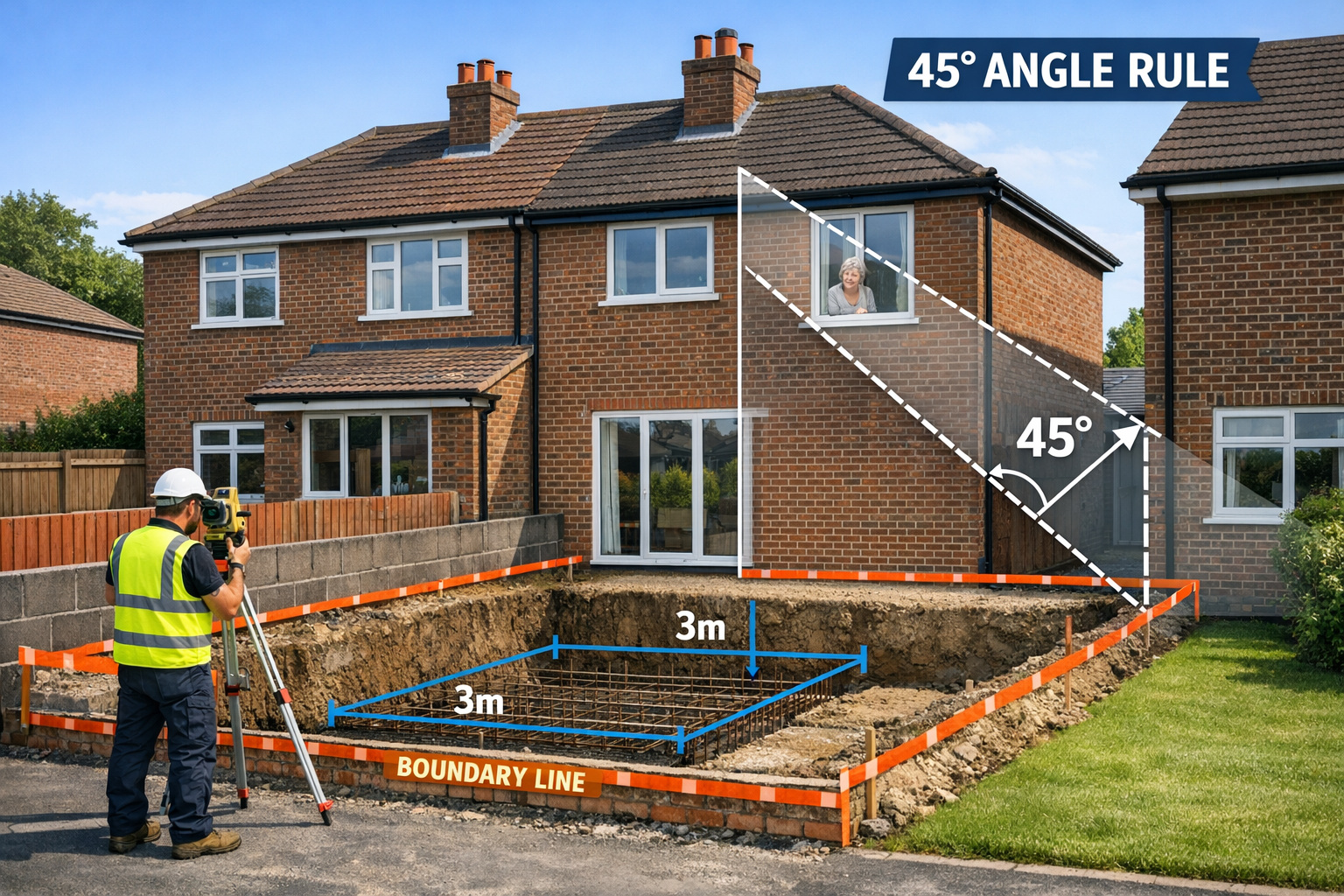
Party wall excavation notice becomes mandatory under specific distance and depth conditions:
| Distance from Neighbour's Structure | Depth Requirement | Notice Required? |
|---|---|---|
| Within 3 metres | Below their foundation level | ✅ Yes |
| 3-6 metres | Within 45° angle from foundation base | ✅ Yes |
| Beyond 6 metres | Any depth | ❌ No |
| Within 3 metres | Above their foundation level | ❌ No |
This 45-degree rule requires careful measurement and often professional surveyor assessment to determine compliance obligations[1].
Line of Junction Work
Building on or at the boundary line—known as Line of Junction work—represents one of the most common scenarios for extensions. This includes:
- Constructing new walls directly on the property boundary
- Building foundations that straddle the boundary line
- Erecting fences or structures at the exact boundary location
Even if the structure doesn't touch the neighbouring property, positioning it precisely at the boundary triggers the two-month notice requirement[2].
Compliance Essentials: Serving Proper Party Wall Notices in 2026
Serving legally compliant notices forms the foundation of the entire party wall process. Errors at this stage can invalidate the notice, forcing homeowners to restart the process and causing significant project delays.
Mandatory Notice Content Requirements
A valid party wall notice must include specific information to meet legal standards:
Essential Details:
- 📋 Clear work description outlining all proposed construction activities
- 📐 Architectural plans and drawings showing the scope of work
- 📅 Accurate proposed start date for construction commencement
- 🏠 Property identification precisely identifying affected boundaries or structures
- 🚪 Access requirements if entry to neighbouring property is needed
- ✍️ Building owner details including full legal names and contact information[2]
Professional surveyors strongly recommend against homeowners drafting notices themselves. Incorrect or incomplete notices can be challenged and invalidated, forcing the entire process to restart and potentially delaying projects by months[1].
Understanding Notice Periods and Timelines
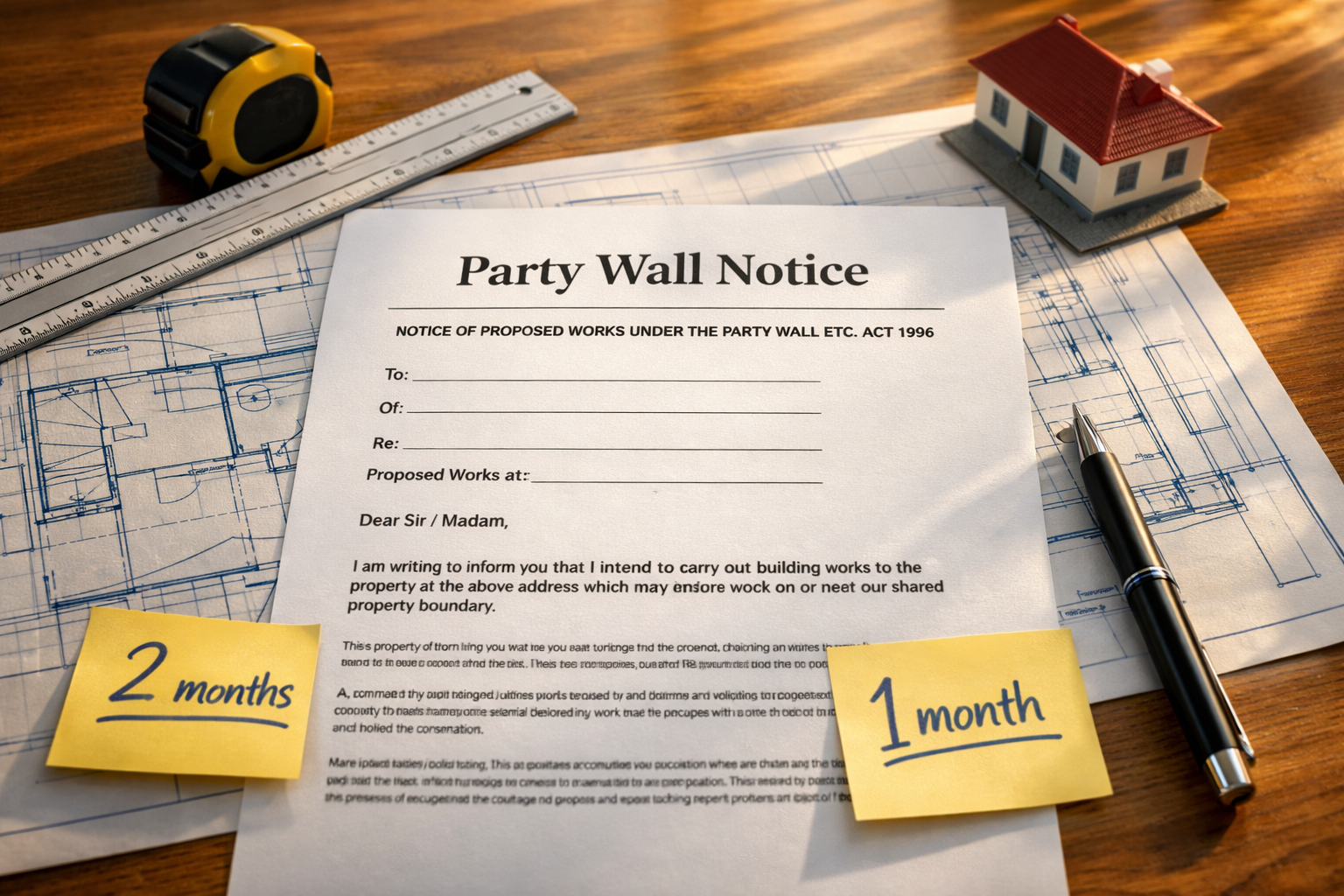
The Party Wall etc. Act 1996 establishes two distinct notice periods depending on work type:
Two-Month Notice Period:
- Building on or at the boundary line (Line of Junction)
- Excavating within the 3-metre or 6-metre rules
- Constructing new party walls
One-Month Notice Period:
- Work on existing party walls
- Repairs or modifications to shared structures
- Inserting damp-proof courses in party walls
⏰ Critical timing consideration: The notice period begins when neighbours receive the notice, not when it's sent. Using recorded delivery or hand delivery with signed receipt provides proof of service date.
Identifying All Parties Requiring Notice
A common mistake involves failing to serve notice to all legal stakeholders. The requirement extends beyond immediate occupants:
Who must receive notice:
- All legal owners of affected properties (not just tenants)
- Freeholders in leasehold arrangements
- Multiple owners if the property has shared ownership
- Landlords in rental situations, even if tenants occupy the property[4]
For leasehold properties, this often means serving notice to both the building owner and individual leaseholders—a complexity that professional surveyors navigate routinely.
The Response Process and Party Wall Agreement Development
After serving proper notice, neighbours have 14 days to respond. Their response determines the next steps in the party wall process.
Three Possible Neighbour Responses
1. Written Consent ✅
The neighbour agrees to the proposed work in writing. This represents the simplest outcome, allowing work to proceed after the notice period expires. However, even with consent, documenting the property's pre-construction condition through a Schedule of Condition protects both parties.
2. Formal Dissent ❌
The neighbour objects to the work by providing written dissent or requesting modifications. This triggers the surveyor appointment process but does not prevent work from proceeding[3].
3. No Response 🔇
Silence after 14 days is legally interpreted as dissent under the Act. This automatic dissent requires the same surveyor appointment process as formal objection[3].
"If neighbours dissent or fail to respond, you must appoint a qualified party wall surveyor to prepare a party wall agreement or award, but dissent does not prevent the works from being carried out."[3]
Appointing Party Wall Surveyors
When dissent occurs (formal or through silence), the Act requires surveyor involvement. Property owners have two options:
Option 1: Agreed Surveyor
Both parties jointly appoint a single surveyor to act impartially for both sides. This approach:
- Reduces overall costs (one surveyor fee instead of two)
- Streamlines the process
- Requires mutual agreement on the surveyor selection
- Demands absolute impartiality from the appointed professional
Option 2: Separate Surveyors
Each party appoints their own surveyor to represent their interests. The two surveyors then:
- Collaborate to produce the party wall agreement
- May appoint a third surveyor if they cannot reach agreement
- Provide dedicated representation for each party's concerns
Understanding party wall surveyor costs helps with budgeting. In 2026, London surveyor fees typically range £750-£1,800 per neighbour, with the building owner (person undertaking the work) responsible for all reasonable surveyor fees—including the neighbour's surveyor if separate surveyors are appointed[1].
The Party Wall Award Document
Surveyors prepare a Party Wall Award—a legally binding document that:
📄 Establishes work parameters: Specifies exactly what work is permitted and any conditions or limitations
📸 Documents existing conditions: Includes a Schedule of Condition with photographs and descriptions of the neighbouring property before work begins
⏱️ Sets timelines: Defines when work can commence and any time restrictions (e.g., limiting noisy work to specific hours)
🔧 Addresses access: Clarifies if and when the building owner can access neighbouring property
💰 Allocates costs: Confirms who pays for surveyor fees and any required remedial work
The Award protects both parties by creating clear expectations and providing a baseline for assessing any damage claims after construction completes.
Avoiding Common Party Wall Disputes and Compliance Failures
Understanding potential pitfalls helps homeowners navigate the party wall process smoothly and maintain positive neighbour relations.
Critical Compliance Mistakes to Avoid
❌ Starting work before the notice period expires
Even with neighbour consent, construction cannot legally commence until the appropriate notice period (one or two months) has elapsed. Premature commencement violates the Act[3].
❌ Proceeding without required notice
Some homeowners mistakenly believe friendly neighbour relations eliminate notice requirements. The Party Wall etc. Act 1996 is statutory legislation—legal obligations exist regardless of relationship quality.
❌ Using template notices without professional review
Online template notices often lack jurisdiction-specific requirements or fail to adequately describe complex work. Invalid notices must be re-served, restarting the entire timeline[1].
❌ Ignoring the excavation rules
Many homeowners overlook party wall excavation notice requirements when digging foundations, particularly the 45-degree rule for work 3-6 metres from neighbouring structures.
❌ Failing to obtain proper party wall consent
Without valid party wall consent or a completed Award, work proceeds illegally and exposes the building owner to significant liability.
Consequences of Non-Compliance
Failing to comply with party wall legislation carries serious ramifications:
Legal Action ⚖️
Neighbours can seek court injunctions to immediately halt construction. Courts generally favour neighbours when proper notices haven't been served, and obtaining an injunction is relatively straightforward[3].
Financial Liability 💷
Building owners may face:
- Compensation claims for property damage
- Legal costs for both parties
- Surveyor fees to retrospectively regularize the situation
- Costs to remedy any damage caused by unauthorized work
Project Delays ⏸️
Court injunctions can stop work for months while the proper party wall process completes. The 2-4 month timeline for completing party wall procedures becomes even longer when starting from a position of non-compliance.
Damaged Neighbour Relations 🏘️
Perhaps most significantly, proceeding without proper notice destroys trust and goodwill. What might have been an amicable process becomes adversarial, making future interactions difficult.
Strategies for Smooth Party Wall Processes
Early Communication 💬
Informally discussing renovation plans with neighbours before serving formal notice builds goodwill. While not legally required, this courtesy often results in smoother formal processes.
Professional Surveyor Engagement 👷
Engaging qualified surveyors from the outset ensures:
- Properly drafted and served notices
- Accurate identification of all affected parties
- Correct application of the 3-metre and 6-metre rules
- Professional mediation if concerns arise
Comprehensive Documentation 📸
Even when neighbours consent, creating a detailed Schedule of Condition protects against future disputes. Photographs and written descriptions of the neighbouring property's pre-construction state provide invaluable evidence if damage claims arise.
Realistic Timeline Planning 📅
Factor the complete 2-4 month party wall process into project planning. Attempting to rush or circumvent these requirements inevitably causes greater delays than following proper procedures from the start[1].
Transparent Communication 🗣️
Keep neighbours informed throughout construction. Addressing concerns promptly and maintaining open communication channels prevents minor issues from escalating into formal party wall disputes.
The Role of Professional Surveyors in 2026's Renovation Boom
As DIY renovation activity accelerates in 2026, professional surveyors play increasingly vital roles in ensuring compliance and protecting property owners.
Why Professional Surveyor Involvement Matters
Technical Expertise 🔍
Qualified party wall surveyors possess specialized knowledge of:
- The Party Wall etc. Act 1996 and related case law
- Construction methodologies and their impacts on neighbouring structures
- Structural engineering principles affecting shared walls
- Local building regulations and planning requirements
Impartial Assessment ⚖️
When acting as an Agreed Surveyor, professionals provide unbiased evaluation of both parties' interests, balancing the building owner's right to improve their property against the neighbour's right to protection from damage.
Dispute Prevention 🛡️
Experienced surveyors anticipate potential concerns and address them proactively through carefully drafted Awards that establish clear parameters and expectations.
Legal Protection 📋
Properly prepared party wall documentation provides legal protection if disputes arise post-construction. The Award serves as evidence that proper procedures were followed and reasonable precautions taken.
Selecting Qualified Party Wall Surveyors
When choosing a surveyor, consider:
Qualifications and Memberships
- Royal Institution of Chartered Surveyors (RICS) membership
- Faculty of Party Wall Surveyors (FPWS) membership
- Proven experience with similar property types and work scopes
Local Knowledge
Surveyors familiar with local construction practices, property types, and common issues provide more effective service than those unfamiliar with the area.
Communication Skills
Effective surveyors explain complex legal and technical matters clearly, helping both building owners and neighbours understand the process and their rights.
Availability and Responsiveness
With 2026's renovation boom creating high demand, surveyors who respond promptly and can accommodate project timelines deliver better outcomes.
The Agreed Surveyor Advantage
Appointing an Agreed Surveyor (single surveyor acting for both parties) offers significant benefits:
💰 Cost Efficiency: One surveyor fee instead of two reduces overall expenses
⏱️ Faster Process: Eliminates the need for two surveyors to coordinate and potentially appoint a third
🤝 Collaborative Approach: Encourages cooperative problem-solving rather than adversarial positioning
📊 Simplified Communication: Single point of contact streamlines information flow
However, Agreed Surveyors require both parties' consent. If neighbours prefer independent representation, separate surveyors must be appointed.
Planning Your 2026 Loft Conversion or Extension: A Compliance Checklist
Successfully navigating party wall requirements demands systematic planning and attention to detail.
Pre-Construction Compliance Steps
Step 1: Identify Party Wall Triggers 🔍
Review your project plans against the Act's requirements:
- Does work involve shared walls?
- Will construction reach or cross boundary lines?
- Does excavation fall within 3-6 metres of neighbouring foundations?
- Are you building new structures at the boundary?
Step 2: Engage Professional Surveyors Early 👷
Contact qualified party wall surveyors during the design phase, ideally 3-4 months before planned construction start. Early engagement allows:
- Proper notice drafting and serving
- Adequate time for the 14-day response period
- Surveyor appointment and Award preparation if needed
- Buffer for unexpected delays
Step 3: Identify All Affected Parties 📝
Compile a complete list of everyone requiring notice:
- Immediate adjoining property owners
- Properties within excavation distance thresholds
- All legal owners (freeholders, leaseholders, landlords)
- Multiple owners if properties have shared ownership
Step 4: Serve Proper Notices 📬
Ensure notices include all mandatory information and are served using verifiable methods (recorded delivery, hand delivery with receipt).
Step 5: Manage the Response Period ⏰
Track the 14-day response deadline carefully. If neighbours consent, document it in writing. If they dissent or remain silent, proceed immediately to surveyor appointment.
Step 6: Complete the Award Process 📄
Work with appointed surveyor(s) to:
- Conduct pre-construction property inspections
- Prepare comprehensive Schedules of Condition
- Finalize the Party Wall Award with all necessary provisions
- Obtain signatures from all parties
Step 7: Wait for Legal Commencement Date 🗓️
Do not begin construction until:
- The appropriate notice period has fully elapsed, AND
- You have either written neighbour consent OR a completed Party Wall Award
During Construction Best Practices
✅ Adhere to Award conditions: Follow all specifications, time restrictions, and access provisions outlined in the Award
✅ Maintain communication: Keep neighbours informed of progress and promptly address any concerns
✅ Document everything: Photograph work stages, particularly anything affecting party walls or boundaries
✅ Manage contractor compliance: Ensure builders understand and respect party wall requirements and Award conditions
✅ Address issues immediately: If neighbours raise concerns about damage, vibration, or other impacts, investigate and respond quickly
Post-Construction Obligations
After completing work:
📸 Final inspections: Arrange for surveyor inspection of neighbouring properties to assess any damage
🔧 Remedial work: Complete any necessary repairs identified during final inspection
📋 Documentation: Obtain final sign-off confirming work complied with the Award and any damage has been remedied
💰 Final accounts: Settle all surveyor fees and any agreed compensation
Conclusion
Party Wall Notices for Loft Conversions and Extensions: Compliance Essentials as DIY Renovation Activity Accelerates in 2026 represents more than bureaucratic formality—it's essential legal protection for both building owners and their neighbours. As renovation activity surges in 2026, understanding and properly navigating party wall requirements prevents costly delays, legal disputes, and damaged relationships.
The key principles are straightforward: identify when notices are required, serve them properly with adequate lead time, engage qualified professional surveyors, and follow the established process through to completion. While the 2-4 month timeline may seem lengthy, proper compliance from the outset proves far less disruptive than attempting shortcuts that ultimately result in court injunctions, financial liability, and project abandonment.
Next Steps for Homeowners Planning Renovations
- Review your project plans against party wall triggers outlined in this guide
- Contact qualified party wall surveyors at least 3-4 months before planned construction
- Budget appropriately for surveyor fees (£750-£1,800 per neighbour in London)
- Communicate early with neighbours about your renovation plans
- Factor compliance timelines into your overall project schedule
- Engage experienced contractors familiar with party wall requirements
For comprehensive guidance on party wall matters, explore our detailed resources on party wall legislation and legal requirements for party walls. Professional surveyor support transforms party wall compliance from a daunting obstacle into a manageable process that protects your investment and preserves positive neighbour relations.
References
[1] Party Wall Agreement London 2026 – https://www.mayfairstudio.co.uk/blog/party-wall-agreement-london-2026
[2] Knowledge Article Partywall Notice – https://www.aylingassociates.com/knowledge-article-partywall-notice.html
[3] All You Need To Know About Party Wall Notices – https://www.stephensons.co.uk/site/blog/consumer-law-blog/all-you-need-to-know-about-party-wall-notices
[4] Party Wall Agreements What You Need To Know – https://www.fmb.org.uk/find-a-builder/ultimate-guides-to-home-renovation/party-wall-agreements-what-you-need-to-know.html