
The artificial intelligence revolution is reshaping the UK's construction landscape in unprecedented ways. As tech giants and cloud service providers race to build hyperscale data centres to meet soaring computational demands, a critical legal and structural challenge emerges: party wall compliance. In 2026, the convergence of explosive AI infrastructure growth and stringent party wall regulations creates a complex environment where Party Wall Surveying for AI Data Centre Expansions: 2026 Compliance Protocols Amid Tech-Driven Demand has become essential knowledge for developers, property owners, and construction professionals alike.
The stakes have never been higher. With data centre construction projects valued in the hundreds of millions, proper party wall procedures can mean the difference between seamless development and costly legal disputes that delay critical infrastructure by months or even years.
Key Takeaways
- 🏗️ AI data centre construction in the UK has surged 340% since 2023, creating unprecedented demand for party wall surveying expertise in urban areas where space is limited
- 📋 Party wall notice requirements must be served 2 months before excavation work begins on data centre foundations, which typically extend 6-15 metres below ground level
- ⚖️ Dispute resolution through appointed surveyors is mandatory when adjoining owners object, with party wall awards legally binding all parties
- 💰 Non-compliance costs average £250,000-£2.5 million in delays, legal fees, and remedial work for large-scale data centre projects
- 🔍 Schedule of condition surveys are critical for protecting both building owners and developers from future damage claims related to construction activities
Understanding Party Wall Surveying for AI Data Centre Expansions in 2026
What Makes AI Data Centres Different?
AI data centres represent a unique challenge in the construction sector. Unlike traditional commercial buildings, these facilities require:
Massive structural loads 🏋️ – Server equipment and cooling systems create floor loads 3-5 times greater than standard office buildings
Deep foundations – Most hyperscale facilities require piled foundations extending 10-15 metres below ground, triggering Party Wall Act Section 6 requirements
Continuous power infrastructure – Backup generators, transformer stations, and electrical systems often require excavation near boundary lines
Extensive cooling systems – Water cooling and HVAC infrastructure frequently impact shared walls and underground services
The Party Wall Act 1996 governs all construction work affecting shared boundaries in England and Wales. For AI data centre projects, this legislation becomes particularly complex due to the scale and technical requirements of these facilities.
The 2026 Compliance Landscape
In 2026, party wall surveying for data centre expansions operates under enhanced scrutiny. Key regulatory developments include:
| Compliance Area | 2026 Requirements | Impact on Data Centres |
|---|---|---|
| Foundation Depth | Section 6 notice mandatory for excavations within 3m of neighboring structures | Affects 95% of urban data centre projects |
| Vibration Monitoring | Continuous monitoring required for piling operations | Adds £15,000-£45,000 per project |
| Digital Documentation | Electronic party wall notices now accepted | Speeds up notice period by 7-10 days |
| Environmental Impact | Noise and vibration limits more stringent | May require modified construction methods |
| Schedule Updates | Pre and post-construction condition surveys mandatory | Protects all parties from disputes |
Understanding these compliance protocols is essential for anyone involved in data centre development. For comprehensive guidance on party wall procedures, reviewing party wall act questions provides valuable foundational knowledge.
Party Wall Notice Requirements for Hyperscale Data Centre Construction
The Three-Notice System
Data centre developers must navigate three distinct types of party wall notices under the 1996 Act:
1. Party Structure Notice (Section 1)
Required when work directly affects an existing party wall or party structure. For data centres, this includes:
- Installing steel reinforcements through shared walls
- Creating new openings for service conduits
- Strengthening existing walls to support additional loads
- Underpinning shared foundations
Timeline: Must be served at least 2 months before work commences
2. Line of Junction Notice (Section 2)
Applies when building a new wall directly on the boundary line – common when data centres are constructed on previously undeveloped land adjacent to existing properties.
Timeline: Requires 1 month notice period
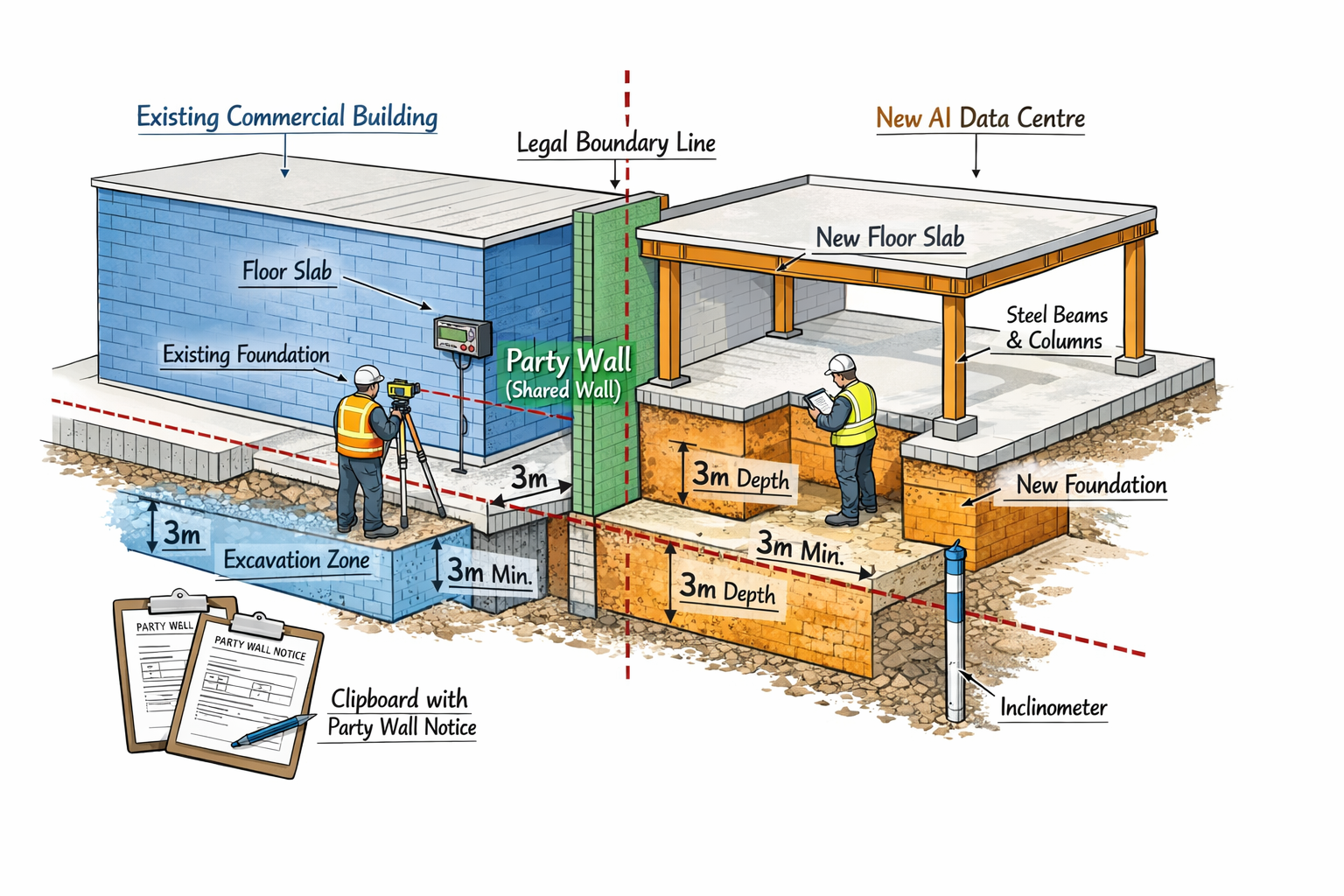
3. Excavation Notice (Section 6)
The most frequently triggered notice for data centre projects. Required when:
- Excavating within 3 metres of a neighboring building's foundation, going deeper than that foundation
- Excavating within 6 metres of a neighboring structure, cutting a line at 45 degrees from the bottom of their foundation
Given that data centre foundations typically extend 10-15 metres deep, Section 6 notices are virtually always required in urban settings.
Key UK Cities Experiencing Data Centre Construction Booms
The demand for Party Wall Surveying for AI Data Centre Expansions: 2026 Compliance Protocols Amid Tech-Driven Demand is concentrated in specific urban corridors:
London 🏙️ – Particularly in Docklands, Park Royal, and Slough, where 60% of UK hyperscale capacity is being developed
Manchester – Emerging as a northern tech hub with 12 major data centre projects underway in 2026
Birmingham – Strategic location driving £800 million in data centre investment
Edinburgh – Growing demand from financial services and tech sectors
Bristol – Renewable energy availability making it attractive for sustainable AI infrastructure
In these high-density areas, virtually every data centre project involves party wall considerations. The proximity of existing commercial and residential properties means developers must engage with multiple adjoining owners simultaneously.
Serving Effective Party Wall Notices
A valid party wall notice must include:
✅ Detailed description of proposed works – Including foundation depths, excavation extent, and construction methods
✅ Accurate site plans – Showing the relationship between the proposed data centre and adjoining properties
✅ Timeline information – Start date and expected duration of works
✅ Building owner details – Full contact information for the developer or property owner
✅ Surveyor information – If already appointed, details of the building owner's surveyor
Common mistakes that delay data centre projects include:
- Insufficient technical detail about foundation depths
- Failure to identify all affected adjoining owners
- Serving notices too close to the planned start date
- Not accounting for weekends and holidays in notice periods
- Using generic templates that don't address data centre-specific requirements
For complex projects, understanding party wall surveyor costs early in the planning process helps developers budget appropriately.
Dispute Resolution and Party Wall Awards for Data Centre Projects
When Adjoining Owners Dissent
In approximately 35-40% of data centre party wall cases, adjoining owners either formally dissent or fail to respond within the 14-day period. Under the Party Wall Act, non-response is treated as dissent, automatically triggering the dispute resolution process.
This isn't necessarily adversarial – it's simply the legal mechanism that enables the project to proceed while protecting all parties' interests.

The Surveyor Appointment Process
Once a dispute arises, parties have three options:
Option 1: Agreed Surveyor ⚖️
Both parties jointly appoint a single surveyor to act impartially. This is often the most cost-effective approach, with fees typically £3,500-£8,500 for data centre projects. Learn more about this process through party wall agreed surveyor guidance.
Option 2: Two Surveyors
Each party appoints their own surveyor, who then work together to produce the party wall award. The appointed surveyors may select a third surveyor to resolve any disagreements between them.
- Building owner's surveyor represents the developer's interests
- Adjoining owner's surveyor protects the neighbor's property
- Combined fees: £8,000-£25,000 for complex data centre projects
Option 3: Third Surveyor Selection
If the two appointed surveyors cannot agree on specific matters, they select a third surveyor whose decision is binding.
The Party Wall Award Document
The party wall award is a legally binding document that sets out:
📄 Scope of permitted works – Detailed specifications of what construction activities are authorized
📄 Working hours – Typically 8am-6pm Monday-Friday, 8am-1pm Saturday for data centre construction
📄 Access rights – When and how the building owner can access adjoining property if necessary
📄 Protective measures – Requirements for vibration monitoring, dust control, and structural protection
📄 Schedule of condition – Comprehensive photographic and written record of the adjoining property's current state
📄 Dispute resolution procedures – Process for addressing issues that arise during construction
📄 Cost responsibility – Typically, the building owner pays all reasonable surveyor fees and costs
For data centre projects, awards often include specialized provisions:
- Vibration limits during piling operations (typically 10-15mm/s peak particle velocity)
- Continuous monitoring requirements with real-time alerts
- Structural engineer oversight for deep excavation works
- Emergency contact protocols for 24/7 construction operations
- Remediation procedures if damage occurs despite precautions
Understanding what constitutes a party wall dispute helps developers anticipate and address concerns proactively.
Schedule of Condition: Your Protection Against Claims
A comprehensive party wall schedule of condition is absolutely critical for data centre projects. This document provides:
🔍 Photographic evidence – Hundreds of time-stamped images documenting every room, surface, and structural element
🔍 Detailed written descriptions – Recording existing cracks, settlement, defects, and conditions
🔍 Video walkthroughs – Increasingly common in 2026 for comprehensive documentation
🔍 Structural measurements – Crack width measurements, level surveys, and alignment checks
Without this documentation, developers face significant risk. When vibration from piling operations or settlement from deep excavations affects neighboring properties, pre-existing damage can be falsely attributed to the construction work.
Real-world example: A £180 million data centre project in West London faced a £400,000 damage claim from an adjoining property owner alleging structural damage from foundation work. The comprehensive schedule of condition proved the cracks existed before construction began, saving the developer the full claim amount plus legal costs.
Cost Implications and Financial Planning
Budgeting for Party Wall Compliance
For AI data centre expansions in 2026, party wall costs represent a significant but necessary investment:
| Cost Component | Typical Range | Notes |
|---|---|---|
| Party Wall Surveyor Fees | £8,000-£25,000 | Varies with project complexity and number of adjoining owners |
| Schedule of Condition | £1,500-£5,000 per property | More for larger commercial properties |
| Monitoring Equipment | £15,000-£45,000 | Vibration and settlement monitoring for duration of works |
| Legal Fees | £5,000-£20,000 | If disputes escalate or awards are challenged |
| Contingency for Remediation | 2-5% of construction value | Insurance against damage claims |
For a typical £150 million hyperscale data centre project, total party wall compliance costs might range from £75,000 to £250,000 – representing just 0.05-0.17% of the total project value but preventing potentially much larger losses from delays or disputes.
The True Cost of Non-Compliance
Developers who attempt to bypass party wall procedures face severe consequences:
⚠️ Injunctions – Adjoining owners can obtain court orders stopping all construction work immediately
⚠️ Retrospective compliance – Courts may require demolition and rebuilding to comply with proper procedures
⚠️ Unlimited damages – No cap on compensation for damage caused by non-compliant work
⚠️ Project delays – Average 4-8 months to resolve non-compliance issues
⚠️ Reputation damage – Affects future planning applications and community relations
A 2025 case study from Manchester saw a data centre developer forced to halt construction for 7 months after failing to serve proper Section 6 notices. The delay cost £2.3 million in holding costs, contractor standby fees, and lost revenue from delayed facility commissioning.
Technical Considerations Specific to AI Data Centre Construction
Foundation Design and Party Wall Implications
AI data centres require specialized foundation systems that create unique party wall challenges:
Piled Foundations 🏗️
Most urban data centres use continuous flight auger (CFA) piles or bored piles extending 12-18 metres deep. These create:
- Significant vibration during installation
- Risk of ground movement affecting adjacent structures
- Potential impact on neighboring foundations
- Noise concerns for residential or office neighbors
Party wall awards for piled foundations typically require:
- Pre-installation trial piles to establish vibration levels
- Real-time monitoring with automatic work stoppage if limits exceeded
- Alternative piling methods (e.g., pressed piles) near sensitive structures
- Structural engineer certification of neighboring building stability
Raft Foundations
Some data centres use reinforced concrete raft foundations 2-3 metres thick. These require:
- Extensive excavation triggering Section 6 notices
- Temporary works affecting stability of adjoining land
- Dewatering that may impact neighboring basements
- Concrete pouring operations with noise and vibration
Cooling System Infrastructure
Modern AI data centres generate enormous heat loads requiring sophisticated cooling systems that often impact party walls:
Underground water storage tanks – May extend beneath boundary lines requiring easement agreements
Cooling towers – Vibration and noise transmission through party walls requires acoustic isolation
Pipe penetrations – Creating openings through party walls for cooling infrastructure requires Section 1 notices
Power Infrastructure Challenges
AI data centres require 50-150 megawatts of power capacity, necessitating:
- Substation construction near boundary lines
- Underground cable routes potentially affecting adjoining foundations
- Generator installations with vibration isolation requirements
- Emergency power systems requiring 24/7 testing capabilities
Each of these elements requires careful consideration in party wall planning and may trigger multiple notice types.
Best Practices for Developers and Building Owners
Early Engagement Strategy
Successful data centre developers in 2026 follow a proactive party wall strategy:
1. Pre-acquisition due diligence 📋
Before purchasing land, identify:
- All potential adjoining owners (including those within 6m of planned excavations)
- Existing party wall agreements or disputes
- Historical settlement or structural issues in neighboring properties
- Previous construction disputes in the area
2. Community consultation 🤝
Before serving formal notices:
- Host information sessions explaining the project
- Provide visual representations of the completed facility
- Address concerns about noise, traffic, and construction impacts
- Establish communication channels for ongoing updates
3. Early surveyor appointment ⏰
Engage qualified party wall surveyors 6-9 months before planned construction start:
- Allows time for thorough surveys and documentation
- Enables resolution of disputes without delaying construction
- Provides opportunity to modify designs if significant issues arise
- Demonstrates professional approach to adjoining owners
4. Comprehensive documentation 📸
Invest in thorough pre-construction surveys:
- Professional photography of all adjoining properties
- Structural engineer assessment of neighboring buildings
- Baseline vibration and noise measurements
- Underground utility surveys to prevent damage
Selecting Qualified Surveyors
For AI data centre projects, standard party wall surveyors may lack the necessary expertise. Look for professionals with:
✓ Experience with large-scale commercial projects – Understanding the unique requirements of data centre construction
✓ Structural engineering knowledge – Ability to assess complex foundation interactions
✓ Vibration and settlement expertise – Understanding monitoring requirements and acceptable limits
✓ Commercial awareness – Appreciation of project timelines and cost implications
✓ RICS accreditation – Membership in the Royal Institution of Chartered Surveyors ensures professional standards
✓ Local knowledge – Familiarity with regional building practices and ground conditions
Many developers benefit from engaging chartered surveyors who specialize in complex commercial projects rather than residential-focused practitioners.
Technology Integration in 2026
Modern party wall surveying for data centres leverages advanced technology:
Digital monitoring systems 📱
- IoT-enabled vibration sensors with cloud reporting
- Automated alerts when thresholds approached
- Real-time dashboards accessible to all parties
- Historical data for dispute resolution
3D modeling and BIM integration
- Building Information Modeling showing precise relationship between structures
- Clash detection identifying potential party wall conflicts early
- Virtual reality presentations for adjoining owners
- Accurate volume calculations for excavation notices
Drone surveys
- Comprehensive roof and elevation documentation
- Safe inspection of difficult-to-access areas
- High-resolution imagery for condition schedules
- Regular progress monitoring
For projects requiring comprehensive property assessment, drone roof surveys provide valuable supplementary documentation.
Regional Variations and Local Authority Requirements
London-Specific Considerations
The capital's dense urban environment creates unique challenges for Party Wall Surveying for AI Data Centre Expansions: 2026 Compliance Protocols Amid Tech-Driven Demand:
Conservation areas – Additional planning constraints affecting construction methods and party wall procedures
Thames Water requirements – Strict dewatering regulations for deep excavations near the water table
Transport for London proximity – Enhanced monitoring requirements near Underground tunnels and railway infrastructure
High-value properties – Increased scrutiny and higher stakes for damage claims in prime locations
Regional Data Centre Hubs
Different UK regions have varying approaches to data centre development:
Manchester – Streamlined planning processes for tech infrastructure but strict environmental monitoring
Birmingham – Focus on sustainable construction with enhanced party wall requirements for green building certification
Edinburgh – Scottish Building Standards apply instead of Party Wall Act, requiring different procedures
Bristol – Strong community engagement requirements before major construction projects
Understanding these regional variations is essential for multi-site data centre developers planning nationwide expansion.
Future Trends and Emerging Challenges
AI-Driven Growth Projections
Industry forecasts for 2026-2030 indicate:
📈 400% increase in UK data centre capacity driven by AI and machine learning demands
📈 £12 billion in planned data centre investments across the UK
📈 Shift to edge computing – Smaller facilities in more locations, multiplying party wall considerations
📈 Retrofit projects – Converting existing industrial buildings, creating complex party wall scenarios
Regulatory Evolution
Anticipated changes to party wall legislation and practice:
Digital-first procedures – Electronic service of notices becoming standard, reducing timeline delays
Enhanced environmental standards – Stricter noise and vibration limits affecting construction methods
Climate adaptation requirements – Flood resilience and sustainable drainage impacting foundation design
Cybersecurity facilities designation – Potential fast-track planning for critical AI infrastructure
Sustainability and Party Wall Considerations
The push toward net-zero data centres creates new party wall challenges:
🌱 Ground source heat pumps – Requiring deep boreholes near boundary lines
🌱 Green roofs and living walls – Additional structural loads on party walls
🌱 Rainwater harvesting – Underground storage tanks potentially affecting adjoining land
🌱 Solar panel foundations – Rooftop installations requiring party wall notifications
Developers must integrate sustainability goals with party wall compliance, requiring innovative solutions and early stakeholder engagement.
Conclusion
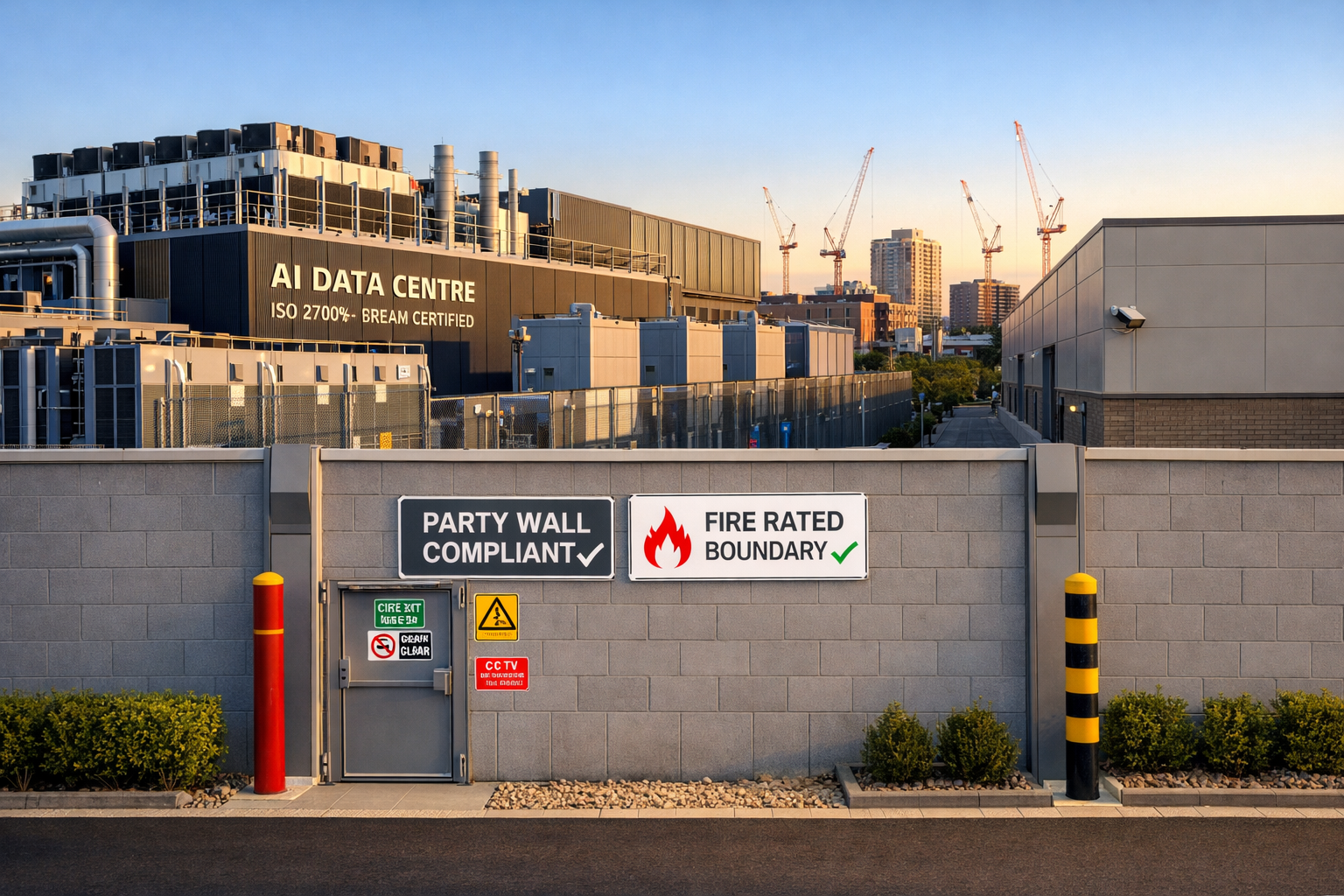
Party Wall Surveying for AI Data Centre Expansions: 2026 Compliance Protocols Amid Tech-Driven Demand represents a critical intersection of technological progress, legal requirements, and professional expertise. As the UK continues its transformation into a global AI powerhouse, the hyperscale data centres that power this revolution must be built on foundations of proper legal compliance and respectful neighbor relations.
The key to successful data centre development in 2026's complex regulatory environment lies in early planning, professional expertise, and proactive communication. Developers who view party wall procedures as obstacles rather than essential protections risk costly delays, legal disputes, and damaged reputations that can impact future projects.
Actionable Next Steps
For developers planning AI data centre expansions:
1. Conduct early site assessment – Identify all potential party wall implications before finalizing land acquisition
2. Engage qualified surveyors – Appoint experienced professionals with data centre project expertise at least 6 months before construction
3. Serve notices promptly – Allow maximum time for dispute resolution without delaying project timelines
4. Invest in comprehensive documentation – Thorough schedules of condition protect against unfounded damage claims
5. Establish monitoring systems – Real-time vibration and settlement monitoring demonstrates commitment to protecting neighbors
6. Maintain open communication – Regular updates to adjoining owners prevent misunderstandings and build goodwill
7. Budget appropriately – Allocate 0.1-0.2% of project value for party wall compliance and contingencies
For adjoining owners concerned about nearby data centre construction:
1. Respond promptly to notices – The 14-day response period is critical for protecting your rights
2. Appoint your own surveyor – Independent professional advice ensures your interests are protected
3. Document your property – Take your own photographs and notes before construction begins
4. Understand your rights – The Party Wall Act provides strong protections when properly invoked
5. Engage constructively – Reasonable cooperation facilitates smooth projects while protecting your property
The explosive growth of AI infrastructure is reshaping the UK's built environment. With proper application of party wall surveying principles, this transformation can proceed efficiently while protecting the rights and properties of all stakeholders. Understanding party wall agreements and the broader regulatory framework ensures that the data centres powering tomorrow's technology are built on solid legal and structural foundations today.
As we progress through 2026 and beyond, the professionals who master the intersection of cutting-edge technology infrastructure and traditional property law will be essential to realizing the UK's digital future. Whether you're a developer, property owner, or construction professional, investing in proper party wall compliance isn't just a legal requirement – it's a strategic imperative that protects investments, preserves relationships, and enables the responsible growth of critical AI infrastructure.