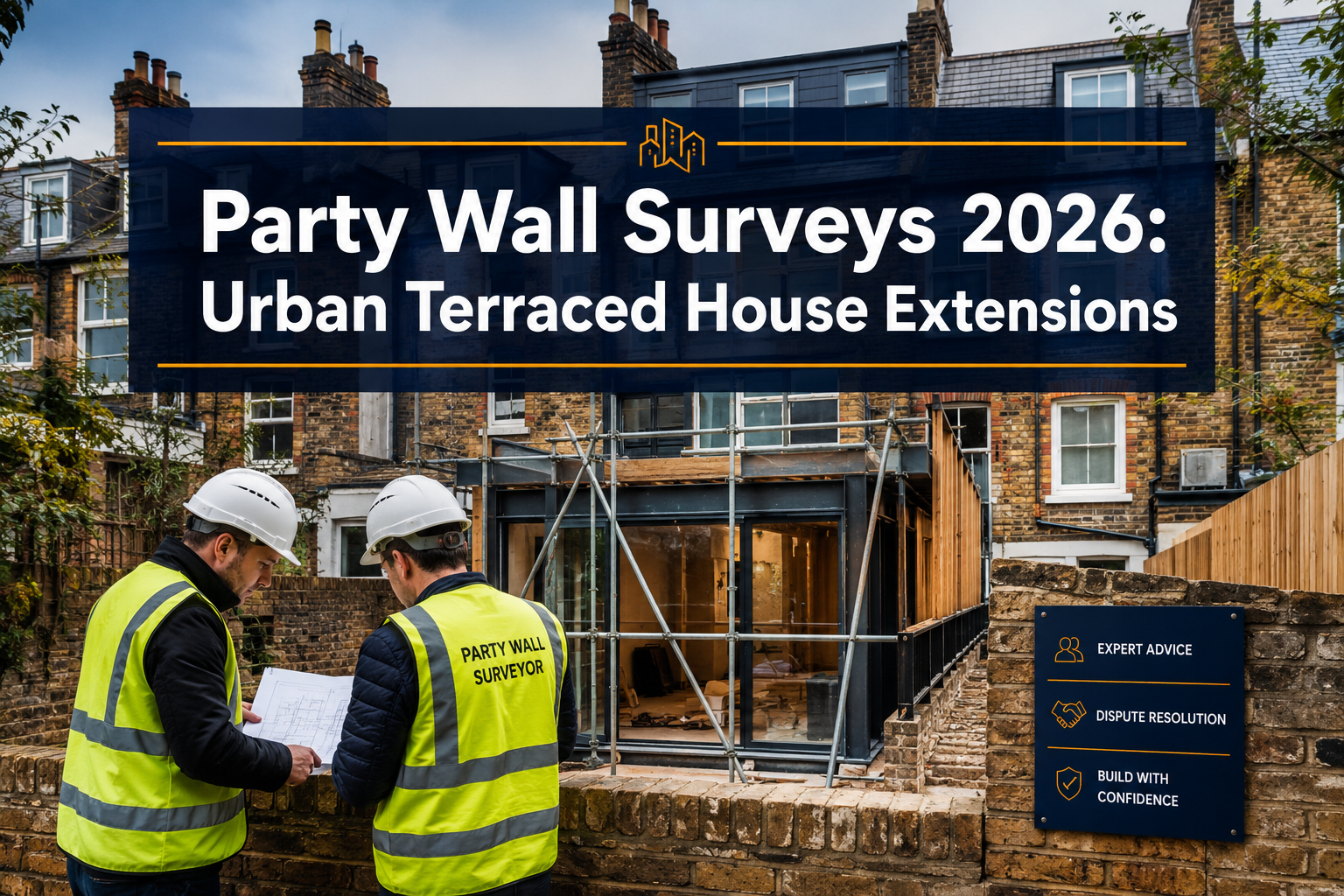
Nearly one in three planning applications for rear extensions in London's terraced housing stock stall — not because of council objections, but because the Party Wall Act process was started too late or handled incorrectly. For homeowners planning to extend in 2026, that delay can cost months of build time and thousands in abortive fees.
Party Wall Surveys for 2026 Urban Terraced House Extensions: Notice Timelines and Neighbour Safeguards is not a bureaucratic box-ticking exercise. It is a legally structured framework under the Party Wall etc. Act 1996 that protects both the person building and the neighbours living next door. Understanding the notice timelines, surveyor roles, and the protections embedded in a Party Wall Award is essential before a single spade hits the ground. [4]
Key Takeaways 📋
- Two separate notice periods apply: 2 months for party wall work; 1 month for excavations and new boundary walls.
- Excavation triggers apply at 3 metres and 6 metres from a neighbour's foundations — critical for rear extensions.
- The building owner pays all surveyor fees, so neighbours face no financial barrier to raising concerns.
- A Party Wall Award is a legally binding document that sets out permitted work, working hours, and dispute resolution.
- Early communication with neighbours dramatically reduces the risk of dissent, delays, and costly dual-surveyor proceedings.
What the Party Wall Act 1996 Actually Covers
The Party Wall etc. Act 1996 remains the governing legislation across England and Wales for any construction work that affects a shared wall, boundary structure, or adjacent foundations [4]. It does not apply in Scotland or Northern Ireland, where separate legal frameworks operate.
For urban terraced houses — the dominant housing typology in cities like London, Manchester, and Birmingham — the Act is almost always triggered when a rear extension is planned. This is because terraced properties share party walls on both sides, and rear extensions frequently involve:
- Cutting into or building off the party wall
- Excavating foundations close to the shared boundary
- Constructing new walls at or near the boundary line
Understanding party wall matters from the outset prevents costly surprises mid-project.
What Work Is Exempt?
Not all work on or near a party wall requires formal notification. Minor works are exempt, including [4]:
| Exempt Works | Notifiable Works |
|---|---|
| Plastering a party wall | Cutting into a party wall |
| Drilling for shelves or kitchen units | Raising or lowering a party wall |
| Electrical work on internal faces | Demolishing and rebuilding a party wall |
| Attaching lightweight fixtures | Excavating within 3–6 metres of foundations |
💡 Pull Quote: "If the work is structural, affects the wall's load-bearing capacity, or disturbs foundations near a boundary, a Party Wall Notice is almost certainly required."
Notice Timelines: The Two Critical Deadlines
Getting the notice timeline right is the single most important administrative step in Party Wall Surveys for 2026 Urban Terraced House Extensions: Notice Timelines and Neighbour Safeguards. There are two distinct notice periods, and confusing them is a common — and expensive — mistake.
The 2-Month Notice Period
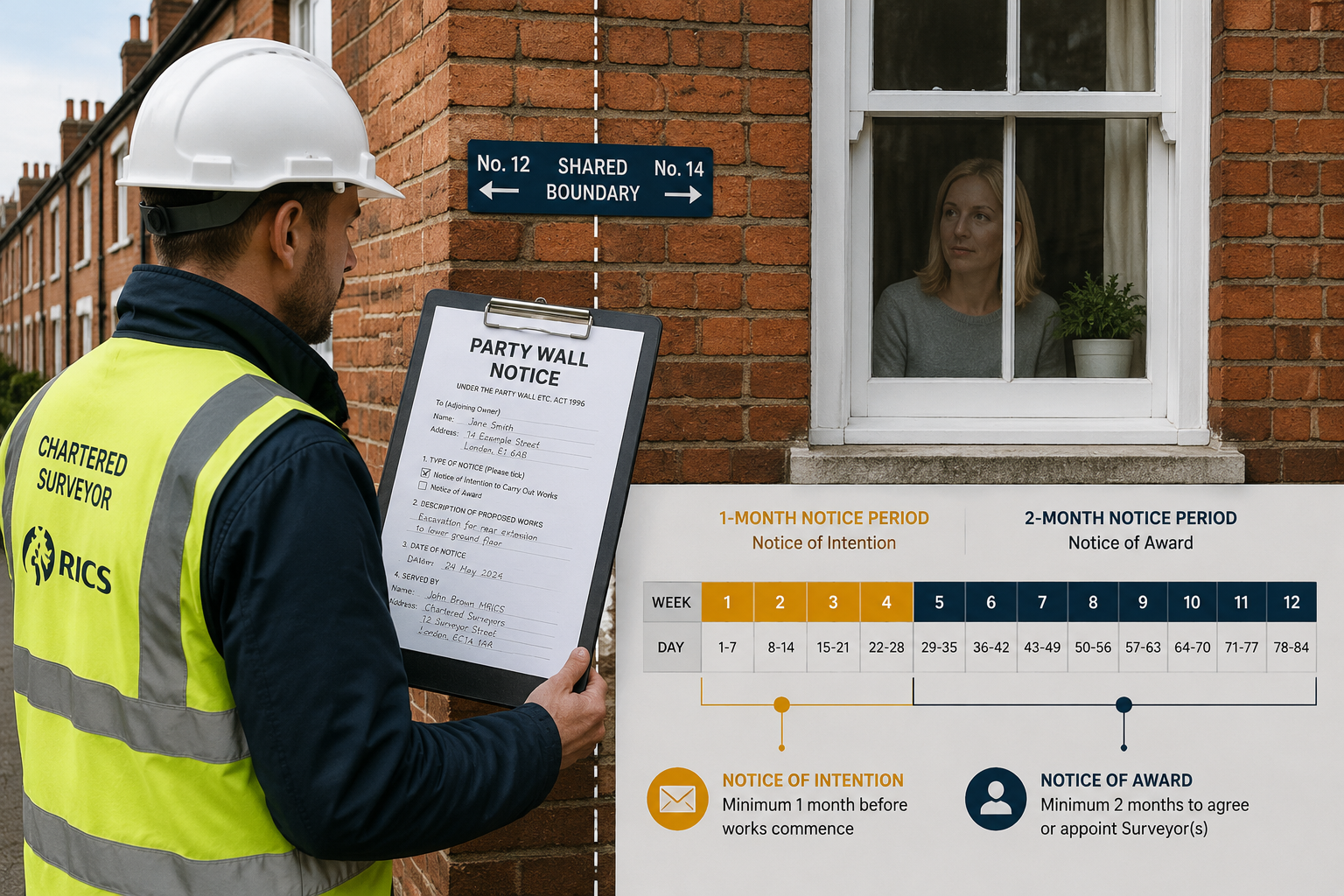
When proposed work directly affects a party wall or party structure, the building owner must serve a formal Party Wall Notice on the adjoining owner(s) at least 2 months before work begins [4].
This applies to:
- ✅ Cutting into the party wall to insert beams or RSJs
- ✅ Raising the height of a shared wall
- ✅ Demolishing and rebuilding a party wall
- ✅ Full-width rear extensions where the new external wall becomes an extension of the party wall [2]
For a full-width rear extension on a terraced house — extremely common in London's narrow-garden Victorian stock — the new side walls effectively become extensions of the existing party walls. This automatically triggers the 2-month notice requirement and, in most cases, requires a formal Party Wall Award before work can commence [2].
The 1-Month Notice Period
For work involving excavation near the boundary or the construction of a new wall at the boundary line, a shorter 1-month notice period applies [4].
This covers:
- ✅ Digging foundations for a rear extension
- ✅ Building a new garden wall on the boundary
- ✅ Installing drainage or services near the boundary
⚠️ The 3-Metre and 6-Metre Excavation Rules
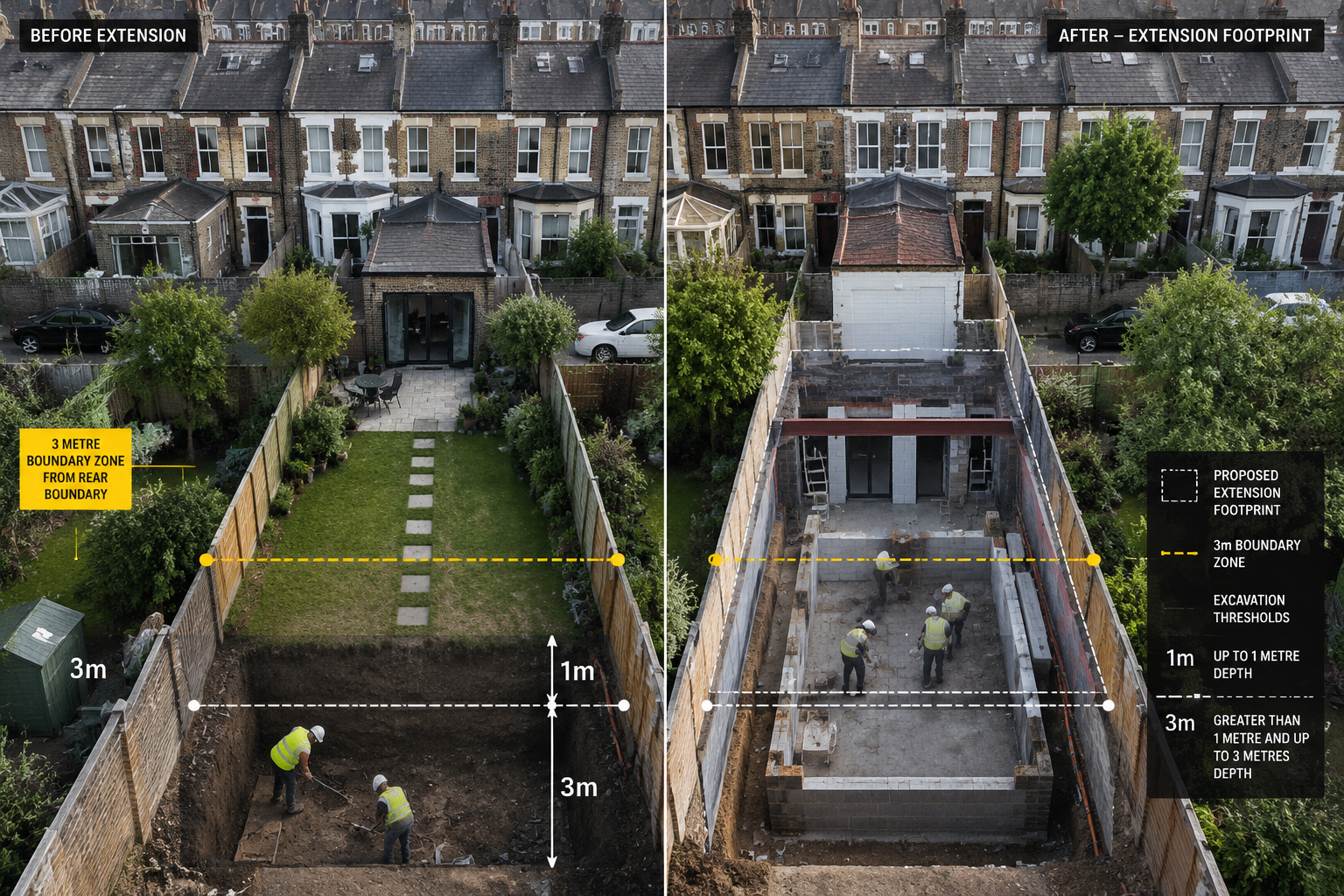
This is where many homeowners are caught off guard. Under the Act's Section 6 provisions, a Party Wall Notice must be served if excavation takes place:
- Within 3 metres of a neighbour's building, where the excavation goes deeper than the neighbour's foundations [1]
- Within 6 metres of a neighbour's building, where the excavation would cut a line drawn downward at 45° from the bottom of the neighbour's foundations [1]
Single-storey rear extensions typically require foundations at least 1 metre deep [2]. On a narrow terraced plot, that almost always brings the excavation zone within 3 metres of the adjoining property's foundations — making the Party Wall Notice non-negotiable.
For a practical breakdown of how the 3-metre rule works in practice, see this detailed guide on the Party Wall Act 3-metre rule.
Notice Timeline Checklist ✅
Use this checklist before starting any terraced house extension in 2026:
- Confirm whether work affects a party wall, party structure, or boundary
- Identify all adjoining owners (including upstairs leaseholders in converted properties)
- Serve the correct notice type (2-month or 1-month) in writing
- Include a description of the proposed works and a plan where required
- Record the date of service and keep proof of delivery
- Wait for the statutory response period before commencing work
- If consent is given in writing, retain it; if dissent is raised, appoint a surveyor
The Party Wall Award: Neighbour Safeguards Explained
When a neighbour dissents to a Party Wall Notice — or simply fails to respond within 14 days — a dispute is deemed to have arisen under the Act. At this point, the process moves to the appointment of a surveyor (or surveyors) and the production of a Party Wall Award [4].

What Is a Party Wall Award?
A Party Wall Award is a legally binding document that governs how the notifiable works are to be carried out. It typically includes [1]:
- Scope of permitted works — exactly what the building owner is allowed to do
- Method of construction — materials, techniques, and sequencing
- Working hours — usually restricted to weekday daytime hours
- Schedule of condition — a photographic and written record of the adjoining property's condition before works begin
- Access rights — when and how the building owner's contractors may access the neighbour's property if needed
- Dispute resolution process — how damage claims are assessed and resolved
The schedule of condition is particularly valuable for neighbours. It creates an independent baseline record of any pre-existing cracks, damp patches, or structural issues. If damage is later alleged, the schedule provides objective evidence. Learn more about how a schedule of dilapidations works in practice.
Agreed Surveyor vs. Two Surveyors
There are two routes once a dispute is deemed to have arisen:
| Route | Description | Timeline Impact |
|---|---|---|
| Agreed Surveyor | Both parties appoint a single impartial surveyor | Faster, lower cost |
| Two Surveyors | Each party appoints their own surveyor | Slower, higher cost |
If two surveyors cannot agree, a Third Surveyor — selected at the outset — makes the final determination. This three-surveyor tribunal is rare but available as a backstop.
💡 Pull Quote: "Delays are most common when both parties appoint separate surveyors and negotiations stall — potentially pushing a project start date back by several months." [1]
Choosing the agreed surveyor route, where both parties trust the same professional, is almost always faster and more cost-effective for straightforward terraced house extensions.
Who Pays?
A common misconception is that neighbours must fund their own surveyor. Under the Act, the building owner bears all reasonable surveyor costs — including the fee for the adjoining owner's surveyor if separate appointments are made [4]. This removes any financial barrier for neighbours to participate in the safeguard process.
In 2026, party wall surveyors typically charge between £150 and £200 per hour, with a complete Party Wall Award costing approximately £1,000 in straightforward cases [4]. For complex urban terraced extensions involving multiple adjoining owners or loft conversions, costs can be higher. For a detailed breakdown, review current party wall surveyor costs.
Practical Guidance: Preventing Disputes Before They Start
Party Wall Surveys for 2026 Urban Terraced House Extensions: Notice Timelines and Neighbour Safeguards work best when treated as a collaborative process rather than an adversarial one. The most common challenges arise not from legal complexity, but from poor neighbour communication [1].
Common Reasons Neighbours Dissent
- 🏚️ Fear of structural damage to their property
- 🔊 Noise and disruption concerns during construction
- 🌿 Loss of light or garden access during the build
- 📋 Lack of information about what the works actually involve
Pre-Notice Communication: A Simple Template
Before serving the formal notice, consider a brief informal conversation or letter to neighbours. A good pre-notice communication should:
- Explain the project in plain language — what is being built and why
- Acknowledge the impact — noise, dust, and access during construction
- Invite questions and offer to share architect's drawings
- Mention the Party Wall process and their rights under it
- Provide contact details for the appointed surveyor
This approach costs nothing and dramatically reduces the likelihood of formal dissent. For further guidance on handling situations where a neighbour is already carrying out work near your boundary, see this resource on what to do if a neighbour is carrying out party wall work.
Loft Conversions and Shared Chimneys
Urban terraced loft conversions present their own party wall considerations. Work on shared chimney stacks — common in Victorian and Edwardian terraces — is specifically covered by the Act. Any structural alteration to a shared chimney requires a Party Wall Notice and, in most cases, a formal Award. For more on this specific issue, see the guide to party wall shared chimneys.
When Boundary Disputes Overlap
Sometimes a party wall matter reveals an underlying boundary dispute — particularly where old deeds are ambiguous or fences have shifted over decades. These are separate legal issues but often arise simultaneously. Early engagement with a specialist can prevent a party wall process from becoming entangled with a boundary claim. For specialist support, explore the guide to boundary dispute and party wall surveyors in London.
RICS Compliance and the 2026 Construction Market
The Royal Institution of Chartered Surveyors (RICS) sets professional standards for party wall surveyors. In 2026, with urban construction activity recovering strongly following several years of supply chain disruption, the volume of party wall notices being served has increased significantly. [5]
RICS-regulated surveyors are bound by professional conduct rules that require impartiality, transparency, and competence. When selecting a party wall surveyor for a 2026 terraced house extension, homeowners should confirm:
- RICS membership or membership of the Faculty of Party Wall Surveyors (FPWS)
- Experience with urban terraced properties specifically
- Clear fee structures provided in writing before appointment
- Familiarity with local authority requirements in the relevant borough
For a comprehensive overview of the full party wall process from notice to Award, the party wall notice guide provides a structured walkthrough.
Conclusion: Actionable Next Steps for 2026
Party wall compliance is not optional — it is a legal requirement that protects everyone involved in an urban terraced house extension. The good news is that the process, when started early and managed professionally, rarely causes significant delays.
Here are the actionable next steps for homeowners planning a 2026 extension:
- Start the party wall process at least 3 months before your planned start date — this gives buffer time for the notice period and any Award negotiations.
- Identify all adjoining owners early, including leaseholders in converted flats who may also be entitled to notice.
- Engage a RICS-regulated party wall surveyor before serving notice — they can advise on the correct notice type and help draft compliant documentation.
- Speak to neighbours informally first — a brief conversation can prevent formal dissent and months of delay.
- Budget for surveyor costs — approximately £1,000 for a straightforward Award, potentially more for complex multi-owner situations.
- Retain all documentation — notices, acknowledgements, Awards, and schedules of condition form a legal record that protects both parties long after the build is complete.
The Party Wall etc. Act 1996 exists for good reason. In the densely packed terraced streets of urban Britain, construction work on one property inevitably affects the next. The notice timelines and neighbour safeguards built into the system are not obstacles — they are the foundation of a fair and orderly process that keeps projects moving and relationships intact.
References
[1] Navigating Challenges With Party Wall Agreements For House Extension Projects – https://www.gooddesignbuild.co.uk/navigating-challenges-with-party-wall-agreements-for-house-extension-projects/
[2] What You Need To Know About Party Walls – https://www.houzz.ie/magazine/what-you-need-to-know-about-party-walls-stsetivw-vs~55681438
[4] Party Wall Agreement – https://hoa.org.uk/advice/guides-for-homeowners/i-am-improving/party-wall-agreement/
[5] Party Wall Surveys And Neighbour Disputes During 2026s Construction Uptick RICS Compliance Framework – https://nottinghillsurveyors.com/blog/party-wall-surveys-and-neighbour-disputes-during-2026s-construction-uptick-rics-compliance-framework