
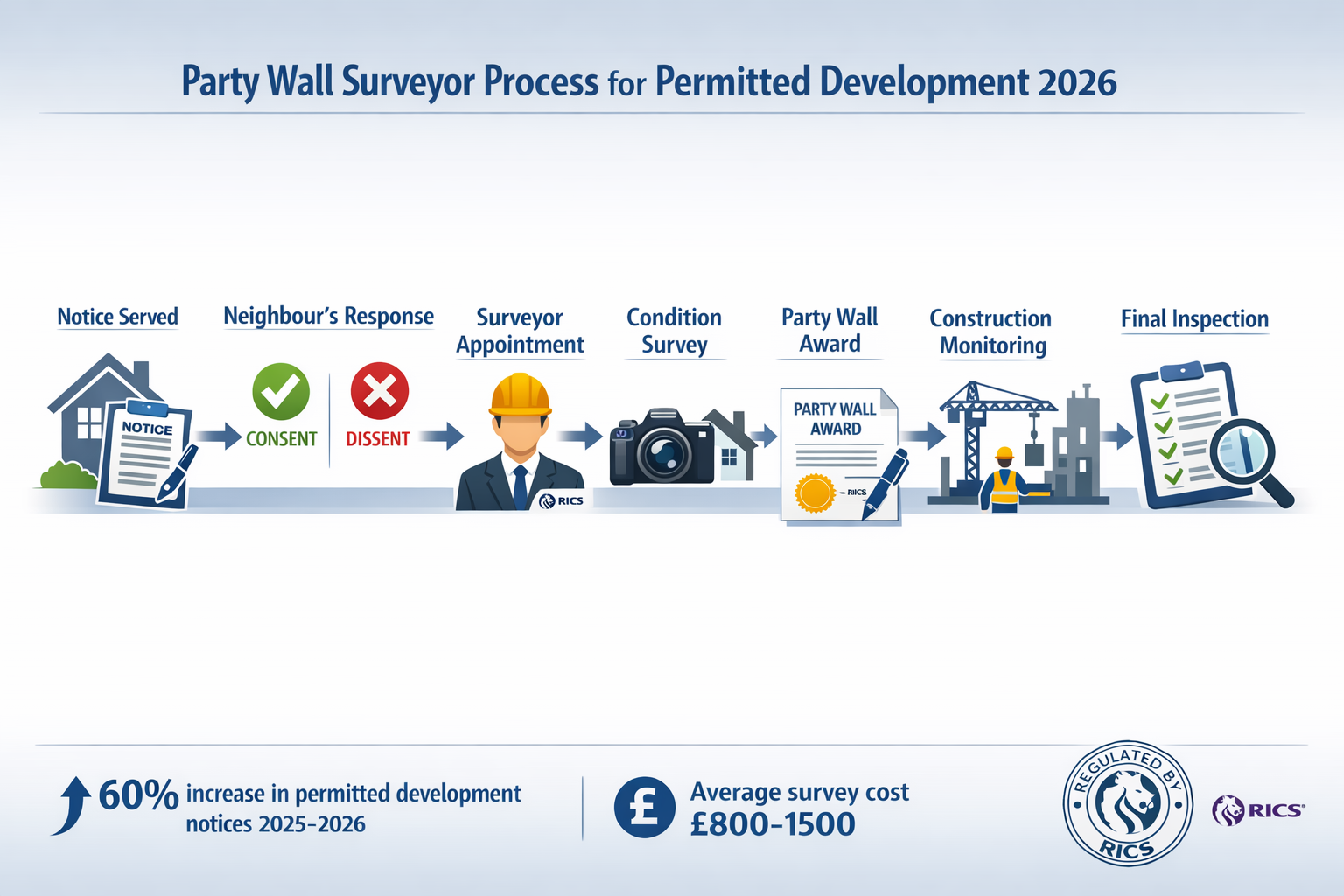
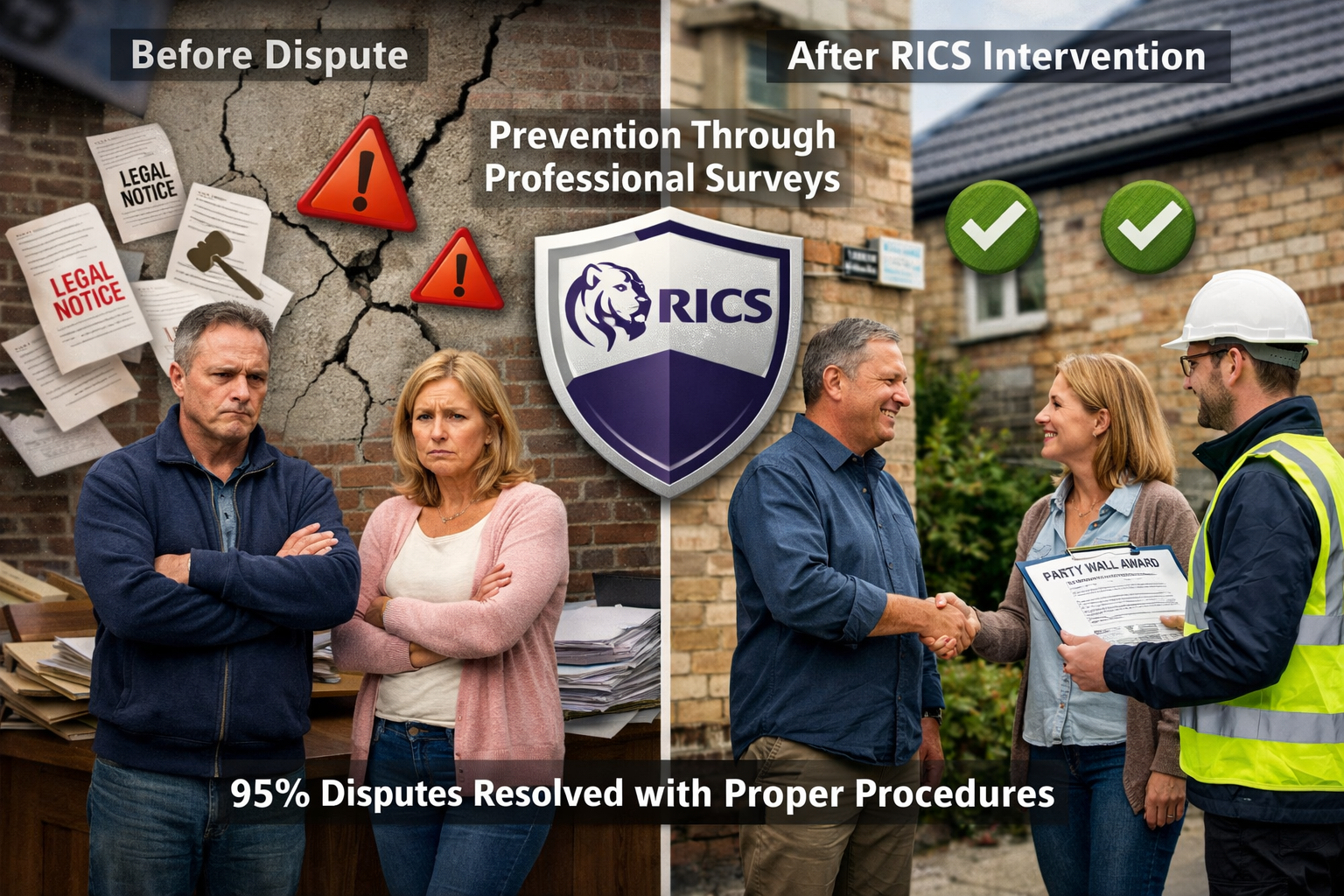
{"cover":"Professional landscape format (1536x1024) hero image featuring bold text overlay 'Party Wall Surveys for Permitted Development Expansions in 2026: RICS Guidelines Amid Housing Recovery Demand' in extra large 70pt white sans-serif font with dark shadow effect, positioned in upper third with perfect alignment. Background shows split composition: left side displays modern UK semi-detached homes with visible extension work and scaffolding, right side shows professional surveyor with tablet reviewing architectural plans against shared wall. Color scheme: deep navy blue, white, gold accents suggesting professional authority and housing recovery. Include subtle overlay of RICS logo watermark and construction blueprints. Magazine cover quality, editorial style, high contrast, rule of thirds composition, represents permitted development rights and professional surveying standards in 2026 housing market recovery.","content":["Landscape format (1536x1024) detailed illustration showing cross-section diagram of UK terraced houses with labeled party wall elements: shared chimney breast, boundary wall, foundation excavation zones. Include color-coded annotations showing 3-metre rule measurements, notice requirements timeline (2 months for structural work, 1 month for excavation), and permitted development expansion areas highlighted in green. Professional architectural drawing style with clean lines, measurement callouts, and small figures of homeowners on either side. Text overlay: 'Understanding Party Wall Act 1996 Requirements' in bold 48pt font. RICS standards badge visible in corner, technical yet accessible visual design.","Landscape format (1536x1024) professional infographic showing RICS party wall surveyor process flowchart for permitted development projects in 2026. Visual timeline from left to right: homeowner serving notice, neighbour response options (consent/dissent), surveyor appointment, condition survey with camera icon, party wall award document, construction phase monitoring, final inspection. Each stage represented by distinct icons and connected by arrows. Include statistics overlay: '60% increase in permitted development notices 2025-2026' and 'Average survey cost £800-1500'. Color scheme: professional blue, grey, green checkmarks. Clean infographic design with data visualization elements and RICS compliance stamps.","Landscape format (1536x1024) split-screen comparison image showing 'Before Dispute' vs 'After RICS Intervention' scenarios. Left side: frustrated neighbours with crossed arms, red warning symbols, cracked wall imagery, legal document chaos. Right side: handshake between neighbours, professional surveyor in high-vis reviewing detailed party wall award document, green checkmarks, protected property with monitoring equipment. Center divider shows RICS professional standards shield logo. Include text overlays: 'Prevention Through Professional Surveys' and '95% Disputes Resolved with Proper Procedures'. Professional photography style with documentary quality, emphasizing conflict resolution and housing recovery context in 2026 UK market."]}
As the UK housing market experiences renewed momentum in 2026, homeowners across England and Wales are seizing opportunities to expand their properties through permitted development rights. With mortgage rates falling and market confidence returning, the demand for home extensions, loft conversions, and basement excavations has surged dramatically. However, this construction boom brings a critical requirement that many property owners overlook: Party Wall Surveys for Permitted Development Expansions in 2026: RICS Guidelines Amid Housing Recovery Demand have become essential safeguards against costly disputes and legal complications.
The Party Wall etc. Act 1996 remains the cornerstone legislation governing building work that affects shared structures between neighbouring properties. As construction activity intensifies throughout 2026, understanding the intersection between permitted development rights and party wall obligations has never been more important for homeowners planning extensions.
Key Takeaways
🏠 Permitted development rights do not override Party Wall Act requirements – homeowners must still serve proper notices even when planning permission isn't needed
📋 RICS-qualified surveyors provide professional standards exceeding statutory minimums – ensuring comprehensive protection and dispute prevention
⏱️ Timeline planning is critical – party wall procedures require 2 months' notice for structural work and 1 month for excavations before construction begins
💰 Professional surveys cost £800-1,500 on average but prevent disputes that can cost tens of thousands in legal fees and delays
✅ 2026 housing recovery has increased party wall notice volumes by 60% – making early professional guidance essential for project success
Understanding Party Wall Surveys for Permitted Development Expansions in 2026
What Constitutes Permitted Development in 2026
Permitted development rights allow homeowners to carry out certain building works without obtaining full planning permission. In 2026, these rights typically include:
- Single-storey rear extensions up to 6 metres (semi-detached/terraced) or 8 metres (detached)
- Two-storey side extensions within specific dimensional limits
- Loft conversions that don't exceed height restrictions
- Basement excavations subject to volume and depth constraints
However, permitted development status does not exempt property owners from Party Wall Act compliance. This common misconception has led to numerous disputes and construction delays throughout 2026's housing recovery period.
The Party Wall Act 1996: Core Requirements
The Party Wall etc. Act 1996 applies to three main scenarios:
- Building on or at the boundary between properties
- Work to an existing party wall or structure (walls, floors, ceilings shared between properties)
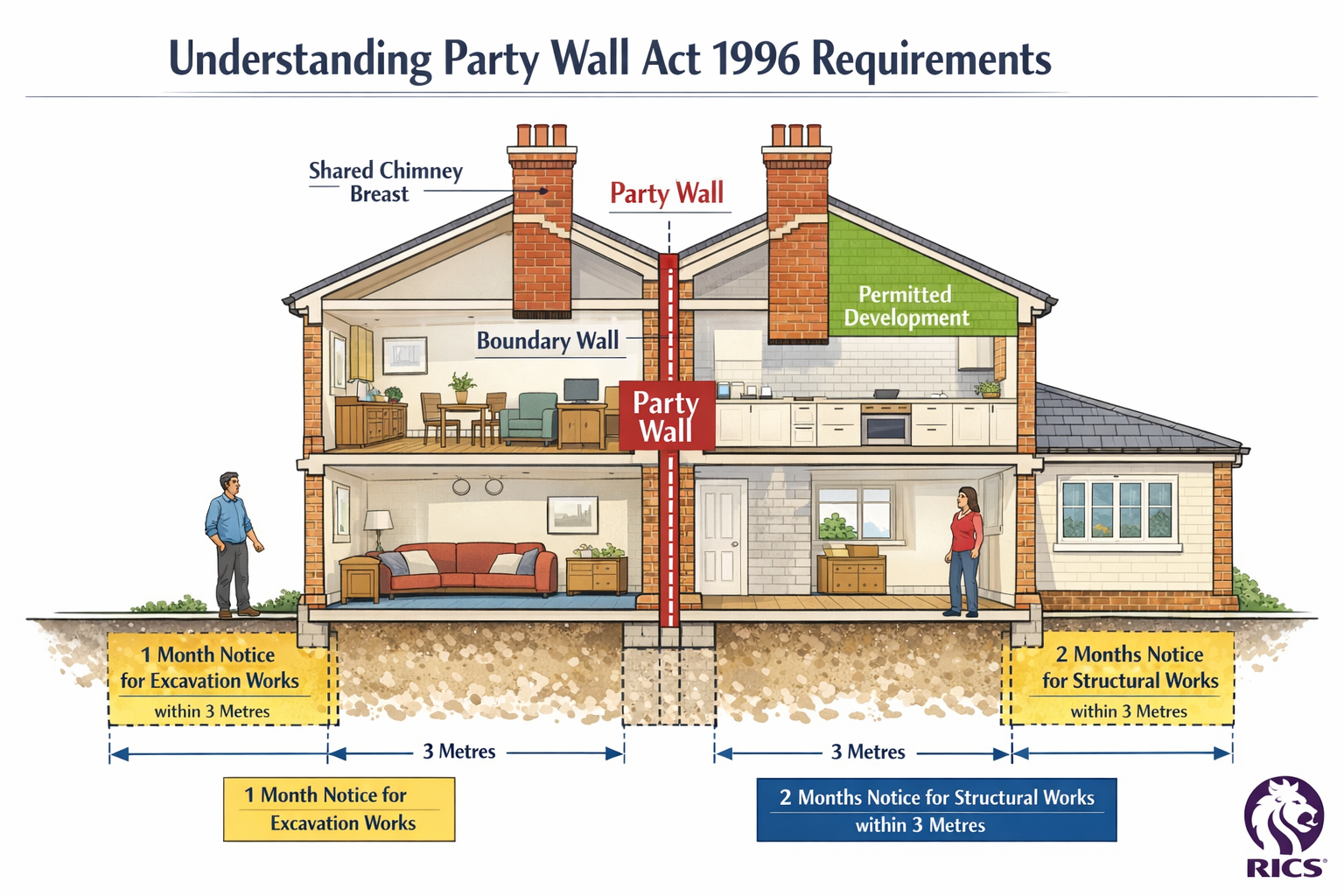
- Excavation within 3 or 6 metres of neighbouring structures
When planning permitted development expansions, homeowners must determine whether their project triggers any of these conditions. Professional guidance from chartered surveyors helps identify obligations early in the planning process.
Why RICS Guidelines Matter in 2026
The Royal Institution of Chartered Surveyors (RICS) provides comprehensive guidance that exceeds minimum legal compliance requirements.[1] RICS members must act with "due skill, care and diligence" while complying with the Party Wall etc. Act 1996, with additional ethical standards beyond statutory minimums.[1]
In 2026's competitive construction environment, RICS-qualified party wall surveyors offer:
- Professional indemnity insurance protecting all parties
- Standardized methodologies for condition surveys and assessments
- Ethical obligations to remain impartial and fair
- Technical expertise in structural assessment and risk mitigation
- Dispute resolution frameworks preventing escalation
"RICS professional standards ensure party wall surveyors maintain independence and technical competence, providing confidence to both building owners and adjoining owners during sensitive construction projects." – RICS Building Surveying Standards[3]
The Party Wall Survey Process for Permitted Development Projects
Step 1: Determine Party Wall Act Applicability
Before serving any notices, homeowners must assess whether their permitted development project affects:
- Party walls – shared walls between semi-detached or terraced properties
- Party fence walls – walls standing on the boundary line (not part of a building)
- Boundary structures – where new construction will be built directly on the property line
- Excavation zones – digging within 3 metres of a neighbour's structure (and deeper than its foundations) or within 6 metres (and below a 45-degree line from the bottom of foundations)
Understanding the Party Wall Act 3-metre rule is particularly important for basement conversions and deep foundation work associated with permitted development extensions.
Step 2: Serve Appropriate Party Wall Notices
Three types of notices exist under the Act:
| Notice Type | When Required | Notice Period |
|---|---|---|
| Party Structure Notice | Work directly to existing party walls/structures | 2 months minimum |
| Line of Junction Notice | Building new walls on/at the boundary | 1 month minimum |
| Excavation Notice | Digging within 3m or 6m of neighbouring foundations | 1 month minimum |
Homeowners must serve party wall notices in writing, including:
- Detailed description of proposed works
- Commencement date (after notice period expires)
- Drawings and specifications
- Contact information
Step 3: Neighbour Response and Surveyor Appointment
Adjoining owners have 14 days to respond with either:
✅ Consent – work may proceed without a party wall award (though a condition survey is still advisable)
❌ Dissent or no response – triggers the formal dispute resolution process requiring surveyor appointment
When disputes arise, three surveyor appointment options exist:
- Agreed Surveyor – single surveyor acting for both parties (most cost-effective)
- Two Surveyors – each party appoints their own surveyor who then select a third surveyor
- Three Surveyors – if the two appointed surveyors cannot agree
Professional guidance on party wall agreed surveyors helps navigate this critical decision point efficiently.
Step 4: Condition Survey and Documentation
RICS-qualified surveyors conduct comprehensive condition surveys of the adjoining owner's property before work commences. This documentation includes:
- Photographic records of all potentially affected areas
- Crack mapping showing existing defects and their severity
- Structural assessments identifying vulnerable elements
- Written descriptions of current property condition
- Video documentation for complex or extensive projects
This baseline evidence proves invaluable if party wall disputes arise regarding damage causation during construction.
Step 5: Party Wall Award Preparation
The surveyor(s) prepare a party wall award – a legally binding document detailing:
- Scope of permitted works with technical specifications
- Working hours and access arrangements
- Protection measures required during construction
- Monitoring schedules for ongoing inspections
- Dispute resolution procedures if issues arise
- Cost allocation for surveyor fees and related expenses
Awards typically take 2-4 weeks to prepare after condition surveys complete, adding to overall project timelines.
Step 6: Construction Phase Monitoring
RICS standards recommend periodic inspections during construction to:
- Verify compliance with award conditions
- Monitor for unexpected damage or settlement
- Document construction progress photographically
- Address emerging concerns before they escalate
- Maintain communication between all parties
This ongoing oversight has proven particularly valuable during 2026's construction uptick, when contractor scheduling pressures sometimes compromise quality.[2]
RICS Guidelines for Party Wall Surveys in 2026's Housing Recovery
Professional Standards and Ethics
RICS maintains building surveying standards covering residential surveys, commercial assessments, dilapidations, and party walls as core professional areas.[3] In 2026, these standards emphasize:
Independence and Impartiality 🎯
Party wall surveyors must remain neutral, serving the interests of the Act rather than either party. This independence prevents bias and ensures fair outcomes even in contentious situations.
Competence and Continuing Professional Development
RICS members must demonstrate:
- Current knowledge of party wall legislation and case law
- Technical competence in structural assessment
- Understanding of construction methods and materials
- Awareness of 2026 market conditions and housing recovery dynamics
Due Skill, Care and Diligence
Surveyors must exercise professional judgment appropriate to each project's complexity, conducting thorough investigations and providing comprehensive documentation.[1]
Cost Considerations and Fee Structures
Understanding party wall surveyor costs helps homeowners budget appropriately for permitted development projects in 2026:
Typical Fee Ranges:
- Agreed surveyor (simple extension): £800-1,200
- Agreed surveyor (complex project): £1,200-2,000
- Two surveyors (each): £1,500-3,000
- Third surveyor fees: £1,000-2,500
Factors Affecting Costs:
- Project complexity and scope
- Number of adjoining owners
- Property type and construction
- Geographic location (London typically 20-30% higher)
- Dispute complexity if disagreements arise
The building owner typically pays all reasonable surveyor fees under the Act, including the adjoining owner's surveyor costs. This represents a significant consideration when budgeting for permitted development expansions.
Common Pitfalls and How to Avoid Them
❌ Starting work before notice periods expire
Many homeowners begin construction prematurely, invalidating their notices and exposing themselves to injunctions. Always wait until statutory periods complete.
❌ Inadequate notice descriptions
Vague or incomplete notice details lead to disputes and delays. Include comprehensive drawings and specifications from the outset.
❌ Assuming permitted development exempts Party Wall Act compliance
This fundamental misunderstanding causes the majority of 2026 disputes. The two regulatory frameworks operate independently.
❌ Neglecting condition surveys
Even when neighbours consent, baseline documentation protects against unfounded damage claims. Professional surveys provide essential evidence.
❌ Poor contractor briefing
Ensure builders understand party wall award conditions and working restrictions. Violations can trigger work stoppages and additional costs.
Special Considerations for 2026 Housing Market Conditions
The 2026 housing recovery has created unique circumstances affecting party wall procedures:
Increased Construction Demand 📈
With construction activity surging, contractor availability and material costs have fluctuated significantly. Party wall timelines must accommodate these market realities when scheduling commencement dates.
Mortgage-Driven Extensions
Falling mortgage rates have enabled homeowners to finance substantial improvements, increasing the scale and complexity of typical permitted development projects. Larger projects require more comprehensive party wall assessments.
Neighbour Relations in Dense Urban Areas
London and major cities experience particularly high volumes of party wall notices in 2026. Maintaining positive neighbour relationships through professional surveyor mediation prevents disputes that could derail projects.
Data Centre and Commercial Parallels
The construction uptick extends beyond residential properties, with commercial developments also requiring party wall compliance.[2] Homeowners benefit from the enhanced professional standards developed for these complex projects.
Practical Guidance for Homeowners Planning Extensions
Timeline Planning for Permitted Development Projects
Successful project delivery in 2026 requires careful timeline coordination:
Months 1-2: Planning and Design
- Develop extension designs within permitted development limits
- Consult with architects or designers
- Identify party wall obligations
- Obtain initial cost estimates
Month 3: Party Wall Process Initiation
- Appoint RICS-qualified party wall surveyor
- Prepare and serve appropriate notices
- Allow 14 days for neighbour responses
Months 4-5: Survey and Award Preparation
- Conduct condition surveys
- Negotiate award terms
- Finalize party wall award documentation
- Obtain building control approval
Month 6 Onwards: Construction Phase
- Commence work after all approvals secured
- Implement monitoring schedule
- Maintain communication with surveyors
- Complete final inspections
This timeline assumes straightforward consent scenarios. Disputes or complex negotiations may extend the process by 1-3 months.
Selecting the Right RICS Party Wall Surveyor
When choosing professional representation, homeowners should consider:
✓ RICS membership verification – confirm current accreditation
✓ Local experience – familiarity with regional construction practices
✓ Permitted development expertise – specific experience with residential extensions
✓ Communication skills – ability to explain complex issues clearly
✓ Professional indemnity insurance – adequate coverage for project value
✓ Transparent fee structures – clear quotations without hidden costs
Engaging experienced party wall surveyors early in the planning process prevents costly mistakes and delays.
Maintaining Positive Neighbour Relations
Beyond legal compliance, successful permitted development projects in 2026 depend on constructive neighbour relationships:
Pre-Notice Communication 💬
Informal discussions before serving formal notices help:
- Explain project benefits and minimize concerns
- Identify potential objections early
- Demonstrate consideration and respect
- Establish cooperative tone for formal process
Transparency Throughout Construction
Regular updates on:
- Construction schedules and milestones
- Temporary inconveniences (noise, access, parking)
- Progress toward completion
- Addressing concerns promptly
Professional Mediation
When tensions arise, RICS surveyors provide neutral mediation, preventing personal conflicts from escalating into formal disputes.
When Neighbours Undertake Party Wall Work
Homeowners may also find themselves as adjoining owners when neighbours carry out party wall work. Understanding rights and responsibilities from this perspective ensures balanced protection:
Adjoining Owner Rights:
- Appoint own surveyor at building owner's expense
- Request comprehensive condition surveys
- Require adequate protection measures
- Seek compensation for proven damage
- Challenge unreasonable working hours or methods
Adjoining Owner Responsibilities:
- Respond to notices within 14 days
- Allow reasonable access for surveys
- Cooperate with appointed surveyors
- Avoid unreasonable objections to legitimate work
Regional Considerations Across England and Wales
London and Major Urban Centers
Dense urban environments present unique party wall challenges in 2026:
- Higher property values increase potential damage claim amounts
- Complex ownership structures (leaseholds, freeholds, multiple occupancy)
- Victorian and Edwardian terraces with aging party wall structures
- Basement excavations requiring specialized foundation assessments
- Premium surveyor fees reflecting higher operating costs
Homeowners in Central London and surrounding areas should budget 20-30% above national average costs for party wall procedures.
Suburban and Semi-Rural Areas
Outside major cities, party wall work often involves:
- Detached and semi-detached properties with simpler party wall scenarios
- Larger plot sizes reducing excavation proximity concerns
- More cooperative neighbour relationships in established communities
- Lower surveyor availability potentially requiring wider geographic searches
Regional Variations in Construction Practices
Different regions exhibit varying construction methods affecting party wall assessments:
- Cavity wall construction (common post-1920s)
- Solid wall terraces (Victorian/Edwardian properties)
- Modern timber frame (recent developments)
- Listed buildings requiring heritage considerations
RICS surveyors adapt their methodologies to accommodate these regional and historical variations.
Case Studies: Party Wall Surveys in 2026 Permitted Development Projects
Case Study 1: Single-Storey Rear Extension, Semi-Detached Property
Project Details:
- 5-metre single-storey rear extension
- Permitted development (no planning permission required)
- Shared party wall with neighbour
- Foundation excavation within 3 metres of neighbour's structure
Party Wall Process:
- Party Structure Notice served (2-month notice period)
- Excavation Notice served (1-month notice period)
- Neighbour initially dissented, concerned about foundation damage
- Agreed surveyor appointed (£1,100 total fee)
- Comprehensive condition survey documented existing minor cracks
- Award specified underpinning requirements and monitoring schedule
- Construction completed without incident
- Final inspection confirmed no new damage
Outcome: Professional party wall procedures prevented potential dispute, with project completing on schedule and maintaining positive neighbour relations.
Case Study 2: Loft Conversion with Party Wall Complications
Project Details:
- Two-storey terraced property
- Loft conversion within permitted development rights
- Shared chimney breast removal required
- Steel beam installation affecting party wall
Party Wall Process:
- Party Structure Notice served for chimney and beam work
- Neighbour consented but requested independent surveyor
- Two surveyors appointed (£1,800 each, plus £1,200 third surveyor)
- Detailed structural calculations required for award
- Neighbour's surveyor identified additional support requirements
- Modified design incorporated enhanced structural protection
- Phased monitoring during construction
- Minor plaster cracking addressed through award provisions
Outcome: Higher surveyor costs offset by avoiding potential structural damage claims and legal disputes. Enhanced structural design benefited both properties.
Case Study 3: Basement Excavation Dispute Resolution
Project Details:
- Basement excavation under existing footprint
- Permitted development under 2026 regulations
- Victorian terrace with shallow foundations
- Excavation within 3 metres of both neighbours
Party Wall Process:
- Excavation Notices served to both adjoining owners
- One neighbour consented; other dissented citing structural concerns
- Two surveyors appointed for dissenting neighbour
- Extensive structural investigation revealed foundation vulnerabilities
- Award required temporary shoring and permanent underpinning
- Construction costs increased by £18,000 for enhanced protection
- Weekly monitoring throughout excavation phase
- Settlement monitoring continued 6 months post-completion
Outcome: Professional party wall procedures identified genuine structural risks, preventing potential catastrophic damage. Additional costs proved essential investment in property protection.
Future Outlook: Party Wall Surveys Beyond 2026
Anticipated Regulatory Developments
While the Party Wall etc. Act 1996 remains unchanged, several trends may influence future practice:
Digital Notice Service 📱
Electronic notice service and digital documentation may gain formal recognition, streamlining administrative processes while maintaining legal protections.
Enhanced Consumer Protection
Growing recognition of homeowner vulnerability may prompt additional guidance on surveyor selection and fee transparency.
Climate Adaptation Works
Increasing flood resilience and energy efficiency retrofits may trigger party wall considerations, requiring updated technical guidance.
Continuing Housing Market Evolution
The 2026 housing recovery represents one phase in ongoing market cycles. Party wall procedures will remain essential regardless of market conditions, protecting property rights and preventing disputes during:
- Market upturns driving extension activity
- Downturns when value protection becomes paramount
- Stable periods with steady improvement activity
Professional Standards Development
RICS continues evolving its professional standards to address:
- Emerging construction technologies and methods
- Complex ownership structures in modern developments
- Environmental and sustainability considerations
- Enhanced dispute resolution frameworks
Homeowners benefit from these ongoing improvements through more comprehensive protection and clearer guidance.
Conclusion: Navigating Party Wall Surveys Successfully in 2026
Party Wall Surveys for Permitted Development Expansions in 2026: RICS Guidelines Amid Housing Recovery Demand represent an essential component of responsible home improvement planning. As the UK housing market continues its recovery trajectory, homeowners pursuing permitted development rights must recognize that planning exemptions do not override party wall obligations.
The key principles for success include:
🏗️ Early Planning – Identify party wall requirements during initial design phases, allowing adequate time for notice periods and survey processes.
👥 Professional Guidance – Engage RICS-qualified party wall surveyors who bring technical expertise, ethical standards, and dispute prevention capabilities exceeding statutory minimums.
💰 Realistic Budgeting – Include party wall surveyor fees (£800-3,000+) and potential protection measures in project budgets from the outset.
⏰ Timeline Management – Allow 3-6 months for complete party wall procedures before construction commencement, particularly for complex projects or multiple adjoining owners.
🤝 Neighbour Relations – Maintain open communication and demonstrate consideration throughout the process, leveraging professional surveyors as neutral mediators when needed.
📋 Comprehensive Documentation – Ensure thorough condition surveys and detailed party wall awards protect all parties against unfounded claims and genuine damage concerns.
Actionable Next Steps
For homeowners planning permitted development extensions in 2026:
-
Assess party wall obligations using the three-category framework (boundary work, party structures, excavations)
-
Consult RICS-qualified surveyors for initial guidance on notice requirements and timeline implications
-
Prepare comprehensive project documentation including detailed drawings and specifications for notices
-
Serve appropriate notices with adequate lead time before desired construction commencement
-
Engage constructively with neighbours and appointed surveyors throughout the process
-
Budget appropriately for surveyor fees, protection measures, and potential design modifications
-
Maintain compliance with party wall award conditions during construction
By following RICS guidelines and embracing professional party wall procedures, homeowners can successfully navigate permitted development expansions while protecting their investments, maintaining neighbour relationships, and contributing to 2026's housing recovery with confidence and legal compliance.
The intersection of permitted development rights and party wall obligations may seem complex, but professional guidance transforms potential obstacles into manageable processes. In an era of housing market optimism and construction activity growth, proper party wall surveys represent not bureaucratic burdens but essential safeguards ensuring sustainable, dispute-free property improvements.
For expert assistance with party wall matters, contact qualified chartered surveyors who understand the unique demands of 2026's housing recovery and can guide your permitted development project to successful completion.
References
[1] Party Wall Legislation And Procedure – https://www.rics.org/profession-standards/rics-standards-and-guidance/sector-standards/building-surveying-standards/party-wall-legislation-and-procedure
[2] Party Wall Surveys For Data Centre Expansions In The Uk Ai Boom Rics Guidance And Case Studies From 2026 Projects – https://nottinghillsurveyors.com/blog/party-wall-surveys-for-data-centre-expansions-in-the-uk-ai-boom-rics-guidance-and-case-studies-from-2026-projects
[3] Building Surveying Standards – https://www.rics.org/profession-standards/rics-standards-and-guidance/sector-standards/building-surveying-standards