The UK property market is experiencing an unprecedented shift in 2026. For the first time in decades, Northern England and Scotland are outpacing London and the South East in price growth, creating a complex landscape for property valuers. This regional valuation divergence demands new approaches, sophisticated adjustment techniques, and a fundamental rethinking of traditional appraisal methodologies.
As surveyors navigate Regional Valuation Divergence 2026: Surveyor Strategies for North-South Market Bifurcation, understanding these geographical splits has become essential for accurate property assessments. The traditional assumption that London and the South East would always lead market appreciation has been turned on its head, requiring valuers to develop region-specific expertise and adjustment frameworks.
Key Takeaways
- 📊 Northern regions are experiencing stronger price growth than London and the South East, reversing decades of market trends
- 🔍 Surveyors must apply sophisticated regional adjustment factors to comparables when conducting valuations across different UK markets
- 📅 The April 2026 revaluation deadline creates urgency for accurate market movement adjustments in property assessments
- 💼 Regional industrial properties are outperforming London-centric assets, presenting new valuation challenges and opportunities
- 🎯 Fundamentals-driven, location-specific approaches are replacing one-size-fits-all valuation methodologies in 2026
Understanding the North-South Market Bifurcation in 2026
The Regional Valuation Divergence 2026: Surveyor Strategies for North-South Market Bifurcation phenomenon represents more than a temporary market fluctuation. It reflects fundamental economic restructuring across the United Kingdom.
The Drivers Behind Regional Divergence
Several powerful forces are reshaping regional property markets:
Economic Regeneration in the North 🏗️
- Major infrastructure investments in Northern cities
- Business relocations from expensive Southern locations
- Government levelling-up initiatives creating employment hubs
- Lower entry costs attracting first-time buyers and investors
Southern Market Pressures 📉
- Stamp duty impacts on high-value properties
- Affordability constraints limiting buyer pools
- Remote working reducing London's employment premium
- Regulatory pressures on landlords in established markets
According to industry analysis, regionally-exposed REITs are showing higher earnings growth at lower multiples compared to those primarily concentrated in London[1]. This trend directly impacts how chartered surveyors across London must approach property valuations.
Market Performance Data: A Tale of Two Markets
| Region | Average Price Growth (2025-2026) | Rental Yield | Investment Activity |
|---|---|---|---|
| Northern England | +8.2% | 5.8% | ↑ High |
| Scotland | +7.5% | 5.4% | ↑ Increasing |
| Midlands | +6.1% | 5.1% | → Stable |
| South East | +2.3% | 3.9% | ↓ Declining |
| London (Prime) | +1.8% | 3.2% | ↓ Softening |
These divergent trends create significant challenges for surveyors conducting commercial property valuations across multiple regions.
The Global Context
The UK's regional divergence mirrors broader global patterns. Industry research indicates that 2026 is characterized as a market of specific opportunities, with diverging global trends and a still-fragmented recovery requiring selective, fundamentals-driven investment positioning[3].
Globally, equity multiples for REITs are trading nearly 30% cheaper than historical levels compared to global equities—the deepest discount since the aftermath of the 2008 Global Financial Crisis[1]. This creates a complex backdrop for UK property valuations.
Surveyor Adjustment Techniques for Regional Valuation Divergence 2026

Addressing Regional Valuation Divergence 2026: Surveyor Strategies for North-South Market Bifurcation requires surveyors to develop sophisticated adjustment methodologies that capture regional market dynamics accurately.
Comparable Selection in Bifurcated Markets
Traditional comparable selection assumes relatively uniform market conditions. In 2026, this assumption no longer holds.
Key Principles for Regional Comparables:
✅ Geographic Proximity Weighting – Prioritize comparables within the same regional market segment rather than defaulting to larger geographic areas
✅ Temporal Adjustments – Apply region-specific time adjustments reflecting local market velocity rather than national averages
✅ Economic Alignment – Match comparables to properties with similar regional economic drivers (industrial regeneration, commuter patterns, local employment)
✅ Infrastructure Correlation – Consider proximity to region-specific infrastructure investments that drive value
Surveyors must carefully adjust comparables for market movements ahead of the April 2026 revaluation deadline, reflecting post-budget 2026 valuation pressures on high-value properties[2]. This is particularly critical for chartered surveyors in North London working across the North-South boundary.
Regional Adjustment Factor Framework
Developing a systematic approach to regional adjustments is essential:
Northern Market Adjustments (+)
- Industrial regeneration premium: +5% to +15%
- Infrastructure proximity bonus: +3% to +8%
- First-time buyer demand factor: +4% to +10%
- Commercial relocation premium: +6% to +12%
Southern Market Adjustments (-)
- Stamp duty impact on £2M+ properties: -3% to -7%
- Affordability constraint factor: -2% to -5%
- Reduced London premium: -4% to -9%
- Regulatory compliance costs: -1% to -3%
These adjustments must be applied judiciously, with clear documentation supporting each modification. Expert surveyor advice emphasizes the importance of transparent adjustment rationale.
The April 2026 Revaluation Challenge
The upcoming revaluation deadline creates particular pressure points:
Critical Considerations:
- Market Movement Capture – Accurately reflecting rapid regional price changes
- Comparable Currency – Ensuring comparables reflect current market conditions
- Documentation Standards – Meeting RICS requirements for adjustment justification
- Client Communication – Explaining regional divergence to clients expecting traditional patterns
For properties in transitional areas, surveyors working in South West London or South East London must be particularly careful in selecting appropriate regional benchmarks.
Sector-Specific Adjustment Strategies
Different property sectors require tailored approaches:
Industrial & Logistics 🏭
- Northern industrial properties showing strongest growth
- Proximity to transport corridors driving premiums
- E-commerce fulfillment demand concentrated regionally
- Regional outperformance vs. London-centric assets[1]
Residential 🏘️
- First-time buyer affordability driving Northern demand
- Southern luxury market experiencing correction
- Suburban vs. urban divergence within regions
- Remote working impact varying by location
Retail & Commercial 🏬
- Regional shopping centers showing resilience
- High street performance varying dramatically by region
- Digital infrastructure supporting regional commercial growth[4]
Understanding these sector dynamics is crucial for valuation factors assessment across regions.
Practical Implementation: Regional Valuation Strategies for 2026
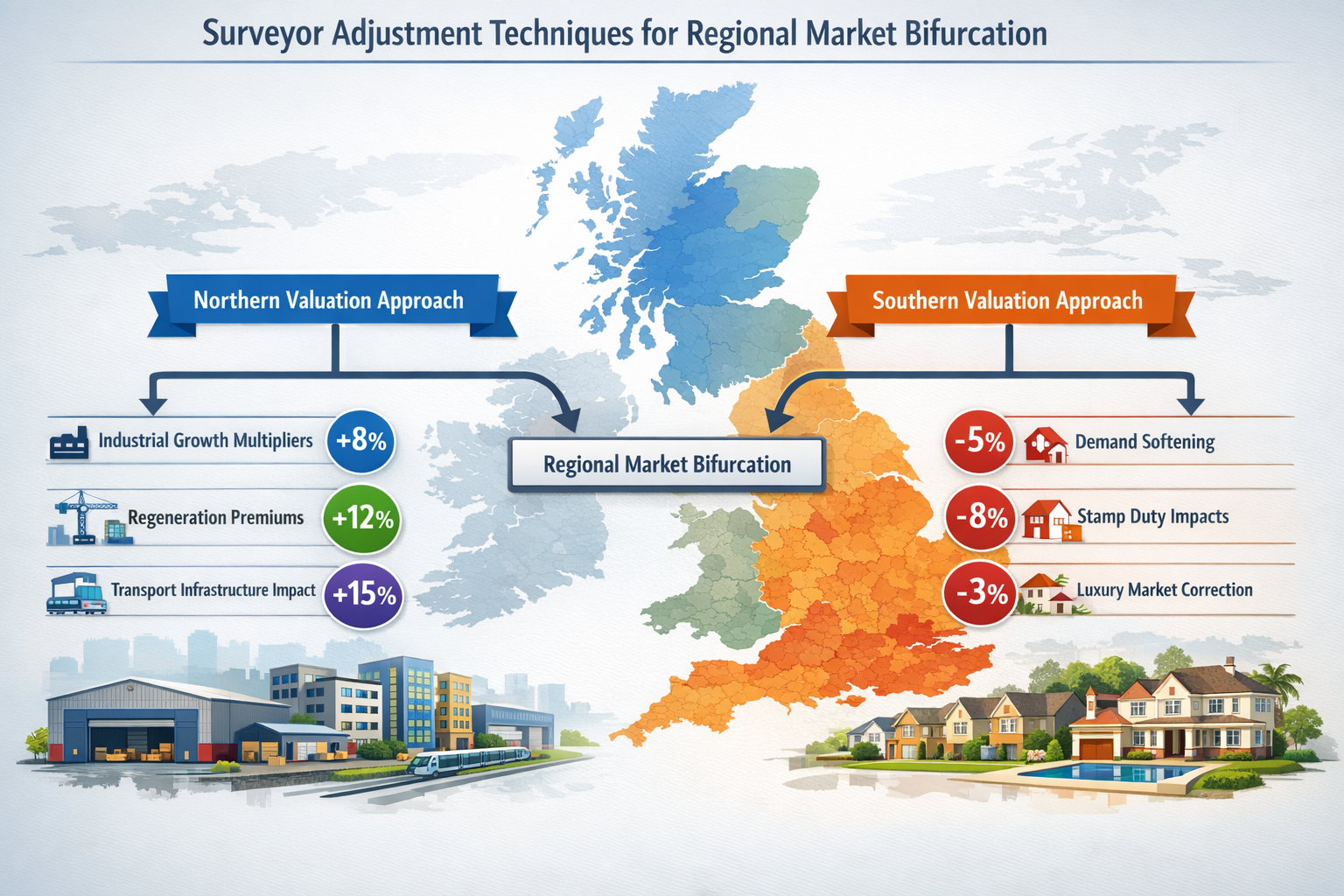
Implementing effective strategies for Regional Valuation Divergence 2026: Surveyor Strategies for North-South Market Bifurcation requires practical tools and systematic approaches.
Building Regional Market Intelligence
Surveyors must develop deep regional expertise:
Data Sources to Monitor:
- Regional Land Registry transaction data
- Local authority planning approvals
- Regional employment statistics
- Infrastructure investment announcements
- Local rental market indicators
- Regional REIT performance metrics
Intelligence Gathering Techniques:
- Establish local agent networks in key regions
- Monitor regional property auction results
- Track regional development pipeline
- Analyze regional mortgage lending data
- Review regional commercial lease transactions
This intelligence gathering is particularly important for surveyors working across multiple regions, from Berkshire to Richmond.
Technology Tools for Regional Analysis
Modern surveying technology enables sophisticated regional analysis:
Essential Technology Solutions:
- GIS Mapping Systems – Visualize regional price gradients and market boundaries
- Automated Valuation Models (AVMs) – Calibrated for regional market conditions
- Market Analytics Platforms – Track real-time regional performance indicators
- Comparable Databases – Filter and weight by regional characteristics
- Reporting Software – Generate region-specific adjustment documentation
These tools help surveyors conducting RICS valuations maintain consistency while adapting to regional variations.
Client Communication Strategies
Explaining regional divergence to clients requires clear communication:
Key Messages for Clients:
💬 "Regional markets are experiencing unprecedented divergence in 2026, requiring location-specific valuation approaches rather than national assumptions."
Effective Communication Techniques:
- Use visual aids showing regional performance data
- Provide comparative regional market analysis
- Explain adjustment factors with clear examples
- Reference authoritative market research
- Demonstrate regional comparable selection rationale
For specialized valuations like capital gains tax assessments or matrimonial valuations, regional context becomes especially important in explaining value conclusions.
Risk Management in Regional Valuations
The bifurcated market creates specific risk considerations:
Valuation Uncertainty Factors:
- Rapid regional market velocity creating comparable obsolescence
- Limited transaction evidence in some regional segments
- Infrastructure announcement impact on forward values
- Policy changes affecting regional markets differently
Risk Mitigation Strategies:
✓ Widen comparable search parameters while maintaining regional relevance
✓ Apply appropriate valuation uncertainty ranges
✓ Document regional market assumptions explicitly
✓ Update market intelligence frequently
✓ Consider multiple valuation approaches for verification
These risk management principles apply whether conducting insurance reinstatement valuations or help-to-buy assessments.
Case Study Applications
Northern Industrial Property Example:
A 50,000 sq ft warehouse in Manchester requires valuation. Comparable properties in London show declining values, while regional comparables demonstrate 8% annual growth. The surveyor applies:
- +10% regional growth adjustment
- +7% infrastructure proximity premium (HS2 corridor)
- -2% condition adjustment
- Net regional premium: +15% vs. London comparables
Southern Residential Property Example:
A £2.5M property in Hampstead requires assessment. Recent comparables show softening:
- -5% stamp duty impact adjustment
- -3% affordability constraint factor
- +2% location premium within micro-market
- Net adjustment: -6% vs. 2025 peak values
Regulatory Compliance Considerations
RICS standards require particular attention in divergent markets:
Red Book Compliance Requirements:
- Clear disclosure of regional market conditions
- Transparent adjustment methodology documentation
- Appropriate valuation uncertainty statements
- Market commentary explaining regional divergence
- Comparable analysis demonstrating regional selection rationale
Surveyors conducting commercial dilapidation surveys or rent reviews must ensure regional factors are properly incorporated.
Future-Proofing Regional Valuation Strategies
Looking beyond 2026, surveyors should prepare for continued regional divergence:
Emerging Trends to Monitor:
- Digital infrastructure investment patterns
- Green energy corridor development
- Regional housing policy divergence
- Transport infrastructure completion impacts
- Regional economic performance indicators
The U.S. market provides instructive parallels, with southern U.S. markets identified as key growth drivers, while different regions experience varying recovery patterns[4]. UK surveyors can learn from these international examples of regional bifurcation.
Professional Development Priorities
Surveyors must invest in regional expertise:
Recommended Development Areas:
- Regional market economics training
- Advanced comparable adjustment techniques
- Regional data analytics skills
- Local market networking
- Sector-specific regional knowledge
Whether working in Central London or Guildford, developing regional specialization enhances valuation accuracy and professional credibility.
Conclusion
The Regional Valuation Divergence 2026: Surveyor Strategies for North-South Market Bifurcation represents a fundamental shift in UK property markets. Northern regions are experiencing robust growth while Southern markets face headwinds—a reversal of decades-long trends that demands new surveying approaches.
Successful surveyors in 2026 must:
🎯 Develop Deep Regional Expertise – Understanding local market drivers, infrastructure impacts, and economic fundamentals across different UK regions
📊 Apply Sophisticated Adjustment Techniques – Moving beyond simple percentage adjustments to nuanced, evidence-based regional modification frameworks
🔍 Maintain Rigorous Documentation – Clearly explaining regional selection criteria and adjustment rationale to meet RICS standards and client expectations
📈 Monitor Market Intelligence Continuously – Building systematic regional data collection and analysis processes
💼 Communicate Regional Context Effectively – Helping clients understand how regional divergence impacts their specific property values
The April 2026 revaluation deadline creates immediate urgency, but the underlying regional bifurcation will likely persist beyond this milestone. Surveyors who invest in regional specialization, advanced adjustment methodologies, and comprehensive market intelligence systems will be best positioned to deliver accurate valuations in this complex landscape.
Next Steps for Surveyors
Immediate Actions:
- Audit your current comparable databases for regional representation
- Develop region-specific adjustment factor frameworks
- Establish regional market intelligence gathering systems
- Review and update valuation templates for regional documentation
- Invest in professional development for regional market expertise
Long-Term Strategic Priorities:
- Build regional networking relationships with local agents and valuers
- Develop sector-specific regional specializations
- Implement technology solutions for regional market analysis
- Create client education materials explaining regional divergence
- Monitor emerging regional trends and infrastructure developments
The bifurcated market of 2026 presents both challenges and opportunities. Surveyors who embrace regional specialization and develop sophisticated adjustment techniques will not only navigate current market conditions successfully but position themselves as trusted experts for clients seeking accurate valuations in an increasingly complex regional landscape.
For professional guidance on regional valuation challenges, consult with experienced chartered surveyors who understand the nuances of North-South market bifurcation and can provide location-specific expertise for your property assessment needs.
References
[1] 2026 Global Reits Outlook Regional Divergence And Sector Opportunities – https://www.centersquare.com/insights/2026-global-reits-outlook-regional-divergence-and-sector-opportunities/
[2] Post Budget 2026 Valuation Challenges Surveyor Strategies For High Value Properties Over 2 Million – https://nottinghillsurveyors.com/blog/post-budget-2026-valuation-challenges-surveyor-strategies-for-high-value-properties-over-2-million
[3] Rics Monitor Why 2026 Is A Market Of Specific Opportunities – https://www.commercialsearch.com/news/rics-monitor-why-2026-is-a-market-of-specific-opportunities/
[4] 61392 Industry Outlooks Diverge On Timing Agree On Growth Drivers – https://www.enr.com/articles/61392-industry-outlooks-diverge-on-timing-agree-on-growth-drivers