"
Over 60% of party wall disputes in London now involve AI-assisted defect assessments, yet until March 2026, no professional standard governed their use. The Royal Institution of Chartered Surveyors (RICS) has fundamentally transformed surveying practice by introducing the world's first mandatory professional standard for responsible AI use—a framework that now defines how surveyors must deploy Responsible AI Tools for Party Wall Defect Prediction: RICS Standards Compliance in 2026 Disputes. This regulatory shift affects every RICS member and regulated firm conducting party wall work, establishing clear accountability lines when technology meets traditional surveying expertise.
The intersection of artificial intelligence and party wall disputes represents both opportunity and risk. While AI systems can identify structural defects with unprecedented speed and consistency, they also introduce new failure modes that require professional oversight. Understanding how to implement these tools within RICS compliance parameters has become essential for surveyors navigating the complex landscape of neighbour disputes and construction-related damage claims.
Key Takeaways
✅ RICS mandatory AI standard became effective 9 March 2026, governing all AI-assisted surveying work including party wall defect prediction and dispute resolution
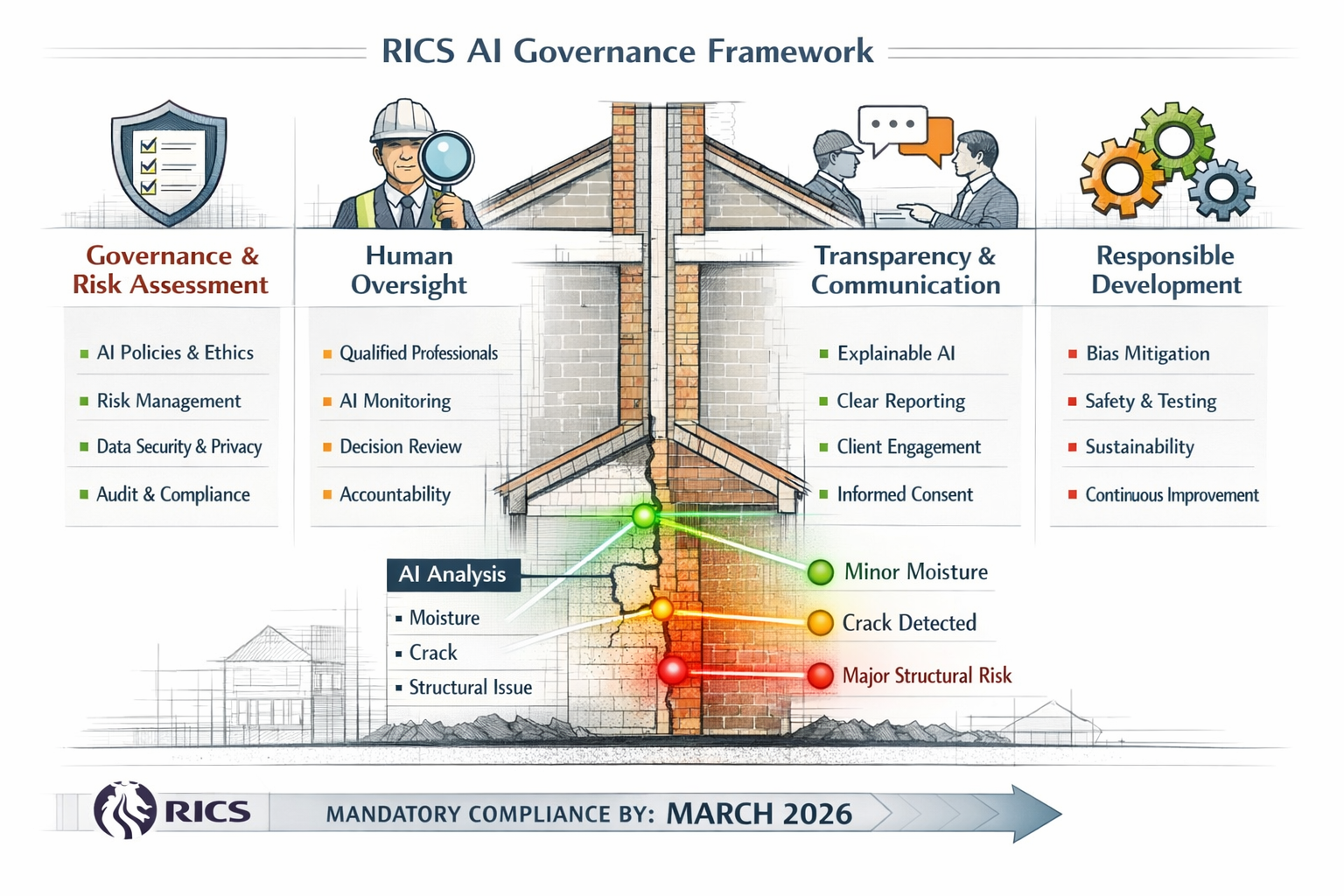
✅ Four core governance pillars define compliance: governance and risk management, professional judgement retention, transparency with clients, and responsible AI development
✅ Surveyors remain fully accountable for all professional advice regardless of AI tool involvement—technology assists but never replaces professional responsibility
✅ Written documentation requirements mandate recording when AI outputs materially impact service delivery, with firms determining materiality thresholds
✅ Implementation protocols differ between agreed surveyor and two-surveyor scenarios, requiring tailored transparency and communication strategies
Understanding the RICS Responsible AI Standard Framework
The RICS professional standard for responsible AI represents a watershed moment in surveying regulation. Effective from 9 March 2026, this framework applies universally to all RICS members and regulated firms, making compliance non-negotiable for anyone conducting party wall work with AI assistance [2].
The Four Core Pillars of AI Governance
The standard establishes four foundational pillars that structure how surveyors must approach AI deployment:
1. Governance and Risk Management 🛡️
This pillar requires firms to establish comprehensive oversight systems before deploying AI tools. Surveyors must complete structured system governance assessments and document these evaluations in writing [3]. The framework mandates:
- Creation of risk registers identifying potential AI failure modes
- Development of responsible AI use policies informed by identified risks
- Procurement due diligence procedures for evaluating AI systems before implementation
- Regular review cycles to reassess governance effectiveness
For party wall applications, this means evaluating how defect prediction algorithms might fail in specific scenarios—such as when analyzing Victorian brickwork versus modern cavity wall construction.
2. Professional Judgement and Oversight 👨💼
Perhaps the most critical principle embedded in the standard: AI systems must not replace professional surveyor accountability [2]. This pillar emphasizes that technology serves as an assistant, not a substitute, for professional expertise.
Surveyors must understand AI limitations including:
- Hallucinations: When AI generates plausible but incorrect defect identifications
- Bias: Systematic errors in training data that skew predictions
- Data quality dependencies: How poor lighting, low resolution, or obstructed views distort assessment results [1]
When conducting party wall agreed surveyor appointments, professionals must interpret AI outputs through their expertise rather than accepting them uncritically.
3. Transparency and Client Communication 📢
The standard mandates clear communication protocols regarding AI involvement in surveying services [3]. Clients must understand:
- Which aspects of the service involve AI assistance
- How AI outputs influence final recommendations
- Limitations of the technology used
- The surveyor's role in validating AI-generated insights
For party wall consent processes, this transparency becomes particularly important when explaining defect predictions to both building owners and adjoining owners.
4. Responsible Development of AI 🔧
This pillar addresses how AI systems should be designed, trained, and refined. While many surveyors use third-party AI tools rather than developing their own, the standard requires understanding:
- How the AI system was trained and on what data
- Whether training datasets represent the types of properties being assessed
- How the system handles edge cases and unusual construction types
- Update and maintenance protocols for the AI system
Material Impact Determination Requirements
A critical compliance element involves documenting when AI outputs materially influence service delivery. Firms must record in writing their determination of material impact, with responsibility resting on the member or firm to make this assessment [3].
For party wall work, material impact typically occurs when:
- AI defect detection identifies damage requiring remediation in a party wall award
- Predictive algorithms influence the scope of protective measures recommended
- AI-generated cost estimates affect financial provisions in awards
- Defect severity classifications derived from AI inform dispute resolution strategies
Responsible AI Tools for Party Wall Defect Prediction: Technical Capabilities and Limitations
Modern AI systems designed for party wall defect prediction employ machine learning and computer vision algorithms to analyze visual footage and identify structural issues [1]. Understanding both their capabilities and constraints is essential for RICS-compliant deployment.
What AI Can Detect in Party Wall Scenarios
Contemporary defect detection AI systems identify multiple issue types relevant to party wall disputes:
| Defect Category | AI Detection Capability | Typical Accuracy Range |
|---|---|---|
| Structural Cracks | Width measurement, pattern classification, progression tracking | 85-95% with high-quality imagery |
| Moisture and Damp | Thermal anomaly detection, visual staining analysis | 75-90% depending on access |
| Corrosion | Surface deterioration identification, material degradation assessment | 80-92% for exposed elements |
| Incomplete Installation | Comparison against BIM models, specification verification | 90-98% when reference models exist |
| Settlement Indicators | Differential movement detection, alignment analysis | 70-85% requiring baseline data |
These systems can compare site data to Building Information Modeling (BIM) models in real-time during construction phases, enabling early intervention before defects escalate [1].
Critical Limitations Requiring Professional Oversight
Despite impressive capabilities, AI defect prediction systems face significant constraints that make professional surveyor oversight mandatory:
Input Quality Dependencies 📸
AI accuracy is fundamentally dependent on input quality. Poor lighting conditions, low-resolution imagery, and obstructed views can dramatically distort assessment results [1]. When conducting party wall excavation notice inspections in confined spaces or poorly lit basements, AI systems may miss critical defects or generate false positives.
Contextual Understanding Gaps 🧩
AI systems lack the contextual knowledge that experienced surveyors bring to assessments. They cannot:
- Understand local construction practices from specific historical periods
- Recognize legitimate construction variations versus defects
- Assess whether apparent damage existed prior to notifiable works
- Interpret the significance of defects within broader building performance
Algorithmic Opacity 🔍
The mechanism by which AI prioritizes or interprets information may be difficult to understand, even for technically proficient users [1]. This "black box" problem creates challenges when:
- Explaining defect classifications to clients or opposing surveyors
- Defending AI-influenced recommendations in dispute resolution
- Identifying why the system reached particular conclusions
Training Data Limitations 📊
AI systems trained primarily on modern construction may perform poorly when analyzing Victorian or Edwardian party walls common in London. Similarly, systems trained on residential properties may struggle with commercial party wall scenarios.
AI Report Generation Reliability Considerations
AI-assisted report generation carries specific risks that surveyors must manage. The accuracy of AI-processed outputs depends on foundational data quality, and automated report writing may introduce errors through:
- Misapplication of template language to specific circumstances
- Incorrect cross-referencing of defect locations
- Inappropriate severity classifications based on algorithmic rather than professional judgment
RICS standards require that surveyors review and validate all AI-generated report content before issuing it to clients [2].
Implementing Responsible AI Tools for Party Wall Defect Prediction: RICS Standards Compliance in 2026 Disputes
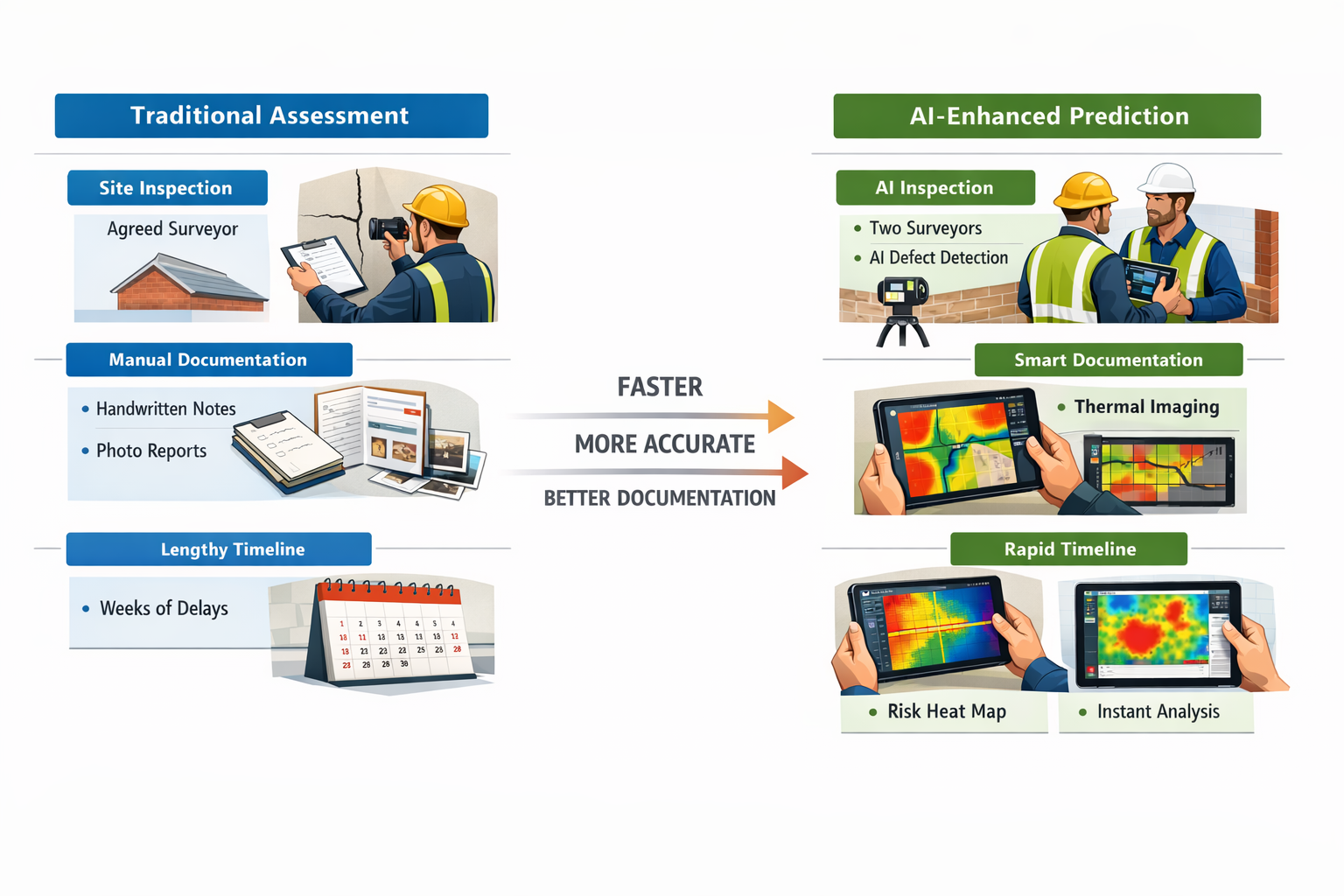
Practical implementation of AI tools within RICS compliance parameters requires systematic approaches that differ based on the party wall appointment structure.
Pre-Deployment Governance Assessment
Before deploying any AI system for party wall work, RICS-regulated firms must complete and document structured assessment steps [3]:
Step 1: System Evaluation and Risk Identification 🔎
Conduct comprehensive evaluation of the AI tool including:
- Technical specifications and underlying algorithms
- Training data composition and relevance to your practice area
- Known failure modes and error rates
- Vendor support and update protocols
- Data security and privacy protections
Create a risk register documenting identified concerns specific to party wall applications, such as:
- Risk of misclassifying historic settlement as new damage
- Potential for bias toward detecting defects (false positives)
- Data privacy implications when imaging neighbouring properties
- Reliability issues in challenging inspection conditions
Step 2: Policy Development 📋
Develop written responsible AI use policies covering:
- Circumstances when AI tools will and won't be deployed
- Required professional review protocols for AI outputs
- Client communication standards regarding AI involvement
- Documentation requirements for material impact determinations
- Training requirements for staff using AI systems
Step 3: Procurement Due Diligence 💼
If procuring third-party AI systems, conduct thorough due diligence including:
- Vendor reputation and track record in surveying applications
- Compliance with data protection regulations (GDPR)
- Professional indemnity insurance implications
- Contractual terms regarding liability for AI errors
- Integration capabilities with existing workflows
Implementation in Agreed Surveyor Scenarios
When acting as an agreed surveyor appointed by both parties, AI implementation requires balanced transparency:
Initial Appointment Communication 📞
During appointment acceptance, inform both building owner and adjoining owner that:
- AI tools may be used to assist defect identification and prediction
- All AI outputs will be professionally reviewed and validated
- The surveyor retains full professional responsibility for assessments
- AI use aims to improve accuracy and consistency of defect detection
Schedule of Condition Protocols 📝
When preparing schedules of condition documenting pre-works property status:
- Use AI defect detection to systematically identify existing conditions
- Personally verify all AI-identified defects through direct inspection
- Document in the schedule which defects were AI-assisted in detection
- Include photographic evidence validated by professional assessment
- Note any defects identified by professional observation that AI missed
This approach leverages AI's systematic scanning capabilities while maintaining professional oversight.
Predictive Risk Assessment 📊
AI tools can forecast potential damage based on:
- Proposed excavation depths and proximity to party walls
- Historical defect patterns in similar construction types
- Structural vulnerability indicators in existing conditions
- Environmental factors like soil conditions and water table levels
When incorporating AI predictions into protective measures recommendations:
- Clearly distinguish between observed conditions and AI-predicted risks
- Apply professional judgment to assess prediction reliability
- Document the reasoning behind accepting or modifying AI recommendations
- Ensure protective measures reflect professional standards regardless of AI input
Implementation in Two-Surveyor Appointments
When separate surveyors represent each party, AI implementation introduces additional transparency considerations:
Cross-Surveyor Communication 🤝
If one surveyor uses AI tools while the other doesn't:
- Disclose AI use to the other appointed surveyor
- Share information about the specific AI system employed
- Provide access to raw data underlying AI assessments
- Be prepared to explain and defend AI-influenced conclusions
Award Preparation Considerations ⚖️
When drafting party wall awards:
- Document which aspects of the award incorporated AI assistance
- Ensure all AI-influenced provisions can be professionally justified
- Include sufficient detail for third-party review if disputes escalate
- Maintain records of AI outputs alongside professional assessments
Dispute Resolution Protocols 🔧
If surveyors disagree on defect assessments where one used AI:
- The AI-using surveyor must explain the system's methodology
- Provide evidence of RICS compliance in AI deployment
- Demonstrate professional validation of AI outputs
- Be prepared for third surveyor review of AI-influenced conclusions
Training and Competency Requirements
RICS standards require members to understand AI systems before deployment [2]. Firms should establish training programs covering:
- Technical Understanding: How different AI types (machine learning, computer vision, neural networks) function and their respective strengths and weaknesses
- Failure Mode Recognition: Identifying when AI outputs appear unreliable or inconsistent with professional expectations
- Validation Techniques: Methods for verifying AI-generated assessments through traditional surveying approaches
- Documentation Standards: Proper recording of AI use and material impact determinations
Documentation and Record-Keeping
Comprehensive documentation is essential for RICS compliance:
Required Records 📁
Maintain written documentation of:
- System governance assessments conducted prior to AI deployment
- Material impact determinations for each party wall matter involving AI
- Client communications regarding AI use
- Professional validation steps applied to AI outputs
- Any instances where AI recommendations were overridden by professional judgment
Retention Periods ⏰
Align AI-related documentation retention with standard surveying records—typically six years minimum, though longer periods may be prudent for complex disputes.
Ethical Considerations and Professional Responsibilities
Beyond technical compliance, responsible AI use in party wall work raises important ethical considerations.
Maintaining Professional Independence
AI systems might introduce subtle biases that compromise professional independence:
- Commercial Pressure: AI tools marketed as "efficiency enhancers" might unconsciously encourage rushed assessments
- Confirmation Bias: Surveyors might give undue weight to AI outputs that confirm initial impressions
- Technology Deference: Over-reliance on AI recommendations at the expense of independent professional judgment
RICS members must actively guard against these influences, remembering that professional responsibility cannot be delegated to algorithms [2].
Balancing Efficiency with Thoroughness
AI tools promise faster defect identification, but speed must never compromise thoroughness:
- Resist pressure to reduce inspection time simply because AI provides rapid initial assessments
- Allocate sufficient time for professional validation of AI outputs
- Recognize that some defects require tactile assessment, moisture meter readings, or other non-visual evaluation methods that AI cannot replace
Client Best Interests
When determining whether to deploy AI tools on specific matters, consider:
- Whether AI use genuinely serves the client's interests or primarily benefits the surveyor's efficiency
- If AI capabilities match the specific requirements of the property and works involved
- Whether the client understands and consents to AI involvement
- If AI use affects professional indemnity insurance coverage
Data Privacy and Neighbouring Properties
AI-powered defect detection often involves extensive photographic documentation that may capture neighbouring properties beyond those directly involved in the party wall matter. Consider:
- Data protection implications of storing and processing images of third-party properties
- Consent requirements when AI systems analyze broader areas than traditional inspections
- Security measures protecting sensitive property information processed by AI systems
Future Developments and Emerging Considerations
As AI technology evolves and RICS standards mature, several developments warrant attention:
Enhanced Predictive Capabilities
Next-generation AI systems are developing capabilities to:
- Predict defect progression over time with greater accuracy
- Model the cumulative impact of multiple nearby construction projects
- Integrate environmental data (weather patterns, ground movement) into risk assessments
These advances will require updated governance frameworks and professional competency standards.
Integration with IoT Monitoring
AI systems increasingly integrate with Internet of Things (IoT) sensors for continuous monitoring:
- Crack width sensors providing real-time movement data
- Vibration monitors tracking construction impact
- Environmental sensors measuring temperature, humidity, and other conditions
This continuous data stream enables AI to detect emerging issues before they become visible, but also raises questions about monitoring scope, data ownership, and privacy.
Standardization of AI Disclosure
Industry practice is evolving toward standardized disclosure formats for AI use in surveying reports. Future RICS guidance may specify:
- Required statement formats regarding AI involvement
- Standard terminology for describing AI capabilities and limitations
- Consistent approaches to documenting material impact determinations
Professional Indemnity Insurance Implications
Insurance providers are developing specific policy terms addressing AI use. Surveyors should:
- Notify insurers of AI tool deployment
- Understand any exclusions or conditions related to AI-assisted work
- Maintain documentation demonstrating RICS compliance to support claims defense
Conclusion
The mandatory RICS professional standard for responsible AI use fundamentally reshapes how surveyors approach party wall defect prediction and dispute resolution in 2026. While AI tools offer powerful capabilities for systematic defect identification, predictive risk assessment, and efficient documentation, they introduce new responsibilities and potential failure modes that require careful management.
Successful implementation of Responsible AI Tools for Party Wall Defect Prediction: RICS Standards Compliance in 2026 Disputes depends on three critical principles:
- Governance First: Complete comprehensive system assessments, develop written policies, and establish risk management protocols before deploying any AI tool
- Professional Oversight Always: Maintain professional accountability for all assessments regardless of AI involvement, validating outputs through traditional surveying expertise
- Transparent Communication: Clearly inform clients and fellow surveyors about AI use, limitations, and the role of professional judgment in final recommendations
Actionable Next Steps
For surveyors preparing to implement AI tools in party wall work:
✅ Conduct immediate compliance audit: Review current practices against RICS standard requirements, identifying gaps in governance, documentation, or transparency
✅ Develop written AI use policies: Create firm-specific policies addressing the four core pillars of the RICS framework, tailored to your party wall practice
✅ Establish training programs: Ensure all surveyors understand AI capabilities, limitations, and validation requirements before deployment
✅ Update client communication templates: Revise appointment letters, terms of engagement, and report templates to incorporate AI disclosure requirements
✅ Review professional indemnity coverage: Confirm insurance adequately covers AI-assisted work and understand any specific requirements or exclusions
✅ Create documentation systems: Implement processes for recording material impact determinations, system governance assessments, and professional validation steps
The integration of AI into party wall practice represents an evolution, not a revolution. Technology enhances but never replaces the professional judgment, ethical responsibility, and contextual understanding that define quality surveying practice. By implementing AI tools within the structured framework RICS has established, surveyors can harness technological advantages while maintaining the professional standards that protect clients and uphold public trust.
As party wall matters continue to increase in complexity alongside urban densification and construction activity, responsible AI deployment offers a path toward more accurate defect prediction, earlier intervention, and better outcomes for all parties involved—provided it remains firmly grounded in professional expertise and ethical practice.
References
[1] Ruai Case Studies 06 – https://www.rics.org/profession-standards/rics-standards-and-guidance/conduct-competence/responsible-use-of-ai/ruai-case-studies-06
[2] Rics First Ever Standard On Responsible Ai Use Now In Effect – https://www.rics.org/news-insights/rics-first-ever-standard-on-responsible-ai-use-now-in-effect
[3] Ai Responsible Use Standard – https://ww3.rics.org/uk/en/journals/construction-journal/ai-responsible-use-standard.html
[4] Rics Introduces Mandatory Ai Standard For Surveyors What Insurers And Their Clients Need To Know – https://cms.law/en/gbr/legal-updates/rics-introduces-mandatory-ai-standard-for-surveyors-what-insurers-and-their-clients-need-to-know
[5] Ai Driven Precision In Land Surveying How Artificial Intelligence Is Transforming Data Collection And Analysis – https://nottinghillsurveyors.com/blog/ai-driven-precision-in-land-surveying-how-artificial-intelligence-is-transforming-data-collection-and-analysis